Changes in Griffintown, 2011-2014
February 6, 2014 § 1 Comment
I got an email from Dave Flavell the other day. I’ve known Dave for a few years; he contacted me awhile back for some help on a project he was doing on Griffintown. He was collecting oral histories of the community and its diaspora, with a view towards publishing a book. Last time we talked about it, he said the book was on its way to publication. This email contained photos of Griff, in particular of the Horse Palace on Ottawa street, taken in 2011, 2013, and 2014. The changes are stunning.
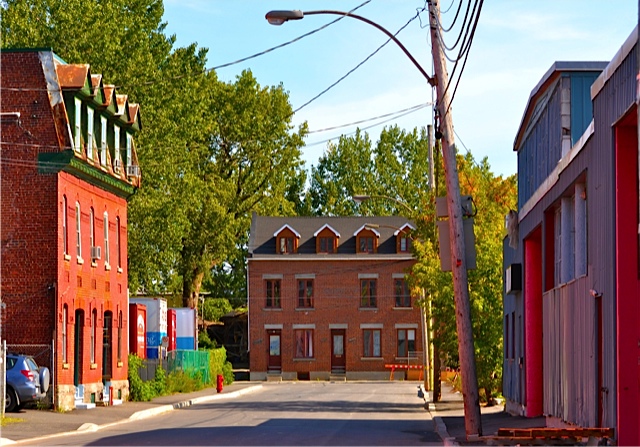
Griffintown Horse Palace, 2011. Photo courtesy of Dave Flavell
In the first photo, we look down Eleanor street at the Horse Palace, built in 1862, standing at the end of the block on Ottawa, surrounded by huge trees. Time was these were amongst the only trees in Griffintown a hundred years ago. The old St. Ann’s Kindergarten is on the left, now the headquarters of King’s Transfer, a moving company that’s been based in the neighbourhood for almost a century. It’s also where I conducted the majority of the oral history interviews for House of the Irish, thanks to the generosity of Bill O’Donell, the president of King’s. In this picture, the Horse Palace looks much as it has for the past thirty-forty years. But a closer look shows that it’s already under transformation. Leo Leonard, the legendary proprietor of the Horse Palace, and his wife Hugeuette, had already sold and moved to a retirement home. Leo, though, did not get much of an opportunity to enjoy retirement, he died in in July 2012 at the age of 87. Already, the building is under renovation, new windows have been put in on the second floor. But the actual stable, which is just out of sight, behind those moving trucks, was still in full working order.

Griffintown Horse Palace, 2013. Photo courtesy of Dave Flavell
The next picture was taken last year. From the exact same spot. Now the Horse Palace residence is dwarfed by an 8-story condo built next door and behind it, fronting on rue de la Montagne. This building was under construction in 2011, but had not yet risen to dwarf the Horse Palace. The Horse Palace building looks tiny and insignificant in the shadow of the condo, which stretches across at least three lots on de la Montagne.
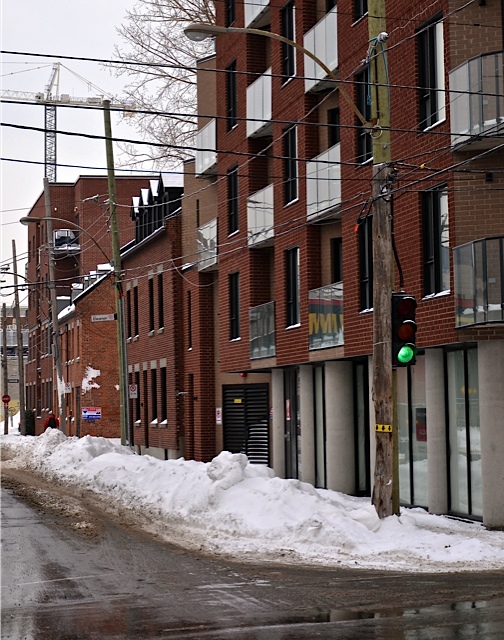
New condo tower and the Griffintown Horse Palace, January 2014. Photo courtesy of Dave Flavell
The final picture was taken a couple of weeks ago, from the corner of Ottawa and de la Montagne, looking east. The shop fronts on Ottawa in the new building remain empty, but looking down the block, after the Horse Palace residence is the old paddock of the stable, which was bought last year by the Ville de Montréal for purposes of turning it into a park to provide access to the actual stables, which the Griffintown Horse Palace Foundation has done yeoman’s work to preserve and save. (Full disclosure: I was a board member of the GHPF from 2008 until I left Montréal in 2012). Continuing on past the paddock, another mid-19th century residence still stands. And then, at the corner of Ottawa and Murray, another, shorter, 4-story condo stands. It was built in 2011. The crane is on the site of Devimco’s massive “District Griffin” development on Peel street.
Even though I have seen this view down Ottawa from de la Montagne, I was still shocked by Dave’s photo. The entire landscape of Griffintown is massively changed. The condo at the corner of de la Montagne and Ottawa is representative of the redevelopment. The streets of Griffintown are narrow, the buildings have always been hard up against the sidewalk. This has contributed to a somewhat claustrophobic atmosphere, at least on those blocks where enough buildings still remain. But these old buildings were 2 floors, at most 3. The stacking of 4, 6, 8, 10-story condos, lining these narrow streets only enhances this claustrophobia. It devastates the urban environment.
The Civil War and the Atlanta Flames
February 5, 2014 § Leave a comment

Atlanta Flames goalie, Daniel Bouchard, c. 1977
Last week, I was watching the Calgary Flames play, I can’t remember who they were playing; I watch a lot of hockey. I’ve never liked the Flames. They were arch rivals of the Vancouver Canucks in the 1980s and, as much as I have never cheered for the Canucks (who wore the ugliest uniforms in NHL history in that era), I never cheered for their rivals either (Edmonton Oilers, Winnipeg Jets, Calgary), with the exception of the Los Angeles Kings. The Flames also committed the venial sin of defeating the Montréal Canadiens for the Stanley Cup in 1989 (to this day, the last time two Canadian teams played for Lord Stanley of Preston’s mug).

Vancouver Canucks road uniforms, 1978-84
The Calgary Flames came into existence in 1980, when the Atlanta Flames packed up shop and moved to the much smaller Canadian city (in a wonderful twist of fate, Atlanta’s next chance at an NHL team, the Thrashers, packed up and moved the much smaller Canadian city of Winnipeg in 2011, where they became the Jets, Version 2.0, the original Jets having moved to Phoenix in 1996, becoming the Coyotes).
When I was a kid, the Atlanta Flames were this team that no one ever thought about. The only real time they entered my consciousness was in 1977 or 1978, when my parents were considering moving from Montréal to Atlanta. We moved to Toronto instead. But, due to the snow storm that hit Atlanta last week and the fact that it was in the news, I was thinking about the old Atlanta Flames whilst watching the Calgary Flames.
I may be slow on the uptake, but the reason why the Atlanta NHL team was called the Flames was a Civil War reference. After Atlanta fell to the Union Army under General William Tecumseh Sherman in July 1864, Sherman, a vindictive sort, ordered the civilian population out, and then proceeded to sack the city old school, by burning it (though he was persuaded to save the city’s churches by Fr. Thomas O’Reilly of the Church of the Immaculate Conception). The city was devastated.

The ruins of the Atlanta rail roundhouse, July 1864

Calgary Flames star Kent Nilsson, c. 1984
When Atlanta was awarded an NHL expansion franchise for the 1972-3 season, Tom Cousins, the owner, chose the name to commemorate the burning of Atlanta. When the Flames relocated to Calgary eight years later, Nelson Skalbania, the new owner, decided to keep the name, thinking it a fitting name for an oil town. The uniforms remained the same, except that the flaming A was replaced by a flaming C.
Matterhorn: Fiction of the Vietnam War
February 4, 2014 § Leave a comment
 Last February, I was back in Vancouver for a visit. I love visiting Vancouver, a city I know well (having grown up there). Everytime I’m back in town, I go to Blackberry Books on Granville Island. I have bought many, many books there over the years. This time when I was in, I got into a long chat with the guy working there about history and fiction (two of my favourite subjects) and he recommended Karl Marlantes’ sprawling Vietnam War book, Matterhorn. It’s an epic novel, telling the story of a young Marine lieutenant, Waino Mellas, and his indoctrination into the jungle war. It takes a long, long time to get going, I must say, but eventually it became engrossing and nearly impossible to put down. The guy at Blackberry Books said that he doesn’t read long fiction anymore, but this book was an exception to his rule. I agree. For some odd reason, probably due to the amount of American history I’ve taught of late, I’ve read a lot of Vietnam War fiction, and Matterhorn is definitely up there with Tim O’Brien’s two works, The Things They Carried and If I Die in A Combat Zone, Box Me Up and Ship Me Home.
Niall Ferguson Almost Gets It Right
February 3, 2014 § 4 Comments
Niall Ferguson likes attention. There’s no other way to explain his public pronouncements. Like when he predicted there’d be blood on the streets of major Western cities in response to the 2008 global economic meltdown. Or when he said John Maynard Keynes was a bad economist because he was gay. Or when he attacked Gandhi in his Civilization: The West and the Rest. Then there’s that book in general, with its incredibly lame attempt to be hip, as Ferguson talked about the West developing “killer apps” that allowed it to dominate the rest of the world. This idea was so bad it detracted from what was actually a decent argument. Ugh. So when I saw that Ferguson had opined to the BBB’s History magazine that Britain should never have entered the First World War in 1914, I was already in mid-eye roll when I realised that Ferguson was actually onto something here.
The BBC article is behind a paywall, but when Ferguson speaks, the media listens and The Guardian published a quick account. Basically, Ferguson says that Britain made “the biggest error in modern history” by entering the war in 1914. He says that Britain could’ve let the Germans, French, and Russians slug it out on the continent, and then dealt with a victorious Germany at a later date, on its own terms. He also notes that had Germany defeated the Russians and French, it would have had the same problems Napoléon had a century earlier, in terms of governing an unruly empire and being behind a British sea blockage. In 1914, Britain was simply not ready for war, especially a land war.
And then he looks at the long-term cost for Britain of the war. It nearly bankrupted the nation, Britain was saddled with debt after 1918. It ultimately cost the British their empire and their status as a major world power (as it also did to France).
There is something to be said for his argument here, but, as usual with a polemicist, he overshoots his mark, taking a claim that might actually be something and then wrapping it up with ridiculousness, like what he did with the unfortunate Civilization. At its core, the Great War was calamitous for Britain, there’s no two ways about that. But Ferguson doesn’t take into account the human cost of the war. An entire generation of young men was destroyed by the war. The costs of that lost generation are immense, in terms of politics, economy, and culture. It also meant a decline in birth rates, so the lost generation had a long-term effect of Britain.
Ferguson does talk about the cost of the war economically, the massive debt the country accumulated, and the fact that this ended up costing Britain its empire. This is where I think Ferguson gets his hackles up, given that he’s the last great defender of the force of civilisation that the British Empire was.
As historians, we are supposed to enjoy the benefit of hindsight, to be able to see the bigger picture that, say, Sir Herbert Asquith, the British Prime Minister in 1914, could not. But we still need to take into account the view from White Hall in August 1914. From Asquith’s point-of-view, Britain was bound by treaty to protect its Allies. Britain was also militarily prepared for war (a point Ferguson dismisses), even if it was the wrong kind of war it anticipated.
Recently, I read a review of three books on the start of the First World War in the Times Literary Supplement. There will be a lot of that this year, since its the centenary of the start of the war. One of the books was written by a journalist, and one with a particular axe to grind, and was full of broad, sweeping statements about the war, the British generals, and politicians. The reviewer took issue with this approach as being ahistorical and anti-intellectual. And while I wouldn’t go that far with Ferguson’s argument, it’s on that route. At least at this point. I hope a book will emerge from this thought, as it would certainly be worth the read.
 Matthew Barlow