A Storm of Witchcraft: Salem in 1692 & Ballyvadlea in 1895
December 15, 2014 § 8 Comments
 I read my colleague Emerson Baker’s fantastic A Storm of Witchcraft: The Salem Trials and the American Experience this weekend. Salem bills itself as “Witch City, USA”, the image of a witch on a broom adorns the police cars here. My wife is on the board of the Salem Award Foundation, which seeks to draw
upon the lessons of the Salem Witch Trials of 1692, [to promote] awareness, understanding and empathy in support of human rights, tolerance and social justice. We advance social change through educational programming, stewardship of the Salem Witch Trials Memorial as a place of reflection, and by awarding and celebrating contemporary champions who embody our mission.

The Salem Witch Trials Memorial
As a public historian, the Hallowe’en silliness has fascinated me, as ‘ghost walks’ are held all around town, showing some of the locations sort of connected to the Witch Trials. I say ‘sort of’ because most of the action did not take place in Salem. Most of the accused came from Salem Village (then apart of Salem, now Danvers) and Andover. Some of the trials took place here, though. Nonetheless, every year, hundreds of thousands of people come to Salem, in the wake of the murder of twenty innocent people in 1692-3, most of them on Gallows Hill, to engage in revelry and have fun.
But, this is the first time I’ve engaged seriously in the actual history of the events. I knew the stories, I knew the outlines of what happened here and how those twenty people came to be killed in an explosion of mass hysteria. But, in reading Barker’s book I’ve been impressed at just how deeply held was the beliefs in witches in 17th century New England. Baker makes this argument forcefully, noting how a belief in witches, and in the wickedness of Satan drove Puritan beliefs. In this way, as he argues, witches became a convenient scapegoat in tumultuous times in Massachusetts. There was war with the aboriginals on the frontiers, from what is now Maine to towns located 15-20 miles inland from Salem, like Billerica. The economy was suffering. Puritans felt themselves under attack as religious toleration was extended.
Salem is itself named after the Hebrew word shalom, meaning peace, and is a shortened version of Jerusalem, or City of Peace. Massachusetts was established as a city on the hill, and Salem is amongst the oldest towns in Massachusetts, settled in 1626 by Roger Conant and a group of Puritans, and is two years older than Boston. In 17th century Massachusetts, Salem and Boston were the two major commercial and administrative centres in Massachusetts. All of this was under attack in the late 17th century.
The story Baker tells is not unlike that told by Angela Bourke in one of my favourite books, The Burning of Bridget Cleary, the story of the burning to death of Bridget Cleary, a 25-year old woman, by her husband, Michael, in 1895 in Ballyvadlea, in rural Co. Tipperary, Ireland. What seems a straight-forward case of domestic violence is more than that. Michael Cleary claimed his wife had been taken away by the faeries, and he killed the changeling posing as his wife, as the real Bridget would return from the nearby ringfort, where she had been held captive by the faeries. Bourke then ties the case of Bridget Cleary into larger stories of Irish nationalism and the fight for Home Rule; faeries, then, were a traditional folkway for the people of rural Ireland in a rapidly changing time.
Bridget is often called the ‘last witch’ to be burned in Ireland. She was never accused of witchcraft, so that’s unfair (yes, I am aware of my title). But what is interesting in the similarity of these two stories.
The Burning of Bridget Cleary
November 19, 2014 § 3 Comments
My students in my Irish History course read Angela Bourke’s fantastic The Burning of Bridget Cleary and wrote a paper on it. The essay question asked them to situate Bridget Cleary’s murder within the context of Irish politics at the time, as this is what Bourke does, and why her book is so powerful. So much so that I assign this book every time I teach Irish History.
In reading the essays this semester, my students were particularly struck by the comparison of the Irish Catholics of the late 19th century with ‘Hottentots’ and Catholic Ireland with ‘Dahomey’ by both the British and Irish Unionist press. This was, of course, code for dismissing Irish claims to the right to Home Rule by comparing them with what the British regarded as ‘savage’ African nations. Leaving aside the racism inherent in this construction of Africa for another day, what struck me this year with the papers was the very fact that my students were so struck by these comparisons.
The major theme of my course is the way in which Ireland existed as a British colony, and the ways in which the British colonial discourse worked in keeping Ireland separate from, and excluded from, the wealth that accumulated in the United Kingdom of Great Britain and Ireland by the 19th century. This is obvious in moments like The Famine, especially when the Under Secretary of the Treasury, Charles Trevelyan, declared The Famine a gift from the Almighty and celebrated the change to reform Ireland away from the ‘perverse’ character of the native population.
For me, teaching Irish History, this has become de rigeur, I see this discourse and I don’t, it’s so deeply embedded into my brain. Thus, I really enjoyed seeing my students’ response to the discourse of Irishness on the part of the Unionists and British in 1895, when Bridget Cleary was murdered. I suppose it’s one thing to imagine Trevelyan’s cold response to The Famine as something that happened a long time ago. But, sometimes 1895 doesn’t seem like so long ago.
Bourke’s book has pictures of the inside of the Clearys’ cottage in Ballyvadlea, Co. Tipperary, and we see their poverty laid bare. However, the Clearys were not, actually, poor by Irish standards. But, because we can see some comparison between the Clearys in 1895 and our world today, they don’t seem so far away. Michael and Bridget Cleary were in their 30s and were childless. But perhaps more than that, they both had careers, so to speak. He was a cooper and she a milliner. Bridget, unlike many women of her era, especially in rural Ireland, was more or less independent. Thus, the Clearys look more like us than Trevelyan, and therefore, closer to us. So to read this comparison of the Clearys’ people, Irish Catholics, with African tribes dismissed as ‘cannibals’ is shocking (again, leaving aside the racist assumptions implicit in the dismissal of Dahomey as the land of cannibals).
And this is why I love teaching, I love the opportunity to get refreshed and re-enforced by my students as they discover something for the first time.
The Wisdom of Marc Bloch
October 8, 2014 § 5 Comments
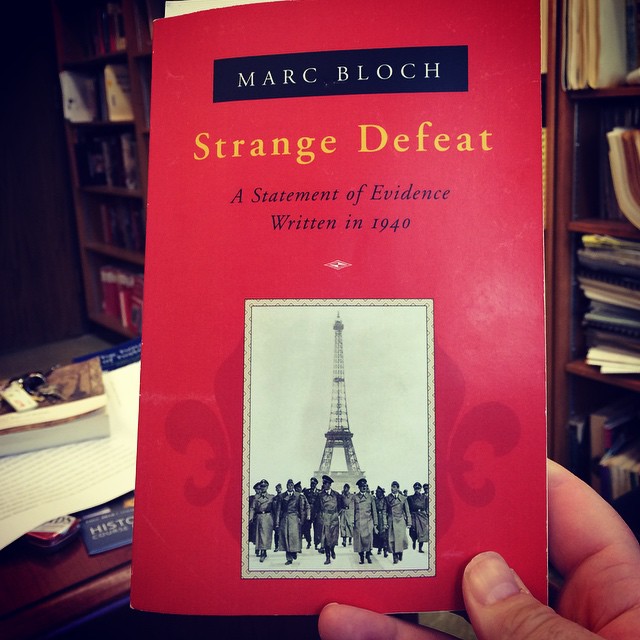 Marc Bloch is one of the most influential historians ever. An historian of mostly medieval France, he, along with Lucien Febvre, founded the Annales school of historiography in the late 1920s. The Annalistes preferred examining history over the long durée, and across various periods of time. They also advocated a more complete history than one of generals, presidents, prime ministers, and other so-called Great Men.
Bloch met his end at the hands of the Gestapo on in Saint-Didier-des-Champs, in France, on 16 June 1944, ten days after D-Day, as the Nazis realised they were going to lose France. Bloch had been a member of the Résistance since 1942. He was captured by the Vichy police in March of that year and handed over to the Gestapo. He was interrogated by Klaus Barbie, and tortured. It was a sad end for a great man.
Bloch had served in the French Army during the First World War, and remained a member of the Army reserve in the interregnum between the two wars. He was called up into action during the Second World War and was on hand for the baffling collapse of France in the face of the Nazi blitzkrieg attack in May 1940. That summer, he wrote his blistering and searing account of the Fall of France, Strange Defeat, not knowing if his words would ever see the light of day. The book was published in 1948, four years after his murder, and three years after the war ended.
Bloch is unflinching in his critique of French High Command, and France in general, for the collapse of its Army in 1940. In part, he blames the High Command’s over reliance on a false reading of history, that led it into a state of pathetic stasis, incapable of recognising that 1939-40 was not 1918, and that the Second World War was a different war than the Great War. In this passage, he makes a passionate argument for what the study of History is.
History is, in its essentials, the science of change. It knows and it teaches that is impossible to find two events that are ever exactly alike, because the conditions from which they spring are never identical…the lesson it teaches is not that what happened yesterday will necessarily happen to-morrow, or that the past will go on reproducing itself. By examining how and why yesterday differed from the day before, it can reach conclusions which will enable it to foresee how to-morrow will differ from yesterday. The traces left by past events never move in a straight line, but in a curve that can be extended into the future.
I assigned this book for my historiography class, and was deeply struck by this passage. I’ve re-read it four times now, it goes against what our culture thinks history is. Our culture thinks history is exactly what Bloch says it isn’t, that it can teach us to avoid the same mistakes over and over again.
I was thinking about this in light of my Irish history class dealing with The Liberator, Daniel O’Connell last week. O’Connell led the movement for Catholic Emancipation in Ireland, succeeding in 1829. He the turned his sights on the Repeal of the Act of Union (1800), which created the United Kingdom of Great Britain and Ireland. In this, he failed. He failed because times had changed, and attitudes were different. In the early 19th century, many in Britain, and even some amongst the Protestant Ascendancy in Ireland, had come to the conclusion that the denial of civil rights for Catholics in Ireland was not a good thing, and that Emancipation was necessary. Three of the staunchest opponents of Emancipation came around to O’Connell’s way of thinking: Sir Robert Peel, the Home Secretary; The Duke of Wellington, the Prime Minister, and King George IV). In the 1840s, though, when O’Connell’s Repeal movement reached its apogee, he did not have a groundswell of support in Britain (or amongst the Protestant Ascendancy) for Repeal. Thus, he failed because O’Connell failed to learn the proper lessons of History.
We would do well to remember Bloch’s maxim. Even we historians.
The West and the Rest and the Fate of the Environment
May 2, 2014 § 2 Comments
I just read a quick book review in Foreign Affairs of Charles Kenny’s new book, The Upside of Down: Why the Rise of the Rest is Good for the West. This comes on the heels of a spate of books in recent years about why it is that the West rules now, but why it won’t shortly. The best of these books (at least amongst those I’ve read) is Ian Morris’ Why the West Rules — For Now: The Patterns of HIstory and What They Reveal about the Future. The worst is my favourite village idiot, Niall Ferguson’s Civilization: The West and the Rest, and not just because of his incredibly stupid device of the “killer apps” that the West downloaded first, but have since been downloaded by the rest, but because of Ferguson’s inability to hide his triumphalist ethno-centrism. I also teach a lot of World History, so the topic interests me.
Kenny argues that, in contrast to Ferguson and others, that the rise of the Rest isn’t necessarily a bad thing for the West. Moreover, Kenny also claims that the rise of the Rest isn’t due to any failure on the part of the US, but, rather, is a function of Washington’s global leadership. And, unlike any other writer I’ve read on the matter, Kenny is also concerned about the possibilities for environmental degradation due to global economic advancement. This is interesting, actually, making me think of Doug Saunder’s Arrival City: How the Largest Migration in History is Re-Shaping Our World (I reviewed that here on this blog). Saunders is also a triumphalist, arguing that urbanisation is a great boon to humankind, but he overlooks the environmental degradation from cities.
However. Where Kenny falls down, at least according to this review (I do look forward to reading The Upside of Down), is that he expects the free market (along with education and innovation) to take care of that problem. This is where I get suspicious, given that the free market has done very little for environmental degradation, and left to our own devices, we humans would destroy the environment without some kind of governmental intervention. I don’t see why it would work any better in the developing world, frankly.
But, Kenny also redeems himself in his concluding argument wherein he favours the establishment of global rules and regulations to regulate global development and environmental damage. Of course, I’m not sure how this squares with his faith in the free market, but I suppose I’ll have to read the book to find the answer to that.
 Matthew Barlow