Reflections on Feminism and Class
February 6, 2015 § 2 Comments
I watched The Punk Singer, the documentary about Kathleen Hanna, the frontwoman of the Riot Grrrl band, Bikini Kill, as well as Le Tigre and The Julie Ruin, the other night. Hanna was, essentially, the founder of the Riot Grrrl movement back in 1992; she wrote the Riot Grrrl Manifesto. I’ve always been a fan, and I remember going to Bikini Kill shows back in the day. Hanna would insist the boys move to the back of the crowd and the girls come down to the front. And we listened to her. She was an intimidating presence on a stage. The girls came down front so they could dance and mosh and not get beaten to a pulp by the boys. Early 90s mosh pits were violent places, and they got worse as they got invaded by the jocks after Nirvana, Pearl Jam, Soundgarden, and a few other bands went mainstream. Bikini Kill never did, but their shows, as well as those of L7 and Babes in Toyland, still attracted these wider audiences, at least the gigs I went to. Hanna and Bikini Kill were unabashedly feminist. If you didn’t like, you could just fuck off.
Yesterday in class, in a very gender-segregated room (women on the left, men on the right), we had an interesting discussion. We were discussing Delores Hayden’s The Power of Place, about attempts to forge a public history on the landscape of Los Angeles that gives credence to the stories of women and minorities. So. I asked my students if women were a minority. To a person, they all knew that women are not a minority, at least not in demographic terms. Women are the majority; right now in the United States and Canada, around 51% of the population. But. Women are a minority in terms how they are treated in our culture, how they are second-class citizens, essentially. The women in my class all knew this, they were all adamant about it. The men stayed silent, though they nodded approvingly at what the women were saying.
Despite the fact that close to nothing has changed in the mainstream of our culture, that we still live in a rape culture that is designed to keep women de-centred and unbalanced, I was so happy that my students knew what was what in our world, and I was so happy that the men knew to keep their mouth shut.
In The Punk Singer, Lynn Breedlove, a queer feminist writer, singer, and punk, noted that feminism is about the struggle of the sub-altern, about the struggle of the oppressed. And feminism should fight for the oppressed, no matter the fight, be it race, sexuality, or class. And I had this lightning bolt moment. This is why I have always been pro-feminist. I had a prof in undergrad who argued that men cannot be feminists; feminism is a movement for and by women. Men could be allies, in fact, they were welcomed, but it was a women’s movement. Hanna reflects this, she has always worked to create a space and a voice for women, and men were welcome, but in a supporting role. I like that.
I was raised by women, and my mother instilled this pro-feminism in me at a young age (thanks, Ma!). But, feminism (along with punk) helped give me the tools I need to emancipate myself from the oppression of class. From these two movements, I gained a language of emancipation. To recover from being told by my high school guidance counsellor that “People like you don’t go to university,” because I was working-class and poor. Richard Sennett and Jonathan Cobb, in a 1993 book, talk about the ‘hidden injuries of class.” Hidden, yes, but still very real.
Canada’s National Disgrace
February 2, 2015 § 151 Comments
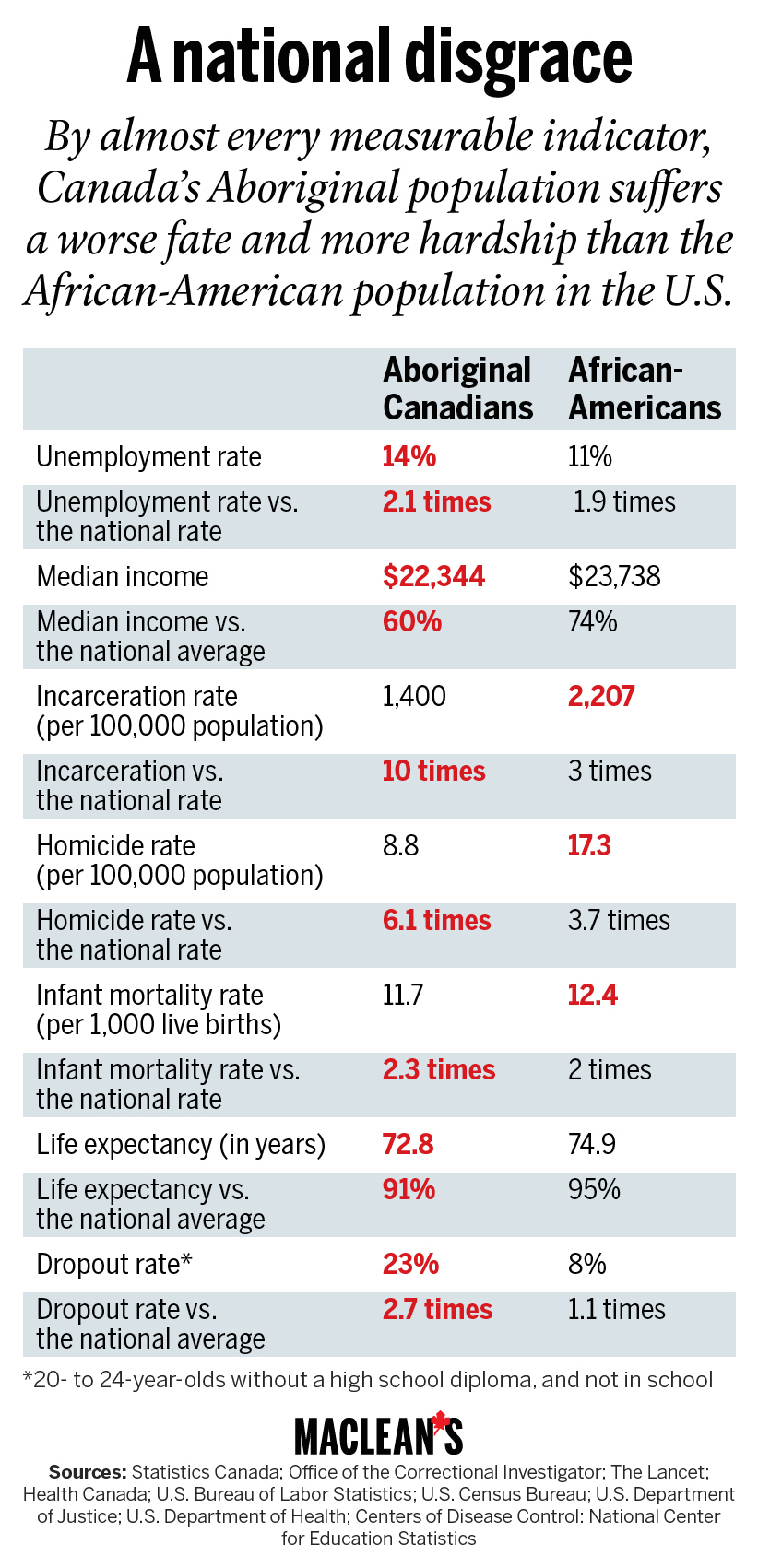
Two weeks ago, MacLeans, Canada’s only national news magazine, published an article that caused quite the uproar. Written by a former diplomat, Scott Gilmore, and entitled, “Canada’s Racism Problem? It’s Even Worse Than America’s,” it’s not hard to see why this upset people. Even better was the sub-title, “For a country so self-satisfied with its image of progressive tolerance, how is this not a national crisis?” I wish I had written this article, it says what I’ve been saying for a long, long time.
Aboriginal peoples in Canada get screwed. Have been since the first Europeans arrived, and still do today. And that’s not going to change any time soon unless Canadians do something about it. But, in my experience, they don’t care. Last year, I wrote a post about a funny sweatshirt that an aboriginal man, Jeff Menard, in Winnipeg (which MacLeans also called out as Canada’s most racist city) created that said: “Got Land? Thank an Indian.” I wrote this post in response to a response I got to a tweet stating that if you thought this hoodie racist, you’re an idiot. This response tweet said “I’m offended because they used the word Indian. My grandfather was from India. He worked for a living.”
How to unpack that? This tweet was anti-historical and offensive on so many levels. Starting with being upset at the use of the word “Indian,” the term applied to aboriginal peoples by Euro-Canadians historically. But the real kicker is “He worked for a living.” Many of the comments on Gilmore’s article, and a lot of the vituperative, racist tweets I saw complained that aboriginal peoples in Canada survive on handouts from the government and don’t work for a living. No mention of imperialism, the taking of land, the systematic attempts by the Canadian government to steal away aboriginal languages, cultures, religions, and names, of the residential schools designed to also take the children of aboriginals away from them (to say nothing of the horrific sexual abuse therein).
Gilmore pointed just how badly aboriginal peoples get screwed in Canada, by comparing them to African-Americans in the United States, in easy table format, which I produce here (and hope that MacLeans doesn’t mind). Look at those statistics and just try not to be offended, saddened, and, if you are Canadian, embarrassed. Hell, even if you’re American, you should be embarrassed by these stats. But, Gilmore’s right. Canadians are a smug lot. My Twitter feed is usually full of all kinds of anti-American comments, the implicit meaning is “Well, the US is a mess, thank god I live in Canada.” Information such as this should end such discussions and puncture our smugness forever.
At the same time the furor over Gilmore’s article was raging, another debate was happening over the death of Makayla Sault, an 11-year old from the New Credit First Nation in Ontario. Makayla died of leukaemia. When she was first diagnosed last year, she underwent chemotherapy in Hamilton, ON. But the side-effects were too great. And so she refused further treatment, preferring instead traditional medicine. Obviously, it didn’t work.
This raises interesting questions, starting with who has the right to control the lives of children who have cancer. But. Ultimately, we have to respect her decision. Why? Because it was her life.
But, then the enfant terrible of Quebec journalism, Denise Bombardier, had to get involved. Bombardier is perhaps most famous outside of Quebec for having been fired by Radio-Canada for having participated in a debate on marriage equality, taking the position against it. At any rate, this is Bombardier’s comments on Makayla Sault (thanks to Mikayla Cartwright for the image):

For those who cannot read French, a few of the highlights: After complaining about the cost of political correctness, she states that Makayla made the choice to be treated according to traditional medicine, encouraged, perhaps, by her parents and other members of her First Nation. Then the kicker, “A white child wouldn’t have to make this choice. This is where we see the delusional ancestral rights of the aboriginals open the door to quackery. This child died because she was the sacrifical victim of a deadly, anti-scientific culture that is killing aboriginal people.”
It took me all of about 0.33 seconds to find a Euro-American child who faced this dilemma. Daniel Hauser, a 13-year old boy who was refusing treatment in 2009, for religious reasons. Daniel Hauser, I might add, is white. My Google search turned up other kids faced with this same awful dilemma (the same search also turned up other children in the same position). So, Bombardier is factually wrong.
But she is also morally, ethically wrong. Bombardier’s screed reads like far too many documents I read in the records of Aboriginal Affairs and Northern Development Canada, the government agency (which has had many names) in charge of carrying out the responsibility that the Government of Canada has to aboriginals, according to treaties that both pre- and ante- date Confederation in 1867, as well as Section 35 of the Canadian Constitution. In many of the documents I read during my days working in the field of aboriginal law and litigation in Ottawa, various employees of Aboriginal Affairs, from lowly agents in the field to the directors of the department in Ottawa, referred to the need to civilise the aboriginals, and how white people knew what was right for them. In academia, we call this imperialism.
Bombardier says the same thing. She dismisses aboriginal culture as “anti-scientific” and “deadly.” She refers to traditional ways of life as “quackery.” In short, Canada needs to civilise the aboriginals for their own good, just as Aboriginal Affairs agents and employees argued a century ago.
In short, Gilmore is bang-on correct. Canada’s treatment of its aboriginal population is a national disgrace and tragedy, made worse by the fact that most Canadians don’t know or don’t care, and a good number of them are part of the problem, as Bombardier shows. Gilmore writes:
We are distracted by the stories of corrupt band councils, or flooded reserves, or another missing Aboriginal woman. Some of us wring our hands, and a handful of activists protest. There are a couple of unread op-eds, and maybe a Twitter hashtag will skip around for a few days. But nothing changes. Yes, we admit there is a governance problem on the reserves. We might agree that “something” should be done about the missing and murdered women. In Ottawa a few policy wonks write fretful memos on land claims and pipelines. But collectively, we don’t say it out loud: “Canada has a race problem.”
And until we do, nothing is going to change.
The Burning of Bridget Cleary
November 19, 2014 § 3 Comments
My students in my Irish History course read Angela Bourke’s fantastic The Burning of Bridget Cleary and wrote a paper on it. The essay question asked them to situate Bridget Cleary’s murder within the context of Irish politics at the time, as this is what Bourke does, and why her book is so powerful. So much so that I assign this book every time I teach Irish History.
In reading the essays this semester, my students were particularly struck by the comparison of the Irish Catholics of the late 19th century with ‘Hottentots’ and Catholic Ireland with ‘Dahomey’ by both the British and Irish Unionist press. This was, of course, code for dismissing Irish claims to the right to Home Rule by comparing them with what the British regarded as ‘savage’ African nations. Leaving aside the racism inherent in this construction of Africa for another day, what struck me this year with the papers was the very fact that my students were so struck by these comparisons.
The major theme of my course is the way in which Ireland existed as a British colony, and the ways in which the British colonial discourse worked in keeping Ireland separate from, and excluded from, the wealth that accumulated in the United Kingdom of Great Britain and Ireland by the 19th century. This is obvious in moments like The Famine, especially when the Under Secretary of the Treasury, Charles Trevelyan, declared The Famine a gift from the Almighty and celebrated the change to reform Ireland away from the ‘perverse’ character of the native population.
For me, teaching Irish History, this has become de rigeur, I see this discourse and I don’t, it’s so deeply embedded into my brain. Thus, I really enjoyed seeing my students’ response to the discourse of Irishness on the part of the Unionists and British in 1895, when Bridget Cleary was murdered. I suppose it’s one thing to imagine Trevelyan’s cold response to The Famine as something that happened a long time ago. But, sometimes 1895 doesn’t seem like so long ago.
Bourke’s book has pictures of the inside of the Clearys’ cottage in Ballyvadlea, Co. Tipperary, and we see their poverty laid bare. However, the Clearys were not, actually, poor by Irish standards. But, because we can see some comparison between the Clearys in 1895 and our world today, they don’t seem so far away. Michael and Bridget Cleary were in their 30s and were childless. But perhaps more than that, they both had careers, so to speak. He was a cooper and she a milliner. Bridget, unlike many women of her era, especially in rural Ireland, was more or less independent. Thus, the Clearys look more like us than Trevelyan, and therefore, closer to us. So to read this comparison of the Clearys’ people, Irish Catholics, with African tribes dismissed as ‘cannibals’ is shocking (again, leaving aside the racist assumptions implicit in the dismissal of Dahomey as the land of cannibals).
And this is why I love teaching, I love the opportunity to get refreshed and re-enforced by my students as they discover something for the first time.
Success at Failure
March 26, 2014 § 3 Comments
Last week I was in sunny California at the National Council on Public History‘s annual conference in Monterey on the central coast. I was in a roundtable called “Failure: What is it Good For?” The idea behind the panel arose out of discussions between myself and Margo Shea in the autumn, surrounding various community-based projects we’ve been involved over the years, as well as our wider experiences in public history. At that point, Margo ran with it, and we proposed a roundtable to the NCPH, along with Jill Ogline Titus of the Civil War Institute at Gettysburg College, Melissa Bingmann of West Virginia University, and Dave Favolaro of the New York Tenement Museum. All five of us have a wide and divergent experience in community-based history projects in Canada and the US.
We were slightly nervous before our session, unsure if we’d have a full or empty house. The word “failure” is one that our culture and society does not like very much. We seem to go out of our way to avoid using the word, given it’s negative connotations. I have been slightly bemused with Gwyneth Paltrow and Chris Martin’s announcement yesterday that they were splitting up, they were “consciously uncoupling.” A column I read somewhere on that term (which I conveniently cannot find today) poked fun at their pretentious terminology (aren’t all breakups conscious uncouplings?) as it is really a way of getting around saying their marriage failed. I don’t find it surprising. Failure is a bad thing, continual failure makes us losers, etc.
https://twitter.com/Matthew_Barlow/status/446676391136751616
 We were very pleasantly surprised to watch the room fill up; by the time Margo began the introduction to our session, I counted 3 empty seats in a room that sat somewhere between 45 and 50 people. What followed was amazing. We had our audience play some Failure Bingo ™ to get our crowd involved in the session early. And then we began to discuss the commonalities of our case studies, as well as some discussion about our particular cases.
One of the really neat things about the NCPH conference was that it was live-tweeted by several of the participants (myself included). The conference as a whole was interesting for this feature, as at every session there were a handful of people glued to their phones, laptops, and tablets as they live tweeted. I had several interactive sessions with session participants on Twitter, carrying on discussions about their talks throughout the panel.
What followed during the roundtable was kind of amazing, as a number of participants were live-tweeting events as they unfolded. After I was done with my bit, I sat back and resumed live-tweeting our session, engaging in dialogue with some of the audience members. This led to a multi-dimensional discussion between us and the audience. We had a live talk, amongst us in the room, we also used an app called Poll Everywhere to have people text their comments in, which then appeared on the screen behind us, and then there was the live-tweeting, which included interaction between me and some of the tweeters.
https://twitter.com/Matthew_Barlow/status/446779880185663488
The discussion in this multi-platform setting was fascinating, and, of course, kind of hard to keep up with. But that made it all the more interesting. As a group we spent a lot of talking about how failure works in other settings. In particular, medicine, science, and design. In those fields, failure is a necessary part of the process. It’s not too trite to say that in those cases, failure is part of success. In order to be successful, one has to first fail.
https://twitter.com/Matthew_Barlow/status/446794528393928705
https://twitter.com/Matthew_Barlow/status/446780787732381696
https://twitter.com/Matthew_Barlow/status/446792393816166400
But, of course, the difference between fields such as science, medicine, and design is that we, as public historians engaged in community-based projects is that we are dealing with other human beings. So, while I think we must be more open to failure in the same way that medical researchers and scientists and techies are, we must also keep in mind the human costs of failure. It can be embarrassing, humiliating and all other kinds of things. Marla Miller, from UMass-Amherst, also noted the way around this:
https://twitter.com/Matthew_Barlow/status/446796105963950081
But, either way, it is impossible to escape failure. But,
As this multi-dimensional discussion carried on, it was hard not to feel amazed, looking out at such a passionately engaged audience. I felt like we had at least succeeded at getting failure into the discussion.
https://twitter.com/Matthew_Barlow/status/446794954082242561
The following day, more than a few people told me ours was their favourite session of the conference. A few, tongue firmly in cheek, called me “The Failure Guy.”
https://twitter.com/Matthew_Barlow/status/447036533799784448
The Making of the Historian
January 12, 2014 § Leave a comment
One of my favourite history books is Angela Bourke’s The Burning of Bridget Cleary. The book, published in 2001, tells the story of Bridget Cleary’s death at the hands of her husband, Michael, and a mixture of extended family, in Ballyvadlea, Co. Tipperary in Ireland in March 1895. As Bourke unravels the story, the murder of Bridget Cleary is an opportunity for the historian (or folklorist, in her case) to examine the collision between modern culture and folkways. Ballyvadlea in 1895 was essentially the boondocks of Ireland, far removed from the encroaching modern world, people there still lived according to old Irish ways, with beliefs in fairies, banshees, and the like. Whether or not Michael Cleary and his cohorts actually believed in this is neither here nor there, argues Bourke, what matters is that the belief system still existed and was still accessible to Cleary and his co-conspirators.
When I was in graduate school, I was fascinated by the collision between modernity and ancient folkways. In particular, I was interested in charivari, a means of community policing in pre-modern societies in Europe and amongst settler societies in North America. In fact, I was so interested in this, I set out to do my Master’s degree on this topic in Québec. What fascinated me then, and still does today, and why I enjoy Bourke’s book so much (I usually assign it when I teach Irish History) is the way in which modern legal culture intersects with traditional folkways.
Societies have traditionally been able to police themselves. Today, we live in a society where the state is omnipresent, whether in the form of of our driver’s licenses, or the regulation of education, and various other means. When someone breaks the law, we expect the police to make an arrest, the prosecutor to secure a conviction, and the jail to secure the lawbreaker until her debt to society is paid. But it hasn’t always been that way.
In October 1855, Robert Corrigan was beaten to death in Saint-Sylvestre, Québec, a remote agricultural community, some fifty miles south of Québec City, in the foothills of the Appalachians. He was beaten by a gang of his neighbours for stepping out of line. They did not mean to kill him, they meant to discipline him for his bullying, aggressive behaviour. That Corrigan was an Irish Protestant and his murderers Irish Catholics was secondary (at least in Saint-Sylvestre, for the rest of Canada, that was the most important detail in the highly sectarian mid-19th century). When the state attempted to arrest the accused men, they were easily able to elude the police forces sent in from Montréal and Québec, aided by their neighbours. When they did finally turn themselves in in January 1856, they did so on their own terms. They were also able to rig the jury when they went to trial in February so that they were acquitted.
The Corrigan Affair, in this light, was entirely about a local community maintaining its right to police itself in the face of the power of the state. The mid-19th century in Canada was a time of massive state formation and expansion. The same period in Québec saw a spate of construction projects around the province of courthouses and jails and other such buildings. The buildings were all the same down to the shade of paint used on them. Why? Because the state was attempting to establish its control across the province and it was attempting to do so with the message that the state was indifferent to local contingencies. Not surprisingly, the people of Québec rebelled against this. The mid-19th century in Canada offers endless examples of local communities rebelling against the state in Nova Scotia, New Brunswick, Québec, Ontario, Prince Edward Island, and Newfoundland.
The Wild West in the United States is another such example. The West has a reputation for violence that is only partly deserved. Much of the legends of the Wild West are just that: legends. But violence there was. Much of it was about the same thing as charivari in England or The Corrigan Affair in Québec: community policing. Disputes were settled between the belligerents for several reasons, most importantly, the state did not have the power yet to mediate between its citizens.
Historians have been studying this collision between folkways and the rise of modernity since the 1960s. During that era, that great generation of English historians (E.P. Thompson, Christopher Hill, Dorothy Thompson, Eric Hobsbawm) became fascinated by this collision. I always find it interesting when I see the influence of the historians I read in graduate school still on me today, all these years later.
Last semester, our favourite work study student, Alvaro, graduated. Alvaro had worked in our departmental office since we both (as in my wife and I) arrived here in the fall of 2012. For his graduation, we decided to buy him the books that had the greatest impact on us in our development as historians, as Alvaro is planning on going on to graduate school. I got him E.P. Thompson’s The Making of the English Working Class. I first read this book in 1996, my first semester of graduate school. It was one of the few books I read in graduate school where I just couldn’t put it down. Meticulously research, and brilliantly insightful, Thompson crafted an historical study that could stand on its own on its literary merits. I re-read it a couple of years ago. It remains one of my favourite books of all time.
Student Debt and the Cost of a University Education
October 23, 2013 § Leave a comment
Post-secondary education is expensive. That’s common knowledge. That’s why I was out in the streets with tens, if not hundreds, of thousands of my fellow citizens in Montréal last summer, protesting the then-Liberal government’s plans to halt the tuition freeze. Québec’s tuition is the lowest in North America, if not the Western world. And it’s a good value, as Québec’s universities compete on the Canadian, North American, and global levels. Of course, tuition is only super cheap if you are a Quebecer, but even the out of province rates are relatively low, which is why so many Americans send their kids to McGill.
Here in the United States, education is prohibitively expensive. One of my students last year told me he transferred from Northeastern because his education was costing well over $30,000/year. I nearly spat my coffee out. Even at my small state university, tuition is more expensive than it is pretty much anywhere in Canada. Many of my students work multiple jobs to pay the bills. One of my students in my American history class works full-time in a career-track job and then supplements his income with a part-time job to keep a roof over his head, food on his table, and his school bills paid.
Not surprisingly, student debt is also a major problem. It has been for a long time, I might add. I came out of my undergraduate degree owing something close to the GNP of Nicaragua to the Canadian government. I’ll be paying that off until I retire, or something very close to it. And that’s from Canada! My American wife also owes what my friend Karl would call a “metric shit-tonne” of money for her education.
The average student loan debt in Canada is around $27,000. It’s about the same in the US. A website, projectstudentdebt.org, offers an interactive map for each state in the union with details on the average debt in each state and the proportion of students with debt. In New Hampshire, the average debt is the highest, north of $32,000, and 75% of the students in the Granite State have debt. The highest proportion of debt is in North Dakota, where 83% of students are carrying some. I recently read another scary stat. In Massachusetts in 1988, state student aid paid 80% of average tuition and fees. Today, state student aid only pays 8% of the average tuition and fees.
Obviously, education costs something, it’s not free, and I’m not sure it should be. But the reason why I was out in the streets in Montréal last summer is simple: once the freeze gets lifted, then tuition is set to the market. And the market can always bear more than what many people can afford to pay. And then education gets priced out of the range of many. At my small state university, many of our students are the sons and daughters of immigrants, or they’re working-class kids, the first in their families to go to university. Or they’re veterans returning from Iraq and Afghanistan, looking for a chance to get ahead.
My school also has relatively poor rankings, both in state and nationally. But not because the students are weak. Nor because faculty are weak. Nor is it due to student-professor ratios (most classes max out around 30), nor is it even because of a poor library. No. My school gets poor rankings because our students are forced to juggle so many jobs (and families and careers) to be here, so that they take longer than normal (whatever that is) to complete their degrees. Or they’re forced to drop out.
Given our present-day economy, a university education is essential to getting a job, establishing a career and having access to all the things we want from life. And I applaud my students as the scramble to get an education. But I also know that if it wasn’t for student loans and what scholarships I qualified for in undergrad (and grad school), I’d still be flipping burgers at an IHOP in suburban Vancouver. My parents couldn’t afford to send me to school. I don’t regret it, even with the massive debt I carry. But I also wish that education didn’t require so many sacrifices on the part of my students.
 Matthew Barlow