Thoughts on the Montréal Massacre
December 6, 2014 § 12 Comments
Twenty-five years ago today, on 6 December 1989, a deranged young man wandered into the École Polytechnique in Montréal and opened fire. He was angry at women, he was angry at feminists whom he blamed for ruining his life. So he targeted women studying at an engineering school. He killed fourteen of them:
- Geneviève Bergeron
- Hélène Colgan
- Nathalie Croteau
- Barbara Daigneault
- Anne-Marie Edward
- Maud Haviernick
- Maryse Laganière
- Maryse Leclair
- Anne-Marie Lemay
- Sonia Pelletier
- Michèle Richard
- Annie St-Arneault
- Annie Turcotte
- Barbara Klucznik-Widajewicz
Today, I’ve seen patently stupid media articles in Canada praising us for being so much better today than we were then. Bullshit. We’re not. I’m not even going to list all the misogyny and other bullshit I see around me on a daily basis. I’ve noted much of it on this blog.
I’m sick of. I’m sick of misogyny. I’m sick of men’s violence towards women. It’s time to man up, it’s time to end this.
Thoughts on Ferguson
November 25, 2014 § 10 Comments
 This is Emmett Till, who was murdered when he was 14 years old. This is Emmett Till after he was abducted by a gang of men in rural Mississippi on the night of 28 August 1955. These men, headed by local grocer Roy Bryant, pistol-whipped Till, beat him, gouged out his eye, and then shot him. When Bryant, who was transporting Till’s body in his pick-up truck, was questioned as to what happened by an African American man, Bryant said that “this is what happens to smart niggers.” This picture sickens me. Till’s mother, Mamie, insisted on an open casket for his funeral so the world could see what happened to her little boy.
Last night, as I listened to the prosecutor in Ferguson, MO, and, then watched President Obama’s response, and watched the outrage on Twitter in response to the Michael Brown decision, I thought of Emmett Till. Last night, I had the depressing thought that Emmett Till died for nothing. I teach American history, and Till’s murder is usually regarded as a key moment in the birth of the Civil Rights movement in the United States.
Michael Brown is just one of many black men and boys to be killed in the United States by white men, oftentimes white police officers. I couldn’t help think last night of Trayvon Martin, and of Tamir Rice, the 12-year old boy gunned down by a police officer for waving a toy gun at a playground. But, the kinds of events that led to the deaths of Rice, Brown, and Martin aren’t all that new. For example, Yusef Hawkins. Or Amadou Diallo. I could go on.
Till was killed because he flirted with a white woman. Martin was killed because a neighbourhood watch captain thought him suspicious. Rice was killed because he was playing with a fake gun. Hawkins was killed because he was black in a white neighbourhood. Diallo was killed because he looked like a suspect in violent rapes. Brown was killed, well, I’m not entirely sure why. Because in August, the police claimed that the officer who shot him didn’t know he was a suspect in a convenience store robbery, though last night, the DA said that that’s why Brown was stopped.
So the right has come to the conclusion that Brown was a criminal and got what he deserved. My Twitter timeline last night had the occasional tweet or re-tweet to this effect. And news coverage I’ve read this morning follows that up. I say whether or not Brown rolled a convenience store is immaterial to his murder. The officer fired twelve shots at Brown. Six of those hit him. Two of this hit him in the head. The issue here is that a white police officer thought it necessary to fire twelve shots at an unarmed man. Fox News in the summer wondered whether Brown was, in fact, unarmed, given his physical size.
Ultimately:
https://twitter.com/Matthew_Barlow/status/537075505087131648
Perhaps, like last time I posted on race, I will get trolled by the racists. This time, I will not post racist comments in response to this article (I control what comments get posted, and, until last time, I generally allowed free speech here), but I will take them, and create a new blog post of racist, idiotic comments. And should I receive threats in response to this post, I will report them to the authorities. Consider that your fair warning.
The Burning of Bridget Cleary
November 19, 2014 § 3 Comments
My students in my Irish History course read Angela Bourke’s fantastic The Burning of Bridget Cleary and wrote a paper on it. The essay question asked them to situate Bridget Cleary’s murder within the context of Irish politics at the time, as this is what Bourke does, and why her book is so powerful. So much so that I assign this book every time I teach Irish History.
In reading the essays this semester, my students were particularly struck by the comparison of the Irish Catholics of the late 19th century with ‘Hottentots’ and Catholic Ireland with ‘Dahomey’ by both the British and Irish Unionist press. This was, of course, code for dismissing Irish claims to the right to Home Rule by comparing them with what the British regarded as ‘savage’ African nations. Leaving aside the racism inherent in this construction of Africa for another day, what struck me this year with the papers was the very fact that my students were so struck by these comparisons.
The major theme of my course is the way in which Ireland existed as a British colony, and the ways in which the British colonial discourse worked in keeping Ireland separate from, and excluded from, the wealth that accumulated in the United Kingdom of Great Britain and Ireland by the 19th century. This is obvious in moments like The Famine, especially when the Under Secretary of the Treasury, Charles Trevelyan, declared The Famine a gift from the Almighty and celebrated the change to reform Ireland away from the ‘perverse’ character of the native population.
For me, teaching Irish History, this has become de rigeur, I see this discourse and I don’t, it’s so deeply embedded into my brain. Thus, I really enjoyed seeing my students’ response to the discourse of Irishness on the part of the Unionists and British in 1895, when Bridget Cleary was murdered. I suppose it’s one thing to imagine Trevelyan’s cold response to The Famine as something that happened a long time ago. But, sometimes 1895 doesn’t seem like so long ago.
Bourke’s book has pictures of the inside of the Clearys’ cottage in Ballyvadlea, Co. Tipperary, and we see their poverty laid bare. However, the Clearys were not, actually, poor by Irish standards. But, because we can see some comparison between the Clearys in 1895 and our world today, they don’t seem so far away. Michael and Bridget Cleary were in their 30s and were childless. But perhaps more than that, they both had careers, so to speak. He was a cooper and she a milliner. Bridget, unlike many women of her era, especially in rural Ireland, was more or less independent. Thus, the Clearys look more like us than Trevelyan, and therefore, closer to us. So to read this comparison of the Clearys’ people, Irish Catholics, with African tribes dismissed as ‘cannibals’ is shocking (again, leaving aside the racist assumptions implicit in the dismissal of Dahomey as the land of cannibals).
And this is why I love teaching, I love the opportunity to get refreshed and re-enforced by my students as they discover something for the first time.
Lest We Forget
November 11, 2014 § 1 Comment
One thing I have learned teaching history, of all varieties (World, Western Civ, American, Irish) is that human beings have long held a fascination with killing each other. Human beings have developed all kinds of methodologies and technologies dedicated to making murder easier and faster, from crucifixion, to Dr. Guillotine’s invention, to machine guns, tanks, bombers, etc. I may be a cynic, but I believe that a world without war is impossible, based on history. I’m reading Njal’s Saga, a Norse saga set in Iceland, amongst the Vikings, in the late 10th century. The violence just goes around in cycles, as a feud develops between two good friends, Njal and Gunnar.
And yet, today is Remembrance Day (or Veteran’s Day in the United States). On 11 November, every year, I think of several things. First, I think of Erich Maria Remarque’s novel, All Quiet on the Western Front, and the sad, lonely death of Paul Bäumer, killed on the morning of 11 November 1918, amongst the last casualties of the Great War. I think of the Treaty of Versailles, and all the damage caused by France’s very understandable desire to punish Germany. I think of how the Germans were complicit in Hitler’s rise to power. I think of the Japanese imperial mandate and the horrors of its empire, and I think of the butchery of both World Wars. The Somme. The trenches. Dresden. The Blitz. Hiroshima. Nagasaki.
I also think of Dr. John McCrae’s poem, “In Flanders’ Field”:
In Flanders fields the poppies blow
Between the crosses, row on row,
That mark our place; and in the sky
The larks, still bravely singing, fly
Scarce heard amid the guns below.We are the Dead. Short days ago
We lived, felt dawn, saw sunset glow,
Loved and were loved, and now we lie
In Flanders fields.Take up our quarrel with the foe:
To you from failing hands we throw
The torch; be yours to hold it high.
If ye break faith with us who die
We shall not sleep, though poppies grow
In Flanders fields.
When I was a kid in school back home in Canada, and I had to memorise this poem every November; it depressed me. It made me want to cry (I probably did cry a couple of times when I was really young). McCrae wrote this poem on 3 May 1915 after he presided over the funeral of his friend, Alexis Helmer, after the Second Battle of Ypres. McCrae himself met his end in the First World War, on 28 January 1918, of pneumonia, at the No. 3 Canadian General Hospital at Boulogne.
I also think of my own grandparents, Rodney Rupert Browne (1925-98) and Eleanor Shipman Browne (1918-2003). Rod and Eleanor, who didn’t yet know each other, served in the Royal Canadian Air Force. I don’t know when Eleanor joined, but I know that Rod enlisted when he was 17 in 1943, just before his 18th birthday. He served as a tail gunner. He never talked about what he saw or what he did during the war. And I knew better than to ask him. Same with Eleanor. Whilst she was obviously based in England, I know she saw horrors, of injured men, of German bombing blitzes. Rod came back to Montreal and married another woman, who bore him three children (two of whom, including my mother Carole Anne, and her brother, Russell, survived), and Eleanor went back to Ontario and married another man. Both ended up divorced, and they met in the 1960s and married. They remained together until Rod died of cancer on Christmas Day, 1998. Eleanor, who was a feisty old gal, held on until 2003, when she died that summer.
Rod is the reason I became an historian. One day in 1992, he met me in Montreal (I lived in Ottawa; he and Eleanor had retired to Gananoque, Ontario), and for some reason, he took me on a tour of his Montreal, showing me my family’s past, he inculcated in me that day a sense of my own history, my own past. And he and Eleanor nurtured it in me until the end of their lives. And they loved me and supported me unconditionally.
But the Second World War profoundly marked them. They both came home scarred by what they had seen. They both wandered in the wilderness for a couple of decades after 1945.
So, for them, I wore poppies every year in Canada, something I can no longer do in the United States. But, it is them I will be thinking of today (though I still miss them both every day), and all their comrades-in-arms, all those who did not come back (including the wars since 1945), those who came home troubled, damaged, and who have had to struggle to regain an equilibrium.
Lest we forget.
On the New Racist Discourse in America
November 4, 2014 § 78 Comments
[Note: Comments have become out of control on this blog post, including some downright racist terminology that I have not allowed to be posted, as well as a few that include veiled, and occasionally direct, threats against me.]
So Ben Stein thinks that Obama is the most racist president in the history of this great republic. He thinks so because allegedly Obama “is purposely trying to use race to divide Americans,” and is using the ‘race card’ to convince all African Americans to vote for the Democratic Party. Ben Stein is wrong.
Obama is not the racist one, but Stein is tapping into a new discourse of racist ideology arising from the right in this country. In this discourse, anyone who mentions race as an issue in contemporary American life risks being called a racist. Anyone who points out racial inequality is at risk of being branded racist. In the mindset of those who trumpet this new discourse, we’re all equal, no matter our ethnicity, gender, sexual preference, or racial background. And any attempt to point out inequality is therefore racist/sexist/homophobic, etc, by definition.
But what this discursive technique does is to deny the experiences of women and minorities in our society. It says to those who have experiences different than white men that their experiences are invalid. In short, this new racist discourse is meant to work as shorthand for racist viewpoints. Thus, by claiming Obama is racist, Stein is both diverting attention from his own racism, and engaging in that very racism he blames on Obama.
More often than not, this discursive technique comes hand-in-hand with declarations of what is in the best interests of African Americans. And in this sense, we return to the paternal racism of slave owners in the pre-Civil War era. I’m not saying that Ben Stein = slave plantation owner. I’m saying the tricks of technique here are very similar. Last spring, we saw the Carolina Chocolate Drops up in Vermont. Towards the end of the show, Rhiannon Giddens, the frontwoman of the band, told us of her own explorations of American history, and a book she read on slave narratives in the post-Civil War era. One story in particular struck her, and she wrote the song “Julie” about it.
In the story, the mistress of the plantation is shocked at the fact that Julie, the former slave woman would have a will of her own. She thought that she knew best for Julie, as did slave owners in general in a paternalist racist system.
And every time a white man or woman purports to know what’s best for African Americans, or any other minority, they’re engaging in this kind of paternalistic racism, which appears to be part and parcel of this new racist discourse from certain sectors of the political right in the United States.
The Wisdom of Marc Bloch
October 8, 2014 § 5 Comments
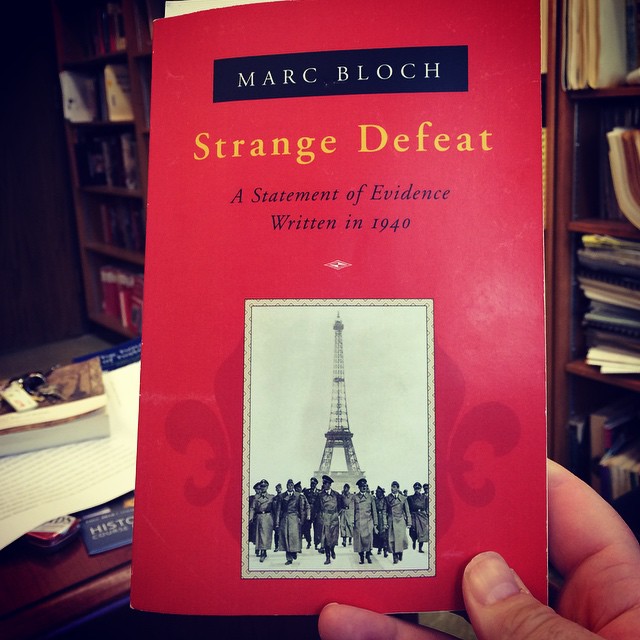 Marc Bloch is one of the most influential historians ever. An historian of mostly medieval France, he, along with Lucien Febvre, founded the Annales school of historiography in the late 1920s. The Annalistes preferred examining history over the long durée, and across various periods of time. They also advocated a more complete history than one of generals, presidents, prime ministers, and other so-called Great Men.
Bloch met his end at the hands of the Gestapo on in Saint-Didier-des-Champs, in France, on 16 June 1944, ten days after D-Day, as the Nazis realised they were going to lose France. Bloch had been a member of the Résistance since 1942. He was captured by the Vichy police in March of that year and handed over to the Gestapo. He was interrogated by Klaus Barbie, and tortured. It was a sad end for a great man.
Bloch had served in the French Army during the First World War, and remained a member of the Army reserve in the interregnum between the two wars. He was called up into action during the Second World War and was on hand for the baffling collapse of France in the face of the Nazi blitzkrieg attack in May 1940. That summer, he wrote his blistering and searing account of the Fall of France, Strange Defeat, not knowing if his words would ever see the light of day. The book was published in 1948, four years after his murder, and three years after the war ended.
Bloch is unflinching in his critique of French High Command, and France in general, for the collapse of its Army in 1940. In part, he blames the High Command’s over reliance on a false reading of history, that led it into a state of pathetic stasis, incapable of recognising that 1939-40 was not 1918, and that the Second World War was a different war than the Great War. In this passage, he makes a passionate argument for what the study of History is.
History is, in its essentials, the science of change. It knows and it teaches that is impossible to find two events that are ever exactly alike, because the conditions from which they spring are never identical…the lesson it teaches is not that what happened yesterday will necessarily happen to-morrow, or that the past will go on reproducing itself. By examining how and why yesterday differed from the day before, it can reach conclusions which will enable it to foresee how to-morrow will differ from yesterday. The traces left by past events never move in a straight line, but in a curve that can be extended into the future.
I assigned this book for my historiography class, and was deeply struck by this passage. I’ve re-read it four times now, it goes against what our culture thinks history is. Our culture thinks history is exactly what Bloch says it isn’t, that it can teach us to avoid the same mistakes over and over again.
I was thinking about this in light of my Irish history class dealing with The Liberator, Daniel O’Connell last week. O’Connell led the movement for Catholic Emancipation in Ireland, succeeding in 1829. He the turned his sights on the Repeal of the Act of Union (1800), which created the United Kingdom of Great Britain and Ireland. In this, he failed. He failed because times had changed, and attitudes were different. In the early 19th century, many in Britain, and even some amongst the Protestant Ascendancy in Ireland, had come to the conclusion that the denial of civil rights for Catholics in Ireland was not a good thing, and that Emancipation was necessary. Three of the staunchest opponents of Emancipation came around to O’Connell’s way of thinking: Sir Robert Peel, the Home Secretary; The Duke of Wellington, the Prime Minister, and King George IV). In the 1840s, though, when O’Connell’s Repeal movement reached its apogee, he did not have a groundswell of support in Britain (or amongst the Protestant Ascendancy) for Repeal. Thus, he failed because O’Connell failed to learn the proper lessons of History.
We would do well to remember Bloch’s maxim. Even we historians.
Historians Being Mean: A Glossary
October 4, 2014 § 4 Comments
[Note: This is not mine, my wife, Margo Shea, came up with this last week in prepping for the Historiography course she’s teaching. But, I think it’s brilliant, and kind funny, too, and worth sharing. I took this, with her permission, of course, directly from her blog. All credit goes to her, not me. I’m just married to a woman who’s smarter than me.]
Historians Being Mean : A Glossary
OK, I think back to graduate seminars and wonder if they may be sites of some of the most grievous crimes against reality when it comes to language usage. Pompousness galore! While aspirational erudition can be really annoying (see – told you!), there are instances in which the correct word matters, not the OK word or the more or less descriptive word. This, of course, is coming from the woman who, as a four year old, asked her mom if she could postpone her nap because she wasn’t currently tired. I used the perfectly appropriate word and got out of my nap. Life lesson learned. Check.
In no particular order, then, here are a few of the most commonly used words historians sling at each other and what they mean. Followed by what they really mean
Unsubstantiated. Obvious and unequivocal, this means you just don’t have the evidence to make the claim. You rarely see the “unsubstantiated argument” in print as a response to an entire article or text, because it’s the baseline for the profession and most research that can’t pass muster on the whole ‘evidence’ thing doesn’t get published. If seen, it is usually applied to one aspect of the research, sometimes because the reviewer can’t think of anything else to criticize. More likely to be heard at conferences, occasionally seen in print records of scholarly roundtables. In which case it means, “I just don’t like you at all and I don’t care who knows it” or “You are getting way too close to my research topic.” Implied insult: You didn’t do your homework. (Alternate reading: Your sweeping, elegiac study kind of blows my mind, so instead of feeling unworthy of you, I’ll just hang out over here and quibble over details in this one subsection of this one chapter, OK?).
Overdetermined. In layman’s terms, this means that an argument about cause or motivation attributes way too much significance to one criterion or set of criteria amongst a much larger pool of possible causes or motivations. The interpretation doesn’t leave enough room for alternate readings. This critique can be lodged in a few different circumstances and can be related either to the argument itself or to the person presenting the argument. Sometimes it is just a fancy way of saying, “Hey there, you’re right on the verge of manipulating your sources to your own dastardly ends.” Also, scholars opposed to the ideologies espoused explicitly by an author or implied in the context of the historical work may use overdetermination as a stand-in for “interested.” (See below.) Implied insult: Your interpretation is about as subtle as two dogs sniffing each other’s nether regions.
Lost in the Structure/Agency Corn Maze. Anyone writing about what people did and why people did what they did, especially if they happen to occupy subaltern status vis á vis a dominant power structure, has to grapple with the whole agency thing. To what extent do individual actors and groups exert personal and collective choice propelling them to act or not act, to speak, to be silent, etc? And to what extent do the forces that structure their society influence and shape the boundaries of what is possible? (Marx’s superstructure, Bourdieu’s field, etc.) It is easy to get lost in this maze and critics are unfortunately somewhere looking down watching you bounce off dried husks. Implied Insult: Seriously, who really cares about what ordinary people did or why?
*Special thanks to Lara Kelland, who cares deeply about ordinary people who create social change, for this one.
Methods-Fetishistic. This basically red-flags an obsessive fascination with methods or methodology, a blind or perhaps naïve faith in methodology as the key to unveiling hitherto opaque historical truths. Historians who rely on quantitative, computational, data-mining methodologies fall under this scrutiny on the grounds that statistics don’t speak for themselves. Implied insult: Got analysis?
Essentialist/Essentializing. Basically, an essentialist argument applies an indispensable set of characteristics to any group of people, set of events or places or things. Over generalization but more than that – it often but not always involves negative judgment. All Irish people are alcoholic-soaked pugilists. All middle class women whose primary work is in the home in the 1950s were sexually repressed. It projects the characteristics of a few onto an entire group. Making data/evidence about a small number of historical actors apply to the whole. Treating as representative the actions, performance, rhetoric of a few. Implying connections between actions and subject positions without a lot of evidence. Implied insult: The trees aren’t the forest, sweetie. And btw, there are a LOT of shades of green.
Teleological. A teleological argument ignores contingencies that make historical change happen and basically suggest a certain inevitability of events. It is the classic “all roads led to here” argument. Basically, a teleological argument looks at the present scenario and structures evidence about the past in such a way as to explain smoothly and coherently how A led to Z. And occasionally you might get really lucky and be get told that you are “reifying a teleology.” Historical scholarship as means to end. Implied insult: Go back to grad school, Marxist.
Interested/Present-minded. These are teleological’s pesky little brothers. It is a somewhat less harsh way of saying much the same thing. You are hereby convicted of reading the past through a set of political, social or cultural interests and commitments or are looking at present circumstances and making assumptions about how historical actors might have responded to the same kinds of circumstances or how historical processes might have operated, etc. Plus, you aren’t even badass enough for me to throw teleology at you. Implied insult: Go to American Studies or Performance Studies or somewhere, you contemporary person, you. You don’t belong here.
Whiggish. Present-Minded + Pollyanna. Herbert Butterfield published The Whig Interpretation of History in 1931. “The Whig interpretation of history,” he said, was “the tendency in many historians to write on the side of Protestants and Whigs, to praise revolutions provided they have been successful, to emphasize certain principles of progress in the past and to produce a story which is the ratification if not the glorification of the present.” Things are always getting better. Progress is inevitable. History is a straight line towards awesome. Implied insult: If you love the system so much, maybe you should have just gone to business school.
What Steve Earle can teach us about the Annales school of historiography
October 2, 2014 § 4 Comments
I’m teaching a course on Historiography this semester. This week, we’re dealing with the Annales school of history, as a sort of background before we read Marc Bloch’s Strange Defeat. While this book isn’t really an annaliste work, Bloch’s theories of history still impacted his evisceration of his country after the Fall of France in 1940. We’re reading an excerpt from Fernand Braudel’s magnum opus, La Méditerranée et le Monde Méditerranéen à l’Epoque de Philippe II, published in 1949.
In it, Braudel talks about the mountain regions of the Mediterranean world, and argues that the culture and civilisation of the plains didn’t reach into the mountains. The hills, he claims “were the refuge of liberty, democracy, and peasant ‘republics.'” And he mentions bandits. One of my favourite history books of all-time, and one which was massively influential on me as a young scholar, is Eric Hobsbawm’s Social Bandits and Primitive Rebels, which, despite Hobsbawm being primarily thought of as a Marxist, was deeply indebted to the annalistes, and to Braudel in particular.
But, as Braudel goes on and on about the freedom of the mountains, I kept thinking about hillbilly culture, about the Hatfields and the McCoys, about hillbilly culture, and so on. And it occurred to me that the mountains are no longer this mythical place beyond the reach of modern society. The coercive power of the state has caught up to the mountains.
And then I thought of my favourite Steve Earle song, “Copperhead Road.” In this song, Earle sings of three generations of a family who live in the ‘holler’ down Copperhead Road. In the American Civil War era, copperheads were northern Democrats who opposed the Civil War and called upon President Lincoln to immediately come to peace with the Confederacy. Braudel argues that
The mountain dweller is apt to be the laughing stock of the superior inhabitants of the towns and plains. He is suspected, feared, and mocked…The lowland peasant had nothing but sarcasm for the rude fellow from the highlands, and marriages between their families were rare.
At any rate, Earle sings of John Lee Pettimore III, named after his “daddy and his daddy before.” Granddaddy John Lee made moonshine down Copperhead Road. Daddy John Lee ran whiskey in a big black Dodge, which he bought at an auction. Meanwhile, John Lee III is a Vietnam vet growing marijuana in the holler down Copperhead Road. He signs the song in a good ol’ boy twang, and sings of white trash.
Granddaddy John Lee hid out down Copperhead Road, only came to town twice yearly for supplies, and successfully dealt with a “revenue man” from the government. Daddy John Lee was doing alright for himself before he crashed that big, black Dodge and the whiskey he was running burst into flames, killing him, on the weekly trip down to Knoxville. Meanwhile, John Lee III wakes up in the middle of the night with the DEA and its choppers in the air above his land.
In other words, as we move through the 20th century, from Granddaddy in the 1940s to John Lee III in the 1980s, we see the mountains lose their allure and mystique. What was once the badlands is now under the control of the government. In the early 21st century, it is even more so.
UPDATE: The Griffintown Horse Palace
September 29, 2014 § 1 Comment
The Griffintown Horse Palace Foundation has met and exceeded its goal, and with three days to spare! As of right now, the Indiegogo page has raised $49,335! The goal was $45,000.
The Foundation is also hosting a fundraising soirée at the Horse Palace, 1226, rue Ottawa, in Griffintown, on Thursday night, 2 October, from 5pm. Tickets are $75, and can be purchased here. More details on the soirée can be found on the Foundation’s Facebook page here.
A huge thank you to all who have contributed. Even though I am no longer involved with the Foundation, I strongly believe in its mission and want to see Leo’s Horse Palace saved!
Deindustrialisation in the Rural Heartland
September 22, 2014 § 8 Comments
The Macon County Fair in Decatur, Il, was cancelled this year. The fair has been a going concern for 158 years, but it also survives through funding from the state of Illinois. Illinois, of course, is a particularly cash-strapped state, which is saying something. It has the lowest bond rating from Moody’s of all 50 states of these United States of America. So funding for county fairs in Illinois has dropped drastically since the turn of the century, from $8.16 million to $5.07 million. Meanwhile, Macon County’s population has been in steady decline since the 1980s, falling from 131,375 to 109,278 today.
We were in Decatur last summer, in our drive across the continent to my sister’s wedding in Portland, OR. It was a pretty, but sleepy town in Central Illinois. It remains a central component of the industrial/agricultural heartland of the United States. It is also the birthplace of the Chicago Bears, the franchise known as the Decatur Staleys, after its original owner, a food-processing magnate.
But Decatur is in trouble, its population also in steady decline since the 1980s. And this decline is reflected in the trouble the Macon County Fair has encountered, as the organisation that puts on the fair is carrying a $300,000 debt, and its headquarters was damaged by heavy rains in July.
What is happening in Macon County is not unique, it is symptomatic of most rural areas in the United States (and Canada) today, as corporate farming becomes further and further entrenched, in the wake of deindustrialisation. Oportunities in these areas dry up, people are left with no choice but to move away, most of them to big cities, both in the MidWest, but also Chicago and coastal cities. Most Midwestern cities continue to grow, though St. Louis seems to be bucking this trend, its population in free-fall since the mid-20th century.
The story of deindustrialisation in North America is one that has been largely limited to big coastal cities, most notably in the northeast, and the so-called “Rust Belt” that stretches around the Great Lakes on both sides of the border (for an excellent treatment of deindustrialisation in the Rust Belt, check out Steve High’s book, Industrial Sunset). Left out of this story is the affect of deindustrialisation on the rural areas across the Heartland.
 Matthew Barlow