The Dystopian Promise of Neo-Liberalism
September 6, 2016 § 3 Comments
I spent late last week laid up with the flu. This means I read. A lot. I don’t have the patience for TV when I’m sick, unless it’s hockey. And since it’s late August, that didn’t happen. While laid up, I finished Jonathan Lethem’s early career Amnesia Moon, and also ploughed through Owen Hatherley’s The Ministry of Nostalgia. On the surface, these two books don’t have anything in common. The former is a novel set in a dystopic American future, whilst the latter is a polemic against austerity and the Conservative Party in the United Kingdom.
But both point to a golden era past. In the case of Amnesia Moon, obviously, given its dystopic future setting. And Hatherley is perplexed over the British right’s ability to control a public discourse of British history and memory.
In Amnesia Moon, the protagonist, a man named Chaos in some situations and Everett Moon in others, finds himself in Vacaville, which is actually a real place, about halfway between Sacramento and San Francisco in North Central California. In Vacaville, the residents are kept unstable by the central state: they are forced to move residences every Wednesday and Sunday. The majority of the residents work mind-numbing jobs, including Chaos’ love interest, Edie. The society is run by the gorgeous, who are featured on TV every night, parading about in an early version of reality TV. The people of Vacaville love and worship them. All of pop culture in Vacaville has been re-written to venerate the president and the ruling class. But most insidious, everything in Vacaville, for all residents, is based on ‘luck,’ a state-sponsored system based on a test administered by bureaucrats. Not surprisingly, those with the best luck are in the ruling classes. And then everyone else is organized and assigned their place in society based on their luck. Not surprisingly, our Edie has bad luck: her ex-husband has lost his mind, so she is a single mother with two children. She is also kept in place by a desperate government official, Ian Cooley, who is in love with her.
Compare this to Hatherley’s view of the United Kingdom in 2016:
We find ourselves in an increasingly nightmarish situation where an entirely twenty-first century society — constantly wired up to smartphones and the internet, living via complicated systems of derivatives, credit and unstable property investments, inherently and deeply insecure — appears to console itself with the iconography of a completely different and highly unlikely era, to which it is linked solely through the liberal use of the ‘A’ [i.e.: austerity] word.
See the similarities?
The Point of Privilege
September 1, 2016 § 2 Comments
Unless you’ve been living under a rock, you know that San Francisco 49ers quarterback Colin Kaepernick refused to stand for the national anthem last weekend. Asked to explain himself, Kaepernick said:
I am not going to stand up to show pride in a flag for a country that oppresses black people and people of color. To me, this is bigger than football and it would be selfish on my part to look the other way. There are bodies in the street and people getting paid leave and getting away with murder…This is not something that I am going to run by anybody. I am not looking for approval. I have to stand up for people that are oppressed. … If they take football away, my endorsements from me, I know that I stood up for what is right.
It is moments like this where I very much do feel like a stranger in a strange land in the United States. Where I come from, I have seen the ‘O Canada’ booed, cheered, ignored, and everything in between. We do tend to stand for our anthem, some of us sing it, some of us sing in both official languages. But not always. But here, in the US, everyone is expected to stand, hand over heart, and belt out ‘The Star Spangled Banner.’
Critics have been all over Kaepernick like Von Miller. They have said he’s grandstanding. That he’s trying to attract attention to his failing career. That he’s privileged. That he is disrespecting veterans. That his protest doesn’t count because he is biracial and was adopted by white people. And so on on and so on. Kaepernick is not the first black athlete to refuse to stand for the anthem. Jackie Robinson refused, for much the same reason. And, of course, so did Muhammad Ali. And Kaepernick is only the latest African American professional athlete to comment on the plight of black people in this country, following Dwyane Wade, Carmelo Anthony, and LeBron James. The most famous protest came from the WNBA, where a number of players, both black and white and including the entire Minnesota Lynx, wore Black Lives Matters t-shirts during warmups.
As for the criticism of Kaepernick, I can’t help but feel it rings hollow. The First Amendment guarantees us the right to freedom of expression. Critics say that Kaepernick lacks patriotism. But what’s the point of enforced patriotism? Doesn’t that just make it hollow and knee-jerk?
The fact that Kaepernick is biracial and was adopted by white parents when he was a small child has not been lost on critics. Former NFL safety and current NBC analyst Rodney Harrison claimed Kaepernick isn’t black. I’ve seen worse on Twitter. The argument here is that because of his upbringing, Kaepernick has no idea what it’s like to be black. This is specious logic. Of course he knows what it’s like to be black. He’s long since figured out that due to his skin colour, he can never be white. He has had police pull guns on him and a friend in college when moving out of an apartment. He has seen inequality in the world around him.
As for his declining career and the argument he is not Robinson or Ali. Sure, no one is Robinson or Ali. But Kaepernick is still a former Pro Bowl QB, who carried his team to the Super Bowl. Some argue that this makes it harder for the 49ers to cut him. I doubt it. The NFL is a business and its mercenary. The New York Giants’ kicker Josh Brown has acknowledged he beat his ex-wife, to the point where she called the police over 20 times for over 20 separate instances. Think the Giants care? Of course not. Teams have also cut players for supporting marriage equality and medicinal marijuana. And even if the 49ers cut him, maybe they’ll get a bit of flack, but life will go on. Levi Stadium is still sold out. Fans will still buy 9ers gear.
As for his privilege: Of course he’s privileged. That’s the whole point. Kaepernick has made something like $20 million in the NFL. He’s a very recognisable player. So he has a platform upon which to make a statement. Privilege works in many different ways. And the only way the world gets better is if those with privilege use it for good. And Kaepernick is using his to point out American hypocrisy regarding African Americans. Kaepernick refusing to stand for the anthem and then explaining his motivations clearly and patiently is a much bigger deal than the average punter refusing. Kaepernick’s privilege here is what allows the statement.
And that, gentle reader, is how privilege should be used.
Margaret Sanger Was Not Who You Think
August 29, 2016 § 3 Comments
Margaret Sanger might be the least understood, most slandered person in American history right now. Everyday in my Twitter feed, I see arguments over her, her beliefs on birth control, abortion, and African Americans. She has been latched onto by many on the right as an example of what is purely evil with liberals in the US. The problem is that the historical reality does not bear out this demonization of Sanger.
Nonetheless, the Twitter warriors persevere:
https://twitter.com/npnikk/status/767738900198588416
https://twitter.com/peddoc63/status/767060591412412416
This isn’t limited to Twitter. New Hampshire Representative William O’Brien (R) said that Sanger was a KKK member. Herman Cain, in his run for the GOP presidential nomination in 2011, claimed that the whole point of Planned Parenthood, which Sanger founded, had a genocidal mission to prevent black babies from being born. Last fall, Ben Carson, on his own run to secure the GOP nod, declared that Sanger’s goal was to eliminate African Americans.
The belief that Sanger was a white supremacist and a member of the KKK is a particularly popular one on the American political right This photo in particular has been circulating for years, after it was uploaded to the white supremacist site Stormfront in 2008:

While it is true that Sanger gave a speech to a women’s auxiliary of the KKK, both this photo and the supposed message of her talk are lies (she talked to the KKK women about birth control and called it “one of the weirdest experiences I had in lecturing.”). But, like any good lie or meme, this one is careful to be specific, even offering us a location. This photo is a photoshopped version of this:

Very different, no?
Yes, Sanger was a believer in eugenics. So, too, were Winston Churchill, Teddy Roosevelt, H.G. Wells. Even W.E.B. DuBois believed in aspects of the eugenics, though he was vehemently opposed to the racist viewpoint of many eugenicists, for perhaps obvious reasons. And, let us not forget that the eugenics movement was one predicated on classism, racism, and almost every other -ism you can imagine. At its purest, it was a movement devoted to purifying the human race of the disabled, criminal, addicted, and many others. And that also included racism. And, of course, eugenics is part of what drove the Nazis and the Holocaust.
Eugenics, however, was a mult-faceted movement. In the United States, it was not simply a belief in sterilization of ‘undesirables’ and other medical horrors. Rather, it also included a larger public health movement that sought to make Americans healthier through exercise, the creation of parks, eradication of STDs, clinics for maternal and infant health, immunization, and other aspects of healthy living. And this is where Sanger’s beliefs largely lay. In a 1957 interview with Mike Wallace, Sanger stated that
I think the greatest sin in the world is bringing children into the world — that have disease from their parents, that have no chance in the world to be a human being practically. Delinquents, prisoners, all sorts of things just marked when they’re born. That to me is the greatest sin — that people can — can commit.
Moreover, a belief in eugenics did not necessarily equate racism in the United States. To take the case of Sanger: she did not believe in segregation, she opposed Jim Crow in the South. She was a firm believer in birth control, and she thought all women, not just wealthy, white women, should have access to it. That includes poor white women, hence the talk to the KKK auxiliary. But this belief also brought her into African American neighbourhoods in New York, Chicago to open clinics there so African American women would also have access to birth control. She also worked closely with African American ministers in her attempts to educate black women.
In her actual organization, Sanger would not tolerate racism, and fired people for racism. More to the point, in 1966, Planned Parenthood honored Rev. Martin Luther King with its Margaret Sanger Award, which is granted to people who work to ensure reproductive health and rights. King was unable to accept the award in person, sending instead his wife, Coretta Scott King. She read his acceptance speech, which included this passage:
There is a striking kinship between our movement and Margaret Sanger’s early efforts. She, like we, saw the horrifying conditions of ghetto life. Like we, she knew that all of society is poisoned by cancerous slums. Like we, she was a direct actionist – a nonviolent resister.
Thus, in the end: Sanger was not a racist, she did not advocate mass sterilizations of anyone, let alone African Americans. She was not a member of the KKK. In reality, she was a rare person in the early 20th century: she believed in racial and class equality when it came to reproductive health. And she was dead-set opposed to racial segregation and Jim Crow.
The Problem with France’s Burkini Ban UPDATED!
August 25, 2016 § 8 Comments
135_C
So 16 towns and cities in France, all on the Mediterranean Coast, have banned the so-called burkini, a body-covering garment that allows devout Muslim women to enjoy the beach and summer weather. France, of course, has been positively rocked by Islamist violence in the past 18 months or so. So you had to expect a backlash. But this is just downright stupid.
There is a historical context here (read this whole post before lambasting me, please). French society believes in laïcité, a result of the French Revolution of 1789 and the declericisation of French society and culture in the aftermath. To this end, French culture and the French state are both secularised. Religious symbols are not welcome in public, nor are the French all that comfortable with religious practice in public. Now, this makes perfect sense to me, coming as I do from Quebec, which in the 1960s, during our Revolution tranquille, also underwent a process of declericisation. Quebec adopted the French model of a secular state.
But, in Quebec as in France, not all secularism is equal. Catholic symbols still exist all over France as a product of French history, to say nothing of the grand cathedrals and more humble churches that dot the landscape. But other religious symbols, they’re not quite as welcome, meric.
Nonetheless, it is in the context of this laïcité that the burkini ban arises.
But in practice, it is something else entirely. This is racism. This is ethnocentrism. And this is stupid. Just plain stupid. French Prime Minister Manuel Valis claims that the burkini is a symbol of the ‘enslavement of women.’ The mayor of Cannes claims that the burkini is the uniform of Muslim extremism. It is neither. And the burkini bans are not about ‘liberating’ Muslim women in France. They are not about a lay, secular society. They are designed to target and marginalize Muslim women for their basic existence in France.
In the New York Times this week, Asma T. Uddin notes the problem with these bans when it comes to the European Court of Human Rights and symbols of Islam. Back in 2001, the Court found that a Swiss school teacher wearing a head scarf in the classroom was ‘coercive’ in that it would work to proselytize young Swiss children. I kid you not. And, as Uddin reports, since that 2001 decision, the Court has continually upheld European nations’ attempts to limit the rights of Muslims, especially Muslim women, when it comes to dress.
Then there was the shameful display of the police in Nice this week, which saw four armed policemen harass a middle-aged Muslim woman on the beach. She was wearing a long-sleeved tunic and bathing in the sun. The police, however, issued her a ticket for not ‘wearing an outfit respecting good morals and secularism.’ Again, I kid you not.
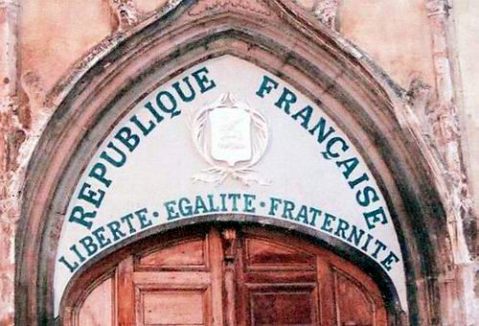
Laïcité is supposed to be not just the separation of church and state, but also the equality of all French citizens. Remember the national motto of the French republic: ‘liberté, éqalité, et fraternité.’ These are lofty goals. But the attempts to ban the burkini and attack Muslim women for their attire is not the way one goes about attaining liberté, nor égalité nor fraternité. Rather, it creates tiered culture, it creates one group of French who are apart from the rest. It is discriminatory and childish. And let’s not get on the subject of former French president Nicolas Sarkozy, who wants to run again, and promises to ensure that Muslim and Jewish students in the lycées eat pork.
I understand France’s concerns and fears. But attacking Islam is not the way to defeat terrorists who claim to be Muslim. It only encourages them. It is time for France to live up to its own mottos and goals. And Western feminists (and pro-feminist men) need to speak up on this topic.
UPDATE!!!!!
News comes this evening that the Deputy Mayor of Nice, and President of the Regional Council of Provence-Alpes-Côte d’Azur, has threatened to sue people who share images of the police attempting to enforce the burkini ban on social media. I kid you not. Christian Estrosi states that the images cause harm to the police (if that is true, that is not right, of course).
It is worth pointing out that it would be very difficult for Estrosi to find legal standing to launch a lawsuit, as French law allows citizens and media outlets to publish images and videos of the police and that, without a judicial order, French police cannot seize a photographer’s camera or phone.
What the Hell?
August 22, 2016 § 4 Comments
UPDATE: I thought this rhetoric about the Prime Minister couldn’t get worse. Turns out I was wrong; it can. And it has been for some time.
As every Canadian knows, the Tragically Hip held their last ever concert in their hometown of Kingston, ON, on Saturday night. Something like 11 million TV sets in Canada were tuned to the gig, broadcast coast-to-coast-to-coast on the CBC. For those of you who don’t know, that’s about 1/3 of the population of the entire country. I haven’t seen numbers for how many of us watched on YouTube, as the CBC streamed the show worldwide. Social media was full of pics, remembrances, stories about The Hip, a quintessentially Canadian band. If you’re not Canadian, I simply cannot explain the importance of this band to most Canadians. It’s something non-quantifiable.
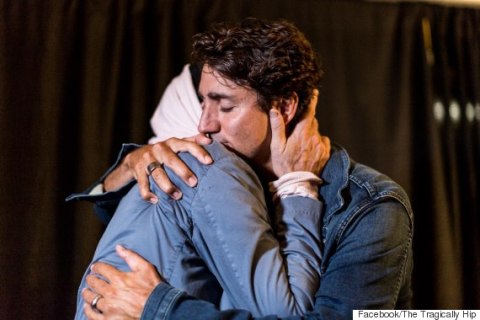
The Prime Minister, Justin Trudeau, was there in Kingston, one of the lucky 7,000 people inside the unfortunately named K-Rock Centre. Gord Downie, the frontman who is dying of cancer, gave the PM a couple of shoutouts, particularly insofar as Canada’s abysmal record vis-à-vis our First Nations. In the aftermath, a picture of Downie and Trudeau sharing a hug made the rounds on social media. It’s a particularly touching image, and it shows Downie’s frailty.
But then Twitter happened. A series of tweets from bitter, and mostly anonymous, Canadian conservatives attacked Trudeau for a variety of reasons, most of them just a sad bit of bitterness. For example:
https://twitter.com/politicsinmemes/status/767155353746153473
or,
These were relatively mild, however. Others wished personal ill on the Prime Minister. But the worst tweet I saw was this one:
https://twitter.com/FACLC/status/767174725747433473
What kind of person says something like this? What has happened to the Canadian conservative movement that this can even happen? FACLC’s tweet is simply the most egregious example that came through my timeline in the past few days.
While I can certainly understand a deep-seated dislike, even hatred, for a Prime Minister (i.e.: Stephen Harper), I do not know anyone who tweeted vileness like this, who wished personal ill on the Prime Minister of Canada FACLC and anyone who supports such viciousness should be deeply ashamed of themselves. So should anyone who posted such vileness in the first place. This is not Canada, this is not who we are.
Whither the Poor? Or, Why You Need to Vote!
August 10, 2016 § 4 Comments
I live in the second poorest county in Tennessee, as defined by median income. That puts it in the Top 50 nationally, with a median income of $28,086. Here, the near impossibility of farming on top of a mountain, combined with the long-term effects of coal-mining are all over the place, from the environmental degradation to the deep poverty.
On Monday, I published a post on Lyndon Baines Johnson and his Great Society. The Great Society was really the last time the government made an attempt to confront white poverty in the US. But that was half a century ago. They were amongst the constituency of the Democratic Party. But they’ve long since shifted their allegiances. But the GOP doesn’t accord them any attention, they’re taken for granted. The people here are the forgotten people of the country.
Nancy Isenberg, in her fantastic book, White Trash: The 400-Year Untold History of Class in America, argues that class has been central to American life and American history. And for poor white people, they have been marginalized here for four centuries, just as they have been in England. Americans like to think they live in a classless society. They don’t. At the time of the Civil War, a grand total of 6 per cent of white Southerners owned slaves. Yet, they managed to convince the other 94 per cent of the justness of a war to protect their economic interests. For the massive majority of the South, these poor white people, the war was pointless. And they came to realize this pretty quickly, as soldiers grumbled about the wealthy who sent them to their death.
By the late 1960s and into the 70s and 80s, the Republican Party gained their allegiance. This came about due to a response on the part of poor, white Southerners to the Civil Rights Era, combined with the rise of evangelical Christianity. In the first case, there was both frustration with being forgotten by the federal government, combined with a residual racism that dates back to the nineteenth century, when the Southern élite kept them in place by telling poor whites that, “Hey, it may suck to be you, but, you know, it could be worse, you could be black.” And yes, this worked (don’t believe me, go check out David Roediger’s excellent The Wages of Whiteness: Race and the Making of the American Working Class; think Roediger’s ‘biased’?, read this). In the second case, the GOP nationally hitched its horses to the evangelical movement, which had its greatest successes in the South.
Driving all over the county this weekend, I noticed where the Trump supporters live. There are people in this county who are well-off. There is even a very tiny middle class. But the Trump supporters, as defined unscientifically by bumper stickers and lawn signs, are the poor. Trump stickers tend to be on older cars in various stages of disrepair. The lawn signs tend to be outside of trailers, tiny houses, and cabins and shacks.
But what fascinates me about this is not who they support, but that they do so at all. This is a politically mobilized group in my county. During the presidential primaries in May, voter turnout in both the Democratic and Republican primaries was over 60 per cent. Despite being forgotten, ignored, and left behind, the people of my county are still voting. Angrily, but they’re voting. They’re voting for Trump for what I see as obvious reasons: he speaks their language, even if he is a demagogic, power-hungry, liar.
A politician who could harness their anger and frustration and offer hope, something other than the dystopian view of Trump, whilst building a coalition that offered something to other frustrated constituencies (I’m thinking primarily of inner-city African Americans), could actually make a real change in the United States.
But, instead, we get the same hollow language of the Democratic nominee, versus this horrible, Hunger Games dystopian, crypto-fascism of the Republican nominee.
Resuscitating Lyndon Baines Johnson
August 8, 2016 § 3 Comments
Last week, I finally got around to reading Stephen King’s 11/22/63. I hadn’t read a Stephen King novel since I was around 16 and I discovered his early horror work: Dead Zone, Christine, Carrie, The Stand, The Shining, and Cujo. I read and devoured them, then moved on to other things. But my buddy, J-S, raved about this book. So, I humoured him, bought it, and read it. It was pretty phenomenal. I’m not really a fan of either sci-fi or alt.history, but this book was both. Time travel and a re-imagined history of the world since 1958.
The basic synopsis is that a dying Maine restaurateur, Al Templeton, convinces 35-year old, and lonely, high school English teacher, Jake Epping, to go back in time. See, Templeton discovered a rabbit hole to 1958 in his stock room. He’s been buying the same ground beef since the 1980s to serve his customers, hence his ridiculously low-priced greasy fare. Templeton went back in time repeatedly, until it dawned on him he could prevent the assassination of JFK. Templeton figures if he prevents JFK from dying, he’ll prevent Lyndon Baines Johnson from becoming president. And thus, he will save all those American and Vietnamese lives. So he spent all this time shadowing Lee Harvey Oswald, and plotting how to stop him. But then he contracted lung cancer. His time was almost up. So, he got Epping involved.
After a couple of test runs, Epping agrees. So back to 1958 in Maine he goes again, spends five years in the Land of Ago, as he calls it, under the name George Amberson. I’ll spare you the details. But, he is, ultimately successful in preventing the assassination of John Fitzgerald Kennedy in Dealey Plaza in Dallas on 22 November 1963.
But when he returns to Maine in 2011, he returns to a dystopian wasteland. Before entering the rabbit hole back to the future, Epping/Amberson talks to the gatekeeper, a rummy. The rummy explains that there are only so many strands that can be kept straight with each trip back and each re-setting of time.
Anyway. Read it. You won’t be disappointed. I cannot speak to the series on Hulu, though. Haven’t seen it.
I found myself fascinated with this idea of preventing LBJ from becoming president. See, I’m one of the few people who think that LBJ wasn’t a total waste as president. This is not to excuse his massive blunder in Vietnam. Over 1,300,000 Americans, Vietnamese, Laotians, and Cambodians died in that war. And the war left a long hangover on the United States that only really went away in time for the Iraq War hangover we’re currently living in.
But. LBJ wasn’t a total disaster. Domestically, he was a rather good president. He was, of course, the brain behind The Great Society. LBJ wanted to eliminate racial injustice and poverty in the United States. This led to the rush of legislation to set the record straight on these issues. We got the Civil Rights Act, Medicare, Medicaid, and a whole host of other initiatives in the fight against poverty in inner cities and rural areas. We got the birth of public television that ultimately led to the birth of PBS in 1970. Borrowing some from JFK’s Frontier ideas, the Great Society was envisioned as nothing less than a total re-making of American society. In short, LBJ was of the opinion that no American should be left behind due to discrimination. It was a lofty goal.
LBJ’s Great Society, moreover, was incorporated into the presidencies of his Republican successors, Richard Nixon and Gerald R. Ford. In other words, the Great Society met with approval from both Republicans and Democrats, to a degree anyway.
Of course, the Great Society failed. In part it failed because LBJ’s other pet project, the Vietnam War, took so much money from it. It did cause massive change, but not enough. In many ways, the rise of Donald Trump as the GOP nominee can be seen as long-term response to the Great Society. Trump has the most support from non-college-educated white people, the ones who feel they’ve been victimized by the liberal agenda. And, as the New York Times pointed out this week, Trump is really the benefactor of this alienation and anger, not the cause of it.
Nevertheless, I do take exception to the dismissal of LBJ as a horrible president based on the one glaring item on his resumé. No president is perfect, every president has massive blemishes on his record. Franklin Delano Roosevelt signed an executive order for Japanese Internment. Abraham Lincoln only slowly came to the realization that slavery had to end, and he did not really believe in the equality between black and white. I could go on.
King also makes an interesting point in 11/22/63: when Epping/Amberson returns to 2011 after preventing JFK’s assassination, he learns that the Vietnam War still happened. JFK, after all, was the first president to escalate American involvement in great numbers. And worse, the Great Society did not happen. There was no Civil Rights Act, no War on Poverty, etc. JFK, as King notes, was not exactly a champion of equal and civil rights.
Thus, as maligned as the Big Texan is by historians and commentators in general, I think it is at least partially unfair. LBJ had ideas, at least. And he was a visionary.
Clint Eastwood and Political Correctness
August 5, 2016 § 22 Comments
I have to admit, I like Clint Eastwood, the artist. He’s the star of one of my favourite films of all-time, The Good, the Bad & The Ugly. And he’s made some mighty fine films of his own. He’s also a complex man. He claims to be libertarian, but he’s supported both Democrat and Republican politicians. He’s called for gun control since the early 1970s. He was also a progressive mayor of Carmel-By-The-Sea, at least on environmental issues. And he’s long been an advocate of environmental controls. And, clearly, since he’s been mayor of his little resort town, he clearly isn’t opposed to government at all costs, nor is he opposed to using government power for the common good.
But, in recent years, he’s become a bit of a loose cannon. His speech at the 2012 Republican Conference, the so-called “Empty Chair” routine, was unforgettable. But this week, he was in the news again, complaining about the “pussy generation.” See, Ol’ Clint is tired of political correctness:
[Trump]’s onto something because secretly everybody’s getting tired of political correctness, kissing up. That’s the kiss-ass generation we’re in right now. We’re really in a pussy generation. Everybody’s walking on eggshells.
We see people accusing people of being racist and all kinds of stuff. When I grew up, those things weren’t called racist.
My response? So what? First, Clint Eastwood loves to come off as a tough guy when he’s going off on a tangent like this. Clint Eastwood ain’t no tough guy, he plays them in movies. That’s a big difference. Second, Clint Eastwood is 86 years old. When he was growing up, Jim Crow and segregation existed in the US. Is that what he wants to return to? I presume not.
As for “political correctness,” you know what? I’m sick of this one too. Creating an environment in the world where people feel comfortable, where we are all respected and treated fairly is not a bad thing. It’s easy for a multi-millionaire 86-year old white man to complain about the things that weren’t called racist 80 years ago. What discrimination has Clint Eastwood faced in his life?
And this is the thing, the people who complain about “political correctness” tend to be white and middle class, and quite often male. In other words, they tend to be people who don’t know what it feels like to be the target of discrimination or hate speech, or, worse. It’s easy for them to claim there is no discrimination, no racism in society. They’re not targeted by it. It’s easy for Eastwood to complain about the “pussy generation.”
In short, you cannot complain about “political correctness,” or claim there is no such things as racism, sexism, misogyny, or homophobia if you are of the dominant group in society.
More to the point, a long time ago, a great man once noted that the mark of a democracy was how it treated its minorities. And that is most certainly true. That great man, by the way, was former Canadian Prime Minister, Pierre Elliott Trudeau (the father of current PM, Justin “Hotty Pants” Trudeau).
On Experts & Anti-Intellectualism
July 5, 2016 § 5 Comments
Nancy Isenberg‘s new book, White Trash: The 400-Year Untold History of Class in America, is attracting a lot of attention. No doubt this is, in part, due to the catchy title. White trash is a derogatory and insulting term, usually applied to poor white people in the South, the descendants of the Scots-Irish who settled down here prior to the Civil War, the men who picked up their guns and fought for the Confederacy during the Civil War. (Oddly, the term is not really applied all that often to poor white people in the North).
I am also deeply suspicious of books that promise to tell me the “untold” or “true” story of anything. And certainly, if you asked American historians if class was an “untold story”, they’d laugh you right out of their office. But no doubt the title is due to Viking’s marketing department, not Isenbeg.
Nonetheless, I bought the book, but as I was doing so, I read some of the reviews on Amazon.The negative ones caught my eye. Most of the negative reviews were either misogynistic or anti-Semitic. But, one, by someone calling themselves Ralphe Wiggins, caught my eye:
This book purports to be a history of white trash in America. It is not. It is a series of recounting of what others have said about the lower white classes over the past 400 years. In most cases the author’s summarizations are a simple assertions of her opinion.
…
The book is 55% text, 35% references and 10% index. The “Epilog” is a mishmash of generalizations of Isenberg’s earlier generalizations.
Let us now parse Wiggins’ commentary. First, Wiggins complains that Isenberg simply summarizes “her opinion” and then generalizes her generalizations. Clearly, Wiggins does not understand how historians go about their craft. Sure, we have opinions and politics. But we are also meticulous researchers, and skilled in the art of critical thinking. The argument Isenberg makes in White Trash are not simply her “opinion,” they’re based on years of research and critical thinking.
Second, Wiggins complains that the book is 35% references and 10% index. Of course it is, it’s an academic work. The arguments Isenberg makes are based on her readings of primary and secondary sources, which are then noted in her references so the interested reader can go read these sources themselves to see what they make of them. Revealing our sources is also part of the openness of scholarship.
Wiggins’ review reminds me of Reza Aslan’s famous turn on FoxNews, where he was accused by the host of not being able to write a history of Jesus because he’s a Muslim. Aslan patiently explained to her over and over again that he was a trained academic, and had spent twenty years researching and pondering the life and times of Jesus. That was what made him qualified to write Zealot: The Life and Times of Jesus of Nazareth.
But all of this, Wiggins’ review, Aslan’s turn on FoxNews is symptomatic of a bigger problem: the turning away from expertise. In the wake of the Brexit vote, the satirical news site “News Thump” announced that all experts would be replaced by Simon Kettering, a local at the neighbourhood pub:
Williams knows absolutely everything about any subject and is unafraid to hold forth against the received wisdom of 400 years of the scientific method, especially after four pints of Strongbow.
Amongst his many accomplishments Simon is remarkably well-informed about optimal football formations, the effects of political events on international capital and bond markets, and the best way to pleasure a woman – possibly his favourite subject.
His breadth of knowledge is all the more impressive as he doesn’t even need to bother spending ten seconds fact-checking on Google before issuing a firm statement.
As my good friend, Michael Innes, noted in response:
Yep. Personally, I’m looking forward to all the medical and public health experts at my local surgery being fired and replaced with Simon. Not to mention the car mechanics at my local garage. I’m sure with a little creative thinking (no research!!!) we can dig deeper and weed out yet more of the rot, too.
See, experts can be useful now and then. And Nancy Isenberg is certainly one, given that she is T. Harry Williams Professor of History at Louisiana State University.
Stupid Memes, Lies, and Ahistoricism
June 27, 2016 § 4 Comments
There is a meme going around the interwebs in the wake of last Thursday’s Brexit referendum and decision. This meme is American and has appeared on the FB and Twitter feeds of pretty much every conservative I know. And, like nearly all memes, it is stupid. And ahistorical.
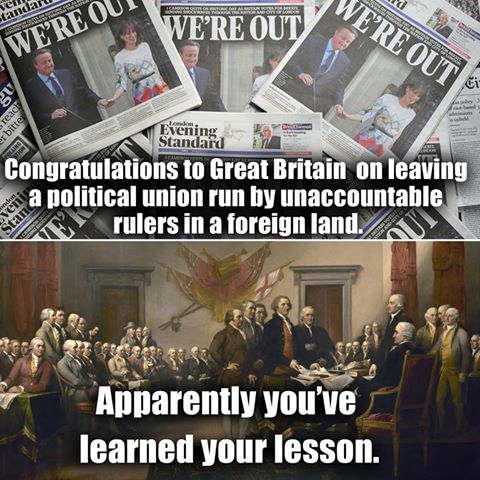
I watched an argument unfold on a friend’s FB wall over the weekend, where one of the discussants, in response of someone trying to historicize and contextualize the EU, said that “History is irrelevant.” He also noted that history is just used to scare people. OK, then.
But this is where history does matter. The European Union is a lot of things, but it is not “a political union run by unaccountable rulers in a foreign land.” Rather, the EU is a democracy. All the member states joined willingly. There is a European Parliament in Brussels to which member states elect members directly. Leadership of the EU rotates around the member states.
And, the 13 Colonies, which rose up against the British Empire in 1774, leading to the creation of the United States following the War of Independence, were just that: colonies. The United Kingdom is not and was not a colony of Europe.
The two situations are not analogous. At all. In other words, this is just another stupid meme. #FAIL
 Matthew Barlow