Canada’s National Shame redux
February 4, 2015 § 3 Comments
Yesterday, a new report was released on the plight of Canada’s aboriginal peoples in the healthcare system. The title, “First Peoples, Second Class Treatment,” perhaps says all you need to know. The CBC also posted a story on-line about the experiences of several aboriginal people vis-à-vis healthcare in Victoria, British Columbia. A couple of the “highlights”:
- Michelle Labrecque went to the Royal Jubilee Hospital complaining of severe stomach pain in 2008. A doctor gave her a prescription. When she got home and opened the paper with the prescription on it, it was a drawing of a beer bottle with a circle slashed through it.
- Carol McFadden went to the doctor with a lump in her breast, only to be told she could’ve gone to mammography herself. She now has Stage 4 breast cancer, and it has spread to her liver.
- McFadden reports that whilst some doctors have been compassionate, others have been rude and brusque, to the point where they kick her bed when they want her attention, and continually asking her if she drinks or does drugs.
I recently read Joanna Burke’s book, The Story of Pain: From Prayer to Painkillers. In it, she talks about the body in pain, and the responses thereto, both from the victims of the pain, as well as the medical profession. Nineteenth century doctors, insofar as they discussed the colonialized body, they dismissed the idea that indigenous bodies could feel pain in the same way that an upper-class British man could. For that matter, they also argued that working-class men had a higher tolerance to pain. Their recommendation was to try to take the body in pain seriously, but not to be sympathetic, to be brusque when talking to the victim. We live in the twenty-first century. Why are aboriginal peoples treated this way by doctors?
Of course I know why, Canada is a deeply, deeply racist society vis-à-vis the aboriginal population. It is acceptable in Canada to be openly racist against First Nations people. I wish I could say I was surprised by the findings of this report. I am not.
Canada’s National Disgrace
February 2, 2015 § 151 Comments
Two weeks ago, MacLeans, Canada’s only national news magazine, published an article that caused quite the uproar. Written by a former diplomat, Scott Gilmore, and entitled, “Canada’s Racism Problem? It’s Even Worse Than America’s,” it’s not hard to see why this upset people. Even better was the sub-title, “For a country so self-satisfied with its image of progressive tolerance, how is this not a national crisis?” I wish I had written this article, it says what I’ve been saying for a long, long time.
Aboriginal peoples in Canada get screwed. Have been since the first Europeans arrived, and still do today. And that’s not going to change any time soon unless Canadians do something about it. But, in my experience, they don’t care. Last year, I wrote a post about a funny sweatshirt that an aboriginal man, Jeff Menard, in Winnipeg (which MacLeans also called out as Canada’s most racist city) created that said: “Got Land? Thank an Indian.” I wrote this post in response to a response I got to a tweet stating that if you thought this hoodie racist, you’re an idiot. This response tweet said “I’m offended because they used the word Indian. My grandfather was from India. He worked for a living.”
How to unpack that? This tweet was anti-historical and offensive on so many levels. Starting with being upset at the use of the word “Indian,” the term applied to aboriginal peoples by Euro-Canadians historically. But the real kicker is “He worked for a living.” Many of the comments on Gilmore’s article, and a lot of the vituperative, racist tweets I saw complained that aboriginal peoples in Canada survive on handouts from the government and don’t work for a living. No mention of imperialism, the taking of land, the systematic attempts by the Canadian government to steal away aboriginal languages, cultures, religions, and names, of the residential schools designed to also take the children of aboriginals away from them (to say nothing of the horrific sexual abuse therein).
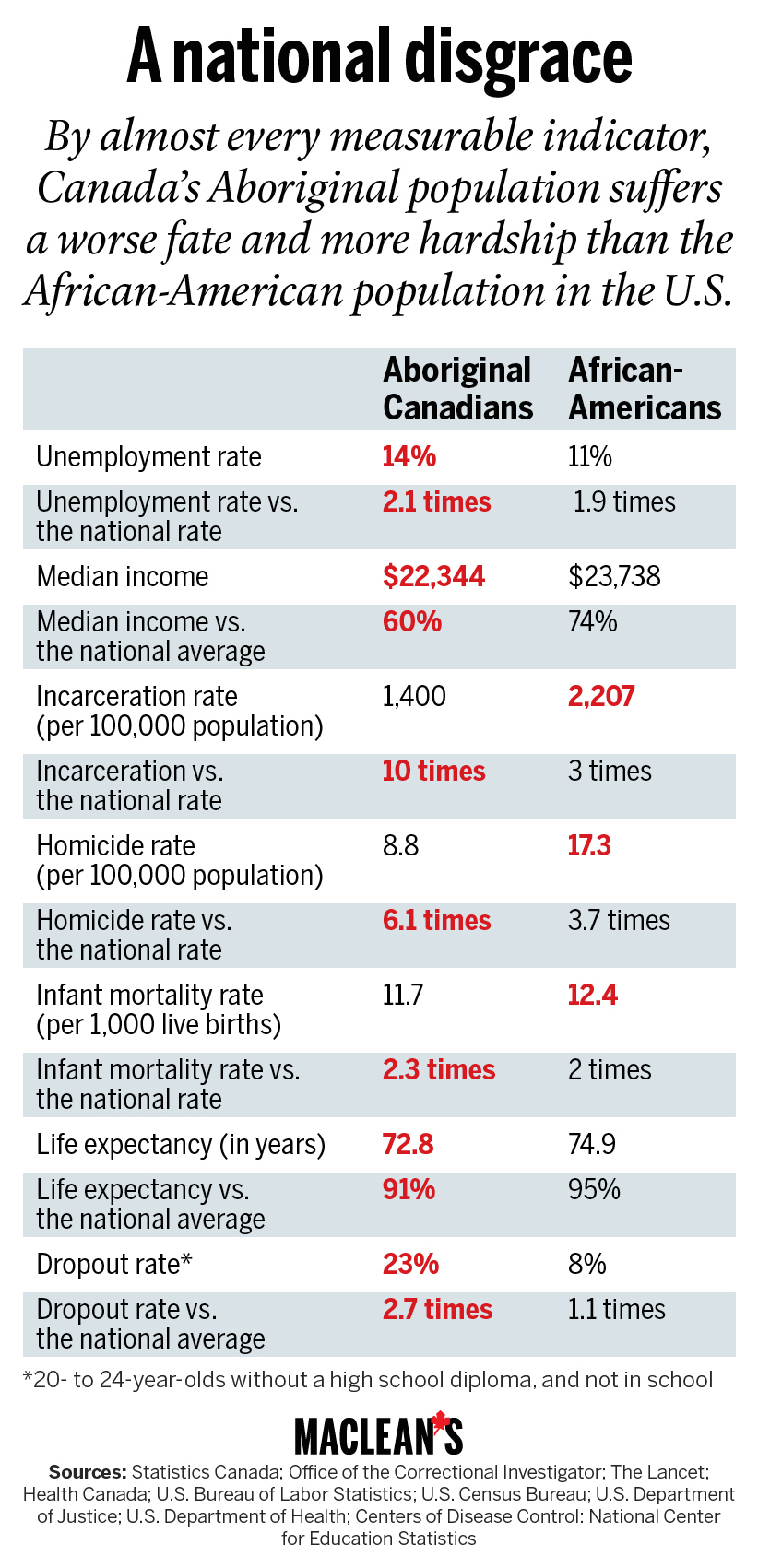
Gilmore pointed just how badly aboriginal peoples get screwed in Canada, by comparing them to African-Americans in the United States, in easy table format, which I produce here (and hope that MacLeans doesn’t mind). Look at those statistics and just try not to be offended, saddened, and, if you are Canadian, embarrassed. Hell, even if you’re American, you should be embarrassed by these stats. But, Gilmore’s right. Canadians are a smug lot. My Twitter feed is usually full of all kinds of anti-American comments, the implicit meaning is “Well, the US is a mess, thank god I live in Canada.” Information such as this should end such discussions and puncture our smugness forever.
At the same time the furor over Gilmore’s article was raging, another debate was happening over the death of Makayla Sault, an 11-year old from the New Credit First Nation in Ontario. Makayla died of leukaemia. When she was first diagnosed last year, she underwent chemotherapy in Hamilton, ON. But the side-effects were too great. And so she refused further treatment, preferring instead traditional medicine. Obviously, it didn’t work.
This raises interesting questions, starting with who has the right to control the lives of children who have cancer. But. Ultimately, we have to respect her decision. Why? Because it was her life.
But, then the enfant terrible of Quebec journalism, Denise Bombardier, had to get involved. Bombardier is perhaps most famous outside of Quebec for having been fired by Radio-Canada for having participated in a debate on marriage equality, taking the position against it. At any rate, this is Bombardier’s comments on Makayla Sault (thanks to Mikayla Cartwright for the image):

For those who cannot read French, a few of the highlights: After complaining about the cost of political correctness, she states that Makayla made the choice to be treated according to traditional medicine, encouraged, perhaps, by her parents and other members of her First Nation. Then the kicker, “A white child wouldn’t have to make this choice. This is where we see the delusional ancestral rights of the aboriginals open the door to quackery. This child died because she was the sacrifical victim of a deadly, anti-scientific culture that is killing aboriginal people.”
It took me all of about 0.33 seconds to find a Euro-American child who faced this dilemma. Daniel Hauser, a 13-year old boy who was refusing treatment in 2009, for religious reasons. Daniel Hauser, I might add, is white. My Google search turned up other kids faced with this same awful dilemma (the same search also turned up other children in the same position). So, Bombardier is factually wrong.
But she is also morally, ethically wrong. Bombardier’s screed reads like far too many documents I read in the records of Aboriginal Affairs and Northern Development Canada, the government agency (which has had many names) in charge of carrying out the responsibility that the Government of Canada has to aboriginals, according to treaties that both pre- and ante- date Confederation in 1867, as well as Section 35 of the Canadian Constitution. In many of the documents I read during my days working in the field of aboriginal law and litigation in Ottawa, various employees of Aboriginal Affairs, from lowly agents in the field to the directors of the department in Ottawa, referred to the need to civilise the aboriginals, and how white people knew what was right for them. In academia, we call this imperialism.
Bombardier says the same thing. She dismisses aboriginal culture as “anti-scientific” and “deadly.” She refers to traditional ways of life as “quackery.” In short, Canada needs to civilise the aboriginals for their own good, just as Aboriginal Affairs agents and employees argued a century ago.
In short, Gilmore is bang-on correct. Canada’s treatment of its aboriginal population is a national disgrace and tragedy, made worse by the fact that most Canadians don’t know or don’t care, and a good number of them are part of the problem, as Bombardier shows. Gilmore writes:
We are distracted by the stories of corrupt band councils, or flooded reserves, or another missing Aboriginal woman. Some of us wring our hands, and a handful of activists protest. There are a couple of unread op-eds, and maybe a Twitter hashtag will skip around for a few days. But nothing changes. Yes, we admit there is a governance problem on the reserves. We might agree that “something” should be done about the missing and murdered women. In Ottawa a few policy wonks write fretful memos on land claims and pipelines. But collectively, we don’t say it out loud: “Canada has a race problem.”
And until we do, nothing is going to change.
Stephen Harper’s War on Canada
January 30, 2015 § 6 Comments
Last weekend, the Toronto Star published a scathing article, looking at how Canada’s elected government, led by Prime Minister Stephen Harper, has muzzled, shut down, and otherwise sullied government branches. Harper has silenced scientists working for Environment Canada and Health Canada, all in an attempt to keep them from publicising the harm caused by the Tarsands in Alberta.
Then there’s Harper’s war against the Library and Archives Canada. This is the national archives and library of the country. In other words, it’s kind of important. Rather than fund it properly, ensure that Canadians have access to their national history, Harper has cut funding, shut down branches, and done everything it can to prevent us from knowing the history that his government spends too much time blaming us for not knowing. This is unacceptable, and downright terrifying.
Mark Bourrie, the author of the article notes that: “In 2008–2009, Library and Archives Canada spent $385,461 on historic documents. In 2011–2012 it spent nothing. In Washington, the Library of Congress’s acquisition budget was between $18 million and $19 million annually from 2009 to 2012.” Think about that. In 2008-09, LAC’s acquisition budget was .02% of that of the Library of Congress. In 2011-12, it was 0%. This is a national disgrace.
During Daniel Caron’s reign of error at the the LAC, he and his management team came up with a code of conduct for employees:
Caron and his management team came up with a code of conduct banning librarians and archivists from setting foot in classrooms, attending conferences and speaking at public meetings, whether on the institution’s time or their own. The 23 pages of rules, called “Library and Archives Canada’s Code of Conduct: Values and Ethics,” came into effect in January 2013. Employees could get special dispensation from their bosses, but the fine print of the gag order made it unlikely that permission would be granted. The rules called public speaking, whether to university students, genealogy groups, historians and even other archivists and librarians, “high risk” activities that could create conflicts of interest or “other risks to LAC.” The code stressed federal employees’ “duty of loyalty” not to history or to Library and Archives Canada, but rather to the “duly elected government.” Employees breaking the code could find themselves reported to LAC managers by colleagues who turned them in on what James Turk, executive director of the Canadian Association of University Teachers, called a “snitch line.”
“As public servants, our duty of loyalty to the Government of Canada and its elected officials extends beyond our workplace to our personal activities,” the code said. It reminded librarians and archivists, many of whom do not consider themselves public menaces, that they must maintain awareness of their surroundings, their audience and how their words or actions could be interpreted (or misinterpreted). They were warned not to fall into the trap of social media. And LAC employees were warned that teaching a class or speaking at a conference put them at special risk, since “such activities have been identified as high risk to Library and Archives Canada and to the employee with regard to conflict of interest, conflict of duties and duty of loyalty.”
This is appalling. I cannot think of a universe where giving a pubic talk is “high risk.” Especially for an archivist. How is it high risk? University students might learn how to use the archives? Various publics may learn how to look for their ancestors? And the very fact that Harper has farmed out aspects of LAC’s geneaology department to Ancestry.ca is criminal, and nothing short of that.
Then there’s the part about “loyalty to the Government of Canada and its elected officials.” Um, no. Civil servants DO have a loyalty to the Government. It’s part of their job. But a loyalty to the elected officials. No. Wrong. The loyalty of civil servants in Canada is to Canadians, the taxpayers and citizens. We have a right to know whether or not the tarsands are harming our environment. We have a right to be able to go to the LAC to discover our history.
Harper’s war on brains, as The Star terms is, is unacceptable, wrong, and dangerous. The way to build a healthy nation is through an educated populace. But Harper clearly does not want this. He wants Canadians to be poorly-educated, to not have the essential information they need to make decisions on matters of public policy. Stephen Harper needs to be stopped. The Government of Canada needs to recover its moral compass. The government should serve Canadians, not see them as contemptuous and a nuisance to the government.
Harper’s behaviour is nothing short of undemocratic and un-Canadian.
Auschwitz and Newtown, CT: Sites of Atrocity and Remembrance
January 29, 2015 § 7 Comments
Monday was the 70th anniversary of the liberation of Auschwitz. Survivors gathered there to recall their horrific experiences, and we continued to draw lessons from the Holocaust. Auschwitz, a collection of concentration and death camps, has become a tourist site. Upwards of 1.5 million people a year visit, and over 30 million have visited since it was opened as a tourist site in 1947. Most who go do so to draw on the lessons to be learned, to ponder the evil of Hitler’s plans to eradicate the Jews and Roma from the face of the Earth. Some who go are survivors, other are their siblings, children, grand-children. Others seek answers from the dead, they seek to understand the Holocaust. People also go just to say they went. And some people go to take horrible selfies. Auschwitz as a site of atrocity and remembrance continues to hold a powerful grip on Western society. It is one of the very few words that crosses linguistic boundaries and is instantly recognisable for anyone who hears it as a site of horrific acts.
Each time I hear the word “Auschwitz,” I think of Ann Frank, who was amongst the last ‘shipment’ of prisoners to the camp, before she was processed and sent on to Bergen-Belsen. I also think of Viktor Frankl, who was also shipped there and then sent on to Dachau. I feel the same slightly nauseous feeling that is connected to the word for me. Each time I’ve typed the word in this post, my stomach has turned bit.
Far away from Auschwitz in Poland stands the Lanza family home in Newtown, Connecticut. A week ago yesterday, the town council voted to tear down the home of shooter of the infamous Sandy Hook Massacre. Neighbours had been demanding town council tear down the house, as it was a painful reminder of the massacre. The house has stood empty since the morning of the massacre, when Lanza killed his mother, Nancy, before heading to the school. Nancy’s other son, Ryan, sold it. The bank that purchased it then turned the building and property to the town. Everything in the house was incinerated, to avoid macabre tourists looking for keepsakes. Not that this kept tourists from visiting the property.
The house will be torn down this spring and, at least, for the time being, remain an open lot. A proposal exists to create a fund so that any proceeds from a future development of the property will accrue to the victims. The town also demolished the school in 2013, with plans to build a new one on the same spot.
I find the difference in response to these two sites of atrocity interesting. Clearly, there are huge differences between Auschwitz and the home of a perpetrator of a mass shooting. Auschwitz was built for purpose, the Lanza home was not, nor was Sandy Hook Elementary School. The Holocaust tore nations asunder, Hitler’s goal was the destruction of Europe’s Jews. The Sandy Hook Massacre tore a town asunder.
The massacre took place in a small New England town. The shooter was neighbour to the children he killed. The families of the victims still live in the neighbourhood. The school bus stop had to be moved because its location near the home was frightening for the children. Residents of the neighbourhood spoke to town council of being unable to move on because they pass it multiple times a day.
I find all of this interesting for the simple fact that sites of atrocity, the remembrance of places of evil, and our public histories of them interest me. How do we deal with atrocity? How do we deal with sites of horror? Auschwitz is now a park, of sorts, to serve as to educate and preserve. The Lanza family home will be torn down. On university campuses, where shootings have taken place, the buildings, even the classrooms are still used. Tuol-Seng Genocide Museum in Cambodia exists on the site, and using the buildings, that was once a high school, but became S-21, a prison during Pol Pot’s genocidal reign. The house where the Charlie Manson and his ‘family’ murdered Sharon Tate and her family in 1969 has since been demolished. But not until 1994. The last person to live in the house was Trent Reznor of Nine Inch Nails. He recorded two of his own albums, as well as Marilyn Manson’s début album, there. When he moved out, however, he said he couldn’t handle the history of the place.
So that is what I am pondering. How do we handle those histories? We do not do so consistently, obviously. Some sites of evil are preserved as memorials to the victims, as at Auschwitz and Tuol Seng. Others continue their initial usages, such as the classrooms. Others are eradicated. But, while some would suggest that the actions of the council of Newtown to destroy both the school and the home of the shooter are calculated acts of forgetting, I’m not so sure. Tearing down the buildings will simply remove them from the landscape. They won’t remove memory of the atrocity from the people of Newtown any time soon.
Memory and the Screaming Trees.
January 26, 2015 § 4 Comments
Memory works in odd ways. So this course on space, place, landscape & memory. Last Thursday, in addition to that article on Western Mass, we read Doreen Massey’s article “Places and Their Pasts,” from way ‘back in 1995. And, this got me thinking. About music. I’m currently in a hard rock phase, where everything I’m listening to has loud, very loud guitars. And inevitably, when I am in one of these phases, I come back to the Screaming Trees’ 1992 album, “Sweet Oblivion.” My favourite Trees’ song, “Nearly Lost You” is on this album. But, the album as a whole is one of my favourites of all-time. I first bought it on cassette tape, back when it came out in the fall of 1992. I bought it at the Record Runner, a legendary record store on Rideau Street in Ottawa, that closed in January 2006, after 31 years in business due to gentrification and condofication. When I moved back to Vancouver the following spring, 1993, my best friend, Mike, had the album on CD.
We spent a lot of time driving around the Vancouver region that summer and fall, in his 1982 Mercury Lynx, which I had dubbed the Mikemobile. Mike had a Sony Discman, which he plugged into the cassette player of his car to listen to CDs. It was incredibly moody and jumped when the car hit bumps. Nonetheless, “Sweet Oblivion” was in constant rotation that year. There is, however, a difference between the cassette and CD (and now, digital) versions of the album, however. Track 6, “For Celebrations Past” was not on the cassette version. I listened to the cassette version of the album a lot, but I’ve listened to the CD and digital versions of the album even more. I’ve listened to this album hundreds of times, and I’d estimate at least 80% of those plays are either the CD or digital version. And yet, every time I hear “For Celebrations Past,” it feels like a rude interlude into a classic album of my youth, even though I like this song, too.
I find it interesting that my initial memories of this album trump the memories of the version of the album I’ve heard many more times over the years. I’m not sure what to make of this, really. My memories of Ottawa in 1992-3 are not all that happy, though there was the diversion of Montreal and the Habs’ last Stanley Cup victory, but by the time Guy Carbonneau lifted Lord Stanley’s mug that spring, I was back in Vancouver. So it is bizarre, I think that, my initial memories of the album trump the happier ones, back in Vancouver. And yet, listening to the album, as I did last night, doesn’t transport me back the sub-Arctic cold of Ottawa anymore than it puts me back in the passenger seat of the Mikemobile. Unlike a lot of the music of the early 90s, it’s not evocative of that time and place. Maybe because I’ve continued to listen to the album in the years since. Yet, for me, the proper version of the album lacks “For Celebrations Past” and goes straight from the organs and guitars of “Butterfly” into the vicious punk-inflected “The Secret Kind.”
Western Massachusetts and Place
January 22, 2015 § 6 Comments
I’m teaching a course on space, place, landscape, and memory this semester. To get us thinking about these things, I have my students reading this article from the Boston Globe last week. In it, the author, llison Lobron, claims that Bostonians don’t care about Western Massachusetts. This isn’t exactly news, Western Mass is another world from the Boston region, and this has been blatantly obvious going back to the Revolutionary Era and Daniel Shays’ Rebellion in Springfield in 1786. There are still bullet holes in the Springfield Armory from Shays’ Revolt, apparently.
Anyway. Lobron goes on to make a claim that Western Mass is really more attuned to New York City than Boston, that there are more Giants and Yankees caps than Patriots and Red Sox caps where she lives, in Great Barrington, etc. Her TV stations come from Albany, NY, not Boston. (It’s also interesting that, in 2012, Lobron claimed that Great Barrington was “Cambridge with more time.” She is, after all, a transplanted Bostonian) I find this an interesting argument in a lot of way, given that she is essentialising Western Mass as a whole based on her experience in Great Barrington. My experiences in the Hilltowns of Western Mass and the Pioneer Valley say otherwise. Here, the Red Sox and Patriots are the main teams; here, the “city” is Boston, not New York, for the most part. TV stations here are Boston-based, too. She claims that where she lives, it’s easier to get your hands on the New York Times than the Boston Globe. Here, they’re about equal.
So what? So, it is incredibly difficult to generalise about space and region, apparently. Great Barrington is about 60 miles southwest of where I’m sitting in Amherst right now. Amherst is about 90 miles from Boston. Great Barrington, on the other hand is about 140 miles away, which is, coincidentally, the distance from Great Barrington to New York City, but it’s only 45 miles to Albany.
Lobron is correct, I think, when she notes that for most people in the Boston region, the world ends just to the west of Worcester. She is right to note that the state government in Boston generally ignores the western part of the state (I would add that it tends to ignore the central part, too). Newly-installed Governor Charlie Baker, for example, has no one from Western Mass in his cabinet or transition team. Plus ça change, says I. Even when Martha Coakley, who lost to Baker in the November election, was in power in Governor Deval Patrick’s team, despite her Western Mass roots, focused more on her adopted home of Cambridge, than her hometown of Pittsfield.
But. What I take away from Lobron’s article more than anything is that place tends to mean an intensely thing; our “place” is tightly bounded, and generalisations like “Western Mass” or “Central Mass” really don’t mean much in the larger scheme, because the 60 miles that separate my office at UMass-Amherst from Lobron in Great Barrington are huge, just as huge as the 90 miles between here and Boston. Somewhere between here and Great Barrington, on the other side of Springfield and the I-91 corridor, Massachusetts becomes Eastern New York.
On Public History in Canada
January 20, 2015 § 1 Comment
This is shameless self-promotion which is, of course, what this site is for. I had this post published on the NCPH’s (National Council on Public History) History@Work blog today. In it, I discuss the difficulties in being a Public History practitioner in Canada. I imagine this will ruffle some feathers, but I can live with this. It arises out of a series of discussions I had with two men named Nick, Nick Sacco and Nick Johnson, both of whom were at the Indiana University-Purdue University Indianapolis at that time, at the NCPH’s conference last spring in Monterey, California. The Nicks are both pubic historians of non-American topics, and I am, of course, a Canadian who does Public History (though I am obviously now based in the States). Nick Sacco’s piece was published in August, wherein he looks at the role of the NCPH in international Public History.
Thoughts on the Montréal Massacre
December 6, 2014 § 12 Comments
Twenty-five years ago today, on 6 December 1989, a deranged young man wandered into the École Polytechnique in Montréal and opened fire. He was angry at women, he was angry at feminists whom he blamed for ruining his life. So he targeted women studying at an engineering school. He killed fourteen of them:
- Geneviève Bergeron
- Hélène Colgan
- Nathalie Croteau
- Barbara Daigneault
- Anne-Marie Edward
- Maud Haviernick
- Maryse Laganière
- Maryse Leclair
- Anne-Marie Lemay
- Sonia Pelletier
- Michèle Richard
- Annie St-Arneault
- Annie Turcotte
- Barbara Klucznik-Widajewicz
Today, I’ve seen patently stupid media articles in Canada praising us for being so much better today than we were then. Bullshit. We’re not. I’m not even going to list all the misogyny and other bullshit I see around me on a daily basis. I’ve noted much of it on this blog.
I’m sick of. I’m sick of misogyny. I’m sick of men’s violence towards women. It’s time to man up, it’s time to end this.
Thoughts on Ferguson
November 25, 2014 § 10 Comments
 This is Emmett Till, who was murdered when he was 14 years old. This is Emmett Till after he was abducted by a gang of men in rural Mississippi on the night of 28 August 1955. These men, headed by local grocer Roy Bryant, pistol-whipped Till, beat him, gouged out his eye, and then shot him. When Bryant, who was transporting Till’s body in his pick-up truck, was questioned as to what happened by an African American man, Bryant said that “this is what happens to smart niggers.” This picture sickens me. Till’s mother, Mamie, insisted on an open casket for his funeral so the world could see what happened to her little boy.
Last night, as I listened to the prosecutor in Ferguson, MO, and, then watched President Obama’s response, and watched the outrage on Twitter in response to the Michael Brown decision, I thought of Emmett Till. Last night, I had the depressing thought that Emmett Till died for nothing. I teach American history, and Till’s murder is usually regarded as a key moment in the birth of the Civil Rights movement in the United States.
Michael Brown is just one of many black men and boys to be killed in the United States by white men, oftentimes white police officers. I couldn’t help think last night of Trayvon Martin, and of Tamir Rice, the 12-year old boy gunned down by a police officer for waving a toy gun at a playground. But, the kinds of events that led to the deaths of Rice, Brown, and Martin aren’t all that new. For example, Yusef Hawkins. Or Amadou Diallo. I could go on.
Till was killed because he flirted with a white woman. Martin was killed because a neighbourhood watch captain thought him suspicious. Rice was killed because he was playing with a fake gun. Hawkins was killed because he was black in a white neighbourhood. Diallo was killed because he looked like a suspect in violent rapes. Brown was killed, well, I’m not entirely sure why. Because in August, the police claimed that the officer who shot him didn’t know he was a suspect in a convenience store robbery, though last night, the DA said that that’s why Brown was stopped.
So the right has come to the conclusion that Brown was a criminal and got what he deserved. My Twitter timeline last night had the occasional tweet or re-tweet to this effect. And news coverage I’ve read this morning follows that up. I say whether or not Brown rolled a convenience store is immaterial to his murder. The officer fired twelve shots at Brown. Six of those hit him. Two of this hit him in the head. The issue here is that a white police officer thought it necessary to fire twelve shots at an unarmed man. Fox News in the summer wondered whether Brown was, in fact, unarmed, given his physical size.
Ultimately:
https://twitter.com/Matthew_Barlow/status/537075505087131648
Perhaps, like last time I posted on race, I will get trolled by the racists. This time, I will not post racist comments in response to this article (I control what comments get posted, and, until last time, I generally allowed free speech here), but I will take them, and create a new blog post of racist, idiotic comments. And should I receive threats in response to this post, I will report them to the authorities. Consider that your fair warning.
Lest We Forget
November 11, 2014 § 1 Comment
One thing I have learned teaching history, of all varieties (World, Western Civ, American, Irish) is that human beings have long held a fascination with killing each other. Human beings have developed all kinds of methodologies and technologies dedicated to making murder easier and faster, from crucifixion, to Dr. Guillotine’s invention, to machine guns, tanks, bombers, etc. I may be a cynic, but I believe that a world without war is impossible, based on history. I’m reading Njal’s Saga, a Norse saga set in Iceland, amongst the Vikings, in the late 10th century. The violence just goes around in cycles, as a feud develops between two good friends, Njal and Gunnar.
And yet, today is Remembrance Day (or Veteran’s Day in the United States). On 11 November, every year, I think of several things. First, I think of Erich Maria Remarque’s novel, All Quiet on the Western Front, and the sad, lonely death of Paul Bäumer, killed on the morning of 11 November 1918, amongst the last casualties of the Great War. I think of the Treaty of Versailles, and all the damage caused by France’s very understandable desire to punish Germany. I think of how the Germans were complicit in Hitler’s rise to power. I think of the Japanese imperial mandate and the horrors of its empire, and I think of the butchery of both World Wars. The Somme. The trenches. Dresden. The Blitz. Hiroshima. Nagasaki.
I also think of Dr. John McCrae’s poem, “In Flanders’ Field”:
In Flanders fields the poppies blow
Between the crosses, row on row,
That mark our place; and in the sky
The larks, still bravely singing, fly
Scarce heard amid the guns below.We are the Dead. Short days ago
We lived, felt dawn, saw sunset glow,
Loved and were loved, and now we lie
In Flanders fields.Take up our quarrel with the foe:
To you from failing hands we throw
The torch; be yours to hold it high.
If ye break faith with us who die
We shall not sleep, though poppies grow
In Flanders fields.
When I was a kid in school back home in Canada, and I had to memorise this poem every November; it depressed me. It made me want to cry (I probably did cry a couple of times when I was really young). McCrae wrote this poem on 3 May 1915 after he presided over the funeral of his friend, Alexis Helmer, after the Second Battle of Ypres. McCrae himself met his end in the First World War, on 28 January 1918, of pneumonia, at the No. 3 Canadian General Hospital at Boulogne.
I also think of my own grandparents, Rodney Rupert Browne (1925-98) and Eleanor Shipman Browne (1918-2003). Rod and Eleanor, who didn’t yet know each other, served in the Royal Canadian Air Force. I don’t know when Eleanor joined, but I know that Rod enlisted when he was 17 in 1943, just before his 18th birthday. He served as a tail gunner. He never talked about what he saw or what he did during the war. And I knew better than to ask him. Same with Eleanor. Whilst she was obviously based in England, I know she saw horrors, of injured men, of German bombing blitzes. Rod came back to Montreal and married another woman, who bore him three children (two of whom, including my mother Carole Anne, and her brother, Russell, survived), and Eleanor went back to Ontario and married another man. Both ended up divorced, and they met in the 1960s and married. They remained together until Rod died of cancer on Christmas Day, 1998. Eleanor, who was a feisty old gal, held on until 2003, when she died that summer.
Rod is the reason I became an historian. One day in 1992, he met me in Montreal (I lived in Ottawa; he and Eleanor had retired to Gananoque, Ontario), and for some reason, he took me on a tour of his Montreal, showing me my family’s past, he inculcated in me that day a sense of my own history, my own past. And he and Eleanor nurtured it in me until the end of their lives. And they loved me and supported me unconditionally.
But the Second World War profoundly marked them. They both came home scarred by what they had seen. They both wandered in the wilderness for a couple of decades after 1945.
So, for them, I wore poppies every year in Canada, something I can no longer do in the United States. But, it is them I will be thinking of today (though I still miss them both every day), and all their comrades-in-arms, all those who did not come back (including the wars since 1945), those who came home troubled, damaged, and who have had to struggle to regain an equilibrium.
Lest we forget.
 Matthew Barlow