We, The Other People
November 15, 2016 § Leave a comment

The election of Donald Trump to the presidency last week has many people in the United States worried or scared, or both. Anxiety is running rampant across the nation. He was elected with something less than 25% of the vote of the voting age public, which is a problem in and of itself. He lost the popular vote to Hillary Clinton. These are all things we must keep in mind. Many people are feeling worried about their place in Donald Trump’s America.
Many of us feel like we don’t belong, like the nation held a referendum on our right to exist, and we lost. People of color, immigrants, women, Muslims, LGBTQ people, disabled people and many others find themselves devalued and vulnerable to harassment. Let’s join together to hold the incoming President accountable for the fear, anger and hate he has stirred in our country. Let our voices be heard; we will not allow hatred to hold sway.
We believe that if we speak truth from the heart again and again and again, our words and stories have the power to affect change. We create a record of our dissent. We demand our system of government work for us, not against us. We stand our ground in a way that honors the office of the Presidency and the promises of freedom and justice for all. ’
We, the project organizers, are documentary filmmakers and public historians who are deeply committed to making sure that all people are able contribute to the historical record. We believe that stories matter and that everyone has a right to make their voices heard.
We, The Other People is a project to collect letters from Americans and immigrants who live here. We are all protected by the Constitution of the United States of America.
So why letters? Glad you asked:
Letters to the President of the United States (POTUS) have a long tradition. Revolutionary War veterans wrote to President Washington seeking pensions that were promised but not delivered. Escaped African American slaves petitioned President Lincoln on behalf of their families. Children beseeched President Roosevelt to help them survive the Great Depression and Jewish Americans pleaded with their President to help get their relatives out of Nazi Germany. Japanese Americans wrote to Reagan asking him to remember the devastation of Hiroshima and Nagasaki as the Cold War raged.
Across centuries, letters to the President have expressed the concerns, hopes, fears and expectations of our nation’s people. They have called on the holder of the seat of power to hear them and to be their leader.
We are collecting them for now on our website. But, come January, we will deliver them to the White House, to deliver our message for an inclusive United States, to the president. This will also ensure that the letters enter the official record and eventually end up officially documented in the National Archives in Washington, D.C.
Trump and the White Working Class
November 14, 2016 § 2 Comments
The chattering classes are twisting themselves into knots to try to explain and understand how and why Donald Trump won last Tuesday. How did he win out in traditionally Democratic territory in the Rust Belt? This has been the $64,000,000,000,000 question. Me? I don’t see it as being that complicated.
Underneath it all, there is a very simple economic message that Trump has communicated to his base: he has promised to cut up NAFTA and bring the jobs back. The United States is currently reaping the consequences of ignoring the plight of a sizeable chunk of the population for nigh-on 30 years. They have lost their jobs, their self-esteem, their way of life. Time was, you could graduate from high school on Thursday. And Friday morning, wake up and head over to the HR office of the local factory or plant. They knew you; your dad worked there, so did your uncles and big brother. Your mom worked there, so did your sisters and your aunts. They hired you immediately. And on Monday, you came to work for the first time. And then you stayed there for 35-40 years. You made good money. Got married, had kids, raised them. Eventually, you retired. Your thanks for your loyalty and hard work was a generous pension plan that took care of you in return for giving your working years to the company. But that’s all gone. Deindustrialization. And free trade.
What happened when the jobs dried up? People lost their homes; their cars; their marriages. Alcoholism and addiction became more common. Re-training programs were a joke, they didn’t plan anyone for a new career in computers. Some were lucky and found a new career in the service industry. But making $9/hr to stock shelves at Walmart doesn’t pay the bills. Then there’s health insurance and benefits. With GE, those were all taken care of. Waffle House doesn’t take care of them. Their churches tried to take care of them but most of them weren’t religious to start with. And their politicians? They paid lip service for a bit, both Democrats and Republicans. But then they got bored and got obsessed with other things. And so no one had these dispossessed, under- and un- employed people’s backs.
And as a result, the Midwest joined the South as the lands of cultural carnage. They got written out of the national narrative, except when something stupid happens (don’t believe me, go read this rant from the Bitter Southerner). Think about TV and the movies. Time was, they were set in Milwaukee and Minneapolis and Savannah, GA. Now? Not so much. And when they are, you get Mike & Molly; their characters met at Overeaters’ Anonymous. And besides, it’s set in Chicago. Chicago isn’t of the Midwest anymore. It’s a national city. America no longer tells stories about the heartland anymore. There are no more little ditties about Jack and Diane. Midwesterners don’t see themselves on TV or the big screen, unless it’s a story about them going to NYC or LA. For example, The Unbreakable Kimmy Schmidt. Or Parks and Recreation, which also began as a mockumentary making fun of Lesley Knope and the residents of Pawnee, IN.
The United States has long been a deeply divided nation. We like to think it’s North-South. It’s not. It’s the coasts and Chicago vs. the ‘flyover states.’ What’s more dismissive than referring the bulk of the nation as ‘flyover’ territory? No one listens to the fears and frustrations of the former white working class. And their visceral anger brings out all their latent fears of mistrust of anyone not exactly like them: African Americans, Muslims, immigrants, LGBTQ, and so on (and this in no way excuses hatred) And then Trumpism occurs.
Donald Trump and his Cult of Personality came along in the 2016 election and he promised to be their champion, to get rid of NAFTA, to bring the jobs back. I get this argument, I think I understand the visceral nature of it as both a son of the working class and an historian of deindustrialization. My family lost out with the first FTA between Canada and the US in 1988. My Old Man lost his job as his company sold out to a larger one south of the border. And the brief period of relative prosperity we had in the mid-80s was gone. He eventually recovered, luckily for us, he was a skilled tradesman, a welder. And my mom was university-educated. But. We lost. And so many others. Their anger is visceral. Even now, 30 years on, I still maintain deep, deep suspicion to FTA agreements, for this exact reason, despite knowing the rational reasons to support it.
But Trump cannot deliver on his promises. If he tears up NAFTA and other FTAs, the American economy will collapse, and so, too, will the world’s. Those factory jobs aren’t coming back. Automation, people. The smallish factories across the region I live in, the South, do not employ more than a fraction of what they used to; automation. More to the point, Trump doesn’t care about these people any more than anyone before him did. He used them to get to the White House, he exploited their anger.
So what is going to happen when all these angry white working class people realize they’ve been lied to, again? When Trump is revealed as nothing more than a false prophet, that anger will still be there. But it will be amped up because he failed to deliver. And they will look for scapegoats, and all the people who already feel unsafe will feel it all the more. Racism, homophobia, misogyny; these will all be amplified. Maybe Trump will mollify them by blaming someone else, another shadowy group that hindered his ability to deliver on his promises as our leader. Or maybe he’ll double down on the elitists, Mexicans, Muslims, immigrants, etc., etc. I don’t feel optimistic either way.
The Point of Privilege
September 1, 2016 § 2 Comments
Unless you’ve been living under a rock, you know that San Francisco 49ers quarterback Colin Kaepernick refused to stand for the national anthem last weekend. Asked to explain himself, Kaepernick said:
I am not going to stand up to show pride in a flag for a country that oppresses black people and people of color. To me, this is bigger than football and it would be selfish on my part to look the other way. There are bodies in the street and people getting paid leave and getting away with murder…This is not something that I am going to run by anybody. I am not looking for approval. I have to stand up for people that are oppressed. … If they take football away, my endorsements from me, I know that I stood up for what is right.
It is moments like this where I very much do feel like a stranger in a strange land in the United States. Where I come from, I have seen the ‘O Canada’ booed, cheered, ignored, and everything in between. We do tend to stand for our anthem, some of us sing it, some of us sing in both official languages. But not always. But here, in the US, everyone is expected to stand, hand over heart, and belt out ‘The Star Spangled Banner.’
Critics have been all over Kaepernick like Von Miller. They have said he’s grandstanding. That he’s trying to attract attention to his failing career. That he’s privileged. That he is disrespecting veterans. That his protest doesn’t count because he is biracial and was adopted by white people. And so on on and so on. Kaepernick is not the first black athlete to refuse to stand for the anthem. Jackie Robinson refused, for much the same reason. And, of course, so did Muhammad Ali. And Kaepernick is only the latest African American professional athlete to comment on the plight of black people in this country, following Dwyane Wade, Carmelo Anthony, and LeBron James. The most famous protest came from the WNBA, where a number of players, both black and white and including the entire Minnesota Lynx, wore Black Lives Matters t-shirts during warmups.
As for the criticism of Kaepernick, I can’t help but feel it rings hollow. The First Amendment guarantees us the right to freedom of expression. Critics say that Kaepernick lacks patriotism. But what’s the point of enforced patriotism? Doesn’t that just make it hollow and knee-jerk?
The fact that Kaepernick is biracial and was adopted by white parents when he was a small child has not been lost on critics. Former NFL safety and current NBC analyst Rodney Harrison claimed Kaepernick isn’t black. I’ve seen worse on Twitter. The argument here is that because of his upbringing, Kaepernick has no idea what it’s like to be black. This is specious logic. Of course he knows what it’s like to be black. He’s long since figured out that due to his skin colour, he can never be white. He has had police pull guns on him and a friend in college when moving out of an apartment. He has seen inequality in the world around him.
As for his declining career and the argument he is not Robinson or Ali. Sure, no one is Robinson or Ali. But Kaepernick is still a former Pro Bowl QB, who carried his team to the Super Bowl. Some argue that this makes it harder for the 49ers to cut him. I doubt it. The NFL is a business and its mercenary. The New York Giants’ kicker Josh Brown has acknowledged he beat his ex-wife, to the point where she called the police over 20 times for over 20 separate instances. Think the Giants care? Of course not. Teams have also cut players for supporting marriage equality and medicinal marijuana. And even if the 49ers cut him, maybe they’ll get a bit of flack, but life will go on. Levi Stadium is still sold out. Fans will still buy 9ers gear.
As for his privilege: Of course he’s privileged. That’s the whole point. Kaepernick has made something like $20 million in the NFL. He’s a very recognisable player. So he has a platform upon which to make a statement. Privilege works in many different ways. And the only way the world gets better is if those with privilege use it for good. And Kaepernick is using his to point out American hypocrisy regarding African Americans. Kaepernick refusing to stand for the anthem and then explaining his motivations clearly and patiently is a much bigger deal than the average punter refusing. Kaepernick’s privilege here is what allows the statement.
And that, gentle reader, is how privilege should be used.
Oh, Canada. :-(
August 26, 2016 § 5 Comments
Earlier this week, I wrote of some vile tweets about Prime Minister Justin Trudeau in the wake of the Tragically Hip’s final show in Kingston lat Saturday night. It turns out this was hardly the worst.
I read this article on The Walrus’ site last night. This is disgusting. There are people on Facebook blatantly calling for Trudeau’s assassination. Others, riffing on the Conservative Party of Canada’s pathetic milk carton ad, have descended to hoping the Prime Minister dies in an avalanche like his younger brother, Michel did in British Columbia in 1998.

I got into a discussion with an old friend on Facebook in the wake of Monday’s post. He was of the opinion that this animus against Trudeau was really nothing new, recalling the Mulroney era. I argued otherwise. That this IS new, it is the Americanisation of our political discourse.
I also wonder where the hell the RCMP is in all of this? Should it not be investigating calls to assassinate the Prime Minister?
Rue Shamrock, Montréal
August 24, 2016 § 1 Comment
When I was in Montreal in the spring, I was interviewed by Tricia Toso, a PhD candidate in Communications at Concordia University/Université du Québec à Montréal, about the Montreal Shamrocks Lacrosse Club. Tricia is a multi-media practitioner and does some pretty wild stuff, and this particular interview was for a podcast on rue Shamrock, which is up next to Marché Jean-Talon in the north end of the city. The market is on the site of the old Shamrocks LC grounds.
Tricia posted the podcast last week on Soundcloud, and it’s turned out brilliantly. You can listen to it here.
What the Hell?
August 22, 2016 § 4 Comments
UPDATE: I thought this rhetoric about the Prime Minister couldn’t get worse. Turns out I was wrong; it can. And it has been for some time.
As every Canadian knows, the Tragically Hip held their last ever concert in their hometown of Kingston, ON, on Saturday night. Something like 11 million TV sets in Canada were tuned to the gig, broadcast coast-to-coast-to-coast on the CBC. For those of you who don’t know, that’s about 1/3 of the population of the entire country. I haven’t seen numbers for how many of us watched on YouTube, as the CBC streamed the show worldwide. Social media was full of pics, remembrances, stories about The Hip, a quintessentially Canadian band. If you’re not Canadian, I simply cannot explain the importance of this band to most Canadians. It’s something non-quantifiable.
The Prime Minister, Justin Trudeau, was there in Kingston, one of the lucky 7,000 people inside the unfortunately named K-Rock Centre. Gord Downie, the frontman who is dying of cancer, gave the PM a couple of shoutouts, particularly insofar as Canada’s abysmal record vis-à-vis our First Nations. In the aftermath, a picture of Downie and Trudeau sharing a hug made the rounds on social media. It’s a particularly touching image, and it shows Downie’s frailty.
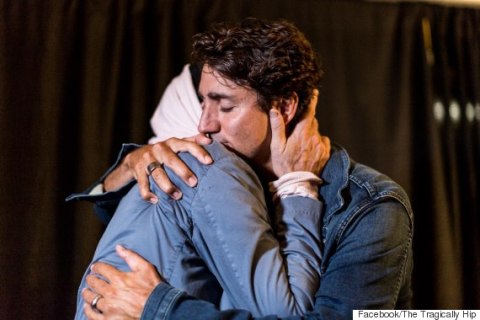
But then Twitter happened. A series of tweets from bitter, and mostly anonymous, Canadian conservatives attacked Trudeau for a variety of reasons, most of them just a sad bit of bitterness. For example:
https://twitter.com/politicsinmemes/status/767155353746153473
or,
These were relatively mild, however. Others wished personal ill on the Prime Minister. But the worst tweet I saw was this one:
https://twitter.com/FACLC/status/767174725747433473
What kind of person says something like this? What has happened to the Canadian conservative movement that this can even happen? FACLC’s tweet is simply the most egregious example that came through my timeline in the past few days.
While I can certainly understand a deep-seated dislike, even hatred, for a Prime Minister (i.e.: Stephen Harper), I do not know anyone who tweeted vileness like this, who wished personal ill on the Prime Minister of Canada FACLC and anyone who supports such viciousness should be deeply ashamed of themselves. So should anyone who posted such vileness in the first place. This is not Canada, this is not who we are.
Clint Eastwood and Political Correctness
August 5, 2016 § 22 Comments
I have to admit, I like Clint Eastwood, the artist. He’s the star of one of my favourite films of all-time, The Good, the Bad & The Ugly. And he’s made some mighty fine films of his own. He’s also a complex man. He claims to be libertarian, but he’s supported both Democrat and Republican politicians. He’s called for gun control since the early 1970s. He was also a progressive mayor of Carmel-By-The-Sea, at least on environmental issues. And he’s long been an advocate of environmental controls. And, clearly, since he’s been mayor of his little resort town, he clearly isn’t opposed to government at all costs, nor is he opposed to using government power for the common good.
But, in recent years, he’s become a bit of a loose cannon. His speech at the 2012 Republican Conference, the so-called “Empty Chair” routine, was unforgettable. But this week, he was in the news again, complaining about the “pussy generation.” See, Ol’ Clint is tired of political correctness:
[Trump]’s onto something because secretly everybody’s getting tired of political correctness, kissing up. That’s the kiss-ass generation we’re in right now. We’re really in a pussy generation. Everybody’s walking on eggshells.
We see people accusing people of being racist and all kinds of stuff. When I grew up, those things weren’t called racist.
My response? So what? First, Clint Eastwood loves to come off as a tough guy when he’s going off on a tangent like this. Clint Eastwood ain’t no tough guy, he plays them in movies. That’s a big difference. Second, Clint Eastwood is 86 years old. When he was growing up, Jim Crow and segregation existed in the US. Is that what he wants to return to? I presume not.
As for “political correctness,” you know what? I’m sick of this one too. Creating an environment in the world where people feel comfortable, where we are all respected and treated fairly is not a bad thing. It’s easy for a multi-millionaire 86-year old white man to complain about the things that weren’t called racist 80 years ago. What discrimination has Clint Eastwood faced in his life?
And this is the thing, the people who complain about “political correctness” tend to be white and middle class, and quite often male. In other words, they tend to be people who don’t know what it feels like to be the target of discrimination or hate speech, or, worse. It’s easy for them to claim there is no discrimination, no racism in society. They’re not targeted by it. It’s easy for Eastwood to complain about the “pussy generation.”
In short, you cannot complain about “political correctness,” or claim there is no such things as racism, sexism, misogyny, or homophobia if you are of the dominant group in society.
More to the point, a long time ago, a great man once noted that the mark of a democracy was how it treated its minorities. And that is most certainly true. That great man, by the way, was former Canadian Prime Minister, Pierre Elliott Trudeau (the father of current PM, Justin “Hotty Pants” Trudeau).
The Violence of the Misogynist Mind
February 4, 2016 § 2 Comments
Yesterday, one of my alma maters, Simon Fraser University in Burnaby, British Columbia, sent out a video from Facilities about #NationalSweaterDay, which is a Canadian initiative to turn down the heat in the winter, to remind consumers about environmental responsibility (and the cost of heating). The video itself is several years old, but it was circulated again.
To my eyes, this is horrible. A female professor is named “Pinkums” and is addressed as “Miss.” I know from conversation with my female colleagues that they have a real struggle to be addressed as Doctor, or Professor. Oddly I, as a white man, do not. And, frankly, this video is degrading.
News of the video became widely known through the blog of Elise Chenier, a professor at SFU. I was appalled when I came across this and tweeted my shock and dismay at SFU. No university should engage in this. Ever. To the credit of the university, it apologized almost immediately. And the video had long been pulled from circulation. According to the CBC:
SFU vice-president for external relations Joanne Curry later released a statement addressing some of Chenier’s concerns. In the statement, Curry agrees the videos were “inappropriate, sexist, and not in keeping with our equity commitments.”
“As the video was produced by an external vendor, I had not seen it. When I did watch it, I immediately agreed with the feedback we had received,” the statement read.
“We took steps to remove the video as quickly as possible and have followed up with the group who produced and distributed the video to ensure it will no longer be used.”
Note, however, that Curry immediately passes by buck, noting that it was made by an external vendor. But, the university did the right thing, as Chenier notes.
Today, I awoke to find my Twitter feed aflame with trolls. Interestingly, all but two were men. The two women both noted they were “anti-feminist” in their bios. Getting trolled on Twitter is nothing new. It has happened before, it will happen again. I have received all kinds of hate on Twitter, including death threats. But today’s trolling was interesting in the sense that the men, all of whom were white, who attacked me descended into homophobia from the get go. Some hoped I got raped, others told me to perform sexual acts on other men. One threatened to rape me. And then there was the garden variety name-calling.
I spent a good amount of time blocking and reporting people today, thinking that this happens everyday to feminists on Twitter. I can only imagine the abuse Chenier is getting right now. There was #Gamergate. Or what about when women suggested that a woman’s face be put on paper money in the UK? This happens every, single, fucking day to women who are threatened with rape and death for calling out patriarchy and male privilege. And we let that happen. Every single one of us. Right-thinking men, in particular. We need to find a way to fix this, we need to figure out a way to marginalize these kinds of men, or the likes of Roosh V. This is not ok.
MLK noted that the problem African Americans in his time faced wasn’t actually an African American problem. It was a white problem. Hence, he worked to raise white consciousness. To convince white people they were the problem and had it in their power to fix racism. By no means have we succeeded, but we have made a lot of progress.
Misogyny and sexism, similarly, is a male problem. But, it seems that sexism and misogyny is considered acceptable for some men. When people are offended by things like the SFU video, they respond with banal statements like “Can’t you take a joke?” Yes, I can. But this isn’t funny. This is the basic laddish response. But then there’s the anger, the violent, misogynist, threatening anger.
Male anger needs to be curbed.
But as much as I want this kind of thing stopped, I still struggle with the basic question of why some men act like this? Is it simply about power? Is it because they feel marginalized? Why do some men feel the need to respond to feminism with vile, disgusting language? And in some of these men, I think it goes beyond words and there is a danger in their threats and fits.
Sadly, I fully expect more trolling in response to this post. The trolling will continue on Twitter. And there will be some nasty comments left on this blog.
The Myth of the ‘Founding Fathers’
November 2, 2015 § 1 Comment
Rand Paul got in trouble recently for making up quotations he attributed to the Founding Fathers. In other words, Paul is making a habit of lying to Americans, in attempting to get their votes, by claiming the Founding Fathers said something when, in fact, it’s his own policies he’s shilling. Never mind the fact that Paul says “it’s idiocy” to challenge him on this, he, in fact, is the idiot here.
The term “Founding Fathers” has always made me uncomfortable. Amongst the reasons why this is so is that the term flattens out history, into what Andrew Schocket’s calls ‘essentialism’ in his new book, Fighting over the Founders: How We Remember the American Revolution. (I wrote about this book last week, too). The term “Founding Fathers” presumes there was once a group of men, great men, and they founded this country. And they all agreed on things.
Reality is far from this. The American Revolution was an incredibly tumultuous time, as all revolutions are. Men and women, fathers and sons, mothers and daughters, brothers, sisters, disagreed fundamentally about a multitude of issues, not the least of which was whether or not independence was a good idea or not. Rarely taught in US history classes at the high school or university level, loyalists, at the end of the War of Independence, numbered around 15-20% of the population. And there is also the simple fact that less than a majority actively supported independence, around 40-45%. The remaining 35-45% of the population did its best to avoid the war or independence, for a variety of reasons.
The Constitutional Congress, then, did not speak for all the residents of the 13 Colonies, as many Americans seem to believe. The Articles of Confederation and the Constitution were fraught affairs, with many of the men involved in their drafting in staunch opposition to each other. Aside from ego, there were deep, fundamental differences in thought. In other words, the Constitution was a compromise. The generation of men (and the women who influenced them, like Abigail Adams) who created the United States were very far from a unified whole, whether in terms of the larger population, or even within the band of men who favoured and/or fought for independence.
Thus, the term “Founding Fathers” is completely inadequate in describing the history of this country between c. 1765-1814. But, then again, most Americans tend to look back on this period in time and presume a single ethnicity (British) and religion (Protestantism) amongst the majority of residents of the new country. In fact, it is much more complicated than that, and that’s not factoring in the question of slavery.
It’s not surprising that Americans would wish a simple narrative of a complex time. Complexity is confusing and it obfuscates even more than it shows. And clearly, for a nation looking at its founding myths, complexity (or what Schocket would call ‘organicism’) is useless. You cannot forge myths and legends out of a complicated debate about independence, government, class, gender, and race. It’s much simpler to create a band of men who looked the same, talked the same, and believed the same things.
But, such essentialism obscures just as much as complexity does when it comes time to examine the actual experience of the nascent US during the Revolution. The disagreements and arguments amongst the founders of the country are just as important as the agreements. The compromises necessary to create a new country are also central. I’m not really a big believer in historical “truths,” nor do I think facts speak for themselves, but we do ourselves a disfavour when we simplify history into neat story arcs and narratives. Unlike Schocket, I do think there is something to be gained from studying history, that there are lessons for our own times in history, at least to a degree: the past is not directly analogous to our times.
Of course, as a public historian, this is what I love to study: how and why we re-construct history to suit our own needs. So, perhaps I should applaud the continuing need for familiar tropes and storylines of the founding of the US.
Feel-Good Advertizing and Colonialist Guilt
September 21, 2015 § 1 Comment
Technology companies have developed this annoying habit in advertizing lately. I think Facebook was the first to do this, but now Microsoft is. I’m not talking about the insanely pretentious ads Apple produces. I’m talking about ads made to make white liberals in North America, Western Europe, and Oceania feel better about the world. These ads show kids in the Developing World, and pretending that they have the same chances as kids in Western Europe and North America, because they have the internet, or Facebook, or Windows 10.
To this, I call bullshit. Windows 10, like Facebook, is not going to lift a child out of poverty in Africa or Asia. Nor, for that matter, in an inner-city neighbourhood of New York City or Berlin. Nor on an aboriginal reserve in Canada or the US or Australia. These ads are simplistic and, well, frankly, stupid.
In order to correct poverty in the developing world (or parts of North America, Western Europe, and Oceania), children need a lot more than Facebook and Microsoft Windows 10. They need poverty eradication programmes that encourage families to let their kids stay in school. They need their parents to have an opportunity to succeed. They need the chance to have good nutrition. They need a chance to go to university. And that’s just a start.
Certainly, Facebook, Microsoft, and countless other technology companies, including Apple and Google, DO attempt to make a difference in the developing world, Western inner-cities, and even sometimes aboriginal reserves. But these ads are little more than an attempt to assuage our collective first world guilt for the basic systems of exploitation that ensure that Bangladesh, for example. Until we think about where our products come from (my MacBook, for example, upon which this blog post/rant is being written, was made in China), and we try to do something about it, nothing will change for all these bright kids in the developing world, no matter how much Facebook and Microsoft wants us to think otherwise.
On the upside, at least, Microsoft acknowledges at the end of the ad that we need to make sure these kids get what they need. On the downside, the answer is Window 10.
 Matthew Barlow