The Alabama Cultural Resource Survey
August 27, 2015 § 5 Comments
Alabama is one of the forgotten states. The chair of my department calls it a fly-over state, a place you look down upon when flying from Miami to Chicago. The only time Alabama ever seems to enter the national discussion is when something bad happens here, or when the University of Alabama or Auburn University’s football teams are ranked in the Top 25. But otherwise, Alabama only makes the national news when bad things happen. It’s like Alabama is the butt of a joke the entire country is in on.
Not surprisingly, I find this problematic. Alabama is a surprisingly diverse place, both in terms of racial politics, politics in general, and culture. Like most states, the population and culture is not homogenous. Where I live, in Northern Alabama, the area is more culturally attuned to Nashville and Tennessee as a whole, rather than Birmingham or Montgomery.
The town I live in, Florence, is an amazingly funky little college town. We have a bustling downtown with restaurants, cafés, nightclubs, and stores. There are a series of festivals here and the people of Florence take pride in their downtown, which has been rejuvenated despite the fact the city is ringed with stripmalls, including two Wal-Marts. Like many other towns and cities across the state, Florence is the beneficiary of Main Street Alabama, dedicated to the revival of the urban cores of the state.
Across the Tennessee River are three more towns (Muscle Shoals, Sheffield, and Tuscumbia) and collectively, the region is known as The Shoals. Anyone who knows anything about music knows about the rich musical history of the Shoals area. Every time I turn around, I see more potential public history projects.
One thing that we are involved in is the Alabama Cultural Resource Survey. This project is a collaboration between the Public History programme here at the University of North Alabama and the Auburn University History Department. Since I arrived in Alabama last month, I have been to a series of meetings around Northern Alabama talking to people about the survey and its importance in leading up to the 2019 Alabama Bicentennial. This project is unique, I cannot think of anywhere else in the United States or Canada where such a project has been undertaken. We are asking the people of Alabama to contribute to a telling of their history for the Bicentennial. Eventually, this survey will migrate over to the Archives of Alabama website.
So far the response has been impressive. Alabamians are anxious to tell their stories, multiple and multifold as they are, to have them entered into this massive database for themselves and their descendants to use.
But this isn’t the kind of thing that Alabama makes the news for. Maybe that’s a good thing, we can keep all the good stuff going on in our state to ourselves.
Ben Affleck Speaks
April 22, 2015 § 10 Comments
Well, Ben Affleck has spoken. And he has said what I would have hoped he’d have said the first go around. He posted on his Facebook page last evening:
After an exhaustive search of my ancestry for “Finding Your Roots,” it was discovered that one of my distant relatives was an owner of slaves.
I didn’t want any television show about my family to include a guy who owned slaves. I was embarrassed. The very thought left a bad taste in my mouth.
Skip decided what went into the show. I lobbied him the same way I lobby directors about what takes of mine I think they should use. This is the collaborative creative process. Skip agreed with me on the slave owner but made other choices I disagreed with. In the end, it’s his show and I knew that going in. I’m proud to be his friend and proud to have participated.
It’s important to remember that this isn’t a news program. Finding Your Roots is a show where you voluntarily provide a great deal of information about your family, making you quite vulnerable. The assumption is that they will never be dishonest but they will respect your willingness to participate and not look to include things you think would embarrass your family.
I regret my initial thoughts that the issue of slavery not be included in the story. We deserve neither credit nor blame for our ancestors and the degree of interest in this story suggests that we are, as a nation, still grappling with the terrible legacy of slavery. It is an examination well worth continuing. I am glad that my story, however indirectly, will contribute to that discussion. While I don’t like that the guy is an ancestor, I am happy that aspect of our country’s history is being talked about.
Ben Affleck
Obviously, I wish he had said this last October, but kudos to Affleck to taking this head on. I don’t think anyone can have issue with anything he (or, more likely his PR people) say here. I would like, though, to see him do more than just make this statement, I would like to see a Hollywood mega star actually start a discussion on the legacies of slavery. But. I suppose I’m asking for too much.
Why Tom Cotton is Wrong about LGBT Rights
April 6, 2015 § 6 Comments
Last week, Senator Tom Cotton (R-Arkansas) had a very clear message to LGBT folk in the United States: “In Iran they hang you for the crime of being gay.” This comes as Cotton’s defence of the now amended Defence of Religious Freedom Act passed by the Indiana legislature the week before.
So this is what is has come to. A senator of this country is telling a group of its citizens that they’re lucky they don’t live in Iran. In other words, shut up. For Senator Cotton the United States should not strive to be leader of human rights in this world. In his mind, the country should just forget the statement that “We hold these truths to be self-evident: That all men are created equal.” Nope. We should just forget what the State Department says on its webpage:
The protection of fundamental human rights was a foundation stone in the establishment of the United States over 200 years ago. Since then, a central goal of U.S. foreign policy has been the promotion of respect for human rights, as embodied in the Universal Declaration of Human Rights. The United States understands that the existence of human rights helps secure the peace, deter aggression, promote the rule of law, combat crime and corruption, strengthen democracies, and prevent humanitarian crises.
None of this matters to Senator Cotton. And this is very sad. Politics in this country is a blood sport, at least symbolically. Whenever people throw up their arms and express frustration at the current impasse between Democrats and Republicans, I like to gently remind them it’s never really been any different here, dating back to the first fights in Congress between the Federalists and the Republicans (not, of course, the same party as that today, which dates from the 1850s). On the one side, the Federalists, led by Alexander Hamilton and John Adams, believed in a strong federal government; the Republicans, led by Thomas Jefferson and James Madison, preferred a smaller national government and favoured personal liberty, free from government interference.
Nonetheless, there was a general belief in the right of Americans to dignity and a protection of their human rights (unless, of course, one was African American). But we’ve already fought this fight. In the 1960s, Americans sought a “Great Society,” one which provided care for its dispossessed and one that sought to protect its vulnerable citizens. Congresswoman Kay Granger (R-Texas) perhaps summed up how human rights work, including in this country:
Human rights are not a privilege granted by the few, they are a liberty entitled to all, and human rights, by definition, include the rights of all humans, those in the dawn of life, the dusk of life, or the shadows of life.
Cotton clearly has this equation backwards, he seeks to refuse basic rights to LGBT people in this country. It is not just that Cotton’s greatest ambition in terms of equality is to ensure American LGBT people are treated at least as well as the 75th ranked country on the 2013 Human Rights Index (the US, for reference, is ranked 5th). That is not good enough and violates everything that this country is supposed to stand for. And it does not represent the country that the vast majority of Americans hope for.
Tom Cotton should be deeply ashamed of himself.
Scary Ideas and Lazy Journalism
April 3, 2015 § 6 Comments
Last week, the New York Times published another in a depressing series of articles in the print media about how colleges and universities are allegedly catering to sensitive-little flower millennials, who cannot handle big ideas that challenge their deeply-held beliefs, and how, instead, they seek to create ‘safe spaces’ all across campus, where they won’t come into contact with big, scary ideas. I can never get through one of these articles without seething. See, I am a professor. That means I work and teach on a university campus. I come into daily contact with these millennials. And I’ve come to despise generational stereotypes about them, as much as I despised the stereotypes applied to my generation twenty years ago. The stereotypes are largely similar: apathetic, self-centred, self-obssessed, etc. And, just as they were a ridiculous accusation against Gen X, the same is true of millennials.
The larger problem with these kinds of articles is that they are written by journalists looking for sensation, and supported by their editors looking for clickbait (hey, look, Ma! I used the term ‘clickbait’ in successive posts). These articles are drive-by smearings of academe (not that there aren’t a lot of problems within the system, but journalists aren’t interested in them, because they don’t generate headlines), written without bothering to understand how the academy works, how ideas are exchanged, and how we professors work to challenge and destabilize commonly-held beliefs, even if we agree with them ourselves.
Take, for example, the story of a course at Arizona State University called “US Race Theory and The Problem of Whiteness.” FoxNews host Elizabeth Hasselbeck attacked the course, after talking to a student at ASU. The problem was that the student Hasselbeck talked to wasn’t enrolled in the class, and she herself never bothered to talk to the professor. No, instead, Hasselbeck instead ranted about the problems with this kind of course, in predictable fashion. This led the professor of the course to doxxed and to receive death threats.
But back to the Times article. I was going to write a strongly-worded riposte to it here, but my wife beat me to it. So, instead, I point you, gentle reader, over to Margo’s blog, as she says what I wanted to say in a much better fashion.
Canada’s National Disgrace
February 2, 2015 § 151 Comments
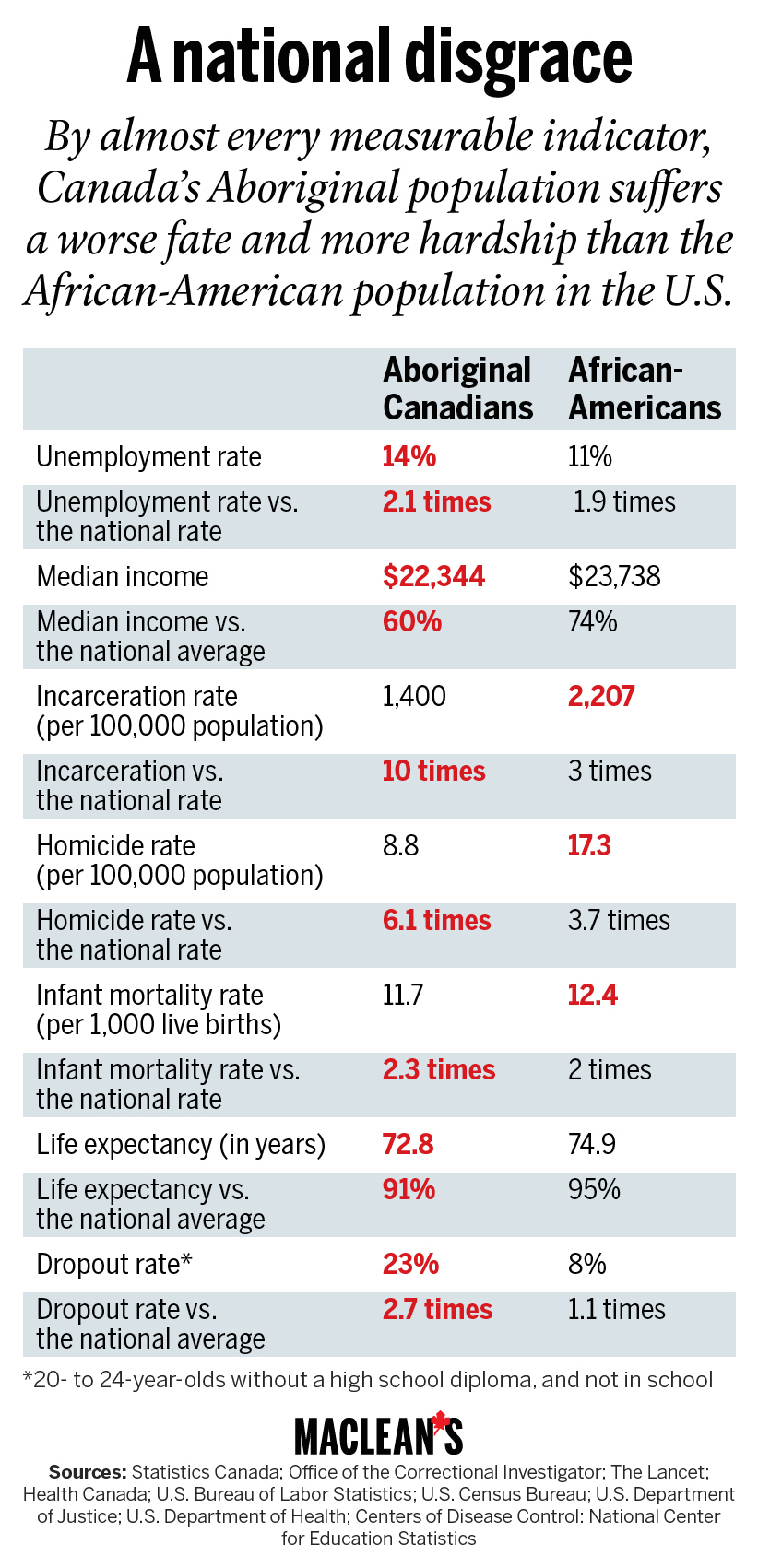
Two weeks ago, MacLeans, Canada’s only national news magazine, published an article that caused quite the uproar. Written by a former diplomat, Scott Gilmore, and entitled, “Canada’s Racism Problem? It’s Even Worse Than America’s,” it’s not hard to see why this upset people. Even better was the sub-title, “For a country so self-satisfied with its image of progressive tolerance, how is this not a national crisis?” I wish I had written this article, it says what I’ve been saying for a long, long time.
Aboriginal peoples in Canada get screwed. Have been since the first Europeans arrived, and still do today. And that’s not going to change any time soon unless Canadians do something about it. But, in my experience, they don’t care. Last year, I wrote a post about a funny sweatshirt that an aboriginal man, Jeff Menard, in Winnipeg (which MacLeans also called out as Canada’s most racist city) created that said: “Got Land? Thank an Indian.” I wrote this post in response to a response I got to a tweet stating that if you thought this hoodie racist, you’re an idiot. This response tweet said “I’m offended because they used the word Indian. My grandfather was from India. He worked for a living.”
How to unpack that? This tweet was anti-historical and offensive on so many levels. Starting with being upset at the use of the word “Indian,” the term applied to aboriginal peoples by Euro-Canadians historically. But the real kicker is “He worked for a living.” Many of the comments on Gilmore’s article, and a lot of the vituperative, racist tweets I saw complained that aboriginal peoples in Canada survive on handouts from the government and don’t work for a living. No mention of imperialism, the taking of land, the systematic attempts by the Canadian government to steal away aboriginal languages, cultures, religions, and names, of the residential schools designed to also take the children of aboriginals away from them (to say nothing of the horrific sexual abuse therein).
Gilmore pointed just how badly aboriginal peoples get screwed in Canada, by comparing them to African-Americans in the United States, in easy table format, which I produce here (and hope that MacLeans doesn’t mind). Look at those statistics and just try not to be offended, saddened, and, if you are Canadian, embarrassed. Hell, even if you’re American, you should be embarrassed by these stats. But, Gilmore’s right. Canadians are a smug lot. My Twitter feed is usually full of all kinds of anti-American comments, the implicit meaning is “Well, the US is a mess, thank god I live in Canada.” Information such as this should end such discussions and puncture our smugness forever.
At the same time the furor over Gilmore’s article was raging, another debate was happening over the death of Makayla Sault, an 11-year old from the New Credit First Nation in Ontario. Makayla died of leukaemia. When she was first diagnosed last year, she underwent chemotherapy in Hamilton, ON. But the side-effects were too great. And so she refused further treatment, preferring instead traditional medicine. Obviously, it didn’t work.
This raises interesting questions, starting with who has the right to control the lives of children who have cancer. But. Ultimately, we have to respect her decision. Why? Because it was her life.
But, then the enfant terrible of Quebec journalism, Denise Bombardier, had to get involved. Bombardier is perhaps most famous outside of Quebec for having been fired by Radio-Canada for having participated in a debate on marriage equality, taking the position against it. At any rate, this is Bombardier’s comments on Makayla Sault (thanks to Mikayla Cartwright for the image):
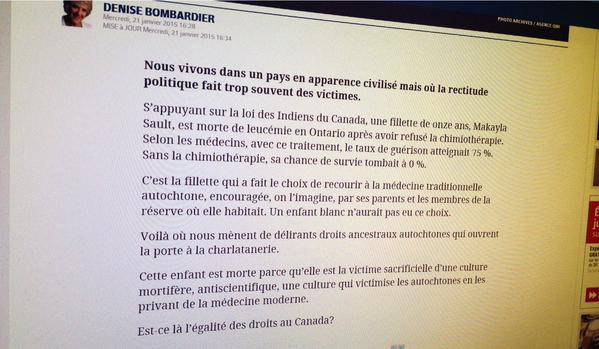
For those who cannot read French, a few of the highlights: After complaining about the cost of political correctness, she states that Makayla made the choice to be treated according to traditional medicine, encouraged, perhaps, by her parents and other members of her First Nation. Then the kicker, “A white child wouldn’t have to make this choice. This is where we see the delusional ancestral rights of the aboriginals open the door to quackery. This child died because she was the sacrifical victim of a deadly, anti-scientific culture that is killing aboriginal people.”
It took me all of about 0.33 seconds to find a Euro-American child who faced this dilemma. Daniel Hauser, a 13-year old boy who was refusing treatment in 2009, for religious reasons. Daniel Hauser, I might add, is white. My Google search turned up other kids faced with this same awful dilemma (the same search also turned up other children in the same position). So, Bombardier is factually wrong.
But she is also morally, ethically wrong. Bombardier’s screed reads like far too many documents I read in the records of Aboriginal Affairs and Northern Development Canada, the government agency (which has had many names) in charge of carrying out the responsibility that the Government of Canada has to aboriginals, according to treaties that both pre- and ante- date Confederation in 1867, as well as Section 35 of the Canadian Constitution. In many of the documents I read during my days working in the field of aboriginal law and litigation in Ottawa, various employees of Aboriginal Affairs, from lowly agents in the field to the directors of the department in Ottawa, referred to the need to civilise the aboriginals, and how white people knew what was right for them. In academia, we call this imperialism.
Bombardier says the same thing. She dismisses aboriginal culture as “anti-scientific” and “deadly.” She refers to traditional ways of life as “quackery.” In short, Canada needs to civilise the aboriginals for their own good, just as Aboriginal Affairs agents and employees argued a century ago.
In short, Gilmore is bang-on correct. Canada’s treatment of its aboriginal population is a national disgrace and tragedy, made worse by the fact that most Canadians don’t know or don’t care, and a good number of them are part of the problem, as Bombardier shows. Gilmore writes:
We are distracted by the stories of corrupt band councils, or flooded reserves, or another missing Aboriginal woman. Some of us wring our hands, and a handful of activists protest. There are a couple of unread op-eds, and maybe a Twitter hashtag will skip around for a few days. But nothing changes. Yes, we admit there is a governance problem on the reserves. We might agree that “something” should be done about the missing and murdered women. In Ottawa a few policy wonks write fretful memos on land claims and pipelines. But collectively, we don’t say it out loud: “Canada has a race problem.”
And until we do, nothing is going to change.
F-Bombs for Feminism
November 7, 2014 § 4 Comments
FCKH8.com, a website dedicated to eradicating hatred, posted this video a few weeks back. Not surprisingly, it caused a bit of a sensation
After all, we can’t have little kids swearing, can we? Never mind the fact that they’re noting the ridiculous gender imbalance in our world. Of course, that’s not shocking. Denise Balkissoon published this devastating opinion piece in the Toronto Globe and Mail today; she argues that the Jian Ghomeshi situation is not some magical watershed for violence against women, reciting a long litany of shocking moments that should’ve marshalled our collective anger to stop it. And this is just the Canadian context of violence against women.
But it’s not just violence. A couple of weeks ago in class, two of my female students commented on their own experiences. Both are incredibly intelligent young women, and both come from a place of privilege. They are white, and they come from relatively affluent backgrounds. Both grew up treated equally and fairly vis-à-vis the boys, but when it came time to graduate from high school and go to university, they discovered the world was not so fair. Both report they received diminished opportunities in comparison to the men they knew, in terms of their choices for university, the internships they received, the jobs they got. Why? Because they’re girls.
The Facebook post I first saw this FCK8 video on had a bunch of comments tut-tutting about the foul language of these little girls, not on the fact that what they were saying was true. And that is the entire point. If it takes a famous Canadian radio host beating his dates, a South African athlete killing his girlfriend, or little girls swearing to draw our attention to this general societal problem, we’ve failed.
Anita Sarkeesian and Why I Got So Much Trouble on my Mind
October 16, 2014 § 7 Comments
I got so much trouble on my mind, like Chuck D. back in 1990. Anita Sarkeesian is a feminist gamer, and critic of gamer culture. I’m not a gamer, but I have female friends who are, and I have friends who design video games, including women. They all report a culture of wider misogyny. But I’m not here to lambaste gamers, I’m here to point out misogyny is a deep-seated cultural issue. It permeates every corner of our culture, it’s regarded as acceptable by far too many, both men and women. Too many of us stand around and watch it happen, and we do not call it out for what it is. We do not stand up.
Men have a particular moral imperative to stand up in the face of misogyny. Why? Because misogynists are also men. Men threaten women. Men rape women. Men kill women. And spare me the “men’s movement.” It’s nothing but a sad-sack attempt by a rearguard of men, upset that their access to patriarchal privilege is under threat. Of course, that threat is only in their tiny little minds.
Sarkeesian was scheduled to give a talk on misogyny and gamer culture at the Utah State University. Then some pathetic little man emailed an anonymous threat promising a “Montreal-style massacre” if USU allowed her talk to go ahead. I’m not going to quote this pathetic little man’s threat here. But I will remind readers that on 6 December 1989, one misogynist opened fire at the École Polytechnique de Montréal and shot 27 people, killing 14. All of the dead were women. All of them. Why did he do this? Because he claimed that feminists had ‘ruined’ his life. So, too, did the anonymous man who threatened Sarkeesian at USU.
Sarkeesian wasn’t even told about the threat against her life by USU. She read about it after landing in Utah. Moreover, USU and the Utah police were unable to provide protection for her, as Utah is an open-carry state, meaning it is entirely legal to carry concealed weapons onto a university campus. To prevent weapons on campus, or to have people check their guns at the door would have violated their Second Amendment rights. I’m not sure that’s even true, but that’s an argument for another day. So Sarkeesian cancelled.
I can’t say I blame her. Who wants to be a martyr? Especially for something as basic and simple as civil and human rights and the right of women to be treated equally by society. But, this also lets the crazies win. This lets the misogynists win.
I have had death threats in the past, in response to articles I published on a now-defunct London-based magazine website. The threats against me were not credible, so I ignored them. I have had a variety of threats against my person and my employment on Twitter. But, again, they weren’t credible, so I ignored them. But this is what the bullies do. If they don’t like what you’re saying, they threaten you. If you’re a woman, they threaten to rape you. They threaten to kill you. The threats Sarkeesian felt was very real. Hell, she’s already been the target of some asshole’s idea of a joke with a video game that allows players the chance to punch her in the face over and over again.
We cannot let the crazies win. And Sarkeesian continues to speak out about the threat to her life. I applaud her. If the crazies win, we lose civilisation. Someone’s Second Amendment rights do NOT trump my First Amendment rights. And, arguably, USU, as a state institution, violated Sarkeesian’s First Amendment rights. There is a lot of talk about “rights” in the US, the rights guaranteed to us by the Bill of Rights. But nowhere does it say that anyone’s rights trump those of someone else’s. Not in the Bill of Rights, not in the voluminous jurisprudence that has developed surrounding the Constitution.
And yet, I haven’t seen a politician come out in support of Sarkeesian. Nor have I read a thing about an attempt to find the man who made this anonymous threat in the first place. He sent an email. It’s not that hard to trace it.
Welcome to the Terrordome indeed.
Acura #Fail
October 6, 2014 § Leave a comment
Acura is a luxury car maker, owned by Honda Motor Company. It has a new ad on TV I’ve seen a few times, and every time I see it, I’m completely gobsmacked. The ad, which I’ve posted below, shows a generic luxury car, but it’s the music that shocks. That’s Sid Vicious, former “bassist” for the Sex Pistols, mangling “My Way,” Paul Anka’s song made famous by Frank Sinatra.
Vicious, real name John Simon Ritchie, wasn’t a musician. His bass was usually unplugged when the Pistols played live. He was a junkie and a general degenerate, what would today be called a ‘gutter punk.’ On 12 October 1978, Vicious killed his girlfriend, Nancy Spungen, in a drug-stupor in the Chelsea Hotel in Manhattan. He stabbed her once in the abdomen, and she bled to death. Vicious was arrested. He eventually died of a drug overdose on 2 February 1979. No major loss, really.
Aside from the fact that Acura has clearly missed the point of 1970s punk, a movement against corporate rock and other creeping commercialisation, Acura has completely lost the plot in casting a girlfriend-killing junkie’s music as a means of selling a car. This is a complete and utter disgrace and a #fail.
 Matthew Barlow