Happy St. Patrick’s Day: “Race” and the “True Celt”
March 17, 2014 § 2 Comments
I’m currently finishing off my Griffintown manuscript, and continuing the endless revisions of the PhD dissertation it was based on. By this point, “based on” is loose, like when movies claim to be based on a book, but you can’t really see the book in the movie. Anyway, right now I’m revising the sections on Irish nationalist sentiment amongst the Irish-Catholics of Griff in the early 20th century. And so, I’m reading Robert McLaughlin’s Irish Canadian Conflict and the Struggle for Irish Independence, 1912-1925. McLaughlin’s work, like mine, is part of a growing movement amongst historians to challenge a decades-old belief amongst Canadian historians that Irish Catholics in Canada couldn’t care less about what happened in Ireland. This is a refreshing change.
McLaughlin, unlike most of us who study the Irish in Canada, focuses on both sides of the divide, looking at both Catholics and Protestants. This is what makes his book so valuable. Off the top of my head, McLaughlin’s is the only book-length study to look at the Protestant Irish response to agitations for Home Rule and outright independence for Ireland in Canada.
As such, McLaughlin spends a fair amount of time discussing Sir Edward Carson, the leader of the Ulster Unionists in Ireland. I talked about Carson in class the other week in discussing Home Rule and Unionism. I had a picture of him up on the screen, blown up behind me. When I turned around, I kind of jumped, not really expecting Sir Edward to be so big and glaring at me.  The picture, however, is beautiful. Sir Edward looks out contemptuously at his audience, his lips pursed into a sour look, as if he had just smelled some Catholics. His jawbone is fierce, and his hair slicked back. He looks for all the world like a hard man. But, of course, he wasn’t. He was a knighted politician. But he was also the perfect avenue into discussing the “manliness problem” of the late Victorian/Edwardian British Empire, and the response, created by Lord Baden-Powell of the Boy Scouts, “muscular Christianity.” Sir Edward looks like he could tear you a new one as easily as argue the merits of Unionism versus Home Rule. And, in turn, this allowed me a direct entré into the Gaelic Athletic Association’s concept of “muscular Catholicism,” which turned muscular Christianity on its ear for Catholic Irish purposes.
At any rate, back to McLaughlin and his quoting of Sir Edward. Sir Edward wrote to his former Conservative Party colleague, Sir John Marriott in 1933, long after Irish independence and the partitioning of Ireland:
The Celts have done nothing in Ireland but create trouble and disorder. Irishmen who have turned out successful are not in any case that I know of true Celtic origin.
I find this humourous. See, by Sir Edward’s day, there was no such thing as a “true Celt” (not that Irish nationalists didn’t speak this same language). By the 18th and 19th centuries, the Irish, both Catholic and Protestant, were a wonderful mixture of Celtic Irish, Anglo-Saxons, Vikings, Spanish, English, Welsh, Scots, and so on that no one was a “pure Celt” or pure anything. But, of course, that myth persisted and still persists today.
I still have people come up to me today, in the early years of the 21st century, and want to discuss the “real Irish” or the “pure Irish” or the “real Celts” in Ireland. After disabusing them of the notion that there is such a thing (anywhere in the world, quite frankly, we’re all mutts, no matter our various ethnic heritages), I am left to just shake my head.
Happy St. Patrick’s Day.
The Value of Research
March 12, 2014 § 3 Comments
I find myself annoyed by complaints about government money being “wasted” on research. The argument is simple, and simplistic: obscure research is a waste of taxpayer money and should be stopped. There are countless examples of allegedly obscure and useless research paying off. But I like this one the most.
I recently read Siddartha Mukerjee’s epic The Emperor of all Maladies: A Biography of Cancer, a rather deserving Pulitzer Prize-winner. In it, Mukerjee tells a brief story about an obscure biophysicist, Barnett Rosenberg, at Michigan State University, who was conducting research to find out whether electrical currents would cause bacterial cell division in 1965. Exciting stuff. Mukerjee describes what happened next:
When Rosenberg turned the electricity on, he found, astonishingly, that the bacterial cells stopped dividing entirely. Rosenberg initially proposed that the electrical current was an active agent in inhibiting cell division. But the electricity, he soon determined, was merely a bystander. The platinum electrode had interacted with the salt in the bacterial solution to generate a new growth-arresting molecule that had diffused throughout the liquid. That chemical was cisplatin.
Cisplatin, it turns out, was part of the next generation of chemotherapeutic treatments of cancer in the 1970s. And it led to improved survival rates due to that treatment (as well as insane nausea).
Nevertheless, Rosenberg’s apparently obscure discovery in a lab in East Lansing, Michigan, led to thousands of lives being saved, extended, and cancers put into remission. Thus the value of research.
It turns out that this is a especially prescient given the recent state of cancer research, at least, in the United States. According to the Sunday Boston Globe last weekend, industry is coming to provide more and more research money, both in terms of absolute and relative numbers, in the past few years. At Boston’s Dana-Farber Cancer Institute, one of the world’s leading sites of cancer-related research, industry funds have risen steadily as a total of funds in the past decade; today, 22.7% of all research moneys come from industry (the remainder from the federal government). The same is true at the rest of the nation’s leading cancer centres.
The consequences of this are very real. As government cutbacks lead to reduced investments in research, industry increases its involvement. This is in and of itself not a bad thing, but pharmaceutical companies have a bottom line and are looking for profit. And it’s not unheard of for the companies to interfere in the research. For example, industry-sponsored research trials more often lead to positive results for the drug being tested. Many of the researchers interviewed for the Boston Globe story are ambivalent about industry-funded research, but recognise it can be the only source for funding.
But, industry-funded trials will not lead to the kinds of developments like that of Rosenberg, this model is not equipped for obscure research or, for that matter, long-term research and trials.
Dear Boston: Reflecting on the Marathon Memorial at the Boston Public Library
March 7, 2014 § Leave a comment
Back in July, when the insta-memorial for the Boston Bombing of 15 April 2013 was taken down, I wrote this piece at the National Council of Public History’s history@work blog. In it, I expressed my cynicism of what happens to the items of the memorial when they are removed from the site and put in storage, or even brought out again for a more permanent exhibition. I also argued in favour of insta-memorials such as this, seeing some value in our hyper-mediated lives, watching the world through the screens of our iPhones. What resulted, from the piece on history@work, as a notification here on this site, as well as Rainy Tisdale’s blog, was a rather robust discussion, especially between myself and Rainy, a Boston-based independent curator about authenticity and memorials.
 To sum up the discussion, we debated whether or not Boston needed an exhibition on the first anniversary of the attack. I argued that the running of the 118th Boston Marathon, as well as the traditional Boston Red Sox game at Fenway Park, would serve as a chance for Bostonians to reclaim Boylston Street and Copley Square one year later. Rainy, on the other hand, argued that an exhibition was necessary in order to prevent the kind of frenzy that began to emerge surrounding the #BostonStrong rallying cry when the Bruins went to the Stanley Cup Finals last spring (and lost. I hate the Bruins).
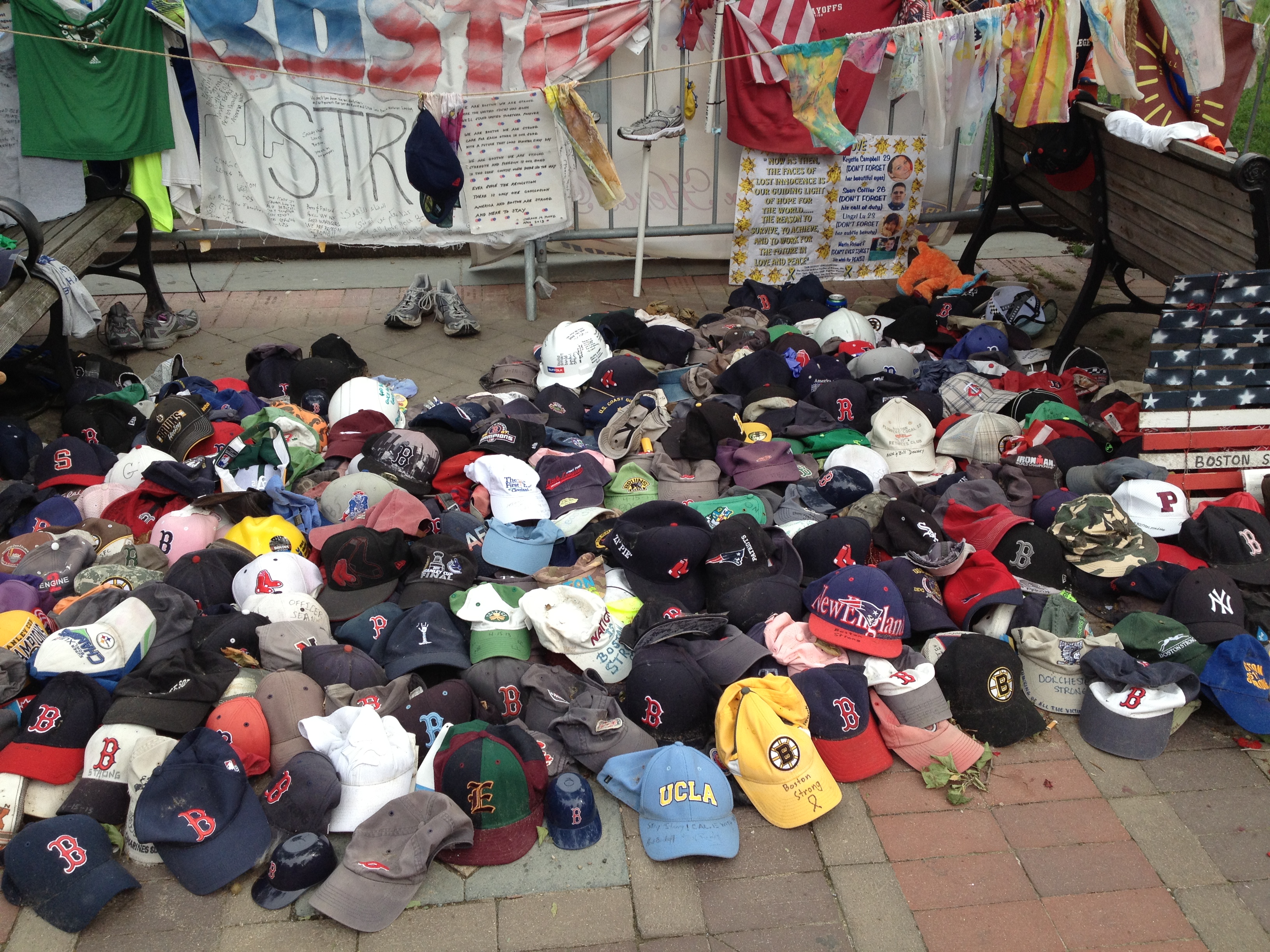 In the time since, I have come around more to Rainy’s argument than my own, though I still worry about questions of authenticity and memorial mediation on the part of the curatorial hand (though, of course, that spontaneous memorial, first on Boylston Street and then at Copley Square was also curated, in part). Nevertheless, I am very much looking forward to Rainy’s exhibit at the main branch of the Boston Public Library on Copley Square. Dear Boston: Messages from the Marathon Memorial opens on 7 April, and will run to 11 May. It is a tri-partite exhibit: the first part will encompass the immediate responses to the bombing, the second will be people’s reflections on the bombs, and the final part will be the hopeful part, messages of hope and healing.
 I appreciate the exhibit’s title perhaps more than anything at this point, as it makes direct references to the curatorial hand at work here, as the exhibit will deliver messages from the memorial. In July last year, I worried about the loss of meaning of the individual artefacts when they were boxed up and stored in the Boston Archives. A running shoe had a very poignant and powerful meaning when displayed at the memorial, and in a box in the archives, it’s a running shoe. Restored to the public eye, however, attached with a symbolic meaning that no one in Boston, or anyone visiting the exhibit, will miss, the shoe regains its poignancy.
What struck me in my discussion with Rainy last summer was how she intended to approach the exhibit, and her sensitivity to the very issues that concerned me. I am very much looking forward to what she comes up with.
Montréal’s Griffintown Redevelopment #FAIL
February 6, 2014 § 3 Comments
The Gazette this morning reports news that the Keegan House just around the corner on rue de la Montagne from Wellington, and across from where St. Ann’s Church once stood, is under threat of demolition from Maitre-Carré, the developer responsible for the condo tower at the corner of de la Montagne and Ottawa. The Keegan House was built sometime between 1825 and 1835 on Murray Street, a block over. In 1865, it was moved to its current site.

The house was moved because of the development around Griff. Unlike many other urban neighbourhoods, and unlike the current redevelopment, Griffintown was developed on a lot-by-lot basis. There were not block long, or multi-lot developments as a rule. So as Murray Street was developed, Andrew Keegan, a school teacher, moved his house to a more prestigious locale, across the street from St. Ann’s Church. As David Hanna, an urban studies professor at UQÀM, notes, the block across the street from St. Ann’s was where the nicest housing in Griff was. But that is still a relative statement. Even the nicest homes in Griffintown could not compare with even the swankier locales across the canal in Pointe-Saint-Charles.
In recent years, the Keegan House has fallen into disrepair. I was in the building 7 or 8 years ago, and it was in rough shape. Maitre-Carré have bought the lots from 161-75 de la Montagne for redevelopment. Also slated to be demolished is the building that housed what used to be the Coffee Pot, a hangout for Griffintowners across the street from the Church. After the Coffee Pot closed in the early 1960s, the building was split in two, with a dépanneur and a tavern operating there. The tavern limped to its death about a decade ago. Both the Coffee Pot building and the Keegan House were given an unfortunate renovation in the 1950s or 60s, with their outer walls encased in concrete, which greatly diminished their aesthetic appeal.
Now what makes this story interesting and oh-so Montréal is that Hugo Girard-Beauchamp, the president of Maitre-Carré, claims that his company has no intention of destroying the Keegan House and, in fact, wishes to incorporate it into the new development. You know what? I believe him. Maitre-Carré and Girard-Beauchamp are the ones were worked with through the Griffintown Horse Palace Foundation. And while he remains a businessman, Girard-Beauchamp was also more than willing to listen to us and even help us preserve the Horse Palace. In fact, I would go so far as to say, at least when I was on the Board of the GHPF, that we would not have succeeded without his help.
However. This is Montréal. The borough isn’t sharing the plans for this development. Julie Nadon, the chief of planning for the borough, says they’re “confidential.” They shouldn’t be. Too much of the redevelopment of Griffintown has been done this way. The Ville de Montréal has operated in Star Chamber secrecy, refusing to divulge its plans to anyone other than the developers until it’s too late. A couple of years ago, the Ville de Montréal held a public session at the ÉTS to show off its plans for Griff. It’s plans had already been made with 0 public input. None. At all.
Montréal’s Star Chamber secrecy violates the very principles of democracy and the things that Montréal likes to pride itself on, which is an open city, with a creative class proud of its civic engagement. In Griffintown, the Ville de Montréal stonewalls civic engagement at each and every turn. It’s embarrassing and it’s no way to run a city. #fail
Changes in Griffintown, 2011-2014
February 6, 2014 § 1 Comment
I got an email from Dave Flavell the other day. I’ve known Dave for a few years; he contacted me awhile back for some help on a project he was doing on Griffintown. He was collecting oral histories of the community and its diaspora, with a view towards publishing a book. Last time we talked about it, he said the book was on its way to publication. This email contained photos of Griff, in particular of the Horse Palace on Ottawa street, taken in 2011, 2013, and 2014. The changes are stunning.
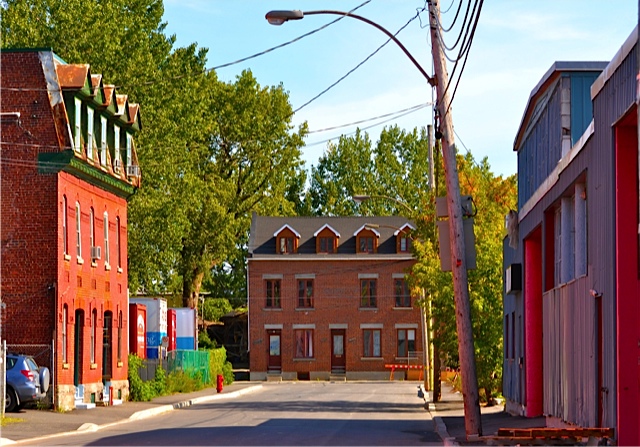
Griffintown Horse Palace, 2011. Photo courtesy of Dave Flavell
In the first photo, we look down Eleanor street at the Horse Palace, built in 1862, standing at the end of the block on Ottawa, surrounded by huge trees. Time was these were amongst the only trees in Griffintown a hundred years ago. The old St. Ann’s Kindergarten is on the left, now the headquarters of King’s Transfer, a moving company that’s been based in the neighbourhood for almost a century. It’s also where I conducted the majority of the oral history interviews for House of the Irish, thanks to the generosity of Bill O’Donell, the president of King’s. In this picture, the Horse Palace looks much as it has for the past thirty-forty years. But a closer look shows that it’s already under transformation. Leo Leonard, the legendary proprietor of the Horse Palace, and his wife Hugeuette, had already sold and moved to a retirement home. Leo, though, did not get much of an opportunity to enjoy retirement, he died in in July 2012 at the age of 87. Already, the building is under renovation, new windows have been put in on the second floor. But the actual stable, which is just out of sight, behind those moving trucks, was still in full working order.

Griffintown Horse Palace, 2013. Photo courtesy of Dave Flavell
The next picture was taken last year. From the exact same spot. Now the Horse Palace residence is dwarfed by an 8-story condo built next door and behind it, fronting on rue de la Montagne. This building was under construction in 2011, but had not yet risen to dwarf the Horse Palace. The Horse Palace building looks tiny and insignificant in the shadow of the condo, which stretches across at least three lots on de la Montagne.
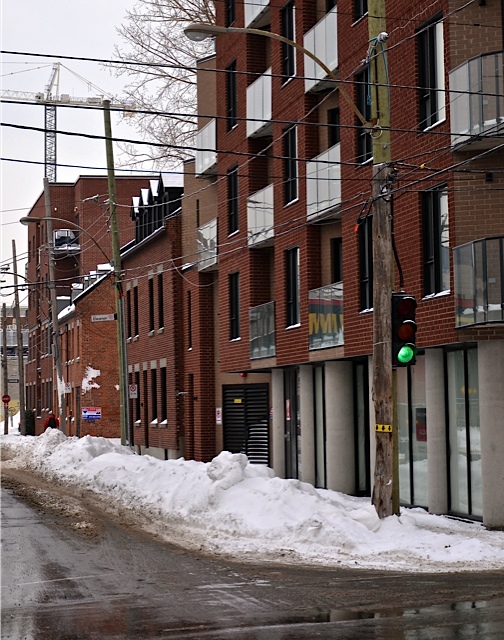
New condo tower and the Griffintown Horse Palace, January 2014. Photo courtesy of Dave Flavell
The final picture was taken a couple of weeks ago, from the corner of Ottawa and de la Montagne, looking east. The shop fronts on Ottawa in the new building remain empty, but looking down the block, after the Horse Palace residence is the old paddock of the stable, which was bought last year by the Ville de Montréal for purposes of turning it into a park to provide access to the actual stables, which the Griffintown Horse Palace Foundation has done yeoman’s work to preserve and save. (Full disclosure: I was a board member of the GHPF from 2008 until I left Montréal in 2012). Continuing on past the paddock, another mid-19th century residence still stands. And then, at the corner of Ottawa and Murray, another, shorter, 4-story condo stands. It was built in 2011. The crane is on the site of Devimco’s massive “District Griffin” development on Peel street.
Even though I have seen this view down Ottawa from de la Montagne, I was still shocked by Dave’s photo. The entire landscape of Griffintown is massively changed. The condo at the corner of de la Montagne and Ottawa is representative of the redevelopment. The streets of Griffintown are narrow, the buildings have always been hard up against the sidewalk. This has contributed to a somewhat claustrophobic atmosphere, at least on those blocks where enough buildings still remain. But these old buildings were 2 floors, at most 3. The stacking of 4, 6, 8, 10-story condos, lining these narrow streets only enhances this claustrophobia. It devastates the urban environment.
An Alternative America
January 30, 2014 § 4 Comments
A couple of days ago, an interesting article appeared in the Des Moines Register. I knew of it because my social media friend, and a geographer at Mansfield University in Pennsylvania, Andy Shears, had a map published with the article. Andy’s map is an alternative United States, based on historically proposed states, none of which came into existence. He created the map 2 1/2 years ago for his own blog. The Register also mis-identifies Andy’s map as one of what the country would look like if all the separatist movements in history had actually worked. But, either way, it’s actually a really interesting map, put together in what I image was after agonising research, Andy came up with an alternative United States based on a country of 124 separate states, all based on proposals that never came to be. In the case of Massachusetts, there would actually be two states: Massachusetts and Boston. Of course, anyone who lives outside the Hub, especially in Western Mass, would say there already ARE two Massachusetts. Cascadia, in this version, is a state that straddles the mountains of eastern Washington and Oregon. And then there’s a wonderful little state called Forgottonia carved into what is today the border between Illinois and Missouri, just north of the hypothetical state of St. Louis.

The America That Never Was, map courtesy of AndrewShears.com
But I digress. The column in the Register was written by Steffan Schmidt, a political scientist at Iowa State. In it, Schmidt ruminates on an apparent proposal in California to split the state into six smaller states, based on a proposal from Silicon Valley. Schmidt notes that this would give the general California region 12 senators compared to the 2 it has now, which means that it would have much greater power in Washington. Schmidt, though, seems to assume that the 6 Californias would all elect Democratic senators, which is incredibly unlikely.
Schmidt’s larger point is about the apparent immutability of the United States, that Americans consider the national boundaries to be sacrosanct. He ties that back to the Civil War, just another legacy of that war in American life. But then he goes on to note that countries fracture into newer ones continually, pointing to various examples from Slovakia to Scotland to South Sudan. Interestingly, he does not mention Québec and Canada. But that’s an entirely different kettle of fish (though, interestingly, both Canadians and Quebecers consider their national borders to be sacrosanct). But it is a point well worth considering, at least to a degree.
The difference between, say, Scotland and the United States is simple. Scotland was annexed by England to create Britain in 1707. The United States is comprised of states that all chose to be part of the Union. By that I mean the European settlers of the territory that is now the United States of America all petitioned to Congress to be admitted to the Union. And even if the Confederate States were defeated and then had to be re-admitted to the Union, they also did so willingly (or at least as willingly as they could). In contrast, Scotland was annexed. Slovakia was annexed. We all know how Yugoslavia was formed and what happened when that came apart.
So there is a huge difference between the American model and those Schmidt offers in comparison. Similarly, Canada was formed in a manner very similar to the United States. But Schmidt is correct to note that it is remarkable how resilient the American state has been since 1776. I was recently thinking about this when I saw news that the population shift in the United States, based on recent census data, will make the South and the West stronger politically, at least in the House. This led me to think about my current research, of course (The far right of American politics and history), and I began to wonder if the relative decline of New England and the Northwest in favour of greater power in the South and Southwest would lead to separatist movements throughout the nation. Not that I think they’d ever be successful, any more than I think Québec will ever separate. But it’s fun to have such idle thoughts.
And then I got one of the great classics of punk rock in my head, “Alternative Ulster,” by Belfast punks Stiff Little Fingers. The song dates from 1978, the height of the Troubles, and the Stiffies, two Catholics and two Protestants, simply wanted a different future for themselves.
The Upside to Gentrification?
January 22, 2014 § 7 Comments
I read an interesting article on NPR.org this morning, about gentrification. Based on recent research from Columbia University and the Federal Reserve Bank of Cleveland, gentrification may not entirely suck for low-income people in gentrifying neighbourhoods. The Columbia study looked at displacement in Harlem and across the US, calculating how many low income people moved out of their neighbourhoods when gentrification occurred. Meanwhile, the Federal Reserve Bank looked at the credit scores of low income people in gentrifying neighbourhoods. In the first case, researchers found that people didn’t necessarily move out, in fact, low income earners were no more likely to move out of a gentrifying neighbourhood than a non-gentrifying one. In the case of the Federal Reserve Bank, the credit scores of low income earners actually improved with gentrification of their neighbourhoods.
Not surprisingly, I find these kinds of studies slightly disarming. Lance Freeman, Director of the Urban Planning programme at Columbia, expected to find that displacement was a common occurrence. But he is still cautious to note that gentrification can and does indeed lead to displacement.
Most studies, at least most I have read from a wide variety of disciplines, lay out the reasons for displacement with gentrification: higher housing costs, higher food costs, higher taxes (if they own), amongst others. In my experience of living in gentrifying neighbourhoods, the cost of gentrification is obvious on the street, as the original residents get marginalised as cafés, hipster clothing stores, and yuppy restaurants open. There is no place for them to go, and the coffee shops and bodegas they used to frequent close down. However, it is also obvious that people stay. In part, they are helped by things such as rent control, or dedicated low income housing. And, at least from my own anecdotal evidence, mixed-residential neighbourhoods are certainly friendlier, more community-based, and generally nicer to live in.
Last weekend, there was a story in the Boston Globe about a Southie woman, Maureen Dahill, who ran for State Senate, but lost gloriously, in large part because she supported the right of LGBT groups to march in the St. Patrick’s Day parade. Dahill ran for office in order to attempt to bridge the gulf between “new” and “old” Southie, between the yuppies, artists, and hipsters, and the old Irish. Dahill, a native of South Boston, works in the fashion industry, her husband is a firefighter. In other words, she was the ideal candidate for the role.
What I find interesting, aside from the fact she was trounced in the election, was the discussion in this article about the gulf that exists between the old and the new in Southie. And this is something that is overlooked by quantified research studies such as the Columbia and Federal Reserve Bank ones. However, what they add to the discussion is that there are those who remain, who refuse to leave for a variety of reasons. The job now is to, if not attempt to emulate Dahill’s failed campaign (the Globe notes that from the get go “there were many who didn’t want any part of her bridge-building.” The article doesn’t identify which side of the gulf this resistance came from.
At any rate, it is refreshing to see researchers attempt to explore the myths of gentrification, but I would also caution that we do not need a neo-liberal backlash that leads us to conclude that gentrification is good, it’s the best thing that can happen to us. We must still discuss the human costs of gentrification, we must still fret over the plight of low income earners in neighbourhoods where rents go from $500 to $3,000 a month in short order.
Genesis 1:28: Justification for Colonialism
January 17, 2014 § Leave a comment
I assigned William Cronon’s landmark Changes in the Land: Indians, Colonists, and the Ecology of New England this semester in American History. I read this the first a long, long time ago at the University of British Columbia during my undergrad. I read it again at Simon Fraser University during my MA studies. The book itself is 31 years old this year, but it was re-issued in a 20th anniversary edition in 2003. It is still a fantastic book, in my opinion.
But one thing struck me as I was reading. Cronon writes, concerning the English Crown’s attempts at taking possession of the land of New England:
The Crown derived its own claim to the region from several sources: Cabot’s “discovery” of New England in 1479-98; the failure of the Indians to adequately subdue the soil as Geneis 1.28 required; and from the King’s status — initially a decidedly speculative one — as the first Christian monarch to establish colonies there.
These are all points I am familiar with, obviously, after all those years of schooling and my teaching career. But sometimes, when I see the justification for early imperialism laid so bare as this, I am astounded. I won’t even get into the logical fallacies of relying on the Bible to justify the Crown’s claim to the land, possessed by non-Christians.
It gets better though, Cronon notes:
…by the late seventeenth century, Indian lands were regarded as being entirely within English colonial jurisdiction; indeed, the logic of the situation seemed to indicate that, for Indians to own land at all, it had first to be granted them by the English Crown.
Oy vey.
Phil Robertson, the 1st Amendment and Free Speech
December 20, 2013 § 1 Comment
As I wrap up the Griffintown book, and reach the end of what has been a decade-plus-long odyssey, I have begun work on a new research project that examines the far right of American politics and its relationship to history. As such, I have spent a lot of time working with the US Constitution, its history, its interpretation, and its meaning. Beginning with this post, I will be using this space to begin to hash out ideas for this project.
———
So Phil Robertson is a homophobic bigot. The Duck Dynasty patriarch was interviewed by GQ and when asked his definition of sinful behaviour responded “Start with homosexual behaviour and just morph out from there.” Robertson is a deeply religious man. So his beliefs, as deeply offensive as they are, aren’t all that surprising.
What has struck me is the firestorm on Twitter about Robertson, and the conservative backlash against his suspension from the show (not that it’ll matter, this season’s episodes are already filmed, the season starts in the spring and the long-term future of the show is up in the air). From what I’ve seen on Twitter, Robertson’s bigotry is being framed as a 1st Amendment issue. The argument I’ve seen on Twitter from rank and file “constitutional conservatives” is that A&E (the network that Duck Dynasty is on) and all the “libtards” (I suppose I’m one of them) are violating Robertson’s 1st Amendment rights. Even Louisiana Governor Bobby Jindal has suggested Robertson’s constitutional rights are at stake.
They’re not. At all. The 1st Amendment reads as follows:
Congress shall make no law respecting an establishment of religion, or prohibiting the free exercise thereof; or abridging the freedom of speech, or of the press; or the right of the people peaceably to assemble, and to petition the Government for a redress of grievances.
In other words, the 1st Amendment is limited to government. “Congress shall make no law…”, and the courts, up to and including the Supreme Court of the United States (SCOTUS) have consistently limited the alleged rights and freedoms the Bill of Rights gives to government, limiting the reach of government. In other words, private corporations and private citizens are not bound by the 1st Amendment or any other of the Amendments that are part of the Bill of Rights. So that takes care of that argument.
As for Bobby Jindal, when he says, “This is a free country, and everyone is entitled to express their views,” he is bang on correct. But it has nothing to do with the Constitution or the Bill of Rights. Robertson can expose his own bigotry any day of the week and six times on Sunday. But Jindal’s argument is disingenuous at best. His implication is that anyone who is opposed to Robertson’s ideas is stifling his right to speak his mind. In other words, those who are appalled at Robertson’s comments to GQ are NOT entitled to their right to speak their minds. Interesting, that.
 Matthew Barlow