The Death of the Artist
December 18, 2013 § 8 Comments
In her brilliant The Gentrification of the Mind: Witness to a Lost Imagination, Sarah Schulman spends some time discussing the consequences of the lost imagination, for both the individual and society as a whole. What struck me is her discussion of what existed on the Lower Eastside of Manhattan in the 1980s in terms of culture and art. It also got me thinking about my own experiences in the punk scenes of Montréal, and Vancouver in the early 1990s, and the creativity of the artists in those scenes. Schulman also pointed out that the artists in New York City, like the ones I knew in Canada, lived in poverty, scraping to get by, sometimes begging, borrowing, and/or stealing, or even turning tricks, in order to make rent. We also threw rent parties, where our friends would all give us a few bucks to help us cover the rent for the month.
I used to sit amongst these scenes pondering individuality. What initially attracted me to the punk scenes was that: individuality. Growing up in suburbia, I felt an intense pressure to conform, and punk offered me a way out. But, from the inside of the scene, I began to grow somewhat disenchanted, in that we all looked the same, the bands all sounded the same. Sort of, anyway. In 1994, Courtney Love’s band, Hole, released their epic album, Live Through This, which ended with the dystopian punk song, “Olympia.” Yes, there was once a time when Courtney Love was a musician, and not the butt of a joke. Love sang:
When I went to school in Olympia
Everyone’s the same
And so are you in Olympia
Everyone is the same
We look the same, we talk the same, yeah
We even fuck the same
When I went to school in Olympia!
And that was kind of it, but we were also so far out of the mainstream it didn’t matter. We may have been the same, but we were different than everyone else. I have a feeling it wasn’t that different in New York City in the 1980s. Schulman’s friends, mostly gay artists, stood out from society due to their vocation and their sexuality. We stood out due to our fashion and our aesthetic.
But now, it’s 20-30 years later. What was then the fringe is now the mainstream. Hell, for that matter the various Fringe Festivals in North America and Western Europe are mainstream. Punk exploded into the suburbs around the time I was down and out on the Eastside of Vancouver. As Schulman notes, being gay has gone mainstream (though she has a blistering critique of this, and I would note that LGBT people remain essentialised and discriminated against in the mainstream of society).
Our society has become corporate and cookie cutter. This isn’t s surprise to anyone reading this blog, I’m sure. Schulman blames this on the rise of lifestyle magazines. These magazines sell a lifestyle and a design ethos. We shop at Crate & Barrel or Ikea or Anthropologie for our home furnishings. When I look at all the urban hipsters in whatever city I am in, whether it’s Montréal or Portland or Seattle or Vancouver or Denver of Indianapolis or Boston or Pittsburgh, they all look the same. They wear the same ironic glasses, the same ironic clothes, and adopt the same ironic poses. And their older counterparts are pretty much the same, the women in yoga wear and the men in North Face wear.
Schulman bemoans the younger artists she meets who are corporatised and, as a result, larger uncreative, or their creativity is sucked up by a corporate mindset. I wish I could disagree with her. But I can’t. As a culture, we’ve lost our creativity in so many ways because we can’t really escape the corporate world. So it turns out I still have a little punk in me. Who knew?
Shameless
December 7, 2013 § Leave a comment
We’ve been watching the American version of Shameless off and on for the past year. The American version is based on the British show, but is set in the South Side of Chicago. It is centred around the big and cacophonous Gallagher clan. The patriarch is Frank, played by William H. Macy. Frank is a drunk asshole. There’s no other way to put it. His wife, the children’s mother, has up and left. The family is held together by the eldest daughter, Fiona. There are 5 more children, the youngest of which is 2 (and somehow African American in a family of white Irish Americans; this is never explained). Fiona scrounges and scrimps and saves to keep food on the table and the roof over the heads of the other Gallagher kids. The house is possessed by the Gallaghers through dubious means, involving some welfare scam on the part of Frank. Fiona is left to scam to keep the family together and to keep the rest of the kids from ending in foster care.
I have to say, I enjoy the TV show, though occasionally it hits kind of close to home, in that I grew up mostly poor with an alcoholic and abusive step-father. But, this show is a rather complicated look at poverty, particularly white poverty in America. It also dovetails nicely with Michael Patrick MacDonald’s points about South Boston. The show is set in Canaryville, the historically Irish section of Chicago’s South Side. Canaryville, like Southie or Griff, is rather legendary for being both Irish and hostile to outsiders.
As I watch the show, I can’t help but wonder if Shameless romanticises poverty, portrays it accurately, or stereotypes poor people as scammers. I find myself torn every time I watch it.
On the one hand, the Gallagher clan and their friends struggle everyday trying to make ends meet, but it seems they’re always able to put aside their money worries to have fun. No, they don’t get drunk (except for Frank) and they don’t do drugs. But they do have a lot of fun, there’s a lot of wisecracking, and teasing. There’s also a lot of scamming of pretty much anything that can be scammed, from welfare officers to schools, to businesses and anyone else stupid enough to get involved.
When I was growing up, my life wasn’t exactly as glamourous as the Gallaghers, but it’s not like we spent our entire lives miserable because we were poor. And the “system,” such as it were, was there to be scammed. To a degree. It was not like anyone I knew scammed welfare or Unemployment Insurance (as Employment Insurance was once called in Canada), and so on. Scams tended to be smaller scale. Like scamming free rides on the bus or the Skytrain. Life wasn’t one thing or the other, it wasn’t black and white. It was complicated.
And this is where I think Shameless is a brilliant show. Obviously there is some mugging for the cameras and the creation of some dramatic storylines for entertainment purposes. But it represents the life of these poor white trash Irish Americans in Canaryvlle, South Side Chicago, as complicated. Their lives aren’t all of one or the other. They live lives as complicated as the middle-classes. Perhaps more so, because they’re always worried about having something to eat and having gas to heat the house. In the end, Shameless represents the poor as multi-faceted, complicated people, who are pulled in various different directions according to their conflicting and various roles (as breadwinner, daughter, son, friend, lover, etc.). In short, at the core, their lives are no different than ours. They are, essentially, fully human.
Too often, when I see representations of the working-classes and the poor in pop culture, whether fiction or non-fiction, these representations are nothing more than stereotypes. Poor people are lazy. Poor people are scammers. Poor people are dishonest. Poor people are victims. Poor people need help. And so on and so on. In reality poor people are none of these things and all of these things and more. In fact, the poor are just like you and me. And, at least in my experience, essentialising the working classes does them a disservice.
And this is where works like Shameless or All Souls come in. MacDonald complicates our stereotypes of Southie. He shows us the complications of the impoverished Irish of South Boston, and he makes it impossible for us to stereotype. In the end, Shameless does the exact same thing.
Irish Slums
December 5, 2013 § 4 Comments
Last month, I met Michael Patrick MacDonald at an Irish Studies conference in Rhode Island. He was the keynote speaker. I didn’t know much about him beforehand, other than he wrote All Souls about growing up in South Boston in the 70s and 80s. I knew All Souls was a story about heartbreak, drugs, and the devastation suffered by his family. But MacDonald’s talk was one of the best I’d ever heard, he spoke of Whitey Bulger, drugs, Southie, his work in non-violence and intervention, and he talked about gentrification. He was eloquent and fierce at the same time. He is, of course, an ageing punk. He was also pretty cool to talk to over beers in the hotel bar later that night.
I finally got around to reading All Souls last week. I’m glad I did. I was stunned that MacDonald and his siblings could survive what they’ve survived: three of their brothers dead due to gangs, drugs, and violence. One of their sisters permanently damaged by a traumatic brain injury brought about due to drugs. And another brother falsely accused of murder. It was a heartbreaking read, at least to a point. I know how the story ends, obviously.
It was also interesting to read another version of Southie than the one in the mainstream here in Boston. The mainstream is that Southie was an Irish white trash ghetto, run by Whitey Bulger, terrorised by Whitey Bulger, but all those Irish were racists, as evidenced by the busing crisis in 1974. And while MacDonald tried to revise that narrative, both in his talk and in All Souls, pertaining to the busing crisis, it is hard to argue that racism wasn’t the underlying cause of the explosion of protesting and violence. But, MacDonald also offers both a personal and a sociological view of how Southie was terrorised and victimised by Bulger (and his protectors in the FBI and the Massachusetts State Senate). And, today, he talks about gentrification in a way that most mainstream commentators do not (something I’ve railed about in my extended series on Pointe-Saint-Charles, Montréal, his blog, Pt. 1, Pt. 2, Pt. 3, Pt. 4, and Pt. 5).
But something else also struck me in reading MacDonald’s take on Southie. I found that he echoed many of the oldtimers I’ve talked to in Griffintown and the Pointe in Montréal about their experiences growing up. Griff and the Pointe were the Montréal variant of Southie, downtrodden, desperately poor Irish neighbourhoods. And yet, there is humour to be found in the chaos and poverty, and there is something to be nostalgic for in looking back.
MacDonald writes:
I didn’t know if I loved or hated this place. All those beautiful dreams and nightmares of my life were competing in the narrow littered streets of Old Colony Project. Over there, on my old front stoop at 8 Patterson Way, were the eccentric mothers, throwing their arms around and telling wild stories. Standing on the corners were the natural born comedians making everyone laugh. Then there were the teenagers wearing their flashy clothes, their ‘pimp’ gear, as we called it. And little kids running in packs, having the time of their lives in a world that was all theirs.
This echoes something journalist Sharon Doyle Driedger wrote of Griffintown, where she grew up:
Griffintown had the atmosphere of an old black-and-white movie. Think The Bells of St. Mary’s,with nuns and priests and Irish brogue and choirs singing Latin hymns. Then throw in the Bowery Boys, the soft-hearted tough guys wisecracking on the corner.
The difference, of course, is that MacDonald’s ambivalence runs deep, he also sees the drug addicts and dealers, and the grinding poverty. Doyle Driedger didn’t. But, MacDonald is standing in Southie as an adult when he sees this scene, Doyle Dreidger is writing from memory.
Nostalgia is a funny thing, and it’s not something to be dismissed, as many academics and laypeople do. It is, in my books, an intellectually lazy and dishonest thing to do. Nostalgia is very real and is something that tinges all of our views of our personal histories.
But what I find more interesting here are the congruencies between what MacDonald and Doyle Driedger writes, between what MacDonald says in All Souls and what he said in his talk last month in Rhode Island, and what the old-timers from Griff and the Pointe told me whenever I talked to them. There was always this nostalgia, there was always this black humour in looking back. I also just read Roddy Doyle’s Paddy Clarke Ha Ha Ha, about a kid growing up in Dublin’s Barrytown, a fictional inner-city neighbourhood. Through Paddy Clarke, Doyle constructs an idyllic world for a boy to grow up in, as he and his mates owned the neighbourhood, running around in packs, just like the kids in Southie MacDonald describes, and just as MacDonald and his friends did when they were kids.
I don’t know if this is something particular to Irish inner-city slums or not. But I do see this tendency as occurring any time I talk to someone who grew up in such a neighbourhood, or read stories, whether fiction or non-fiction, to say nothing of the music of the Dropkick Murphys (I’m thinking, in particular, of almost the entirety of their first album, Do Or Die, or the track “Famous for Nothing,” on their 2007 album, The Meanest of Times), I’m not one for stereotyping the Irish, or any other group for that matter, I don’t think there’s anything “inherent” to the Irish, whether comedy, fighting, or alcoholism. But there is something about this view of Irish slums.
Ken Dryden and Prosthetic Memory
December 2, 2013 § 8 Comments
 On Saturday night, I went to the Bruins’ game with a buddy. Those who know me know that the only thing on God’s Green Earth I hate are the fucking Bruins. My buddy, John, is a Bruins’ fan. He has no love lost for my Canadiens de Montréal. And everytime he goes on and on about the Big Bad Bruins of the early 70s, the teams of his childhood, I say two words to him: Ken Dryden.
For those of you who don’t know, the Boston Bruins won the Stanley Cup in 1970 and 1972. They were a big, rugged team led by Phil Esposito, Wayne Cashman and, of course, Number 4, Bobby Orr. They were far and away the best team in hockey in the early 70s. But in 1971, something happened that disrupted their reign: the Montréal Canadiens. The Habs weren’t that good in 1971. They had won the Stanley Cup in 1969, but in 1970, they were the first Habs team to miss the playoffs since 1948. And the Habs wouldn’t miss the playoffs again until 1995. In 1970-71, they were an average team.
But then, in the spring, a call-up from the American Hockey League took over the Habs’ nets. Ken Dryden was his name. In the first round of the playoffs that year, the Habs took on the Big Bad Bruins. The Bruins finished with 121 points in 78 games, 12 more than the 2nd place New York Rangers. The Habs finished a full 24 points back. But the Canadiens knocked off the defending champs in the first round in 7 games, finally eliminating the Bruins in the hostile confines of the old Boston Garden. The Habs, riding Dryden’s brilliance, went on to win the Stanley Cup over the Chicago Blackhawks.
I wasn’t born in 1971, it would be a full two years until I made my début. My first hockey memories are from 1976 or so, I vaguely remember seeing a game between the Canadiens and Vancouver Canucks on our old black and white TV, and my dad took me to the Stanley Cup parade that spring in Montréal. But. Just as with Paul Henderson’s series-winning goal against the Soviets in 1972, Ken Dryden’s run in the spring of 1971 is burned into my memory.
How does this happen? Alison Landsberg’s 2004 book, Prosthetic Memory: The Transformation of American Remembrance in the Age of Mass Culture, attempts to explain. Due to the onslaught of mass media in our lives, we are increasingly able to assimilate the memory of things we did not experience. Thus, I can see, in my mind’s eye, the incredible artistry of Ken Dryden in the spring of 1971 before I was born, and long before I had any sentient thoughts.
From where we sit in 2013, almost 2014, nearly a decade since Landsberg published her book (and nearly two decades since her argument was made for the first time in an article in one of those 90s books about the “cyber-world” and “information super-highway”), the argument seems rather obvious. But it wasn’t a decade ago.
And yet, whilst Landsberg focuses on the proliferation of mass media, it is also clear that the internet plays a very clear role in the formation of prosthetic memory for her. In the case of Ken Dryden, my memories were made in the 1980s. In 1984 and again in 1986, the Habs had young, hot goalies in net to start the playoffs. Steve Penney carried a pretty lousy team to the semi-finals in 1984 and two years later, Patrick Roy carried a mediocre team all the way to the Cup. Both years, Hockey Night in Canada ran endless Dryden video, and talked about Dryden. The newspapers I read, all the way out in Vancouver, talked about Dryden. The Hockey News, of which I was a dedicated reader, talked about Dryden. I went out and bought Dryden’s book, The Game, with my own money because of the 1986 playoffs and the myth-making. And while, clearly, mass media was central to the formation of my prosthetic Dryden memories as a kid in the 80s, this is long before the internet.
The interesting thing is that, when I taught in Montréal, at both Concordia University and John Abbott College, my students, who were born in the late 80s and early 90s, long after Dryden retired, and at the height of Roy’s brilliance, knew about the legends of Ken Dryden, as if they were born with fully formed prosthetic memories.
I read an article on the BBC’s website today about how memories can be transferred from generation to generation through biology. A study of mice at Emory University in Atlanta has demonstrated how this works. For the study, a generation of lab mice were trained to fear the smell of cherry blossoms. This fear was passed on to their children and grandkids, even though the children and grandchildren had never experienced anything negative surrounding the scent of cherry blossoms.
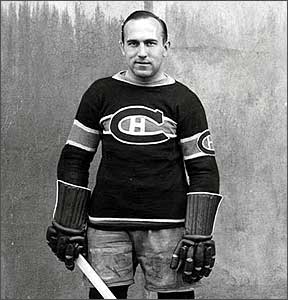
Maybe the legends of the Montréal Canadiens are passed on this way, from father to son and daughter. Maybe this is why I can see in my mind’s eye Howie Morenz rushing up the ice in the late 1920s, when my grandfather was just a lad?
The Truth and How to Deal With it When Studying History
November 19, 2013 § 6 Comments
In two of the books I’ve read recently I found myself incredibly frustrated by the authors’ insistence on “The Truth” and the “True Story.” It is worth noting that neither book was written by a professional historian, despite the fact that both dealt with historical subjects. So I began to think about how we historians are trained to think about “truth” in graduate school, how we deal with various truths in the documents, and by obvious attempts at obfuscation by historical actors. And how we deal with gaps in the sources.
Each author deal with these problems differently. In Jack Weatherford’s Genghis Khan and the Making of the Modern World, I was troubled by Weatherford’s inability to deal with at least one of his sources critically. Weatherford makes great use of a source called “The Secret History”, which covers the early history of the Mongols in Temujin’s (Chinggis Khan) rise. I found myself continuously wondering if The Secret History was actually verifiably true, or if it was something to be taken with a grain of salt, which is what my sense was in reading Weatherford’s book.
But the bigger problem came in C.J. Chivers’ The Gun. Chivers was understandably frustrated throughout his research and writing process by the varying story of the development and proliferation of the AK-47 in the Soviet Union. Mikhail Kalashnikov himself has published multiple autobiographies, both during the Soviet era and after, and has given countless interviews to the media, both before and after the fall of the USSR. And in almost everyone of them, he gave different versions of his own biography, of his development of the AK-47 and so on. I would’ve been frustrated in Chivers’ shoes.
For example, Kalasknikov’s brother, Nikolai, was sent to a Stalin-era prison camp when they were young. Chivers is frustrated in figuring out what Nikolai’s sentence was. At the end of the day, I found myself wondering “who cares”? I am less interested in what sentence Nikolai Kalashnikov received than the fact that he was sentenced to a labour camp in the first place. And I felt that Chivers spent too much time and space in the book expressing his frustration and inability to get to the fact of the matter there to the detriment of a discussion of the Kalashnikov family’s status as kulaks during Collectivisation during the Stalin era.
Chivers also spends the most time and effort complaining about Kalashnikov’s biography. He also is downright naïve in expressing his frustration with Soviet-era sources and the multiple truths of the era, as if nothing like that ever happened in the US or any other Western nation. At any rate, Chivers goes on a long rant about Kalashnikov co-operating with Soviet authorities in the re-crafting of his biography (Chivers prefers the term “white-washing”, which, while being accurate is ahistorical). Kalashnikov’s family were kulaks, enemies of the state. They were exiled to Siberia. No kidding Kalashnikov needed a new biography when he became the inventor of the AK-47, which Chivers makes a strong and compelling argument as the greatest invention of the USSR. His background as the son of kulaks had to be deleted from the story and a new version be created for public consumption. To criticise Kalashnikov for participating in this process is almost laughable. Obviously he had to participate. He didn’t have a choice in a totalitarian dictatorship. At least not if he wanted to keep living.
At any rate, it just so happens that, as a public historian, this is the kind of thing I study. Public historians spend a lot of time looking at how stories get created, whether they are wider cultural stories or individual ones. If Chivers thinks that what Kalashnikov participated in only happened in totalitarian communist states, he’s deeply, deeply mistaken. Manufactured histories are part and parcel of almost daily life in Canada and the USA.
But the question of truth is what I’m interested in here. Fact. Statistics don’t speak for themselves. Numbers don’t speak for themselves. A picture is not worth a thousand words. Facts are simple things. Fact: Canadian Confederation happened on 1 July 1867. But why? And what did it mean? The why can be answered in many ways, both narrowly and widely. It can be answered looking at what was happening in the United States, it can be answered looking at British colonial politics. Or by what was happening in Canada. Or a combination thereof. The standard interpretation of what it means is that it was the birth of Canada. But Canada in 1867 was four provinces, comprised of three colonies. That’s about it. It didn’t mean that Canada now had control of its own internal affairs. That happened in 1848. It didn’t mean that Canada gained control of foreign affairs. That happened in 1931. There was no such thing as Canadian citizenship until 1948. Nor was the Supreme Court of Canada the highest court of appeal until then. Canada did not control its own constitution until 1982. So, in short, facts only cover a very simple corner of the story. Interpretation is necessary.
To use an example from The Gun: The Ak-47 was developed in 1947. Or was it? Chivers does a wonderful job teasing out the details of the weapon’s creation in the late 1940s, to say nothing of the massive re-tooling of the gun that continued into the 1950s. Even nailing down 1947 as the date of the gun’s creation isn’t as straight-forward as one would think, at least according to Chivers.
So, the truth. Or the true story. In my experience, rarely is something billed as the “true story” actually that. Truth is a messy concept. And this is what we historians are trained in. We recognise that the honest truth isn’t necessarily a possibility (or even desirable) in telling a story. Other things are more important, such as in the case of Nikolai Kalashnikov’s trip to the gulag. Again, the actual sentence doesn’t interest me as much as why he was sent to the gulag. In other words, there are varying shades of grey in sorting out the historical story. And sometimes the actual straight truth isn’t that important to the story. In the end, Chivers’ story is made all the more interesting for all the work he does in developing and elucidating the various stories of the development of the AK-47 and the various biographies and stories to be told about its inventor (or maybe he wasn’t the inventor, another version of the story could just as easily been that the gun was the result of a collective team), Mikhail Kalashnikov.
Rural Palimpsests: Amity, Missouri
October 24, 2013 § 9 Comments
 Amity is a blink-and-you-miss it tiny town on Route J in northwestern Missouri. The last census put its population at 54, though it has since shrunk to 47 (though, in the stupidity of American metropolitan areas, it is apart of the St. Joseph MO-KS Metropolitan Statistical Area, despite the fact that there is 30 miles of relatively empty farmland between St. Joseph and Amity). It looks, for all intents and purposes, like a dying town. Amity was founded in 1872, but when the Chicago and Rock Island Railway was completed in 1885, the townsite moved about a mile north to straddle the tracks. In its new location, Amity thrived, as general stores, hotels, banks, schools, and churches popped up as the town became an important stop on the railway. A stockyard for the Rock developed and the town became a waystation and loading zone for agricultural products from DeKalb County onto the railway. Similarly, consumer items were unloaded in Amity for the stores there and for DeKalb County in general. The town’s population rose to a high of 225 in the 1920s.
But Amity was a victim of circumstances, as it lived with the Rock, it also died with it. The Chicago Rock Island and Pacific (as it was eventually called) was a notoriously poorly-run and inefficient railway. By the 1970s, the gig was up. It had been run into the ground, and it pulled out of Amity in 1975. But the Rock (and Amity) were the victims of more than just poor management. Deindustrialisation was also central to the story here. As factories shut down in the major cities of the MidWest, from Chicago to Kansas City and beyond, the railways became increasingly less important to the heartland of the United States. And Amitysuffered. Even before the railway pulled out, the stores were suffering, the schools and churches were closing.

The former site of the Chicago Rock Island Pacific Railway through Amity
Today, Amity is barely hanging on. During our cross-country trip in August, we stayed with friends in Amity, Sam and Monica. To my city eyes, Amity was a piece of rural paradise. But Sam and I got talking about the history of the town. Sam is a native of Amity and Monica is from nearby Maysville. The longer we talked, the more fascinated with Amity’s past and present I became. I have written before on the changing rural landscape in North America (Hawley, Massachusetts, Phoenix, British Columbia, and Sainte-Sylvestre, Québec), but in talking with Sam I began to think about the costs of deindustrialisation in North America.

Abandoned home, Amity
Reams of work has been done on deindustrialisation in major cities (Buffalo, Cleveland, Chicago, Pittsburgh, Toronto, Hamilton), and my own work has looked at the cost of deindustrialisation on Griffintown, Montréal. But there was a real trickle-down effect at work here. The landscape of the MidWest (to say nothing of the rest of the continent) is cluttered with Amitys, places that were once important waystations on the railways, or homes to factories themselves (Monica’s mother worked at a Quaker Oats plant packaging instant oatmeal for two decades before it closed down). But their stories are in danger of being lost through little more than negligence.
As a culture, we don’t pay attention to these forgotten places, hell, we don’t even pay attention to the MidWest, at least outside of Chicago. For the life of me, I cannot call to mind a single TV show or movie set in a Midwestern city that’s not Chicago in the past quarter century. No wonder the people of the MidWest feel left out.

2nd Street, Amity, looking north towards where the railway used to be
But there is history here (I realise that sounds like a dead obvious statement) and the stories from places like Amity are important, as they speak to the human and cultural cost of deindustrialisation in the 1960s, 70s, and 80s just as much as those stories that arise out of Buffalo and Hamilton and Milwaukee. They place a human cost on the depopulation of rural areas of North America, and they place a cost on the loss of culture. The four of us (my wife, Margo, and I, Sam and Monica) are barely into our 40s, but we have lived through a series of cultural revolutions, from politics to technology. We are a transitional generation between the old ways of doing things and the (post)modern, post-industrial culture that we live in today. We remember rotary telephones and a world before the internet. Hard to imagine. But we’re also glued to our iPhones and lost without the internet when it goes down. Sam’s work as an artist seeks to preserve what he calls “obscure” technologies, printmaking and pottery. And I am an historian, my entire professional life is centred on the past. As a public historian, my work is centred on how we remember that past.
I am currently working on a research project that looks at the relationship between the far right of American politics and its relationship to history. But once that wraps up, hopefully in the next 6-8 months, I am going to begin work on my next project, which will be based on Amity and DeKalb County, looking at the cost of deindustrialisation on these rural spaces in the MidWest.
Immigration: The More Common North American Experience
September 6, 2013 § 4 Comments
The scenery as we drove across the United States and back was amazing. So were many of the place names. There is a town in Colorado named Rifle. Another town in Colorado is called Cahones. I kid you not. But perhaps my favourite highway road sign in all of the United States was this one we saw on the side of I-84 in Eastern Oregon.
 The sign pretty much says it all. Canadian and American culture is full of stories of the successful immigrant, the ones who came to these shores with nothing and made lives for themselves, who made fortunes and found fame. And while certainly there were a few who experienced this good fortune on North American shores, the majority did not. Most settled somewhere in between fame and fortune and poverty and despair.
Certainly, pop culture contains references to the downside of emigration. In Canada, university students in Canadian history and literature are tortured with perhaps one of the worst books in Christendom, Susanna Moodie’s interminable Roughing It In the Bush, Or, Life in Canada, about the trials and tribulations of Moodie and her husband, John Weddiburn Dunbar Moodie, a down-at-the-heels member of the British gentry, in the wilds of Upper Canada in the 1830s and 40s. While Moodie was a horrible writer and her husband an even worse poet, the book is a key text on the struggles of even wealthy emigrants in the British colonies in the mid-nineteenth century (it worked out ok for the Moodies, they ended up moderately wealthy and living in the thriving town of Belleville, Ontario).
One of my favourite Pogues songs is “Thousands Are Sailing,” which is the story of downtrodden Irish emigrants in New York City in the 19th century. The song is actually kind of heartbreaking.
So this sign for an exit on I-70 in Eastern Oregon struck me as a remarkable site. Old Emigrant Hill Road is on the northern side of I-70, and it runs into Poverty Flat Road on the southern side of the highway. Obviously, these two roads have been there for a lot longer than the Interstate. And, as you can see from the terrain surrounding the sign for the exit on the highway, the landscape around Poverty Flat Road isn’t exactly all that welcoming. This was also a common experience for emigrants to the “New World” in the 19th and 20th centuries: they ended up farming lands that were not conducive to growing much of anything. Generations struggled to make a living on these farms until someone, whether out of optimism or desperation, decided to clear off the land and make his or her fortunes elsewhere.
Perhaps this is the more common story of the immigrant in North America than the one of fame and fortune.
The Historian’s Job
July 31, 2013 § 2 Comments
Three times in the past three days I’ve been reminded of what it is that we historians do. And let me be clear, by “historian,” I mean academically-trained holders of advanced degrees who study the past. Yeah, call me pretentious or whatever. I don’t care. The first reminder I got was the now notorious interview of Reza Aslan by FoxNews concerning his new book, Zealot: The Life and Times of Jesus of Nazareth. In the interview, Aslan had to continuously remind the FoxNews host that he was a trained historian, not just some Muslim dude writing about the founder of Christianity. Jesus Christ isn’t usually a topic I find interesting, but after hearing the NPR interview wherein Aslan actually got to discuss the book, I almost want to read it. Almost.
The second reminder of what it is that an historian does came yesterday. Against my better judgement, I got involved in a Twitter discussion with a conspiracy theorist. I should’ve tuned out when he told me that Pierre Elliott Trudeau, whom many (including me) consider Canada’s greatest Prime Minister, was a communist. Trudeau, you see, made Canada communist. But, wait, there’s more! The communist path was paved for Trudeau by his predecessor, Lester B. Pearson, who was PM from 1963-8. Pearson, this guy claimed, had been named by a Soviet spy before US Congress as having passed on secrets to the Soviets during the Second World War. I have, believe it or not, seen this claim before, I have a vague recollection of having read something of it in connection to the Gouzenko Affair. The author of whatever this piece was addressed the Pearson claim in a footnote and gave his sources. As an historian does. My interlocutor, however, did not consider this enough. He dismissed this academic article as a MSM source (mainstream media) and biased, blah blah blah. I found myself thinking of Aslan repeating ever-so-patiently noting what it is that makes him qualified to speak on the subject of Jesus Christ. I thought, well, let’s see, I’ve read somewhere around 5,000 books and articles over the course of my career. Maybe more, maybe a little less. I am trained to critically assess an argument, its logic and its evidence. As are all the rest of us academic, professional historians. My interlocutor had offered up a Google search as his “proof” that Pearson and Trudeau were dirty commies. But he dismissed my evidence as “nothing.” Ah, wonderful, anti-intellectualiam. Carry on then, good sir, and good luck with your alternate reality.
The third time I was reminded of the historians’ path came today when reading The Times Literary Supplement. I allowed my subscription to lapse last fall. I regret that. I just renewed, and the first new issue came yesterday (note geek excitement here). In it comes a review of Brian Levack’s new book, The Devil Within: Possession and Exorcism in the Modern World, by Peter Marshall. I thought several things of this book and its review. The first was it appears to have been a colossal miss in terms of Public History. Levack is bedeviled (pun intended) by the fact that it is well nigh impossible to rationally explain possessions. And yet, people continued to believe they happened. I’m more interested in that cognitive dissonance, I must say. Anyway. Towards the end of the review, Marshall opines that “The folie de grandeur of historians is that we are conditioned to believe we can explain anything.” Huh. Not sure I agree with that. Certainly, the rational, positivist bent of our training is given over to such pursuits. And we tend to take on rational topics, things we can explain. Certainly, anything I’ve tackled in a research project from undergrad to now fits into this category. But there are some things that are harder to explain. Like, for example, the life and times of Jesus of Nazareth. Or a belief (or unbelief) in God. Or, possessions, demons, and exorcisms. Here, the historian is left with this cognitive dissonance, of attempting to conduct a rational discussion (and argument) about something that may not actually be rational. Herein lies my interest in exactly that dissonance. What is it that makes people persist in their beliefs? Even in the face of all rational evidence to the contrary (as in the case of, say, possessions)? The very fact that the subject of discussion is not explainable is exactly what makes it so interesting. So, in a sense, then, Marshall is incorrect, historians cannot explain anything. Nor should we wish to.
National Review on Brown v. Board of Education and Desegregation
July 19, 2013 § 2 Comments
The National Review is one of the United States’ longest-standing conservative voices. It is also usually a reasoned, steady voice. But, well, as I read a bizarre rant about George Zimmerman in its pages full of thinly veiled racism, I find myself recalling National Review’s response to Brown v. Board of Education and government-mandated desegregation in the South in the late 1950s.
Writing in 1957 (the 24 August edition, to be exact), the editors of National Review had this to say:
The central question that emerges — and it is not a parliamentary question or a question that is answered by merely consulting a catalogue of the rights of American citizens, born Equal — is whether the White community in the South is entitled to take such measures as are necessary to prevail, politically and culturally, in areas where it does not predominate numerically? The sobering answer is Yes [italics in original] — the White community is so entitled because, for the time being, it is the advanced race.
Yup. And for an added bonus, here is James J. Kilpatrick, who was then the editor of the Richmond News-Leader in Virginia. He was of the opinion that Brown and forced desegregation would “risk, twenty or thirty years hence, a widespread racial amalgamation and debasement of the society [of the South] as a whole.”
Why Friedrich Hayek was NOT a Conservative
July 18, 2013 § 3 Comments
I found this interesting little gem yesterday from Friedrich Hayek who, in by 1960, found himself somewhat alarmed that his The Road to Serfdom had become such a bible for right-wing laissez-faire capitalists and their supporters. Hayek subtitled the Postscript to his book, The Constitution of Liberty, “Why I’m Not a Conservative,” he writes that, amongst other things, conservatism (at least in 1960) lacked coherency in terms of countering liberalism (and other enemies). But, perhaps more to the point, Hayek argues that conservatism was hostile to innovation and new knowledge. It was shaky on the economic foundations of free market economics (which he himself was not all that fond of, as noted in The Road to Serfdom), and, to quote George H. Nash, “altogether too inclined to use the State for its own purposes rather than to limit this threat to liberty.”
Interesting, really.
 Matthew Barlow