The “Curation” of Southie and the General Over Use of the Term
December 10, 2012 § 4 Comments
We were in Southie yesterday, the former Irish-Catholic working-class neighbourhood of Boston. Southie is undergoing massive yuppification these days. The working classes are being squeezed out, and the yuppies are moving in. This was clear as we took the #9 Broadway bus from Copley Square into Southie. The bus is the great equaliser of Boston society; in some parts of the city, it’s the only time one sees large numbers of minorities. We got off the bus at the corner of West Broadway and A Street, on our way to a yuppified Christmas foodie craft fair at Artists for Humanity on West 2nd Street. In a lot of ways, Southie looked to me like a combination of parts of the Plateau Mont-Royal and Pointe-Saint-Charles back home in Montréal. The architecture was Plateau-like in terms of post-industrial spaces and housing, but the people looked like they could be in the Pointe. There was a curious mixture of the down and out, the working-classes, hipsters, and yuppies of every skin colour.
Gentrification is a creeping problem in pretty much every North American and European city, and much has been written about this, including on this very blog (like, here, here, here, here, here, here, and here, for starters). But what struck me the most was Social Wines, a wine and beer emporium in a spanking new building on West Broadway at A Street. Social Wines offers its clientele “Curated Craft Beer and Spirits.” Now, I must confess, this is my kind of store: it focuses on smaller, indie breweries and vineyards. I like giving my money to these kinds of companies, rather than the Molsons, Budweisers, and massive vineyard conglomerates of the world. But curated? What the hell does that mean?
According to the Meriam-Webster dictionary on-line, a “curator” is “one who has the care and superintendence of something; especially : one in charge of a museum, zoo, or other place of exhibit. To “curate” is: “to act as curator of a museum or exhibit curated by the museum’s director.”
Of late, hipsters and academics have abused the term “curate” like it’s nobody’s business. It is one thing, in the field of Public History and its corollaries, to write of the ways in which museums and the like have “curated” items. That is the proper use of the term. But when editors of edited collections of academic papers start referring to themselves as “curators” and not “editors,” well, then we have a problem. Meanwhile. Hipsters. On any given day, one can go to PitchforkMedia and see articles about this or that music festival that has been “curated” by someone. The most egregious example of this is the All Tomorrow’s Parties festival, which takes place in merry olde England, with branches occurring in the US, too. Each year, ATP is “curated” by a guest musician, one of stature and great fame. What that means is that someone is in charge of deciding who should play, and the list of artists reflects the curator’s tastes. Yup, deciding who should play a music festival is curation.
And so now we have a hipster beer and wine store in Southie that offers us “curated” booze. What, exactly is curated? The collection of booze on sale. See, the old ma and pop liquor store down the street just orders in booze that they figure their clientele will enjoy. But, not hipsters, they lovingly and carefully “curate” the collection of booze on sale at Social Wines. I don’t know about you, but I feel a lot better knowing that rather than having some old geezer just randomly order wines and beers that may or may not be any good, we have the fine folk at Social Wines to very carefully curate their collection.
My problem with the use of this term? It’s very simple. It’s pretentious. And nothing quite says “I’m a wanker” like declaring that you curated your liquor store. I applaud Social Wines’ mission. Hell, next time I’m in Southie, I may even stop in and peruse their collection of wines. But the use of this term by book editors, musicians, and liquor store owners also seriously devalues the meaning of the word in its true professional sense.
Professional curators, those who work in museums and art galleries, do not just collect stuff they like to display. They are responsible for the content of exhibits, and they are required to carefully make decisions on what is appropriate and what is not, to carefully arrange the displays, to negotiate with sponsors, and so on and so forth. There is a reason why curators go to school to learn how to properly curate. Musicians and liquor store owners do not.
Arrival Cities: The Book
December 10, 2012 § Leave a comment
I have touched on Doug Saunders’ Arrival City previously on this blog here and here. This review was also in the works with Current Intelligence before I left back in 2011. So, I am sticking it here for my own purposes.
Doug Saunders. Arrival City: The Final Migration and Our Next World. London: William Heinemann, 2010. ISBN: 9780307396891. 356pp.
Doug Saunders’ Arrival City was published to almost universal acclaim last fall. The Guardian nearly fell over itself hailing it as “the perfect antidote to the doom-laden determinism of the last popular book on urbanisation, Mike Davis’s Planet of Slums” and declaring it “the best popular book on cities since Jane Jacobs’s The Death and Life of Great American Cities half a century ago.” Saunders’ own newspaper, The Globe & Mail hails his calming certitude on the wonderful nature of progress that the city provides us. And the Wall Street Journal praises Arrival Cities for its optimistic view of globalisation.
Certainly, Arrival Cities is an important book, its well-written and is clearly and cogently argued. It is also somewhat of a disappointment, at least in the first half of the book. Saunders is the European Bureau Chief for The Globe & Mail and his reportage and columns generally provide a balanced view of the world; his is one of the few columns in that newspaper I actively seek out. Thus, I expected more from Arrival Cities. I did not get it. While Saunders does give us a counter-narrative to Davis’ doom and gloom, it occasionally reads Pollyana-ish. And at times, Saunders’ journalistic eye overwhelms his argument. Indeed, Dwight Garner in The New York Times notes this problem: his lengthy quotes from the people he talked to in arrival cities around the world sound formulaic and too easy.
Certainly, Planet of Slums was an overly statistical analysis, and statistics are on the aggregate level, they do not always us to view the micro- and quotidian levels. But Arrival City is plagued by the opposite problem: in focusing on a success story or two from each of the arrival cities he visits around the world (and Saunders has certainly been travelling the world), he over-personalises his arguments, which gives the impression that he’s choosing to extrapolate the success stories he saw, not the marginalised. Certainly, all of the people in arrival cities are marginalised in the larger sense of the word, but within the poor, there are class/caste divisions.
More fundamental, though, is Saunders’ reliance on Hernando de Soto’s arguments that all people need in the slums and favellas of the world is security of tenure, if they owned their own homes, all would be good. As Davis notes, the problem with titling in the slums is that it perpetuates the problem of class, in that the wealthier squatters win and the poorer lose, or continue to lose. And de Soto has also been criticised for over-estimating the amount of wealth land titling would create. The other problem of de Soto’s claims is the very notion of property: generally speaking, slums and favellas work due to the co-operation between residents. The creation of private property is at diametrical odds to this economic system. Saunders parrots de Soto throughout large part of Arrival City, arguing that private ownership of homes and security of tenure would encourage slum-dwellers to, essentially, take pride in their homes and communities and would give them a base of capital to invest in the economy. This is not to suggest that de Soto and Saunders are all wrong and their critics all right, but it is to suggest that life does not work quite as neatly and systematically as de Soto and Saunders would hope.
The first five chapters of the book are also plagued by an alarming ahistoricism as Saunders takes us on a tour of arrival cities across the globe from London to Dhaka, Nairobi, Los Angeles, and Shenzhen. In Chapter 5, he looks a the historical growth of cities in the west, focussing specifically on Paris, London, Toronto, and Chicago. Oddly enough, even in a historical chapter, one is left alarmed at Saunders’ ahistoricism. In discussing the differences between urbanisation rates in the United Kingdom and France in the mid-19th century, Saunders somehow manages to overlook the major impetus behind urbanisation in that century: the Industrial Revolution. The Industrial Revolution is the determinative factor behind the wildly different rates of urbanisation in France and Britain in the 19th century, plain and simple.
Also, a cardinal crime to an entire generation of historians, Saunders attempts to take on E.P. Thompson and The Making of the English Working Class. The problem is that he seems not to have read the book. He says that Thompson sees his working class heroes as “passive victims.” This is just plain wrong, the key argument that emerges from The Making is that the working classes were not just passive victims, that they employed agency in agitating for their rights through corresponding societies, proto-unions, and through the church.
In addition, one is left rather flummoxed by Saunders’ apparent naïveté in looking at housing projects in Paris. He criticises the project builders for not soliciting input from those who were to be the future residents of the projects. Seriously. Nonetheless, he does make the point that the lack of accountability on the part of both the authorities and residents in the projects, to say nothing of their discombobulating impact on community.
Following this, however, Arrival City improves exponentially, in the final five chapters. In this sense, it is as if the book is split in two. In the second half of the book, Saunders seems to adopt a more complicated approach to the arrival cities of the world. This includes pointing out the ridiculousness of immigration policies in Canada and the United States. Canada and the United States take in the largest number of immigrants in the world, at least on a per capita basis for Canada, a relatively tiny (population-wise) country.
But it is Saunders’ chapter on the geçekondus that surround Istanbul that really shines. Here, we get a detailed, excellent study of the politics of the geçekondus from the 1970s to today and the struggle of the resident of the slums to attain regularisation and integration into Istanbul. Istanbul, of course, is one of the fastest growing cities in the world. In 1950, Istanbul’s population was 983,000; today, over 13,000,000 call the city home. The slums on the Asian side of the Bosporus grew up in the 70s as impoverished rural Turks migrated to the great city. They established their slum housing outside the boundaries of the city and then agitated for the right to have such luxuries as running water and sewers. The organisers of the 70s and 80s were almost all radical lefties and, during the military dictatorship and its aftermath in Turkey, many spent time in jail and saw their homes routinely torn down. By the turn of the millennium, their geçekondus had been integrated into Istanbul (a large part of what saw the city’s population triple in the past thirty years). Today, these old geçekondus are now part of the inner ring of Istanbul suburbs, fully integrated into the city, and the children of these old radicals are Istanbullus. However, the geçekondus aren’t simply a case of de Soto’s economic theories being put into practice, the regularisation of the geçekondus and their residents, the geçekondullus, required state assistance.
In the second half of the book, Saunders also goes beyond the role of banks and business in the regularisation of the arrival cities. He also notes that the state needs to take an activist role, whether of its own accord or spurred on by the arrival city residents. In order to do this, however, the state needs to have the resources to do so. This is simply not possible in many impoverished and/or corrupt developing world nations, like Bangladesh. Instead, it requires the intervention of richer nations like Turkey, which could afford for Istanbul to absorb and regularise its geçekondus. But more than this, the integration and regularisation of these arrival cities is necessary for local schools, jobs, health care facilities, water and sewer services, and transportation. And then, finally, Saunders strikes a balance between the de Soto right and the Davis left:
What comes from this work, and form the experiences of families like the Magalhãeses in Brazil and the Parabs in India, is a conclusion that is unlikely to please the ideologues on the socialist left or the free-market right: to achieve social mobility and a way into the middle class for the rural-migrant poor, you need to have both a free market in widely held private property and a strong assertive government willing to spend heavily on this transition. When both are present, change will happen [p. 288].
What we are left with then, is half a great book. The first half of Arrival City is done in by its overly simplistic and journalistic approach, its lack of historicity and its over-reliance on de Soto. In the second half, though, Saunders finds his feet, and finds his own original argument that more than splits the difference between de Soto and Davis. I remain unconvinced that the urbanisation of humanity on such a level as we are seeing today is a good thing, but it is also a truism throughout history, at least in the West, that periods of urbanisation have spurred on trade, the economy, and general human progress. And during periods of de-urbanisation, such as in the Dark Ages following the fall of the Roman Empire in the West, Europeans were only slightly more evolved than cavemen, at least in relation to the rest of the Mediterranean world and the Middle East, as David Levewing Lewis points out in God’s Crucible: Islam and the Making of Europe, 579-1215. Either way, there is no simple answer to the question of the massive urbanisation of the globe today, despite what the Mike Davises and Doug Saunderses of the world would have us believe.
Montréal’s Anglo Mayor: Dr. JJ Guerin
November 16, 2012 § Leave a comment
So Montréal got itself a new mayor today, Michael Applebaum. He wasn’t democratically elected, but given the sudden resignation of the scandal-plagued Gérald Tremblay on 5 November, he has to be an improvement. The big woopedy-do about Applebaum is that he’s Anglophone (he’s also the metropole’s very first Jewish mayor). Montréal hasn’t had an Anglo mayor since 1910, when James John Guerin sat in the mayor’s chair.
Guerin, despite the last name, was Irish Catholic. He was also a central player in one of the most vicious election campaigns in Canadian history. In 1917, at the height of the First World War, Prime Minister Sir Robert Borden called an election over the issue of conscription. Borden had invited the Liberal Party, under Sir Wilfrid Laurier (Prime Minister of Canada, 1896-1911), into his government to form a Union government for Canada for the duration of the war. Laurier, however, could not countenance conscription nor could his Québec powerbase. He refused. Borden called an election for 17 December.
By 1917, voluntary enlistments into the Canadian Expeditionary Force (CEF) was pretty much drying up. The war had been going on for three years. And the Great War was little more than a killing field. Mechanised warfare wreaked havoc on the soldiers. Casualty rates were enormous. Canada, with a population of little more than 7 million, lost 65,000 men, with another 150,000 wounded. Many of those who were wounded and survived were never the same again. They lost their eyesight, their hearing, limbs; their lungs were destroyed by the Germans’ poisonous gas; they were shell-shocked. It wasn’t just in Canada that enlistments were drying up by 1917, the same was true in England, Scotland, and Wales. Thus, conscription was needed to compel young Canadian men to fight. Conscription was made palpable in the rest of Canada, in part, due to exemptions. The most famous case was that of farmboys, whose labour was needed on the farms of the Prairies (and Ontario). (Not that Borden kept this promise). But, in Québec, nationalists failed to see why Canada should be wrapped up in an imperialist war that had nothing to do with Canada’s interests. Indeed, Henri Bourassa, the most influential nationalist leader of the day, and founding editor of Le Devoir, argued in that paper’s pages
Le Canada aurait pu intervenir comme nation, lié a l’Angleterre par des attaches politiquées, et à la France par des motifs de sentiment et d’intérêt, sans compromettre en rien son état politique…[and that Canada had] aucune sort d’obligation morale ou légale de participer à la guerre et tenir compte des conditions particulières, des intérêts vitaux qu’il doit sauvegarder comme pays d’Amérique avant lier sont à celui des nations d’Europe.
Bourassa wasn’t entirely correct, Canada did have a legal obligation to participate. Britain still controlled Canada’s foreign affairs, and would continue to do so until the Statute of Westminster in 1931. Thus, when Britain went to war, Canada went to war.
At any rate, the Liberal Party of Canada split over conscription in 1917. Most Liberals outside of Québec took Borden up on his offer; most Liberals in Québec stood behind Laurier. The outcome of the election was a foregone conclusion, of course. But that didn’t stop the Bordenites from engaging in some skeezy politics. They enfranchised women who had sons or husbands in the military, calculating that they would vote for the Bordenites. They gerrymandered ridings to ensure the best possible outcome for the Unionists.
One of the gerrymandered ridings was St. Ann’s, in Montréal’s west end. Prior to the 1917 election, the riding was comprised of Griffintown, Little Burgundy, and Pointe-Saint-Charles, a working-class industrial slum. The sitting member was Charles J. Doherty, a Conservative and the Minister of Justice in Borden’s government. He was initially election to represent St. Ann’s in 1917. He was also Irish-Catholic, so, in essence, the Irish of Griffintown (and Pointe-Saint-Charles) had elected one of their own. Again. St. Ann’s was one of those ridings where the outcome was not a foregone conclusion. It could just as easily go Liberal. Thus, the gerrymander. Conservative, non-Irish, neighbourhoods including the western part of Pointe-Saint-Charles and all of Verdun, were added to the riding.
The Irish were an issue in 1917 because of the effect of the 1916 Easter Rising in Dublin on the Irish diaspora. The 1916 Rising, and the brutality of the British response, served to radicalise the Irish, both in Ireland and the diaspora, including and perhaps especially, Griffintown. Griffintown was home of the most radical republican Irish nationalists in Canada in the 1910s, mostly centred on the Ancient Order of Hibernians (AOH). Thus, for the Bordenites, it was essential that Doherty, who was responsible for conscription, be protected at all costs. Hence, the gerrymander.
Borden was opposed in the riding by two Liberals at the outset. Daniel Gallery, the former Liberal member (and city councillor) for St. Ann’s, as well as Dr. J.J. Guerin, a long-time city councillor and former mayor of Montréal. Gallery, though, ultimately lost the Liberal Party’s endorsement and was left to run as an independent against the Liberal Guerin and the Conservative Doherty. The election was vicious in Griffintown. Goon squads intimidated followers of all three candidates. All three were heckled mercilessly on the campaign trail. Threats were made.
Doherty won the election handily. Indeed, he won with the largest margin of his career. But he also won in large part due to the gerrymander. In Griffintown, the heart of St. Ann’s, Guerin walked away with the vote, outpolling Doherty by an almost 2-1 margin. Gallery, despite a long career in service of Griffintown, was never a credible candidate. He spent most of his time denying that the Unionists were paying him to split the Liberal vote with Guerin. He garnered fewer than 1000 votes. Guerin may have lost the election, but he won Griffintown. And he eventually succeeded in representing St. Ann’s in Parliament; he was elected the Liberal member in the 1925 election and held the seat until his death five years later.
In Griffintown
June 12, 2012 § 1 Comment
I spent Sunday morning, prior to the destruction of the Irish team at the hans of Croatia in Euro 2012, in Griffintown, with Scott MacLeod, working on his documentary, In Griffintown/Dans l’Griff. It was an incredibly hot day, and Scott, myself, the crew, and Claude Mercier who, along with his wife, Lyse, are the stars of the film, all got nice and sunburned. Below are some action shots, as well as Claude, Scott, and I in Parc Saint-Ann/Griffintown, squinting in the bright sunlight. It was a great experience, in between shots, Scott and I talked about his vision for the film, how he planned to intersplice archival footage, his own animations, and live action shots to create the documentary. I look forward to seeing the final version.
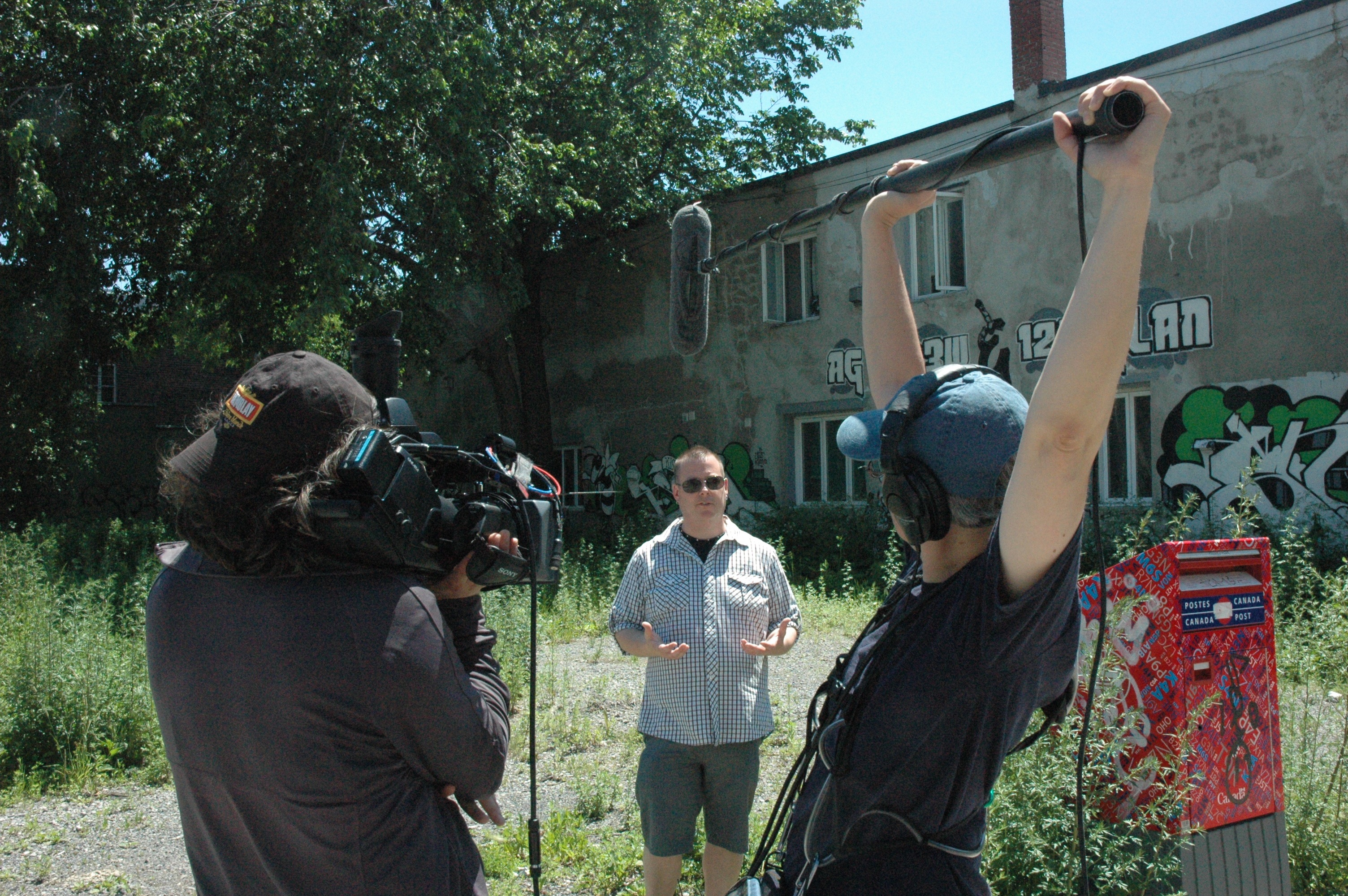

Filming Griffintown
June 10, 2012 § Leave a comment
Two months ago, I posted this about film-maker Scott MacLeod‘s fundraising attempts for a documentary on Griffintown. I’m happy to report he raised enough money and all systems are go. Today, I will be meeting up with Scott and his crew for a bit of filming before Ireland takes on Croatia in its first match of Euro 2012. I am slated to discuss the destruction of Griffintown in the 20th century, due to both bureaucratic inertia on the part of Hôtel de Ville, and depopulation due to deindustrialisation in Griffintown. Of course, all the Lachine Canal-side neighbourhoods of Montréal experienced deindustrialisation, but Pointe-Saint-Charles, Little Burgundy, Saint-Henri, Côte-Saint-Paul and the like didn’t become ghost towns like the Griff. The difference? A combination of local populations resisting deindustrialisation and depopulation (the Pointe, in particular, was home to a radical, populist resistance), as well as political support. Griffintown got none of that. The city abandoned Griffintown, left it to die.
Fast-forward 50 years and now there is nothing the Ville de Montréal loves more than Griffintown. You can practically see the dollar signs in Mayor Gerald Tremblay’s eyes whenever someone mentions the word “Griffintown.” All the city can see is the tax dollars that will come in from all the condo dwellers there once Devimco and a handful of other developers are done with the neighbourhood. Did I say neighbourhood? Oops, sorry. To me, neighbourhood means a form of community, there is common cause amongst neighbours. In some cases, this is organic, in other cases, communities can be planned to encourage neighbourliness. The re-jigged Griffintown, however, is not one of those. No parks, no schools. None of that. Can’t have that, that’d steal space from condos!
So we are going to get a district of high rise condominiums, populated by harried, busy urban dwellers with no real, organic chances for community living, unless they seize the chances themselves. Maybe they’ll become the condo dwellers here in the Pointe, many of whom have joined the casseroles protests, such as they exist in the Pointe, and have joined the community gardens, and have joined the old populist community organisations of the Pointe? Or maybe they won’t. I’m not optimistic, because the Pointe already had this community-based model when the condos went up and when we gentrifiers moved into remodelled tenements. The Griff has none of that.
But don’t tell Gerald Tremblay. Actually, go ahead, he’s not listening anyway.
Adding to the Wasteland of Griffintown
April 13, 2012 § 1 Comment
I have taken to going through Griffintown on my morning run of late, in part because it gives me a chance to keep an eye on the redevelopment there. I come up from the Lachine Canal to de la Montagne, to Ottawa, over to Peel and then down Wellington back down to the Canal, which gives me a quick tour through the heart of old Griffintown, past the old ruins of St. Ann’s Church, by the recently sold Horse Palace, past the Merciers’ old home and Fire Station No. 3.
A condo tower is going up at the corner of de la Montagne and Ottawa, there is work going on around the Horse Palace, there is a new condo bloc at the corner of Ottawa and Murray. And another development is underway on the northeastern corner of Peel and Wellington. And then, of course, across Wellington, between Young and Shannon is Devimco’s massive construction site. Buildings have come down and holes have been dug for Devimco.

And Devimco has moved its condo sales office. It was once located up the block on the eastern side of Peel near Ottawa, but now it sits proudly, if not somewhat barrenly, on the southeastern corner of Peel and Wellington. I did find myself wondering if the sales people are still promising potential buyers that the CNR would move its railway, as the viaduct is across the very narrow Smith street from the site of Devimco’s condo towers.
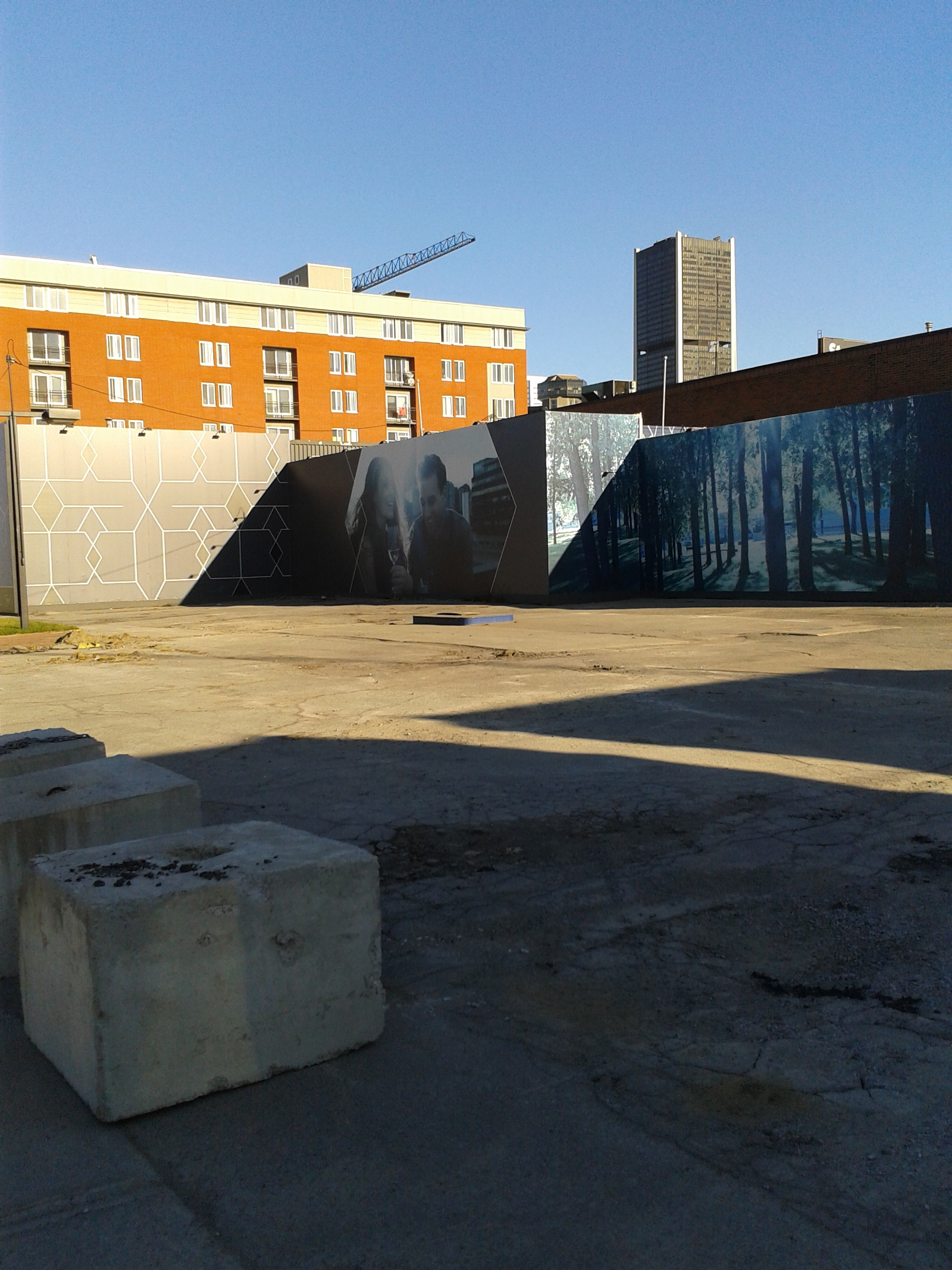
At any rate, the old sales office is now just another wasteland on Griffintown’s landscape, yet another lot of urban refuse, but this time created by the very company which proposes to rejuvenate and renovate the Griff. Ironic, I thought.
Constructing Landscapes
February 8, 2012 § 1 Comment
[note: I originally wrote this article nearly 4 years ago for a site that no longer exists; as the ideas contained in this piece are still of interest to me, I am re-publishing it now, mostly for my own purposes going forward. I have updated parts of this article that were dated.]
I read a fascinating post at Geoff Manaugh’s BLDG Blog about a new video game from LucasArts that allows the player to modify the game’s battlespace through various (fictive?) technologies. And while that in an of itself is interesting, what struck me most was Manaugh’s reference to historian David Blackbourn’s book, The Conquest of Nature: Water, Landscape, and the Making of Modern Germany.

Frederick the Great, King of Prussia, 1740-86
Blackbourn argues that modern Prussia (a pre-cursor state to today’s Germany) was literally “made,” or at least its coastline was, during the reign of the Frederick the Great, who ruled Prussia from 1740-86. During this period, dykes were built, bogs and marshes were drained, land along the shoreline was created, moulded, and so on. Vegetation was imported and shifted from one locale to another along Prussia’s coastline. Frederick’s imperial projects in Prussia were not, in fact, unlike the works the Dutch did along their coastline to make the Netherlands both more productive and more liveable.
Blackbourn’s argument is an interesting one, to be sure: that modern Prussia (and therefore, today’s Germany) was literally made in the shape that Frederick desired; the land was sculpted. This was done not to give him more land to rule over, as Manaugh suggests, but to increase Prussia’s wealth. In the pre-Adam Smith era, the wealth of nations was measured in agricultural production. Indeed, this was a pretty common Enlightenment argument, popularised by François Quesnay and his colleagues in France, the Physiocrats.
Frederick was keenly interested in Enlightenment theories, and corresponded with many leading thinkers of the era. He even hosted the idiosyncratic French thinker Voltaire at his palace at Sans Souci for a while, until their particular personalities led to conflict. Adam Smith, for his part, was a colleague and correspondent of Quesnay and the Physiocrats, and developed his own theories on the wealth of nations, in part from this correspondence.
What’s of interest here is Blackbourn’s argument. Germany isn’t the only nation to be literally made from the ground up. All modern, industrialised, militarised Western nations are so-made. Many former colonial territories, such as India, Pakistan, and Bangladesh, also fall into this category. Our landscape is, all around us, “made”, both in the physical and intellectual sense. Our landscape is only as it is because we – as a culture, a society, as individuals – see it in a certain way.
 More than this, the landscapes of these industrialised, Western nations (and their former colonies) are man-made in many ways. Germany and the Netherlands are but two examples. England, also, is crisscrossed by canals, constructed by re-shaping the landscape of the nation to transport goods and commodities during its Industrial Revolution. Indeed, England is a good example of the forging, or of a landscape, as it has been largely deforested in order to create the fuel for industrialisation, and the landscape for industrialisation.
There’s more. All countries are made, or manufactured, in the sense Blackbourn means. In some cases, this is a natural phenomenon, such as the erosion of sea shores and river banks and coastlinesIn others, it’s man-made. Take, for example, the Gulf Coast of the United States and, in particular, New Orleans. We saw how much of that coast was devastated by Hurricane Katrina in 2005. While the hurricane was devastating enough, what failed in the case of New Orleans were man-made defences around the city, located as it is on the delta of the Mississippi River, and on the shores of Lac Pontchartrain.

New Orleans after Katrina
Close to 49% of the New Orleans’s geographic footprint is below sea level, and large parts of the city are sinking. New Orleans averages out at 0.5 metres below sea level, with some parts reaching 5 metres below sea level; but the city has been made a viable location for settlement, industrialisation, and economic activity due to mitigating works being built on the Mississippi and Lac Pontchartrain. All of this economic and industrial activity in New Orleans and along the Gulf Coast has also meant the destruction of nearly 5,000 square kilometres of coastline in Louisiana alone in the twentieth century, including many off-shore islands, all of which used to protect New Orleans and the Mississippi delta.
Thus, when Katrina hit 6 ½ years ago, on 28 August 2005, there were few natural defences left to protect New Orleans. The man-made “improvements” to New Orleans and the surrounding area were simply insufficient to deal with a hurricane the force of Katrina, which was classified as a Class 1 or 2 storm. The result was nearly 80 per cent of the city was flooded out, as well as massive social and economic dislocation. Today, New Orleans’s population is still only 60 per cent what it was prior to Katrina.
Getting back to Blackbourn’s argument: his arguments vis-à-vis the creation of modern Prussia can be transported across and around the industrialised Western world. Montréal (the population of Montréal’s metropolitan area is nearly four times the size of that of New Orleans), is the beneficiary of similar modern landscape engineering. The city is located on an island in the middle of the Saint-Lawrence River, and in a cold, northern climate. In the nineteenth century, each spring, during the spring run-off and thawing of the river, the low-lying portions of the city, located near the river bank on the flood plain, were swamped with water.

1886 Flood, Chaboillez Square, Griffintown, Montréal
In 1886, flood waters were over 3 metres deep. The flood led to mitigating works being constructed along the river, the bank was re-landscaped and engineered, dyking was constructed, and so on, all in order to prevent further flooding. This allowed Montréal’s industrial development to continue throughout the late nineteenth and early twentieth century . This allowed it go through an unprecedented growth cycle that only ended with the Depression of the 1930s, and enabled Montréal to solidify its position as Canada’s metropole (a role it has since lost to Toronto).
This re-shaping of the environment, however, is not limited to the West. More recently, the insta-city of Dubai in the United Arab Emirates has followed suit. Dubai itself is a manufactured landscape, as all cities are to a degree, but in the case of Dubai, the landscape has been purposely re-appropriated for the construction of the city. A more specific example can be seen in the city’s golf courses, for example, the Tiger Woods Dubai golf resort and residences. Golf courses are, in fact, a perfect example of the re-engineering of the landscape, as grass and various other features such as sand traps and water hazards – to say nothing of surrounding vegetation – are imported and planted into foreign
The construction and maintenance (such as irrigation and pesticides) of Dubai’s golf courses, situated as they are in the desert, present us with a massive redevelopment of the landscape, the environmental consequences of which appear to be lost on Woods and his partners in the project. Dubai City itself is an example of environmental re-landscaping for human needs and settlement. Without the sorts of technologies created by the Dutch and the Prussians (to say nothing of the English, Americans, and Canadians), Dubai itself would not exist in its present, insta-city form.
Under London
February 7, 2012 § 5 Comments
I originally wrote this review for Current Intelligence, before I left the publication in the autumn of 2011, so it never saw the light of day there. I am publishing it here as a means of starting a discussion, or thread, concerning the underside of cities. And by that, I don’t mean the criminal underside or something like that, I mean the literal underground of the city. Peter Ackroyd here has written an history of the London underground (and no, not the Tube), an idea I wish other historians and writers would seize upon for other cities. There is an entire world located under our cities, not quite lost Atlantises, but at the very least, the ruins of previous civilisations. But wait! There’s more! The urban infrastructure is also below ground: the telecommunications and electrical wiring, sewers, subways, roadway tunnels and more. The underside is a topic of fascination and revulsion and something I am interested in as an urban historian. In short, I’ll be returning to this theme in coming weeks.
Peter Ackroyd. London Under. London: Chatto & Windus, 2011. 202pp. ISBN: 9780701169916 £12.99
Peter Ackroyd is one of the most prolific authors writing in the English language today, having churned out exactly fifty works of fiction, poetry, and non-fiction in the past forty years, to say nothing of another half-dozen TV shows. While his subjects have been diverse, a constant throughout his oeuvre has been London. Many of his novels have been set there and a decade years ago, he published London: The Biography, followed in 2003 by The Illustrated London and in 2007 by the biography of the great river that flows through the city, The Thames. His latest book, London Under is a product of these three books, as well as his 2009 book, Venice: Pure City. However, London Under reads as leftovers from London and Thames. It’s the story of what’s under London, from natural springs, to the ancient Roman settlement, raunchy sewers, and, of course, the Tube. Certainly a fascinating little book, whether or not London Under is successful is another matter.
What lies beneath the surface is a topic that has transfixed humans since we first evolved away from apes. For the Greeks, the dead went to the great Hades Hall under the world. Grave yards and the undead were a staple of Victorian ghost stories. What lies beneath the sea is still a topic that makes my skin crawl. But there is also an entire underworld that lies beneath our cities. In Roman times, the city’s catacombs provided shelter for the Christians. The Catacombs of Paris have held an eery hold over pop culture since the days of Edgar Allen Poe. Turkish novelist Orhan Pamuk has his characters running through the old Byzantine city underneath Istanbul in his novel, The Black Book. And London’s myriad underground tunnels were said to be the home of thieves, street urchins, mobsters, and slavers.
More than just the terror, though, there is a duality to the underground, which Ackroyd acknowledges; it can be both a site of safety and a site of evil and terror. On the bright side, he cites the protection afforded the Christians under ancient Rome. On the dark side, he points to the medieval prison, which was oftentimes a pit in the ground, or the depths of the Tower of London. Indeed, under London are some nasty little places, such as the House of Detention, which was a dank, terrifying prison. But it was during the nineteenth century that the underground began to take on its truly nefarious tone in London, as it was seen as the den of criminals and smugglers who only came out at night. Then there’s what creeps and crawls through the underground: rats, eels, snakes, and other such creepy creatures. Rats, in particular, spark fear in humans, no doubt due to their role in causing the Great Plague in the fourteenth century (to be fair, it wasn’t the rats, it was their fleas, but who’s counting?).
After a general introduction, we are transported back to the aftermath of the Great Fire of 1666 and the discovery of what lay beneath the ruins of the torched city. Ackroyd introduces us to Sir Christopher Wren, the great architect, and his excavations of St. Paul’s Cathedral after the fire. He was surprised to discover, amongst other things, Anglo-Saxon graves, on top of Saxons, on top of Britons, on top of Romans. Along with the Roman remains, he found pavement from Londonium (as it was called during the Roman era) and below that, sand and seashells. London had once lay under the ocean. As for the bodies, Ludgate Hill, the site of St. Paul’s, had long been a sacred burial ground, and was the site of a temple to Diana, the Roman goddess of the hunt. After a catalogue of all the neat and not-quite-so-neat things that have bubbled up to the surface of London over the past five or so centuries, we move onto more conceptual and sequential chapters.
From Chapter 3 “Holy Water,” onwards, it’s a whirlwind tour of what lies beneath London. Water, not surprisingly, is the focus of much of the book, a total of five chapters are devoted to water in some form or another, including sewers, pipes, and the buried River Fleet, “the most powerful of all London’s buried rivers.” [p. 52]. Powerful, maybe, but the Fleet was more of an open sewer when it still flowed above ground. Thus, after the Great Fire, Wren sought to re-create the Fleet as a majestic, Venetian-type river that flowed through the City down to the Thames. To this end, he constructed a canal. But this did not turn out so well; by the 1720s, Alexander Pope was using the Fleet as the backdrop to the corruption of Britain in The Dunciad. As commercial activity closed in on the Fleet, it became silted up, and was eventually built over and that’s how we get Fleet street today.
The chapters leading up to that on pipes (Ch. 8), however, read like they were picked up off the cutting room floor from when Ackroyd was writing London and Thames. Perhaps it’s a testament to Ackroyd’s skill as a writer, but these chapters feel effortless, and not in a good way, as if he just rather sneezed them out. They contain a lot of interesting information, but not much more in terms of analysis and organisation.
It is only when we get to the eighth of thirteen chapters that London Under hits its stride. “The Mole Men” tells the story of the men who built the tunnels that lie under the city. The Thames Tunnel is the star of the chapter. Its construction is a fascinating study in engineering, ingenuity, and the sheer terror induced by water. Having grown up in cities that have made great hullaballoo about tunnels under great rivers for transportation purposes, perhaps the story of the Thames Tunnel resonates with me more than most. While the harrowing stories of the gasses under the ground that burst into flame are enough, it is the horror conveyed in the voices of the long-dead workmen on the tunnel when the river broke through: “The Thames is in! The Thames is in!” When it was finally complete in the 1840s, the Thames Tunnel was a financial disaster, costing nearly £500,000 to construct. It was eventually absorbed into the nascent railway system before becoming part of the Underground and, today, the London Overground.
The next several chapters are dominated by the Tube. In particular, I was taken by the chapter on the disused Underground stations that dot the system. The London Underground is enough to boggle the mind at the best of times, servicing some 270 stations (though this is a far site fewer than the 468 served by the New York Subway). In addition to the disused Tube stations, there are “dead tunnels”, empty, abandoned tunnels that run to nowhere off the main lines. (There is a website dedicated to the abandoned Tube stations, entitled, appropriately enough, London’s Abandoned Tube Stations). Being fascinated by underground subway systems and the abandoned and empty tunnels we can see out the windows of the train as we hurtle below the city, I found this chapter to be the most entertaining and rewarding.
On the whole, London Under reads as though it is the B-side to London and Thames double A-Side single. It is breezily written, one can easily sit down to read it in the morning with coffee and finish it by the point it’s time to put dinner on. This has both its virtues and its vices. At its best, London Under is a rollicking tour through subterranean London, well worth the read. At its worst, though, it is as if Ackroyd sneezed it out, with little thought to narrative or analysis, or to even tying it all together, it’s a long recitation of fact. At all times, though, Ackroyd is informative and interesting.
Phoenix, British Columbia: Ghost Town Reclaimed by Nature
February 5, 2012 § 14 Comments
Continuing in the vein of the Hawley Town Commons in Western Massachusetts and the changing rural landscape of Saint-Sylvestre, Québec, I present now to you the ghost town of Phoenix, British Columbia. Phoenix is located in the Kootenay Mountains of eastern BC, not far north of the American border.
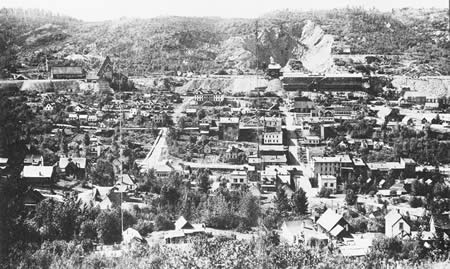
Phoenix, BC, 1912
About a century ago, Phoenix was a thriving copper mining town. It boasted modern amenities such as electricity and phone lines, there was a ballroom and an opera house. it had a stop on the stage lines that ran through the Boundary Region of the Kootenays, there was a post office and around 1900, both the Canadian Pacific Railway and the Great Northern Railway arrived in Phoenix. In short, the town had made it. It was thriving. But as was often the case in the mining regions of the North American west, the boom years were short. At the end of the First World War, the price of copper dropped dramatically and the Phoenix Mine was shut down. And the town of Phoenix died.

Phoenix First World War Cenotaph, 1937
In the 1920s, the homes and buildings were torn down or buried and there was nothing left of Phoenix, except for its First World War cenotaph, which is still there today. Otherwise, nature has reclaimed the old town site of Phoenix, despite the operation of an open-pit mine in the 1950s, 60s, and 70s. When I visited Phoenix about 15 years ago, I was floored by the site. I had seen other ghost towns in BC, most notably Barkerville, a tourist site. But many other sites I had seen were maintained to at least some degree. Phoenix was a smallish clearing in the dense forest, and the forest was rapidly moving back in, re-claiming its territory. The grave yard was the most fascinating location on the old Phoenix townsite. Most of the head stones were long gone. Many of the graves no doubt never had a proper head stone in the first place, graves marked by wooden crosses, wooden heads, or whatever was handy. One grave, otherwise unmarked, had a furniture cabinet as a marker.
But otherwise, the grave yard had 80 year old pine trees reclaiming their territory, encouraged by the heavy fertiliser in the soil in the form of decomposing human bodies. (Since my visit, residents of nearby towns have sought to restore the graveyard some, restoring the headstones that do exist). What struck me the most about standing in the Phoenix cemetery, though, was not so much the dilapidated headstones, the cenotaph in the distance, or the trees. It was the black bear about 500 metres away, happily munching away on some berries. It was also the bear that convinced us to get back in the car, slowly and quietly, and get the hell out of there.
Rural Palimpsests; Or, the Changing Rural Landscape
February 3, 2012 § 9 Comments

Drawing of the Old Hawley Town Commons
About 18 months ago, I wrote this piece about the old Town Commons in Hawley, Massachusetts. I was struck by the history of what could no longer be seen in Hawley at the Town Commons where, in the mid-19th century, there was a vibrant townsite. Hawley also stirred up my own memories of having lived in a ghost town as a teenager, on the old town site of Ioco, British Columbia, now a part of Port Moody, BC. But Ioco, which will eventually become condos, I’m sure, was a (sub)urban townsite. Hawley is a town a few miles west of the Middle of Nowhere.
 In urban centres, we see the ruins of past civilisations all around us, whether they are palimpsests of old advertisements on the sides of buildings, or the ruins of buildings, still dotting the landscape. Indeed, I wrote my doctoral dissertation and a book on a neighbourhood that was, at least when I started writing, a ruin: Griffintown, Montréal. A decade ago, the landscape of Griffintown was an urban ruin, the foundations of the old Irish-Catholic Church, St. Ann’s, poking through the grass of Parc St. Ann/Griffintown; the rectory of the French Catholic Church, Ste-Hélène still stands, but the church is long gone, just a few corner stones and the remains of an iron fence are left. But this is a city, and cities, we are constantly reminded by scholars, poets, novelists, film-makers, etc., are living organisms, built to be rebuilt, constantly evolving and changing. By definition, then, the rural landscape is unchanging and constant.
Don’t believe me? Spend a bit of time reading literature set in the countryside. Or watch movies. Read poems. The landscape of the country side is eternal and unchanging. Entire nations have been built on the mythology of the countryside (I’m looking at you, Ireland!). Here in Québec, Maria Chapdelaine, a major novel of the early 20th century nationalist school explicitly tied the virtue of the nation to the land. The anti-modernists of a century ago celebrated the unchanging “natural” landscape of the countryside as a tonic for the frayed nerves of modern man. In Canada, the Group of Seven built their entire careers/legends on representing Ontario’s mid-North back to us as the nation. Watch a Molson Canadian ad these days, and you’ll learn that Canada has more square miles of “awesomeness” than any other country on Earth. And all that awesomeness is somewhere in the wheat fields of Saskatchewan. But the rural landscape DOES change and evolve, as the Old Hawley Town Commons will tell you.
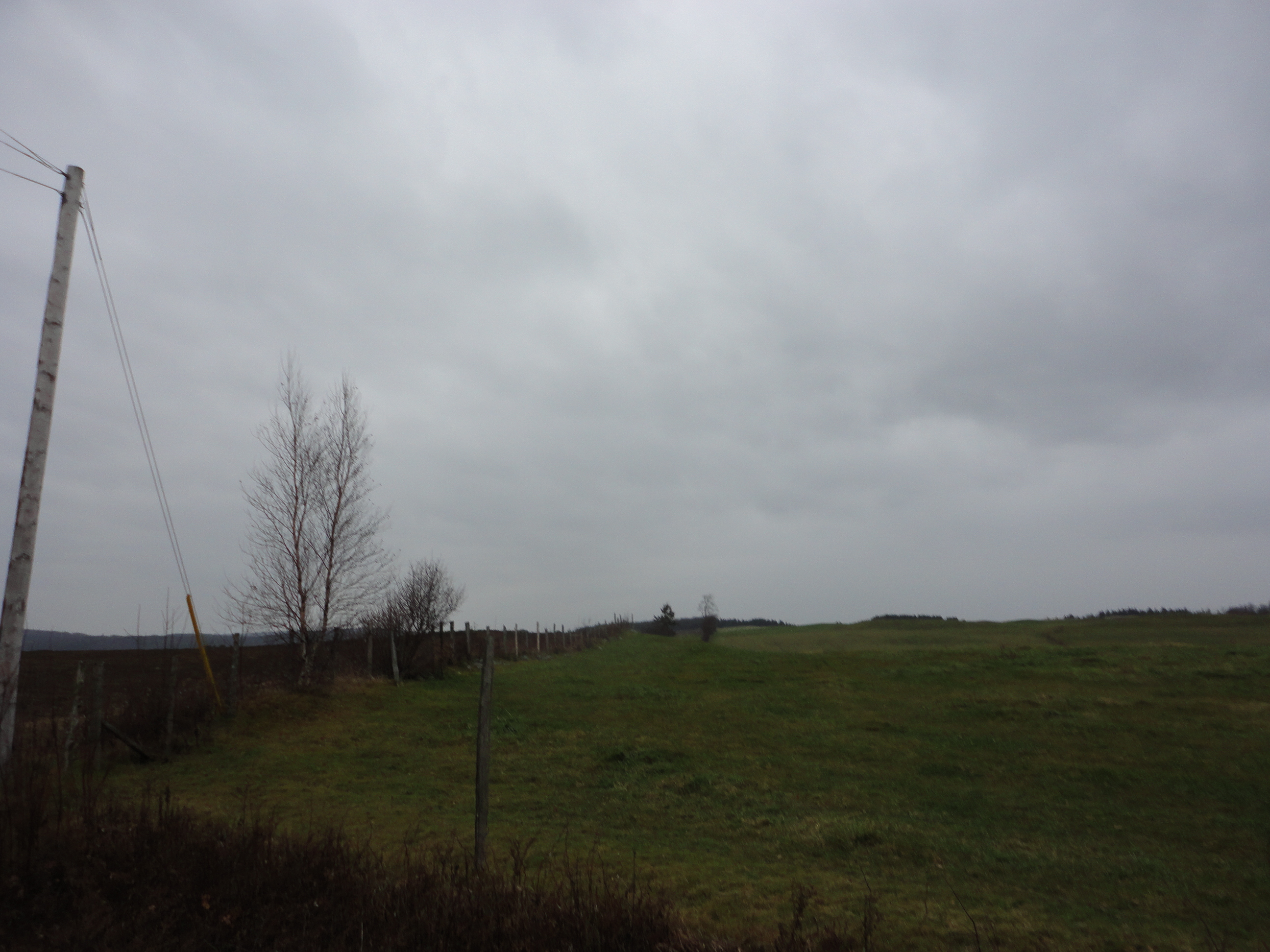
This is where Robert Corrigan was fatally beaten on 17 October 1855
This was brought all the closer to me in late November, when I travelled out to Saint-Sylvestre, Québec, which is located about 70km south of Québec City, in the Appalachian foothills. I was there because a long time ago, I wrote my MA thesis on the Corrigan Affair, which erupted in Saint-Sylvestre on 17 October 1855 when Robert Corrigan, an Irish-Protestant bully, was beaten to death by a gang of his Irish-Catholic neighbours. The mid-1850s saw the height of sectarianism in Canada and a murder case involving the two groups of Irish proved to be too much for many Anglo-Protestant Canadians to take and a national crisis broke out. By the time the Affair was over in 1858, not only had Corrigan’s murderers been acquitted of all charges, the McNab-Taché coalition government had fallen. All these years later, I had it in my mind that it was time to do something with the Corrigan Affair. I had done my best to avoid it after I finished my MA, I did attempt to write an academic article, but it seemed to me to be too good a story to be wasted in a journal article that no one would ever read. So I have decided to write a book that no one will ever read, but at least a book is a physical thing, something to offer tribute to this rather amazing story that erupted onto the front pages of newspapers across British North America from a rural backwater. So it was out to Saint-Sylvestre to meet Steve Cameron, a local man who has a deep interest in the Corrigan Affair and the history of the Saint-Sylvestre region in general.
Corrigan's homestead, Saint-Sylvestre, Québec

Hugh Russell's farm
Steve offered to give me the grand tour of the landscape, where the Corrigan Affair took place. I don’t really know what I expected, but I certainly didn’t expect what I saw: the entire landscape of Saint-Sylvestre and the landscape of the Corrigan Affair is gone, completely changed in the 155 years since Corrigan’s death. He was beaten on the county fair grounds; the site where he was beaten is completely non-descript today, just a corner of a farmer’s field. Corrigan’s homestead is covered with scrub and a random cross someone threw up sometime in the past century. Where the farm of Corrigan’s friend, Hugh Russell was once located there is nothing but high tension electrical wires, forest, and a dirt road passing by in front. There is no evidence of human habitation ever having stood there. Where the Protestants had their burial ground here in the backwoods of Saint-Sylvestre/Saint-Gilles, there is nothing left but a stone wall, though the grave yard has been carefully and lovingly restored by Steve’s organisation, Coirneal Cealteach.

Old Anglican grave yard in the backwoods of Saint-Sylvestre
In short, the rural landscape is just as dynamic of that of the city. In Saint-Sylvestre, the mostly Irish-Catholic farmers were settled on poor farming land in a harsh and unforgiving landscape; their descendants left. And in their stead, nature reclaimed its place. When I first began studying Griffintown a decade ago, Talking Heads’ song “Nothing But Flowers” kept creeping into my head as I pondered the ruins of the churches, the trees growing in vacant lots and the vegetation in the cracks of the concrete. But “Nothing But Flowers” applies just as much to Hawley or Saint-Sylvestre or countless other rural landscapes once settled by humans who have long since moved on.
 Matthew Barlow