The End of History? Or, Maybe Fukuyama was Right After All?
August 22, 2011 § 1 Comment
I have always thought Francis Fukuyama’s The End of History and the Last Man to have been an elaborate joke Fukuyama pulled on all of us. How else to explain that Fukuyama still has a career and is still taken seriously? But, maybe he was right, in a sense anyway. I recently read Doug Saunders’ Arrival City back-to-back with Mike Davis’ Planet of Slums. Both books are instructive and informative, both have fundamental problems. Saunders is way too optimistic and Pollyana-ish, and Davis is far too much of a Debbie Downer.
Saunders thinks cities are just about the greatest things ever and that they’ll lead to the liberation of humanity across the globe, the poor will rise out of their ghettos and slums, they will become middle class, and we’ll all live happily ever after. I exaggerate his argument, of course. But one thing about the book that really annoyed me was this on-going sense that slum-dwellers should have expected to have been consulted about the construction of housing projects in Western Europe and North America. It’s a fine sentiment, but it’s so ahistorical it made me spit out my coffee when I read it (and I do not spit out my coffee lightly!).
The reason why Saunders could honestly think this hit me while reading a review of Leif Jerram’s fascinating-sounding new book, Streetlife: The Untold Story of Europe’s Twentieth Century: we have reached the end of history in the West. I don’t know why it took me so long to figure it out, given the rhetoric that has emerged from the mouths of Barrack Obama, Stephen Harper, Angela Merkel, and David Cameron during the Arab Spring and Summer, or what Dubya had to say about Iraq and Afghanistan, and what our politicians say about pretty much every tinpot dictator the world over.
We are all liberals (even the conservatives), we believe in democracy, free markets, and capitalism. We have so deeply internalised these ideas we can no longer see outside of them, or even around them. We are losing out historical consciousness. And so Saunders, who is an intelligent, thoughtful columnist for the Globe & Mail can, in all seriousness, write the phrase that made me spit out my coffee. He can’t see around liberalism. And no surprise.
So maybe we have indeed reached the end of history after all, despite the last decade of terrorism and jihadism. Maybe Fukuyama was right after all.
On Irish Historiography, Revisionism, and the Troubles
August 22, 2011 § 3 Comments
Last month, at the Annual Conference of the Canadian Association of Irish Studies at my alma-mater, Concordia University, I was witness to an interesting discussion about revisionism in Irish historiography. The discussion centred around issues of identity in Northern Ireland during the Troubles. In particular, the issue of binaries, in that one was either Protestant or Catholic and the twain never met.
I have long had problems with revisionist history (in the historiographical sense, let me be clear), in that it seeks to normalise, which means it plays down the unusual, the anachronisms, and so on. In some ways, this is a good thing. In the case of Ireland, there is some good which has come out of revisionism, most notably, we are free to focus less on the stereotypical tragic history of a “famished land, who fortune could not save” (to quote the Pogues). In short, Ireland is free to become (to borrow from revisionism in Québec historiography) “une nation comme les autres.” Revisionism also leads us to post-structuralism and allows us to get past the binaries in many ways: Catholic v. Protestant, man v. woman, city v. rural, North v. South, Ireland v. England, etc. We can see the greys now, a process begun with the muddying of the playing field by the great revisionists of the 20th century: T.W. Moody and Robert Dudley Edwards, as well as the great troubadour of revisionism of our era: Roy Foster.
But, this becomes problematic when taken too far. When we become too focussed on seeing past the binaries, to see all the ways Catholics and Protestants got along in Belfast, in Derry, and across the North, we run a new risk. And that is to trivialise the Troubles. The Troubles was, ultimately, a civil war between nationalists and unionists in Northern Ireland. For the most part, we have long used “nationalist” and “Catholic” and “Protestant” and “unionist” as synonyms. And it is good to see across the lines, to see the attempts at peace-building and community-making in the midst of the terror and devastation of the Troubles. But if we push this impulse too far, then we are blind to the Troubles (or any other conflict that relies on binaries). There is a reason that those two sets of words were/are seen synonymously. It remains that over 3,500 people are dead, countless lives were torn asunder, and the two cities of Northern Ireland, Belfast and Derry, still bear the scars of the Troubles on their landscapes.
We, as historians can try all we like to see past the binaries here, but the simple fact remains that this binary was a pretty fundamental one, it resonated with people, it caused them to fight, sometimes to the death, for what they believed in. It caused them to engage in terrorism. It tore families and communities apart. We cannot lose sight of that.
Globalised Montréal
May 12, 2011 § Leave a comment
In the past few years, there’s been a new trend in Montréal History and historiography that has seen us seek to place the city within a global context. This is a welcome change from our usual navel-gazing, as we sought to explain developments in Canada solely within a Canadian context. Certainly, the local context is important, but Canada did not develop in solitude. It was always a colony and nation tied into global political and economic currents, closely related to goings-on in Paris, London, and Washington. Indeed, scholars of Canadian foreign policy have long framed Canada within the North Atlantic Triangle, along with the UK and USA.
But, culturally and socially, while historians have noted the impact of British and/or American ideas in Canada, we have gone onto explain and analyse the Canadian context separate from the global. In Québec, though, perhaps due to political exigencies. Back in undergrad at UBC, Alan Greer’s masterful book, The Patriots and the People was the first study I ever read that attempted to internationalise Canadian history. In it, Greer re-cast the 1837 Patriote rebellions in Lower Canada within the revolutionary fervour that had swept Europe and the United States since the late 18th century. Seen in this light, the Parti Patriote wasn’t just a nationalist French Canadian political party, but part of an international of liberal revolutionaries that had corollaries in England, Ireland, France, the German territories, the Italian countries, the United States, and so on.
Greer’s book fit into the larger work of the revisionist Québec historians, who often sought to put Québec into a global context, both to explain the colony/province/nation’s development, as well as to give credence to Québec’s claims to nationhood. The goal was to present Québec as a nation commes les autres. Perhaps the book that had the greatest impact on me in this sense was Gérard Bouchard’s 2000 monograph, Genèse des nations et cultures du Nouveau Monde: Essai d’histoire comparée, in which Bouchard examines the development of Québec in relation to other “new world” cultures in Mexico, Australia, New Zealand, Canada, and the United States. Put this way, Québec’s (and Canada’s) development from the moment of European settlement is globalised and we realise that Canada (and Québec) is not really all that unique.
This tendency to internationalise Québec seems to be continuing with a younger generation of historians. My friend and colleague, Simon Jolivet, has just published his new book, Le vert et le bleu: Identité québécoise et identité irlandaise au tournant du XXe siècle. Simon and I did our PhDs together at Concordia, and in 2006, the School of Canadian Irish Studies there hosted a roundtable discussion that looked at connections between Ireland and Québec, in large part this grew out of the work our PhD supervisor, Ronald Rudin had done early in the decade. It was probably the most dynamic and informative conference I’ve been at, as ideas flew around the table. Both Simon and I gained a lot from that conference and it is clear in both of our work.
For my part, I am interested in the Irish in Griffintown, Montréal, over the course of the 20th century. What I look at is, of course, identity, but I’m interested in the shaping of a diasporic identity amongst the Montréal Irish, one that situates the Irish of the city within the global context of the Irish around the world, as well as the links (such as they were) with Ireland itself. To do so, I make use of post-colonial theory, which seems particularly à-propos for the Irish, descendents of a colonial culture in Ireland, living in Montréal, the largest city of the French diaspora and thus necessarily a post-colonial location.
And this is what Sean Mills picks up in his brilliant new book, The Empire Within: Postcolonial Thought and Political Activism in Sixties Montreal. Mills situates Montréal within that postcolonial framework, and examines the ideas of decolonisation and colonialism within activist circles in Montréal in the 60s. The activists were heavily influenced by what was going on in the world around them, in de-colonial movements in Algeria, Tunisia, and, especially, Cuba, as well as the Caribbean in the 50s and 60s. Certainly, they were well aware of their skin colour and Canada’s place as a first-world nation. But the ambivalence of Montréal (still the economic centre of Canada in the 60s) is something Mills excels at drawing out. As the decade went on, American activists, in particular African American activists like Malcolm X and Stokely Carmichael, became influential in the de-colonial struggle of the French Canadian majority of the city. This was further complicated by Montréal’s own black population, which also identified itself with the ideas coming out of the United States and the Caribbean. And as Montréal became a more complicated city, ethnically-speaking, to say nothing of the actions of the FLQ in October 1970, ideas of decolonisation lost their appeal.
Nonetheless, what is clear is that Montréal is a global city, one that takes its cue from its global connections as much as its local ones. Indeed, this is the basis of my next project about layers of diaspora on the urban landscape of the city. In the meantime, it also gives me a way to situate my own work on the Irish of Montréal in a larger global context.
The Redemptorists
January 10, 2011 § 2 Comments
I went to mass on Christmas Day, I’m not Catholic, but I kind of like the tradition. This year we were in Keene, NH, where my sister-in-law lives. The priest had as the theme of his Christmas morning sermon “redemption,” noting that that was the true meaning of the season. I like to think that is one of the good points of Catholicism, that redemption is granted through the fallibility of humanity, God’s forgiveness for our sins, in part through the sacrifice of Jesus, in part through confession. I presume that this is where the Redemptorist Brothers got their name, their job being to redeem the souls of both their parishioners, as well as their converts (they are a missionary brotherhood).
Anyway, all of this is by way of introduction of my destination tomorrow in Toronto: the archives of the Redemptorists. The Redemptorists were the parish priests in Griffintown from 1885 until the destruction of St. Ann’s Church in 1970, and the ultimate closing of the parish a dozen or so years later. So far as I know, no one has actually gone in and looked at the brothers’ records from Griffintown. I was told about them years ago by Rosalyn Trigger, who was at the time doing her PhD at McGill, but I never found the time to get to Toronto to look at them when I was researching my PhD. Funny: last time I saw my supervisor, Ron Rudin, a few months ago, I was telling him about my plans to go take a look as I finished off the research for the book. He wondered if he could take back my PhD for keeping knowledge of this archive from him. ‘Fraid not, Ron.
Anyway, I’m rather excited to be heading to the archive tomorrow morning to see what I can find, to deepen our general knowledge of Irish-Catholic Griffintown, it will also add something to my book that is not in other histories of the neighbourhood, including my own dissertation.
That the Redemptorist priests were popular in their parish of St. Ann’s is not in doubt. In 1885, when the Sulpicians were stripped of their parish of St. Ann’s, the Irish-Catholics of Griffintown were furious, to the point where they remonstrated with the Bishop of Montréal. However, the Redemptorists, upon their arrival, were able to almost instantly win the hearts and minds of their parishioners, by investing money in the church and parish. By the time that Father Strubbe, the “Belgian Irishman,” was recalled to Belgium, the Irish-Catholics were loudly remonstrating with the powers-that-be over this decision. All the former Griffintowners that I have done oral histories with fondly recall the priests of St. Ann’s, in particular Fr. Kearney.
So I’m hoping here to find out how the priests saw their impoverished parishioners, what they felt they could do for them, whether they enjoyed being in Griffintown, their impressions of the neighbourhood. I’m also interested in the question of faith. All of the former Griffintowners I’ve talked to, as well as all other evidence I’ve seen, shows a very Catholic community, one where people took the ceremonies and rituals of their faith. But what has always interested me is whether this was just that: familiar ritual. One thing the Church is very good at is giving its faithful ritual and ceremony that are both familiar and reassuring. But I’ve always wondered how deep the idea of faith goes, not just with respect to Griffintown, but the Catholic Church in general.
Then there’s the question of Irishness. One of the reasons the Griffintowners protested the removal of the Sulpicians in 1885 was because the Sulpicians were very good about ensuring the parish priests at St. Ann’s were Irish. The Redemptorists who arrived in Griffintown that year were all Belgian. Of course, Fr. Strubbe was able to win over his parishioners and even gain status as an Irishman by the time of his recall. And by the mid-20th century, the priests, like Fr. Kearney, were Irish once more. Was this a conscious decision by the Redemptorists and the Bishop to represent the faithful? What did the priests make of the Irishness of their parishioners?
So here’s hoping I can begin to find some answers to these questions in the archive.
Nos Amours
October 18, 2010 § 1 Comment
I have a post up at the National Counil on Public History’s (NCPH) sponsored blog, Off the Wall, looking at the difference between marketing and nostalgia when it comes to the ill-fated Montréal Expos.
Metropolitan Statistic Areas
October 16, 2010 § 3 Comments
As an addendum to Wednesday’s post on the old Town Commons of Hawley:
Usually, I study cities and the palimpsests of history upon them, the ways in which their histories are used by their publics and their powers that be, and historians as well. Hawley is about as rural a place you can get. But, Hawley (and all the tiny towns around it, none of which have much more than 1000 people in them) is included in something called the Springfield Census Metropolitan Statistical Area. The Springfield CMSA is home to over 680,000 people. Sounds impressive, no? But this is an artificial “Metropolitan” area, as are all such beasts. To wit, Springfield is actually home to about 155,000 people. Certainly, there are cities within the Springfield CMSA beyond Springfield, like West Springfield and Holyoke. But Hawley isn’t a city. And it’s not exactly near Springfield. It’s about 45 miles away, in fact.
Thus, the Springfield CMSA is an artificial catchment area. Officially, the US Office of Management and Budget and the US Census Bureau make use of CMSAs for policy making and the like. The basic idea behind the CMSA is an urban “cluster”, a region with a relatively high population density. The outlying areas are included if they have strong ties to the central urban centre. And this is where the Springfield CMSA doesn’t make a lot of sense. Hawley and the towns around it are not all that closely connected culturally or economically with Springfield. Instead, Greenfield in the Pioneer Valley and Pittsfield, in the Berkshires, are the urban centres that are tied to these towns. Northampton could also make a claim. It is to these places that the residents of Hawley, Charlemont, Plainfield, Ashfield, etc., commute if they commute. Rarely is it Springfield.
But this might also explain their inclusion in the Springfield CMSA, as both Greenfield and Northampton lie within it. And so the catchment area of Springfield just keeps spreading. Pittsfield is its own CMSA. But, still, it remains that deeply rural communities are artificially included in a statistical area that has little if any connection to them. Life in Hawley and life in Springfield are not even remotely related. Springfield, despite being a small city, is a downtrodden and gritty one. Hawley is a rural community nestled into the hills of Western Massachusetts.
Either way, while I can see the argument here, I do not see the statistical value of including Hawley with Springfield. They are 45 minutes and worlds apart from each other.
And it also speaks to the danger of trying to compare urban populations. For example, it is often said that Boston has a population over 5 million. That’s just not correct. The City of Boston has 650,000 people in it. Boston is the centre of Suffolk Co., which has a population of about 760,000. If you factor in the immediate suburbs of Boston, its population grows to about 1.5 million. But Boston’s Census Metropolitan Area is home to something close to 4.5 million people. However, Boston’s CMSA extends from New Hampshire in the north to include most of eastern Massachusetts, as well as ALL of Rhode Island, which itself includes the CMSA of Providence, the largest city in Rhode Island.
In other words, the Boston CMSA covers some 366 square kilometres, and includes regions that, like Hawley, are about as far from urban as you can get. In short, CMSAs are wildly inaccurate when it comes to measuring and comparing urban populations, especially when definitions of what constitutes a CMSA in the US is not all that consistent across the board, or when other nations use different defintions of what constitutes an urban area.
For example, in Canada, the equivalent is a Census Metropolitan Area, which is a statistical unit centred around a “large” city, of at least 100,o00 people. Montréal’s CMA is a much more sensible defintion of such a statistical area, as it includes the core city and the Île-de-Montréal, as well as the neighbouring Île-de-Jésu, which includes Laval, and the south shore, which includes suburbs such as Longeuil. And then it includes the expanded ring of suburbs that surround the Laval-Montréal-Longeuil nexus. And while there are rural areas included in this territory, especiallty to the north-west of the Île-de-Montréal, they lie between and betwixt bedroom communities and other regions that are clearly centred on Montréal.
But, either way, one cannot compare the Boston CMSA to the Montréal CMA because they are not similar birds. In fact, they might not be birds at all. To equate Montréal’s with Boston’s, one would have to include Sherbrooke, or Québec, or Ottawa within the Montréal CMA, much like Providence, RI, and Manchester, NH, are included within Boston’s.
New Adventures in the Arts, or, Art, History, and “Authenticity”
September 3, 2010 § 1 Comment
Yesterday I met with a stage and set designer for a new play being produced at the Hudson Village Theatre in Hudson, QC (just off the Island of Montréal), opening Thursday, 28 October, entitled Wake of the Bones, written Montréal playwright David Gow. Wake of the Bones centres around the discovery of a mass grave of Famine victims on Pointe-Saint-Charles in Montréal by Irish labourers constructing the Victoria Bridge a decade later. The labourers were from Griffintown, at least in this version, and they decide that a wake needs to be held to send the dead souls off to their eternal paradise.
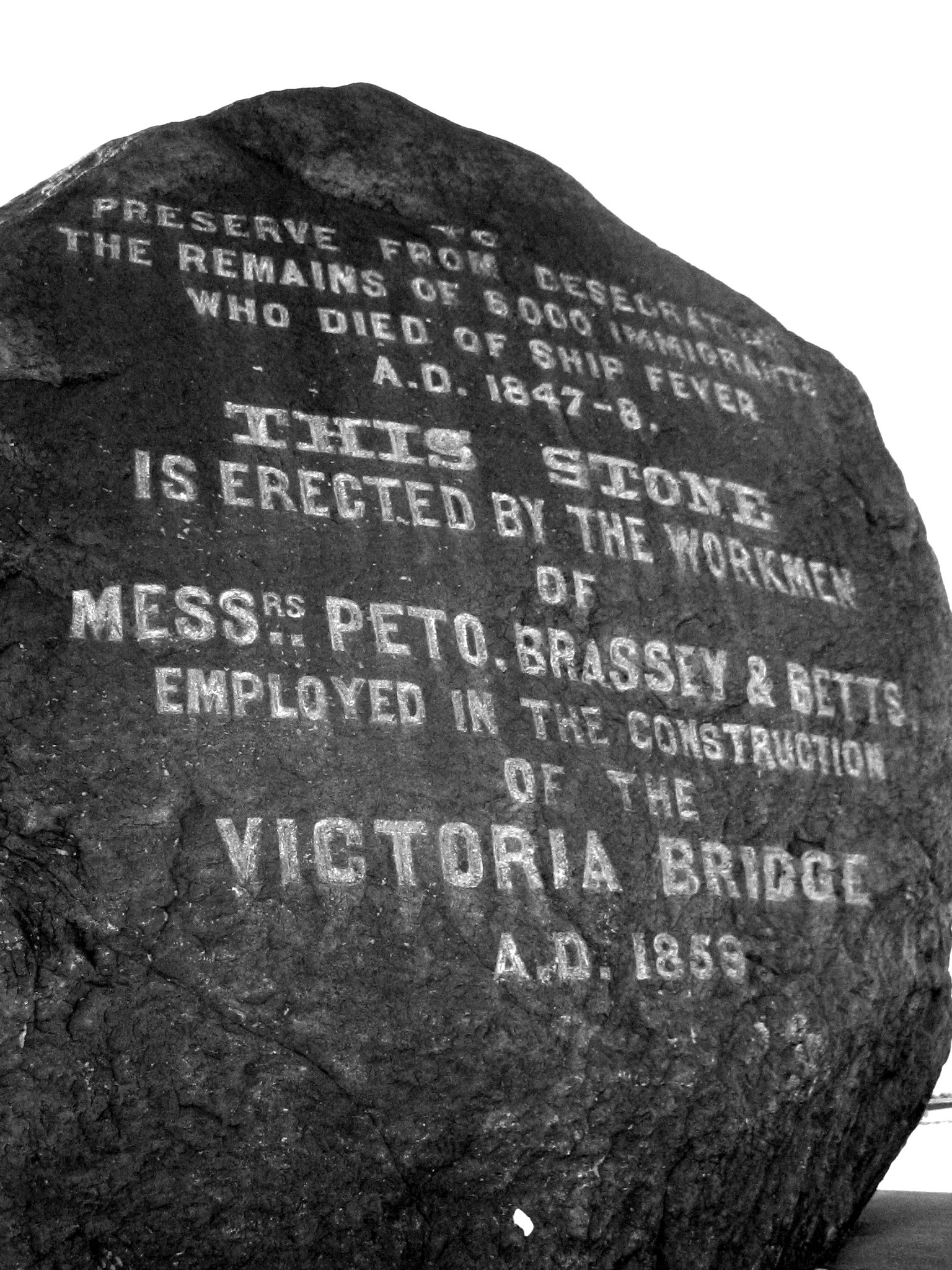
The Black Rock, erected in the memory of the mass grave. Today it's located on Bridge St. in Pointe-Saint-Charles, on the approach to the Victoria Bridge
The designer, Anouk Louten, contacted me as she attempts to get a handle on Irish culture and life in Griffintown in the mid-19th century, attempting to re-create a set as authentic as possible.
This, of course, got me thinking about the usual intersection of history, memory, and the public. Because of course Gow is taking licence from the historical record for the purpose of creating art. It is true that the mass grave of Irish Famine victims was found by the bridge workers, who were also Irish. But the workers probably lived in Goose Village, not Griffintown. A minor quibble with the historical record, to be sure, but still one that those who argue for ‘authenticity’ get their knickers in a twist over. And, I’m sure Gow will also take artistic licence with the characters, their setting, and so on and so forth.
This week, in class, I was teaching the Persian Wars, including the legendary battle at Thermopylae in 480 BCE. Of course, pretty much the entire Western world has seen the movie, 300, which fictionalises what actually happened at Thermopylae some 2,490 years ago. The movie over-dramatises the valour of the Spartans, distorts and obscures the rationale for battle decisions made by the Greeks (including the Spartans, who are conveniently left out of the decision to withdraw 6,700 Greek troops from Thermopylae to avoid being caught in a pincer movement by the Persians), leaving the brave Leonidas and his 299 Spartan warriors to hold off the Persians. As much as I love this film, I always find myself somewhat troubled by it, I kind of feel the film-makers made like the cops in the OJ Simpson case with the glove. Recall that the glove didn’t fit Simpson, who more than likely got away with murder at that trial. At the time, a friend of mine, a law student, opined that the cops may’ve planted the glove, so desperate they were to secure a conviction. If this is true (and really, who knows?), the over-zealousness of the cops allowed Simpson to walk (though, as they say, karma is a mother, and Simpson is in the slammer for other crimes right now). In the case of 300, the film-makers took an already dramatic story about Leonidas and his warriors and over-shot, they over-dramatised something which could’ve stood on its own.
So, as an historian, films like 300 bother me. Not because they take licence with the historical story, but because they pull an Oliver Stone. Stone, of course, once said that you had to hit American film audiences over the head with a mallet in order to get their attention. I think he’s wrong, people aren’t that stupid. But sometimes it makes great art, sometimes, most of the time, it’s just superfluous.
But artistic licence, I fail to see what’s wrong with that, it can make the story more interesting, it can allow the artist to make their point more effectively.
As for authenticity, I’m not sure it matters so much in the larger sense. Certainly, I like Anouk’s attempts to create an authentic set. That, for whatever reason, matters to me. The setting of historical novels, plays, films, this is the detail, the background of people’s lives. Take, for example, The Gangs of New York: a wildly fictional account of the goings-on in the Five Points of Manhattan in the early 1860s. The story itself may be a load of bollocks, but the setting of it in the Five Points, from what I can see, that’s authentic, that reflects the reality of life in what was probably the worst slum in the world.
But authenticity of story or experience (in the case of museums, etc.), I’m not so sure this is desirable or even possible. I think it is impossible to completely re-create the ‘authentic’ historical experience. For one, there’s the obvious problem: it’s impossible, because it is no longer 1861, or whenever. The physical setting is just that, a re-creation of the historical, it can be an authentic re-creation, but that’s as far as it goes. And I think that by itself is a laudable goal, but that should be the end goal. There is no need to go any further, because it is impossible to go any further.
And, so far as I’m concerned, if the story is based in this historical record, that it aims to reflect the setting, then that’s fine. Artistic licence needs to be taken, at least most of the time, maybe not so much in the case of Leonidas’ last stand.
The Shoe on the Other Foot
August 23, 2010 § Leave a comment
Being Canadian, it sometimes feels like we’re the ones on the short end of the stick in global affairs. We’re the ones the Americans invaded during the War of Independence and again in 1812. During World War I, the British used our troops as cannon fodder in battles like the Somme. We have been colonies of the French and the British. Economically, we’re largely dependent upon the Americans. Our peoples are descendent from the colonised of the world (ok, so is the rest of the Western world). In short, I think Canadians like to see themselves as victims, or at least feel like victims far too often. This is why winning double gold medals in hockey over the Americans at the Olympics is such a big deal. For that moment, we’re the winners.
The once-great Vancouver band, Spirit of the West, wrote a song back in the early 90s called “Far Too Canadian.” It’s a lament for our status as hewers of wood and drawers of water, amongst other things. The lyrics:
I’m so content, to stand in line
Wait and see, pass the time
Talk a streak, fall alseep, wake up late, whine and weep
I kiss the hand that slaps me senseless
I’m so accepting, so defenseless
I am far too Canadian
Far too Canadian
…I am the face of my country
Experssionless and small
Weak at the knees, shaking badly
Can’t straighten up at all
I watch the spine of my country bend and break
I’m a sorry state.
A sobering thought, that song. And all the cheesy, stupid, lame-brained Molson Canadian ads in the world (apparently has more square feet of “awesomeness per person” than any other nation on Earth) can’t change it.
That being said, we do have our moments, our victories, and our glories. But we tend to play those down, too (except when they involve gold medals, hockey, and the Olympics). We’re a modest people, I suppose.
So all of this being said, I’m always surprised to find Canadians on the other side, at least historically-speaking. Not far from Charlemont, Massachusetts, is the town of Deerfield. On 29 February 1704, during the War of Spanish Succession, a joint force of 47 French and Canadian soldiers and 200 Mohawk warriors (including the Pocumtuck, who had lived in what is now the Pioneer Valley before the English settlers arrived) raided Deerfield before dawn. The raid was partly in revenge for the settlers’ violent and callous treatment of the Pocumtuck, which culminated in a massacre in what is now nearby Montague Township in 1676.
The combined French-Canadian-aboriginal force caught the settlers unaware before dawn and massacred 56 people. 109 people survived the raid, they were captured and made to march 500km north to Québec, in harsh winter conditions. 21 of them either died or were killed during the trek. Most of those who made it to Québec were eventually ransomed and made their way back to Deerfield. A few, most notably the pastor’s daughter, Eunice Williams, chose to remain. Williams spent the rest of her life at Kahanwake, a Mohawk settlement near Montréal, marring a Mohawk man and having a family with him.
The Deerfield Raid was no doubt a traumatic event for the people of the small settlement. And it has lived on for the past 300 years, it is a foundational story in the Pioneer Valley of Massachusetts. At times, listening to people describe it, reading newspaper stories about the raid, and seeing how it is represented in the pop culture of the Valley, I even get the sense that the trauma of the raid lives on. Certainly, it is strange for a Canadian to realise the Americans were victims of the colonial era. It is even more bizarre to realise that one’s ancestors were the ones who caused the trauma. We are usucally the victims, not the aggressors of historical trauma.
The fact that the 1704 raid lives on in Deerfield, and is largely forgotten in Québec (as France lost that war), is significant. No doubt it lives on in part because Deerfield’s raison d’être today is as a tourist site. Historic Deerfield is a national historic site, and the town’s economy centres around the historical experience there, and the 1704 raid factors heavily into it. It is no doubt the most significant event to have occurred in Deerfield in its 337 year history. And, as a result of the historicisation of Deerfield, the 1704 raid gets played out, reinterpreted, and re-assessed almost daily by the town’s residents, the historical educators, and the tourists who come to visit.
But for me, a Canadian, the first time I visited Deerfield, on a warm, sunny day in late May 2006, I was stunned to find a place that was traumatised by Canadians, at least a place that was not an aboriginal settlement/reserve. And as I took in the colonial American scene in front of me that day, I couldn’t help but feel a shudder of fear imagining that 247-man strong force crawling across the plain along the Deerfield River, coming out of the mist and the snow and laying siege to a small frontier settlement. And every time since that I have driven past, or been into Historic Deerfield, I cannot shake that feeling of terror that the colonist there must’ve felt that cold February morning 306 1/2 years ago.
New Project: NCPH’s Off the Wall
July 14, 2010 § Leave a comment
My friend, Cathy Stanton, has begun a new blog, sponsored by the National Council on Public History in the US, called Off the Wall. The aim of the blog is to offer up “critical reviews of history exhibit practice in an age of ubiquitous display.” Cathy has assembled an impressive set of contributors and commentators to facilitate discussion. Since the blog was launched last week, there have been a handful of posts, reviewing events, exhibits, and displays, my favourite being this one on Flick’s “Looking into the Past” project.
I am one of the contributors, though, so far, all I’ve added to the discussion is a single comment. But the discussions that are arising over there are rather central to the study of history in the digital age. History is all around us, and is a central component of pop culture. At Off the Wall, we’re interested in examining how history interacts with pop culture and the public, to examine how history is used (and abused), how usable pasts are created. Or not created, as the case may be.
Enjoy!
Historical Consciousness
July 13, 2010 § Leave a comment
So, I’m reviewing and revising a textbook right now (not mine, I’m just the outside expert). In this textbook, in the Introduction, I have come across the following passage, which I find amusing. I’m not sure I agree entirely with the idea, but it is an intriguing one for someone who lives in Québec and is a citizen of Canada and who studies Irish history:
In essence, reflecting on human reality means reflecting on ourselves, since we are all humans and nothing in the human experience is completely foreign to us. In this sense, history is to groups of people what psychology is to individuals. Imagine an historian talking to his “patient”:
You suffer from a colonization complex, compounded by a repressed rebellion and a weak constitution. I recommend that you go through a major political crisis every ten or fifteen years over the next 100 years. Then you should feel a bit better. But your past will follow you until the end of your days, in one way or another. You’ll be better off if you accept it right away.
 Matthew Barlow