Bring on the Brand New Renaissance
November 17, 2009 § Leave a comment
For Canadian males of a certain vintage, being a fan of the Tragically Hip is compulsory for maintaining citizenship. It’s true, we can get deported for denouncing the Hip. At the very least, you can get mocked, made fun of, and ostracised for suggesting they’re not all they’re cracked up to be. Even a relatively innocuous statement like noting they’ve kinda fallen off in recent years can get you in trouble, as I learned a decade ago in Ottawa. But once, back in the 1990s, the Hip were it. They defined Canada, beyond hockey, beer, and healthcare. And they had a song called “Three Pistols,” ostensibly about the disappearance of iconic Canadian painter Tom Thomson in Algonquin Park in Ontario in 1917.
There is a line in that song about bringing on the brand new Renaissance, and this is what I thought about when I read an article in the The Times yesterday about all the money flowing out of Middle Eastern nations into sport, in particular, European sport. Brazil and England played a football friendly in Qatar this week (won, not surprisingly, by Brazil, 1-0). Manchester City FC is owned by Sheikh Mansour bin Zayed Al Nahyan of Abu Dhabi. A Middle Eastern consortium is also sniffing around Liverpool FC, which is buried under massive debt brought on by the club’s current American owners. And, as The Times points out, the Middle East is host to not one, but two Grand Prix races. Britain is in danger of losing its F1 race, and Canada actually did lose its last year, though it’s apparently returning to Montréal this coming year.
Bahrain, Abu Dhabi, Qatar, United Arab Emirates, and other small, wealthy Middle Eastern nations, no larger than an Italian city-state during the Renaissance, really, have sought to diversify their economies away from an over-reliance on oil money, and sport has become their ticket to diversification. All fine and good, no doubt (though there are all kinds of environmental issues involved in the over-development of these city-nations).
But what I find interesting about these Middle Eastern cities appealing to the Wayne Rooneys, Kakas, Tiger Woods, Robinhos, Lewis Hamiltons of the world is that it is entirely reminiscent, culturally-speaking, to the Italian Renaissance. In 15th and 16th century, cities like Florence (under the rule of the Medici), Genoa, Venice, and Milano, competed with each other, inviting famous artists and writers to take up residence. The artists would then be subsidised by the rulers, and charged with producing great art, including and especially public art, to be displayed on the public square, or in the church. Other installations and works of art were for the private collections of the likes of the Medici. But then these cities could use their great art, and the reputations of their artists-in-residence as a means of claiming greater prestige than their neighbours and rivals. This competition between Italian city-states drove the Italian Renaissance, which itself drove the Renaissance northwards and across Europe in the 15th and 16th centuries.
In the Middle East, rather than Leonardo, it’s Robinho called in. Sporting evens in the Middle East not only bring in scads of cash for the local economy, they bring in prestige. The F1 series is the most prestigious racing circuit in the world. And it stops in the Middle East twice, in Abu Dhabi and Bahrain. Drawing the greatest football team in the world (Brazil) to play a friendly against the resurgent English side also brings prestige, as does having Tiger Woods design a golf course, as he has done in Dubai.
Qatar is pondering a run at hosting the World Cup in 2022, whilst Dubai is measuring a bid for the 2020 Summer Olympics. Not surprisingly, these are the world’s two largest sporting events, and come not only with economic stimulus for the local economy, but prestige and honour as well.
The Times article rather overlooks the prestige factor here, focussed as it is only on the financial aspects of these sporting events. That is only part of it. The buying power of these Middle Eastern city/nations is only worth so much, the prestige and honour of hosting F1 races, international football friendlies, the World Cup, the Olympics is not to be overlooked, nor is the tourism money. People want to go to Dubai to play on Tiger Woods’ golf course.
[Cross-posted, in slightly different format, at Current Intelligence].
Griffintown Horse Palace Foundation Launch
November 15, 2009 § Leave a comment
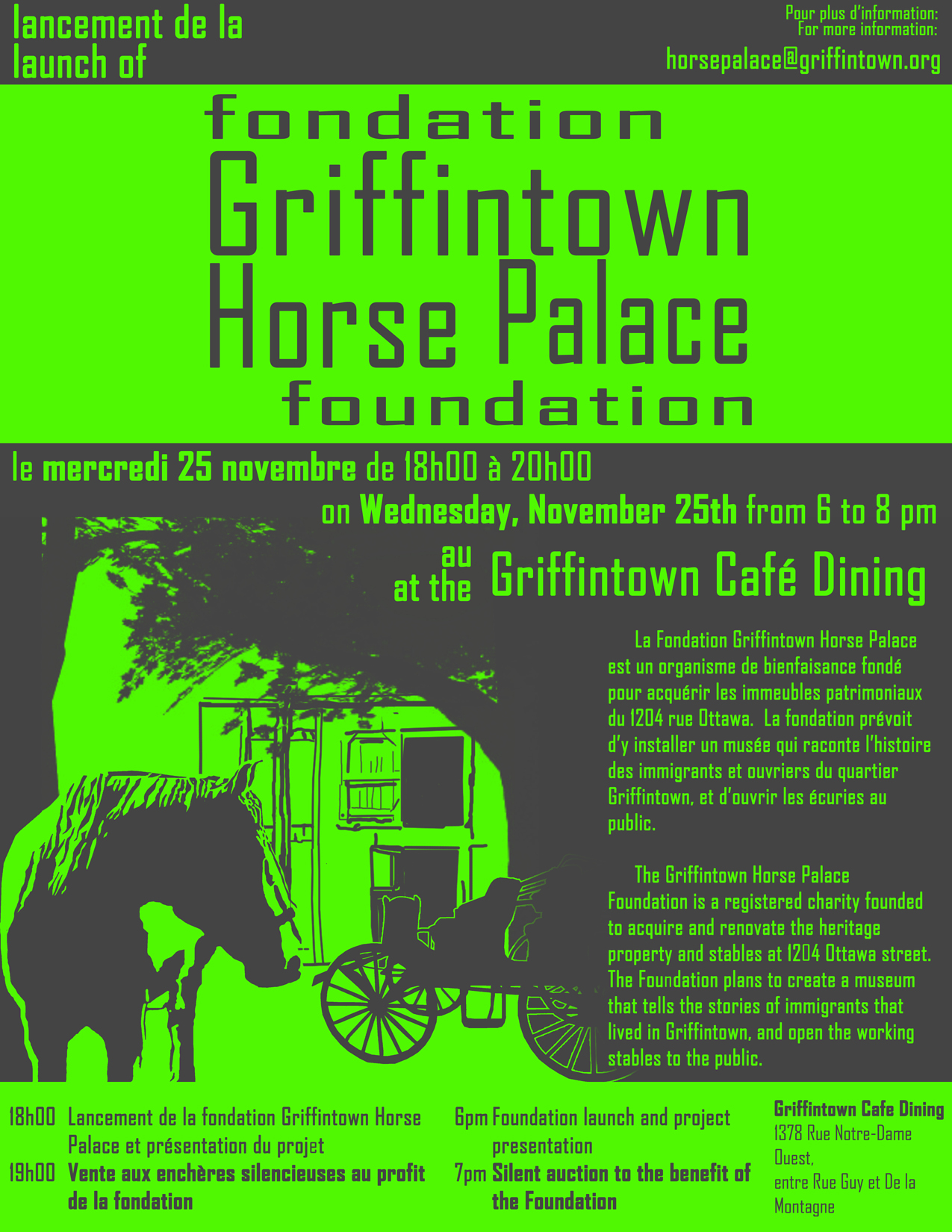
The Griffintown Horse Palace Foundation is dedicated to purchasing and renovating Leo Leonard’s Horse Palace in Griffintown, to turn it into a museum along the lines of the legendary Tenement Museum on the Lower East Side of Manhattan (frankly, one of two museums I find interesting). The Foundation is holding its launch at Café Griffintown at 1378 rue Notre-Dame in the Griff on Wednesday, 25 November, from 6-8pm. Unfortunately, I cannot be there, as I teach a night class on Wednesday nights out at Abbott, but I hope this is a resounding success. For more information, contact the Foundation at horsepalace@griffintown.org.
Assassin’s Creed
November 14, 2009 § Leave a comment
The entire world has gone haywire today over the release of Call of Duty: Modern Warfare 2. Forgive me for not stifling my yawn. Another shoot’em up, bang, bang video game. More terrorists and bad guys, complete with funny accents. Just what the world needs.
No, what excites me is Assassin’s Creed II, to be released next week. OK, call me a nerd, geek, whatever, I could care less. Besides, I’m an historian, I’m used to it.
This game is so totally cool because it’s not just another shoot’em up, bang, bang affair. No, sir. Set in the late 15th and early 16th centuries, the game centres around the Florentine nobleman Ezio Auditore da Firenze, who, in his spare time, is an assassin. The beauty of Italian Renaissance cities Rome, Venice, and, of course, Florence (the centre of the Renaissance), around the time of the rule of the Medici, as well as the Tuscan countryside, is on full display.
The game was developed by Ubisoft’s Montréal-based studio, and the developers were assisted by two historians from McGill University, in order to ensure accuracy. If there’s one thing that amuses me about gamers, they are sticklers for historical accuracy in the background of the games they play, if not in the action itself.
Ubisoft have gone full-out on the advance publicity for the game. In 2008, it bought out Hybride, which had done the graphics for films like 300 and Snakes on a Plane. Ubisoft’s gaming expertise and Hybride’s graphics have led to the release of Assassin’s Creed: Lineage, a movie, essentially, designed for marketing purposes, and to test the waters for Ubisoft’s movie-making capabilities. Parts I and II are below. This is frakin’ wild, my dudes and dudettes:
Cross-posted at Current Intelligence.
Oh, Canada. What are you doing?
February 19, 2009 § Leave a comment
This morning, Le Devoir informed me that Canada is the only western nation not re-patriating its citizens who have been rotting in legal limbo at Guantanamo Bay. In fact, Canada is the only western nation that still has a citizen in Gitmo. There is only one Canadian there, the rather notorious Omar Khadr. Now whatever you may think about young Mr. Khadr is irrelevant. What is relevant is that he is a Canadian citizen, full stop. He was born in Toronto. He is Canadian. And yet, our government here in the Great White North has done exactly nothing to aid young Mr. Khadr, who was all of 15 years of old when he was captured. That would qualify him as a child soldier, I might add, under international law.
All other western nations (France, the United Kingdom, Denmark, Sweden, Spain, Australia, and Belgium) have repatriated their citizens from Gitmo. Not Canada. No sir. Not under the Liberal government in power until January 2006. And certainly not under the Conservative government since then. This is, plain and simple, wrong. Khadr should face justice for his actions in Afghanistan, true. But he should not be facing a kangaroo court, which is what the military court charged with trying him in Gitmo seems to have been. The rules of trial kept changing. And when US President Obama signed the decree to close Gitmo, according to Khadr’s military lawyer, Lt.-Cmdr. William Kuebler, the military commissions in Cuba were effectively ended. Thus, there is no court anymore to try Khadr. Canadian Prime Minister Stephen Harper says that the country cannot interfere in the American judicial process. If that was truly the case, I have yet to see Harper’s explanation as to how those French, British, Danish, Swedish, Spanish, Belgian, and Australian prisoners found their way home.
Khadr has two Canadian lawyers, Dennis Edney and Nate Whitling, who visited him in May 2007. They accuse Canada of abandoning Khadr and the Americans of mistreating him. Edney argues: “You have a gutless country called Canada where the government has not been able to extract even the most meagre of concessions from the U.S. My client is a boy who was shot twice and is blind in one eye, but they won’t even let an independent medical person in to visit him. Out of all the cases I have done, Khadr is the one that gives me nightmares. He has been completely abandoned — and we in Canada have done this.”
I’m afraid that about sums it up. Whatever one things of Khadr, and he is a polarising figure, it doesn’t matter. What does matter is that Canada is not standing up for one of its citizens abroad. And that is wrong. Plainly and completely wrong.
Allison Des Forges
February 15, 2009 § Leave a comment
Allison Des Forges was one of the victims of Thursday’s plane crash in Buffalo, where she was returning home. Des Forges was a leading human rights activists, working with Human Rights Watch, where she was their Africa specialist. She was also one of the first to call a spade a spade in Rwanda back in 1994. The world has suffered a great loss. She was 66. A tribute page on Human Rights Watch’s website can be found here.
The problem with headline writers
February 10, 2009 § Leave a comment
On the website of The Gazette, Montréal’s Anglophone newspaper, there is this headline: “Canada can decide its own future in Afghanistan: US.” In other words, the United States of America, paragon of democracy, is actually allowing a foreign sovereign state to decide on where it will send its military. Oh, thank you, great overlords!
BUT, click on the link, read the story and it’s a rather different story being reported. In actual reality, the Chairman of the Joint US Chiefs of Staff, Adm. Mike Mullen said something very different. He said that he has not, and will not, ask Canada to extend its combat role in Afghanistan beyond the 2011 deadline agreed to by the governing Conservatives and some of the opposition parties last year. That, said Adm. Mullen, is something for Canadians to decide, though he’s, not surprisingly, love to see Canada extend its mission. But he will not, he repeats, formally ask Canada to do so. In fact, Adm. Mullen seems to be aware of the political minefield the Afghan mission is in Canada and would like to stay far away from that.
So, what in the name of God is The Gazette up to? No good, it would seem. There is a very strong sentiment of anti-Americanism in Canada. It’s a good way to score cheap points, politically, and also, it seems, in a newspaper. It’s not as if this anti-Americanism isn’t entirely justified. Former US Ambassador to Canada Paul Celucci did, at one point, tell the Canadian government to spend less money on healthcare and more money on the military. Former US President Lyndon Johnson did shake former Canadian Prime Minister Leaster B. Pearson by the lapels for having an opinion on the Canada-US Auto Pact that didn’t jibe with Johnson’s. There are other examples, but the point is less that than the fact that Canadians do have an historic right to be suspicious of American designs and goals.
But, The Gazette is purposefully mis-leading its readers here. And while I’m not usually a big fan of The Gazette at the best of times, this is just a cheap shot. There is nothing in the story to connect to the headline. Instead, the newspaper is going for the cheap, lowest common denominator. And that is just wrong.
Agricultural Terrorism?
February 10, 2009 § Leave a comment
Geoff Manaugh over at BLDGBLOG, one of my favourite sites, has an interesting bit about a Welsh farmer who found a unique way of protesting Wales’ banning of genitically modified food. It seems that, upset with the fact that the Welsh assembly did not open the decision up to debate, the dude got himself some genetically modified seed and planted it, grew it, and fed it to local sheep and cattle. The seed he got was on the EU’s common variety list, making it legal to grow anywhere in the EU.
This is rather fascinating, in a scary kind of way. Genetically modified food has kind of become part of our cultural landscape in recent years. Whether we want to or not, I’m sure most of us consume it if we don’t go out of our way to ensure we eat organic. But this got me thinking about a case here in Canada a few years back involving a farmer in Saskatchewan. I’m not sure I’m remembering this completely correctly, but I seem to recall that he was sued by Monsanto for illegally acquiring its GM wheat. From what I recall, he had the seed because it blew onto his farm.
This, in turn, led me to ponder my general desire to eat organic fruits, veggies, and meat. Pesticides are kind of a scary thing, I think. Does the consumption of GM wheat on the part of these Welsh sheep and cattle, even inadvertently, now mean that dairy and meat products that come from them cannot be considered all-natural or organic? Does this mean that if GM food blows onto a farm or ranch and the animals consume it, or it gets mixed in with the organic seed, that we now have non-organic food? It would seem to me that that is indeed the case. So what does this mean for organic farming and meat production? What does this mean when I head off to Marché Atwater tomorrow and specifically purchase organic beef? Does this mean that I need to be wondering what this cow ate, that maybe it’s not organic?
Does this count as agricultural terrorism? One of the responses to Manaugh’s post seems to think so.
Continuing the discussion: Power & Imperialism
February 4, 2009 § Leave a comment
My apologies, Janet Ajzenstat replied to me nearly two weeks ago, but I have been insanely busy. Most notably, I have finished and submitted my doctoral dissertation. Finally. So, without further ado:
In response to my initial post “Power & Colonialism,” (which itself was inspired by the Professor’s blog)you can find the Professor’s comments. I’m not so sure that I’m entirely ready to accept her argument that “even humanitarian aid can have a depressing effect on democratic development.” All sorts of things can have a depressing effect on democratic development, including democracy itself. Exhibit A would be the actions of the late, unlamented Bush Administration in the United States. During Bush’s tenure in office, many anti-democratic measures were taken and/or insituted by the American government, from wire taps, to the Patriot Act, and beyond.
However, the Professor is very correct to note the ambivalence and contradiction of the British colonial project. British democracy is founded upon the Lockean principle that populations cannot be governed without their consent. Indeed, this is exactly what the Americans were on about at the time of their War of Independence in the 1770s and 1870s. However, a major portion of the British colonial project involed governing over subordinate peoples, ostensibly to teach them how to goven themselves, but just as often to enrich Britain (case in point: India). Not that this did not have some positive benefits, though I think imperial apologists like Niall Ferguson go too far. In his Empire, Ferguson almost completely lets the British off the hook because they brought democracy around the world and essentially civilised the natives. I’m sorry, but that is not a good enough defence to justify the brutality of the colonial experience in Asia, Africa, and Ireland.
But then the Professor turns back to Israel and notes that its democratic institutions are also founded on Lockean principles. And yet, here is Israel acting as imperialist in the Gaza Strip and beyond. The recent move by the Israeli Central Election Committee to ban Arab parties from running in the upcoming elections there is more than slightly disturbing. This enforces a form of apartheid. I am not entirely prepared to accuse Israel of apartheid in its relations with the Palestinians, but decisions such as this are frigthtening, anti-democratic, and have the appearances of apartheid.
Très intéressant
January 22, 2009 § Leave a comment
In Le Devoir today, Catherine Côté, who teaches Political Studies at the University of Ottawa, has an interesting piece on the political discourse of Barack Obama and French President Nicholas Sarkozy, entitled “Obama et Sarkozy: Même discours.” In it, she notes the similarity in their campaign trail discourses in the French presidential election of 2007 and the American presidential election of last year. Indeed, even their campaign slogans are remarkably similar. Sarkozy: “Ensemble, tout devient possible.” Obama: “Yes, we can!”
I’ll leave those interested in the article to read it themselves, but I will offer up here a few quotes Côté provides us to compare the two politicians. In the first istance, she compares Sarkozy’s speech eight days before the French election at the palais Omnisport de Bercy, with Obama’s infomercial six days before the American election.
Sarkozy: “Huit jours pour fair de nos rêves une réalité; huit jours pour se lever; huit jours pour bâtir l’espérance dont la France a besoin; huit jours pour dire ce que nous voulons pour nos enfants; huit jours pour dire que la France est un vieux pays qui a tant de choses à dire au monde, à l’Europe; huit jours pour faire du travail, du mérite, de l’effort, de la récompense, de l’humanisme, les valeurs de la République française; huit jours pour que l’avenir soit une espérance; pour convaincre, pour rassembler, pour que tous ceux qui aiment passionément la France nous aident à bâtir la France de renouveau…J’ai besoin de vous, comme jamais un candidat n’a eu besoin du peuple à ses côtés; j’ai besoin de vois, pour être le candidat du peuple de France; j’ai besoin de vous, la victoire est en vous; la victoire sera belle parce que ce sera la vôtre; vive le République et vive la France!”
Obama: “In six days, we can choose an economy that rewards work and creates new jobs and fuels prosperity from the bottom-up; in six days, we can choose to invest in health care for our families, and education for our kids, and renewable energy for our future; in six days, we can choose hope over fear, unity over division, the promise of change over the power of the status quo; in six days, we can come together as one nation, and one people, and once more choose our better history…If you will stand with m e, and fight with me, and give me your vote, then I promise you this: we will not just win North Carolina, we will not just win this election, but together, we will change this country and we will change the world. Thank you. God bless you, and may God bless America!”
Côté does not suggest that Obama is ripping off Sarkozy, but she is arguing that they are making very similar arguments that might seem to stand at odds with what we think of when we think of Obama. Let us not forget that Sarkozy is a conservative, or at least that’s how he was elected, as the candidate for the Union pour un Mouvement Populaire, the mainstream right-wing party in France. Côté concludes that: “Dans les deux discours, une même incarnation pour conquérir les coeurs: patriotisme, conservatisme et populisme, une même incantation qui se fait homme.”
Barack Obama as a conservative populist. Hmm.
I would also suggest that there are more similarities between Obama and Sarkozy than their political discourse. Both tout their non-partisan approaches to politics. Indeed, Sarkozy has appointed Socialists to his cabinet. Obama has appointed Republicans to his, though we have yet to see how Obama will work in this sense. But perhaps even more, both are cultural phenomena. Sarkozy, largely because he left his wife, or she left him, and he hooked up with Carla Bruni, the sexy chanteuse. But through Bruni, “Sarko,” became the number one celebrity in France. Indeed, so obssessed did Sarkozy become with his image, he had his buddies in the media airbrush his love handles off him in a photo of him canoeing. It got so bad that last year, the French people began to turn on him because they saw him more as a rock star than a president and there was a sense that he was beginning to do damage to the Office of the President.
Obama, on the other hand, is a rock star of his own accord.
Either way, Côté brings up some interesting points about everyone’s (including mine) favourite American president.
Power & Colonialism
January 19, 2009 § 1 Comment
Janet Ajzenstat, Professor Emeritus of Political Science at McMaster University has a fascinating post on her blog on the issue of money and colonialism. Ajzenstat is interested in the Gaza Strip and its colonial status, which, she argues, is a given. But the question, in her mind, is who is the coloniser? Rather than fall back on the standard argument of Israel as coloniser, she goes a bit deeper and follows the money.
One of my favourite TV shows is The Wire. In the first season, the cops are trying to pin down one of the biggest drugdealers in Baltimore, Avon Barksdale. In Episode 8, “Lessons,” the cops learn something important. They’re used to busting the drug dealers and the drug addicts. But this time, they stop the bagman, the dude carrying the drug money picked up from the point-of-sale to be taken to the safe house. So they arrest the bagman and the money. The bagman is the driver for a Maryland state senator. This is where it gets interesting: where is the money going? Detective Lester Freamon notes that if you follow the money, you end up in all sorts of uncomfortable places.
And so this is where Ajzenstat is going with her exploration of the colonial status of the Palestine, noting that the money comes largely from Arab supporters of the Hamas on the Gaza Strip. Thus, she concludes: “So by Ajzenstat’s definition, Gaza is a colony. But is Israel the colonizer? Insofar as it is supplying humanitarian aid, yes. But so are the “Arab sources”…Iran, the UN, and “the West” relieve Hamas of the necessity of improving the lives of its people.”
In other words, she concludes that because the money for the heavy-lifting of governing the Gaza Strip comes from these Arab sources, they are the colonisers in this sense. This is a fascinating argument and one that should not be dismissed. She argues that “Colonizers can be defined as groups or countries that make rules for others by which the colonizers themselves are not bound. And as I explained a couple of days ago colonizers often enforce those rules by paying into the colony’s coffers.”
This is an interesting argument, but personally, I am not entirely ready to accept her argument. The question arises out of what the Arab states purchase with their money in the Gaza Strip. Money is power in a lot of senses, including this one.
But money is only part of the story. And colonialism is not so simply defined. Colonies can take on all sorts of shapes and sizes. Canada was a colony of Britain for most of its history. But what did that mean? The British were not here to civilise and extract great profits from Canada. But the British also colonised other locales. Like, for example, Ireland. What did the British do in Ireland? They proscribed the freedom of the native Irish population, attempting to “civilise” (this is the word the British used, not me, go look it up) the natives. They also wanted to not have a potentially hostile nation on its periphery. In India, they had other things to do. Sure, the “civilising” mission was there, but India also made Britain a boatload of money. So, in these three instances, the finances really only matter in one location: India.
Of course, in making her argument, Ajzenstat points to colonial early-19th century Lower Canada (Québec today), and the fact that by some estimates, Britain was paying nearly half of the Lower Canadian colonial government’s expenses. Hence the connection to the Gaza Strip today.
This, however, is only part of the story. There is also the question of who is proscribing Arab movement and power in the Gaza Strip. The answer to that question is Israel. So we must not lose track of that fact of this colonial situation. Israel’s role goes beyond the supplying of humanitarian aid, which is what Ajzenstat points to in locating Israel’s colonising status in the Gaza Strip.
Having said all of this, what makes Ajzenstat’s argument so interesting is the complication it brings to the usual debate about Israel and the Gaza Strip. Complexity is what is needed here to try to make sense of a complicated, and messy situation.
 Matthew Barlow