More on the zero trope
December 21, 2008 § Leave a comment
Mike Innes has an interesting piece over on his blog, picking up the discussion of the zero trope. This is an interesting discussion, at least to me, as Mike and I have been arguing, haggling, and bickering for the past year or so on the issue. This piece is interesting. He picks up on an article written by Antoine Bousquet in 2006 that looks at 11 September 2001 as a ground zero. Bousquet, in effect, argues that 11 September, like the Hiroshima bombing (and I am going with Mike’s interpretation of Bousquet’s argument here, as my institution doesn’t allow me to access the full text of Bousquet’s article) was a rupture in the historical consciousness of the Western world.
Mike takes issue with suggesting that 11 September can be properly termed a ground zero in the sense that Bousquet means it: a total rupture of the historical consciousness, and narrative, of Western culture. His problem arises from the fact that we don’t have historical perspective to judge the impact of 11 September on our historical consciousness yet. In building his argument, however, Bousquet uses the example of Hiroshima as an analogy, Mike suggests the Holocaust. Either way, I think both of those historical moments can be seen as ruptures. Hiroshima ushered in the nuclear age, led to the Cold War and the dominant ideology anyone over the age of 35 in Europe and North America, if not elsewhere, grew up in. The Holocaust was such an evil that the world has reeled since, in a sense, we live in the age of genocide now, in part thanks to Raphael Lemkin coining the term, in part due to the world’s response to the Holocaust, and those famous words: “Never again.” Of course, it has happened again, and as many historians have shown, lingering anti-semitism amongst the ruling classes of the UK, Canada, and various other nations ensured that Jews could not flee Nazi Germany for safe harbour there.
But I digress. The point is made. But I’m going to be the historian again here. Recently, I argued on the CTlab review in response to another posting of Mike’s, which was itself a response to an article in The Atlantic reviewing archaeologist Barry Cunliffe’s new book, Europe Between the Oceans. I won’t get into the details of my argument there. But it is relevant to the argument I am going to make here.
The problem I have with this push to find the ground zero, I think, is this: ground zeros exist all around us.
Mike and Antoine have both thought of two alternate ground zeros for Western historical consciousness, both in the same era: Hiroshima and the Holocaust. They argue over whether or not 11 September is one. I might also add the Vietnam War, which was the introduction of television into how war is fought and the attendant responses of belligerent states. How different would wars be since Vietnam if there weren’t TV crews following soldiers around Afghanistan and Iraq today? Or in Somalia in the early 1990s? Or in Iraq and Kuwait a few years earlier?
Ruptures in the historical consciousness happen on the meta level with relative frequency, I would argue. In the first half of the twentieth century, Europe and North America experienced: World War I, the Bolshevik Revolution in Russia, the Depression, World War II (including the Holocaust and Hiroshima), and the outset of the Cold War. Those events all caused massive, fundamental change. In some ways, each caused a rupture in the Western cultural historical consciousness, which I interpret to be, basically, the stories we tell ourselves as a culture.
Similarly, ruptures have occurred on the national level, depending on the nation. In Ireland, independence was gained in the aftermath of World War I, or at least independence for most of the island, because there was also partition. Independence for what became the Republic of Ireland and the creation of the Northern Irish unionist state are clearly moments of rupture in Ireland’s (and Britain’s) historical consciousness.
In Canada, in October 1970, armed terrorists kidnapped the British trade minister in Montréal, James Cross, as well as the Québec Minister of Labour, Pierre Laporte. Laporte was later killed. The terrorists were the Front de Libération du Québec. Their goal was Québec’s independence, and they sought to do so through violence. The FLQ had spent much of the 1960s exploding bombs in and around Montréal, but nothing compared to what happened in October 1970. There were soldiers on the streets of the city for most of the autumn and early winter of 1970. This certainly caused a rupture in our historical consciousness in Canada/Québec. Gone was our prosaic belief in our peaceability, or our belief that we’re safe.
Personally, we all experience our own ground zeros on a regular basis. Moments where we experience a rupture in our own personal historical consciousness. And this doesn’t always have to be negative, they can be positive, too. Getting married. Our parents dying. Being diagnosed with a catastrophic illness. There are always moments after which nothing is ever the same. Indeed, given that there are always consequences of all of our actions. If we want to get down to the micro-historical level, our actions are always leading to different outcomes, our lives are never the same after any given moment in our lives. How do I know how else my decision to go to the dépanneur this evening could have played out? Maybe I would have otherwise stayed home and not missed the call from an old friend in Vancouver? Maybe not. Maybe the call would never have come if I wasn’t home.
I am fascinated with this exploration of the zero trope, and I’m not trying to suggest there is no point to such explorations. However, what I am suggesting is something similar to which I suggested in the CTlab post, and that is we, as a culture, spend so much time trying to find rupture, moments that the world changed, the moments the world stood still. This doesn’t mean necessarily that we shouldn’t look for those great moments of rupture, those instances where our historical consciousnesses are altered. What I’m suggesting is that perhaps they are more common than we think. Or at the very least, we need to be prepared to recognise the multiplicity of such moments, and to recognise that they exists at the meta and micro levels, as well as those levels in between.
Thoughts on Zimbabwe & Empire
December 21, 2008 § Leave a comment
The Canadian Broadcasting Corporation reports today the the United States has no faith in the deal cut in September that would see Mugabe and Tsvangirai share power, with the former as President and the latter as Prime Minister. The United States doesn’t believe that Mugabe intends to actually do so. Jendayi Frazer, who is the US Assistant Secretary of State for Foreign Affairs, also noted to reporters in Pretoria, South Africa, that Mugabe’s claims that the west is engaging in biological warfare by launching cholera in Zimabwe shows that Mugabe is “a man who’s lost it, who’s losing his mind, who’s out of touch with reality.”
Tsvangirai, meanwhile, claims that 42 of his supporters have been abducted by state agents, and so he and his Movement for Democratic Change have pulled out of power-sharing discussions if nothing is put forth by New Year’s Day.
That is discouraging.
Meanwhile, the CBC allows for people to pontificate on news stories on its website, which usually leads to a whole raft of, for the lack of a better term, interesting positions put forth. One argues the following: “Currently popular opinion that “Mugabe is guilty for everything” is apparent oversimplification. The sad truth is that if it was not Mugabe, it would have been Nkomo; if not Nkomo it would have been someone else, but the result would have been the same, as the same scenario repeats itself over and over again in literally ALL African countries liberated from “white rule”. The history of failures of newly liberated African countries proves over and over again that “equal representation” democracy does not work in Africa.” By “equal representation”, he means equality between blacks and whites. He goes onto argue that blacks in the former Rhodesia were still tribesmen in the 60s and 70s and were not literate, nor did they speak English. This, in his mind, means that black Rhodesians were not ready for democracy and self-rule.
He also argues that land was distributed equally to blacks and whites under British rule in Rhodesia and that whites farmed the land better, whereas black farms suffered from soil erosion. Of course, in reality, white Britons received the vast majority of land in Rhodesia, all of it well-drained, fertile, and on flat land. Blacks, on the other hand, got less land (though they were the majority) and it tended to be land on hillsides, have poor soil, and not well drained.
Another poster argues, after having read an article in The Economist on the civil war in Congo, and Rwanda’s involvement therein, argues that all of the people commenting on this article “blames the west, the US, Britain, France or China. They blame greedy corperations, they blame a weak AU. Anyone but the combatants. A continent that cannot take responsibility for it’s actions cannot rule itself.” He actually posts in response to this article, too, arguing that Africans behave like spoiled teenagers. I think he’s referring to the leadership cadre.
I find this kind of commentary depressing. The first poster on the CBC’s website is basically making the same argument the British used for centuries to justify their colonialism in various parts of the world, including India, Rhodesia, and Ireland. The natives aren’t ready to rule themselves. Funny, but seems to me that they were doing fine before being colonised. A former colleague once argued in response, vis-à-vis Ireland, that the British united the fractious kingdoms of Ireland into a unified nation. This, in his mind, justified imperialism and colonialism, and the horrors attached thereto.
As for the poster’s argument that the fact that black Rhodesians did not even speak English meant that they were unfit for democracy and self-rule is so far beyond the pale of being worth responding to.
The second poster’s arguments are from the same vein. In the end, on The Economist‘s website he seems to be arguing that it is time for Zimbabweans to rise up against Mugabe. Fair enough, but the poster is also Canadian. He lectures people that in Canada, when faced with a corrupt régime, we turf them out of office. As I noted in a previous post, this is exactly what Zimbabweans tried to do in the spring of 2008, vote Mugabe out of office. Mugabe refuses to take heed. I also noted that Mugabe’s response has been violence. Very easy to be sitting in Canada and suggest that people who are starving, poor, desperate just to survive, to say nothing of the cholera epidemic, should be taking up arms against their government. Very easy. But then he goes on to suggest that Africans are spoiled teenagers and the continent (the entire continent, mind) is incapable of self-rule, though he does pat South Africa on the back for being on the right track.
Commentary like this just astounds me. Where do you start to respond to this? It’s so wrapped up in racist, colonialist mindsets. The logic of their argument is inconsistent, arguing on the one hand that the citizens of Zimbabwe need to rise up against Mugabe, and then arguing that Africans are incapable of ruling themselves. Which one is it? Then they complain that everyone blames the west, in purposeful reductionism. The problem with this type of mindset is that, 1) it refuses to recognise the legacy of colonialism, and 2) it advocates neo-colonialism as a solution. This, my friends, is what logicians call circular logic. Me, I call it disturbing and offensive.
Whither Zimbabwe
December 20, 2008 § Leave a comment
Stephen Ellis has an excellent analysis of the role of the African Union in the Zimbabwean Crisis at the CTlab’s Review.
Mugabe: L’état, c’est moi
December 20, 2008 § Leave a comment
Oy vey. Robert Mugabe. Today’s Globe & Mail reports his latest paranoid dictator declaration: “Zimbabwe is mine.” He goes on to state that not only do other African states lack the will to remove him, but that only Zimbabweans can remove him from power. Funny that. It seems to me that that is exactly what Zimbabweans tried to do back in the spring. But, of course, Morgan Tsvangirai didn’t win an absolute majority in that election, so there was a run-off. Mugabe held onto power in that run-off by having his goonda squads run around beating, imprisoning, and threatening Tsvangirai’s supporters. So, in the end, he maintained power through nefarious means. We all know the result. But the thing that I find most frightening about Mugabe’s most recent outburst is this, taken from the same Globe & Mail article:
He warned: “Now we know you and we are watching you closely.”
Does this mean that Mugabe is going to make like Stalin and engage in purges of people he thinks are disloyal? Paranoia is certainly not out of the question for Mugabe, given his continued pronouncements against the British.
Either way, it is time for Mugabe to go. At this point, it seems that Zimbabweans have suffered too much. More than enough. Mugabe has no interest in looking out for his people, his interest is in looking out for himself.
The question is, then, what is to be done? What is the solution? Will Mugabe’s ouster have to come from within Zimbabwe? Or will other African nations put pressure on him, whether diplomatic or militarily, to resign? Or will that force come from outside of Africa? It seems that the entire world is calling on Mugabe to go.
Enfin, la justice & the narcissism of academic debate
December 18, 2008 § 2 Comments
So news has come that Théonaste Bagasora, a former colonel in the Rwandan army, was sentenced to life in prison for his actions in inciting the genocide there in 1994, in Arusha, Tanzania. The Rwandan government of Paul Kagamé (whose behaviour during the genocide remains open to debate) is pleased. Aloys Mutabingwa, a Rwandan government spokesperson, told Agence France-Presse that “En ce qui concerne Bagosora, la justice a été rendue. Nous sommes satisfaits.”
Part of what concerns me about the emergent view of the Rwandan genocide today is that the number of victims gets downplayed. Whilst the BBC reports that 800,000 ethnic Tutsis and moderate Hutus were massacred in the spring of 1994 in Rwanda, Canada’s own The Globe & Mail insists the numbers are closer to 500,000. What’s more interesting is that The Globe relies on the same Associated Press article that the Montreal Gazette does, but has downshifted the numbers from 800,000 to 500,000. This isn’t really news insofar as The Globe goes, the 500,000 figure has consistently been in their stories for at least the last few years. I once emailed The Globe’s Africa correspondent, Stephanie Nolen, but she never responded. Today, I have had an email exchange with the Foreign Desk Editor, but I haven’t really received a satisfactory response.
Of course, the 500,000 figure gets into a debate about start and end date of the Rwandan genocide. The accepted parameters here are the 100 days after President Juvénal Habyarimana’s plane was shot down near the Kigali airport on 6 April 1994. In those 100 days, 800,000 people died. That’s 8,000 people killed every day for 100 days in Rwanda. I still shudder at that. Anyway. I guess that when we start debating 500,000 v. 800,000 killed, we start defining starting and ending dates of the genocide.
And, on one level, given the number of dead in Rwanda in a 90-day genocide is so astronomic, a difference of 300,000 is probably not a big deal, on another level, we are talking about 300,000 people, bludgeoned to death. The numbers are overwhelming, but these were still people. I guess my problem here is that I find myself overwhelmed by numbers when we discuss genocide and genocidal massacres, and the body counts just make my head swim. I took a course on genocide and human rights at the outset of my PhD and had to stop doing the readings because they were really just clinical listings of the dead. A few million here, 100,000 there, and so on. I suppose the only way to deal with genocide is to adopt a clinical tone, but I can’t do it. So the difference between 500,000 and 800,000 matters.
And while the Aegis Trust reminds us that the important thing to remember is that there was a genocide, I also think that we need to remember that 800,000 people lost their lives because of their political beliefs (in the case of moderate Hutus) or simply their ethnicity (in the case of the Tutsis). And that, my friends, is not right, it is abhorrent, it still makes me ill. One of the things most clearly seared into my head is Gen. Roméo Dallaire’s description of going to a meeting with this or that military commander, having to cross a river that had stopped flowing, so filled with bloated corpses it was. In short, we need to remember not just that there was a genocide, but that actual real people died. I think we forget that too quickly when we get into academic debates about start and end dates and so on.
shameless self-promotion
December 1, 2008 § Leave a comment
here is the link to the next ctlab event, a virtual symposium to be held 5-8 december in response to antoine bousquet’s new book, The Scientific Way of Warfare: Order and Chaos on the Battlefields of Modernity(London: Hurst & Co. Publishers; New York: Columbia University Press, 2009).
the zero trope
November 27, 2008 § 6 Comments
so, about this time last year, mike was developing this idea of the zero trope with regards to the terrorist, the ground zero creating the terrorist. we had a lively exchange on the subject, mostly categorised by me playing the role i apparently am supposed to, which is the cranky historian historicising the discussion. anyway. last week, i was at a public lecture by katie gough, a visiting professor in irish studies at concordia university, on irish theatre, and a representation of the slave ship zong in elizabeth kuti’s 2005 play, the sugar wife.
in her talk, gough referred to the zong as the “ground zero” of the anti-slavery movement, due to the events on board the zong which resulted in the massacre of 60 african slaves in 1781. in other words, the zong was the event that lead to the beginnings of an anti-slavery movement in england and the rest of the british isles, culminating in the abolition of the slave trade in the united kingdom and its empire in 1833.
so this got me thinking about mike’s idea of the zero trope and terrorism, and since he’s probably the only person who bothers reading this blog, i’m sure he’ll have something to say in response. i argued last winter that finding a ground zero for terrorism is probably impossible, because all forms of terrorist activity owe some sort of debt to what came before them. al-qaeda is in the debt of the mujahaddin, who owe something to the viet cong, the plo owes something to the ira and the stern gang. and so on and so forth.
but, terrorism as a largely over-arching concept is one thing, but the terrorist is another. i’m still not entirely sure you can find one event, one moment that makes a terrorist. but maybe you can find one event, one moment that gives birth to a new movement? to take the example of the provisional irish republican army: it grew up in 1969, claiming to be a continuation of the irish republican army that had fought, first in the irish war of independence and then the irish civil war in the early 1920s. the provos, as they are called, argued that neither the republic or ireland nor the northern irish government were legitimate, and that only the 1919 irish republic is/was. and thus, they continued the fight to push the british out of ireland. the provos emerged out of a split of the irish republican army over abstentionism and the explosion of violence in derry and belfast in 1969. thus, we have a ground zero for the provisional irish republican army. sort of. because the provos are connected with the independence-era irish republican army. that body, however, is murkier in terms of defining whether or not it was a terrorist organisation because, of course, it won irish independence (though it lost the civil war, sort of, as the irish civil war was a battle between ira members who supported the treaty granting independence to ireland by britain and those who opposed the treaty). moreover, whilst forming an army for independence was a new one, sort of, in 1913, when the ira was founded, it grew out of the irish volunteers, a military organisation formed around the same time out of various other para-military secret societies agitating for irish independence in some shape or form. in other words, finding ground zero of an armed struggle for irish independence is nigh-on impossible, and the provisional ira claims to be a descendant of that struggle, as it argues that ireland is still not free and united, or at least it did before the current round of peace that has exited in ireland and northern ireland for the past decade. but even the last major terrorist act, that in omagh, northern ireland, in august 1998, was carried out by the real ira, itself a splinter group from the provos. and so on and so forth.
i guess, though, at the end of the day, what my problem with this trope is that it compartmenatlises too much, it breaks down and separates too much. terrorism is an ancient concept, and has existed as long as there has been organised violence. but individual terrorist groups, ok, maybe they do develop, but they don’t do so in a vacuum, the idea comes from somewhere. and that idea has historical antecedents, though perhaps they are cast anew with each new form.
but does this mean we can find the ‘ground zero’ of a terrorist, a terrorist organisation? of that i am not so sure.
this is wild
November 20, 2008 § Leave a comment
check out geoff manaugh’s bldgblog, for the latest on piracy in the high seas: http://bldgblog.blogspot.com/2008/11/piracy-live-at-sea.html
le monde virtuel et les soldats réels
November 20, 2008 § Leave a comment
on the trip into work today, i saw an interesting piece in le devoir about virtual training for canadian soldiers. according to le devoir, virtual training through army learning support centre at cfb gagetown in new brunswick ends up being cheaper than actual training for some functions. for example, to train a soldier to drive a tank, it usually costs close to 145,000$ per soldier in the real world, over the course of 6 weeks. but doing so virtually, costs only 96,000$, and it only takes two weeks. moreover, the success rate of the soldiers has shot up from 72% to 83%. according to capt. jeremy macdonald, who was interviewed at the Sommet international du jeu de Montréal, “plus de simulation, moins de terrain, plus de diplômés et moins d’argent: les chiffres parlent d’eux-mêmes et l’avantage de la formation virtuelle et s’avère indéniable.”
the centre has a staff 90 full-time, 20 contractors, and 30 interns from a nearby college. they support training for land forces in infantry, armour, artillery, tactics, as well as the canadian forces school of military engineering at cfb gagetown, as well as the canadian forces land advanced warfare centre, the canadian forces school of electrical and mechanical engineering and the canadian forces school of communications and electronics, all of which are in ontario.
given the continual budget crunch facing the canadian military, and i suppose, increasingly, all militaries, i think that the move to use virtual training instead of land training is an interesting one. i find myself wondering, in the case of the tank driver, if his virtual training is actually helpful for him in real life?
many of my students are gamers, and sometimes i wonder if their gaming experiences prepare them for or distort their interactions with reality, not necessarily because of whatever game they’re playing, but due to the virtual experience: it’s not real. it’s artificial and exists inside a computer. but is there a difference between that and the training of a soldier at cfb gagetown?
either way, i think it’s kinda neat.
Upcoming CTlab event, 26 November in London, UK
November 8, 2008 § Leave a comment
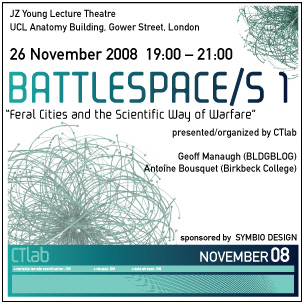
For more details, check out the website of the complex terrain laboratory or the battlespaces page.
 Matthew Barlow