The Enduring Legacy of Slavery
February 18, 2019 § 2 Comments
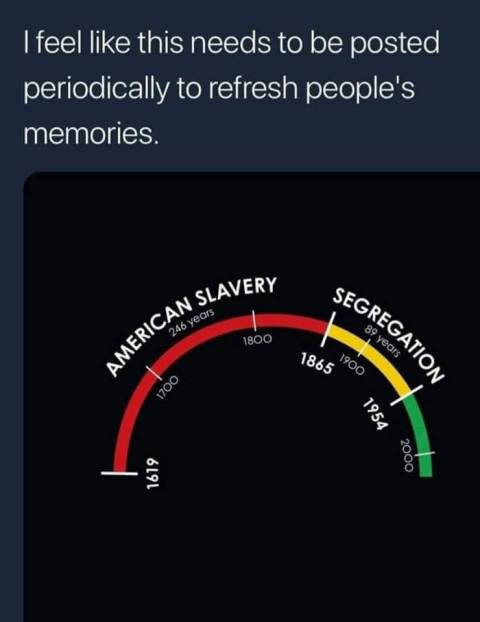
This came through my feed on Facebook a few days ago. It’s worth re-posting and it’s worth a deeper commentary. The United States was founded upon slavery. Fact. The Founding Fathers included slave owners. Face. The Founding Fathers didn’t deal with slavery in the Constitution. Fact. The Civil War happened because the South seceded over slavery. Fact. The Southern response to Emancipation was Black Codes, the Ku Klux Klan and segregation. Fact. Desegregation only happened because of the intervention of the Supreme Court. Fact.
But. None of this is a Southern thing. Slavery initially existed in the North as well. But even after the North banned slavery, it benefited from slavery. The American industrial revolution began in Lowell, MA, due to the easy availability of Southern cotton. The North got wealthy, in other words, on the backs of Southern slaves. The North countenanced slavery.
After the Civil War, the North countenanced segregation. The second Ku Klux Klan emerged in Atlanta, true, but it operated all over the country. And, following Brown v. Board of Education, the Supreme Court decision that desegregated schools, the North was affected, most notably during the Boston Busing Crisis in the 1970s.
But even with the official end of desegregation with Brown v. Board, it’s not like segregation went away. Schools today remain very segregated across the United States due to the outcomes of racism, poverty and housing choices. In fact, one of the outcomes of the Boston Busing Crisis. The busing ‘experiment’ in Boston ended in 1988, by which time the Boston school district had shrunk from 100,000 students to only 57,000. Only 15% of those students were white. As of 2008, Boston’s public schools were 76% African American and Hispanic, and only 14% white. Meanwhile, Boston’s white, non-Hispanic population in 2000 was 55% white. White Bostonians pulled their children out of the city’s public schools and either enrolled them in private schools, or moved to the white suburbs.
As for housing, the Washington Post found last year, the United States is a more diverse nation than ever here in the early 21st century, but its cities remain segregated. Historian Richard Rothstein has found that the segregation of American cities was not by accident.
Then there’s the question of redlining, which was officially banned with the Fair Housing Act of 1968. But all that means is that banks and financial institutions have become more clever at discriminating against African Americans and other minorities. And more to the point, those areas of American cities that were redlined when this was legal in the 1930s continue to suffer from the same prejudices today.
Slavery and the complete and utter failure of Reconstruction after the Civil War means that African Americans in the United States today live in the long shadow of slavery and institutionalized racism. So, while the meme above is correct that it was only in 1954 that segregation is outlawed, I would be a lot more hesitant about the green light African Americans have there from 1954 onwards.
Cranky White Men and Viola Desmond
December 14, 2016 § 4 Comments
Last week, the Canadian government announced a new face for the $10 bill. Canada’s first Prime Minister, Sir John A. MacDonald (1867-73; 1878-91), has long been featured on the $10, but Canada has sought to modernize our money and to introduce new faces to the $5 and $10 bills. A decision on the $5, which currently features our first French Canadian PM, Sir Wilfrid Laurier (1896-1911), will be made at a later date.

Viola Desmond will be the face of the $10 bill starting in 2018. Desmond is a central figure in Canadian history. On 8 November 1946, Desmond’s car broke down in New Glasgow, Nova Scotia. Desmond was a cosemetician, trained in Montréal and New York, and operated her own beauty school in Halifax. And she was quite successful. So, stuck in New Glasgow over night, she went to see a movie to kill some time. She bought her ticket and took her seat. Desmond was near-sighted, so she sat in a floor seat. Problem is, she was black. And Nova Scotia was segregated; whites only on the floor, black people had the balcony. She was arrested. The next morning, she was tried and convicted of fraud. Not only were black people prohibited from sitting in the main bowl of the theatre, they also had to pay an extra cent tax on their tickets. Desmond had attempted to pay this tax, but apparently was refused by the theatre. So, she was fined $20 and made to pay $6 in court costs.
Desmond is often referred to as the ‘Canadian Rosa Parks,’ but truth be told, Rosa Parks is the American Viola Desmond. Unlike Parks, though, Desmond wasn’t a community organizer, she didn’t train for her moment of civil disobedience. But, Nova Scotia’s sizeable African Canadian community protested on her behalf. But, not surprisingly, they were ignored. She also left Nova Scotia, first moving to Montréal, where she enrolled in business college, before settling in New York, where she died on 7 February 1965 of a gastrointestinal hemorrhage at the age of 50.
I am on a listserv of a collection of Canadian academics and policy wonks. I have been for a long time, since the late 1990s. A discussion has broken out, not surprisingly, about Desmond being chosen as the new face of the $10. The government initially intended to put a woman on the bill. A collection of white, middle-aged men on this listserv are not pleased. They have erupted in typical white, middle-aged male rage.
One complains that the Trudeau government commits new outrages daily and he is upset that “they are going to remove John A. Macdonald from the ten dollar bill to replace him with some obscure woman from Nova Scotia whom hardly anyone has ever heard of.” He also charges that Trudeau’s government would never do this to Laurier (another Liberal), whereas Sir John A. was a Conservative. On that he’s dead wrong.
Another complains that:
Relative to John A., Viola Desmond is no doubt a morally superior human being. If we are to avoid generating our own version of Trumpism, we must be careful not to tear down symbols of our shared history by applying current, progressive criteria to determine who figures on the currency.
Imagine with what relish Trump would tear into his opponents if the US eliminated George Washington and Thomas Jefferson from their currency. Both were slave owners – presumably far worse crimes in present terms than John A’s alcoholism or casual attitude to bribery.
Seriously. All I can say to this is “Oh, brother.” But it gets worse. A third states that:
I have to agree with —–’s sentiment here. We have to stop doing nice, progressive things just because we can. There is a culture war, and we need to be careful about arming the other side.But I would say that having such things enacted by a government elected by a minority of Canadians doesn’t help. (Likely, the NDP and the Greens and even some Conservatives would have supported such a resolution, but) it does contribute to a sense of government acting illegitimately. It contributes to cynicism and outrage to have Trump as president-in-waiting with fewer votes than Clinton, for example.
 Matthew Barlow