Alienation and Belonging
March 28, 2014 § 2 Comments
An old friend visited us this weekend, and as he and I drove up the Massachusetts coast to hunt down the best pizza in the Commonwealth (Riverview in Ipswich, if you’re wondering), we got to talking about New England. Despite having lived in New England, he always feels like he could never penetrate the insularity of New England culture, and he always feels alienated here. I found that interesting, given I don’t feel that way at all, despite obviously being a transplant.
This might be the advantage of being an Anglo from Montréal. Anglo Montrealers are always at least slightly alienated from the city and dominant culture. We are a (small) minority, and we speak a minority language. That isn’t necessarily a bad thing, mind you.
I’ve always felt alienated from my surroundings. I grew up in British Columbia, very aware of the fact I didn’t belong, which came out in everything from my distaste of the wet, soggy climate to continuing to cheer for the Montréal Canadiens, Expos, and, when they existed, the Concorde or Alouettes of the CFL, as opposed to my friends who cheered for the Vancouver Canucks, the BC Lions and either the Toronto Blue Jays or Seattle Mariners. I felt similarly alienated in Ottawa. It was only when I moved back to Montréal I finally felt comfortable in my surroundings. But I still felt alienated from the larger culture, mostly due to language, even as my French language skills improved.
But, as with all things Montréal, it was never this simple. My Anglo friends and family dismissed any suggestion I might be a Montrealer, by continually reminding me I grew up out west. On the other hand, my francophone and allophone friends made no such distinction, and this is also true of my separatist friends. Go figure. Anglo mythology would have it the other way round. One of the most amazing moments of my life in Montréal came during the 2000 federal election campaign when I answered a knock on my door and found Gilles Duceppe, the leader of the Bloc québécois, with Amir Khadir, who was the BQ’s candidate in my riding (Khadir has since gone on to be the co-leader of the sovereigntist provincial party, Québec solidaire, and is currently the MNA for the Montréal riding of Mercier). Duceppe, Khadir, and I spent a good 15-20 minutes talking about place, identity, and belonging in Québec. Largely in English. Even the leader of a separatist party and the candidate for my riding didn’t dispute my bona fides as a Montrealer and a Quebecer (maybe, in part, because I assured them the BQ had my vote).
Since 2006, I have spent a lot of time in New England, before moving here in 2012, on account of my wife being American. She lived in Western Massachusetts when we met, so we did our best to split our time between Montréal and Western Mass. After all those years spending time out there, I came to feel like it was Home. Sure, I was never going to fully fit in, be a part of the scenery, but that was ok by me. And, even now, living at the other end of the Commonwealth, in the massive urban sprawl that is Boston, I feel similarly at home. The ways I feel alienated here are mostly due being Canadian. But I don’t find myself feeling excluded by New Englanders, or, really, Americans as a whole. In other words, I can deal with my alienation, it has kind of become my default way of being.
No doubt this is due to being an Anglo Montrealer and experiencing some degree of discomfort and alienation my entire life in my hometown and anywhere else I lived in Canada, tainted as I was, so to speak, by being from Montréal.
Dear Boston: Reflecting on the Marathon Memorial at the Boston Public Library
March 7, 2014 § Leave a comment
Back in July, when the insta-memorial for the Boston Bombing of 15 April 2013 was taken down, I wrote this piece at the National Council of Public History’s history@work blog. In it, I expressed my cynicism of what happens to the items of the memorial when they are removed from the site and put in storage, or even brought out again for a more permanent exhibition. I also argued in favour of insta-memorials such as this, seeing some value in our hyper-mediated lives, watching the world through the screens of our iPhones. What resulted, from the piece on history@work, as a notification here on this site, as well as Rainy Tisdale’s blog, was a rather robust discussion, especially between myself and Rainy, a Boston-based independent curator about authenticity and memorials.
 To sum up the discussion, we debated whether or not Boston needed an exhibition on the first anniversary of the attack. I argued that the running of the 118th Boston Marathon, as well as the traditional Boston Red Sox game at Fenway Park, would serve as a chance for Bostonians to reclaim Boylston Street and Copley Square one year later. Rainy, on the other hand, argued that an exhibition was necessary in order to prevent the kind of frenzy that began to emerge surrounding the #BostonStrong rallying cry when the Bruins went to the Stanley Cup Finals last spring (and lost. I hate the Bruins).
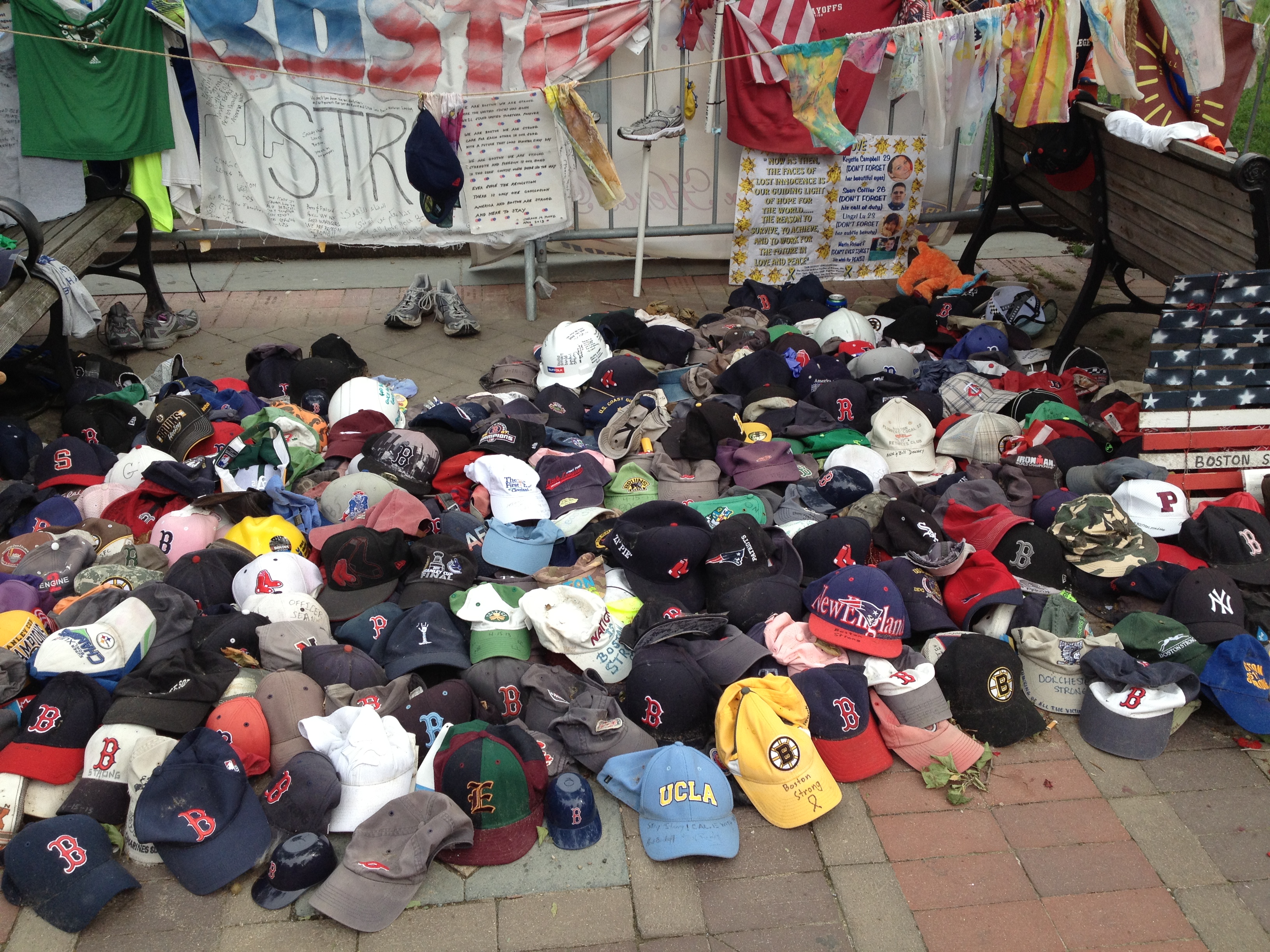 In the time since, I have come around more to Rainy’s argument than my own, though I still worry about questions of authenticity and memorial mediation on the part of the curatorial hand (though, of course, that spontaneous memorial, first on Boylston Street and then at Copley Square was also curated, in part). Nevertheless, I am very much looking forward to Rainy’s exhibit at the main branch of the Boston Public Library on Copley Square. Dear Boston: Messages from the Marathon Memorial opens on 7 April, and will run to 11 May. It is a tri-partite exhibit: the first part will encompass the immediate responses to the bombing, the second will be people’s reflections on the bombs, and the final part will be the hopeful part, messages of hope and healing.
 I appreciate the exhibit’s title perhaps more than anything at this point, as it makes direct references to the curatorial hand at work here, as the exhibit will deliver messages from the memorial. In July last year, I worried about the loss of meaning of the individual artefacts when they were boxed up and stored in the Boston Archives. A running shoe had a very poignant and powerful meaning when displayed at the memorial, and in a box in the archives, it’s a running shoe. Restored to the public eye, however, attached with a symbolic meaning that no one in Boston, or anyone visiting the exhibit, will miss, the shoe regains its poignancy.
What struck me in my discussion with Rainy last summer was how she intended to approach the exhibit, and her sensitivity to the very issues that concerned me. I am very much looking forward to what she comes up with.
The Upside to Gentrification?
January 22, 2014 § 7 Comments
I read an interesting article on NPR.org this morning, about gentrification. Based on recent research from Columbia University and the Federal Reserve Bank of Cleveland, gentrification may not entirely suck for low-income people in gentrifying neighbourhoods. The Columbia study looked at displacement in Harlem and across the US, calculating how many low income people moved out of their neighbourhoods when gentrification occurred. Meanwhile, the Federal Reserve Bank looked at the credit scores of low income people in gentrifying neighbourhoods. In the first case, researchers found that people didn’t necessarily move out, in fact, low income earners were no more likely to move out of a gentrifying neighbourhood than a non-gentrifying one. In the case of the Federal Reserve Bank, the credit scores of low income earners actually improved with gentrification of their neighbourhoods.
Not surprisingly, I find these kinds of studies slightly disarming. Lance Freeman, Director of the Urban Planning programme at Columbia, expected to find that displacement was a common occurrence. But he is still cautious to note that gentrification can and does indeed lead to displacement.
Most studies, at least most I have read from a wide variety of disciplines, lay out the reasons for displacement with gentrification: higher housing costs, higher food costs, higher taxes (if they own), amongst others. In my experience of living in gentrifying neighbourhoods, the cost of gentrification is obvious on the street, as the original residents get marginalised as cafés, hipster clothing stores, and yuppy restaurants open. There is no place for them to go, and the coffee shops and bodegas they used to frequent close down. However, it is also obvious that people stay. In part, they are helped by things such as rent control, or dedicated low income housing. And, at least from my own anecdotal evidence, mixed-residential neighbourhoods are certainly friendlier, more community-based, and generally nicer to live in.
Last weekend, there was a story in the Boston Globe about a Southie woman, Maureen Dahill, who ran for State Senate, but lost gloriously, in large part because she supported the right of LGBT groups to march in the St. Patrick’s Day parade. Dahill ran for office in order to attempt to bridge the gulf between “new” and “old” Southie, between the yuppies, artists, and hipsters, and the old Irish. Dahill, a native of South Boston, works in the fashion industry, her husband is a firefighter. In other words, she was the ideal candidate for the role.
What I find interesting, aside from the fact she was trounced in the election, was the discussion in this article about the gulf that exists between the old and the new in Southie. And this is something that is overlooked by quantified research studies such as the Columbia and Federal Reserve Bank ones. However, what they add to the discussion is that there are those who remain, who refuse to leave for a variety of reasons. The job now is to, if not attempt to emulate Dahill’s failed campaign (the Globe notes that from the get go “there were many who didn’t want any part of her bridge-building.” The article doesn’t identify which side of the gulf this resistance came from.
At any rate, it is refreshing to see researchers attempt to explore the myths of gentrification, but I would also caution that we do not need a neo-liberal backlash that leads us to conclude that gentrification is good, it’s the best thing that can happen to us. We must still discuss the human costs of gentrification, we must still fret over the plight of low income earners in neighbourhoods where rents go from $500 to $3,000 a month in short order.
Shameless
December 7, 2013 § Leave a comment
We’ve been watching the American version of Shameless off and on for the past year. The American version is based on the British show, but is set in the South Side of Chicago. It is centred around the big and cacophonous Gallagher clan. The patriarch is Frank, played by William H. Macy. Frank is a drunk asshole. There’s no other way to put it. His wife, the children’s mother, has up and left. The family is held together by the eldest daughter, Fiona. There are 5 more children, the youngest of which is 2 (and somehow African American in a family of white Irish Americans; this is never explained). Fiona scrounges and scrimps and saves to keep food on the table and the roof over the heads of the other Gallagher kids. The house is possessed by the Gallaghers through dubious means, involving some welfare scam on the part of Frank. Fiona is left to scam to keep the family together and to keep the rest of the kids from ending in foster care.
I have to say, I enjoy the TV show, though occasionally it hits kind of close to home, in that I grew up mostly poor with an alcoholic and abusive step-father. But, this show is a rather complicated look at poverty, particularly white poverty in America. It also dovetails nicely with Michael Patrick MacDonald’s points about South Boston. The show is set in Canaryville, the historically Irish section of Chicago’s South Side. Canaryville, like Southie or Griff, is rather legendary for being both Irish and hostile to outsiders.
As I watch the show, I can’t help but wonder if Shameless romanticises poverty, portrays it accurately, or stereotypes poor people as scammers. I find myself torn every time I watch it.
On the one hand, the Gallagher clan and their friends struggle everyday trying to make ends meet, but it seems they’re always able to put aside their money worries to have fun. No, they don’t get drunk (except for Frank) and they don’t do drugs. But they do have a lot of fun, there’s a lot of wisecracking, and teasing. There’s also a lot of scamming of pretty much anything that can be scammed, from welfare officers to schools, to businesses and anyone else stupid enough to get involved.
When I was growing up, my life wasn’t exactly as glamourous as the Gallaghers, but it’s not like we spent our entire lives miserable because we were poor. And the “system,” such as it were, was there to be scammed. To a degree. It was not like anyone I knew scammed welfare or Unemployment Insurance (as Employment Insurance was once called in Canada), and so on. Scams tended to be smaller scale. Like scamming free rides on the bus or the Skytrain. Life wasn’t one thing or the other, it wasn’t black and white. It was complicated.
And this is where I think Shameless is a brilliant show. Obviously there is some mugging for the cameras and the creation of some dramatic storylines for entertainment purposes. But it represents the life of these poor white trash Irish Americans in Canaryvlle, South Side Chicago, as complicated. Their lives aren’t all of one or the other. They live lives as complicated as the middle-classes. Perhaps more so, because they’re always worried about having something to eat and having gas to heat the house. In the end, Shameless represents the poor as multi-faceted, complicated people, who are pulled in various different directions according to their conflicting and various roles (as breadwinner, daughter, son, friend, lover, etc.). In short, at the core, their lives are no different than ours. They are, essentially, fully human.
Too often, when I see representations of the working-classes and the poor in pop culture, whether fiction or non-fiction, these representations are nothing more than stereotypes. Poor people are lazy. Poor people are scammers. Poor people are dishonest. Poor people are victims. Poor people need help. And so on and so on. In reality poor people are none of these things and all of these things and more. In fact, the poor are just like you and me. And, at least in my experience, essentialising the working classes does them a disservice.
And this is where works like Shameless or All Souls come in. MacDonald complicates our stereotypes of Southie. He shows us the complications of the impoverished Irish of South Boston, and he makes it impossible for us to stereotype. In the end, Shameless does the exact same thing.
Irish Slums
December 5, 2013 § 4 Comments
Last month, I met Michael Patrick MacDonald at an Irish Studies conference in Rhode Island. He was the keynote speaker. I didn’t know much about him beforehand, other than he wrote All Souls about growing up in South Boston in the 70s and 80s. I knew All Souls was a story about heartbreak, drugs, and the devastation suffered by his family. But MacDonald’s talk was one of the best I’d ever heard, he spoke of Whitey Bulger, drugs, Southie, his work in non-violence and intervention, and he talked about gentrification. He was eloquent and fierce at the same time. He is, of course, an ageing punk. He was also pretty cool to talk to over beers in the hotel bar later that night.
I finally got around to reading All Souls last week. I’m glad I did. I was stunned that MacDonald and his siblings could survive what they’ve survived: three of their brothers dead due to gangs, drugs, and violence. One of their sisters permanently damaged by a traumatic brain injury brought about due to drugs. And another brother falsely accused of murder. It was a heartbreaking read, at least to a point. I know how the story ends, obviously.
It was also interesting to read another version of Southie than the one in the mainstream here in Boston. The mainstream is that Southie was an Irish white trash ghetto, run by Whitey Bulger, terrorised by Whitey Bulger, but all those Irish were racists, as evidenced by the busing crisis in 1974. And while MacDonald tried to revise that narrative, both in his talk and in All Souls, pertaining to the busing crisis, it is hard to argue that racism wasn’t the underlying cause of the explosion of protesting and violence. But, MacDonald also offers both a personal and a sociological view of how Southie was terrorised and victimised by Bulger (and his protectors in the FBI and the Massachusetts State Senate). And, today, he talks about gentrification in a way that most mainstream commentators do not (something I’ve railed about in my extended series on Pointe-Saint-Charles, Montréal, his blog, Pt. 1, Pt. 2, Pt. 3, Pt. 4, and Pt. 5).
But something else also struck me in reading MacDonald’s take on Southie. I found that he echoed many of the oldtimers I’ve talked to in Griffintown and the Pointe in Montréal about their experiences growing up. Griff and the Pointe were the Montréal variant of Southie, downtrodden, desperately poor Irish neighbourhoods. And yet, there is humour to be found in the chaos and poverty, and there is something to be nostalgic for in looking back.
MacDonald writes:
I didn’t know if I loved or hated this place. All those beautiful dreams and nightmares of my life were competing in the narrow littered streets of Old Colony Project. Over there, on my old front stoop at 8 Patterson Way, were the eccentric mothers, throwing their arms around and telling wild stories. Standing on the corners were the natural born comedians making everyone laugh. Then there were the teenagers wearing their flashy clothes, their ‘pimp’ gear, as we called it. And little kids running in packs, having the time of their lives in a world that was all theirs.
This echoes something journalist Sharon Doyle Driedger wrote of Griffintown, where she grew up:
Griffintown had the atmosphere of an old black-and-white movie. Think The Bells of St. Mary’s,with nuns and priests and Irish brogue and choirs singing Latin hymns. Then throw in the Bowery Boys, the soft-hearted tough guys wisecracking on the corner.
The difference, of course, is that MacDonald’s ambivalence runs deep, he also sees the drug addicts and dealers, and the grinding poverty. Doyle Driedger didn’t. But, MacDonald is standing in Southie as an adult when he sees this scene, Doyle Dreidger is writing from memory.
Nostalgia is a funny thing, and it’s not something to be dismissed, as many academics and laypeople do. It is, in my books, an intellectually lazy and dishonest thing to do. Nostalgia is very real and is something that tinges all of our views of our personal histories.
But what I find more interesting here are the congruencies between what MacDonald and Doyle Driedger writes, between what MacDonald says in All Souls and what he said in his talk last month in Rhode Island, and what the old-timers from Griff and the Pointe told me whenever I talked to them. There was always this nostalgia, there was always this black humour in looking back. I also just read Roddy Doyle’s Paddy Clarke Ha Ha Ha, about a kid growing up in Dublin’s Barrytown, a fictional inner-city neighbourhood. Through Paddy Clarke, Doyle constructs an idyllic world for a boy to grow up in, as he and his mates owned the neighbourhood, running around in packs, just like the kids in Southie MacDonald describes, and just as MacDonald and his friends did when they were kids.
I don’t know if this is something particular to Irish inner-city slums or not. But I do see this tendency as occurring any time I talk to someone who grew up in such a neighbourhood, or read stories, whether fiction or non-fiction, to say nothing of the music of the Dropkick Murphys (I’m thinking, in particular, of almost the entirety of their first album, Do Or Die, or the track “Famous for Nothing,” on their 2007 album, The Meanest of Times), I’m not one for stereotyping the Irish, or any other group for that matter, I don’t think there’s anything “inherent” to the Irish, whether comedy, fighting, or alcoholism. But there is something about this view of Irish slums.
Ken Dryden and Prosthetic Memory
December 2, 2013 § 8 Comments
 On Saturday night, I went to the Bruins’ game with a buddy. Those who know me know that the only thing on God’s Green Earth I hate are the fucking Bruins. My buddy, John, is a Bruins’ fan. He has no love lost for my Canadiens de Montréal. And everytime he goes on and on about the Big Bad Bruins of the early 70s, the teams of his childhood, I say two words to him: Ken Dryden.
For those of you who don’t know, the Boston Bruins won the Stanley Cup in 1970 and 1972. They were a big, rugged team led by Phil Esposito, Wayne Cashman and, of course, Number 4, Bobby Orr. They were far and away the best team in hockey in the early 70s. But in 1971, something happened that disrupted their reign: the Montréal Canadiens. The Habs weren’t that good in 1971. They had won the Stanley Cup in 1969, but in 1970, they were the first Habs team to miss the playoffs since 1948. And the Habs wouldn’t miss the playoffs again until 1995. In 1970-71, they were an average team.
But then, in the spring, a call-up from the American Hockey League took over the Habs’ nets. Ken Dryden was his name. In the first round of the playoffs that year, the Habs took on the Big Bad Bruins. The Bruins finished with 121 points in 78 games, 12 more than the 2nd place New York Rangers. The Habs finished a full 24 points back. But the Canadiens knocked off the defending champs in the first round in 7 games, finally eliminating the Bruins in the hostile confines of the old Boston Garden. The Habs, riding Dryden’s brilliance, went on to win the Stanley Cup over the Chicago Blackhawks.
I wasn’t born in 1971, it would be a full two years until I made my début. My first hockey memories are from 1976 or so, I vaguely remember seeing a game between the Canadiens and Vancouver Canucks on our old black and white TV, and my dad took me to the Stanley Cup parade that spring in Montréal. But. Just as with Paul Henderson’s series-winning goal against the Soviets in 1972, Ken Dryden’s run in the spring of 1971 is burned into my memory.
How does this happen? Alison Landsberg’s 2004 book, Prosthetic Memory: The Transformation of American Remembrance in the Age of Mass Culture, attempts to explain. Due to the onslaught of mass media in our lives, we are increasingly able to assimilate the memory of things we did not experience. Thus, I can see, in my mind’s eye, the incredible artistry of Ken Dryden in the spring of 1971 before I was born, and long before I had any sentient thoughts.
From where we sit in 2013, almost 2014, nearly a decade since Landsberg published her book (and nearly two decades since her argument was made for the first time in an article in one of those 90s books about the “cyber-world” and “information super-highway”), the argument seems rather obvious. But it wasn’t a decade ago.
And yet, whilst Landsberg focuses on the proliferation of mass media, it is also clear that the internet plays a very clear role in the formation of prosthetic memory for her. In the case of Ken Dryden, my memories were made in the 1980s. In 1984 and again in 1986, the Habs had young, hot goalies in net to start the playoffs. Steve Penney carried a pretty lousy team to the semi-finals in 1984 and two years later, Patrick Roy carried a mediocre team all the way to the Cup. Both years, Hockey Night in Canada ran endless Dryden video, and talked about Dryden. The newspapers I read, all the way out in Vancouver, talked about Dryden. The Hockey News, of which I was a dedicated reader, talked about Dryden. I went out and bought Dryden’s book, The Game, with my own money because of the 1986 playoffs and the myth-making. And while, clearly, mass media was central to the formation of my prosthetic Dryden memories as a kid in the 80s, this is long before the internet.
The interesting thing is that, when I taught in Montréal, at both Concordia University and John Abbott College, my students, who were born in the late 80s and early 90s, long after Dryden retired, and at the height of Roy’s brilliance, knew about the legends of Ken Dryden, as if they were born with fully formed prosthetic memories.
I read an article on the BBC’s website today about how memories can be transferred from generation to generation through biology. A study of mice at Emory University in Atlanta has demonstrated how this works. For the study, a generation of lab mice were trained to fear the smell of cherry blossoms. This fear was passed on to their children and grandkids, even though the children and grandchildren had never experienced anything negative surrounding the scent of cherry blossoms.
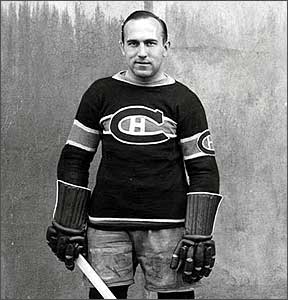
Maybe the legends of the Montréal Canadiens are passed on this way, from father to son and daughter. Maybe this is why I can see in my mind’s eye Howie Morenz rushing up the ice in the late 1920s, when my grandfather was just a lad?
Urban Redevelopment: Getting it Wrong, Springfield, MA
October 27, 2013 § 3 Comments

City Hall Plaza, Boston
As regular readers of this blog know, I am interested in urban redevelopment, especially when it comes to questions of doing it right and doing it wrong (and chances at redemption). For the most part, the wave of urban redevelopment that hit North American cities in the 70s and 80s was the wrong way, in that it left us with neo-brutalist architecture in the midst of our cities that is cold, uninviting and intimidating. A case in point of this would be City Hall Plaza in Boston. It’s a desolate, soulless urban square that people use for one of three purposes: 1) official events, because they have no choice; 2) to sit on the fringes of to eat lunch; 3) to get to the Government Center T station. Many cities have this problem today, these horrid, horrid neo-brutalist buildings. In some places, like Boston, it doesn’t so much matter, because the downtown core of the city is bustling, Government Center lies between Faneuil Hall/Quincy Market and the stately Boston Common. Government Center is the site of, well, government in Boston and so this site is full of civil servants, but also tourists and Bostonians crossing between the tourist centres, the North End, and the downtown core of the city. In other places, like nearby Worcester, this 70s/80s wave of urban redevelopment led to a massive #fail.
But, the legacy of deindustrialisation is also very real, especially in small formerly urban centres, like Worcester, but also Springfield, Mass. Springfield is about 100 miles west of Boston and it feels about as faraway from Boston as one can get. Springfield is a depressed, sad little city. It has a high crime rate, nearly double that for the rest of the Commonwealth, including Boston. It’s murder rate, .13 per thousand, is almost triple the national average (perhaps unironically, Smith & Wesson’s corporate headquarters are in Springfield). The same is true for robbery and assault. Its property crime rates are also well above the national average.
It wasn’t always like this for Springfield. Until the 1960s, it was a bucolic industrial city, surrounded by natural beauty. It had a low crime and unemployment. It was the very first Springfield in the USA, and was the birthplace of basketball. Indian Motorcycles were from Springfield. So was Charles Goodyear. Merriam-Webster’s first dictionary was published there in 1805.

I-91, downtown Springfield and the Basketball Hall of Fame
Springfield experienced decline due to a combination of deindustrialisation, the closing of the Springfield Armory in 1969 (the target of Daniel Shays and his rebels in 1786), and poor urban development decisions (most notably the running of I-91 through the downtown core and cutting off downtown from the waterfront of the Connecticut River. Various attempts to redevelop the city have failed miserably (like the basketball Hall of Fame). And recently, the city decided that it was going to open a massive urban casino to flag the failing fortunes of Springfield. Why they thought this would work is beyond me. Certainly, people will now come to Springfield to shop and gamble. But, the casino will also siphon off jobs and hurt what business still exists in the downtown core. And now, even that appears to be at risk.
The Failure of Urban Redevelopment and the Chance at Redemption: Worcester
October 22, 2013 § 4 Comments
Worcester, Massachusetts, is like pretty much every city in New England not named Boston or Providence, and kinda like those Easter Bunnies I used to get when I was a kid: hollow centre. The downtowns of Hartford, New Haven, Springfield, Worcester, etc. were done in by deindustrialisation and horrid, horrid urban redevelopment schemes. The urban redevelopments schemes of the 70s, in hindsight, look as though they were especially created to destroy urban centres, not save them. Boston’s Government Center, for example, is one of the most hideous examples of neo-brutalist architecture I’ve ever seen.

Water/Fire, Providence, RI

Government Center, Boston
Worcester’s other problem is that it’s near Boston, less than an hour away. In fact, before I moved to Massachusetts, I thought Worcester was just a suburb of Boston. Boston is by far the biggest city in New England, over 5 times as big as the number 2 city, which just so happens to be Worcester (in fact, Worcester is the western boundary of the ridiculous Boston-Worcester-Manchester Combined Statistical Area). Worcester gets by, it is the home to several universities, including the University of Massachusetts Medical School, plus hospitals. But the downtown is a disaster.
City Hall Plaza, Boston
Worcester attempted and failed miserably to redesign its downtown in the 70s. It made sense at the time, as Paul McMorrow points out in today’s Boston Globe, the city erected a shopping mall downtown to counter the growth of suburban shopping malls. This was a common tactic. In some places, usually Canadian cities, this worked. Vancouver, Toronto, Montréal, Calgary, Ottawa all have shopping malls downtown. And in those cities, the malls are successful. Those are also very large cities, Ottawa is the smallest and its urban centre is still over 1 million people. It is worth noting, however, that I cannot think, off the top of my head, of a large American city with a successful shopping mall at its core. Boston has a small shopping concourse in the Prudential Center, but that’s it.
Nevertheless, the Worcester Center Galleria was a valiant effort. But it failed. Twice.

Worcester Center Galleria
The mall, when it was constructed, obliterated the street grid and landscape of downtown Worcester. But now, it’s been town down and the old street grid is being restored. The new CitySquare development is designed to do what most new urban redevelopments do: provide shopping, office space, and urban condos. All to convince a new, wealthy, demographic to move downtown, and stay downtown. McMorrow is hopeful for Worcester, as am I. And as Providence shows, urban redevelopment can be done and can be successful. But Worcester has the same problems as the rest of Massachusetts outside of Boston: the economy.
OMG! Seriously?: On Language and Swearing
October 21, 2013 § 2 Comments
In today’s Boston Globe, I read a column that I thought had been printed by mistake. Or maybe it was a leftover from 1976. Jennifer Graham, a columnist for the venerable (and quite good) Boston daily, is upset that OMG and it’s more offensive variety, “Oh my God!” are lingua franca in our culture today. She’s upset that blasphemy is everyday language. To which I say, where have you been for the past 40 years, lady?
I am from a culture where all the choice swear words are religious-based. French Canadians have a whole range of blasphemous and offensive words for all situations, the worst of which is “Tabarnak!” That literally means “tabernacle.” Other highlights are “câlisse!” and “osti!” (chalice and the holy host, respectively). If you really wanna set grandma’s wig on fire: “osti de tabarnak câlisse” will do the trick. Once more, in English, that’s “holy host of the tabernacle, chalice!” Sounds much better in québécois French, trust me. When I was a kid, these were very bad words (even Anglos in Québec swear in French, it’s much more fun), respectable people did not use them. But, by the time I was an adult, they were everywhere, even in polite company, including in newspapers, on TV, and even my dear great aunt once said “tabarnak!” (I nearly fell over).
It doesn’t take a linguist to figure out that the ramping up of swearing is due to the general breakdown of authority in western culture as a whole in the past 40 years. Sometimes even I am stunned by what I hear coming out of the mouths of my students in the hallways and around campus. Some of the names they call each other, even in jest, would flip the wig of my grandmothers, I can tell you that much.
But. Oh my god? Seriously? Graham is upset by this one because she thinks it insults people’s value systems. Oddly, I learned this particular gem within my Catholic family as a kid. For that matter, my memory of this gem of a swear is that I have tended to hear it from the mouths of Catholics, especially devout ones. Sacrilegious? Oh, heck yes. But spend an hour watching Irish TV and you’ll see what I mean.
It seems to me that Jennifer Graham is about a generation or two late in her hand-wringing over the use of oh my god in pop culture.
Diaspora and Terrorism: The problem with relativism
July 21, 2013 § Leave a comment
Janet Reitman‘s Rolling Stone feature on Dzhokhar Tsarnaev is a fascinating read in many ways, as she explores just what might have radicalised him and turned him into a terrorist. Reitman talked to pretty much everyone in the Boston region who knew him growing up. He comes across as the pretty stereotypical American urban kid. As a Bostonian, the article interested me for obvious reasons. But as an historian, I was struck by questions and notions of diaspora concerning the Tsarnaev family and the youngest son, especially.
Reitman talked to Brian Glyn Williams, who teaches Islamic Studies at UMass-Dartmouth. UMass-Dartmouth, of course, is where Tsarnaev went to school. Interestingly, Tsarnaev, who by all accounts was interested in his history as a Chechen and a Muslim, didn’t take a single one of Williams’ classes. But Williams also comments on the older brother, Tamerlan, who by all accounts was the ring-leader. Williams, says Reitman,
believes that Tamerlan’s journey – which he calls “jihadification” – was less a young man’s quest to join Al Qaeda than to discover his own identity. “To me, this is classic diasporic reconstruction of identity: ‘I’m a Chechen, and we’re fighting for jihad, and what am I doing? Nothing.’ It’s not unlike the way some Irish-Americans used to link Ireland and the IRA – they’d never been to Northern Ireland in their lives, but you’d go to certain parts of Southie in Boston, and all you see are donation cans for the IRA.
I find this comment interesting. Being an Irish Canadian, and having spent much of the past decade-and-a-half studying the Irish in North America, I’ve always been struck by the willingness of Irish-Catholics in both Canada and the United States to identify with the IRA. Usually this identification with the IRA came without complications. Supporters never thought about where that money in those tins was going, what it was going to be used for. What happened when the guns and bombs it bought were used, who got hurt, who got killed. If they had stopped to think about this, if they removed the romanticism of the struggle back “home” (even if Ireland hadn’t been home for several generations), I’m sure support for the IRA would’ve dried up pretty quickly. Not many Irish Canadians or Irish Americans actually went back to Northern Ireland and got involved in the fight.
And yet, Tamerlan Tsarnaev did. He went back to Chechnya and Dagestan. He was, however, told by a cousin in Dagestan that this was not his fight. So he brought the fight home. I shudder at the consequences.
But that is exactly what makes Williams’ comparison invalid after a certain point. All those Irish in Southie who contributed to the IRA’s cause have several degrees of separation from the consequences of their donation. Tamerlan and Dzhokhar Tsarnaev quite literaly have blood on their hands as a direct result of their actions.
 Matthew Barlow