On Black History Month
February 18, 2015 § 6 Comments
It is Black History Month. Specialized history months exist for a reason. They exist because black people, indigenous people, immigrants, LGBT people, women, etc., all get written out of history. Take, for example, a typical US History survey course. Usually US History survey courses at the college level are split into two parts, the first covers the period to Reconstruction, usually with the break coming in 1877; the second part goes from then to today. In the entire broad expanse of American history, nearly every single textbook I have ever reviewed with an eye towards using reflects a triumphalist narrative of progress. Certainly, some focus more on the people than the politics and wars, others focus on culture. Some have a narrative centring around the American fascination with freedom and liberty.
But, still, the narrative is dominated by white men. Indigenous peoples are the stars of the period before colonization, but that’s usually no more than a chapter. Then they share centre-stage with the colonists. Then they disappear from the narrative until the Trail of Tears in the 1830s, and then make a cameo during the story of Western expansion. Women are almost entirely invisible from the main narrative; women, especially, get shunted into little featurettes, usually at the end of the chapters. Possible exceptions are Seneca Falls in 1848, the 19th Amendment (sometimes), the Second World War, and Second Wave feminism to the failure of the Equal Rights Amendment in 1982. As for African Americans, they feature, sort of, in the story of slavery. But even then, the textbooks tend to represent slavery from the Euro-American perspective: why slave owners thought slavery just, why Northern abolitionists sought to end slavery. Rarely do we get actual glimpses of the slaves themselves. Then, after a brief light of Reconstruction, African Americans disappear until the Civil Rights Era of the 1950s and 60s. And that’s it. Thus, there is a need to focus on the history of a minority group, to focus on the contributions of that group, whether singly or collectively, to history. Hence, Black History Month.
The very existence of Black History Month, however, is a result of racism. The weight of history can be felt every single day, whether individually or collectively. We feel our own histories, but we also feel the weight of societal history on us every day. Where we are and what we have is in part a response to history. As a middle-class, white, heterosexual man, I have privilege, all of which comes from history and the way in which society has been moulded by it. Men benefit greatly from patriarchy, but not all men benefit in the same way from patriarchy. For some men, their access to patriarchal privilege is modified by race, ethnicity, sexual orientation, and class.
I got into a Twitter argument today over George Zimmerman and his murder of Trayvon Martin three years ago (Martin would have turned 20 next Thursday, 26 February). The content of the argument doesn’t matter so much as what the argument represents. Trayvon Martin was suspect to Zimmerman because Martin was black. He aroused the neighbourhood watch captain’s suspicions for “walking while black,” a pretty common occurrence for black men and women in the United States.
Racism is very real. And it is historic. It doesn’t have to come with name calling and threats of violence. It comes in more peaceable ways, too. It is subtle, it is silent. But it’s still very real. Racism against black people has a long, long history in the United States. But this was inherited from the British. The British, and other European nations, were the ones who thought it acceptable to enslave Africans and sell them at auction for profit. British cities such as Bristol and Liverpool became rich off the slave trade. In the United States, though, racialized slavery reach its apogee. And this history still weighs down American society 150 years after the Civil War ended.
Why? Eric Foner argues that Reconstruction was an “unfinished” revolution. I would suggest it was a failed revolution. Either way, as Foner rightly notes, Reconstruction failed because African Americans were left free, but impoverished, as the racist mindset that lay behind slavery sill existed. And let me remind you that many, if not most, northern abolitionists were just as deeply racist as southern slave owners. Where they differed is that the abolitionists thought it immoral for someone to own another person. The Civil Rights Era didn’t happen until a century after the Civil War. And today, we live in an era of backlash against the Civl Rights Era.
All of this, though, is due to the weight of history. On this continent, racism pre-dates the founding of Canada, the United States, and Mexico. In the United States, it dates back to the founding of Jamestown in 1608 and the Pilgrims reaching Plymouth Rock twelve years later. The very idea of British superiority over black Africans underpinned the colonial project here, as settlers had the same ideas of their own superiority over the indigenous populations. Thus it is perhaps no surprise that racism is so deeply ingrained in society. And this is not a uniquely American problem. Look at Canada, Britain, Ireland, France, Germany, Russia, Brazil, the Netherlands, etc.
For those of us who have spent their lives fighting against racism (and various other forms of oppression), we are fighting back against the cumulative weight of history; we are trying to push a massive weight off us. And until we do, we need to call out racism, but we also need to understand the reason for Black History Month this month. And Women’s History Month next month. And Native Americans’ History month in November.
The International Museum of Folklore
February 13, 2015 § 6 Comments
In his Remembering the Year of the French: Irish Folk History & Social Memory, Guy Beiner talks a lot about folklore in Connacht, the western-most Irish province. This is where the failed 1798 French invasion took place, and Beiner attempts an archaeology of the folklore of the region in relation to the invasion and its relation to the wider 1798 Rebellion in Ireland.
I’ve never really worked in the realm of folklore, but I’ve always been fascinated by it, dating back to my undergrad years, though my profs were all insistent that folklore did not belong in a history class. In grad school, I read Ian McKaye’s book, The Quest of the Folk: Antimodernism and Cultural Selection in Twentieth-Century Nova Scotia, which was about the collection of Scots and Irish folklore, especially in Cape Breton by Helen Creighton and others in the early decades of the 20th century, around the same time that folklorists were running all over Ireland, England, Scotland, the United States, and various other countries, collecting the folk stories of the region.
Beiner argues that
It is often claimed that modernization struck a deathblow to ‘traditional’ oral culture. Yet, developments in communication and information technologies also provided new media for the transmission and documentation of folklore.
Beiner goes on to discuss all the ways in which modern technology has aided in the collection and dissemination of traditional cultures and folklores. But he is clearly overlooking the fact that modernization DID work to kill traditional oral culture, a point made brilliantly by Angela Bourke in her The Burning of Bridget Cleary: A True Story. This point is made all the more clearly by Keith Basso in his Wisdom Sits in Places: Landscape and Languages Among the Western Apache. Most of the events described by Basso, in terms of his ethnographic amongst the Western Apache of Arizona, take place in the late 1970s and early 1980s, yet his book was published in 1995. In his epilogue, Basso notes the massive change that had come to the community of Cibecue in the fifteen years between his ethnographic work and the book, and what is clear is that modern technology and modern life was killing the traditional way of life for the Western Apache, and with that, traditional relations to the land and the ancestors, which came through in what could be called folklore.
Ireland was no different (nor was any other folk culture anywhere). Modernization has worked to kill traditional oral culture. And while the stories still exist, and we can sill read them and listen to story-tellers, the culture they describe no longer exists. Folklore, through the very act of collection in the early 20th century, was made static and museumized. It became something to be fetishized and studied, and ceased to be a living thing.
Canada’s National Shame redux
February 4, 2015 § 3 Comments
Yesterday, a new report was released on the plight of Canada’s aboriginal peoples in the healthcare system. The title, “First Peoples, Second Class Treatment,” perhaps says all you need to know. The CBC also posted a story on-line about the experiences of several aboriginal people vis-à-vis healthcare in Victoria, British Columbia. A couple of the “highlights”:
- Michelle Labrecque went to the Royal Jubilee Hospital complaining of severe stomach pain in 2008. A doctor gave her a prescription. When she got home and opened the paper with the prescription on it, it was a drawing of a beer bottle with a circle slashed through it.
- Carol McFadden went to the doctor with a lump in her breast, only to be told she could’ve gone to mammography herself. She now has Stage 4 breast cancer, and it has spread to her liver.
- McFadden reports that whilst some doctors have been compassionate, others have been rude and brusque, to the point where they kick her bed when they want her attention, and continually asking her if she drinks or does drugs.
I recently read Joanna Burke’s book, The Story of Pain: From Prayer to Painkillers. In it, she talks about the body in pain, and the responses thereto, both from the victims of the pain, as well as the medical profession. Nineteenth century doctors, insofar as they discussed the colonialized body, they dismissed the idea that indigenous bodies could feel pain in the same way that an upper-class British man could. For that matter, they also argued that working-class men had a higher tolerance to pain. Their recommendation was to try to take the body in pain seriously, but not to be sympathetic, to be brusque when talking to the victim. We live in the twenty-first century. Why are aboriginal peoples treated this way by doctors?
Of course I know why, Canada is a deeply, deeply racist society vis-à-vis the aboriginal population. It is acceptable in Canada to be openly racist against First Nations people. I wish I could say I was surprised by the findings of this report. I am not.
Canada’s National Disgrace
February 2, 2015 § 151 Comments
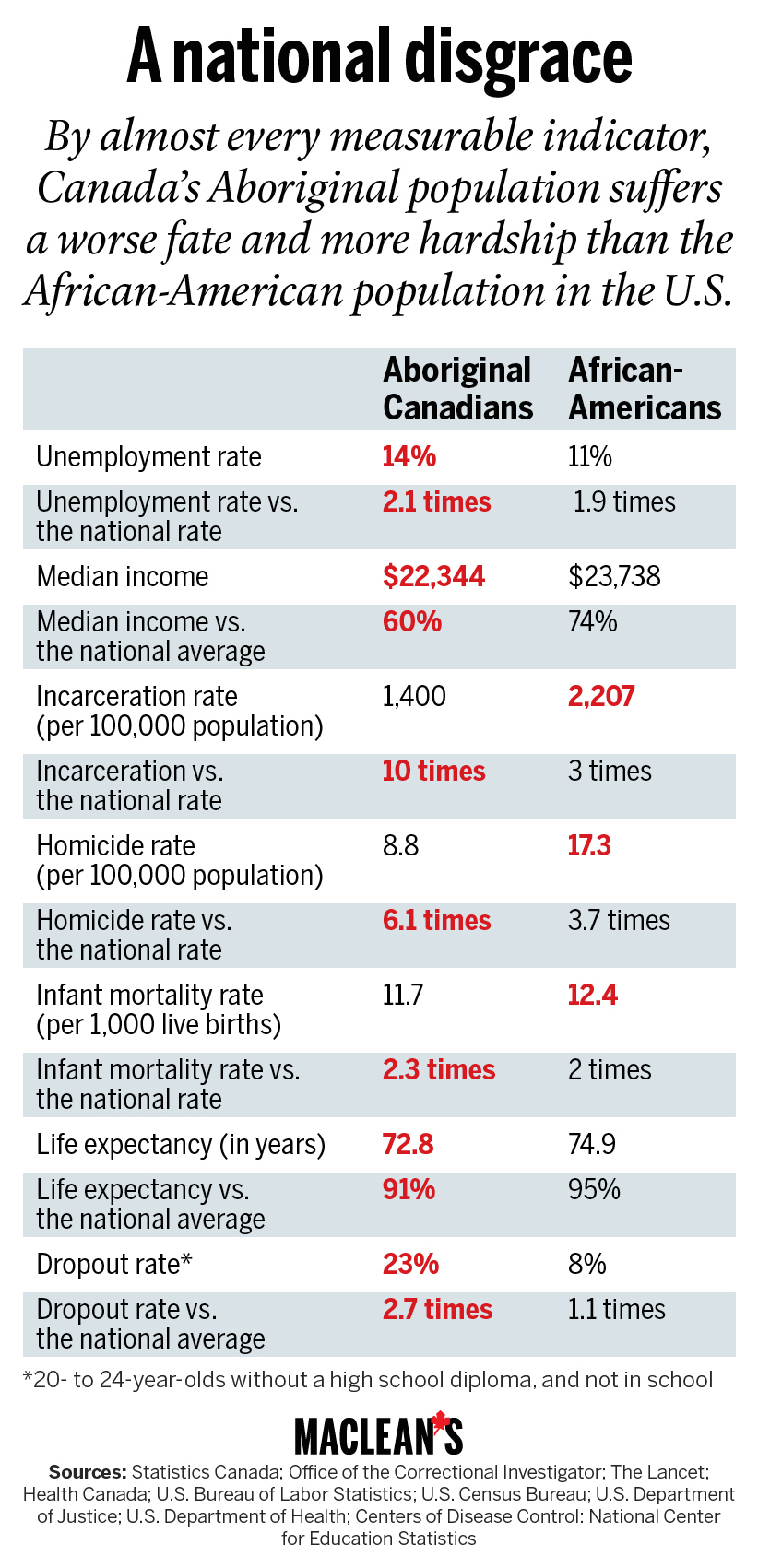
Two weeks ago, MacLeans, Canada’s only national news magazine, published an article that caused quite the uproar. Written by a former diplomat, Scott Gilmore, and entitled, “Canada’s Racism Problem? It’s Even Worse Than America’s,” it’s not hard to see why this upset people. Even better was the sub-title, “For a country so self-satisfied with its image of progressive tolerance, how is this not a national crisis?” I wish I had written this article, it says what I’ve been saying for a long, long time.
Aboriginal peoples in Canada get screwed. Have been since the first Europeans arrived, and still do today. And that’s not going to change any time soon unless Canadians do something about it. But, in my experience, they don’t care. Last year, I wrote a post about a funny sweatshirt that an aboriginal man, Jeff Menard, in Winnipeg (which MacLeans also called out as Canada’s most racist city) created that said: “Got Land? Thank an Indian.” I wrote this post in response to a response I got to a tweet stating that if you thought this hoodie racist, you’re an idiot. This response tweet said “I’m offended because they used the word Indian. My grandfather was from India. He worked for a living.”
How to unpack that? This tweet was anti-historical and offensive on so many levels. Starting with being upset at the use of the word “Indian,” the term applied to aboriginal peoples by Euro-Canadians historically. But the real kicker is “He worked for a living.” Many of the comments on Gilmore’s article, and a lot of the vituperative, racist tweets I saw complained that aboriginal peoples in Canada survive on handouts from the government and don’t work for a living. No mention of imperialism, the taking of land, the systematic attempts by the Canadian government to steal away aboriginal languages, cultures, religions, and names, of the residential schools designed to also take the children of aboriginals away from them (to say nothing of the horrific sexual abuse therein).
Gilmore pointed just how badly aboriginal peoples get screwed in Canada, by comparing them to African-Americans in the United States, in easy table format, which I produce here (and hope that MacLeans doesn’t mind). Look at those statistics and just try not to be offended, saddened, and, if you are Canadian, embarrassed. Hell, even if you’re American, you should be embarrassed by these stats. But, Gilmore’s right. Canadians are a smug lot. My Twitter feed is usually full of all kinds of anti-American comments, the implicit meaning is “Well, the US is a mess, thank god I live in Canada.” Information such as this should end such discussions and puncture our smugness forever.
At the same time the furor over Gilmore’s article was raging, another debate was happening over the death of Makayla Sault, an 11-year old from the New Credit First Nation in Ontario. Makayla died of leukaemia. When she was first diagnosed last year, she underwent chemotherapy in Hamilton, ON. But the side-effects were too great. And so she refused further treatment, preferring instead traditional medicine. Obviously, it didn’t work.
This raises interesting questions, starting with who has the right to control the lives of children who have cancer. But. Ultimately, we have to respect her decision. Why? Because it was her life.
But, then the enfant terrible of Quebec journalism, Denise Bombardier, had to get involved. Bombardier is perhaps most famous outside of Quebec for having been fired by Radio-Canada for having participated in a debate on marriage equality, taking the position against it. At any rate, this is Bombardier’s comments on Makayla Sault (thanks to Mikayla Cartwright for the image):

For those who cannot read French, a few of the highlights: After complaining about the cost of political correctness, she states that Makayla made the choice to be treated according to traditional medicine, encouraged, perhaps, by her parents and other members of her First Nation. Then the kicker, “A white child wouldn’t have to make this choice. This is where we see the delusional ancestral rights of the aboriginals open the door to quackery. This child died because she was the sacrifical victim of a deadly, anti-scientific culture that is killing aboriginal people.”
It took me all of about 0.33 seconds to find a Euro-American child who faced this dilemma. Daniel Hauser, a 13-year old boy who was refusing treatment in 2009, for religious reasons. Daniel Hauser, I might add, is white. My Google search turned up other kids faced with this same awful dilemma (the same search also turned up other children in the same position). So, Bombardier is factually wrong.
But she is also morally, ethically wrong. Bombardier’s screed reads like far too many documents I read in the records of Aboriginal Affairs and Northern Development Canada, the government agency (which has had many names) in charge of carrying out the responsibility that the Government of Canada has to aboriginals, according to treaties that both pre- and ante- date Confederation in 1867, as well as Section 35 of the Canadian Constitution. In many of the documents I read during my days working in the field of aboriginal law and litigation in Ottawa, various employees of Aboriginal Affairs, from lowly agents in the field to the directors of the department in Ottawa, referred to the need to civilise the aboriginals, and how white people knew what was right for them. In academia, we call this imperialism.
Bombardier says the same thing. She dismisses aboriginal culture as “anti-scientific” and “deadly.” She refers to traditional ways of life as “quackery.” In short, Canada needs to civilise the aboriginals for their own good, just as Aboriginal Affairs agents and employees argued a century ago.
In short, Gilmore is bang-on correct. Canada’s treatment of its aboriginal population is a national disgrace and tragedy, made worse by the fact that most Canadians don’t know or don’t care, and a good number of them are part of the problem, as Bombardier shows. Gilmore writes:
We are distracted by the stories of corrupt band councils, or flooded reserves, or another missing Aboriginal woman. Some of us wring our hands, and a handful of activists protest. There are a couple of unread op-eds, and maybe a Twitter hashtag will skip around for a few days. But nothing changes. Yes, we admit there is a governance problem on the reserves. We might agree that “something” should be done about the missing and murdered women. In Ottawa a few policy wonks write fretful memos on land claims and pipelines. But collectively, we don’t say it out loud: “Canada has a race problem.”
And until we do, nothing is going to change.
Stephen Harper’s War on Canada
January 30, 2015 § 6 Comments
Last weekend, the Toronto Star published a scathing article, looking at how Canada’s elected government, led by Prime Minister Stephen Harper, has muzzled, shut down, and otherwise sullied government branches. Harper has silenced scientists working for Environment Canada and Health Canada, all in an attempt to keep them from publicising the harm caused by the Tarsands in Alberta.
Then there’s Harper’s war against the Library and Archives Canada. This is the national archives and library of the country. In other words, it’s kind of important. Rather than fund it properly, ensure that Canadians have access to their national history, Harper has cut funding, shut down branches, and done everything it can to prevent us from knowing the history that his government spends too much time blaming us for not knowing. This is unacceptable, and downright terrifying.
Mark Bourrie, the author of the article notes that: “In 2008–2009, Library and Archives Canada spent $385,461 on historic documents. In 2011–2012 it spent nothing. In Washington, the Library of Congress’s acquisition budget was between $18 million and $19 million annually from 2009 to 2012.” Think about that. In 2008-09, LAC’s acquisition budget was .02% of that of the Library of Congress. In 2011-12, it was 0%. This is a national disgrace.
During Daniel Caron’s reign of error at the the LAC, he and his management team came up with a code of conduct for employees:
Caron and his management team came up with a code of conduct banning librarians and archivists from setting foot in classrooms, attending conferences and speaking at public meetings, whether on the institution’s time or their own. The 23 pages of rules, called “Library and Archives Canada’s Code of Conduct: Values and Ethics,” came into effect in January 2013. Employees could get special dispensation from their bosses, but the fine print of the gag order made it unlikely that permission would be granted. The rules called public speaking, whether to university students, genealogy groups, historians and even other archivists and librarians, “high risk” activities that could create conflicts of interest or “other risks to LAC.” The code stressed federal employees’ “duty of loyalty” not to history or to Library and Archives Canada, but rather to the “duly elected government.” Employees breaking the code could find themselves reported to LAC managers by colleagues who turned them in on what James Turk, executive director of the Canadian Association of University Teachers, called a “snitch line.”
“As public servants, our duty of loyalty to the Government of Canada and its elected officials extends beyond our workplace to our personal activities,” the code said. It reminded librarians and archivists, many of whom do not consider themselves public menaces, that they must maintain awareness of their surroundings, their audience and how their words or actions could be interpreted (or misinterpreted). They were warned not to fall into the trap of social media. And LAC employees were warned that teaching a class or speaking at a conference put them at special risk, since “such activities have been identified as high risk to Library and Archives Canada and to the employee with regard to conflict of interest, conflict of duties and duty of loyalty.”
This is appalling. I cannot think of a universe where giving a pubic talk is “high risk.” Especially for an archivist. How is it high risk? University students might learn how to use the archives? Various publics may learn how to look for their ancestors? And the very fact that Harper has farmed out aspects of LAC’s geneaology department to Ancestry.ca is criminal, and nothing short of that.
Then there’s the part about “loyalty to the Government of Canada and its elected officials.” Um, no. Civil servants DO have a loyalty to the Government. It’s part of their job. But a loyalty to the elected officials. No. Wrong. The loyalty of civil servants in Canada is to Canadians, the taxpayers and citizens. We have a right to know whether or not the tarsands are harming our environment. We have a right to be able to go to the LAC to discover our history.
Harper’s war on brains, as The Star terms is, is unacceptable, wrong, and dangerous. The way to build a healthy nation is through an educated populace. But Harper clearly does not want this. He wants Canadians to be poorly-educated, to not have the essential information they need to make decisions on matters of public policy. Stephen Harper needs to be stopped. The Government of Canada needs to recover its moral compass. The government should serve Canadians, not see them as contemptuous and a nuisance to the government.
Harper’s behaviour is nothing short of undemocratic and un-Canadian.
On Public History in Canada
January 20, 2015 § 1 Comment
This is shameless self-promotion which is, of course, what this site is for. I had this post published on the NCPH’s (National Council on Public History) History@Work blog today. In it, I discuss the difficulties in being a Public History practitioner in Canada. I imagine this will ruffle some feathers, but I can live with this. It arises out of a series of discussions I had with two men named Nick, Nick Sacco and Nick Johnson, both of whom were at the Indiana University-Purdue University Indianapolis at that time, at the NCPH’s conference last spring in Monterey, California. The Nicks are both pubic historians of non-American topics, and I am, of course, a Canadian who does Public History (though I am obviously now based in the States). Nick Sacco’s piece was published in August, wherein he looks at the role of the NCPH in international Public History.
Happy Birthday, Statute of Westminster
December 11, 2014 § 6 Comments
My Google calendar tells me that today is the 83rd birthday of the Statute of Westminster. But, oddly, I don’t think parades are being planned across Canada, nor are there any fireworks shows scheduled. I always find the idea of Canadian independence rather interesting. We celebrate 1 July 1867 as the date of Canadian Confederation, as if it meant anything. I’ve never really been convinced that it does. On that date, the Dominion of Canada was created, that much is true. This was a confederation of the the province of Canada (today’s Ontario and Québec), with Nova Scotia and New Brunswick.
But, for the most part, aside from the new government of the (now) four united provinces, not much else changed. British North America had gained responsible government (for the most part) in 1848, meaning that the democratically elected governments of the colonies could now legislate for themselves independent of the whims of the British Parliament in Westminster, London. But, the new Dominion of Canada had no control over its foreign affairs. This was made patently clear in boundary disputes along the Alaska/British Columbia and New Brunswick/Maine borders where the British, unwilling to upset their new American allies, back the American claims to the detriment of Canada. When the First World War broke out on 28 July 1914, when the British declared war, the Canadians were automatically at war.
The First World War, or so we’re told in Canada, was the time when our country came of age. Nevermind the fact that conscription was an incredibly divisive issue, exploiting fissures in Canada that remain to this day, or that the Unionist government of Sir Robert Borden won the 1917 general election through trickery, disenfranchisement, and gerrymanders. But, fine, let’s just accept the argument that this was Canada’s coming out ball. In the aftermath of the war, Borden and the South African Prime Minister, Jan Smuts, argued that their nations had bled for the war, and deserved their own seats at the Paris Peace Conference. Canada, in particular (as the senior Dominion) continued to agitate throughout the 1920s for more control over its foreign affairs, joined for awhile by the new Irish Free State.
Thus, in 1931, the Parliament in Westminster passed the eponymous statute. Amongst other things (most notably, it established the relationship between the Commonwealth that persists to today), Canada gained complete legislative independence, including over its foreign affairs. In 1909, Canada had created its own Department of External Affairs, reluctantly, under the Liberal premiership of Sir Wilfrid Laurier. In the 1923, under the Liberal William Lyon Mackenzie King (the longest serving PM in British Empire/Commonwealth history, he was office 1921-6, 1926-30, 1935-48), signed its very first international treaty (with the United States) without the involvement of the British. So, in many ways, the Statute of Westminster confirmed the status quo.
Canada used its new legislative independence proudly. When the Second World War began on 1 September 1939, with the German invasion of Poland and the 3 September declaration of war by the British upon Germany, Canada waited a full week to declare war on Germany itself. My history prof in a class on the history of Canadian foreign policy at the University of British Columbia sniffed that this was done simply to point out that Canada could. Knowing Mackenzie King, it wouldn’t surprise me.
But this still does not mean that Canada was a fully independent and sovereign nation. On 1 January 1947, Canadian citizenship came into existence. Prior to that, Canadians were subjects of the British Crown. In 1949, the Supreme Court of Canada became the highest court in the land. But, even then, the Canadian constitution was an act of a foreign legislature, i.e.: Westminster.
In 1982, after much wrangling, and ultimately without Québec signing on, the Canadian constitution was patriated under Liberal Prime Minister Pierre Elliot Trudeau. And with that, one could conclude that Canada was finally a sovereign, independent nation. Maybe. There is still the argument that occasionally surfaces in Canada about the role of the monarchy, since the British monarch is still sovereign over Canada.
But, either way, Canada did not, like many other former colonies (like the one I now call home), spring into existence as a fully independent and sovereign nation; rather, in Canada, this was a long, drawn-out process, beginning in 1848 and ending (maybe) in 1982.
On Immigration, Redux
June 21, 2014 § 2 Comments
In response to my post on immigration and immigrants, my friends and I got into a discussion on Facebook, comparing the political rhetoric in the US, Canada, and the UK. Certainly, attitudes such as that expressed by my Dallas friend exist in Canada and the UK. And there are similarities and differences between the old Anglo-Atlantic triangle. Canada takes in more immigrants per capita than any other nation in the world (bet you didn’t know that) and the United States takes in more immigrants in absolute numbers than any other nation in the world (bet you did know that). Canada, however, while it does have some undocumented immigrants, does not have the same issues as the United States (which likely has the highest number of undocumented people in it) and the United Kingdom. The UK gets the undocumented through Europe and its former empire, as aspirants sneak into the nation, or overstay their visas (if you want a heartbreaking account of the undocumented in the UK, I point you to Chris Cleave’s Little Bee, or, as it’s called in Cleave’s native UK, The Other Hand).
But. There is one fundamental difference between the three nations. In Canada and the United Kingdom, the political parties that pander to racism and anti-immigration positions (and let’s leave the undocumented out of this for now, ok?) are not in the mainstream. Certainly, these types exist in Canada’s governing Conservative Party, but they are not in the centre of the party, at the cabinet table, etc. And in the UK, there are certainly a few in the governing Conservative Party that express these views, but they are also similarly on the margins, and the odious UKIP party is a fringe movement. Whereas, here in the United States, the Republican Party panders to this mindset. It doesn’t mean, of course, that the GOP does much about to tighten immigration laws when in power, but, it still gives credence to arguments such as my Dallas friend’s. It seeks the vote of the likes of him. So, ultimately, anti-immigration positions are very much nearer the mainstream in the United States than in Canada or the United Kingdom.
Research Note: Playing hockey against priests in Griffintown
June 6, 2014 § Leave a comment
As I noted in yesterday’s post on Frank Hanley, we really do live in a different era today. In one of the chapters of The House of the Irish, I talk about hockey in Griffintown in the 1950s and 60s. I interviewed Gordie Bernier, an old Griffintowner, a few summers ago about his life and growing up in Griff and his thoughts on it today. The previous weekend, he was playing in an old-timers hockey tournament in Pointe-Claire, so clearly it was a major part of his life. I can relate.
Bernier recalled playing with the Christian Brothers who ran the School for Boys in Griff and who liked to play hockey against the young men:
Keep your head up. But the league we had, we were only young…I was only, I think 17 or so, and we were playing against men, so some of the guys were older. It was a good experience….You keep your head up [laughs]. We used to go there, I think 8 in the morning to the rink on Basin, I lived other on Duke, we used to walk with our skates on, by the time we get over there if there was snow, give us the shovels, we had to clear off all the snow, and we’d play from 8 in the morning ‘til closing time, 10 at night. We were still there, play hockey all day at the weekend. Walk back, your ankles [were all swollen and sore].
Don Pidgeon, a man who has done more than anyone to create the memory of Griff as an Irish neighbourhood, also remembers playing the Brothers, and smashing one over the boards of the outdoor rink on Basin Street Park in Griffintown, with a hip check.
The Brothers, obviously, played hard, and they played to win. And the lads of Griffintown were not about to give any quarter, as David O’Neill recalls, the Brothers were
great athletes, and a lot of them liked the rough stuff just as much as the boys, and the older boys used to try to establish themselves among their own friends, and there were a few of the priests who used to give and take as good, or better. That generated the respect from the local community towards the priests, and a lot of people respected the priests for their ability to give and take without any complaining. No punishment, except that you got decked back when you weren’t looking.
Certainly, then, this was a different era, when decking a priest, or getting hit back as hard, if not harder, was a means by which the young men and priests earned each others respect, and that of their friends and colleagues, and the wider community.
Research Note: The Legend of “Banjo” Frank Hanley
June 5, 2014 § 1 Comment

Frank Hanley, 1909-2006, in 1942
I met Frank Hanley a couple of times back in the early aughts, including one afternoon in Grumpy’s on lower Crescent St. He was holding court, drinking, I think, a club soda. He was, at this point, already in his 90s. But he was irrepressible. Even though he was 96 or 97 when he died in 2006, I was still surprised to hear the news. He got the nickname sometime back in the 1920s or 30s when he was a minstrel player in Montreal, or so he told me. He didn’t know how to play the instrument. Hanley is the kind of guy that doesn’t exist anymore, which is kind of sad. He was the city councillor for St. Ann’s Ward from 1940 until 1970. He was also the MNA for St. Ann’s from 1948-70. He didn’t belong to any parties, he was always an independent. He tended to side with ‘Le Chef’, Maurice Duplessis, in the National Assembly during the 1950s. But I just never could hold that against him. He also despised Jean Drapeau, Mayor of Montreal from 1954-7 and from 1960-86.
Griffintown was left to die in the 1960s whilst the other neighbourhoods of the sud-ouest were given makeovers, mostly in the form of slum clearances and the building of housing projects in the Pointe, Burgundy, and Saint-Henri. Griff got the rénovations urbaines part, but that was it. Nothing was built to replace what was torn down. And it was not because of the 1963 re-zoning of the area as ‘light industrial.’ All of St. Ann’s Ward was, as were other parts of the sud-ouest. Griffintown, quite simply, did not attract the attention of hôtel de ville and Drapeau’s team of rénovationistes as a site of investment. The only voice demanding Griff get some love was its councillor: Hanley. Local legend has it that Griff was left to die to hurt Hanley’s re-election chances, such was Drapeau’s enmity for him.
Anyway. Hanley was an old school populist politicians, his first real concern was his constituents. And his constituents tended to be poor in Griffintown and the Pointe. He raised money for an emergency fund to help out his constituents when they ran into trouble. Most of this money was raised from other constituents. Occasionally, of course, a few dollars would fall into his own pocket. While today we would shake our heads at this or perhaps bring Hanley up on charges of corruption, in his era, no one had any problem with that.
In the summer of 1967, Hanley ran into trouble with Revenue Canada. He had been handing out over $150 per week to his constituents in trouble for much of the past decade, maybe longer. And, of course, he took a bit for himself. So Revenue Canada threatened to take his house at 500 Dublin St. in Pointe-Saint-Charles. His constituents from Griffintown and Pointe-Saint-Charles had other ideas, and they showed up one morning in Hanley’s yard and proclaimed the ‘Republic of Hanley’ in his front yard.
In the end, Hanley and Revenue Canada reached a settlement.
 Matthew Barlow