Reappraisals and the Forgotten 20th Century
May 21, 2012 § 1 Comment
I picked up Tony Judt’s Reappraisals: Reflections on the Forgotten Twentieth Century on somewhat of a whim at Montréal’s last independent Anglo bookstore, Argo Books on rue Sainte-Catherine, a few months back. Since then, it’s been buried in the knee-deep stack of reading next to the bed. But, after finishing Jerry White’s meditation on 20th century London, as well as a short novella by Jack Kerouac and William S. Burroughs, two defining writers of the 20th century, I thought perhaps it was time to crack the binding on Judt’s book.
I am all 7 pages in and have already read more food for thought than I do in most of what I read in a month. Judt’s main point is that in the West, but especially in North America, particularly the United States, we have done exactly what Mike Edwards, the frontman of the disposable pop band Jesus Jones said we were doing 20 years ago, “waking up from history.” Except, whereas Edwards was optimistic, and Francis Fukuyama was loudly and proudly declaring we had reached the End of History (seriously, how the hell does Fukuyama have ANY credibility after that?!?), Judt is more concerned. He says we’ve lost our way, we live in a society focussed on forgetting, of ignoring the lessons of history.
Judt is particularly concerned with the States, his adopted nation, and where he died in 2010, after a battle with ALS. In particular, he writes of the triumphalism of the States after the end of the Cold War, despite the defeat in Vietnam and the stagnation of Iraq (and Afghanistan) when he was writing in 2007. He notes how the United States is the only Western nation that still venerates and celebrates its military history, a sentiment that disappeared in Europe after the Second World War. He writes:
For many American commentators and policymakers the message of the last century is that was works. The implications of this reading of history have already been felt in the decision to attack Iraq in 2003. For Washington, war remains an option — in this case the first option. For the rest of the developed world, it has become a last resort.
I’m not entirely certain this is indeed the case, given Tony Blair’s hitching of his horses to Dubya’s war machine in 2003, but it certainly does give pause for thought.
It also brings the Harper government here in Canada into sharper focus. Canada is a middle power, and that might be generous, actually. And yet, Harper is hell bent on celebrating Canada’s military history, one that by and large ends with the Second World War, and denigrating our proud history as peacekeepers (including the very simple fact that Lester B. Pearson invented peacekeeping). I wrote about this, somewhat tangentially, with the return of the Winnipeg Jets to the NHL last fall.
And yet, here we are, a minor middle power in the world, striking a more bellicose tone than even the US in some cases, most notably in our support for Israel. This is not a discussion of whether Israel deserves support or not, this is a discussion about the role of military history and veneration in public discourse. Harper has used Canada’s proud (and distant) history as a military power, and Canada’s excellent record in the two World Wars to bolster and justify his muscular vision of Canadian foreign policy.
In this sense, then, while the US remains a major military power, and indeed the world’s major one, Canada remains small potatoes. And all I can think of is an episode of The Simpsons where Bart, Milhouse, Rod, Tod, Nelson, and Martin head into Shelbyville for reasons I can no longer remember, and they decide to break into teams. Bart and Milhouse, Rod and Tod, and Nelson and Martin. As they make their way off, Martin dances around the big, burly Nelson, who is somewhat reluctant of his role as the enforcer, singing his friend’s praise and celebrating his prowess. In my vision, Obama is Nelson and Harper is Martin. Kind of sad, really.
The Cavalier Middle Classes
May 19, 2012 § 3 Comments
I am in the process of reading what is generally an excellent book, Jerry White‘s London in the 20th Century, itself part of a recently completed trilogy on London. The 20th century came first, in 2001, followed by the 19th century in 2008, and the 18th a few months ago. It’s an intriguing read, as White is adept at pulling together disparate strains of the history of the city in a compelling and very readable narrative.
But sometimes, he gets hard to take seriously. For example, in discussing homelessness and begging in London in the 1980s, one of the toughest decades in English history due to a global recession and Margaret Thatcher’s scorched earth economic policies, White writes:
London experienced a begging revivals in the 1980s, especially among the young homeless and squatters, to an extent probably only paralleled in some of the bleakest years of the nineteenth century. In the absence of children, dogs had always been a useful prop for beggars to squeeze that extra penny from a sentimental public. In the 1980s and 1990s the small dog on a length of string was a required fashion accessory for the young beggars of Stoke Newington Church Street or Islington’s Upper Street or Camden High Street and probably every other high road of inner London.
Yes. Right. Because being homeless is really just a career choice, complete with the same fashion accessories of the London City banker. Except instead of the Brooks Brother suit, Rolex watch, and Porsche, the beggar chooses ratty clothes and a mutt on a string to get that extra bit of change out of the public. Obviously White is being sarcastic here, injecting some humour into his narrative. But it’s inappropriate humour.
White strikes a similar chord in discussing the fate of the Port of London and the Royal Opera House, two unionised work places in the 70s and 80s. Here, he calls the unionised workers, and the unions, “stupid” because they were unable to see the long-term and to protect their jobs (and their industries). Indeed, this is a pretty common attitude amongst historians of late in discussing the deindustrialisation that struck Western Europe and North America in the 70s, 80s, and 90s. Unions were daft because they refused to accept their fate. For that matter, we see the same discourse surrounding the plight of Greece today, those dumb Greeks refuse to see reality.
It’s not that simple, of course. The critics of the Greeks aren’t experiencing what the Greeks are experiencing, quite obviously. It’s very easy to preach and be judgemental from Berlin, London, New York, or Toronto. Of course, what those observers also have is a view of the bigger picture, and can no doubt see the forest, rather than just the trees.
It’s the same thing with the historians looking back at deindustrialisation. Sure, from where we sit today in the early 21st century, it’s easy to see the bigger picture of the process of deindustrialisation in the 70s, 80s, and 90s. But, know what? It wasn’t so easy to see that from the position of the working classes in that era. These people were fighting for their jobs and their livelihood. What else you expect them to do? Lie down and take it? To allow the system to run them over, dispossess them? To settle for less than they thought they deserved? How many people do that? Right, approximately zero. Sure, they were wrong. But for them it was a personal fight, not some abstract discussion of the economy and projections, stagnation, and inflation.
It wasn’t pretty. The 80s were a horrible decade for the working classes of North America and Western Europe. Jobs disappeared as the world’s economy globalised. When Free Trade came to Canada at the end of the decade, it had a direct impact on my family. My old man lost his job, victim to Free Trade, because his company realised that a welder in South Carolina could do the same work for far less money than he did in Vancouver. Not only that, but unionisation was a lot less likely in South Carolina. And so on.
The process of deindustrialisation had very real human costs. End of story. Historians would do well to remember than when discussing the process, rather than dismiss workers and their unions as “stupid” or “daft.”
Adding to the Wasteland of Griffintown
April 13, 2012 § 1 Comment
I have taken to going through Griffintown on my morning run of late, in part because it gives me a chance to keep an eye on the redevelopment there. I come up from the Lachine Canal to de la Montagne, to Ottawa, over to Peel and then down Wellington back down to the Canal, which gives me a quick tour through the heart of old Griffintown, past the old ruins of St. Ann’s Church, by the recently sold Horse Palace, past the Merciers’ old home and Fire Station No. 3.
A condo tower is going up at the corner of de la Montagne and Ottawa, there is work going on around the Horse Palace, there is a new condo bloc at the corner of Ottawa and Murray. And another development is underway on the northeastern corner of Peel and Wellington. And then, of course, across Wellington, between Young and Shannon is Devimco’s massive construction site. Buildings have come down and holes have been dug for Devimco.

And Devimco has moved its condo sales office. It was once located up the block on the eastern side of Peel near Ottawa, but now it sits proudly, if not somewhat barrenly, on the southeastern corner of Peel and Wellington. I did find myself wondering if the sales people are still promising potential buyers that the CNR would move its railway, as the viaduct is across the very narrow Smith street from the site of Devimco’s condo towers.
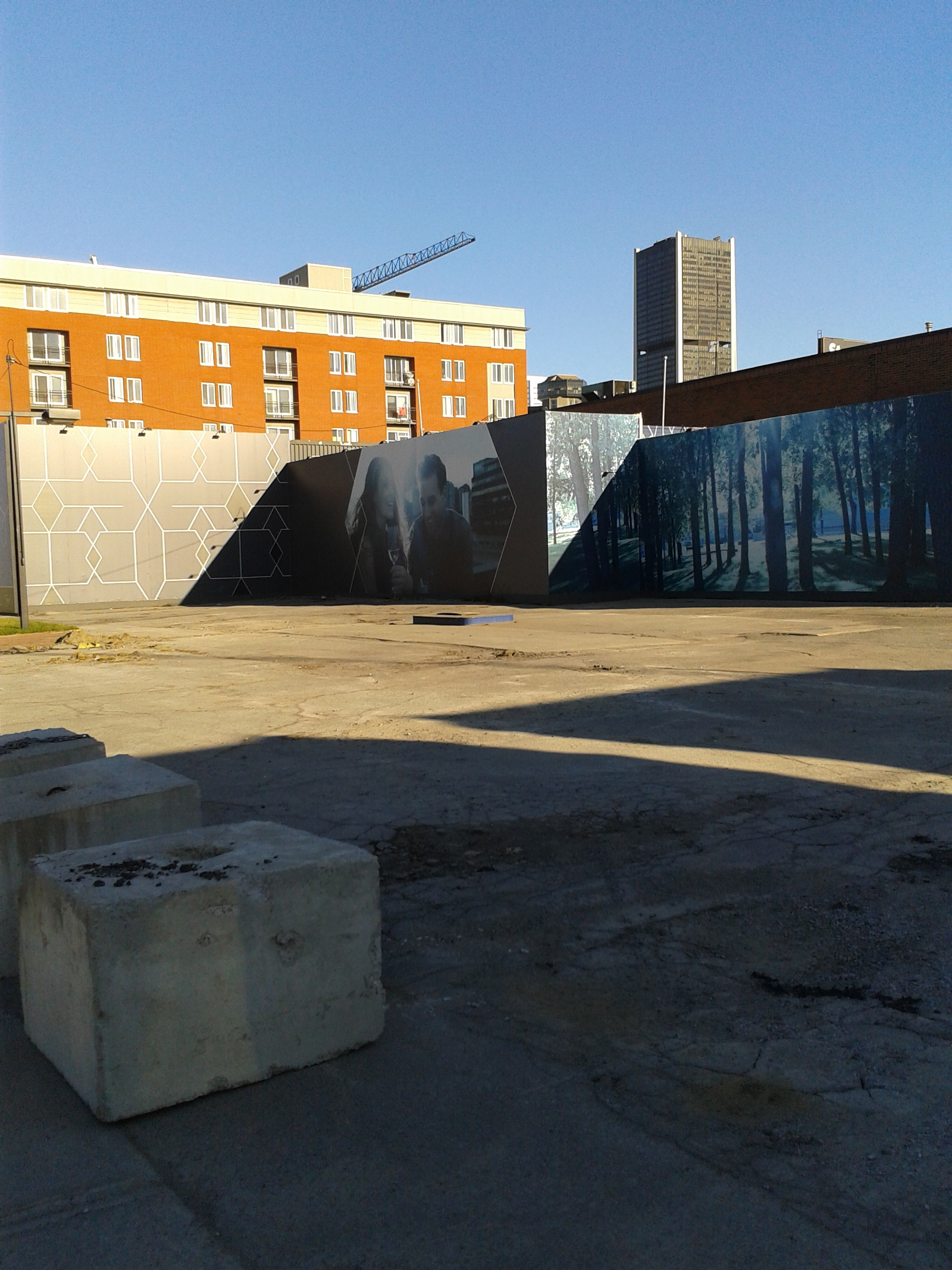
At any rate, the old sales office is now just another wasteland on Griffintown’s landscape, yet another lot of urban refuse, but this time created by the very company which proposes to rejuvenate and renovate the Griff. Ironic, I thought.
In Griffintown/Dans L’Griff
April 2, 2012 § 1 Comment
In Griffintown/Dans L’Griff will be a documentary about Griffintown, made by my friend, film-maker G. Scott MacLeod. Scott’s most recent film, a short entitled The Saga of Murdo MacLeod has been received rapturously by Montrealers at its various showings around town, most recently at Ciné-Gael, Montréal’s Irish film series, which is celebrating its 20th season this year.
Scott is proposing to do a short documentary on Griffintown through the eyes of Claude and Lyse Mercier, amongst the last generation of Griffintowners. Claude and Lyse, as you might guess by their names, are NOT Irish! Shock! Indeed, they are French Canadian, a voice that has long been lost in the stories and memories of the Griff (as my forthcoming book, The House of the Irish: History, Memory and Diaspora in Griffintown, Montreal, will tell you). Almost all the attention on the Griff’s history has been focused on the working-class Irish Catholics, leaving out the other residents there: French Canadians and Anglo-Protestants, and Scott’s about to address this lacuna.
Scott and I have had a lot of conversation about Griffintown, over Thai food and as we’ve wondered the streets of the neighbourhood both of us are so hell-bent on preserving the memory of. And while books are great (especially mine!), a documentary, graphic evidence of what once was, is a brilliant addition to the growing corpus of Griffintown memories.
The trailer for the film is below, but I urge you to click on this link, which will take you to Scott’s indiegogo page, where he is attempting to raise money to help with the costs of film-making. Any amount will help, but Scott is offering 3 levels of support. 20$ gets you a thank you in the end credits and a copy of the DVD, 100$ gets you into the end credits and a DVD, and 1000$ makes you a producer, and you also get a copy of the DVD.
On Living in a Gentrifying Neighbourhood, Part 3
March 3, 2012 § 11 Comments
There is an SAQ outlet at the corner of Centre and Charlevoix here in Pointe-Saint-Charles. For those of you non-Quebecers reading this, SAQ is the Société des Alcools du Québec, the state monopoly, the liquor store. The SAQ here in the Pointe is a tiny one, a little boutique, but very busy and the staff there are friendly, helpful, and very knowledgeable. But the SAQ is closing it down as of 30 March this year because, it alleges, the outlet is unprofitable. If that outlet is unprofitable, I am the King of Siam. What is at work here is the SAQ forgetting its mandate as a state monopoly, which is not just to make money hand-over-fist, but to provide a service.
So the people of the Pointe, as mobilised as ever, are protesting the closure of our SAQ outlet. There was a march to our MNA’s office on rue Saint-Jacques yesterday to protest. Why are people protesting? That should seem to be obvious, quite frankly. But the SAQ at the corner of Centre and Charlevoix is in many ways an anchor of the commercial outlets along the next few blocks of Centre. Kitty corner from the SAQ is Restaurant Machiavelli, a relatively upscale eatery. Next door over is Cari Mela, one of the handful of Indian restaurants in the Pointe, and probably the best. Cari Mela, Machiavelli, and the other Indian restaurants along Centre are all bring your own wine. This makes sense, given the SAQ down the block.
Centre has seen some rough times, but in the past few years there has been a slow regeneration and revival. There have been these new Indian restaurants opening. There is a mosque acros the street and up a block. A series of Bengal dépanneurs have popped up. And a series of coffee shops/casse croutes have opened up or have maintained. More recently, a trendy boutique restaurant, Ma Tante Quiche has opened its doors next to a laundromat, and there are rumours a boulangerie is opening up where the old video store was.
Losing an anchor like the SAQ will have serious ramifications for Centre as a commercial zone.
The CBC had a short story on its website yesterday about the protest, which will no doubt come to naught. The story itself is innocuous, but the comments on it are quite simply, jaw-droppingly stupid. Michael59 says the protest was a stupid joke because the next store is a few blocks away. mikeysm notes that the Pointe is a poor neighbourhood. HughNugent reports that most of his family grew up here and their response would be for us to get up off our fat arses and walk to the Atwater Market, where there’s a big SAQ outlet.
These comments reflect the general idea of the Pointe of a neighbourhood of poor folk, collecting welfare, and spending their banlieue money on lottery tickets. But there is obviously more than that. The Pointe is a diverse neighbourhood these days, and the clientele of the SAQ reflects this. There are people of all ethnicities and socio-economic classes at the outlet buying their alcohol, primarily wine, as that’s what dominates the shelves. Atwater Market is a good 15 minute walk from the corner of Centre and Charlevoix. It’s a lot farther away if you live further into the Pointe.
But beyond that, the general gist of these comments is that the people of the Pointe are fat and lazy and because they are such, they shouldn’t be wasting their money on alcohol to start with. I am very curious what the comments would be in response to a story about the closing of a busy SAQ outlet on, say, the Plateau, or the Mile End, or Outremont, or NDG or Westmount. I’d bet they would be asinine comments such as these.
New Bloomsday Montreal 2012 website
February 24, 2012 § Leave a comment
I will have much more to say shortly, but for now, I just want to update my previous Bloomsday Montreal post with our new website. Everything is coming together nicely for our celebration of Joyce’s masterful Ulysses, 14-16 June. We’ll be updating the site soon. In the meantime, you can also follow us on Twitter and Facebook.
On Living in a Gentrifying Neighbourhood, Part 2
February 24, 2012 § 5 Comments
It is interesting looking at the search terms that have led people to my blog here in the past few days: “car theft pt. st. charles” “murder pt. st. charles” “housing projects pt. st. charles” “crime pointe-saint-charles” “low income housing pointe-saint-charles.”
All negative, all reflecting an old stereotype of the Pointe. When I first moved down here, from the Mile End way back in 2002, my great uncle, a man who has been around some, said to me, “That’s a good place to get your nose punched in. Or worse.” I kept trying to tell him it’s not like that, at least not anymore. He never believed me. I just shook my head. But it seems that old visions of the Pointe die hard.
Constructing Landscapes
February 8, 2012 § 1 Comment
[note: I originally wrote this article nearly 4 years ago for a site that no longer exists; as the ideas contained in this piece are still of interest to me, I am re-publishing it now, mostly for my own purposes going forward. I have updated parts of this article that were dated.]
I read a fascinating post at Geoff Manaugh’s BLDG Blog about a new video game from LucasArts that allows the player to modify the game’s battlespace through various (fictive?) technologies. And while that in an of itself is interesting, what struck me most was Manaugh’s reference to historian David Blackbourn’s book, The Conquest of Nature: Water, Landscape, and the Making of Modern Germany.

Frederick the Great, King of Prussia, 1740-86
Blackbourn argues that modern Prussia (a pre-cursor state to today’s Germany) was literally “made,” or at least its coastline was, during the reign of the Frederick the Great, who ruled Prussia from 1740-86. During this period, dykes were built, bogs and marshes were drained, land along the shoreline was created, moulded, and so on. Vegetation was imported and shifted from one locale to another along Prussia’s coastline. Frederick’s imperial projects in Prussia were not, in fact, unlike the works the Dutch did along their coastline to make the Netherlands both more productive and more liveable.
Blackbourn’s argument is an interesting one, to be sure: that modern Prussia (and therefore, today’s Germany) was literally made in the shape that Frederick desired; the land was sculpted. This was done not to give him more land to rule over, as Manaugh suggests, but to increase Prussia’s wealth. In the pre-Adam Smith era, the wealth of nations was measured in agricultural production. Indeed, this was a pretty common Enlightenment argument, popularised by François Quesnay and his colleagues in France, the Physiocrats.
Frederick was keenly interested in Enlightenment theories, and corresponded with many leading thinkers of the era. He even hosted the idiosyncratic French thinker Voltaire at his palace at Sans Souci for a while, until their particular personalities led to conflict. Adam Smith, for his part, was a colleague and correspondent of Quesnay and the Physiocrats, and developed his own theories on the wealth of nations, in part from this correspondence.
What’s of interest here is Blackbourn’s argument. Germany isn’t the only nation to be literally made from the ground up. All modern, industrialised, militarised Western nations are so-made. Many former colonial territories, such as India, Pakistan, and Bangladesh, also fall into this category. Our landscape is, all around us, “made”, both in the physical and intellectual sense. Our landscape is only as it is because we – as a culture, a society, as individuals – see it in a certain way.
 More than this, the landscapes of these industrialised, Western nations (and their former colonies) are man-made in many ways. Germany and the Netherlands are but two examples. England, also, is crisscrossed by canals, constructed by re-shaping the landscape of the nation to transport goods and commodities during its Industrial Revolution. Indeed, England is a good example of the forging, or of a landscape, as it has been largely deforested in order to create the fuel for industrialisation, and the landscape for industrialisation.
There’s more. All countries are made, or manufactured, in the sense Blackbourn means. In some cases, this is a natural phenomenon, such as the erosion of sea shores and river banks and coastlinesIn others, it’s man-made. Take, for example, the Gulf Coast of the United States and, in particular, New Orleans. We saw how much of that coast was devastated by Hurricane Katrina in 2005. While the hurricane was devastating enough, what failed in the case of New Orleans were man-made defences around the city, located as it is on the delta of the Mississippi River, and on the shores of Lac Pontchartrain.

New Orleans after Katrina
Close to 49% of the New Orleans’s geographic footprint is below sea level, and large parts of the city are sinking. New Orleans averages out at 0.5 metres below sea level, with some parts reaching 5 metres below sea level; but the city has been made a viable location for settlement, industrialisation, and economic activity due to mitigating works being built on the Mississippi and Lac Pontchartrain. All of this economic and industrial activity in New Orleans and along the Gulf Coast has also meant the destruction of nearly 5,000 square kilometres of coastline in Louisiana alone in the twentieth century, including many off-shore islands, all of which used to protect New Orleans and the Mississippi delta.
Thus, when Katrina hit 6 ½ years ago, on 28 August 2005, there were few natural defences left to protect New Orleans. The man-made “improvements” to New Orleans and the surrounding area were simply insufficient to deal with a hurricane the force of Katrina, which was classified as a Class 1 or 2 storm. The result was nearly 80 per cent of the city was flooded out, as well as massive social and economic dislocation. Today, New Orleans’s population is still only 60 per cent what it was prior to Katrina.
Getting back to Blackbourn’s argument: his arguments vis-à-vis the creation of modern Prussia can be transported across and around the industrialised Western world. Montréal (the population of Montréal’s metropolitan area is nearly four times the size of that of New Orleans), is the beneficiary of similar modern landscape engineering. The city is located on an island in the middle of the Saint-Lawrence River, and in a cold, northern climate. In the nineteenth century, each spring, during the spring run-off and thawing of the river, the low-lying portions of the city, located near the river bank on the flood plain, were swamped with water.

1886 Flood, Chaboillez Square, Griffintown, Montréal
In 1886, flood waters were over 3 metres deep. The flood led to mitigating works being constructed along the river, the bank was re-landscaped and engineered, dyking was constructed, and so on, all in order to prevent further flooding. This allowed Montréal’s industrial development to continue throughout the late nineteenth and early twentieth century . This allowed it go through an unprecedented growth cycle that only ended with the Depression of the 1930s, and enabled Montréal to solidify its position as Canada’s metropole (a role it has since lost to Toronto).
This re-shaping of the environment, however, is not limited to the West. More recently, the insta-city of Dubai in the United Arab Emirates has followed suit. Dubai itself is a manufactured landscape, as all cities are to a degree, but in the case of Dubai, the landscape has been purposely re-appropriated for the construction of the city. A more specific example can be seen in the city’s golf courses, for example, the Tiger Woods Dubai golf resort and residences. Golf courses are, in fact, a perfect example of the re-engineering of the landscape, as grass and various other features such as sand traps and water hazards – to say nothing of surrounding vegetation – are imported and planted into foreign
The construction and maintenance (such as irrigation and pesticides) of Dubai’s golf courses, situated as they are in the desert, present us with a massive redevelopment of the landscape, the environmental consequences of which appear to be lost on Woods and his partners in the project. Dubai City itself is an example of environmental re-landscaping for human needs and settlement. Without the sorts of technologies created by the Dutch and the Prussians (to say nothing of the English, Americans, and Canadians), Dubai itself would not exist in its present, insta-city form.
Phoenix, British Columbia: Ghost Town Reclaimed by Nature
February 5, 2012 § 14 Comments
Continuing in the vein of the Hawley Town Commons in Western Massachusetts and the changing rural landscape of Saint-Sylvestre, Québec, I present now to you the ghost town of Phoenix, British Columbia. Phoenix is located in the Kootenay Mountains of eastern BC, not far north of the American border.
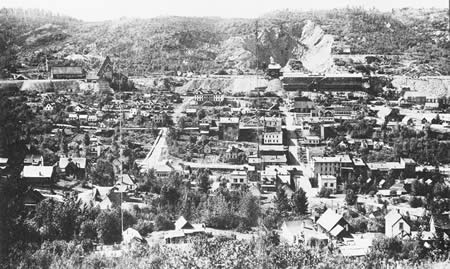
Phoenix, BC, 1912
About a century ago, Phoenix was a thriving copper mining town. It boasted modern amenities such as electricity and phone lines, there was a ballroom and an opera house. it had a stop on the stage lines that ran through the Boundary Region of the Kootenays, there was a post office and around 1900, both the Canadian Pacific Railway and the Great Northern Railway arrived in Phoenix. In short, the town had made it. It was thriving. But as was often the case in the mining regions of the North American west, the boom years were short. At the end of the First World War, the price of copper dropped dramatically and the Phoenix Mine was shut down. And the town of Phoenix died.

Phoenix First World War Cenotaph, 1937
In the 1920s, the homes and buildings were torn down or buried and there was nothing left of Phoenix, except for its First World War cenotaph, which is still there today. Otherwise, nature has reclaimed the old town site of Phoenix, despite the operation of an open-pit mine in the 1950s, 60s, and 70s. When I visited Phoenix about 15 years ago, I was floored by the site. I had seen other ghost towns in BC, most notably Barkerville, a tourist site. But many other sites I had seen were maintained to at least some degree. Phoenix was a smallish clearing in the dense forest, and the forest was rapidly moving back in, re-claiming its territory. The grave yard was the most fascinating location on the old Phoenix townsite. Most of the head stones were long gone. Many of the graves no doubt never had a proper head stone in the first place, graves marked by wooden crosses, wooden heads, or whatever was handy. One grave, otherwise unmarked, had a furniture cabinet as a marker.
But otherwise, the grave yard had 80 year old pine trees reclaiming their territory, encouraged by the heavy fertiliser in the soil in the form of decomposing human bodies. (Since my visit, residents of nearby towns have sought to restore the graveyard some, restoring the headstones that do exist). What struck me the most about standing in the Phoenix cemetery, though, was not so much the dilapidated headstones, the cenotaph in the distance, or the trees. It was the black bear about 500 metres away, happily munching away on some berries. It was also the bear that convinced us to get back in the car, slowly and quietly, and get the hell out of there.
Bloomsday Montréal 2012
February 4, 2012 § 19 Comments
 I am on a steering committee attempting to launch Bloomsday Montréal this year on 16 June.
For those who don’t know, Bloomsday is an annual celebration worldwide of James Joyce’s masterful novel, Ulysses, which was first published in 1922. Ulysses traces the travels of one Leopold Bloom, a Dubliner, across the city on 16 June 1904. That date was significant for Joyce as it was the date of his very first outing with his wife to be, Nora Barnacle. Many consider Ulysses the finest novel of the 20th century. The first Bloomsday was celebrated on 16 June 1954, the 50th anniversary of Bloom’s travels, in Dublin, where the Irish artist John Ryan and the novelist Flann O’Brien decided to re-trace Bloom’s route around the city.
From there, Bloomsday has grown to be a massive cultural phenomenon, celebrated in over 60 nations around the world. In 2004, the 100th anniversary of Bloom’s travels, a massive celebration was held in Dublin, with over 10,000 people in attendance. On 16 June 1958, the star-crossed Ted Hughes and Sylvia Plath were married on Bloomsday. Why Montréal, a major city of the Irish diaspora has not had a Bloomsday until now is beyond my ken. But, it is time.
We are just getting organised, our webpage will be up soon, but in the meantime, follow us on Twitter or Facebook for updates and news of our events on 16 June!
 Matthew Barlow