Rural Palimpsests; Or, the Changing Rural Landscape
February 3, 2012 § 9 Comments

Drawing of the Old Hawley Town Commons
About 18 months ago, I wrote this piece about the old Town Commons in Hawley, Massachusetts. I was struck by the history of what could no longer be seen in Hawley at the Town Commons where, in the mid-19th century, there was a vibrant townsite. Hawley also stirred up my own memories of having lived in a ghost town as a teenager, on the old town site of Ioco, British Columbia, now a part of Port Moody, BC. But Ioco, which will eventually become condos, I’m sure, was a (sub)urban townsite. Hawley is a town a few miles west of the Middle of Nowhere.
 In urban centres, we see the ruins of past civilisations all around us, whether they are palimpsests of old advertisements on the sides of buildings, or the ruins of buildings, still dotting the landscape. Indeed, I wrote my doctoral dissertation and a book on a neighbourhood that was, at least when I started writing, a ruin: Griffintown, Montréal. A decade ago, the landscape of Griffintown was an urban ruin, the foundations of the old Irish-Catholic Church, St. Ann’s, poking through the grass of Parc St. Ann/Griffintown; the rectory of the French Catholic Church, Ste-Hélène still stands, but the church is long gone, just a few corner stones and the remains of an iron fence are left. But this is a city, and cities, we are constantly reminded by scholars, poets, novelists, film-makers, etc., are living organisms, built to be rebuilt, constantly evolving and changing. By definition, then, the rural landscape is unchanging and constant.
Don’t believe me? Spend a bit of time reading literature set in the countryside. Or watch movies. Read poems. The landscape of the country side is eternal and unchanging. Entire nations have been built on the mythology of the countryside (I’m looking at you, Ireland!). Here in Québec, Maria Chapdelaine, a major novel of the early 20th century nationalist school explicitly tied the virtue of the nation to the land. The anti-modernists of a century ago celebrated the unchanging “natural” landscape of the countryside as a tonic for the frayed nerves of modern man. In Canada, the Group of Seven built their entire careers/legends on representing Ontario’s mid-North back to us as the nation. Watch a Molson Canadian ad these days, and you’ll learn that Canada has more square miles of “awesomeness” than any other country on Earth. And all that awesomeness is somewhere in the wheat fields of Saskatchewan. But the rural landscape DOES change and evolve, as the Old Hawley Town Commons will tell you.
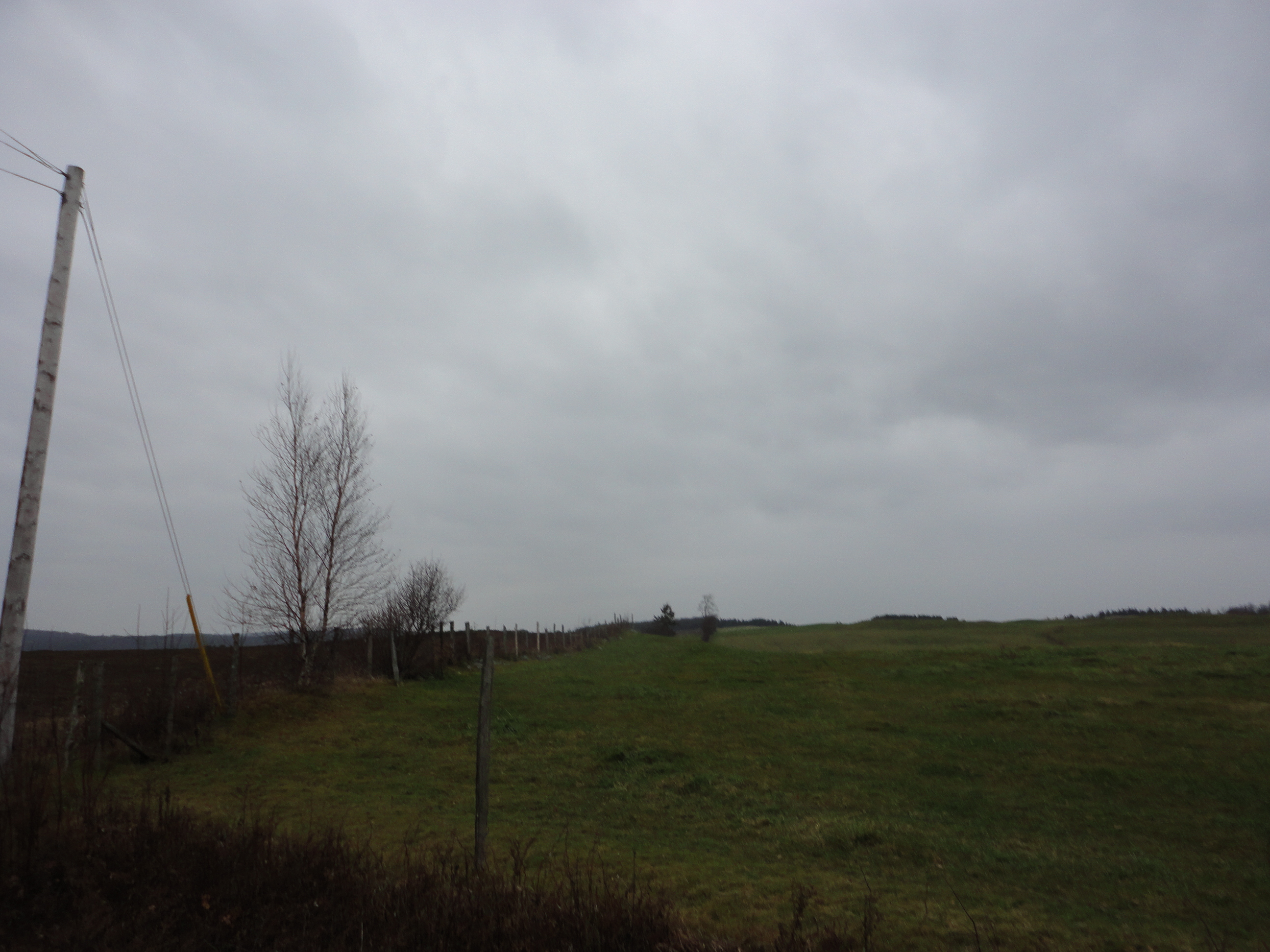
This is where Robert Corrigan was fatally beaten on 17 October 1855
This was brought all the closer to me in late November, when I travelled out to Saint-Sylvestre, Québec, which is located about 70km south of Québec City, in the Appalachian foothills. I was there because a long time ago, I wrote my MA thesis on the Corrigan Affair, which erupted in Saint-Sylvestre on 17 October 1855 when Robert Corrigan, an Irish-Protestant bully, was beaten to death by a gang of his Irish-Catholic neighbours. The mid-1850s saw the height of sectarianism in Canada and a murder case involving the two groups of Irish proved to be too much for many Anglo-Protestant Canadians to take and a national crisis broke out. By the time the Affair was over in 1858, not only had Corrigan’s murderers been acquitted of all charges, the McNab-Taché coalition government had fallen. All these years later, I had it in my mind that it was time to do something with the Corrigan Affair. I had done my best to avoid it after I finished my MA, I did attempt to write an academic article, but it seemed to me to be too good a story to be wasted in a journal article that no one would ever read. So I have decided to write a book that no one will ever read, but at least a book is a physical thing, something to offer tribute to this rather amazing story that erupted onto the front pages of newspapers across British North America from a rural backwater. So it was out to Saint-Sylvestre to meet Steve Cameron, a local man who has a deep interest in the Corrigan Affair and the history of the Saint-Sylvestre region in general.
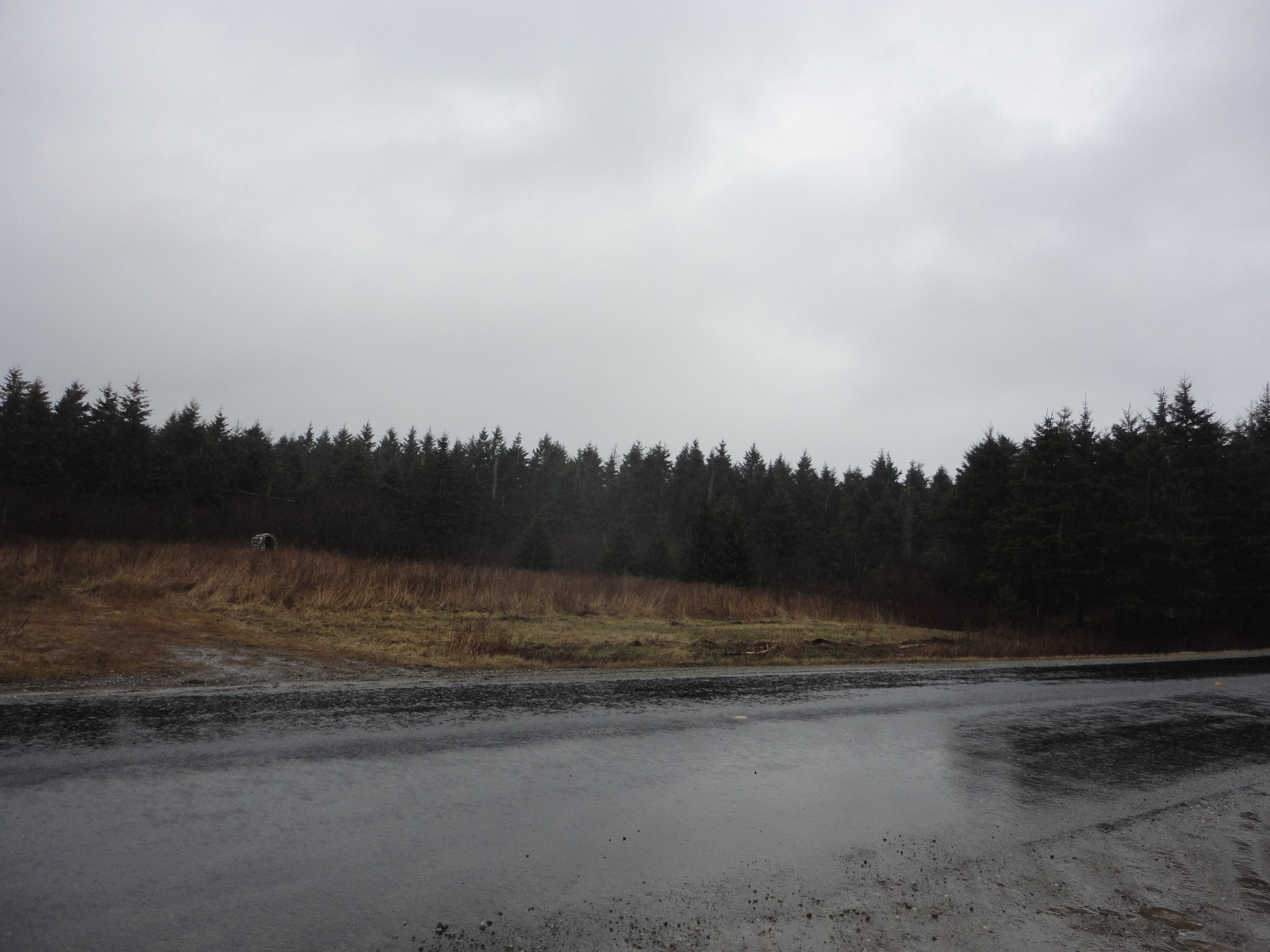
Corrigan's homestead, Saint-Sylvestre, Québec

Hugh Russell's farm
Steve offered to give me the grand tour of the landscape, where the Corrigan Affair took place. I don’t really know what I expected, but I certainly didn’t expect what I saw: the entire landscape of Saint-Sylvestre and the landscape of the Corrigan Affair is gone, completely changed in the 155 years since Corrigan’s death. He was beaten on the county fair grounds; the site where he was beaten is completely non-descript today, just a corner of a farmer’s field. Corrigan’s homestead is covered with scrub and a random cross someone threw up sometime in the past century. Where the farm of Corrigan’s friend, Hugh Russell was once located there is nothing but high tension electrical wires, forest, and a dirt road passing by in front. There is no evidence of human habitation ever having stood there. Where the Protestants had their burial ground here in the backwoods of Saint-Sylvestre/Saint-Gilles, there is nothing left but a stone wall, though the grave yard has been carefully and lovingly restored by Steve’s organisation, Coirneal Cealteach.

Old Anglican grave yard in the backwoods of Saint-Sylvestre
In short, the rural landscape is just as dynamic of that of the city. In Saint-Sylvestre, the mostly Irish-Catholic farmers were settled on poor farming land in a harsh and unforgiving landscape; their descendants left. And in their stead, nature reclaimed its place. When I first began studying Griffintown a decade ago, Talking Heads’ song “Nothing But Flowers” kept creeping into my head as I pondered the ruins of the churches, the trees growing in vacant lots and the vegetation in the cracks of the concrete. But “Nothing But Flowers” applies just as much to Hawley or Saint-Sylvestre or countless other rural landscapes once settled by humans who have long since moved on.
Globalised Montréal
May 12, 2011 § Leave a comment
In the past few years, there’s been a new trend in Montréal History and historiography that has seen us seek to place the city within a global context. This is a welcome change from our usual navel-gazing, as we sought to explain developments in Canada solely within a Canadian context. Certainly, the local context is important, but Canada did not develop in solitude. It was always a colony and nation tied into global political and economic currents, closely related to goings-on in Paris, London, and Washington. Indeed, scholars of Canadian foreign policy have long framed Canada within the North Atlantic Triangle, along with the UK and USA.
But, culturally and socially, while historians have noted the impact of British and/or American ideas in Canada, we have gone onto explain and analyse the Canadian context separate from the global. In Québec, though, perhaps due to political exigencies. Back in undergrad at UBC, Alan Greer’s masterful book, The Patriots and the People was the first study I ever read that attempted to internationalise Canadian history. In it, Greer re-cast the 1837 Patriote rebellions in Lower Canada within the revolutionary fervour that had swept Europe and the United States since the late 18th century. Seen in this light, the Parti Patriote wasn’t just a nationalist French Canadian political party, but part of an international of liberal revolutionaries that had corollaries in England, Ireland, France, the German territories, the Italian countries, the United States, and so on.
Greer’s book fit into the larger work of the revisionist Québec historians, who often sought to put Québec into a global context, both to explain the colony/province/nation’s development, as well as to give credence to Québec’s claims to nationhood. The goal was to present Québec as a nation commes les autres. Perhaps the book that had the greatest impact on me in this sense was Gérard Bouchard’s 2000 monograph, Genèse des nations et cultures du Nouveau Monde: Essai d’histoire comparée, in which Bouchard examines the development of Québec in relation to other “new world” cultures in Mexico, Australia, New Zealand, Canada, and the United States. Put this way, Québec’s (and Canada’s) development from the moment of European settlement is globalised and we realise that Canada (and Québec) is not really all that unique.
This tendency to internationalise Québec seems to be continuing with a younger generation of historians. My friend and colleague, Simon Jolivet, has just published his new book, Le vert et le bleu: Identité québécoise et identité irlandaise au tournant du XXe siècle. Simon and I did our PhDs together at Concordia, and in 2006, the School of Canadian Irish Studies there hosted a roundtable discussion that looked at connections between Ireland and Québec, in large part this grew out of the work our PhD supervisor, Ronald Rudin had done early in the decade. It was probably the most dynamic and informative conference I’ve been at, as ideas flew around the table. Both Simon and I gained a lot from that conference and it is clear in both of our work.
For my part, I am interested in the Irish in Griffintown, Montréal, over the course of the 20th century. What I look at is, of course, identity, but I’m interested in the shaping of a diasporic identity amongst the Montréal Irish, one that situates the Irish of the city within the global context of the Irish around the world, as well as the links (such as they were) with Ireland itself. To do so, I make use of post-colonial theory, which seems particularly à-propos for the Irish, descendents of a colonial culture in Ireland, living in Montréal, the largest city of the French diaspora and thus necessarily a post-colonial location.
And this is what Sean Mills picks up in his brilliant new book, The Empire Within: Postcolonial Thought and Political Activism in Sixties Montreal. Mills situates Montréal within that postcolonial framework, and examines the ideas of decolonisation and colonialism within activist circles in Montréal in the 60s. The activists were heavily influenced by what was going on in the world around them, in de-colonial movements in Algeria, Tunisia, and, especially, Cuba, as well as the Caribbean in the 50s and 60s. Certainly, they were well aware of their skin colour and Canada’s place as a first-world nation. But the ambivalence of Montréal (still the economic centre of Canada in the 60s) is something Mills excels at drawing out. As the decade went on, American activists, in particular African American activists like Malcolm X and Stokely Carmichael, became influential in the de-colonial struggle of the French Canadian majority of the city. This was further complicated by Montréal’s own black population, which also identified itself with the ideas coming out of the United States and the Caribbean. And as Montréal became a more complicated city, ethnically-speaking, to say nothing of the actions of the FLQ in October 1970, ideas of decolonisation lost their appeal.
Nonetheless, what is clear is that Montréal is a global city, one that takes its cue from its global connections as much as its local ones. Indeed, this is the basis of my next project about layers of diaspora on the urban landscape of the city. In the meantime, it also gives me a way to situate my own work on the Irish of Montréal in a larger global context.
Les Expos, Nos Amours: Gone, but not Forgotten
April 25, 2011 § Leave a comment
Last October, as the Expos should have been winning the World Series, I wrote a piece at the National Council on Public History‘s blog, Off the Wall, about the strange marketing after life of Nos Amours. This provoked a steady stream of comments, both on that site and into my inbox, as well, to a lesser degree, here at Spatialities. One of my readers, Sarah, pointed out Montréal rapper Magnum .357′s track “Expos Fitted.
It seems that rap has emerged as a key component to remembering our long gone baseball team here in Montréal. Aside from Mag .357, Anakkin Slayd, who is more famous right now for his viral hit, “MTL Stand UP”, also wrote a song about the Expos, “Remember”.
On Diasporas and Protests
February 6, 2011 § Leave a comment
As unrest unfolds in the Middle East, one thing I’ve enjoyed here in Montréal have been the protests of the various diasporas. A few weeks ago, as I ran errands downtown on a Saturday, I got caught up in a large group of Tunisians protesting against Ben Ali, calling for his removal. Since then, the Tunisians have protested against his brother-in-law, who has attempted to seek shelter in Montréal and claiming refugee status in Canada. Other Arab diasporas have joined in the protests. The Tunisian one I got caught up in had people not only draped in the Tunisian flag, but the Algerian, Lebanese, Palestinian, and Egyptian flag.
Yesterday, the Egyptian diaspora in Montréal was out in the streets downtown protesting against Hosni Mubarak, part of an international day of protests, calling for his ouster. As with the Tunisian protests, they were joined by other Arabs. But what makes these protests special for me is that it’s not just the Arabs, not just the Tunisians and Egyptians, out in the streets in Montréal. They are quickly joined by everyone else in the city: québécois, Anglos, Spanish, Italians, Greeks, Jews, and so on.
The Tunisian protest was a multicultural sea of faces, all united in celebrating Tunisian freedom and Ben Ali’s ouster. Video I’ve seen of yesterday’s anti-Mubarak protests were similar. It’s simply nice to see the coming together of all of these diasporas in Montréal, including ones that don’t historically get along, to protest against injustice on the other side of the world.
UPDATED: Check out this article on the Egyptian diaspora in general and their hopes for reform.
Mon pays
February 5, 2011 § Leave a comment
My erstwhile colleague, Matthew Hayday, has written an interesting critique of John Furlong and VANOC’s attempts to use the Québécois singer Gilles Vigneault’s song, “Mon Pays” for the 2010 Olympic opening ceremony. Except that VANOC made no attempt to contact Vigneault for permission before planning the festivities and they were left holding the bag when Vigneault refused permission. As Matthew notes, quelle surprise, Vigneault is a well-known separatist and “Mon Pays” was the song people cried in their beer to after the 1980 Referendum loss for the “Oui” side.
Matthew goes on to note that Furlong demonstrated a total lack of understanding of Québec here. I have a few things to note in response.
First, Matthew is bang on, deciding to use a Vigneault song for Canada’s Winter Olympics is missing the entire point of Vigneault’s long career. Second, choosing a song that was recorded in 1966 shows a devastatingly pathetic grasp on pop culture in Québec.
But more to the point, the lack of understanding about Québec from some in the ROC is not all that shocking to me. I have been told many times that I speak “very good English” for a Quebecer. The most recent time being last summer when I was in Vancouver. Indeed, it is impressive an Anglo-Montrealer would speak English well.
The Redemptorists
January 10, 2011 § 2 Comments
I went to mass on Christmas Day, I’m not Catholic, but I kind of like the tradition. This year we were in Keene, NH, where my sister-in-law lives. The priest had as the theme of his Christmas morning sermon “redemption,” noting that that was the true meaning of the season. I like to think that is one of the good points of Catholicism, that redemption is granted through the fallibility of humanity, God’s forgiveness for our sins, in part through the sacrifice of Jesus, in part through confession. I presume that this is where the Redemptorist Brothers got their name, their job being to redeem the souls of both their parishioners, as well as their converts (they are a missionary brotherhood).
Anyway, all of this is by way of introduction of my destination tomorrow in Toronto: the archives of the Redemptorists. The Redemptorists were the parish priests in Griffintown from 1885 until the destruction of St. Ann’s Church in 1970, and the ultimate closing of the parish a dozen or so years later. So far as I know, no one has actually gone in and looked at the brothers’ records from Griffintown. I was told about them years ago by Rosalyn Trigger, who was at the time doing her PhD at McGill, but I never found the time to get to Toronto to look at them when I was researching my PhD. Funny: last time I saw my supervisor, Ron Rudin, a few months ago, I was telling him about my plans to go take a look as I finished off the research for the book. He wondered if he could take back my PhD for keeping knowledge of this archive from him. ‘Fraid not, Ron.
Anyway, I’m rather excited to be heading to the archive tomorrow morning to see what I can find, to deepen our general knowledge of Irish-Catholic Griffintown, it will also add something to my book that is not in other histories of the neighbourhood, including my own dissertation.
That the Redemptorist priests were popular in their parish of St. Ann’s is not in doubt. In 1885, when the Sulpicians were stripped of their parish of St. Ann’s, the Irish-Catholics of Griffintown were furious, to the point where they remonstrated with the Bishop of Montréal. However, the Redemptorists, upon their arrival, were able to almost instantly win the hearts and minds of their parishioners, by investing money in the church and parish. By the time that Father Strubbe, the “Belgian Irishman,” was recalled to Belgium, the Irish-Catholics were loudly remonstrating with the powers-that-be over this decision. All the former Griffintowners that I have done oral histories with fondly recall the priests of St. Ann’s, in particular Fr. Kearney.
So I’m hoping here to find out how the priests saw their impoverished parishioners, what they felt they could do for them, whether they enjoyed being in Griffintown, their impressions of the neighbourhood. I’m also interested in the question of faith. All of the former Griffintowners I’ve talked to, as well as all other evidence I’ve seen, shows a very Catholic community, one where people took the ceremonies and rituals of their faith. But what has always interested me is whether this was just that: familiar ritual. One thing the Church is very good at is giving its faithful ritual and ceremony that are both familiar and reassuring. But I’ve always wondered how deep the idea of faith goes, not just with respect to Griffintown, but the Catholic Church in general.
Then there’s the question of Irishness. One of the reasons the Griffintowners protested the removal of the Sulpicians in 1885 was because the Sulpicians were very good about ensuring the parish priests at St. Ann’s were Irish. The Redemptorists who arrived in Griffintown that year were all Belgian. Of course, Fr. Strubbe was able to win over his parishioners and even gain status as an Irishman by the time of his recall. And by the mid-20th century, the priests, like Fr. Kearney, were Irish once more. Was this a conscious decision by the Redemptorists and the Bishop to represent the faithful? What did the priests make of the Irishness of their parishioners?
So here’s hoping I can begin to find some answers to these questions in the archive.
Today in Hockey History
January 5, 2011 § Leave a comment
Happy New Year! It’s been awhile since I’ve posted, I got caught up in the craziness that is the end of the semester and then took a nice relaxing Holiday sabbatical. Anyway, yesterday, whilst sitting in a MacDonald’s parking lot in Pittsfield, Massachusetts, I did a radio interview with CJSW in Calgary, their excellent “Today in Canadian History” series. I was honoured with their first podcast last 1 July talking about the meanings of Canadian Confederation. Today marks 111 years since the Montréal Canadiens played their first home hockey game, so here I am talking about the importance of the Habs.
Magnum .357: “Expos Fitted”
October 23, 2010 § 1 Comment
A tip of the hat to Sarah, who posted a comment in response to Nos Amours (and check out the original post at NCPH’s Off The Wall), directing us to a video of Montréal rapper Magnum .357 and his début single/video, “Expos Fitted.” She posted the video in her comment, but I think it deserves wider exposure. I especially love the nostalgia of the Expos dressed up as gangsta rap.
Mag .357 is practically my neighbour, he hails from Montréal’s Anglo-Black neighbourhood, Little Burgundy, which is across the Lachine Canal from me here in Pointe-Saint-Charles. Burgundy is a curious neighbourhood, as it is home to both inner-city gang violence and yuppies who have gentrified the old worker’s cottages and triplexes that line the streets. It is also one of the oldest Black communities in Canada.
Burgundy also has a long history of being a centre of entertainment in Montréal. In the wake of Prohibition in the US and before the rise of Jean Drapeau as mayor of the city in 1960, Burgundy was home to various jazz clubs, most notably the legendary Rufus Rockhead’s Paradise. Oscar Peterson and his student Oliver Jones, the two greatest jazz musicians this country has ever produced, also grew up on the streets of Burgundy. In this sense, Mag .357 is carrying on the tradition.
I have to say, I love this track and I’ve been checking out his MySpace page. Enjoy.
Nos Amours
October 18, 2010 § 1 Comment
I have a post up at the National Counil on Public History’s (NCPH) sponsored blog, Off the Wall, looking at the difference between marketing and nostalgia when it comes to the ill-fated Montréal Expos.
Metropolitan Statistic Areas
October 16, 2010 § 3 Comments
As an addendum to Wednesday’s post on the old Town Commons of Hawley:
Usually, I study cities and the palimpsests of history upon them, the ways in which their histories are used by their publics and their powers that be, and historians as well. Hawley is about as rural a place you can get. But, Hawley (and all the tiny towns around it, none of which have much more than 1000 people in them) is included in something called the Springfield Census Metropolitan Statistical Area. The Springfield CMSA is home to over 680,000 people. Sounds impressive, no? But this is an artificial “Metropolitan” area, as are all such beasts. To wit, Springfield is actually home to about 155,000 people. Certainly, there are cities within the Springfield CMSA beyond Springfield, like West Springfield and Holyoke. But Hawley isn’t a city. And it’s not exactly near Springfield. It’s about 45 miles away, in fact.
Thus, the Springfield CMSA is an artificial catchment area. Officially, the US Office of Management and Budget and the US Census Bureau make use of CMSAs for policy making and the like. The basic idea behind the CMSA is an urban “cluster”, a region with a relatively high population density. The outlying areas are included if they have strong ties to the central urban centre. And this is where the Springfield CMSA doesn’t make a lot of sense. Hawley and the towns around it are not all that closely connected culturally or economically with Springfield. Instead, Greenfield in the Pioneer Valley and Pittsfield, in the Berkshires, are the urban centres that are tied to these towns. Northampton could also make a claim. It is to these places that the residents of Hawley, Charlemont, Plainfield, Ashfield, etc., commute if they commute. Rarely is it Springfield.
But this might also explain their inclusion in the Springfield CMSA, as both Greenfield and Northampton lie within it. And so the catchment area of Springfield just keeps spreading. Pittsfield is its own CMSA. But, still, it remains that deeply rural communities are artificially included in a statistical area that has little if any connection to them. Life in Hawley and life in Springfield are not even remotely related. Springfield, despite being a small city, is a downtrodden and gritty one. Hawley is a rural community nestled into the hills of Western Massachusetts.
Either way, while I can see the argument here, I do not see the statistical value of including Hawley with Springfield. They are 45 minutes and worlds apart from each other.
And it also speaks to the danger of trying to compare urban populations. For example, it is often said that Boston has a population over 5 million. That’s just not correct. The City of Boston has 650,000 people in it. Boston is the centre of Suffolk Co., which has a population of about 760,000. If you factor in the immediate suburbs of Boston, its population grows to about 1.5 million. But Boston’s Census Metropolitan Area is home to something close to 4.5 million people. However, Boston’s CMSA extends from New Hampshire in the north to include most of eastern Massachusetts, as well as ALL of Rhode Island, which itself includes the CMSA of Providence, the largest city in Rhode Island.
In other words, the Boston CMSA covers some 366 square kilometres, and includes regions that, like Hawley, are about as far from urban as you can get. In short, CMSAs are wildly inaccurate when it comes to measuring and comparing urban populations, especially when definitions of what constitutes a CMSA in the US is not all that consistent across the board, or when other nations use different defintions of what constitutes an urban area.
For example, in Canada, the equivalent is a Census Metropolitan Area, which is a statistical unit centred around a “large” city, of at least 100,o00 people. Montréal’s CMA is a much more sensible defintion of such a statistical area, as it includes the core city and the Île-de-Montréal, as well as the neighbouring Île-de-Jésu, which includes Laval, and the south shore, which includes suburbs such as Longeuil. And then it includes the expanded ring of suburbs that surround the Laval-Montréal-Longeuil nexus. And while there are rural areas included in this territory, especiallty to the north-west of the Île-de-Montréal, they lie between and betwixt bedroom communities and other regions that are clearly centred on Montréal.
But, either way, one cannot compare the Boston CMSA to the Montréal CMA because they are not similar birds. In fact, they might not be birds at all. To equate Montréal’s with Boston’s, one would have to include Sherbrooke, or Québec, or Ottawa within the Montréal CMA, much like Providence, RI, and Manchester, NH, are included within Boston’s.
 Matthew Barlow