Between the Horns
January 10, 2011 § Leave a comment
My good buddy, Jason Santerre, has started a new blog, Between the Horns, to give him some space to ruminate on one of his passions, heavy metal (the other being the Habs). Go check it out. Aside from being a metal head, Big J. has a gentle soul, and he just happens to be a wonderful poet, too.
Magnum .357: “Expos Fitted”
October 23, 2010 § 1 Comment
A tip of the hat to Sarah, who posted a comment in response to Nos Amours (and check out the original post at NCPH’s Off The Wall), directing us to a video of Montréal rapper Magnum .357 and his début single/video, “Expos Fitted.” She posted the video in her comment, but I think it deserves wider exposure. I especially love the nostalgia of the Expos dressed up as gangsta rap.
Mag .357 is practically my neighbour, he hails from Montréal’s Anglo-Black neighbourhood, Little Burgundy, which is across the Lachine Canal from me here in Pointe-Saint-Charles. Burgundy is a curious neighbourhood, as it is home to both inner-city gang violence and yuppies who have gentrified the old worker’s cottages and triplexes that line the streets. It is also one of the oldest Black communities in Canada.
Burgundy also has a long history of being a centre of entertainment in Montréal. In the wake of Prohibition in the US and before the rise of Jean Drapeau as mayor of the city in 1960, Burgundy was home to various jazz clubs, most notably the legendary Rufus Rockhead’s Paradise. Oscar Peterson and his student Oliver Jones, the two greatest jazz musicians this country has ever produced, also grew up on the streets of Burgundy. In this sense, Mag .357 is carrying on the tradition.
I have to say, I love this track and I’ve been checking out his MySpace page. Enjoy.
Nos Amours
October 18, 2010 § 1 Comment
I have a post up at the National Counil on Public History’s (NCPH) sponsored blog, Off the Wall, looking at the difference between marketing and nostalgia when it comes to the ill-fated Montréal Expos.
Shameless Self Promotion, for a good cause
October 14, 2010 § Leave a comment
I was on GlobalNews at 6 last night here in Montréal in a story about the Griffintown Horse Palace and our plans to save the Palace from re-development in Griffintown. Also, The Gazette has a similar story this morning has a story.
Something is Rotten in the Country of Canada
September 6, 2010 § Leave a comment
Seriously, there is something deeply and fundamentally flawed in this country. According to The Globe & Mail, Ontario is making a push to become the centre of the digital entertainment industry in Canada. That’s all fine and good until one realises that the industry is presently centred in Vancouver and Montréal. So, basically, Toronto, backed by the provincial government, is now going to take on the other two major cities in the country, backed by their own provincial governments, in order to see who wins. This is just wrong.
Certainly, the provinces have had flashpoints, economically speaking, including Québec’s infamous deal with Newfoundland for Churchill Falls. But that deal was made because Newfoundland lacked the ability to harness the power of Churchill Falls. Vancouver and Montréal, on the other hand, are already the centre of this industry. What Toronto and Ontario are doing here is nothing short of cannibalisation.
Something is wrong, very wrong, in this country.
Griffintown Horse Palace Foundation Soirée
September 4, 2010 § Leave a comment
I am pleased to announce that the Griffintown Horse Palace Foundation will be hosting a shared benefit soirée on Thursday, 14 October from 6-9pm with the Darling Foundry. The event will be held at the Darling, which is located at 745, rue Ottawa, in Griffntown. The poster is below.
Tickets cost 125$, per person and are tax deductible. They can be procured either by contacting me, or on the Horse Palace Foundation’s website.

New Adventures in the Arts, or, Art, History, and “Authenticity”
September 3, 2010 § 1 Comment
Yesterday I met with a stage and set designer for a new play being produced at the Hudson Village Theatre in Hudson, QC (just off the Island of Montréal), opening Thursday, 28 October, entitled Wake of the Bones, written Montréal playwright David Gow. Wake of the Bones centres around the discovery of a mass grave of Famine victims on Pointe-Saint-Charles in Montréal by Irish labourers constructing the Victoria Bridge a decade later. The labourers were from Griffintown, at least in this version, and they decide that a wake needs to be held to send the dead souls off to their eternal paradise.
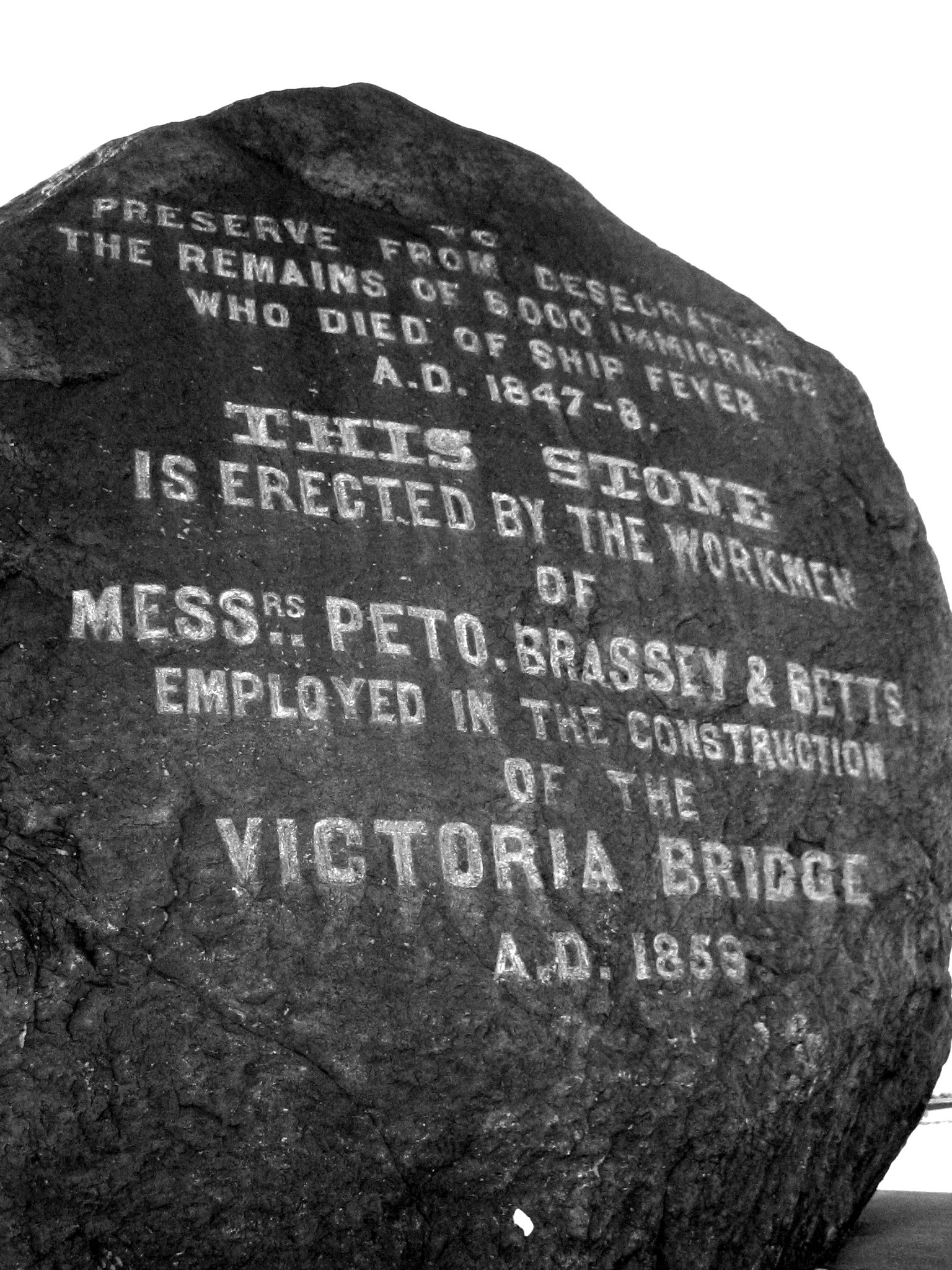
The Black Rock, erected in the memory of the mass grave. Today it's located on Bridge St. in Pointe-Saint-Charles, on the approach to the Victoria Bridge
The designer, Anouk Louten, contacted me as she attempts to get a handle on Irish culture and life in Griffintown in the mid-19th century, attempting to re-create a set as authentic as possible.
This, of course, got me thinking about the usual intersection of history, memory, and the public. Because of course Gow is taking licence from the historical record for the purpose of creating art. It is true that the mass grave of Irish Famine victims was found by the bridge workers, who were also Irish. But the workers probably lived in Goose Village, not Griffintown. A minor quibble with the historical record, to be sure, but still one that those who argue for ‘authenticity’ get their knickers in a twist over. And, I’m sure Gow will also take artistic licence with the characters, their setting, and so on and so forth.
This week, in class, I was teaching the Persian Wars, including the legendary battle at Thermopylae in 480 BCE. Of course, pretty much the entire Western world has seen the movie, 300, which fictionalises what actually happened at Thermopylae some 2,490 years ago. The movie over-dramatises the valour of the Spartans, distorts and obscures the rationale for battle decisions made by the Greeks (including the Spartans, who are conveniently left out of the decision to withdraw 6,700 Greek troops from Thermopylae to avoid being caught in a pincer movement by the Persians), leaving the brave Leonidas and his 299 Spartan warriors to hold off the Persians. As much as I love this film, I always find myself somewhat troubled by it, I kind of feel the film-makers made like the cops in the OJ Simpson case with the glove. Recall that the glove didn’t fit Simpson, who more than likely got away with murder at that trial. At the time, a friend of mine, a law student, opined that the cops may’ve planted the glove, so desperate they were to secure a conviction. If this is true (and really, who knows?), the over-zealousness of the cops allowed Simpson to walk (though, as they say, karma is a mother, and Simpson is in the slammer for other crimes right now). In the case of 300, the film-makers took an already dramatic story about Leonidas and his warriors and over-shot, they over-dramatised something which could’ve stood on its own.
So, as an historian, films like 300 bother me. Not because they take licence with the historical story, but because they pull an Oliver Stone. Stone, of course, once said that you had to hit American film audiences over the head with a mallet in order to get their attention. I think he’s wrong, people aren’t that stupid. But sometimes it makes great art, sometimes, most of the time, it’s just superfluous.
But artistic licence, I fail to see what’s wrong with that, it can make the story more interesting, it can allow the artist to make their point more effectively.
As for authenticity, I’m not sure it matters so much in the larger sense. Certainly, I like Anouk’s attempts to create an authentic set. That, for whatever reason, matters to me. The setting of historical novels, plays, films, this is the detail, the background of people’s lives. Take, for example, The Gangs of New York: a wildly fictional account of the goings-on in the Five Points of Manhattan in the early 1860s. The story itself may be a load of bollocks, but the setting of it in the Five Points, from what I can see, that’s authentic, that reflects the reality of life in what was probably the worst slum in the world.
But authenticity of story or experience (in the case of museums, etc.), I’m not so sure this is desirable or even possible. I think it is impossible to completely re-create the ‘authentic’ historical experience. For one, there’s the obvious problem: it’s impossible, because it is no longer 1861, or whenever. The physical setting is just that, a re-creation of the historical, it can be an authentic re-creation, but that’s as far as it goes. And I think that by itself is a laudable goal, but that should be the end goal. There is no need to go any further, because it is impossible to go any further.
And, so far as I’m concerned, if the story is based in this historical record, that it aims to reflect the setting, then that’s fine. Artistic licence needs to be taken, at least most of the time, maybe not so much in the case of Leonidas’ last stand.
New Project: NCPH’s Off the Wall
July 14, 2010 § Leave a comment
My friend, Cathy Stanton, has begun a new blog, sponsored by the National Council on Public History in the US, called Off the Wall. The aim of the blog is to offer up “critical reviews of history exhibit practice in an age of ubiquitous display.” Cathy has assembled an impressive set of contributors and commentators to facilitate discussion. Since the blog was launched last week, there have been a handful of posts, reviewing events, exhibits, and displays, my favourite being this one on Flick’s “Looking into the Past” project.
I am one of the contributors, though, so far, all I’ve added to the discussion is a single comment. But the discussions that are arising over there are rather central to the study of history in the digital age. History is all around us, and is a central component of pop culture. At Off the Wall, we’re interested in examining how history interacts with pop culture and the public, to examine how history is used (and abused), how usable pasts are created. Or not created, as the case may be.
Enjoy!
Historical Consciousness
July 13, 2010 § Leave a comment
So, I’m reviewing and revising a textbook right now (not mine, I’m just the outside expert). In this textbook, in the Introduction, I have come across the following passage, which I find amusing. I’m not sure I agree entirely with the idea, but it is an intriguing one for someone who lives in Québec and is a citizen of Canada and who studies Irish history:
In essence, reflecting on human reality means reflecting on ourselves, since we are all humans and nothing in the human experience is completely foreign to us. In this sense, history is to groups of people what psychology is to individuals. Imagine an historian talking to his “patient”:
You suffer from a colonization complex, compounded by a repressed rebellion and a weak constitution. I recommend that you go through a major political crisis every ten or fifteen years over the next 100 years. Then you should feel a bit better. But your past will follow you until the end of your days, in one way or another. You’ll be better off if you accept it right away.
 Matthew Barlow