In Griffintown/Dans L’Griff
April 2, 2012 § 1 Comment
In Griffintown/Dans L’Griff will be a documentary about Griffintown, made by my friend, film-maker G. Scott MacLeod. Scott’s most recent film, a short entitled The Saga of Murdo MacLeod has been received rapturously by Montrealers at its various showings around town, most recently at Ciné-Gael, Montréal’s Irish film series, which is celebrating its 20th season this year.
Scott is proposing to do a short documentary on Griffintown through the eyes of Claude and Lyse Mercier, amongst the last generation of Griffintowners. Claude and Lyse, as you might guess by their names, are NOT Irish! Shock! Indeed, they are French Canadian, a voice that has long been lost in the stories and memories of the Griff (as my forthcoming book, The House of the Irish: History, Memory and Diaspora in Griffintown, Montreal, will tell you). Almost all the attention on the Griff’s history has been focused on the working-class Irish Catholics, leaving out the other residents there: French Canadians and Anglo-Protestants, and Scott’s about to address this lacuna.
Scott and I have had a lot of conversation about Griffintown, over Thai food and as we’ve wondered the streets of the neighbourhood both of us are so hell-bent on preserving the memory of. And while books are great (especially mine!), a documentary, graphic evidence of what once was, is a brilliant addition to the growing corpus of Griffintown memories.
The trailer for the film is below, but I urge you to click on this link, which will take you to Scott’s indiegogo page, where he is attempting to raise money to help with the costs of film-making. Any amount will help, but Scott is offering 3 levels of support. 20$ gets you a thank you in the end credits and a copy of the DVD, 100$ gets you into the end credits and a DVD, and 1000$ makes you a producer, and you also get a copy of the DVD.
Rural Palimpsests; Or, the Changing Rural Landscape
February 3, 2012 § 9 Comments

Drawing of the Old Hawley Town Commons
About 18 months ago, I wrote this piece about the old Town Commons in Hawley, Massachusetts. I was struck by the history of what could no longer be seen in Hawley at the Town Commons where, in the mid-19th century, there was a vibrant townsite. Hawley also stirred up my own memories of having lived in a ghost town as a teenager, on the old town site of Ioco, British Columbia, now a part of Port Moody, BC. But Ioco, which will eventually become condos, I’m sure, was a (sub)urban townsite. Hawley is a town a few miles west of the Middle of Nowhere.
 In urban centres, we see the ruins of past civilisations all around us, whether they are palimpsests of old advertisements on the sides of buildings, or the ruins of buildings, still dotting the landscape. Indeed, I wrote my doctoral dissertation and a book on a neighbourhood that was, at least when I started writing, a ruin: Griffintown, Montréal. A decade ago, the landscape of Griffintown was an urban ruin, the foundations of the old Irish-Catholic Church, St. Ann’s, poking through the grass of Parc St. Ann/Griffintown; the rectory of the French Catholic Church, Ste-Hélène still stands, but the church is long gone, just a few corner stones and the remains of an iron fence are left. But this is a city, and cities, we are constantly reminded by scholars, poets, novelists, film-makers, etc., are living organisms, built to be rebuilt, constantly evolving and changing. By definition, then, the rural landscape is unchanging and constant.
Don’t believe me? Spend a bit of time reading literature set in the countryside. Or watch movies. Read poems. The landscape of the country side is eternal and unchanging. Entire nations have been built on the mythology of the countryside (I’m looking at you, Ireland!). Here in Québec, Maria Chapdelaine, a major novel of the early 20th century nationalist school explicitly tied the virtue of the nation to the land. The anti-modernists of a century ago celebrated the unchanging “natural” landscape of the countryside as a tonic for the frayed nerves of modern man. In Canada, the Group of Seven built their entire careers/legends on representing Ontario’s mid-North back to us as the nation. Watch a Molson Canadian ad these days, and you’ll learn that Canada has more square miles of “awesomeness” than any other country on Earth. And all that awesomeness is somewhere in the wheat fields of Saskatchewan. But the rural landscape DOES change and evolve, as the Old Hawley Town Commons will tell you.
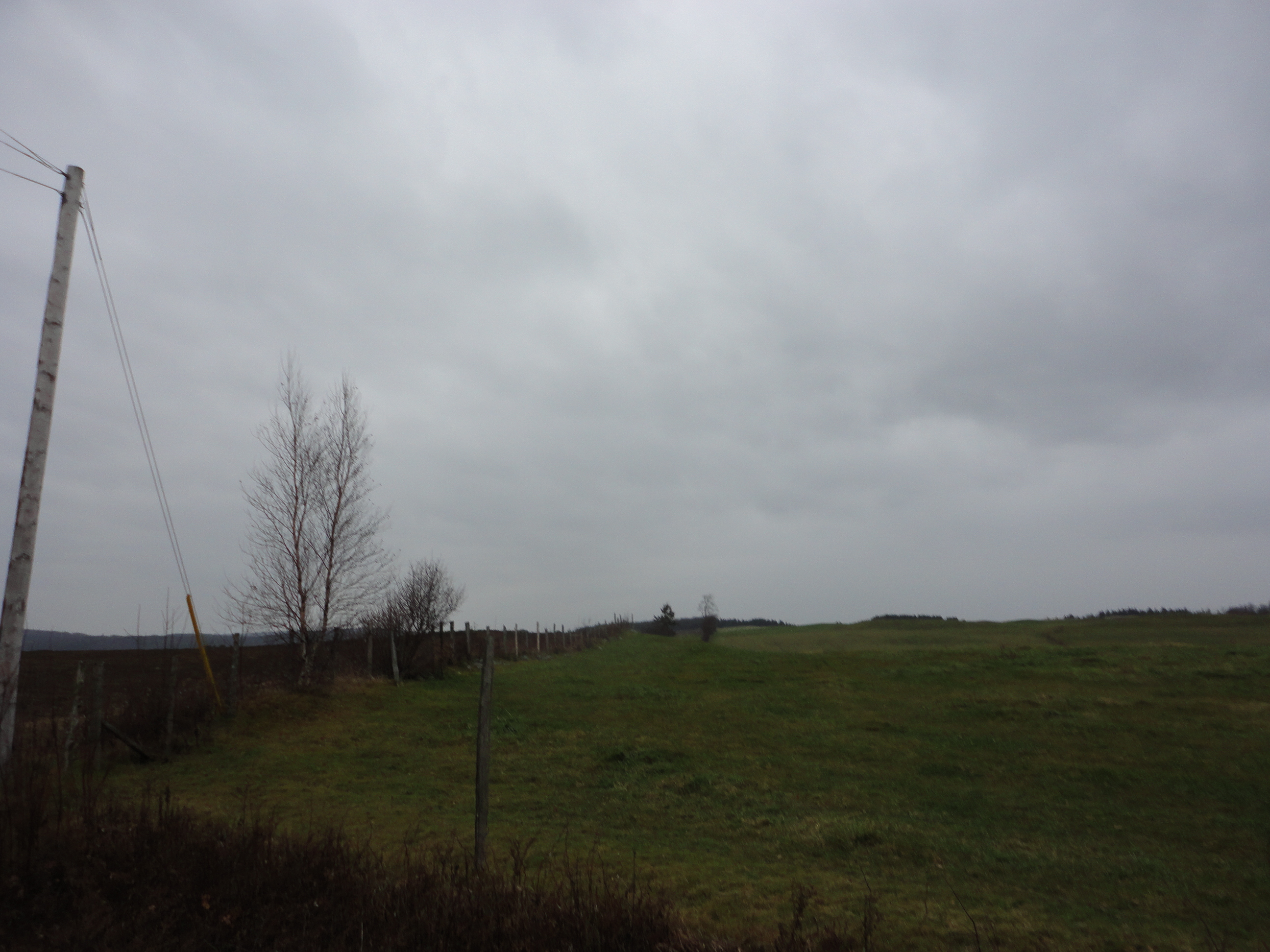
This is where Robert Corrigan was fatally beaten on 17 October 1855
This was brought all the closer to me in late November, when I travelled out to Saint-Sylvestre, Québec, which is located about 70km south of Québec City, in the Appalachian foothills. I was there because a long time ago, I wrote my MA thesis on the Corrigan Affair, which erupted in Saint-Sylvestre on 17 October 1855 when Robert Corrigan, an Irish-Protestant bully, was beaten to death by a gang of his Irish-Catholic neighbours. The mid-1850s saw the height of sectarianism in Canada and a murder case involving the two groups of Irish proved to be too much for many Anglo-Protestant Canadians to take and a national crisis broke out. By the time the Affair was over in 1858, not only had Corrigan’s murderers been acquitted of all charges, the McNab-Taché coalition government had fallen. All these years later, I had it in my mind that it was time to do something with the Corrigan Affair. I had done my best to avoid it after I finished my MA, I did attempt to write an academic article, but it seemed to me to be too good a story to be wasted in a journal article that no one would ever read. So I have decided to write a book that no one will ever read, but at least a book is a physical thing, something to offer tribute to this rather amazing story that erupted onto the front pages of newspapers across British North America from a rural backwater. So it was out to Saint-Sylvestre to meet Steve Cameron, a local man who has a deep interest in the Corrigan Affair and the history of the Saint-Sylvestre region in general.
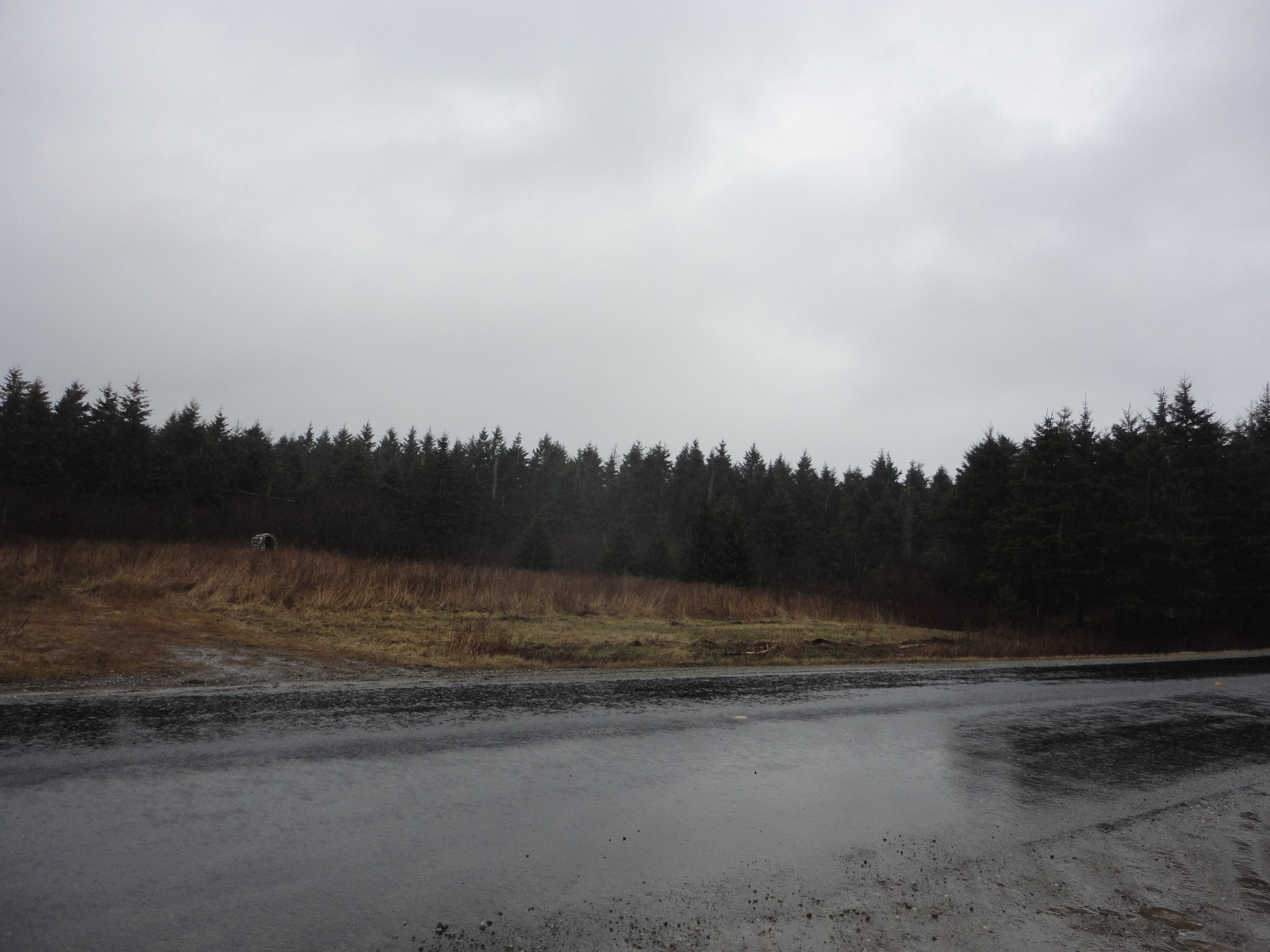
Corrigan's homestead, Saint-Sylvestre, Québec

Hugh Russell's farm
Steve offered to give me the grand tour of the landscape, where the Corrigan Affair took place. I don’t really know what I expected, but I certainly didn’t expect what I saw: the entire landscape of Saint-Sylvestre and the landscape of the Corrigan Affair is gone, completely changed in the 155 years since Corrigan’s death. He was beaten on the county fair grounds; the site where he was beaten is completely non-descript today, just a corner of a farmer’s field. Corrigan’s homestead is covered with scrub and a random cross someone threw up sometime in the past century. Where the farm of Corrigan’s friend, Hugh Russell was once located there is nothing but high tension electrical wires, forest, and a dirt road passing by in front. There is no evidence of human habitation ever having stood there. Where the Protestants had their burial ground here in the backwoods of Saint-Sylvestre/Saint-Gilles, there is nothing left but a stone wall, though the grave yard has been carefully and lovingly restored by Steve’s organisation, Coirneal Cealteach.

Old Anglican grave yard in the backwoods of Saint-Sylvestre
In short, the rural landscape is just as dynamic of that of the city. In Saint-Sylvestre, the mostly Irish-Catholic farmers were settled on poor farming land in a harsh and unforgiving landscape; their descendants left. And in their stead, nature reclaimed its place. When I first began studying Griffintown a decade ago, Talking Heads’ song “Nothing But Flowers” kept creeping into my head as I pondered the ruins of the churches, the trees growing in vacant lots and the vegetation in the cracks of the concrete. But “Nothing But Flowers” applies just as much to Hawley or Saint-Sylvestre or countless other rural landscapes once settled by humans who have long since moved on.
Update
January 31, 2012 § Leave a comment
Ah, what the hell, this is my blog, if I can’t flog my media appearances and other publications and whatnot here, where can I? I’ve been rather silent around here for the past 8 months or so, though that will change in the coming weeks.
First, I have submitted the manuscript for my book, The House of the Irish: History, Memory & Diaspora in Griffintown, Montreal, to the publisher. It is out for review now, and with any luck, it will appear on bookshelves and on-line stores around this time next year. Academic publishing moves rather slow at times. As long as The House of the Irish appears before 2014, we’re good. I published an article on the Montreal Shamrocks Hockey Club at the turn of the last century in a book edited by John Chi-Kit Wong of Washington State University, entitled Coast to Coast: Hockey in Canada to the Second World War. I wrote the article in 2005-6, it was published in 2009.
I have a raft of ideas for the next projects, but two I am pursuing, or will be once I get the chance later this semester are:
1) I wrote my MA thesis on the Corrigan Affair, which involved the fatal beating of a neighbourhood bully, Robert Corrigan, by a gang of his neighbours in Saint-Sylvestre, Québec, in October 1855. Corrigan was an Irish Protestant, and his attackers, Irish Catholics. What’s more, the Orange Order and an Irish Catholic secret society, the Ribbonmen, got involved. This led Corrigan’s death to become a cause célèbre in the era of heavy sectarian tensions in 1850s Canada. Right now, this looks like it will become a book.
2) Boston as the cultural centre of the Irish diaspora. I am fascinated by the Irishification of Boston in recent years in pop culture. Sure, Boston’s always been a major centre of the Irish diaspora, but as the city itself has become less and less Irish over the years, it has become more and more green in pop culture. Aside from the obvious, a basketball team called the Celtics, you’ve also got the Affleck brothers who play up that Southie culture in film, the novels of Dennis Lehane, and, of course, the music of the Dropkick Murphys. I’m not sure how this will proceed, whether as an article, a book, or a documentary film, but time will tell.
In the meantime, last month’s controversy surrounding the Habs and the firing of Jacques Martin and his replacement by a unilingually Anglo coach in Randy Cunneyworth found me doing a bit of punditry in the national media here in the Great White North. First, an article that appeared on Canoe.ca and then I was on Global National news later that week. And way back in September, I welcomed the Winnipeg Jets back to the NHL on the National Council on Public History’s Off the Wall blog.
At any rate, as I move forward with these projects and begin to think about history, memory, and the public in coming months, there will be a lot more here. As they say, “Watch this space!”
Globalised Montréal
May 12, 2011 § Leave a comment
In the past few years, there’s been a new trend in Montréal History and historiography that has seen us seek to place the city within a global context. This is a welcome change from our usual navel-gazing, as we sought to explain developments in Canada solely within a Canadian context. Certainly, the local context is important, but Canada did not develop in solitude. It was always a colony and nation tied into global political and economic currents, closely related to goings-on in Paris, London, and Washington. Indeed, scholars of Canadian foreign policy have long framed Canada within the North Atlantic Triangle, along with the UK and USA.
But, culturally and socially, while historians have noted the impact of British and/or American ideas in Canada, we have gone onto explain and analyse the Canadian context separate from the global. In Québec, though, perhaps due to political exigencies. Back in undergrad at UBC, Alan Greer’s masterful book, The Patriots and the People was the first study I ever read that attempted to internationalise Canadian history. In it, Greer re-cast the 1837 Patriote rebellions in Lower Canada within the revolutionary fervour that had swept Europe and the United States since the late 18th century. Seen in this light, the Parti Patriote wasn’t just a nationalist French Canadian political party, but part of an international of liberal revolutionaries that had corollaries in England, Ireland, France, the German territories, the Italian countries, the United States, and so on.
Greer’s book fit into the larger work of the revisionist Québec historians, who often sought to put Québec into a global context, both to explain the colony/province/nation’s development, as well as to give credence to Québec’s claims to nationhood. The goal was to present Québec as a nation commes les autres. Perhaps the book that had the greatest impact on me in this sense was Gérard Bouchard’s 2000 monograph, Genèse des nations et cultures du Nouveau Monde: Essai d’histoire comparée, in which Bouchard examines the development of Québec in relation to other “new world” cultures in Mexico, Australia, New Zealand, Canada, and the United States. Put this way, Québec’s (and Canada’s) development from the moment of European settlement is globalised and we realise that Canada (and Québec) is not really all that unique.
This tendency to internationalise Québec seems to be continuing with a younger generation of historians. My friend and colleague, Simon Jolivet, has just published his new book, Le vert et le bleu: Identité québécoise et identité irlandaise au tournant du XXe siècle. Simon and I did our PhDs together at Concordia, and in 2006, the School of Canadian Irish Studies there hosted a roundtable discussion that looked at connections between Ireland and Québec, in large part this grew out of the work our PhD supervisor, Ronald Rudin had done early in the decade. It was probably the most dynamic and informative conference I’ve been at, as ideas flew around the table. Both Simon and I gained a lot from that conference and it is clear in both of our work.
For my part, I am interested in the Irish in Griffintown, Montréal, over the course of the 20th century. What I look at is, of course, identity, but I’m interested in the shaping of a diasporic identity amongst the Montréal Irish, one that situates the Irish of the city within the global context of the Irish around the world, as well as the links (such as they were) with Ireland itself. To do so, I make use of post-colonial theory, which seems particularly à-propos for the Irish, descendents of a colonial culture in Ireland, living in Montréal, the largest city of the French diaspora and thus necessarily a post-colonial location.
And this is what Sean Mills picks up in his brilliant new book, The Empire Within: Postcolonial Thought and Political Activism in Sixties Montreal. Mills situates Montréal within that postcolonial framework, and examines the ideas of decolonisation and colonialism within activist circles in Montréal in the 60s. The activists were heavily influenced by what was going on in the world around them, in de-colonial movements in Algeria, Tunisia, and, especially, Cuba, as well as the Caribbean in the 50s and 60s. Certainly, they were well aware of their skin colour and Canada’s place as a first-world nation. But the ambivalence of Montréal (still the economic centre of Canada in the 60s) is something Mills excels at drawing out. As the decade went on, American activists, in particular African American activists like Malcolm X and Stokely Carmichael, became influential in the de-colonial struggle of the French Canadian majority of the city. This was further complicated by Montréal’s own black population, which also identified itself with the ideas coming out of the United States and the Caribbean. And as Montréal became a more complicated city, ethnically-speaking, to say nothing of the actions of the FLQ in October 1970, ideas of decolonisation lost their appeal.
Nonetheless, what is clear is that Montréal is a global city, one that takes its cue from its global connections as much as its local ones. Indeed, this is the basis of my next project about layers of diaspora on the urban landscape of the city. In the meantime, it also gives me a way to situate my own work on the Irish of Montréal in a larger global context.
The Redemptorists
January 10, 2011 § 2 Comments
I went to mass on Christmas Day, I’m not Catholic, but I kind of like the tradition. This year we were in Keene, NH, where my sister-in-law lives. The priest had as the theme of his Christmas morning sermon “redemption,” noting that that was the true meaning of the season. I like to think that is one of the good points of Catholicism, that redemption is granted through the fallibility of humanity, God’s forgiveness for our sins, in part through the sacrifice of Jesus, in part through confession. I presume that this is where the Redemptorist Brothers got their name, their job being to redeem the souls of both their parishioners, as well as their converts (they are a missionary brotherhood).
Anyway, all of this is by way of introduction of my destination tomorrow in Toronto: the archives of the Redemptorists. The Redemptorists were the parish priests in Griffintown from 1885 until the destruction of St. Ann’s Church in 1970, and the ultimate closing of the parish a dozen or so years later. So far as I know, no one has actually gone in and looked at the brothers’ records from Griffintown. I was told about them years ago by Rosalyn Trigger, who was at the time doing her PhD at McGill, but I never found the time to get to Toronto to look at them when I was researching my PhD. Funny: last time I saw my supervisor, Ron Rudin, a few months ago, I was telling him about my plans to go take a look as I finished off the research for the book. He wondered if he could take back my PhD for keeping knowledge of this archive from him. ‘Fraid not, Ron.
Anyway, I’m rather excited to be heading to the archive tomorrow morning to see what I can find, to deepen our general knowledge of Irish-Catholic Griffintown, it will also add something to my book that is not in other histories of the neighbourhood, including my own dissertation.
That the Redemptorist priests were popular in their parish of St. Ann’s is not in doubt. In 1885, when the Sulpicians were stripped of their parish of St. Ann’s, the Irish-Catholics of Griffintown were furious, to the point where they remonstrated with the Bishop of Montréal. However, the Redemptorists, upon their arrival, were able to almost instantly win the hearts and minds of their parishioners, by investing money in the church and parish. By the time that Father Strubbe, the “Belgian Irishman,” was recalled to Belgium, the Irish-Catholics were loudly remonstrating with the powers-that-be over this decision. All the former Griffintowners that I have done oral histories with fondly recall the priests of St. Ann’s, in particular Fr. Kearney.
So I’m hoping here to find out how the priests saw their impoverished parishioners, what they felt they could do for them, whether they enjoyed being in Griffintown, their impressions of the neighbourhood. I’m also interested in the question of faith. All of the former Griffintowners I’ve talked to, as well as all other evidence I’ve seen, shows a very Catholic community, one where people took the ceremonies and rituals of their faith. But what has always interested me is whether this was just that: familiar ritual. One thing the Church is very good at is giving its faithful ritual and ceremony that are both familiar and reassuring. But I’ve always wondered how deep the idea of faith goes, not just with respect to Griffintown, but the Catholic Church in general.
Then there’s the question of Irishness. One of the reasons the Griffintowners protested the removal of the Sulpicians in 1885 was because the Sulpicians were very good about ensuring the parish priests at St. Ann’s were Irish. The Redemptorists who arrived in Griffintown that year were all Belgian. Of course, Fr. Strubbe was able to win over his parishioners and even gain status as an Irishman by the time of his recall. And by the mid-20th century, the priests, like Fr. Kearney, were Irish once more. Was this a conscious decision by the Redemptorists and the Bishop to represent the faithful? What did the priests make of the Irishness of their parishioners?
So here’s hoping I can begin to find some answers to these questions in the archive.
Shameless Self Promotion, for a good cause
October 14, 2010 § Leave a comment
I was on GlobalNews at 6 last night here in Montréal in a story about the Griffintown Horse Palace and our plans to save the Palace from re-development in Griffintown. Also, The Gazette has a similar story this morning has a story.
Griffintown Horse Palace Foundation Soirée
September 4, 2010 § Leave a comment
I am pleased to announce that the Griffintown Horse Palace Foundation will be hosting a shared benefit soirée on Thursday, 14 October from 6-9pm with the Darling Foundry. The event will be held at the Darling, which is located at 745, rue Ottawa, in Griffntown. The poster is below.
Tickets cost 125$, per person and are tax deductible. They can be procured either by contacting me, or on the Horse Palace Foundation’s website.

New Adventures in the Arts, or, Art, History, and “Authenticity”
September 3, 2010 § 1 Comment
Yesterday I met with a stage and set designer for a new play being produced at the Hudson Village Theatre in Hudson, QC (just off the Island of Montréal), opening Thursday, 28 October, entitled Wake of the Bones, written Montréal playwright David Gow. Wake of the Bones centres around the discovery of a mass grave of Famine victims on Pointe-Saint-Charles in Montréal by Irish labourers constructing the Victoria Bridge a decade later. The labourers were from Griffintown, at least in this version, and they decide that a wake needs to be held to send the dead souls off to their eternal paradise.
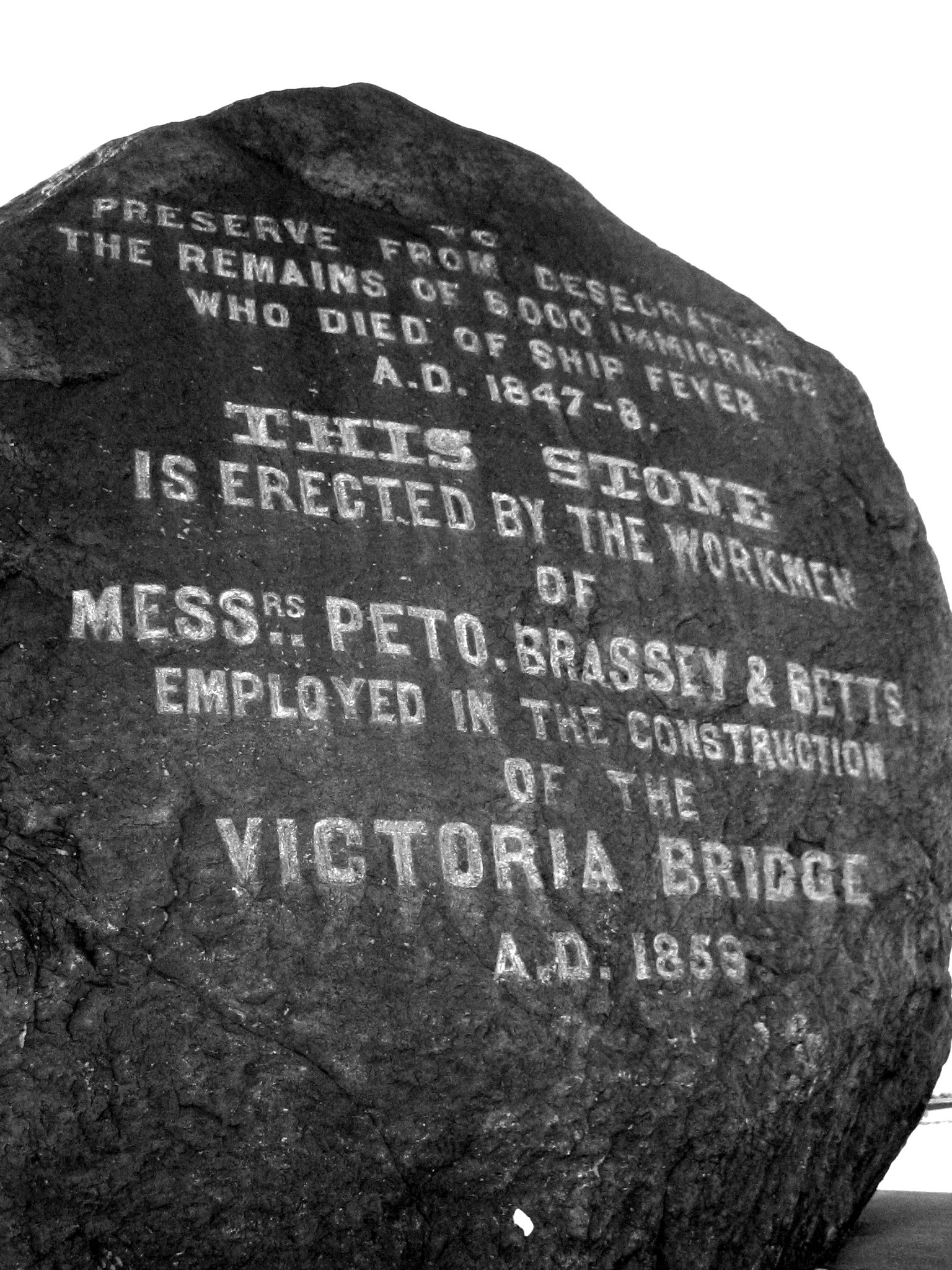
The Black Rock, erected in the memory of the mass grave. Today it's located on Bridge St. in Pointe-Saint-Charles, on the approach to the Victoria Bridge
The designer, Anouk Louten, contacted me as she attempts to get a handle on Irish culture and life in Griffintown in the mid-19th century, attempting to re-create a set as authentic as possible.
This, of course, got me thinking about the usual intersection of history, memory, and the public. Because of course Gow is taking licence from the historical record for the purpose of creating art. It is true that the mass grave of Irish Famine victims was found by the bridge workers, who were also Irish. But the workers probably lived in Goose Village, not Griffintown. A minor quibble with the historical record, to be sure, but still one that those who argue for ‘authenticity’ get their knickers in a twist over. And, I’m sure Gow will also take artistic licence with the characters, their setting, and so on and so forth.
This week, in class, I was teaching the Persian Wars, including the legendary battle at Thermopylae in 480 BCE. Of course, pretty much the entire Western world has seen the movie, 300, which fictionalises what actually happened at Thermopylae some 2,490 years ago. The movie over-dramatises the valour of the Spartans, distorts and obscures the rationale for battle decisions made by the Greeks (including the Spartans, who are conveniently left out of the decision to withdraw 6,700 Greek troops from Thermopylae to avoid being caught in a pincer movement by the Persians), leaving the brave Leonidas and his 299 Spartan warriors to hold off the Persians. As much as I love this film, I always find myself somewhat troubled by it, I kind of feel the film-makers made like the cops in the OJ Simpson case with the glove. Recall that the glove didn’t fit Simpson, who more than likely got away with murder at that trial. At the time, a friend of mine, a law student, opined that the cops may’ve planted the glove, so desperate they were to secure a conviction. If this is true (and really, who knows?), the over-zealousness of the cops allowed Simpson to walk (though, as they say, karma is a mother, and Simpson is in the slammer for other crimes right now). In the case of 300, the film-makers took an already dramatic story about Leonidas and his warriors and over-shot, they over-dramatised something which could’ve stood on its own.
So, as an historian, films like 300 bother me. Not because they take licence with the historical story, but because they pull an Oliver Stone. Stone, of course, once said that you had to hit American film audiences over the head with a mallet in order to get their attention. I think he’s wrong, people aren’t that stupid. But sometimes it makes great art, sometimes, most of the time, it’s just superfluous.
But artistic licence, I fail to see what’s wrong with that, it can make the story more interesting, it can allow the artist to make their point more effectively.
As for authenticity, I’m not sure it matters so much in the larger sense. Certainly, I like Anouk’s attempts to create an authentic set. That, for whatever reason, matters to me. The setting of historical novels, plays, films, this is the detail, the background of people’s lives. Take, for example, The Gangs of New York: a wildly fictional account of the goings-on in the Five Points of Manhattan in the early 1860s. The story itself may be a load of bollocks, but the setting of it in the Five Points, from what I can see, that’s authentic, that reflects the reality of life in what was probably the worst slum in the world.
But authenticity of story or experience (in the case of museums, etc.), I’m not so sure this is desirable or even possible. I think it is impossible to completely re-create the ‘authentic’ historical experience. For one, there’s the obvious problem: it’s impossible, because it is no longer 1861, or whenever. The physical setting is just that, a re-creation of the historical, it can be an authentic re-creation, but that’s as far as it goes. And I think that by itself is a laudable goal, but that should be the end goal. There is no need to go any further, because it is impossible to go any further.
And, so far as I’m concerned, if the story is based in this historical record, that it aims to reflect the setting, then that’s fine. Artistic licence needs to be taken, at least most of the time, maybe not so much in the case of Leonidas’ last stand.
Ruminations on the Wisdom of Don DeLillo & the Ruins of Griffintown
May 23, 2010 § 1 Comment
It’s no secret that Don DeLillo is one of my favourite novelists. His novels have a tendency to strike me on several levels, perhaps because the narrative is usually fragmentary and on several levels. And whilst his dialogue is predictable in many ways, based on particular idioms of New York City English, it’s the way DeLillo constructs sentences and thoughts that always leave me digesting his work long after I’ve read, or re-read, it. I oftentimes lose patience with people who say things like “I don’t have time to read fiction” or “I can’t remember the last time I read a novel.” To me, this shows a fundamentally closed mind; novels percolate with ideas, philosophy, and ways of being in the world. Novels allow us to personalise events and history, to re-consider moments in time, to re-consider our own ways of thinking, our own narratives.
Certainly this is true with DeLillo’s novel, Falling Man, about the aftermath of 9/11 in New York City. This is not just a rumination on 9/11, indeed, the terrorist attack is a motif to explore post-modern family life in New York. But it doesn’t have to be New York, and it doesn’t necessarily have to be post-9/11, either. But the novel would lack the punch if it was set in Winnipeg in 1986.
Anyway, the reason I’m writing this is to give thought to the on-going argument between Nina, the mother of the novel’s main female character, Lianne, and Nina’s lover, Martin. Martin, however, isn’t really Martin, he’s a former terrorist himself, named Ernst Hechinger. Nina and Martin/Ernst argue throughout the book, in the presence of Lianne, over the nature of terrorism and the attack on New York. Nina’s argument is hued by the fact that she is a Manhattanite. Martin/Ernst is German. She lacks the critical distance to see the attacks, he lacks the intimacy with Manhattan. Throughout the argument, which is fierce and scares Lianne, they consider God and the motives of the attackers. Nina sees fear on the part of the terrorists, Martin/Ernst sees history and politics.
Nina has just had knee surgery (and is developing a reliance upon painkillers) in the time after the attacks. Indeed, Lianne is stricken at how her mother, in the wake of the surgery, has embraced her old age. This worries Martin somewhat. He wants her to travel again, to go out and see the world, to revitalise herself in the wake of the surgery and the attacks. She is somewhat more reluctant.
Martin: Travel, yes, it’s a thing you ought to consider. Get your knee back to normal and we’ll go. Quite seriously.
Nina: Far away.
Martin: Far away.
Nina: Ruins.
Martin: Ruins.
Nina: We have our own ruins. But I don’t think I want to see them.”
Martin: But that’s why you built the towers, isn’t it? Weren’t the towers built as fantasies of wealth and power that would one day become fantasies of destruction? You build a thing like that so you can see it come down. The provocation is obvious. What other reason would there be to go so high and then to double it, do it twice? It’s a fantasy, so why not do it twice? You are saying, Here it is, bring it down.
I love this passage, not so much for what it says about NYC and 9/11, but for what it says for cities in general. Ruins are all around us on the urban landscape (or the rural one, for that matter, abandoned homesteads, for example). Ruins tell us the story of what was once here, how we got here, how we might have otherwise been. Ruins tell us powerful stories about destruction, that is true, as Martin is noting. But they also tell us powerful stories about ways of being that have been lost. The ruins of Griffintown are a prime example.
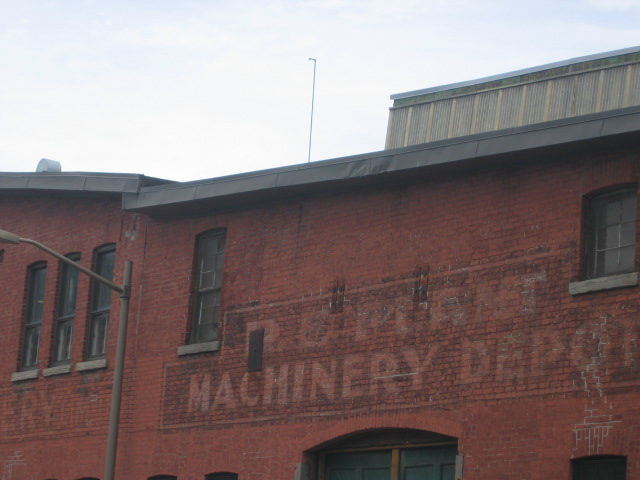
The ruins of the neighbourhood are there for all to see. In Parc St. Anns/Griffintown, on the former site of St. Ann’s Church, the remaining ruins of the church itself, its foundation, as well as foundation stones of the presbytery, the girls’ school, and the dormitory for the crusading priests who came through the Griff on their way to other parts of the world, are all there. There are ruins of factories and warehouses throughout the neighbourhood. Ruins of tenement flats. Palimpsests of advertising for consumer products that are long gone.

Parc St. Ann's/Griffintown
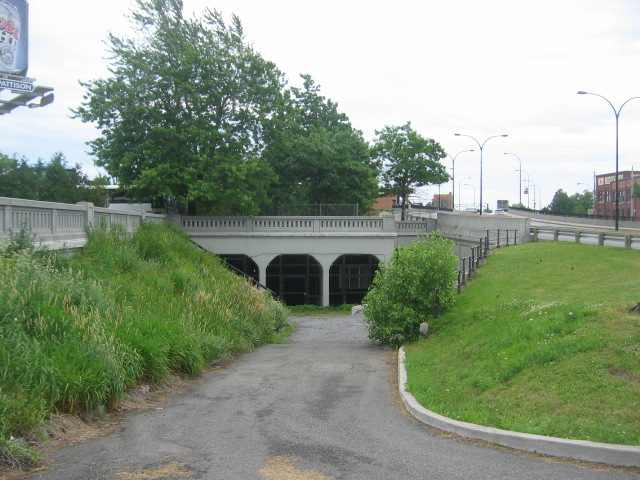
Wellington Tunnel
Griffintown Palimpsest
We see this life as it used to be. We consider what once was. How people moved out of Griffintown because of its proximity to all these factories, train yards, and the like. How the flats were cramped and cold, lacking in modern amenities like hot water. Or yards. The neighbourhood, when I began studying it a decade ago, always reminded me of the Talking Heads’ song, “Nothing but Flowers.” Here was the site of the beginnings of the Canadian Industrial Revolution in the 1830s, reclaimed in large part by nature. An inner city neighbourhood sprouting leaves and trees. And grass growing through fractured concrete. Trees growing out of windows of derelict, decrepit buildings. Their floors reclaimed by nature.
The ruins of Griffintown also speak to this power that Martin refers to in the novel. This was a locus of power for Canada, for the British Empire and Commonwealth. Not just the products manufactured there, but the working classes trudging along to work, filling out the army in World Wars I and II. The hulking CN viaduct, not technically a ruin yet, but something close to it, speaks to a time when the railway was king. Indeed, it was built to separate the railway from the roads.
Anyway. DeLillo’s got me thinking about the meanings of the ruins of Griffintown. And what they mean, to the old Irish community that once lived there, to the urban landscape of Montréal today, and to plans to re-develop the neighbourhood in the future.
Urban Archaeology & Material Culture
April 21, 2010 § 1 Comment
Recently, I’ve been thinking about urban archaeology and material culture. Given my research interests, I suppose it’s only natural that I would also think about the actual physical landscape of the city and how it shifts and changes with time, populations, and construction.
Years ago, I visited Montréal’s Pointe-à-Callière Museum, in the Vieux-Port. Point-à-Callière is the site of the first settlement of Ville-Marie, where Paul de Chomedy, Sieur de Maisonneuve decided to plant his new settlement in 1642. The museum itself is based around 3 archaeological digs (Pointe-à-Callière iteslf, as well as Place Royale and Place D’Youville), and artefacts from these archaeological digs are on display. But it’s not just that. In the underground of the museum, down where the digs took place, one can physically see the layers of city and settlement on Pointe-à-Callière, from the initial aboriginal inhabitants through the founding of Ville-Marie, to the governor’s mansion that was once located there, through urbanisation, industrialisation, and so on. The physical remnants of the buildings, and artefacts are there for the viewer to see.
My favourite part is the William sewer, which canalised, and placed underground, the Rivière Petite Saint-Pierre, which itself had become a stinking cesspool as it flowed above ground through what was once the Nazareth Fief (and later Griffintown), into the St. Lawrence, hence creating Pointe-à-Callière. Apparently (at least according to its entry on Wikipedia), the museum has plans to open up and expose the Petite Saint-Pierre, as well as the old location of St. Ann’s Market in Place D’Youville, as well as the remains of the Parliament House of the United Province of Canada, which was burned down in the Rebellion Losses Bill Riot in 1849 (just imagine a riot today in a democracy burning down the house of parliament!).
Anyway, this is where I first thought about urban archaeology, but I never really gave it much more thought in terms of my academic interests until a couple of summers ago, whilst walking along the Canal Lachine, where, at the St. Gabriel locks, Parks Canada has dug up the foundations and remnants of a factory on the northeastern side of the locks.
Andy Riga, over at The Gazette, has an interesting blog, “Metropolitan News;” his latest post is about the public toilets, disused and buried under Place D’Armes. During the reign of Mayor Camillien Houde in the 1930s, partly as a public works project, Vespesiennes were built in Carré Saint-Louis, Square Cabot, amongst other places, and public washrooms were constructed in places including Place D’Armes. The washrooms there were shuttered in 1980, victim of many things, including Montréal’s notoriously crumbling infrastructure. Since then, there have been a few plans or attempts at plans to revive the public toilets, but they are in serious decay and would cost too much money to renovate them, due to years of neglect, water damage, and humidity. So they remain buried under Place D’Armes which, like Dorchester Square downtown, is undergoing a massive renovation.
So notions of what’s underfoot have long interested me as I’ve wandered about the city, but especially in the sud-ouest, Griffintown and Pointe-Saint-Charles, as well as Saint-Henri, where I’ve lived for most of the past decade.
Also, too, there is the influence of Prof. Rhona Richman Kenneally of Concordia University, who encouraged me to give some thought to material culture in approaching my dissertation and my work on Griffintown. Ultimately, as interesting and exciting as I found approaches to material culture in my studies, there was no way to fit it into the dissertation (the same can be said of proper mapping of the Griff). But I remained intrigued by these ideas.
So, with all of this in mind, I finally got my hands on Stephen A. Brighton’s Historical Archaeology of the Irish Diaspora, based around digs in the Five Points of Manhattan and in Newark, New Jersey. Using the archaeological evidence, Brighton constructs an argument centred on the material culture of 19th century Irish-American life in these two urban centres. Using this methodology, Brighton is able to answer a lot of questions we cannot answer using more traditional historical methodologies. Brighton has the remnants of the material culture of the Irish immigrants and Irish-Americans. Finding glasswares with symbols of Irish nationalism on them suggests that the movement had some traction amongst the tenement dwellers of the Five Points.
My favourite part of his analysis, though, comes in relation to medicine. The artefacts from the Five Points come from the 1850s and 60s, whereas those in the New Jersey digs are from the 1880s. In other words, the Five Points Irish were more recent arrivals and lived in greater poverty than those in New Jersey. Thus, their access to the nascent public health system was different than that of their compatriots in Jersey. Brighton found that the Five Points Irish relied more on cure-alls and pseudo-medical tonics to cure what ailed them. Throughout the dig site are bottles that once contained tonics and cures, whereas in New Jersey, the digs uncovered evidence of reputable medicines. This, concludes Brighton, is symptomatic of that poverty but also, too, perhaps of the alienation of mid-19th century Irish immigrants from the mainstream of American culture and society (remember, the 1850s also saw the Know-Nothing movement in the USA and the Bowery B’hoys Riot of 1857).
So what Brighton offers up here is a piece of evidence to support what historians already know from more traditional sources. And this brings me to my problem with Brighton’s book: it doesn’t add much in the way of new information to our historical knowledge. Rather than challenge historians’ traditional takes on the Irish in the Five Points (especially), Brighton confirms what we already knew with the archaeological evidence.
 Matthew Barlow