The Problem With Writing History
March 5, 2010 § Leave a comment
I just finished Orhan Pamuk’s brilliant novel, Snow. It tells the story of a hapless Turkish exile poet, Ka, who returns to Turkey from Frankfurt. Ka is a poet without poems. He’s not written one for years when he accepts an offer from a friend who edits a Republican newspaper in Istanbul to travel to the distant eastern city of Kars. In Kars, there has been a wave of suicides by young women wearing the hijab, which is seen as a challenge to the Turkish republic of Ataturk. They were expelled from their university studies for refusing to remove them. And so a group of them killed themselves. But nothing is at seems in Kars, and Ka is drawn into the city’s murky underside, in part due to a bizarre coup led by an actor, in part because he falls in love for the beautiful Ipek, in part because of the radical Islamist terrorist, Blue. Kars is a poor city, isolated, and caught in its place in history on the borderlands, caught between its Russian, Turkish, and Armenian pasts. And Kars is isolated during Ka’s visit, it’s snowed in. It’s a mountain city and all roads in and out, as well as the railroad, are blocked by heavy, heavy snow. This isolation has its own in-built tension between this forgotten borderlands city and the cosmopolitan capital of Turkey, Ankara, and its interntionalised largest city, Istanbul. This tension within Kars echoes that of the Turkey that Pamuk presents, between this Europeanised cosmopolitanism and traditional Turkish culture, to say nothing of Islamism. And Ka, as a westernised Turk living in exile in Germany, is a focal point for this tension.
Anyway, I don’t want to give away the plot, because if you’ve not read Snow, you should. It’s not for nothing that Pamuk won the Nobel Prize for Literature in 2006.
What I want to point to is a discussion the narrator of the novel has with an associate of Ka’s, Fazil, at the end of the book. The narrator, Pamuk himself, responds to Fazil’s early declaration that he can only write about him in the book Pamuk is writing on Ka’s visit to Kars if he agrees to include what Fazil wishes to say to Pamuk’s readers. He says this:
‘If you write a book set in Kars and put me in it, I’d like to tell your readers not to believe anything you say about me, anything you say about any of us. No one could understand us from so far away.’
‘But no one believes in that way what he reads in a novel,’ I said.
‘Oh, yes, they do,’ he cried. ‘If only to see themselves as wise and superior and humanistic, they need to think of us as sweet and funny, and convince themselves that they sympathize with the way we are and even love us.’
Fazil’s words have resonance for me as an historian. I study the working-classes, I study people by-and-large excluded from, or oppressed by, systems of power. The community I study is one that was an inner-city, working-class slum. The people who lived there, grew up there, they’ve escaped, moved up the social ladder. But that history is still there.
A few years ago, I was hired as a consultant by an advertising agency working on behalf of Devimco, the development company that was planning to radically re-build Griffintown. Devimco was trying to make its plans more palatable, so they hired this advertising agency, as well as a consultant, an American living in London. This consultant has done some impressive things with shopping malls across the UK and in places like Dubai. Anyway. He prepared a text for all of us to ponder for our 2-day summit on the future of the Griff. Basically, he wanted us to come up with a marketable narrative for Griffintown, which was why I was there; the historian. In this text, he wrote:
Griffintown represents the next generation in Montreal’s long history of bold waterfront stewardship. What makes it unique is that it restores the public’s access to the waterfront, making it home for a real community, instead of simply an industrial workforce.
Leaving aside the fact that Montréal actually has a long history of the opposite of “bold waterfront stewardship” (Autoroute Bonaventure, anyone? How about all those port facilities?), the part I’ve italicised, dismissing the former residents of the Griff as simply an industrial workforce really just echoes what Fazil says in Snow. This consultant is dismissing these real people, arguing that because they were the working-classes, they couldn’t have culture or community. We’re supposed to feel superior to them, we’re supposed to see ourselves as better than them.
This is something that plagues historical scholarship, going back to the days of Herodotus. Even despite E.P. Thompson’s entreaties to be fair to the working-class (or any other subaltern group, really), to “rescue them from the enormous condescension of posterity” (to quote from his masterful The Making of the English Working Class), it’s a hard road to hoe. Indeed, Thompson himself is partly to blame for this, by taking on this providential charge to “rescue” the working-classes. We shouldn’t do that, either.
Instead, what we strive to do is to take our subaltern, down-trodden, excluded, or what-have-you, people is to take them for what they are/were: people like us. This is hard to do, it is hard to be sensitive to our historical actors, to recognise them as multi-dimensional actors, with agency, just like us. Joy Parr helps us see that in her The Gender of Breadwinners, wherein she reminds us that the roles our historical actors play were not sequential, but simultaneous. We are many things at the same time, and so, too, were our historical actors.
This is something I think historians of the subaltern need to be reminded of regularly, it’s not something we can read in a book once and keep in mind when we’re actually doing our work. This point needs constant reinforcement. It’s easy to forget, really. For me, that Devimco session helped. So, too, does doing oral history. And so, too, has the reading of Snow. I must keep Fazil’s words in mind.
Nuit Blanche à Griffintown
February 20, 2010 § Leave a comment
This Saturday, 27 February, is Nuit Blanche in Montréal, and there will be an event in Griffintown to celebrate. Organised by Le Comité pour le sain rédeveloppement de Griffintown, spearheaded by Judith Bauer, the event will be taking place at the site of the New City Gas Works, owned by Harvey Lev, located at 140 and 143, rue Ann.
There’s a whole bevy of cultural events on deck, including talks about the history of the neighbourhood, poetry readings, live music, artwork, and all kinds of other fun stuff. The website is here.
Also of note is that the Griffintown Horse Palace Foundation will have a table there to sign people up for membership and to raise funds for our ultimate goal, to buy and convert the Griffintown Horse Palace into a museum.
Radicalism and Diaspora in Canada
January 15, 2010 § 2 Comments
Yesterday, the ring-leader of the Toronto 18, Zakaria Amara, apologised to Canadians for his role in plotting to blow up U-Haul trucks outside of the Toronto Stock Exchange, the Toronto CSIS HQ, and a military base just outside the city. It is worth noting that the Toronto 18’s goal was specific, to convince the Canadian government to pull out of Afghanistan. Amara said that he “deserves nothing less than [Canadians’] complete contempt.” At least according to The Globe & Mail, he went onto to explain how it was he was radicalised in suburban Mississauga.
Starting off by quoting the Quran, in hindsight, [Amara] said his interpretation of Islam was “naïve and gullible,” and that his belief system made worse by the fact he had “isolated himself from the real world.”
Today he told the court he has been rehabilitated by his time awaiting trial in jail – mostly through his interactions with fellow prisoners who challenged his hate-filled ideology. He promised he would change from a “man of destruction” to a “man of construction.
He also apologised to Canada’s Muslim community, noting that he had brought unwelcome attention and scrutiny.
The Globe also reports on Amara’s accounting of his radicalisation in suburban Mississauga, a multicultural locale with a population larger than all but a handful of Canadian cities (Toronto, Montréal, Vancouver, and Ottawa-Gatineau), one that sounds not all that dissimilar than what Marisa Urgo describes in Northern Virginia, a suburb of Washington, DC. As she notes, Northern Virginia has produced a fair number of radicalised young men. Mississauga, on the other hand, has not, other than the Toronto 18. In Mississauga, Amara isolated himself from all but a small handful of radicals, and they fed off each other.
In prison, Amara claims to have seen the light, befriending a former stock broker who worked at the very exchange Amara had planned to blow up. He, a Sunni Muslim, also befriended both a Jew and a Shi’a Muslim. In his radical era, Amara had nothing but contempt for Jews and Shi’a. But now, he says, he’s seen how wrong he was.
Amara’s psychiatric examination in prison suggests that he became radicalised as a means of escapism, the drudgery of life, of having had to drop out of university to help support and raise a daughter, as well as the pain from his parents’ divorce.
One thing that strikes me the most, though, about the discourse surrounding the Toronto 18, is this horror that Canada might have produced radicalised terrorists from a diasporic community. Canadians seem genuinely befuddled that this could happen in his multicultural nation where immigrants and their progeny are generally welcomed (not that there isn’t racism in Canada, there is. A lot).
But, this is where being an historian is kind of fascinating. As I have argued over at the CTlab, historians get to take the long-view, we see context, and depth. We don’t, or at least we shouldn’t, engage in knee-jerk reactions. And so, I would like to point out that this isn’t the first and only time that diasporic radicals have trod on Canadian soil.
Indeed, the neighbourhood I study, Griffintown, here in Montréal was once one of the hottest of hotbeds of radicalism, in the 1860s, 150 years ago. Then, it was the Fenians, a group of Irish nationalists who were always more successful in the diaspora than in Ireland itself. Indeed, their plan wasn’t all that different than that of the Toronto 18. The Fenians in the United States and Canada dreamed of seizing and conquering Canada and holding it as ransom against the British in return for Irish independence. And Griffintown was the centre of Fenianism in Canada.
The Fenians met secretly around Griffintown and Pointe-Saint-Charles, plotting how to act as a 5th column when their American brethren invaded, and how they would then take over the country. The Griffintown Fenians were also the ones responsible for the first political assassination in Canadian history (there have been only 2 in total), that of Father of Confederation and Member of Parliament for Montréal West, Thomas D’Arcy McGee on 7 April 1868 on Sparks St. in Ottawa. McGee had been a radical in his youth in Ireland, a member of the Young Ireland movement there in the 1840s, but, after relocating to Montréal, he had become convinced of the Canadian cause, and during the particular contentious 1867 federal elections (the first Canadian election), McGee had outed the Fenians in the pages of The Gazette. Not surprisingly, this didn’t go over well, and the Fenians, acting, it seems, independently of their American counterparts, and Patrick Whelan shot him.
Then, as now, there was all sorts of anguish over the thought of terrorists (though this word wasn’t used for the Fenians) on Canadian soil. Anglo-Canadians couldn’t understand why the Irish would wish to carry their old world battles into the new Dominion, and they tended to see Irish-Catholics as a singular whole. Not unlike how Canadians in the early 21st century have responded to the Toronto 18, in fact. Not that this exonerates either the Fenians or the Toronto 18 as radicalised diasporic terrorists, but the long view is always interesting in and of itself.
The House of the Irish: The Book
November 15, 2009 § Leave a comment
Well, almost 6 months to the day of defending my dissertation, I am heading out tomorrow to begin, in earnest, work on the book. Now that I have interest, at least, from a publisher, I am getting going on the new research I want to do, and moving forth with the revisions and whatnot. Next weekend or the following one, depending on when I get a bit of time, I am going to re-write the Preface of the dissertation to lay out where I want the book to go, though, of course, that will change a few times as I move forward.
Anyway, tomorrow I am meeting with a former Griffintowner I met at a talk I gave last year, to do an oral history interview. This is kind of exciting for me, and I’m excited to learn that I am not, in fact, sick of Griffintown and its history yet. In fact, I feel rather rejuvenated by 6 months away from it, as I have been immersed in Griffintown lore for most of the past 3 years, since I started writing the dissertation in earnest.
So let us hope the book doesn’t take as long to write as the dissertation did and sometime in the not-too-distant future, The House of the Irish: Diaspora, History & Memory in Griffintown, Montréal, 1900-2010, will be on the shelves of a bookstore near you.
Griffintown Horse Palace Foundation Launch
November 15, 2009 § Leave a comment
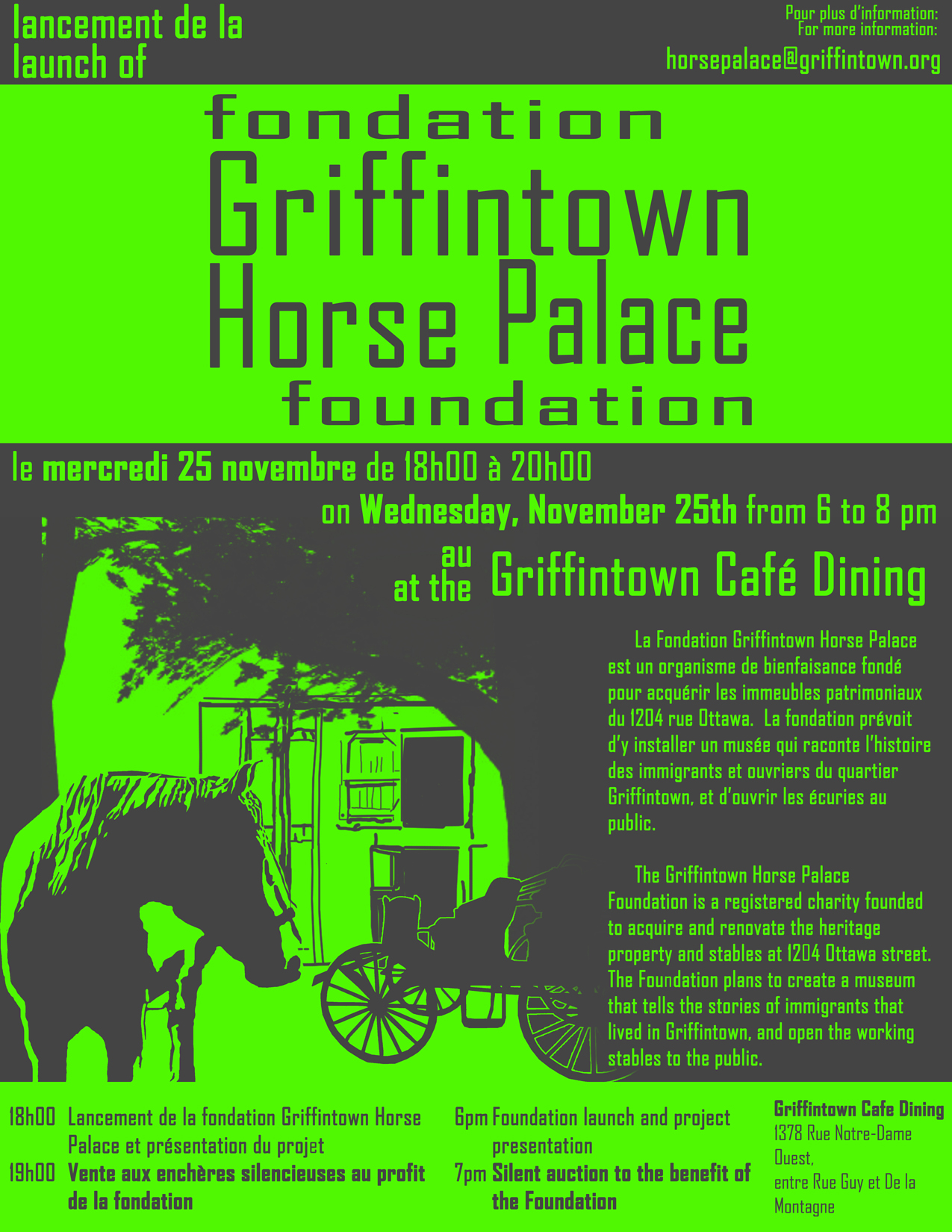
The Griffintown Horse Palace Foundation is dedicated to purchasing and renovating Leo Leonard’s Horse Palace in Griffintown, to turn it into a museum along the lines of the legendary Tenement Museum on the Lower East Side of Manhattan (frankly, one of two museums I find interesting). The Foundation is holding its launch at Café Griffintown at 1378 rue Notre-Dame in the Griff on Wednesday, 25 November, from 6-8pm. Unfortunately, I cannot be there, as I teach a night class on Wednesday nights out at Abbott, but I hope this is a resounding success. For more information, contact the Foundation at horsepalace@griffintown.org.
the house of the irish
October 5, 2009 § Leave a comment
i submitted a book proposal to mcgill-queens university press the other week. i mailed it out monday, i got an email response on thursday. i was astounded canada post could get something somewhere that fast, even if the proposal travelled no more than 3.5km from pointe-saint-charles to mcgill. anyway, mqup liked what they read. they are interested in publishing the book, once it becomes a book.
so now, i am beginning to ponder how to turn “the house of the irish”, the dissertation, into the house of the irish, the book. i am cutting out the first substantive chapter, on the shamrock lacrosse club. that will become an article or two. and i am extending a chapter on nations and nationalism in griffintown, c. 1900-17 to at least 1922, with the establishment of the irish free state. part of my argument is that once ireland gained something approximating independence, even if the north was left out (or, more properly stated, opted out), the irish of the diaspora more or less lost interest in ireland, at least that was, i think, the situation in montréal. ireland was already an imagined nation by the early 20th century on account of there being hardly any irish-born irish in montréal by this time, immigration having dried up shortly after the famine. but after the free state was established, the irish here turned even more inwards. so that’s the first major revision or expansion.
the other is to correct the methodological issues in the last two chapters of the dissertation, which is too much reliance on the same set of sources. to correct this, i am going to engage in some oral history. but i am back to the same problem i had with the dissertation in a sense here. i am not interested in talking to the professional griffintowners, the don pidgeons and denis delaneys of the world. their thoughts and opinions on the griff are very well known, they are part of the commemorative process amongst the griffintown diaspora. i want to talk to people who didn’t necessarily think that they grew up in shangri-la. the ones who have an alternative view of the griff, or at least a more critical one. one former griffintowner in burman’s film said something like it was a shame to see the griff go, as they had it all. oh really? despite the poverty, unemployment, insecurity of tenure, etc.? of course, this is partly nostalgia, partly a child’s view of life in the 1940s. but i want to talk to people who have a more critical memory.
and that’s the hard part. where do i find these people? they’re not the ones at all the various griff gatherings. i have a few ideas, one of which is to make use of the parish of saint-gabriel, the historically irish church in the pointe (in fact, almost next door to us here). i recognise old griffintowners standing outside of saint-gabriel’s every sunday morning, so i’m hoping i can start there, talk to a few of them, get references to their friends, and so on.
either way, i am excited about this, i’m excited to turn this story of griffintown into a book. i think this is a story that has wider implications, not just for montréal, but for the irish diaspora, and even as an example of the acculturation of an ethnic group in a major metropolitan centre in north america.
as my favourite soccer blogger used to say at the end of each post: onwards!
News
March 24, 2009 § 2 Comments
After what has seemed like an eternity, I successfully defended my doctoral dissertation, entitled, “‘The House of the Irish’: Irishness, History, and Memory in Griffintown, Montréal, 1868-2009,” on Friday, 13 March. So now I am Dr. John Matthew Barlow.
This also explains my absence from this blog for the past month, as I prepared for and recovered from said defence. I will be active again in the coming days.
 Matthew Barlow