The Problem With Niall Ferguson
June 16, 2012 § 6 Comments
I’ve never been crazy about Niall Ferguson. I don’t think he’s ever had an original thought, and he’s about the worst kind of academic bully, demeaning himself to attack his critics in a petty, small-minded manner. Hell, we’re talking about a guy who in, his latest book, Civilization: The West and the Rest, who attacks Gandhi! Yes, Gandhi! Gandhi, in a 1931 interview in London, noted the use of disease in the European conquest of the rest of the world (indeed, Jared Diamond confirms the disease theory in his 1999 book, Guns, Germs & Steel: The Fate of Human Societies). Ferguson heaps scorn on Gandhi and goes on to argue that Western medicine did a world of good in the conquered parts of the world. Ferguson isn’t entirely wrong, especially in the case of malaria in Africa. But he’s too smart by half here, by mocking Gandhi, he discounts the fact that disease was a corollary of Western conquest. Want some figures? Try these on for size:
Caribbean Islands, 1492-1542: nearly 6,000,000 dead
Peru, 1570-1620: 750,000 dead.
Mexico, 1519-1600: 24,000,000 dead.
Ferguson’s attack on Gandhi is symptomatic of Ferguson’s general crusade against those who have the temerity to suggest that Western imperialism was not an entirely good thing. See, for example, his Empire: The Rise and Demise of the British World Order and the Lessons for Global Power.
At least in Civilization, when he’s done attacking the likes of Gandhi and others who experienced the negative effects of Western imperialism, he does go on to note the horrors of the German Empire in Africa, which does show some maturity in Ferguson in the decade since Empire.
Then there’s his attack on Marx & Engels. Ferguson wrote his manuscript in 2010, twenty years after the end of the Cold War. And yet, Ferguson, showing how petty-minded he can be, spends almost as much time attacking Marx and Engels personally than actually discussing their arguments. Why bother? Seriously. Ad hominen attacks in the works of an historian as eminent as Ferguson are just kind of sad and pathetic, especially when tacked onto commentary of Marxism/Communism.
Ferguson is also adept at the fine art of quoting out of context. For example, he attributes the following quotation to Orhan Pamuk, the Nobel Prize-winning Turkish author:
Will the West, which takes its great invention, democracy, more seriously than the Word of God, come out against this coup that has brought an end to democracy in Kars?…Or are we to conclude that democracy, freedom and human rights don’t matter, that all the West wants is for the rest of the world to imitate it like monkeys? Can the West endure any democracy achieved by enemies who in no way resemble them?
Sure, Pamuk wrote these words. However, these words are those of the narrator of his fine novel, Snow. They are not the words of Pamuk himself. But Ferguson kind of forgets to tell us that in his book. These words are the epigraph to Chapter 5, “Consumption” (Consumption is one of the “killer apps” we in the West invented, but have now been “downloaded” by the East, seriously, that’s Ferguson’s language). And Pamuk’s words here are meant to be mocking. But when you know the context of the quotation, well, then they mean something quite differently, don’t they?
And so once again, Ferguson, who actually makes a pretty good, if unoriginal argument in Civilization, shoots himself in his rhetorical foot and one is left wondering just how seriously he can actually be taken.
On the Difference between being a Reader and a Writer
June 12, 2012 § Leave a comment
Upon the recommendation of the fine people at Argo Bookshop, I read Italo Calvino‘s If on a winter’s night a traveller, which was in and of itself an excellent read, a meditation on the multiple meanings of reading, amongst other things. I was struck by a discussion between the protagonist, The Reader, and The Other Reader, who at least got a name, Ludmilla. Both The Reader and The Other Reader have been continually frustrated in their attempts to read a book, any book, as they are continually met with incomplete manuscripts, so they get into their novel, only to have it end. Up to this point, it has been due to publisher’s errors and problems in the actual process of printing and binding the books.
But The Reader has made a contact within the publishing firm, who has given him reign to peruse the completed manuscripts, and he excitedly tells The Other Reader when they meet in a café. He then wants to rush back to the publisher to continue their investigation. But she refuses.
Why don’t you want to come?
On principle.
What do you mean?
There’s a boundary line: on ne side are those who make books, on the other those who read them. I want to remain one of those who read them, so I take care always to remain on my side of the line. Otherwise, the unsullied pleasure of reading ends, or at least is transformed into something else, which is not what I want. This boundary line is tentative, it tends to get erased: the world of those who deal with books professionally is more and more crowded and tends to become one with the world of readers…I know that if I cross that boundary, even as an exception, by chance, I risk being mixed up in this advancing tide; that’s why I refuse to set foot inside a publishing house, even for yourself.
It is clear that for The Other Reader, this is her own stance. Of course, within a few chapters, she has violated her position. But that’s irrelevant. What is relevant is the point she raises, and the separation between authors and publishers and readers. I had a thought similar to this last week when I was in Archambault looking for a book. I didn’t find what I was looking for, a history book, but I did see my friend Simon Jolivet‘s book on the shelf. Now, this is not surprising, Simon wrote a book, based on his PhD dissertation, and it got published. That’s the way it’s supposed to work in academia. In fact, that’s the very process I am presently engaged in myself. And certainly I have known many, many authors throughout my academic career (to say nothing of the fiction writers I know). And certainly, books get treated differently in academia than in the general public: we have to publish them if we want to survive in our field, it’s part of the job (which is why I find it obnoxious when people presume that because it’s summer I’m doing nothing if I’m not teaching).
And yet, it’s one thing to see my professors’ books on the shelf in the bookstore, it’s another to see a friend’s, especially when we did our PhD’s together. It’s not an incredibly profound statement, I realise, but there is still something rather exciting about seeing your friend’s book on a shelf in a busy downtown Montréal bookstore, to know that people have bought it and read it and will continue to do so, and to finally have it sink in that this will also happen for me, my book will be on these same shelves and people will buy it and read it, beyond the academy (I hope).
But does that change my relationship with reading, both fiction and non-fiction? I doubt it. And, of course, The Other Reader eventually realised that herself when she started to get mixed up in book production and forgery rings.
In Griffintown
June 12, 2012 § 1 Comment
I spent Sunday morning, prior to the destruction of the Irish team at the hans of Croatia in Euro 2012, in Griffintown, with Scott MacLeod, working on his documentary, In Griffintown/Dans l’Griff. It was an incredibly hot day, and Scott, myself, the crew, and Claude Mercier who, along with his wife, Lyse, are the stars of the film, all got nice and sunburned. Below are some action shots, as well as Claude, Scott, and I in Parc Saint-Ann/Griffintown, squinting in the bright sunlight. It was a great experience, in between shots, Scott and I talked about his vision for the film, how he planned to intersplice archival footage, his own animations, and live action shots to create the documentary. I look forward to seeing the final version.
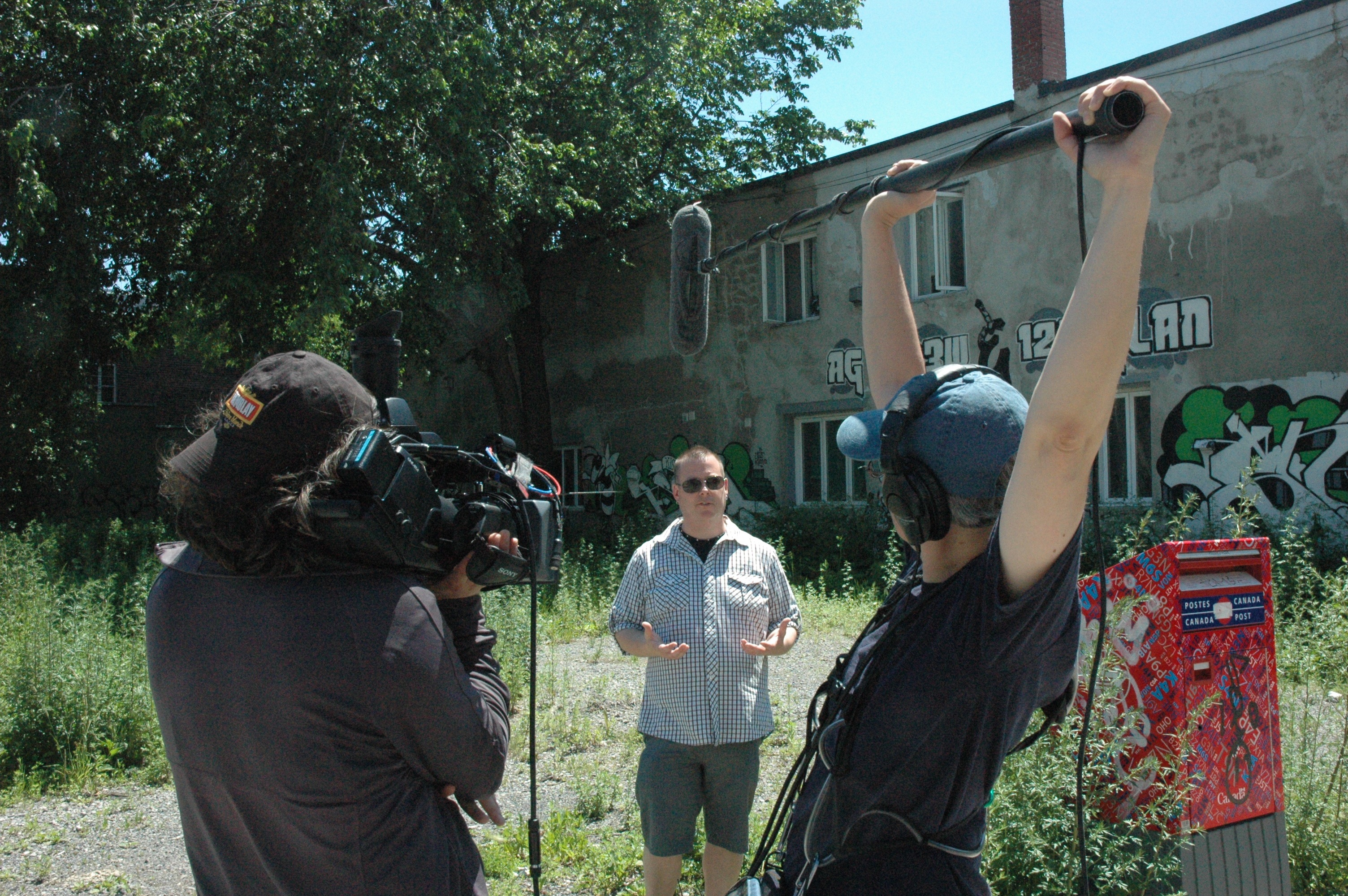

Filming Griffintown
June 10, 2012 § Leave a comment
Two months ago, I posted this about film-maker Scott MacLeod‘s fundraising attempts for a documentary on Griffintown. I’m happy to report he raised enough money and all systems are go. Today, I will be meeting up with Scott and his crew for a bit of filming before Ireland takes on Croatia in its first match of Euro 2012. I am slated to discuss the destruction of Griffintown in the 20th century, due to both bureaucratic inertia on the part of Hôtel de Ville, and depopulation due to deindustrialisation in Griffintown. Of course, all the Lachine Canal-side neighbourhoods of Montréal experienced deindustrialisation, but Pointe-Saint-Charles, Little Burgundy, Saint-Henri, Côte-Saint-Paul and the like didn’t become ghost towns like the Griff. The difference? A combination of local populations resisting deindustrialisation and depopulation (the Pointe, in particular, was home to a radical, populist resistance), as well as political support. Griffintown got none of that. The city abandoned Griffintown, left it to die.
Fast-forward 50 years and now there is nothing the Ville de Montréal loves more than Griffintown. You can practically see the dollar signs in Mayor Gerald Tremblay’s eyes whenever someone mentions the word “Griffintown.” All the city can see is the tax dollars that will come in from all the condo dwellers there once Devimco and a handful of other developers are done with the neighbourhood. Did I say neighbourhood? Oops, sorry. To me, neighbourhood means a form of community, there is common cause amongst neighbours. In some cases, this is organic, in other cases, communities can be planned to encourage neighbourliness. The re-jigged Griffintown, however, is not one of those. No parks, no schools. None of that. Can’t have that, that’d steal space from condos!
So we are going to get a district of high rise condominiums, populated by harried, busy urban dwellers with no real, organic chances for community living, unless they seize the chances themselves. Maybe they’ll become the condo dwellers here in the Pointe, many of whom have joined the casseroles protests, such as they exist in the Pointe, and have joined the community gardens, and have joined the old populist community organisations of the Pointe? Or maybe they won’t. I’m not optimistic, because the Pointe already had this community-based model when the condos went up and when we gentrifiers moved into remodelled tenements. The Griff has none of that.
But don’t tell Gerald Tremblay. Actually, go ahead, he’s not listening anyway.
Reappraisals and the Forgotten 20th Century
May 21, 2012 § 1 Comment
I picked up Tony Judt’s Reappraisals: Reflections on the Forgotten Twentieth Century on somewhat of a whim at Montréal’s last independent Anglo bookstore, Argo Books on rue Sainte-Catherine, a few months back. Since then, it’s been buried in the knee-deep stack of reading next to the bed. But, after finishing Jerry White’s meditation on 20th century London, as well as a short novella by Jack Kerouac and William S. Burroughs, two defining writers of the 20th century, I thought perhaps it was time to crack the binding on Judt’s book.
I am all 7 pages in and have already read more food for thought than I do in most of what I read in a month. Judt’s main point is that in the West, but especially in North America, particularly the United States, we have done exactly what Mike Edwards, the frontman of the disposable pop band Jesus Jones said we were doing 20 years ago, “waking up from history.” Except, whereas Edwards was optimistic, and Francis Fukuyama was loudly and proudly declaring we had reached the End of History (seriously, how the hell does Fukuyama have ANY credibility after that?!?), Judt is more concerned. He says we’ve lost our way, we live in a society focussed on forgetting, of ignoring the lessons of history.
Judt is particularly concerned with the States, his adopted nation, and where he died in 2010, after a battle with ALS. In particular, he writes of the triumphalism of the States after the end of the Cold War, despite the defeat in Vietnam and the stagnation of Iraq (and Afghanistan) when he was writing in 2007. He notes how the United States is the only Western nation that still venerates and celebrates its military history, a sentiment that disappeared in Europe after the Second World War. He writes:
For many American commentators and policymakers the message of the last century is that was works. The implications of this reading of history have already been felt in the decision to attack Iraq in 2003. For Washington, war remains an option — in this case the first option. For the rest of the developed world, it has become a last resort.
I’m not entirely certain this is indeed the case, given Tony Blair’s hitching of his horses to Dubya’s war machine in 2003, but it certainly does give pause for thought.
It also brings the Harper government here in Canada into sharper focus. Canada is a middle power, and that might be generous, actually. And yet, Harper is hell bent on celebrating Canada’s military history, one that by and large ends with the Second World War, and denigrating our proud history as peacekeepers (including the very simple fact that Lester B. Pearson invented peacekeeping). I wrote about this, somewhat tangentially, with the return of the Winnipeg Jets to the NHL last fall.
And yet, here we are, a minor middle power in the world, striking a more bellicose tone than even the US in some cases, most notably in our support for Israel. This is not a discussion of whether Israel deserves support or not, this is a discussion about the role of military history and veneration in public discourse. Harper has used Canada’s proud (and distant) history as a military power, and Canada’s excellent record in the two World Wars to bolster and justify his muscular vision of Canadian foreign policy.
In this sense, then, while the US remains a major military power, and indeed the world’s major one, Canada remains small potatoes. And all I can think of is an episode of The Simpsons where Bart, Milhouse, Rod, Tod, Nelson, and Martin head into Shelbyville for reasons I can no longer remember, and they decide to break into teams. Bart and Milhouse, Rod and Tod, and Nelson and Martin. As they make their way off, Martin dances around the big, burly Nelson, who is somewhat reluctant of his role as the enforcer, singing his friend’s praise and celebrating his prowess. In my vision, Obama is Nelson and Harper is Martin. Kind of sad, really.
The Names and History
May 20, 2012 § Leave a comment
[Ed.’s note: I wrote this about a year ago, it’s already been published. But it’s been front and centre in my mind of late as I read more history, more Don De Lillo, and as world events continue to unfold. It’s often been said that history repeats itself. It’s a trite comment, but there is some truth to it. Anyway, I like this piece. So I’m republishing it. Enjoy.]
Historians take the long view when examining global affairs. I was recently reading microfilm of newspapers from the early 1920s, doing some last research for my book. The countries that dominated the headlines then were the same ones that dominate them today. The Third Anglo-Afghan War had just concluded with the Treaty of Rawalpindi, ostensibly settling boundary issues between India and Afghanistan. The Levant was under British and French mandate following the First World War. The Republic of Turkey was in its infancy under Mustafa Kemal Atatürk, and the British had just revoked Egypt‘s independence.
I had the same sense of déjà-vu in reading Don DeLillo’s 1982 novel, The Names. It’s set against the geopolitical backdrop of the Iranian Revolution, the rescue of the American hostages in Tehran, the Lebanese Civil War, the 1980 Turkish coup d’état, chronic Greco-Turkish tensions over Cyprus, and the instability of Greek democracy. The Names centres around a group of expats involved in various shadowy activities involving international banking, risk analysis, security, and archaeology. Its hero, James Axton, is a risk analyst for a mysterious American group found to have ties to the CIA. David Keller, another American, is based in Athens. He works for a bank that has heavy ties to the Turkish government, and becomes the target of an assassination attempt in Greece. Charles Maitland, a Brit, is a security specialist. The men spend their time flying around the Middle East attending to business in dodgy locales: Tehran, Ankara, Istanbul, Jerusalem, Damascus, and Beirut in particular.
Control is a central theme of the novel, whether it’s states trying to manage their politics or DeLillo’s characters handling their personal affairs. Axton loses control in his marriage as his wife, Kathryn, slips further and further away from him (she moves from a Greek island to Victoria, British Columbia – about as remote and obscure a locale from Greece as possible). He loses control over his own reality, holding on desperately to his job, revelling in mundane office paperwork as he becomes increasingly obsessed by a mysterious, murderous cult. He eventually travels to the Pelopennese and as far as Jerusalem, Damascus, and India in an attempt to learn more about it. Along the way, something interesting happens: language, the means by which people order and make sense of their mental worlds, takes on a new importance for Axton; religion, as exemplified by the mystery cult, is what orders the meaning that he finds through language. The connections they establish and the control they represent suggest a world made in the cult’s own image, which Axton sees painted on a rock on the outskirts of an abandoned village in the Pelopennese: Ta Onómata, The Names.
As the novel closes, Axton is back in Athens. After the CIA revelations, he resigns from his job. Rootless, his wife and son on the other side of the world. He regains control of his life, while the world around him continues to spin out of control; he witnesses the assassination attempt on Keller. Geopolitics and the personal chaos caused by the characters’ involvement in it are useful allegories these days. In the continuing drama of the Arab Spring, states and their residents, the masses and their leaders, are locked in a competition over who gets to dictate the terms of order. The newspapers of the 1920s were clear about who was meant to maintain control over the countries of the Middle East and North Africa. Today, questions of empire, language, religion and politics, domesticated and boiling over, are much more complex. For that we should probably be grateful.
The Cavalier Middle Classes
May 19, 2012 § 3 Comments
I am in the process of reading what is generally an excellent book, Jerry White‘s London in the 20th Century, itself part of a recently completed trilogy on London. The 20th century came first, in 2001, followed by the 19th century in 2008, and the 18th a few months ago. It’s an intriguing read, as White is adept at pulling together disparate strains of the history of the city in a compelling and very readable narrative.
But sometimes, he gets hard to take seriously. For example, in discussing homelessness and begging in London in the 1980s, one of the toughest decades in English history due to a global recession and Margaret Thatcher’s scorched earth economic policies, White writes:
London experienced a begging revivals in the 1980s, especially among the young homeless and squatters, to an extent probably only paralleled in some of the bleakest years of the nineteenth century. In the absence of children, dogs had always been a useful prop for beggars to squeeze that extra penny from a sentimental public. In the 1980s and 1990s the small dog on a length of string was a required fashion accessory for the young beggars of Stoke Newington Church Street or Islington’s Upper Street or Camden High Street and probably every other high road of inner London.
Yes. Right. Because being homeless is really just a career choice, complete with the same fashion accessories of the London City banker. Except instead of the Brooks Brother suit, Rolex watch, and Porsche, the beggar chooses ratty clothes and a mutt on a string to get that extra bit of change out of the public. Obviously White is being sarcastic here, injecting some humour into his narrative. But it’s inappropriate humour.
White strikes a similar chord in discussing the fate of the Port of London and the Royal Opera House, two unionised work places in the 70s and 80s. Here, he calls the unionised workers, and the unions, “stupid” because they were unable to see the long-term and to protect their jobs (and their industries). Indeed, this is a pretty common attitude amongst historians of late in discussing the deindustrialisation that struck Western Europe and North America in the 70s, 80s, and 90s. Unions were daft because they refused to accept their fate. For that matter, we see the same discourse surrounding the plight of Greece today, those dumb Greeks refuse to see reality.
It’s not that simple, of course. The critics of the Greeks aren’t experiencing what the Greeks are experiencing, quite obviously. It’s very easy to preach and be judgemental from Berlin, London, New York, or Toronto. Of course, what those observers also have is a view of the bigger picture, and can no doubt see the forest, rather than just the trees.
It’s the same thing with the historians looking back at deindustrialisation. Sure, from where we sit today in the early 21st century, it’s easy to see the bigger picture of the process of deindustrialisation in the 70s, 80s, and 90s. But, know what? It wasn’t so easy to see that from the position of the working classes in that era. These people were fighting for their jobs and their livelihood. What else you expect them to do? Lie down and take it? To allow the system to run them over, dispossess them? To settle for less than they thought they deserved? How many people do that? Right, approximately zero. Sure, they were wrong. But for them it was a personal fight, not some abstract discussion of the economy and projections, stagnation, and inflation.
It wasn’t pretty. The 80s were a horrible decade for the working classes of North America and Western Europe. Jobs disappeared as the world’s economy globalised. When Free Trade came to Canada at the end of the decade, it had a direct impact on my family. My old man lost his job, victim to Free Trade, because his company realised that a welder in South Carolina could do the same work for far less money than he did in Vancouver. Not only that, but unionisation was a lot less likely in South Carolina. And so on.
The process of deindustrialisation had very real human costs. End of story. Historians would do well to remember than when discussing the process, rather than dismiss workers and their unions as “stupid” or “daft.”
In Griffintown/Dans L’Griff
April 2, 2012 § 1 Comment
In Griffintown/Dans L’Griff will be a documentary about Griffintown, made by my friend, film-maker G. Scott MacLeod. Scott’s most recent film, a short entitled The Saga of Murdo MacLeod has been received rapturously by Montrealers at its various showings around town, most recently at Ciné-Gael, Montréal’s Irish film series, which is celebrating its 20th season this year.
Scott is proposing to do a short documentary on Griffintown through the eyes of Claude and Lyse Mercier, amongst the last generation of Griffintowners. Claude and Lyse, as you might guess by their names, are NOT Irish! Shock! Indeed, they are French Canadian, a voice that has long been lost in the stories and memories of the Griff (as my forthcoming book, The House of the Irish: History, Memory and Diaspora in Griffintown, Montreal, will tell you). Almost all the attention on the Griff’s history has been focused on the working-class Irish Catholics, leaving out the other residents there: French Canadians and Anglo-Protestants, and Scott’s about to address this lacuna.
Scott and I have had a lot of conversation about Griffintown, over Thai food and as we’ve wondered the streets of the neighbourhood both of us are so hell-bent on preserving the memory of. And while books are great (especially mine!), a documentary, graphic evidence of what once was, is a brilliant addition to the growing corpus of Griffintown memories.
The trailer for the film is below, but I urge you to click on this link, which will take you to Scott’s indiegogo page, where he is attempting to raise money to help with the costs of film-making. Any amount will help, but Scott is offering 3 levels of support. 20$ gets you a thank you in the end credits and a copy of the DVD, 100$ gets you into the end credits and a DVD, and 1000$ makes you a producer, and you also get a copy of the DVD.
New Bloomsday Montreal 2012 website
February 24, 2012 § Leave a comment
I will have much more to say shortly, but for now, I just want to update my previous Bloomsday Montreal post with our new website. Everything is coming together nicely for our celebration of Joyce’s masterful Ulysses, 14-16 June. We’ll be updating the site soon. In the meantime, you can also follow us on Twitter and Facebook.
On Living in a Gentrifying Neighbourhood, Part 2
February 24, 2012 § 5 Comments
It is interesting looking at the search terms that have led people to my blog here in the past few days: “car theft pt. st. charles” “murder pt. st. charles” “housing projects pt. st. charles” “crime pointe-saint-charles” “low income housing pointe-saint-charles.”
All negative, all reflecting an old stereotype of the Pointe. When I first moved down here, from the Mile End way back in 2002, my great uncle, a man who has been around some, said to me, “That’s a good place to get your nose punched in. Or worse.” I kept trying to tell him it’s not like that, at least not anymore. He never believed me. I just shook my head. But it seems that old visions of the Pointe die hard.
 Matthew Barlow