Remembering the Montréal Massacre
December 6, 2009 § 1 Comment
On 6 December 1989, a lone gunman burst into the École Polytechnique de Montréal, part of the Université de Montréal, and opened fire. He targeted women specifically. He was upset that “feminists” had ruined his life. For his delusions, 28 innocent people were shot, before he turned the gun on himself. In the first classroom he broke into, he separated men from women, then shot all 9 women, 6 of whom died. Then he wandered the hallways, the cafeteria, and another classroom, targeting women, shooting another 14 women, and 4 men. All 4 men survived, of the 24 women who were shot, 14 died. All this within 20 minutes.
I was 16, living in suburban Vancouver when this happened. I remember the shock. I couldn’t fathom then, and I still can’t, how someone could open fire in a school, let alone, to kill women for being in school. These 14 women died because they were just that: women getting an education. I have never been able to wrap my head around that concept. It doesn’t make sense to me. It didn’t in 1989 and it doesn’t in 2009. The Montréal Massacre is one of those transformative moments in my life, it is deeply embedded in my view of the world. It was a shocking, terrible event. And despite all of the school shootings since in both Canada and the USA, this is the one that is, to me, a horror story. Every 6 December, I remember watching the chilling news footage in the living room back in BC, I remember trying to understand why this had happened, my mother and I both horrified. And every 6 December, I find myself asking those same questions over and over. I still don’t have an answer.
But what particularly upsets me about 6 December is that the shooter’s name lives on, in infamy, of course, but nearly everyone of my generation, we were all affected wherever we were, know his name. I refuse to utter it, print it, post it, etc. I do not want to remember him. Diane Riopel, who taught at L’École Polytechnique in 1989, and narrowly missed meeting the killer, echoes this sentiment: “We have given him enough publicity. Out of respect for the victims, the killer should be completely anonymous.” I don’t think Hell exists, but when I think of him, I hope it does. I don’t think anyone can name all 14 women who died. I certainly can’t. They’re all agglomerated as “the victims.” The shooter maintains his individuality in death, but the 14 women he martyred lose theirs. All we seem to know is that they were engineering students. But what else about them? What were their dreams? What did they plan to do with their lives when they finished school? What books did they read? Where did they hang out with their friends? All of this, I wonder about every year at the anniversary. And I have no idea what the answers to these questions are.
These are the victims:
- Geneviève Bergeron (born 1968), civil engineering student, age 21.
- Hélène Colgan (born 1966), mechanical engineering student, age 23.
- Nathalie Croteau (born 1966), mechanical engineering student, age 23.
- Barbara Daigneault (born 1967), mechanical engineering student, age 22.
- Anne-Marie Edward (born 1968), chemical engineering student, age 21.
- Maud Haviernick (born 1960), materials engineering student, age 29.
- Maryse Laganière (born 1964), budget clerk in the École Polytechnique’s finance department, age 25.
- Maryse Leclair (born 1966), materials engineering student, age 23.
- Anne-Marie Lemay (born 1967), mechanical engineering student, age 22.
- Sonia Pelletier (born 1961), mechanical engineering student, age 28.
- Michèle Richard (born 1968), materials engineering student, age 21.
- Annie St-Arneault (born 1966), mechanical engineering student, age 23.
- Annie Turcotte (born 1969), materials engineering student age 20.
- Barbara Klucznik-Widajewicz (born 1958), nursing student, age 31.
The House of the Irish: The Book
November 15, 2009 § Leave a comment
Well, almost 6 months to the day of defending my dissertation, I am heading out tomorrow to begin, in earnest, work on the book. Now that I have interest, at least, from a publisher, I am getting going on the new research I want to do, and moving forth with the revisions and whatnot. Next weekend or the following one, depending on when I get a bit of time, I am going to re-write the Preface of the dissertation to lay out where I want the book to go, though, of course, that will change a few times as I move forward.
Anyway, tomorrow I am meeting with a former Griffintowner I met at a talk I gave last year, to do an oral history interview. This is kind of exciting for me, and I’m excited to learn that I am not, in fact, sick of Griffintown and its history yet. In fact, I feel rather rejuvenated by 6 months away from it, as I have been immersed in Griffintown lore for most of the past 3 years, since I started writing the dissertation in earnest.
So let us hope the book doesn’t take as long to write as the dissertation did and sometime in the not-too-distant future, The House of the Irish: Diaspora, History & Memory in Griffintown, Montréal, 1900-2010, will be on the shelves of a bookstore near you.
Griffintown Horse Palace Foundation Launch
November 15, 2009 § Leave a comment
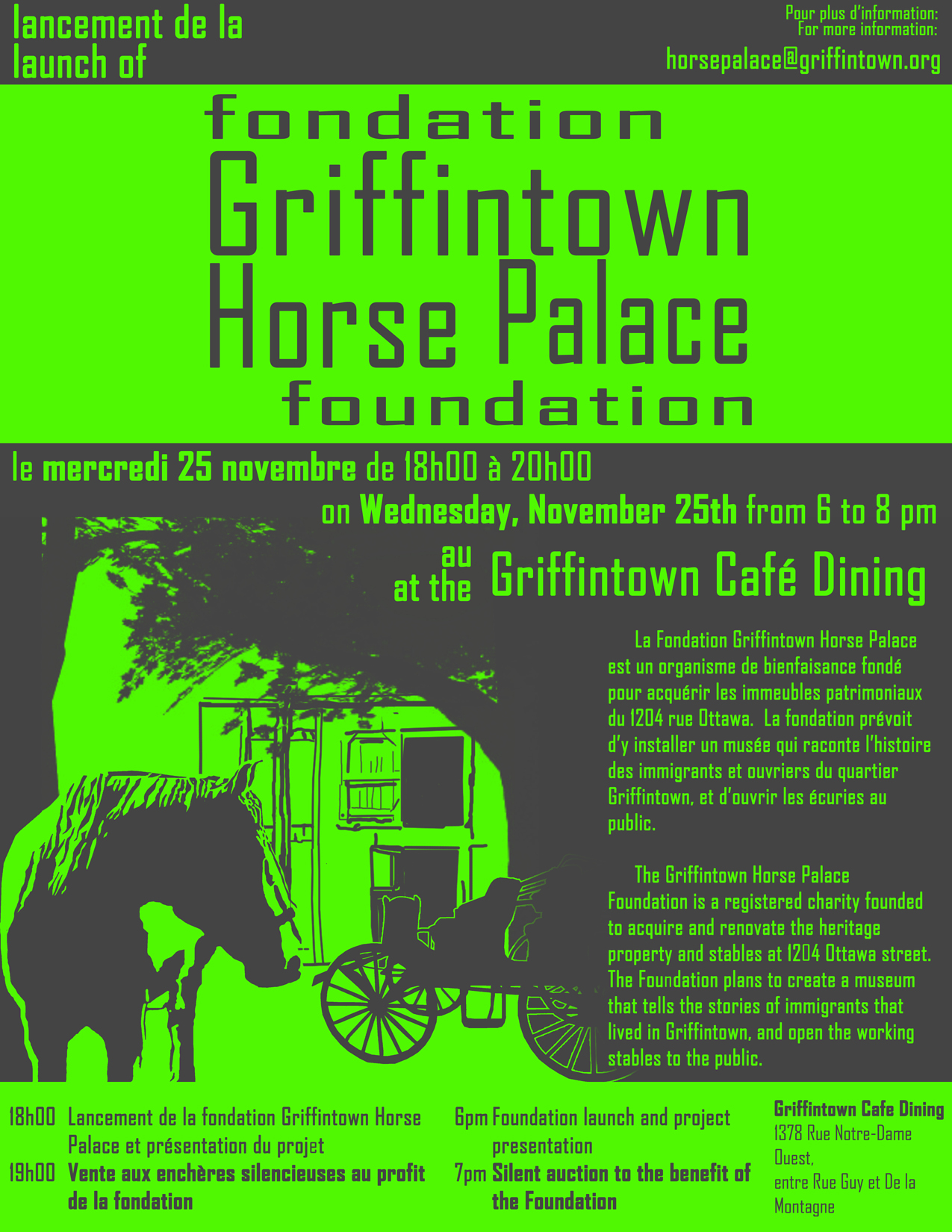
The Griffintown Horse Palace Foundation is dedicated to purchasing and renovating Leo Leonard’s Horse Palace in Griffintown, to turn it into a museum along the lines of the legendary Tenement Museum on the Lower East Side of Manhattan (frankly, one of two museums I find interesting). The Foundation is holding its launch at Café Griffintown at 1378 rue Notre-Dame in the Griff on Wednesday, 25 November, from 6-8pm. Unfortunately, I cannot be there, as I teach a night class on Wednesday nights out at Abbott, but I hope this is a resounding success. For more information, contact the Foundation at horsepalace@griffintown.org.
Layers of Diaspora
November 15, 2009 § Leave a comment
Perhaps as a means of avoiding my current research project, which is to turn my dissertation into a monograph, I have been thinking about my next project, the one that will examine diaspora and its multiple layers on the urban landscape. Really, this is a mobile project, can be fit onto any large city with multiple diasporas, but Montréal is where the idea came from, and Montréal appeals to me because of the bifurcated nature of the host cultures here.
Back in the winter of 2006, I taught the History of Montréal, an upper-level course at Concordia. I think this is where this idea comes from for me, I taught that course as an ethnic history of the city. I traced the history of the landscape that is Montréal through the various ethno-religious groups that have called the area home, dating back to the pre-Contact Mohawk populations in the St. Lawrence River Valley, right through to the Vietnamese and various African and Arab diasporas today. As we moved through history, we dealt with the aboriginals, the Contact era, the French colonial culture here, then the onslaught of the British. This set the city up as a multi-layered, bifurcated location, French and English, the aboriginals more or less marginalised on reserves that ring the Île-de-Montréal. French and English were equal but different, though the British were dominant, they being the conquering colonial power.
It was into this milieu that the Irish arrived, becoming the first immigrant group in Montréal. Whilst the other groups, including the aboriginals, arrived at the location, they had done so as colonisers and conquerers, not as immigrants. The Irish set themselves up, established a model of negotiating space for themselves on the emergent urban landscape of Montréal. They found a niche for themselves in the Catholic Church (indeed, it is due to the Irish that there is an Anglo Catholic Church in Montréal today), established various community organisations, etc. Other immigrant groups that followed the Irish to Montréal all copied this model: Jews, Italians, Spanish, Portuguese, African Americans (and Canadians), Arabs, Africans, South Asians, Southeast Asians, etc.
So I visualise these waves of immigration on the urban landscape of Montréal as successive layers building the landscape. I think of this as an archaeology of diasporic Montréal, not unlike Pointe-à-Callière, the archaeological museum down in the Vieux-Port (and, I might add, one of only a very few museums that can hold my attention). But it is not as simple as this, as each successive wave of immigration didn’t further bury the French and British (though aboriginal culture in Montréal seems to have gone further subterranean over the past century, though that is due more to Canadian government policy than immigration), as both have managed to establish and maintain their hold on the city’s culture and landscape.
But, as these immigrant groups are Montréalised, Québcised, or Canadianised (depending on your politics), there is a sanding down of their edges, of their distinct voices, as they are made more and more part of the urban landscape of the city. For some groups, this is a simpler process, like the Irish in the 20th century (before they re-discovered their separate ethnic identity in the mid-to-late 1990s), due to skin colour, language, and/or religion. For other groups, it isn’t so simple, for religious reasons (Jews) or skin colour (Jamaicans, Haitians), or language, or a combination of all three (Arabs). Indeed, of all the constituent elements of “Angl0-Montréal” throughout the last half of the 20th century, only the old-stock Anglo-Irish fully subsumed themselves into this identity/community. Other groups, most notably Jews, maintained their separate identity, in many ways due to the fact that they were never fully welcomed into the Anglo-Irish core of Anglo-Montréal. Nevertheless, there is a process of acculturation and Canadianisation going on here.
But, however one thinks of this process of immigration, retrenchment, and acculturation, I do think that the layer metaphor helps to make sense of the city and its myriad diasporic populations, and the ways in which they interact and influence each other on the urban landscape of the city.
Assassin’s Creed
November 14, 2009 § Leave a comment
The entire world has gone haywire today over the release of Call of Duty: Modern Warfare 2. Forgive me for not stifling my yawn. Another shoot’em up, bang, bang video game. More terrorists and bad guys, complete with funny accents. Just what the world needs.
No, what excites me is Assassin’s Creed II, to be released next week. OK, call me a nerd, geek, whatever, I could care less. Besides, I’m an historian, I’m used to it.
This game is so totally cool because it’s not just another shoot’em up, bang, bang affair. No, sir. Set in the late 15th and early 16th centuries, the game centres around the Florentine nobleman Ezio Auditore da Firenze, who, in his spare time, is an assassin. The beauty of Italian Renaissance cities Rome, Venice, and, of course, Florence (the centre of the Renaissance), around the time of the rule of the Medici, as well as the Tuscan countryside, is on full display.
The game was developed by Ubisoft’s Montréal-based studio, and the developers were assisted by two historians from McGill University, in order to ensure accuracy. If there’s one thing that amuses me about gamers, they are sticklers for historical accuracy in the background of the games they play, if not in the action itself.
Ubisoft have gone full-out on the advance publicity for the game. In 2008, it bought out Hybride, which had done the graphics for films like 300 and Snakes on a Plane. Ubisoft’s gaming expertise and Hybride’s graphics have led to the release of Assassin’s Creed: Lineage, a movie, essentially, designed for marketing purposes, and to test the waters for Ubisoft’s movie-making capabilities. Parts I and II are below. This is frakin’ wild, my dudes and dudettes:
Cross-posted at Current Intelligence.
 Matthew Barlow