Auschwitz and Newtown, CT: Sites of Atrocity and Remembrance
January 29, 2015 § 7 Comments
Monday was the 70th anniversary of the liberation of Auschwitz. Survivors gathered there to recall their horrific experiences, and we continued to draw lessons from the Holocaust. Auschwitz, a collection of concentration and death camps, has become a tourist site. Upwards of 1.5 million people a year visit, and over 30 million have visited since it was opened as a tourist site in 1947. Most who go do so to draw on the lessons to be learned, to ponder the evil of Hitler’s plans to eradicate the Jews and Roma from the face of the Earth. Some who go are survivors, other are their siblings, children, grand-children. Others seek answers from the dead, they seek to understand the Holocaust. People also go just to say they went. And some people go to take horrible selfies. Auschwitz as a site of atrocity and remembrance continues to hold a powerful grip on Western society. It is one of the very few words that crosses linguistic boundaries and is instantly recognisable for anyone who hears it as a site of horrific acts.
Each time I hear the word “Auschwitz,” I think of Ann Frank, who was amongst the last ‘shipment’ of prisoners to the camp, before she was processed and sent on to Bergen-Belsen. I also think of Viktor Frankl, who was also shipped there and then sent on to Dachau. I feel the same slightly nauseous feeling that is connected to the word for me. Each time I’ve typed the word in this post, my stomach has turned bit.
Far away from Auschwitz in Poland stands the Lanza family home in Newtown, Connecticut. A week ago yesterday, the town council voted to tear down the home of shooter of the infamous Sandy Hook Massacre. Neighbours had been demanding town council tear down the house, as it was a painful reminder of the massacre. The house has stood empty since the morning of the massacre, when Lanza killed his mother, Nancy, before heading to the school. Nancy’s other son, Ryan, sold it. The bank that purchased it then turned the building and property to the town. Everything in the house was incinerated, to avoid macabre tourists looking for keepsakes. Not that this kept tourists from visiting the property.
The house will be torn down this spring and, at least, for the time being, remain an open lot. A proposal exists to create a fund so that any proceeds from a future development of the property will accrue to the victims. The town also demolished the school in 2013, with plans to build a new one on the same spot.
I find the difference in response to these two sites of atrocity interesting. Clearly, there are huge differences between Auschwitz and the home of a perpetrator of a mass shooting. Auschwitz was built for purpose, the Lanza home was not, nor was Sandy Hook Elementary School. The Holocaust tore nations asunder, Hitler’s goal was the destruction of Europe’s Jews. The Sandy Hook Massacre tore a town asunder.
The massacre took place in a small New England town. The shooter was neighbour to the children he killed. The families of the victims still live in the neighbourhood. The school bus stop had to be moved because its location near the home was frightening for the children. Residents of the neighbourhood spoke to town council of being unable to move on because they pass it multiple times a day.
I find all of this interesting for the simple fact that sites of atrocity, the remembrance of places of evil, and our public histories of them interest me. How do we deal with atrocity? How do we deal with sites of horror? Auschwitz is now a park, of sorts, to serve as to educate and preserve. The Lanza family home will be torn down. On university campuses, where shootings have taken place, the buildings, even the classrooms are still used. Tuol-Seng Genocide Museum in Cambodia exists on the site, and using the buildings, that was once a high school, but became S-21, a prison during Pol Pot’s genocidal reign. The house where the Charlie Manson and his ‘family’ murdered Sharon Tate and her family in 1969 has since been demolished. But not until 1994. The last person to live in the house was Trent Reznor of Nine Inch Nails. He recorded two of his own albums, as well as Marilyn Manson’s début album, there. When he moved out, however, he said he couldn’t handle the history of the place.
So that is what I am pondering. How do we handle those histories? We do not do so consistently, obviously. Some sites of evil are preserved as memorials to the victims, as at Auschwitz and Tuol Seng. Others continue their initial usages, such as the classrooms. Others are eradicated. But, while some would suggest that the actions of the council of Newtown to destroy both the school and the home of the shooter are calculated acts of forgetting, I’m not so sure. Tearing down the buildings will simply remove them from the landscape. They won’t remove memory of the atrocity from the people of Newtown any time soon.
Memory and the Screaming Trees.
January 26, 2015 § 4 Comments
Memory works in odd ways. So this course on space, place, landscape & memory. Last Thursday, in addition to that article on Western Mass, we read Doreen Massey’s article “Places and Their Pasts,” from way ‘back in 1995. And, this got me thinking. About music. I’m currently in a hard rock phase, where everything I’m listening to has loud, very loud guitars. And inevitably, when I am in one of these phases, I come back to the Screaming Trees’ 1992 album, “Sweet Oblivion.” My favourite Trees’ song, “Nearly Lost You” is on this album. But, the album as a whole is one of my favourites of all-time. I first bought it on cassette tape, back when it came out in the fall of 1992. I bought it at the Record Runner, a legendary record store on Rideau Street in Ottawa, that closed in January 2006, after 31 years in business due to gentrification and condofication. When I moved back to Vancouver the following spring, 1993, my best friend, Mike, had the album on CD.
We spent a lot of time driving around the Vancouver region that summer and fall, in his 1982 Mercury Lynx, which I had dubbed the Mikemobile. Mike had a Sony Discman, which he plugged into the cassette player of his car to listen to CDs. It was incredibly moody and jumped when the car hit bumps. Nonetheless, “Sweet Oblivion” was in constant rotation that year. There is, however, a difference between the cassette and CD (and now, digital) versions of the album, however. Track 6, “For Celebrations Past” was not on the cassette version. I listened to the cassette version of the album a lot, but I’ve listened to the CD and digital versions of the album even more. I’ve listened to this album hundreds of times, and I’d estimate at least 80% of those plays are either the CD or digital version. And yet, every time I hear “For Celebrations Past,” it feels like a rude interlude into a classic album of my youth, even though I like this song, too.
I find it interesting that my initial memories of this album trump the memories of the version of the album I’ve heard many more times over the years. I’m not sure what to make of this, really. My memories of Ottawa in 1992-3 are not all that happy, though there was the diversion of Montreal and the Habs’ last Stanley Cup victory, but by the time Guy Carbonneau lifted Lord Stanley’s mug that spring, I was back in Vancouver. So it is bizarre, I think that, my initial memories of the album trump the happier ones, back in Vancouver. And yet, listening to the album, as I did last night, doesn’t transport me back the sub-Arctic cold of Ottawa anymore than it puts me back in the passenger seat of the Mikemobile. Unlike a lot of the music of the early 90s, it’s not evocative of that time and place. Maybe because I’ve continued to listen to the album in the years since. Yet, for me, the proper version of the album lacks “For Celebrations Past” and goes straight from the organs and guitars of “Butterfly” into the vicious punk-inflected “The Secret Kind.”
A Storm of Witchcraft: Salem in 1692 & Ballyvadlea in 1895
December 15, 2014 § 8 Comments
 I read my colleague Emerson Baker’s fantastic A Storm of Witchcraft: The Salem Trials and the American Experience this weekend. Salem bills itself as “Witch City, USA”, the image of a witch on a broom adorns the police cars here. My wife is on the board of the Salem Award Foundation, which seeks to draw
upon the lessons of the Salem Witch Trials of 1692, [to promote] awareness, understanding and empathy in support of human rights, tolerance and social justice. We advance social change through educational programming, stewardship of the Salem Witch Trials Memorial as a place of reflection, and by awarding and celebrating contemporary champions who embody our mission.

The Salem Witch Trials Memorial
As a public historian, the Hallowe’en silliness has fascinated me, as ‘ghost walks’ are held all around town, showing some of the locations sort of connected to the Witch Trials. I say ‘sort of’ because most of the action did not take place in Salem. Most of the accused came from Salem Village (then apart of Salem, now Danvers) and Andover. Some of the trials took place here, though. Nonetheless, every year, hundreds of thousands of people come to Salem, in the wake of the murder of twenty innocent people in 1692-3, most of them on Gallows Hill, to engage in revelry and have fun.
But, this is the first time I’ve engaged seriously in the actual history of the events. I knew the stories, I knew the outlines of what happened here and how those twenty people came to be killed in an explosion of mass hysteria. But, in reading Barker’s book I’ve been impressed at just how deeply held was the beliefs in witches in 17th century New England. Baker makes this argument forcefully, noting how a belief in witches, and in the wickedness of Satan drove Puritan beliefs. In this way, as he argues, witches became a convenient scapegoat in tumultuous times in Massachusetts. There was war with the aboriginals on the frontiers, from what is now Maine to towns located 15-20 miles inland from Salem, like Billerica. The economy was suffering. Puritans felt themselves under attack as religious toleration was extended.
Salem is itself named after the Hebrew word shalom, meaning peace, and is a shortened version of Jerusalem, or City of Peace. Massachusetts was established as a city on the hill, and Salem is amongst the oldest towns in Massachusetts, settled in 1626 by Roger Conant and a group of Puritans, and is two years older than Boston. In 17th century Massachusetts, Salem and Boston were the two major commercial and administrative centres in Massachusetts. All of this was under attack in the late 17th century.
The story Baker tells is not unlike that told by Angela Bourke in one of my favourite books, The Burning of Bridget Cleary, the story of the burning to death of Bridget Cleary, a 25-year old woman, by her husband, Michael, in 1895 in Ballyvadlea, in rural Co. Tipperary, Ireland. What seems a straight-forward case of domestic violence is more than that. Michael Cleary claimed his wife had been taken away by the faeries, and he killed the changeling posing as his wife, as the real Bridget would return from the nearby ringfort, where she had been held captive by the faeries. Bourke then ties the case of Bridget Cleary into larger stories of Irish nationalism and the fight for Home Rule; faeries, then, were a traditional folkway for the people of rural Ireland in a rapidly changing time.
Bridget is often called the ‘last witch’ to be burned in Ireland. She was never accused of witchcraft, so that’s unfair (yes, I am aware of my title). But what is interesting in the similarity of these two stories.
Happy Birthday, Statute of Westminster
December 11, 2014 § 6 Comments
My Google calendar tells me that today is the 83rd birthday of the Statute of Westminster. But, oddly, I don’t think parades are being planned across Canada, nor are there any fireworks shows scheduled. I always find the idea of Canadian independence rather interesting. We celebrate 1 July 1867 as the date of Canadian Confederation, as if it meant anything. I’ve never really been convinced that it does. On that date, the Dominion of Canada was created, that much is true. This was a confederation of the the province of Canada (today’s Ontario and Québec), with Nova Scotia and New Brunswick.
But, for the most part, aside from the new government of the (now) four united provinces, not much else changed. British North America had gained responsible government (for the most part) in 1848, meaning that the democratically elected governments of the colonies could now legislate for themselves independent of the whims of the British Parliament in Westminster, London. But, the new Dominion of Canada had no control over its foreign affairs. This was made patently clear in boundary disputes along the Alaska/British Columbia and New Brunswick/Maine borders where the British, unwilling to upset their new American allies, back the American claims to the detriment of Canada. When the First World War broke out on 28 July 1914, when the British declared war, the Canadians were automatically at war.
The First World War, or so we’re told in Canada, was the time when our country came of age. Nevermind the fact that conscription was an incredibly divisive issue, exploiting fissures in Canada that remain to this day, or that the Unionist government of Sir Robert Borden won the 1917 general election through trickery, disenfranchisement, and gerrymanders. But, fine, let’s just accept the argument that this was Canada’s coming out ball. In the aftermath of the war, Borden and the South African Prime Minister, Jan Smuts, argued that their nations had bled for the war, and deserved their own seats at the Paris Peace Conference. Canada, in particular (as the senior Dominion) continued to agitate throughout the 1920s for more control over its foreign affairs, joined for awhile by the new Irish Free State.
Thus, in 1931, the Parliament in Westminster passed the eponymous statute. Amongst other things (most notably, it established the relationship between the Commonwealth that persists to today), Canada gained complete legislative independence, including over its foreign affairs. In 1909, Canada had created its own Department of External Affairs, reluctantly, under the Liberal premiership of Sir Wilfrid Laurier. In the 1923, under the Liberal William Lyon Mackenzie King (the longest serving PM in British Empire/Commonwealth history, he was office 1921-6, 1926-30, 1935-48), signed its very first international treaty (with the United States) without the involvement of the British. So, in many ways, the Statute of Westminster confirmed the status quo.
Canada used its new legislative independence proudly. When the Second World War began on 1 September 1939, with the German invasion of Poland and the 3 September declaration of war by the British upon Germany, Canada waited a full week to declare war on Germany itself. My history prof in a class on the history of Canadian foreign policy at the University of British Columbia sniffed that this was done simply to point out that Canada could. Knowing Mackenzie King, it wouldn’t surprise me.
But this still does not mean that Canada was a fully independent and sovereign nation. On 1 January 1947, Canadian citizenship came into existence. Prior to that, Canadians were subjects of the British Crown. In 1949, the Supreme Court of Canada became the highest court in the land. But, even then, the Canadian constitution was an act of a foreign legislature, i.e.: Westminster.
In 1982, after much wrangling, and ultimately without Québec signing on, the Canadian constitution was patriated under Liberal Prime Minister Pierre Elliot Trudeau. And with that, one could conclude that Canada was finally a sovereign, independent nation. Maybe. There is still the argument that occasionally surfaces in Canada about the role of the monarchy, since the British monarch is still sovereign over Canada.
But, either way, Canada did not, like many other former colonies (like the one I now call home), spring into existence as a fully independent and sovereign nation; rather, in Canada, this was a long, drawn-out process, beginning in 1848 and ending (maybe) in 1982.
Thoughts on Ferguson
November 25, 2014 § 10 Comments
 This is Emmett Till, who was murdered when he was 14 years old. This is Emmett Till after he was abducted by a gang of men in rural Mississippi on the night of 28 August 1955. These men, headed by local grocer Roy Bryant, pistol-whipped Till, beat him, gouged out his eye, and then shot him. When Bryant, who was transporting Till’s body in his pick-up truck, was questioned as to what happened by an African American man, Bryant said that “this is what happens to smart niggers.” This picture sickens me. Till’s mother, Mamie, insisted on an open casket for his funeral so the world could see what happened to her little boy.
Last night, as I listened to the prosecutor in Ferguson, MO, and, then watched President Obama’s response, and watched the outrage on Twitter in response to the Michael Brown decision, I thought of Emmett Till. Last night, I had the depressing thought that Emmett Till died for nothing. I teach American history, and Till’s murder is usually regarded as a key moment in the birth of the Civil Rights movement in the United States.
Michael Brown is just one of many black men and boys to be killed in the United States by white men, oftentimes white police officers. I couldn’t help think last night of Trayvon Martin, and of Tamir Rice, the 12-year old boy gunned down by a police officer for waving a toy gun at a playground. But, the kinds of events that led to the deaths of Rice, Brown, and Martin aren’t all that new. For example, Yusef Hawkins. Or Amadou Diallo. I could go on.
Till was killed because he flirted with a white woman. Martin was killed because a neighbourhood watch captain thought him suspicious. Rice was killed because he was playing with a fake gun. Hawkins was killed because he was black in a white neighbourhood. Diallo was killed because he looked like a suspect in violent rapes. Brown was killed, well, I’m not entirely sure why. Because in August, the police claimed that the officer who shot him didn’t know he was a suspect in a convenience store robbery, though last night, the DA said that that’s why Brown was stopped.
So the right has come to the conclusion that Brown was a criminal and got what he deserved. My Twitter timeline last night had the occasional tweet or re-tweet to this effect. And news coverage I’ve read this morning follows that up. I say whether or not Brown rolled a convenience store is immaterial to his murder. The officer fired twelve shots at Brown. Six of those hit him. Two of this hit him in the head. The issue here is that a white police officer thought it necessary to fire twelve shots at an unarmed man. Fox News in the summer wondered whether Brown was, in fact, unarmed, given his physical size.
Ultimately:
https://twitter.com/Matthew_Barlow/status/537075505087131648
Perhaps, like last time I posted on race, I will get trolled by the racists. This time, I will not post racist comments in response to this article (I control what comments get posted, and, until last time, I generally allowed free speech here), but I will take them, and create a new blog post of racist, idiotic comments. And should I receive threats in response to this post, I will report them to the authorities. Consider that your fair warning.
The Burning of Bridget Cleary
November 19, 2014 § 3 Comments
My students in my Irish History course read Angela Bourke’s fantastic The Burning of Bridget Cleary and wrote a paper on it. The essay question asked them to situate Bridget Cleary’s murder within the context of Irish politics at the time, as this is what Bourke does, and why her book is so powerful. So much so that I assign this book every time I teach Irish History.
In reading the essays this semester, my students were particularly struck by the comparison of the Irish Catholics of the late 19th century with ‘Hottentots’ and Catholic Ireland with ‘Dahomey’ by both the British and Irish Unionist press. This was, of course, code for dismissing Irish claims to the right to Home Rule by comparing them with what the British regarded as ‘savage’ African nations. Leaving aside the racism inherent in this construction of Africa for another day, what struck me this year with the papers was the very fact that my students were so struck by these comparisons.
The major theme of my course is the way in which Ireland existed as a British colony, and the ways in which the British colonial discourse worked in keeping Ireland separate from, and excluded from, the wealth that accumulated in the United Kingdom of Great Britain and Ireland by the 19th century. This is obvious in moments like The Famine, especially when the Under Secretary of the Treasury, Charles Trevelyan, declared The Famine a gift from the Almighty and celebrated the change to reform Ireland away from the ‘perverse’ character of the native population.
For me, teaching Irish History, this has become de rigeur, I see this discourse and I don’t, it’s so deeply embedded into my brain. Thus, I really enjoyed seeing my students’ response to the discourse of Irishness on the part of the Unionists and British in 1895, when Bridget Cleary was murdered. I suppose it’s one thing to imagine Trevelyan’s cold response to The Famine as something that happened a long time ago. But, sometimes 1895 doesn’t seem like so long ago.
Bourke’s book has pictures of the inside of the Clearys’ cottage in Ballyvadlea, Co. Tipperary, and we see their poverty laid bare. However, the Clearys were not, actually, poor by Irish standards. But, because we can see some comparison between the Clearys in 1895 and our world today, they don’t seem so far away. Michael and Bridget Cleary were in their 30s and were childless. But perhaps more than that, they both had careers, so to speak. He was a cooper and she a milliner. Bridget, unlike many women of her era, especially in rural Ireland, was more or less independent. Thus, the Clearys look more like us than Trevelyan, and therefore, closer to us. So to read this comparison of the Clearys’ people, Irish Catholics, with African tribes dismissed as ‘cannibals’ is shocking (again, leaving aside the racist assumptions implicit in the dismissal of Dahomey as the land of cannibals).
And this is why I love teaching, I love the opportunity to get refreshed and re-enforced by my students as they discover something for the first time.
On the New Racist Discourse in America
November 4, 2014 § 78 Comments
[Note: Comments have become out of control on this blog post, including some downright racist terminology that I have not allowed to be posted, as well as a few that include veiled, and occasionally direct, threats against me.]
So Ben Stein thinks that Obama is the most racist president in the history of this great republic. He thinks so because allegedly Obama “is purposely trying to use race to divide Americans,” and is using the ‘race card’ to convince all African Americans to vote for the Democratic Party. Ben Stein is wrong.
Obama is not the racist one, but Stein is tapping into a new discourse of racist ideology arising from the right in this country. In this discourse, anyone who mentions race as an issue in contemporary American life risks being called a racist. Anyone who points out racial inequality is at risk of being branded racist. In the mindset of those who trumpet this new discourse, we’re all equal, no matter our ethnicity, gender, sexual preference, or racial background. And any attempt to point out inequality is therefore racist/sexist/homophobic, etc, by definition.
But what this discursive technique does is to deny the experiences of women and minorities in our society. It says to those who have experiences different than white men that their experiences are invalid. In short, this new racist discourse is meant to work as shorthand for racist viewpoints. Thus, by claiming Obama is racist, Stein is both diverting attention from his own racism, and engaging in that very racism he blames on Obama.
More often than not, this discursive technique comes hand-in-hand with declarations of what is in the best interests of African Americans. And in this sense, we return to the paternal racism of slave owners in the pre-Civil War era. I’m not saying that Ben Stein = slave plantation owner. I’m saying the tricks of technique here are very similar. Last spring, we saw the Carolina Chocolate Drops up in Vermont. Towards the end of the show, Rhiannon Giddens, the frontwoman of the band, told us of her own explorations of American history, and a book she read on slave narratives in the post-Civil War era. One story in particular struck her, and she wrote the song “Julie” about it.
In the story, the mistress of the plantation is shocked at the fact that Julie, the former slave woman would have a will of her own. She thought that she knew best for Julie, as did slave owners in general in a paternalist racist system.
And every time a white man or woman purports to know what’s best for African Americans, or any other minority, they’re engaging in this kind of paternalistic racism, which appears to be part and parcel of this new racist discourse from certain sectors of the political right in the United States.
The Wisdom of Marc Bloch
October 8, 2014 § 5 Comments
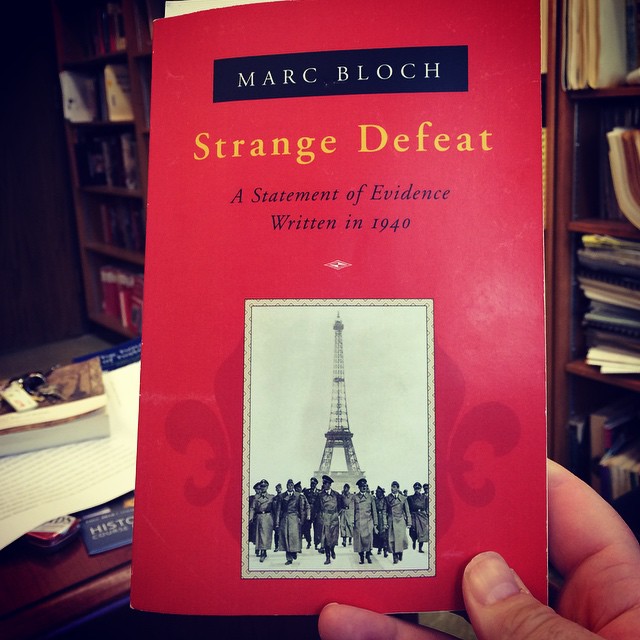 Marc Bloch is one of the most influential historians ever. An historian of mostly medieval France, he, along with Lucien Febvre, founded the Annales school of historiography in the late 1920s. The Annalistes preferred examining history over the long durée, and across various periods of time. They also advocated a more complete history than one of generals, presidents, prime ministers, and other so-called Great Men.
Bloch met his end at the hands of the Gestapo on in Saint-Didier-des-Champs, in France, on 16 June 1944, ten days after D-Day, as the Nazis realised they were going to lose France. Bloch had been a member of the Résistance since 1942. He was captured by the Vichy police in March of that year and handed over to the Gestapo. He was interrogated by Klaus Barbie, and tortured. It was a sad end for a great man.
Bloch had served in the French Army during the First World War, and remained a member of the Army reserve in the interregnum between the two wars. He was called up into action during the Second World War and was on hand for the baffling collapse of France in the face of the Nazi blitzkrieg attack in May 1940. That summer, he wrote his blistering and searing account of the Fall of France, Strange Defeat, not knowing if his words would ever see the light of day. The book was published in 1948, four years after his murder, and three years after the war ended.
Bloch is unflinching in his critique of French High Command, and France in general, for the collapse of its Army in 1940. In part, he blames the High Command’s over reliance on a false reading of history, that led it into a state of pathetic stasis, incapable of recognising that 1939-40 was not 1918, and that the Second World War was a different war than the Great War. In this passage, he makes a passionate argument for what the study of History is.
History is, in its essentials, the science of change. It knows and it teaches that is impossible to find two events that are ever exactly alike, because the conditions from which they spring are never identical…the lesson it teaches is not that what happened yesterday will necessarily happen to-morrow, or that the past will go on reproducing itself. By examining how and why yesterday differed from the day before, it can reach conclusions which will enable it to foresee how to-morrow will differ from yesterday. The traces left by past events never move in a straight line, but in a curve that can be extended into the future.
I assigned this book for my historiography class, and was deeply struck by this passage. I’ve re-read it four times now, it goes against what our culture thinks history is. Our culture thinks history is exactly what Bloch says it isn’t, that it can teach us to avoid the same mistakes over and over again.
I was thinking about this in light of my Irish history class dealing with The Liberator, Daniel O’Connell last week. O’Connell led the movement for Catholic Emancipation in Ireland, succeeding in 1829. He the turned his sights on the Repeal of the Act of Union (1800), which created the United Kingdom of Great Britain and Ireland. In this, he failed. He failed because times had changed, and attitudes were different. In the early 19th century, many in Britain, and even some amongst the Protestant Ascendancy in Ireland, had come to the conclusion that the denial of civil rights for Catholics in Ireland was not a good thing, and that Emancipation was necessary. Three of the staunchest opponents of Emancipation came around to O’Connell’s way of thinking: Sir Robert Peel, the Home Secretary; The Duke of Wellington, the Prime Minister, and King George IV). In the 1840s, though, when O’Connell’s Repeal movement reached its apogee, he did not have a groundswell of support in Britain (or amongst the Protestant Ascendancy) for Repeal. Thus, he failed because O’Connell failed to learn the proper lessons of History.
We would do well to remember Bloch’s maxim. Even we historians.
Historians Being Mean: A Glossary
October 4, 2014 § 4 Comments
[Note: This is not mine, my wife, Margo Shea, came up with this last week in prepping for the Historiography course she’s teaching. But, I think it’s brilliant, and kind funny, too, and worth sharing. I took this, with her permission, of course, directly from her blog. All credit goes to her, not me. I’m just married to a woman who’s smarter than me.]
Historians Being Mean : A Glossary
OK, I think back to graduate seminars and wonder if they may be sites of some of the most grievous crimes against reality when it comes to language usage. Pompousness galore! While aspirational erudition can be really annoying (see – told you!), there are instances in which the correct word matters, not the OK word or the more or less descriptive word. This, of course, is coming from the woman who, as a four year old, asked her mom if she could postpone her nap because she wasn’t currently tired. I used the perfectly appropriate word and got out of my nap. Life lesson learned. Check.
In no particular order, then, here are a few of the most commonly used words historians sling at each other and what they mean. Followed by what they really mean
Unsubstantiated. Obvious and unequivocal, this means you just don’t have the evidence to make the claim. You rarely see the “unsubstantiated argument” in print as a response to an entire article or text, because it’s the baseline for the profession and most research that can’t pass muster on the whole ‘evidence’ thing doesn’t get published. If seen, it is usually applied to one aspect of the research, sometimes because the reviewer can’t think of anything else to criticize. More likely to be heard at conferences, occasionally seen in print records of scholarly roundtables. In which case it means, “I just don’t like you at all and I don’t care who knows it” or “You are getting way too close to my research topic.” Implied insult: You didn’t do your homework. (Alternate reading: Your sweeping, elegiac study kind of blows my mind, so instead of feeling unworthy of you, I’ll just hang out over here and quibble over details in this one subsection of this one chapter, OK?).
Overdetermined. In layman’s terms, this means that an argument about cause or motivation attributes way too much significance to one criterion or set of criteria amongst a much larger pool of possible causes or motivations. The interpretation doesn’t leave enough room for alternate readings. This critique can be lodged in a few different circumstances and can be related either to the argument itself or to the person presenting the argument. Sometimes it is just a fancy way of saying, “Hey there, you’re right on the verge of manipulating your sources to your own dastardly ends.” Also, scholars opposed to the ideologies espoused explicitly by an author or implied in the context of the historical work may use overdetermination as a stand-in for “interested.” (See below.) Implied insult: Your interpretation is about as subtle as two dogs sniffing each other’s nether regions.
Lost in the Structure/Agency Corn Maze. Anyone writing about what people did and why people did what they did, especially if they happen to occupy subaltern status vis á vis a dominant power structure, has to grapple with the whole agency thing. To what extent do individual actors and groups exert personal and collective choice propelling them to act or not act, to speak, to be silent, etc? And to what extent do the forces that structure their society influence and shape the boundaries of what is possible? (Marx’s superstructure, Bourdieu’s field, etc.) It is easy to get lost in this maze and critics are unfortunately somewhere looking down watching you bounce off dried husks. Implied Insult: Seriously, who really cares about what ordinary people did or why?
*Special thanks to Lara Kelland, who cares deeply about ordinary people who create social change, for this one.
Methods-Fetishistic. This basically red-flags an obsessive fascination with methods or methodology, a blind or perhaps naïve faith in methodology as the key to unveiling hitherto opaque historical truths. Historians who rely on quantitative, computational, data-mining methodologies fall under this scrutiny on the grounds that statistics don’t speak for themselves. Implied insult: Got analysis?
Essentialist/Essentializing. Basically, an essentialist argument applies an indispensable set of characteristics to any group of people, set of events or places or things. Over generalization but more than that – it often but not always involves negative judgment. All Irish people are alcoholic-soaked pugilists. All middle class women whose primary work is in the home in the 1950s were sexually repressed. It projects the characteristics of a few onto an entire group. Making data/evidence about a small number of historical actors apply to the whole. Treating as representative the actions, performance, rhetoric of a few. Implying connections between actions and subject positions without a lot of evidence. Implied insult: The trees aren’t the forest, sweetie. And btw, there are a LOT of shades of green.
Teleological. A teleological argument ignores contingencies that make historical change happen and basically suggest a certain inevitability of events. It is the classic “all roads led to here” argument. Basically, a teleological argument looks at the present scenario and structures evidence about the past in such a way as to explain smoothly and coherently how A led to Z. And occasionally you might get really lucky and be get told that you are “reifying a teleology.” Historical scholarship as means to end. Implied insult: Go back to grad school, Marxist.
Interested/Present-minded. These are teleological’s pesky little brothers. It is a somewhat less harsh way of saying much the same thing. You are hereby convicted of reading the past through a set of political, social or cultural interests and commitments or are looking at present circumstances and making assumptions about how historical actors might have responded to the same kinds of circumstances or how historical processes might have operated, etc. Plus, you aren’t even badass enough for me to throw teleology at you. Implied insult: Go to American Studies or Performance Studies or somewhere, you contemporary person, you. You don’t belong here.
Whiggish. Present-Minded + Pollyanna. Herbert Butterfield published The Whig Interpretation of History in 1931. “The Whig interpretation of history,” he said, was “the tendency in many historians to write on the side of Protestants and Whigs, to praise revolutions provided they have been successful, to emphasize certain principles of progress in the past and to produce a story which is the ratification if not the glorification of the present.” Things are always getting better. Progress is inevitable. History is a straight line towards awesome. Implied insult: If you love the system so much, maybe you should have just gone to business school.
What Steve Earle can teach us about the Annales school of historiography
October 2, 2014 § 4 Comments
I’m teaching a course on Historiography this semester. This week, we’re dealing with the Annales school of history, as a sort of background before we read Marc Bloch’s Strange Defeat. While this book isn’t really an annaliste work, Bloch’s theories of history still impacted his evisceration of his country after the Fall of France in 1940. We’re reading an excerpt from Fernand Braudel’s magnum opus, La Méditerranée et le Monde Méditerranéen à l’Epoque de Philippe II, published in 1949.
In it, Braudel talks about the mountain regions of the Mediterranean world, and argues that the culture and civilisation of the plains didn’t reach into the mountains. The hills, he claims “were the refuge of liberty, democracy, and peasant ‘republics.'” And he mentions bandits. One of my favourite history books of all-time, and one which was massively influential on me as a young scholar, is Eric Hobsbawm’s Social Bandits and Primitive Rebels, which, despite Hobsbawm being primarily thought of as a Marxist, was deeply indebted to the annalistes, and to Braudel in particular.
But, as Braudel goes on and on about the freedom of the mountains, I kept thinking about hillbilly culture, about the Hatfields and the McCoys, about hillbilly culture, and so on. And it occurred to me that the mountains are no longer this mythical place beyond the reach of modern society. The coercive power of the state has caught up to the mountains.
And then I thought of my favourite Steve Earle song, “Copperhead Road.” In this song, Earle sings of three generations of a family who live in the ‘holler’ down Copperhead Road. In the American Civil War era, copperheads were northern Democrats who opposed the Civil War and called upon President Lincoln to immediately come to peace with the Confederacy. Braudel argues that
The mountain dweller is apt to be the laughing stock of the superior inhabitants of the towns and plains. He is suspected, feared, and mocked…The lowland peasant had nothing but sarcasm for the rude fellow from the highlands, and marriages between their families were rare.
At any rate, Earle sings of John Lee Pettimore III, named after his “daddy and his daddy before.” Granddaddy John Lee made moonshine down Copperhead Road. Daddy John Lee ran whiskey in a big black Dodge, which he bought at an auction. Meanwhile, John Lee III is a Vietnam vet growing marijuana in the holler down Copperhead Road. He signs the song in a good ol’ boy twang, and sings of white trash.
Granddaddy John Lee hid out down Copperhead Road, only came to town twice yearly for supplies, and successfully dealt with a “revenue man” from the government. Daddy John Lee was doing alright for himself before he crashed that big, black Dodge and the whiskey he was running burst into flames, killing him, on the weekly trip down to Knoxville. Meanwhile, John Lee III wakes up in the middle of the night with the DEA and its choppers in the air above his land.
In other words, as we move through the 20th century, from Granddaddy in the 1940s to John Lee III in the 1980s, we see the mountains lose their allure and mystique. What was once the badlands is now under the control of the government. In the early 21st century, it is even more so.
 Matthew Barlow