Griffintown: Keegan House Saved. Really?
April 29, 2014 § Leave a comment
Montreal is a strange place. The city basically works in completely counter-intuitive ways. Last week, the Comité consultatif d’urbanisme (CCU) of the arrondissement sud-ouest of the Ville de Montréal denied permission to developer, Maitre-Carré, to tear down the oldest building in Griffintown, a grotty old house that stands at 175, rue de la Montagne. The Keegan House, as it is now known, was built sometime between 1825 and 1835, on Murray Street, a block over from its present state. It was moved to what was then McCord Street in 1865, around the same time that the handsome row of townhouses was constructed up the block.
When Maitre Carré’s plans were first made public, I was apprehensive, but also thought that perhaps the developer deserved our benefit of the doubt, insofar as it had, at least, made some nod to heritage in Griff when Hugo Girard-Beauchamp, the company’s president, bought the Horse Palace and has at least nodded to the idea of maintaining the Palace as a working stable going forward (whether this will happen in practice is a whole different kettle of fish). Indeed, as my friend, G. Scott MacLeod, a film-maker interested in Griff, said, Maitre-Carré is the only developer that has at least acknowledged the history and heritage of the neighbourhood. Indeed, other condo developers, most notably Devimco and Préval have been more interested in stuffing ugly, neo-brutalist blocks of condos down on the Griffintown landscape, completely destroying the streetscape (such as it existed) and dwarfing the original buildings.
Having said all that, at this point anyway (because one never knows in Montreal), this is an optimistic sign. Anne-Marie Sigouin, the city councillor for Saint-Paul/Émard, and the chair of the CCU, said (according to The Gazette) “We have sent the architects back to the drawing board. We want to send a clear message on heritage protection.” This is rather surprising, since the CCU and the Ville de Montréal as a whole have not demonstrated much in the way of leadership up to now in Griff.
The Suburbanisation of Punk and Hip Hop
April 23, 2014 § Leave a comment
Questlove, the drummer and musical director of the hip hop band, The Roots (and frankly, if you don’t know just who in the hell The Roots are by now, I’m not sure there’s any hope for you), is writing a six-part series of essays on hip hop, its past, present, and future at Vulture. Not surprisingly, Questlove makes an eloquent argument in part one about the ubiquity of hip hop culture and the dangers that poses to Black America in the sense that if the powers that be wish to quash it, the ubiquity of it is all-encompassing and a quashing would be similarly so. But he also points out the dangers of the all-encompassing nature of hip hop culture.
I like Questlove’s point about the ubiquity of hip hop culture, which means that it’s no longer visible, it’s just everywhere. He also notes that it’s really the only music form that is seen to have this massive cultural phenomenon attached to it: food, fashion, etc. He says that this applies to pretty much anything black people in America do (he also wonders what the hell “hip hop architecture” is, as do I). But I think this goes beyond black America, such is the power of hip hop and the culture that follows it.
There is a relatively long tradition of white rappers, from 3rd Bass and the Beastie Boys up to Eminem and others, and the vast majority of white rappers have deeply respected the culture. More than that, as a white kid growing up in the suburbs in the late 80s, I was totally into hip hop, as were all my friends. This could get stupid, as when guys I knew pretended that life in Port Moody was akin to Compton, but, still. My point is that hip hop music, fashion, and culture has permeated the wider culture of North America entirely (something I don’t think Questlove would disagree with, but it’s irrelevant to his argument).
The only other form of music that has an ethos and culture that follows it, really, is punk. Punk and hip hop are spiritual brother movements, both arise from dispossessed working class cultures. Both originally emerged in anger (think of the spitting anger of Grandmaster Flash and the Furious Five in “The Message” or the Sex Pistols in “Anarchy in the UK”) and were heavily political and/or documented life on the downside. But, both also went viral, both exploded out of their original confines and went suburban and affluent.
Punk and hip hop are the two musical forms that informed me as a young man, they continue to do so as I hit middle age. But punk and hip hop are both deeply compromised by sinking into the affluent culture of middle class suburbia. The anger is blunted, the social message is reduced, and it becomes about “bitches and bling,” whether in hip hop (pretty much any song by Jay-Z) or punk (pretty much any song by The Offspring, Avril Lavigne, Blink-182, or any pop-punk band you hear on the radio). And then these counter-culture voices become the culture, and, as Questlove notes, they become invisible in their ubiquity. But more than that, the ethos they bring is divorced from their origins.
Questlove talks about the social contract we all subscribe to. He references three quotes that guide his series (and, I would guess, his life in general). The first comes from 16th century English religious reformer, John Bradford, who upon seeing another prisoner led to the gallows, commented, “There but for the graces of God goes John Bradford.” The second comes from Albert Einstein, “who disparagingly referred to quantum entanglement as ‘spooky action at a distance.'” Finally, Ice Cube, the main lyricist of N.W.A. (yes, there was once a time, kids, when Cube wasn’t a cartoon character), who, in the 1988 track “Gangsta Gangsta,” delivered this gem, “Life ain’t nothing but bitches and money.” Questlove also notes that Cube is talking about a world in which the social contract is frayed, “where everyone aspires to improve themselves and only themselves, thoughts of others be damned. What kind of world does that create?”
And herein lies the rub for me, at least insofar as the wider culture of hip hop and punk and their suburbanisation. If you take the politics and intelligence out of punk and hip hop, you’re left with the anger, and a dangerous form of nihilism. We’re left with Eminem fantasising about killing his wife and his mother. Charming stuff, really.
This is not to say there is no place for bangers in hip hop culture, nor is to say there’s no place for the Buzzcocks (the progenitors of pop-punk in the late 1970s), it just means that this is a many-edged sword.
The Distinct Culture of Anglo Quebecers
April 7, 2014 § Leave a comment
I have been on this listserv of policy wonks and academics in Canada since sometime in the late 90s. Most of the time, I’m not entirely sure why I remain on it, a small handful of the approximately 100 people on it post, and some use it to beat their hobby horses to many, many deaths. But, occasionally, it serves its purpose and intelligent discussion breaks out about various world events, Canadian politics, and the like. Over the past couple of weeks, one of those broke out over the Québec election, which is underway right now.
This has been the most divisive provincial election I’ve seen in Québec in my lifetime, though, admittedly, the bar was set very low with the ruling Parti québécois’ ridiculous, offensive, and racist charte des valeurs, a sad attempt at laïcité. That in and of itself, is fine, and is perfectly consistent with the Euro-francophone world, but the way it was introduced in Québec, and the manner in which it targeted minorities, most notably Arabs and other Muslims, was appalling. And since then, it’s been a raise to the bottom between the PQ, the Parti libéral du Québec, the Coalition pour l’avenir du Québec, and the 4th party, Québec solidaire. For the uninitiated, the PQ is a former leftist, sovereigntist party; the PLQ is a rightist, federalist party, the CAQ is a right-wing, sovereigntist party, and QS is a largely irrelevant leftist sovereigntist party. For the record, I voted QS in 2012 and would’ve again this year if I was still living in Québec.
So, to return to this discussion on the listserv. It was between an Anglo political scientist in Montréal, a Québec sovereigntist, a lawyer in Vancouver, and myself. Three Quebecers and an Anglo Canadian. The discussion largely centred around the PQ and its fitness for government, though, interestingly, the major issue of the election campaign, the charte was largely ignored by three of the four in this discussion (I was the fourth). The political scientist advocated the continuation of the status quo, a PQ minority, the separatist wished for a PQ majority (and a subsequent third referendum on sovereignty), I suggested the PQ was not fit for government based on the charte, and the lawyer ridiculed the entire idea of sovereignty. Other issues raised included protection of the French language and culture of Québec, as well as the fading generation of sovereigntists.
Pauline Marois, the current leader of the PQ and (at least until later tonight) the premier of Québec, is 65 years old. This puts her at the younger end of the baby boomers, who were the ones who really carried the idea of sovereignty in Québec. Interestingly, support for sovereignty is much lower amongst my generation (Gen X) and the millennials. The political scientist noted this, the need for younger blood in the PQ.
I argued that to simply dismiss the PLQ as incapable of defending the French language and culture in Québec is simple-minded, and I mocked the PQ for the charte and also pointed out QS’ near irrelevance. This led the political scientist to assume I voted PLQ. My guess, though, is that my name had more to do with that than anything. I found this rather disappointing, given nearly everything I’ve ever said about Canada/Québec on this listserv has made it clear I am not a knee-jerk Anglo Montrealer (like one I got into an argument with on Twitter this weekend who seemed to be suggesting Anglo Quebecers are a deeply oppressed minority).
But the real silliness emerged with the lawyer, who appears to be of the opinion that Anglo Montrealers and Anglo Quebecers do not have anything distinct about their language and culture, as compared with the Rest of Canada. He opined that in leaving Montréal for Boston, I did not give up much, as opposed to a francophone who would give up nearly everything. I find this argument both fatuous and depressing.
Anglo Montreal, at the least, has a distinct culture, specific to location. Anglo Montreal is often regarded as a large village, as it seems that all Anglos are no more than 3 or 4 degrees of separation from each other. But, more concretely, as McGill linguist Charles Boberg has discovered, Anglo Montrealers speak a dialect of English that is heavily influenced by French and is rather distinct from the Canadian English dialect. This makes sense. English is the mother tongue of about 650,000 people in Québec as a whole. This out of a total population of over 8 million. Within Montréal, out of a total population of nearly 4 million, about 420,000 people are native English-speakers. In other words, Anglos are a small island in a sea of francophone culture (to borrow the metaphor about Québec adrift in the North American sea of Anglos). As such, Anglo Montreal and Anglo Quebec have their own distinct culture and history, shaped as it was by the simple demographic fact of minority. This is very different than the plight of Anglophones in the rest of most of North America (except for Mexico and the American Southwest).
In other words, despite what a lawyer in Vancouver believes, Anglo Montrealers have their own distinct culture, language and identity, one that is separate and distinct from Anglo Canadians in the rest of the country. There are both positives and negatives to this, of course.
But, my Vancouver lawyer isn’t unique. He represents and all-too-common view of Anglo Canadians. Quebecers are perceived to either be beyond the pale of the Rest of Canada (if we’re francophones, I once got told in southwest Ontario that I speak “good English”), or we’re just like everyone else (if we’re Anglos).
So look at that, Québec is a distinct culture all around (Allophones, or immigrants and their descendants also have their own distinct culture in Québec). It might even be a nation unto itself.
Slave Narratives and the Carolina Chocolate Drops
March 31, 2014 § 6 Comments
Last night, we were up in Woodstock, VT, to see the Carolina Chocolate Drops, a string band from Durham, North Carolina. The band is comprised of three African-Americans and fronted by Rhiannon Giddens, who is of mixed white, black, and aboriginal descent, they play a mixture of traditional and modern folk/roots instruments. They’ve revived a number of songs from the slave era in the Deep South, most of which, according to Giddens, were set down in the 1850s, just before the onset of the Civil War. Most of these, however, come without lyrics, for perhaps obvious reasons. The band were incredibly talkative on the stage last night, which created an incredible community vibe inside this small theatre in small-town Vermont. Both Giddens and band mate Hubby Jenkins kept up a running monologue with the crowd, telling us about their songs, how they came to perform them, write them, play them, their traditional instruments, and so on.
Before one song, Giddens told us about her explorations of American history, specifically African-American history, and about a book she read that collated slave narratives, and analysed them collectively, as opposed to the usual individuated approach to slave narratives. However, Giddens also noted one story that stuck out for her, about a slave woman named Julie at the tail end of the Civil War, as the Union Army was coming over the crest of the hill towards the plantation that Julie lived on. Julie is standing with her Mistress, watching them approach in the song, “Julie.”
This video was shot last night, by someone sitting close by us, though I don’t know who shot it, I didn’t see it happening. This is one powerful song, and it got me thinking. I’m teaching the Civil War right now in my US History class, and as I cast about for sources I am intrigued by slavery apologists, then and now, who argue that the slaves were happy. But even more striking are the stories about slave owners who were shocked to their core when the war ended and their slaves took their leave quickly, looking to explore their freedom.
It seems that the slave owners had really convinced themselves that they and their slaves were “friends” and that their slaves loved them. That arrogance seems astounding to me in the early 21st century. But this song last night powerfully brought the story right back around.
Margaret Atwood: CanCon Queen
March 13, 2014 § Leave a comment
Last weekend, I read Margaret Atwood’s The Year of the Flood, the second of her dystopian trilogy (Oryx & Crake is the first part and MaddAddam is part three). I mentioned Oryx & Crake briefly in my post in January about my 2013 reading. There I noted I’ve never been an Atwood fan. But this trilogy is making me re-think my position. I spent a lot of time with both Oryx & Crake and The Year of the Flood simply overwhelmed with the world Atwood has created for this trilogy. I can see influences from outside sources, and with her previous fascinations with dystopia, most notably in The Handmaid’s Tale, but mostly I’m just impressed that Atwood could invent this alternate universe.
At any rate. Throughout The Year of the Flood, I appreciated reading a Canadian author, maybe out of a sense of missing home, or maybe just enjoying Atwood’s sly humour. The religious cult that is at the centre of this book, God’s Gardeners, have sanctified various ecologists, biologists, zoologists, and others who worked to protect the animals and the environment. God’s Gardeners are a pacifist, vegan sect who believe in the sanctity of all life, incorporating various aspects of Christianity, Buddhism, and the scientific revolution into their belief systems. When Adam One, the leader of God’s Gardeners gives a speech for the Feast of Saint Dian Fossey, Atwood slyly slips in Canadian content:
Today is Saint Dian’s Day, consecrated to interspecies empathy. On this day, we invoke Saint Jerome of Lions, Saint Robert Brown of Mice, and Saint Christopher Smart of Cats; also Saint Farley Mowat of Wolves, and the Ikhwan al-Safa and their Letter of the Animals. But especially Saint Dian Fossey, who gave her life while defending the Gorillas from ruthless exploitation. She laboured for a Peaceable Kingdom, in which all Life would be respected.
“Saint” Farley Mowat is one of Canada’s best-loved authors, at least he used to be. He’s still kicking around at age 92, but he reached the pinnacle of his fame in the 1950s, 60s, and 70s. He is most known for his work on the Inuit of the Canadian Arctic and the wolves of the Canadian tundra. For me, though, he is the author of the children’s lit Canadian classic, The Dog Who Wouldn’t Be. I loved that book when I was a child.
The “peaceable kingdom,” is a biblical reference, yes. But it is also a reference to Canada, the land of “peace, order, and good government,” according to the Constitution (though the latter has been lacking since January 2006).
The Spanish Civil War: On Memory and Forgetting
March 10, 2014 § Leave a comment
 I have just finished reading Jeremy Treglown’s fantastic Franco’s Crypt: Spanish Culture and Memory since 1936. Treglown is a literary critic, so he approaches history and memory in a manner rather different than a historian, nonetheless, there is definite overlap in methodologies. I must say, I was originally concerned when I picked up the book and read this on the dust jacket: “True or False: Memory is not the same thing as History.” Um, yeah, true. No kidding. But, the whims of publishers are rather different than the arguments of authors.
Treglown does a fantastic job of dealing with the complexities of the Spanish Civil War of 1936-9 and then the long Francoist dictatorship from 1939 until the Generalisimo’s death in 1975 and the transition to democracy that followed. Treglown works very hard against the myth that Republicans = Good and Nationalists = bad during the Civil War. He also works hard against the myth that Franco’s régime was purely repressive and oppressive vis-à-vis art and artists, noting that a great amount of art (film, literature, music, visual art, sculpture) emerged in Francoist Spain. This is not to say that Treglown paints a rosy picture of Francoist Spain. He doesn’t. He doesn’t glorify Franco, but he seeks to complicate the dictator and the community of artists in Spain during and since the Civil War. He also deals with the complexity of characters like Camilo José Cela.
Cela was a nationalist soldier during the Civil War, and later worked as the censor for the Francoist state. And yet, he was also himself a novelist, and remarkably blunt and sensitive in his work. He began a literary journal in 1956 “as a way of countering cultural officialdom and giving space to the ideas of Spanish writers living abroad.” A noble sentiment, given that most of those expat Spanish writers were expatriates due to the Civil War and Franco’s dictatorship.
Treglown points to Cela’s most famous work, San Camilo, 1936. While San Camilo, 1936, has been criticised for a lack of morality, both due to the amount of time the characters spend in brothels and Cela’s avoidance of the larger issues of the war, it is in the details that the novel works. Cela shows the moral and actual ambiguity of war, in Treglown’s words:
Above all, San Camilo, 1936 grieves for Spain, gazing at a graveyard full of flowers of all colors, ignoring the shouts of “¡Viva la república!” and “¡Viva España!” because “it is no use being too enthusiastic when melancholy nests in the heart.
But what mostly interests me about Treglown’s discussion about San Camilo, 1936 is the intersection between memory and forgetting. As Cela writes, “No one knows whether it is better to remember or to forget. Memory is sad and forgetting on the other hand usually repairs and heals.” Nevertheless, as Treglown notes, San Camilo, 1936, is essentially a “puzzled, angry act of commemoration.” In other words, Cela and his characters remain ambivalent with what is to be done with trauma, history and memory.
I find Cela’ claims about the virtues of forgetting to be interesting. We live in an era that seems to believe the opposite in many ways. In our times, cultural historical memories have been exhumed and examined in public. Sometimes this takes the form of commemoration, (such as in Cork, Ireland, in the summer of 1997, marking the 150th anniversary of the Famine) or commissions of Truth and Reconciliation (such as in South Africa after Apartheid). Treglown himself recounts attempts by the caretakers of Franco’s memory to maintain his dignity, three decades later at the Valle de los Caidos (Valley of the Fallen), a huge monument outside of Madrid to honour the Nationalist fallen of the Civil War. Meanwhile, since the end of the dictatorship in 1975, the Spanish have attempted to exhume the bodies of massacred Republican soldiers and sympathisers. Indeed, the balance of power has tipped in favour of the Republicans, to the point where the atrocities committed by them during the Civil War have been whitewashed, just as the Francoists whitewashed the Nationalist atrocities.
Cela’s words, however, led me to think about Marc Bloch’s blistering Strange Defeat: A Statement of Evidence Written in 1940, about the quick Fall of France at the start of the Second World War. Bloch, a captain in the French Army and the country’s most famous historian, wrote this on the run from the Nazis (who eventually killed him). Strange Defeat is a searing book, almost painful to read, written by a fierce French patriot stunned and shocked his nation collapsed in defeat at the hands of the Nazis. Bloch blames France’s political and military leaders for failing to have prepared for modern warfare. And while Bloch remains an annaliste (the school of historical scholarship Bloch pioneered) in writing Strange Defeat, the immediacy of the events he’s describing and his anger and fury are clear.
Bloch was too close to the events, and too involved, to provide a long-view analysis of the Fall of France (nor, for that matter, did he wish to). The same can be said of Cela, a Nobel laureate. San Camilo, 1936 was published in 1969, thirty years after the end of the Civil War, while Franco was still alive and in power. Cela, like Bloch, was involved in the events his novel attempts (or doesn’t attempt) to deal with, and his view on the past, memory, and forgetting is perhaps not surprising.
My grandfather, Rodney Browne, was 17 when he joined the Royal Canadian Air Force in 1943. He was a tail gunner, which meant his chances of survival were pretty slim. And yet he did survive, and he came home to Montréal in 1945 with the conclusion of the war. But he was traumatised, deeply. He suffered silently, primarily by drinking. And he was restless, unable to settle into a job or family life, until his late 40s/early 50s, nearly thirty years after the war. By the time I was born, Rod was settled, married again, and he was a good grandfather. It is from him that I gained an historical consciousness about the Irish in Montréal. He didn’t talk about his past much, and he never talked about the war. I later found out that this was pretty common for men of his generation who served in the Second World War. He didn’t want to remember, which is why he drank when he got home, trying to obliterate those memories.
So maybe, it is the generation who lives through the worst of the trauma that wishes to forget, to never have to think of the atrocities they saw or committed. It is their descendants who feel the need to excavate these memories. Either way, these are not complete thoughts on memory, commemorations, and forgetting. Memory and forgetting remain incredibly powerful tools in historical scholarship.
Dear Boston: Reflecting on the Marathon Memorial at the Boston Public Library
March 7, 2014 § Leave a comment
Back in July, when the insta-memorial for the Boston Bombing of 15 April 2013 was taken down, I wrote this piece at the National Council of Public History’s history@work blog. In it, I expressed my cynicism of what happens to the items of the memorial when they are removed from the site and put in storage, or even brought out again for a more permanent exhibition. I also argued in favour of insta-memorials such as this, seeing some value in our hyper-mediated lives, watching the world through the screens of our iPhones. What resulted, from the piece on history@work, as a notification here on this site, as well as Rainy Tisdale’s blog, was a rather robust discussion, especially between myself and Rainy, a Boston-based independent curator about authenticity and memorials.
 To sum up the discussion, we debated whether or not Boston needed an exhibition on the first anniversary of the attack. I argued that the running of the 118th Boston Marathon, as well as the traditional Boston Red Sox game at Fenway Park, would serve as a chance for Bostonians to reclaim Boylston Street and Copley Square one year later. Rainy, on the other hand, argued that an exhibition was necessary in order to prevent the kind of frenzy that began to emerge surrounding the #BostonStrong rallying cry when the Bruins went to the Stanley Cup Finals last spring (and lost. I hate the Bruins).
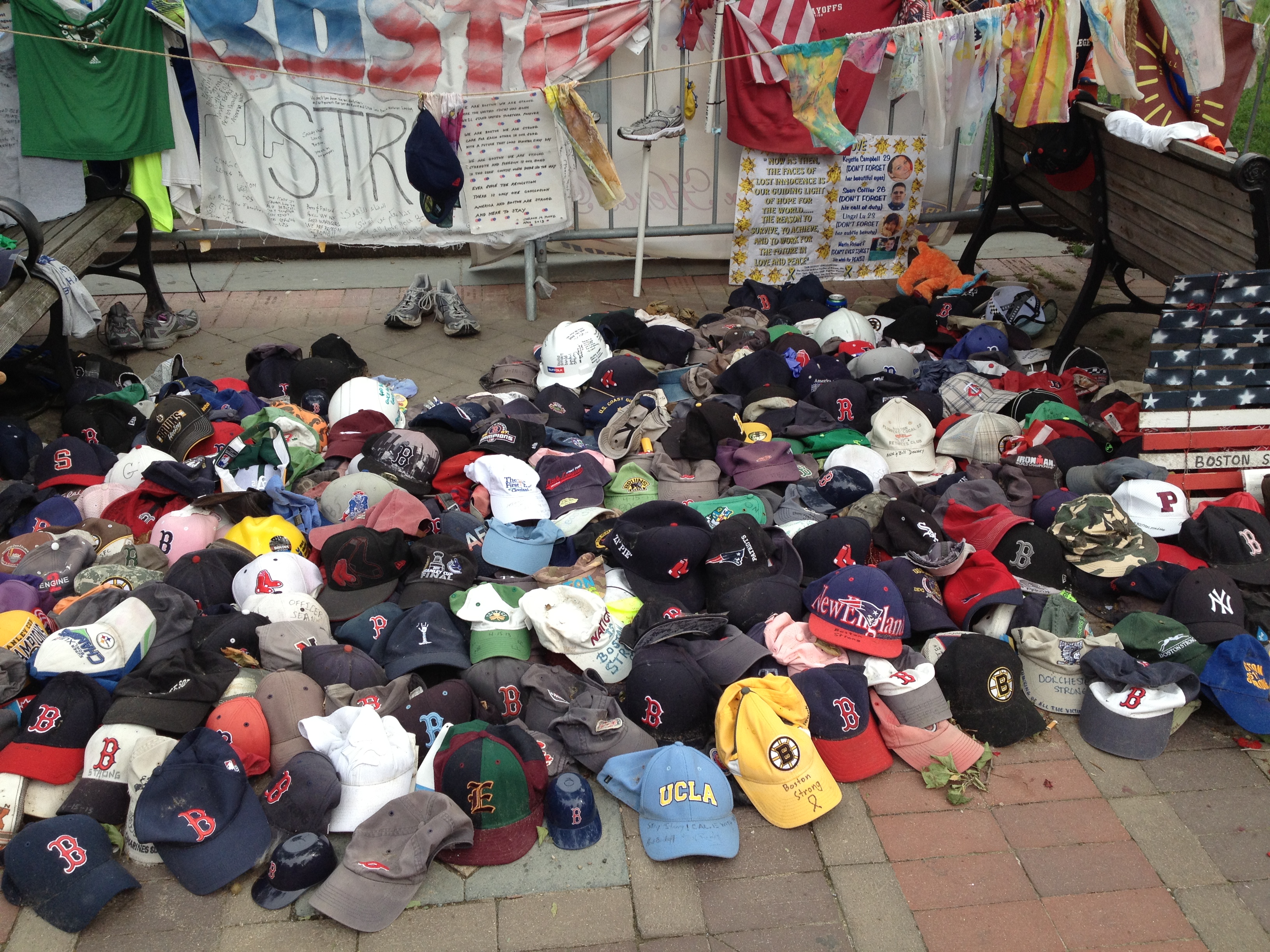 In the time since, I have come around more to Rainy’s argument than my own, though I still worry about questions of authenticity and memorial mediation on the part of the curatorial hand (though, of course, that spontaneous memorial, first on Boylston Street and then at Copley Square was also curated, in part). Nevertheless, I am very much looking forward to Rainy’s exhibit at the main branch of the Boston Public Library on Copley Square. Dear Boston: Messages from the Marathon Memorial opens on 7 April, and will run to 11 May. It is a tri-partite exhibit: the first part will encompass the immediate responses to the bombing, the second will be people’s reflections on the bombs, and the final part will be the hopeful part, messages of hope and healing.
 I appreciate the exhibit’s title perhaps more than anything at this point, as it makes direct references to the curatorial hand at work here, as the exhibit will deliver messages from the memorial. In July last year, I worried about the loss of meaning of the individual artefacts when they were boxed up and stored in the Boston Archives. A running shoe had a very poignant and powerful meaning when displayed at the memorial, and in a box in the archives, it’s a running shoe. Restored to the public eye, however, attached with a symbolic meaning that no one in Boston, or anyone visiting the exhibit, will miss, the shoe regains its poignancy.
What struck me in my discussion with Rainy last summer was how she intended to approach the exhibit, and her sensitivity to the very issues that concerned me. I am very much looking forward to what she comes up with.
A Response to Nicholas Kristof
February 17, 2014 § 7 Comments
I read with some bemusement Nicholas Kristof’s critique of academia in yesterday’s New York Times. Kristof complains that professors have cloistered themselves up in some ivory tower and disdain the real world. He says that the academy exists on a publish or perish mentality and that it encourages conformity. Perhaps due to limited space in a newspaper column, Kristof comes off sounding petulant and occasionally stuck on stereotypes of the academy that are at least twenty years out of date.
He also uses a broad-stroke brush to critique a very large, diverse institution. But I did find his argument that academics are out of touch with reality interesting, in that it reflects an argument I saw on Facebook last week about the massive bloat on university campuses of non-academic staff, which has apparently reached a 2:1 ratio on public and 2.5:1 ratio on private campuses in the United States. In this argument, which largely pitted professors against non-academic staff, the latter repeated this shibboleth that academics are unable to engage with the real world.
However, he does provide a jumping off point.
The academy does operate in a publish or perish paradigm, and academics who spend their time engaging with the public, rather than publishing in peer-reviewed journals, do get punished. And it does encourage conformity, in terms of theory, models, and interpretation. He is correct to note that “This culture of exclusivity is then transmitted to the next generation through the publish-or-perish tenure process. Rebels are too often crushed or driven away.”
Back in 1998, Canada’s crusty old historian, Jack Granatstein (in)famously published Who Killed Canadian History? wherein he lambasted the left for having created microstudies, feminism, and various other things that left us with histories of something Granatstein called “housekeeper’s knee”, which he dismissed pithily with a petulant “Who cares?” Granatstein, perhaps intentionally, engaged in rhetoric and anti-intellectualism in this little gem, essentially dismissing all who disagreed with him as irrelevant, as if he was the sole judge, jury, and executioner of what was a viable topic of study in Canadian history.
In the 1960s, “history from below” developed, primarily in England, around the work of brilliant minds such as Eric Hobsbawm, Christopher Hill, and the husband-and-wife team of E.P. and Dorothy Thompson. They wanted to know how the common person dealt with history and change. Taking their cue, historians in the US and Canada began to conduct similar studies of the working-classes and rural communities, but with far less interesting results than the English New Left, largely because the English historians wrote well, and did not get bogged down in statistics and turgid prose. Nonetheless, these studies in Canada and the US were essential to the development of the field.
But the real problem is that the likes of Kristof and Granatstein hearken back to a glory day in the academy that never existed. Kristof complains that academics write horribly, and seem to go out of their way to not engage. Many do. Because, quite simply, the academy has always worked that way. The great works of Canadian history that Granatstein refers to are horridly boring, I used to read them when I had insomnia to put myself to sleep. Kritof cites stats that claim that academics in the social sciences were more engaged in public debate in the 1930s and 40s than today. That may be true, but the readership of academic journals in the 1930s and 40s was just as limited as it is today. Hundreds of academic monographs get published to almost complete indifference, that is true today and was just as true in this supposed heyday. The academy has always been removed from the world, as it must indeed be to some degree to escape the noise of the world.
Nonetheless, there is some truth in Kristof’s complaint. But, he also undoes his argument by noting that historians, public policy wonks, and economists, amongst others, are very much engaged in public discussions. About economics, he says:
In contrast, economics is a rare academic field with a significant Republican presence, and that helps tether economic debates to real-world debates. That may be one reason, along with empiricism and rigor, why economists (including my colleague in columny, Paul Krugman) shape debates on issues from health care to education.
This comes after a critique of academia for having failed to predict the Arab Spring. I found this juxtaposition curious. The 2008 economic meltdown was missed by the massive majority of economists. And the ones who were sounding the alarm were just as ignored as those academics who foresaw something like the Arab Spring.
And so this brings me to my greatest critique of Nichols Kristof’s argument. Academics can yell and scream and tilt at windmills all we want. But without help, we are largely left standing by ourselves. The only way for our ideas to spread into the mainstream of society is with the help of the likes of Kristof: journalists. When I still lived in Montréal, I found myself fielding calls from the media with some frequency on a variety of topics from Griffintown to Irish history to the Montréal Canadiens. Journalists found me, at first, through Concordia University, where I did my PhD, and then because they had contacts and colleagues who knew me. Never once was I found through this blog (readership tended to spike after I made an appearance in the media) or through my publications. Kristof also takes academics to task for not using Twitter and other social media for communicating with the world. Guess how many times a journalist has asked me a question on Twitter? And this is despite the fact that several journalists follow me. In other words, without journalists seeking me out, I had no platform upon which to speak.
Kristof ends his column with what sounds like a desperate appeal:
I write this in sorrow, for I considered an academic career and deeply admire the wisdom found on university campuses. So, professors, don’t cloister yourselves like medieval monks — we need you!
But in so doing, he is being disingenuous and shifting the blame entirely to academics and removing the role of journalists in this discussion about the relative accessibility or non-accessibility of academics. Kristof is right to call on the academy to make greater engagement with the mainstream, but he is incorrect in assuming that without the help of journalists it will just happen spontaneously.
The Re-Writing of History: The Second Battle of Ypres
February 7, 2014 § 1 Comment
Ypres was a hotspot in the First World War. No fewer than five major battles took place around this Flemish town between 1914 and 1918. During the Second Battle of Ypres, fought in April-May 1915, the Germans wafted a cloud of chlorine gas at the Allied troops across No Man’s Land. The other side was occupied by Moroccan and Algerian troops, flanked by Canadians. In other words, the main targets were French African colonial troops. The Germans didn’t dare set the gas towards Europeans.
The Moroccans and Algerians died on the spot and/or broke ranks and ran. This left a massive gap, 4 miles long, in the Allied lines, which the Germans were rather hesitant to rush into, for obvious reasons. That meant the 13th Battalion, Canadian Expeditionary Force was left to counter the German attack, on its own. It was reinforced by the 10th Battalion of the 2nd Canadian Brigade, as well as the 16th Battalion of the 3rd Canadian Brigade the next day. It’s worth noting that the Canadians became the first colonials to defeat a major European power at Ypres.
In short, the Allied lines when the Germans used chlorine gas on them were manned by colonial troops: Moroccans and Algerians who took the brunt of the gas, and then Canadians who also got hit with gas, but to a lesser extent (they urinated on handkerchiefs and then put them to their faces to survive the attack).
This is the version I was taught in school and university in Canada. And it was also the version I saw in pop culture, films, literature, history books, at least until recently. In the past year or two, this story has been simplified: French and British troops were gassed by the Germans. And while that is technically true, it is massively mis-leading.
In the case of Canada, our national mythology says that our country came to age on the battlefields of the First World War. It led to Canada demanding and gaining the ear of British Prime Minister David Lloyd George with the creation of the Imperial War Council (along with the other Dominions). And Canada (as well as the other Dominions) were seated at the Versailles conference. Eventually, in 1931, Canada (and the other Dominions) gained control of their own foreign affairs in 1931 with the passing of the Statute of Westminster. And, as I argue myself in my own forthcoming book, The House of the Irish: History & Memory in Griffintown, Montreal, 1900-2013, Canadians were consciously fighting for their own nation, they fought in their own army, the Canadian Expeditionary Force. And even if the CEF was appended to the British Expeditionary Force, Canada was coming of age as a nation of its own right. So, to state that the British and French were the victims of the German gas attack is disingenuous. And yet, there it is in our culture, everywhere from writers who should know better to Downton Abbey.
Imagine my surprise, then, to be reading a quick review of Graeme Kent’s new book, On The Run: Deserters Through the Ages, (which has yet to be published in North America) in The Times Literary Supplement, that states that the gas attack “fell four square on the French and to a lesser extent on the Canadian First Division.” I quickly flipped to the back to see who the reviewer, Nathan M. Greenfield, was. A Canadian military historian. So that sort of doesn’t count. And, there is also the fact that while Greenfield did wave the Canadian flag, he also denied the Moroccan and Algerian troops their due.
Montréal’s Griffintown Redevelopment #FAIL
February 6, 2014 § 3 Comments
The Gazette this morning reports news that the Keegan House just around the corner on rue de la Montagne from Wellington, and across from where St. Ann’s Church once stood, is under threat of demolition from Maitre-Carré, the developer responsible for the condo tower at the corner of de la Montagne and Ottawa. The Keegan House was built sometime between 1825 and 1835 on Murray Street, a block over. In 1865, it was moved to its current site.

The house was moved because of the development around Griff. Unlike many other urban neighbourhoods, and unlike the current redevelopment, Griffintown was developed on a lot-by-lot basis. There were not block long, or multi-lot developments as a rule. So as Murray Street was developed, Andrew Keegan, a school teacher, moved his house to a more prestigious locale, across the street from St. Ann’s Church. As David Hanna, an urban studies professor at UQÀM, notes, the block across the street from St. Ann’s was where the nicest housing in Griff was. But that is still a relative statement. Even the nicest homes in Griffintown could not compare with even the swankier locales across the canal in Pointe-Saint-Charles.
In recent years, the Keegan House has fallen into disrepair. I was in the building 7 or 8 years ago, and it was in rough shape. Maitre-Carré have bought the lots from 161-75 de la Montagne for redevelopment. Also slated to be demolished is the building that housed what used to be the Coffee Pot, a hangout for Griffintowners across the street from the Church. After the Coffee Pot closed in the early 1960s, the building was split in two, with a dépanneur and a tavern operating there. The tavern limped to its death about a decade ago. Both the Coffee Pot building and the Keegan House were given an unfortunate renovation in the 1950s or 60s, with their outer walls encased in concrete, which greatly diminished their aesthetic appeal.
Now what makes this story interesting and oh-so Montréal is that Hugo Girard-Beauchamp, the president of Maitre-Carré, claims that his company has no intention of destroying the Keegan House and, in fact, wishes to incorporate it into the new development. You know what? I believe him. Maitre-Carré and Girard-Beauchamp are the ones were worked with through the Griffintown Horse Palace Foundation. And while he remains a businessman, Girard-Beauchamp was also more than willing to listen to us and even help us preserve the Horse Palace. In fact, I would go so far as to say, at least when I was on the Board of the GHPF, that we would not have succeeded without his help.
However. This is Montréal. The borough isn’t sharing the plans for this development. Julie Nadon, the chief of planning for the borough, says they’re “confidential.” They shouldn’t be. Too much of the redevelopment of Griffintown has been done this way. The Ville de Montréal has operated in Star Chamber secrecy, refusing to divulge its plans to anyone other than the developers until it’s too late. A couple of years ago, the Ville de Montréal held a public session at the ÉTS to show off its plans for Griff. It’s plans had already been made with 0 public input. None. At all.
Montréal’s Star Chamber secrecy violates the very principles of democracy and the things that Montréal likes to pride itself on, which is an open city, with a creative class proud of its civic engagement. In Griffintown, the Ville de Montréal stonewalls civic engagement at each and every turn. It’s embarrassing and it’s no way to run a city. #fail
 Matthew Barlow