The Haunting of Patrick Okello
January 13, 2014 § Leave a comment
Yesterday, there was a fantastic article in The Guardian about Uganda and the long-term fall out of Joseph Kony’s Lord’s Resistance Army amongst the Acholi. The Acholi live in northern Uganda, not far from South Sudan. Joseph Kony comes from the Acholi. One of the many things that struck me about the article is the story of Patrick Okello. Okello is a haunted man.
In 1996, five years after a horrible massacre at Amoko on 6 December 1991, Patrick Okello and his brother came across the dismembered remains of his father about 8 miles away from home. Another victim of the LRA:
My brother and I found his body cut up into small pieces. There was a lot of blood. We buried him quickly in a shallow grave with sand near our home. Then we ran away in case the LRA were still in the area. I think my father is still vengeful about the fact that his last funeral rite has not been carried out. He always tells me he needs a proper burial. He is angry.
Journalist Will Storr posits that Okello suffers from PTSD. But Okello, as Storrs notes, lives in a small village, far removed from the world of medical intervention. Instead, Okello is haunted. Storrs writes,
Demons have been visiting him in the night; he wakes to see a strange glow in his hut as they surround him, whispering Okello, Okello, Okello. Flies, rats and bats crawl over him. The other day, he stripped off all his clothes and ran up the hill. “That’s what makes him run,” says elder Martin Olanya. “Because they’re calling his name.” The villagers have a theory as to what’s behind the haunting of Patrick Okello. “Ever since the burials took place,” says Martin, “the people in this community have not been settled. We assume it’s the work of vengeful spirits.”
The Acholi believe in this spiritual world. Like all cultures, they believe in elaborate burial rituals that allow the spirit of the deceased to journey onwards. If those rituals are not observed, the spirit cannot escape and they remain to haunt those left behind. And during the terror caused by Kony and the LRA, which visited the most destruction, death and mayhem on the Acholi because they wouldn’t, for the most part, support Kony, it was near impossible to observe these rituals. Storrs tells of other survivors of the 1991 massacre who buried their dead in shallow graves, quickly, to avoid running into the LRA again lest they be killed as well.
I resent the tone taken by Westerners in describing these belief systems (though Storrs actually does a wonderful job in NOT taking the usual tone), which reflects this sense of Western superiority, that somehow we are rational (yes, I know, this is the entire mindset that justified imperialism in the first place). As if we in the (post)modern world do not have such beliefs, we are entirely rational and modernised.
When I teach World History, I spend a lot of time dealing with religion for the simple fact that religion is, amongst other things, supposed to offer a means of explaining the chaos and disorder of the world, a means of understanding why bad things happen. In other words, religious beliefs have long since ordered and organised cultures, including our own allegedly post-religious society. And belief systems like that of the Acholi do exactly that, it explains why the world works the way it does. And we all need belief systems that help us to understand the world, which is why this theme I’ve been exploring when I teach World History, the Terror of History, is so appealing to me. Religion is one of the main means by which human beings have sought to escape the Terror of History, as religion allows us to rationalise it, to give us meaning for why bad things happen and why we are all going to die.
And so this is what the beliefs of the Acholi do: explain the world to them, and to help them understand why Kony happened in the first place. Indeed, Dorina Adjero, one of Okello’s neighbours, says that Kony is possessed by demons, “That’s why he does all the killings and all these weird things. A normal person who is acting in normal conscience wouldn’t kill people in this way.” As for Okello, his demons appear to have been quieted by an exorcism of sorts performed by pastors from the local evangelical Christian church.
The Making of the Historian
January 12, 2014 § Leave a comment
One of my favourite history books is Angela Bourke’s The Burning of Bridget Cleary. The book, published in 2001, tells the story of Bridget Cleary’s death at the hands of her husband, Michael, and a mixture of extended family, in Ballyvadlea, Co. Tipperary in Ireland in March 1895. As Bourke unravels the story, the murder of Bridget Cleary is an opportunity for the historian (or folklorist, in her case) to examine the collision between modern culture and folkways. Ballyvadlea in 1895 was essentially the boondocks of Ireland, far removed from the encroaching modern world, people there still lived according to old Irish ways, with beliefs in fairies, banshees, and the like. Whether or not Michael Cleary and his cohorts actually believed in this is neither here nor there, argues Bourke, what matters is that the belief system still existed and was still accessible to Cleary and his co-conspirators.
When I was in graduate school, I was fascinated by the collision between modernity and ancient folkways. In particular, I was interested in charivari, a means of community policing in pre-modern societies in Europe and amongst settler societies in North America. In fact, I was so interested in this, I set out to do my Master’s degree on this topic in Québec. What fascinated me then, and still does today, and why I enjoy Bourke’s book so much (I usually assign it when I teach Irish History) is the way in which modern legal culture intersects with traditional folkways.
Societies have traditionally been able to police themselves. Today, we live in a society where the state is omnipresent, whether in the form of of our driver’s licenses, or the regulation of education, and various other means. When someone breaks the law, we expect the police to make an arrest, the prosecutor to secure a conviction, and the jail to secure the lawbreaker until her debt to society is paid. But it hasn’t always been that way.
In October 1855, Robert Corrigan was beaten to death in Saint-Sylvestre, Québec, a remote agricultural community, some fifty miles south of Québec City, in the foothills of the Appalachians. He was beaten by a gang of his neighbours for stepping out of line. They did not mean to kill him, they meant to discipline him for his bullying, aggressive behaviour. That Corrigan was an Irish Protestant and his murderers Irish Catholics was secondary (at least in Saint-Sylvestre, for the rest of Canada, that was the most important detail in the highly sectarian mid-19th century). When the state attempted to arrest the accused men, they were easily able to elude the police forces sent in from Montréal and Québec, aided by their neighbours. When they did finally turn themselves in in January 1856, they did so on their own terms. They were also able to rig the jury when they went to trial in February so that they were acquitted.
The Corrigan Affair, in this light, was entirely about a local community maintaining its right to police itself in the face of the power of the state. The mid-19th century in Canada was a time of massive state formation and expansion. The same period in Québec saw a spate of construction projects around the province of courthouses and jails and other such buildings. The buildings were all the same down to the shade of paint used on them. Why? Because the state was attempting to establish its control across the province and it was attempting to do so with the message that the state was indifferent to local contingencies. Not surprisingly, the people of Québec rebelled against this. The mid-19th century in Canada offers endless examples of local communities rebelling against the state in Nova Scotia, New Brunswick, Québec, Ontario, Prince Edward Island, and Newfoundland.
The Wild West in the United States is another such example. The West has a reputation for violence that is only partly deserved. Much of the legends of the Wild West are just that: legends. But violence there was. Much of it was about the same thing as charivari in England or The Corrigan Affair in Québec: community policing. Disputes were settled between the belligerents for several reasons, most importantly, the state did not have the power yet to mediate between its citizens.
Historians have been studying this collision between folkways and the rise of modernity since the 1960s. During that era, that great generation of English historians (E.P. Thompson, Christopher Hill, Dorothy Thompson, Eric Hobsbawm) became fascinated by this collision. I always find it interesting when I see the influence of the historians I read in graduate school still on me today, all these years later.
Last semester, our favourite work study student, Alvaro, graduated. Alvaro had worked in our departmental office since we both (as in my wife and I) arrived here in the fall of 2012. For his graduation, we decided to buy him the books that had the greatest impact on us in our development as historians, as Alvaro is planning on going on to graduate school. I got him E.P. Thompson’s The Making of the English Working Class. I first read this book in 1996, my first semester of graduate school. It was one of the few books I read in graduate school where I just couldn’t put it down. Meticulously research, and brilliantly insightful, Thompson crafted an historical study that could stand on its own on its literary merits. I re-read it a couple of years ago. It remains one of my favourite books of all time.
The English Language and Montreal
January 8, 2014 § 8 Comments
An interesting oped appeared in the Montreal Gazette today. It was written by a guy, Nicholas Robinson, who teaches Japanese in Montreal, an expat American who has been there for the past 30 years. He is critical of the Anglo community of Quebec when they kvetch about not getting service in English, whether at the hospital or on the STM. He says that learning French is just as essential to living in Montreal as learning Japanese is to living in Kyoto.
I tend to agree, the fact of the matter is that Quebec is a French province and Montreal is a French city. Last time I looked at census data, just a shade under 600,000 Quebecers identified as Anglos, as defined by speaking English as their mother tongue. That’s 7.7% of the population of Quebec. The largest group of Anglos live in and around Montreal, where 16.8% of the population is Anglo. Statistically, that’s a sizeable minority. And yet, most Anglos, at least in Montreal are at least functionally bilingual.
Robinson goes on to argue that “the French speakers of Quebec have been incredibly tolerant of the anglophone “community,” and a vast swath of them have gone to the immense trouble of learning English — when they don’t have to at all.” I also tend to agree here, though I will note something based on my experience of teaching CÉGEP for 6 years. I would say that somewhere between 40-45% of our students at my Anglophone CÉGEP were francophone, some of whom did not have great English-language skills upon entering the school. But their reason for wanting to go to CÉGEP in English (they often went onto French-language universities) was simple: English is the dominant language in the world today, and is the lingua franca of global business (I would also add that about 70% of my students wanted to get degrees in business or related fields). So there are practical reasons for Quebec’s francophones to learn and speak English.
But, as you might expect, the comments in response to Robinson’s missive are, well, predictable. And vitriolic. They include exhortations that he remove himself from Quebec and “go home.” But the first comment I saw was perhaps the most instructive of all. The commentator lambasts Robinson and notes that Canada is a bilingual nation. And Quebec is a province of that bilingual nation. That much is true.
But. Quebec is not bilingual. In fact, there is only one officially bilingual province in Canada: New Brunswick, though Ontario and Manitoba will also provide services in French to their population. Moreover, despite the fact that, say, British Columbia is a province in a bilingual nation, good luck getting anyone to speak French to you in Vancouver. Canadian bilingualism functions in reality a lot more along the Belgian model: insofar as it exists, it’s regional. Canada has something called a “bilingual belt” that stretches from New Brunswick along the St. Lawrence River valley to Eastern Ontario. Within this belt, you will find a sizeable amount of the populace that can speak both English and French, and you’ll also find some bilinguality in Manitoba. Aside from that, though, forget it.
So, in reality, the Anglophone population of Quebec and Montreal, as Robinson notes, has it relatively good. An Anglophone in Montreal can get an education in English, and healthcare in English, and there is a robust Anglo media in the city. And, I might add, while I can speak French, when I had to deal with the government of Quebec, I tended to at least try to get service in English, in large part because I, like many Anglos, don’t trust my French all that much. This was especially the case when dealing with Revenu Québec or the Ministère de la Santé et les services sociaux. Much to my surprise, this was never a problem. I always got responses in English. A francophone in Toronto gets none of that.
Having said that, Montreal has a robust Anglophone community because it has jealously protected itself and its “rights”, especially since the rise of the Parti québécois’ first government in 1976 and Bill 101 in 1977. But that doesn’t mean that Robinson doesn’t have a point.
Final Exams and the Terror of History
December 22, 2013 § 1 Comment
My poor students. I’ve been teaching a World History course centred around the notion of the Terror of History. On the Final Examination this semester, I asked them “What is the Terror of History?” One of the neat things about WordPress is that I can see the Google search terms that have brought people to my blog. The number one term of the past week? “The Terror of History.” Poor kids.
On the Holocaust, Genocide, and Evil
December 19, 2013 § 1 Comment
I’m reading Terry Eagleton’s brilliant pamphlet, On Evil. (This came out in 2010, the ever-prolific Eagleton has churned out 4 books since then). It is, as you’d expect, a meditation on evil, what evil is, what it looks like, how it functions. And as you’d expect from a literary theorist, Eagleton looks at various examples from literature and the real world. This includes 20th century fascism.
I’ve always been disappointed with explanations of the Holocaust (or any other genocide) that reduces the motivation of the génocidaires down to “evil,” as in Hitler (or Pol Pot, the Young Turks, the Serb military leadership, etc.) were simply evil and that’s all there is to it. This is a cop out explanation. It’s reductionist and absurd. Genocides, and other horrible acts, are perpetrated by human beings. Indeed, this was Hannah Arendt’s point about Adolf Eichmann in her monumental Eichmann in Jerusalem: that Eichmann wasn’t a raving anti-Semite, evil excuse for a man. Rather, he was “just doing his job.” She went on to argue against this idea that evil is responsible for the horrid acts humanity has visited upon itself, that, rather, these horrid acts arise out of rationality.
And certainly, the Holocaust is one of those events. Eagleton notes that the Holocaust was exceptional, though not due to the body count. As he notes, both Stalin and Mao killed more people than did Hitler. Rather,
[t]he Holocaust was unusual because the rationality of modern political states is in general an instrumental one, geared to the achievement of specific ends. It is astonishing, then, to find a kind of monstrous acte gratuite, a genocide for the sake of genocide, an orgy of extermination apparently for the hell of it, in the midst of the modern era. Such evil is almost always confined to the private sphere.
Eagleton is both right and wrong here. What makes the Holocaust perhaps more horrifying than other genocides is the sheer rational organisation of it. What happened in Rwanda in 1994 was arguably more vile and disgusting, as 800,000 Tutsis and moderate Hutus were hacked to death in a 100-day spree. But Rwanda was largely wanton violence and indiscriminate killing. In many ways, it was the more evil event. But the Holocaust was organised by the state, it was rational, and it was far-reaching. In short, it was the Enlightenment taken to a horrifying extreme. By the state; the modern state, of course, is based upon these same Enlightenment ideals.
But the Holocaust was not an acte gratuite, as Eagleton argues, it wasn’t a genocide for the hell of it.
But he is right that such organised, rational terror is usually smaller scale, and in the private sphere, simply because it is easier for a serial killer to organise himself than it is to organise an entire state machine dedicated to the eradication of a group of people from the face of the earth.
The Death of the Artist
December 18, 2013 § 8 Comments
In her brilliant The Gentrification of the Mind: Witness to a Lost Imagination, Sarah Schulman spends some time discussing the consequences of the lost imagination, for both the individual and society as a whole. What struck me is her discussion of what existed on the Lower Eastside of Manhattan in the 1980s in terms of culture and art. It also got me thinking about my own experiences in the punk scenes of Montréal, and Vancouver in the early 1990s, and the creativity of the artists in those scenes. Schulman also pointed out that the artists in New York City, like the ones I knew in Canada, lived in poverty, scraping to get by, sometimes begging, borrowing, and/or stealing, or even turning tricks, in order to make rent. We also threw rent parties, where our friends would all give us a few bucks to help us cover the rent for the month.
I used to sit amongst these scenes pondering individuality. What initially attracted me to the punk scenes was that: individuality. Growing up in suburbia, I felt an intense pressure to conform, and punk offered me a way out. But, from the inside of the scene, I began to grow somewhat disenchanted, in that we all looked the same, the bands all sounded the same. Sort of, anyway. In 1994, Courtney Love’s band, Hole, released their epic album, Live Through This, which ended with the dystopian punk song, “Olympia.” Yes, there was once a time when Courtney Love was a musician, and not the butt of a joke. Love sang:
When I went to school in Olympia
Everyone’s the same
And so are you in Olympia
Everyone is the same
We look the same, we talk the same, yeah
We even fuck the same
When I went to school in Olympia!
And that was kind of it, but we were also so far out of the mainstream it didn’t matter. We may have been the same, but we were different than everyone else. I have a feeling it wasn’t that different in New York City in the 1980s. Schulman’s friends, mostly gay artists, stood out from society due to their vocation and their sexuality. We stood out due to our fashion and our aesthetic.
But now, it’s 20-30 years later. What was then the fringe is now the mainstream. Hell, for that matter the various Fringe Festivals in North America and Western Europe are mainstream. Punk exploded into the suburbs around the time I was down and out on the Eastside of Vancouver. As Schulman notes, being gay has gone mainstream (though she has a blistering critique of this, and I would note that LGBT people remain essentialised and discriminated against in the mainstream of society).
Our society has become corporate and cookie cutter. This isn’t s surprise to anyone reading this blog, I’m sure. Schulman blames this on the rise of lifestyle magazines. These magazines sell a lifestyle and a design ethos. We shop at Crate & Barrel or Ikea or Anthropologie for our home furnishings. When I look at all the urban hipsters in whatever city I am in, whether it’s Montréal or Portland or Seattle or Vancouver or Denver of Indianapolis or Boston or Pittsburgh, they all look the same. They wear the same ironic glasses, the same ironic clothes, and adopt the same ironic poses. And their older counterparts are pretty much the same, the women in yoga wear and the men in North Face wear.
Schulman bemoans the younger artists she meets who are corporatised and, as a result, larger uncreative, or their creativity is sucked up by a corporate mindset. I wish I could disagree with her. But I can’t. As a culture, we’ve lost our creativity in so many ways because we can’t really escape the corporate world. So it turns out I still have a little punk in me. Who knew?
The Value of Death and the Value of Passion
December 14, 2013 § 4 Comments
I am reading what is turning out to be one of the best books I’ve read in years, Sarah Schulman’s The Gentrification of the Mind: Witness to a Lost Imagination. Schulman is a survivor of the AIDS Plague in New York City in the 80s and early 90s. She is deeply implicated in queer culture in New York, in the fight for the rights of those inflicted with AIDS during that era and the fight to commemorate and remember those who died. 81,542 people died of AIDS in New York City from 1981 to 2008. 2008 is 12 years after the Plague ended, according to Schulman.
The Gentrification of the Mind is a blistering indictment of gentrification in the East Village of Manhattan, an area of the city I knew as Alphabet City, and the area around St. Mark’s Place. It’s the same terrain of Manhattan that Eleanor Henderson’s fantastic novel, Ten Thousand Saints, takes place in (I wrote about that here). This is one of the things I love about cities: the simultaneous and layered existences of people in neighbourhoods, their lives spatially entwined, but culturally separate.
Schulman’s fury drips off the page of The Gentrification of the Mind, which is largely her own memoir of living through that era, in that neighbourhood where she still lives. In the same flat she lived in in 1982. She makes an interesting juxtaposition of the value of death, arguing that the 81,542 were of no value to our society, that their deaths were marginalised and, ultimately, forgotten. Whereas the 2,752 people who died in New York on 9/11 have experienced the exact opposite in death: their lives have been valued, re-assessed and immortalised. Her point is not to take away from those who died in 9/11, but to interestingly juxtapose those who died due to the neglect of their government and culture and those who died due to external forces.
I just finished reading Amy Waldman’s The Submission, a fictionalised account of the process leading to the creation of the 9/11 Memorial at Ground Zero. Waldman reminds us that the lives of those killed on 9/11 were not valued equally, something that should be intrinsic to us all. The lives of the people who worked in the food courts, the restaurants, cafés and those who manned the parking lots, the custodial staff did not mater, in the end, as much as the first responders, the office workers, the people on the planes.
And this is an interesting argument. Schulman’s response is much more visceral than mine, but she was there in the 80s and 90s. I wasn’t. She was also there on 9/11, I wasn’t. But I am an historian, she is not. Death is never equal, just as life isn’t. It has been this way since forever. In The Iliad and The Odyssey, set in Ancient Greece, the lives of the foot soldiers and the sailors under Odysseus’ command are worth nothing, whereas the lives of Agamemnon, Achilles, and Odysseus are valued. The deaths of the first two cause mourning and grief for Odysseus, both at Marathon and on his epic journey home.
All throughout history, people’s lives have been valued differently. What Schulman sees relative to the victims of the AIDS Plague and 9/11 shouldn’t be surprising. It doesn’t make it right, it doesn’t make it okay. But, fact of the matter, it’s the same as it ever was. And, after researching, writing, and teaching history for much of the past two decades, I can’t even get all that upset about the devaluation of the marginalised in society anymore. I don’t think it’s any more right in 2013 than I did as an angry young man 20 years ago, but I have become so jaded as to not even register surprise or anger anymore.
So in reading Schulman’s book, I am surprised by her anger and her passion, and I am also intrigued by it, and I’m a little sad that being an historian is making me increasingly resigned to bad things happening in the world. It might be time to get my Howard Zinn, E.P. Thompson, and Eric Hobsbawm out, and remember that those men, even after a lifetime of studying, writing, and teaching history, maintained a righteous anger at injustice.
Shameless
December 7, 2013 § Leave a comment
We’ve been watching the American version of Shameless off and on for the past year. The American version is based on the British show, but is set in the South Side of Chicago. It is centred around the big and cacophonous Gallagher clan. The patriarch is Frank, played by William H. Macy. Frank is a drunk asshole. There’s no other way to put it. His wife, the children’s mother, has up and left. The family is held together by the eldest daughter, Fiona. There are 5 more children, the youngest of which is 2 (and somehow African American in a family of white Irish Americans; this is never explained). Fiona scrounges and scrimps and saves to keep food on the table and the roof over the heads of the other Gallagher kids. The house is possessed by the Gallaghers through dubious means, involving some welfare scam on the part of Frank. Fiona is left to scam to keep the family together and to keep the rest of the kids from ending in foster care.
I have to say, I enjoy the TV show, though occasionally it hits kind of close to home, in that I grew up mostly poor with an alcoholic and abusive step-father. But, this show is a rather complicated look at poverty, particularly white poverty in America. It also dovetails nicely with Michael Patrick MacDonald’s points about South Boston. The show is set in Canaryville, the historically Irish section of Chicago’s South Side. Canaryville, like Southie or Griff, is rather legendary for being both Irish and hostile to outsiders.
As I watch the show, I can’t help but wonder if Shameless romanticises poverty, portrays it accurately, or stereotypes poor people as scammers. I find myself torn every time I watch it.
On the one hand, the Gallagher clan and their friends struggle everyday trying to make ends meet, but it seems they’re always able to put aside their money worries to have fun. No, they don’t get drunk (except for Frank) and they don’t do drugs. But they do have a lot of fun, there’s a lot of wisecracking, and teasing. There’s also a lot of scamming of pretty much anything that can be scammed, from welfare officers to schools, to businesses and anyone else stupid enough to get involved.
When I was growing up, my life wasn’t exactly as glamourous as the Gallaghers, but it’s not like we spent our entire lives miserable because we were poor. And the “system,” such as it were, was there to be scammed. To a degree. It was not like anyone I knew scammed welfare or Unemployment Insurance (as Employment Insurance was once called in Canada), and so on. Scams tended to be smaller scale. Like scamming free rides on the bus or the Skytrain. Life wasn’t one thing or the other, it wasn’t black and white. It was complicated.
And this is where I think Shameless is a brilliant show. Obviously there is some mugging for the cameras and the creation of some dramatic storylines for entertainment purposes. But it represents the life of these poor white trash Irish Americans in Canaryvlle, South Side Chicago, as complicated. Their lives aren’t all of one or the other. They live lives as complicated as the middle-classes. Perhaps more so, because they’re always worried about having something to eat and having gas to heat the house. In the end, Shameless represents the poor as multi-faceted, complicated people, who are pulled in various different directions according to their conflicting and various roles (as breadwinner, daughter, son, friend, lover, etc.). In short, at the core, their lives are no different than ours. They are, essentially, fully human.
Too often, when I see representations of the working-classes and the poor in pop culture, whether fiction or non-fiction, these representations are nothing more than stereotypes. Poor people are lazy. Poor people are scammers. Poor people are dishonest. Poor people are victims. Poor people need help. And so on and so on. In reality poor people are none of these things and all of these things and more. In fact, the poor are just like you and me. And, at least in my experience, essentialising the working classes does them a disservice.
And this is where works like Shameless or All Souls come in. MacDonald complicates our stereotypes of Southie. He shows us the complications of the impoverished Irish of South Boston, and he makes it impossible for us to stereotype. In the end, Shameless does the exact same thing.
Irish Slums
December 5, 2013 § 4 Comments
Last month, I met Michael Patrick MacDonald at an Irish Studies conference in Rhode Island. He was the keynote speaker. I didn’t know much about him beforehand, other than he wrote All Souls about growing up in South Boston in the 70s and 80s. I knew All Souls was a story about heartbreak, drugs, and the devastation suffered by his family. But MacDonald’s talk was one of the best I’d ever heard, he spoke of Whitey Bulger, drugs, Southie, his work in non-violence and intervention, and he talked about gentrification. He was eloquent and fierce at the same time. He is, of course, an ageing punk. He was also pretty cool to talk to over beers in the hotel bar later that night.
I finally got around to reading All Souls last week. I’m glad I did. I was stunned that MacDonald and his siblings could survive what they’ve survived: three of their brothers dead due to gangs, drugs, and violence. One of their sisters permanently damaged by a traumatic brain injury brought about due to drugs. And another brother falsely accused of murder. It was a heartbreaking read, at least to a point. I know how the story ends, obviously.
It was also interesting to read another version of Southie than the one in the mainstream here in Boston. The mainstream is that Southie was an Irish white trash ghetto, run by Whitey Bulger, terrorised by Whitey Bulger, but all those Irish were racists, as evidenced by the busing crisis in 1974. And while MacDonald tried to revise that narrative, both in his talk and in All Souls, pertaining to the busing crisis, it is hard to argue that racism wasn’t the underlying cause of the explosion of protesting and violence. But, MacDonald also offers both a personal and a sociological view of how Southie was terrorised and victimised by Bulger (and his protectors in the FBI and the Massachusetts State Senate). And, today, he talks about gentrification in a way that most mainstream commentators do not (something I’ve railed about in my extended series on Pointe-Saint-Charles, Montréal, his blog, Pt. 1, Pt. 2, Pt. 3, Pt. 4, and Pt. 5).
But something else also struck me in reading MacDonald’s take on Southie. I found that he echoed many of the oldtimers I’ve talked to in Griffintown and the Pointe in Montréal about their experiences growing up. Griff and the Pointe were the Montréal variant of Southie, downtrodden, desperately poor Irish neighbourhoods. And yet, there is humour to be found in the chaos and poverty, and there is something to be nostalgic for in looking back.
MacDonald writes:
I didn’t know if I loved or hated this place. All those beautiful dreams and nightmares of my life were competing in the narrow littered streets of Old Colony Project. Over there, on my old front stoop at 8 Patterson Way, were the eccentric mothers, throwing their arms around and telling wild stories. Standing on the corners were the natural born comedians making everyone laugh. Then there were the teenagers wearing their flashy clothes, their ‘pimp’ gear, as we called it. And little kids running in packs, having the time of their lives in a world that was all theirs.
This echoes something journalist Sharon Doyle Driedger wrote of Griffintown, where she grew up:
Griffintown had the atmosphere of an old black-and-white movie. Think The Bells of St. Mary’s,with nuns and priests and Irish brogue and choirs singing Latin hymns. Then throw in the Bowery Boys, the soft-hearted tough guys wisecracking on the corner.
The difference, of course, is that MacDonald’s ambivalence runs deep, he also sees the drug addicts and dealers, and the grinding poverty. Doyle Driedger didn’t. But, MacDonald is standing in Southie as an adult when he sees this scene, Doyle Dreidger is writing from memory.
Nostalgia is a funny thing, and it’s not something to be dismissed, as many academics and laypeople do. It is, in my books, an intellectually lazy and dishonest thing to do. Nostalgia is very real and is something that tinges all of our views of our personal histories.
But what I find more interesting here are the congruencies between what MacDonald and Doyle Driedger writes, between what MacDonald says in All Souls and what he said in his talk last month in Rhode Island, and what the old-timers from Griff and the Pointe told me whenever I talked to them. There was always this nostalgia, there was always this black humour in looking back. I also just read Roddy Doyle’s Paddy Clarke Ha Ha Ha, about a kid growing up in Dublin’s Barrytown, a fictional inner-city neighbourhood. Through Paddy Clarke, Doyle constructs an idyllic world for a boy to grow up in, as he and his mates owned the neighbourhood, running around in packs, just like the kids in Southie MacDonald describes, and just as MacDonald and his friends did when they were kids.
I don’t know if this is something particular to Irish inner-city slums or not. But I do see this tendency as occurring any time I talk to someone who grew up in such a neighbourhood, or read stories, whether fiction or non-fiction, to say nothing of the music of the Dropkick Murphys (I’m thinking, in particular, of almost the entirety of their first album, Do Or Die, or the track “Famous for Nothing,” on their 2007 album, The Meanest of Times), I’m not one for stereotyping the Irish, or any other group for that matter, I don’t think there’s anything “inherent” to the Irish, whether comedy, fighting, or alcoholism. But there is something about this view of Irish slums.
Ken Dryden and Prosthetic Memory
December 2, 2013 § 8 Comments
 On Saturday night, I went to the Bruins’ game with a buddy. Those who know me know that the only thing on God’s Green Earth I hate are the fucking Bruins. My buddy, John, is a Bruins’ fan. He has no love lost for my Canadiens de Montréal. And everytime he goes on and on about the Big Bad Bruins of the early 70s, the teams of his childhood, I say two words to him: Ken Dryden.
For those of you who don’t know, the Boston Bruins won the Stanley Cup in 1970 and 1972. They were a big, rugged team led by Phil Esposito, Wayne Cashman and, of course, Number 4, Bobby Orr. They were far and away the best team in hockey in the early 70s. But in 1971, something happened that disrupted their reign: the Montréal Canadiens. The Habs weren’t that good in 1971. They had won the Stanley Cup in 1969, but in 1970, they were the first Habs team to miss the playoffs since 1948. And the Habs wouldn’t miss the playoffs again until 1995. In 1970-71, they were an average team.
But then, in the spring, a call-up from the American Hockey League took over the Habs’ nets. Ken Dryden was his name. In the first round of the playoffs that year, the Habs took on the Big Bad Bruins. The Bruins finished with 121 points in 78 games, 12 more than the 2nd place New York Rangers. The Habs finished a full 24 points back. But the Canadiens knocked off the defending champs in the first round in 7 games, finally eliminating the Bruins in the hostile confines of the old Boston Garden. The Habs, riding Dryden’s brilliance, went on to win the Stanley Cup over the Chicago Blackhawks.
I wasn’t born in 1971, it would be a full two years until I made my début. My first hockey memories are from 1976 or so, I vaguely remember seeing a game between the Canadiens and Vancouver Canucks on our old black and white TV, and my dad took me to the Stanley Cup parade that spring in Montréal. But. Just as with Paul Henderson’s series-winning goal against the Soviets in 1972, Ken Dryden’s run in the spring of 1971 is burned into my memory.
How does this happen? Alison Landsberg’s 2004 book, Prosthetic Memory: The Transformation of American Remembrance in the Age of Mass Culture, attempts to explain. Due to the onslaught of mass media in our lives, we are increasingly able to assimilate the memory of things we did not experience. Thus, I can see, in my mind’s eye, the incredible artistry of Ken Dryden in the spring of 1971 before I was born, and long before I had any sentient thoughts.
From where we sit in 2013, almost 2014, nearly a decade since Landsberg published her book (and nearly two decades since her argument was made for the first time in an article in one of those 90s books about the “cyber-world” and “information super-highway”), the argument seems rather obvious. But it wasn’t a decade ago.
And yet, whilst Landsberg focuses on the proliferation of mass media, it is also clear that the internet plays a very clear role in the formation of prosthetic memory for her. In the case of Ken Dryden, my memories were made in the 1980s. In 1984 and again in 1986, the Habs had young, hot goalies in net to start the playoffs. Steve Penney carried a pretty lousy team to the semi-finals in 1984 and two years later, Patrick Roy carried a mediocre team all the way to the Cup. Both years, Hockey Night in Canada ran endless Dryden video, and talked about Dryden. The newspapers I read, all the way out in Vancouver, talked about Dryden. The Hockey News, of which I was a dedicated reader, talked about Dryden. I went out and bought Dryden’s book, The Game, with my own money because of the 1986 playoffs and the myth-making. And while, clearly, mass media was central to the formation of my prosthetic Dryden memories as a kid in the 80s, this is long before the internet.
The interesting thing is that, when I taught in Montréal, at both Concordia University and John Abbott College, my students, who were born in the late 80s and early 90s, long after Dryden retired, and at the height of Roy’s brilliance, knew about the legends of Ken Dryden, as if they were born with fully formed prosthetic memories.
I read an article on the BBC’s website today about how memories can be transferred from generation to generation through biology. A study of mice at Emory University in Atlanta has demonstrated how this works. For the study, a generation of lab mice were trained to fear the smell of cherry blossoms. This fear was passed on to their children and grandkids, even though the children and grandchildren had never experienced anything negative surrounding the scent of cherry blossoms.
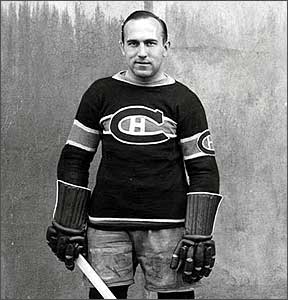
Maybe the legends of the Montréal Canadiens are passed on this way, from father to son and daughter. Maybe this is why I can see in my mind’s eye Howie Morenz rushing up the ice in the late 1920s, when my grandfather was just a lad?
 Matthew Barlow