Happy Failweek!
April 5, 2011 § 4 Comments
My Twitter friend, Emilie Wapnick, one, has a great website, and two, an interesting idea. She wants to celebrate failure.
But I object to the idea that failure is “feedback.” I don’t think so. Failure is failure. Calling it feedback just sounds like some touchy-feely way of making it feel like I never lose, of saving our self-esteem. We all win, we all lose, we all have successes and failures. That’s life. Indeed, Frank Sinatra made exactly that point in song:
That’s life, that’s what all the people say.
You’re riding high in April,
Shot down in May
But I know I’m gonna change that tune,
When I’m back on top, back on top in June.
To call our failures feedback, while an admirable idea in order to get us to learn from our mistakes, is wrong-headed. We need to learn from our failures, but we don’t learn from sugar-coating things, at least in my humble opinion.
But Emilie’s idea goes beyond this:
How about instead of denying the existence of failure (since it’s “all feedback”), we acknowledge that it exists and embrace it. What if we actually PRAISED people for failing? What if success were measured by ACTION rather than results?
I think that if we all took some time to praise failure and even encourage it on a regular basis, there would be much more experimentation, creativity and innovation in the world.
The more we celebrate failure, the more we’ll all be encouraged to take action. So lets do it. Lets take this week and celebrate our most mortifying, horrific, soul-crushing failures!
Alright, so I’m never going to celebrate my mortifying, horrific soul-crushing failures. I don’t think that does anything, I prefer to grieve in private, lick my wounds, and figure out how to go forward.
But I love Emilie’s idea of measuring success by action foremost. Results are important, but sometimes we need to take action even if we’re going to lose, to “fight the good fight,” so to speak. This is part and parcel of the working-class Irish-Catholic culture I come from, immortalised in song by the Dropkick Murphys in their song for “Irish” Micky Ward (who, I must gloat, got his clock cleaned by my hometown boy, the late Arturo Gatti), “The Warrior’s Code”:
Failure works in many ways. It can work in the Mickey Ward sense of not giving up, or in the sense any good activist knows, of fighting the good fight whatever the results. But sometimes success comes from failure, too, as some of the people Emilie talked to on her blog point out. One of my favourite Simpsons moments (yes, there once was a time when that show was funny) comes when Lisa points out to Homer that the Chinese have the same word for crisis and opportunity. Homer, who had been down for some reason or other, immediately brightens up, allegedly recalling the word “crisitunity.” Ok, so we can laugh at Homer’s stupidity, but there’s a point to be made here.
And if we choose not to sink into the doldrums over failure, if we instead celebrate some forms of it, then perhaps we do get what Emilie wants, which is more creativity and experimentation and innovation. I’ve spent a lot of time of late reading about the Scientific Revolution and its aftermath, and one thing that is clear is that the brilliant successes and innovations of the likes of Galileo, Newton, Einstein, and Hawking, is that they are all built on earlier failures. But, in the spirit of scientific experimentation, they had no choice but to carry on. So perhaps we should engage with our inner scientists and take what we can from failure to figure out how to succeed?
So perhaps failure isn’t the evil we’re lead to believe it is, perhaps in failing we can continue to try to make the world a better place and we can learn from our mistakes, or we can recognise that our failures are the keys to our successes.
So, alright, it’s Failweek. The Twitter tag is #failweek. Rock on, my friends, celebrate your failures and figure how to gain from them. If anyone needs me, I’ll be licking my wounds and pondering my comeback.
The Shoe on the Other Foot
August 23, 2010 § Leave a comment
Being Canadian, it sometimes feels like we’re the ones on the short end of the stick in global affairs. We’re the ones the Americans invaded during the War of Independence and again in 1812. During World War I, the British used our troops as cannon fodder in battles like the Somme. We have been colonies of the French and the British. Economically, we’re largely dependent upon the Americans. Our peoples are descendent from the colonised of the world (ok, so is the rest of the Western world). In short, I think Canadians like to see themselves as victims, or at least feel like victims far too often. This is why winning double gold medals in hockey over the Americans at the Olympics is such a big deal. For that moment, we’re the winners.
The once-great Vancouver band, Spirit of the West, wrote a song back in the early 90s called “Far Too Canadian.” It’s a lament for our status as hewers of wood and drawers of water, amongst other things. The lyrics:
I’m so content, to stand in line
Wait and see, pass the time
Talk a streak, fall alseep, wake up late, whine and weep
I kiss the hand that slaps me senseless
I’m so accepting, so defenseless
I am far too Canadian
Far too Canadian
…I am the face of my country
Experssionless and small
Weak at the knees, shaking badly
Can’t straighten up at all
I watch the spine of my country bend and break
I’m a sorry state.
A sobering thought, that song. And all the cheesy, stupid, lame-brained Molson Canadian ads in the world (apparently has more square feet of “awesomeness per person” than any other nation on Earth) can’t change it.
That being said, we do have our moments, our victories, and our glories. But we tend to play those down, too (except when they involve gold medals, hockey, and the Olympics). We’re a modest people, I suppose.
So all of this being said, I’m always surprised to find Canadians on the other side, at least historically-speaking. Not far from Charlemont, Massachusetts, is the town of Deerfield. On 29 February 1704, during the War of Spanish Succession, a joint force of 47 French and Canadian soldiers and 200 Mohawk warriors (including the Pocumtuck, who had lived in what is now the Pioneer Valley before the English settlers arrived) raided Deerfield before dawn. The raid was partly in revenge for the settlers’ violent and callous treatment of the Pocumtuck, which culminated in a massacre in what is now nearby Montague Township in 1676.
The combined French-Canadian-aboriginal force caught the settlers unaware before dawn and massacred 56 people. 109 people survived the raid, they were captured and made to march 500km north to Québec, in harsh winter conditions. 21 of them either died or were killed during the trek. Most of those who made it to Québec were eventually ransomed and made their way back to Deerfield. A few, most notably the pastor’s daughter, Eunice Williams, chose to remain. Williams spent the rest of her life at Kahanwake, a Mohawk settlement near Montréal, marring a Mohawk man and having a family with him.
The Deerfield Raid was no doubt a traumatic event for the people of the small settlement. And it has lived on for the past 300 years, it is a foundational story in the Pioneer Valley of Massachusetts. At times, listening to people describe it, reading newspaper stories about the raid, and seeing how it is represented in the pop culture of the Valley, I even get the sense that the trauma of the raid lives on. Certainly, it is strange for a Canadian to realise the Americans were victims of the colonial era. It is even more bizarre to realise that one’s ancestors were the ones who caused the trauma. We are usucally the victims, not the aggressors of historical trauma.
The fact that the 1704 raid lives on in Deerfield, and is largely forgotten in Québec (as France lost that war), is significant. No doubt it lives on in part because Deerfield’s raison d’être today is as a tourist site. Historic Deerfield is a national historic site, and the town’s economy centres around the historical experience there, and the 1704 raid factors heavily into it. It is no doubt the most significant event to have occurred in Deerfield in its 337 year history. And, as a result of the historicisation of Deerfield, the 1704 raid gets played out, reinterpreted, and re-assessed almost daily by the town’s residents, the historical educators, and the tourists who come to visit.
But for me, a Canadian, the first time I visited Deerfield, on a warm, sunny day in late May 2006, I was stunned to find a place that was traumatised by Canadians, at least a place that was not an aboriginal settlement/reserve. And as I took in the colonial American scene in front of me that day, I couldn’t help but feel a shudder of fear imagining that 247-man strong force crawling across the plain along the Deerfield River, coming out of the mist and the snow and laying siege to a small frontier settlement. And every time since that I have driven past, or been into Historic Deerfield, I cannot shake that feeling of terror that the colonist there must’ve felt that cold February morning 306 1/2 years ago.
Vive le Canada!
June 30, 2010 § 1 Comment
Tomorrow, Canada Day, I will be on CJSW radio in Calgary, as part of their new series, “Today in Canadian History“, where I will be talking about the process of Canadian independence between 1848 and 1982. Details below:
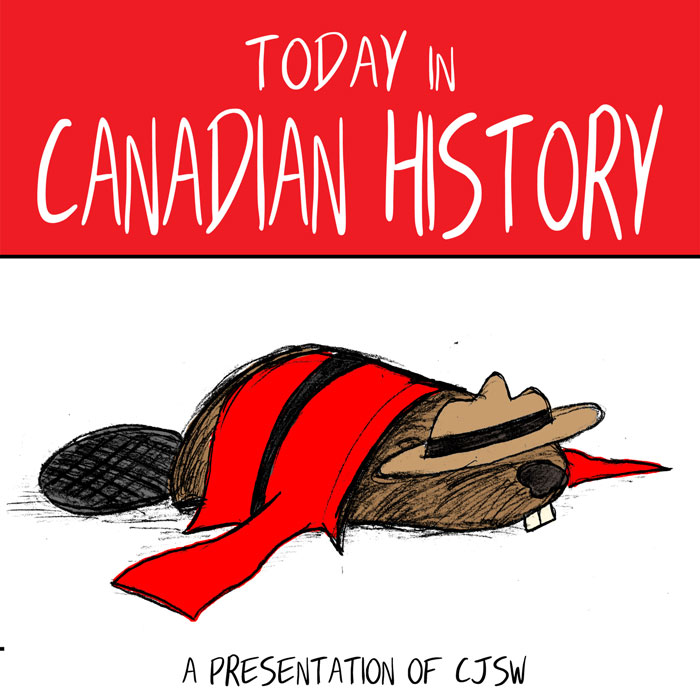
Today in Canadian History launches on Canada Day of 2010. Each episode of the series contains an interview with a Canadian professor, journalist, author, or “everyday” historian and focuses on a unique event or moment that took place on that day in Canadian history. To date, the series has received contributions from over sixty individuals from across Canada.
As a podcast and radio series, Today in Canadian History presents Canada’s past in a unique and accessible manner. The series is designed to be a first step to learning more about our past. We would like to remind Canadians not just about what makes our country great, but what makes it complicated, beautiful, diverse, and ours.
How Can I Listen?
Starting on Canada Day, CJSW will be making the audio available on a variety of platforms. You can listen to the episodes:
- Every weekday morning on CJSW 90.9 FM in Calgary and cjsw.com!
- On this webpage (audio will be posted every weekday)
- On our Facebook page (search, “Today in Canadian History”)
- As a podcast (series will be posted in iTunes on Canada Day)
The series is produced by Joe Burima and Marc Affeld. Local jazz musicians Simon Fisk, Steve Fletcher, and Jon May provided original music for the series. Original artwork was provided by Reid Blakley.
____________
For more information, or to get involved in the series, contact Joe Burima at (403) 220 8033, or todayincanadianhistory@cjsw.com
Canada and Its Inferiority Complex
October 6, 2009 § 8 Comments
Last week, I published a review of Canadian journalist John Lorinc’s new book, Cities: A Groundwork Guide, over at the Complex Terrain Laboratory. As much as I liked and enjoyed this book, I found myself wondering, though, as I read this book, was what is with Canadians’, or maybe just Torontonians’, obsession with Toronto?
Toronto is mentioned more than any other city in the world in Lorinc’s book. More than London, Hong Kong, Sao Paolo; more than Nairobi, and New York. Toronto is mentioned more than twice as often as Canada’s other 2 major cities: Montréal and Vancouver. Moreover, Montréal is usually, though not exclusively, mentioned in a negative light. Not Toronto.
We are a nation with an inferiority complex, that I can accept. Toronto’s wiki page, though, is kind of sad, as it has to point out that: “As Canada’s economic capital, Toronto is considered a global city and is one of the top financial centres in the world.” It is indeed a top financial centre in the world, somewhere around 20th. Great. Who cares, really.
Why can’t we just stand on our own merits and not have to defensively point out that we can play with the big boys? I liked Canada more when we were an unassuming nation, proud to be what we are, but not a neighbourhood bully or the whiny little brother of the USA. This inferiority complex is getting out of hand.
And whilst Lorinc, on the one hand, is showcasing Toronto for the domestic audience, it is kind of sad that it has to come at the expense of Montréal and Vancouver, and that Toronto is mentioned more often than any other city in the entire world. Years ago, the Vancouver band, Spirit of the West, wrote a song about this, called “Far Too Canadian;” times have changed, though, we are no longer content to be the unassuming, quiet Canadians. Now we’re becoming a bunch of loudmouths. I like the old way better.
 Matthew Barlow