Old Hawley Town Commons
October 13, 2010 § 11 Comments
Driving through the hills of Western Massachusetts this past long weekend, we came across the old Town Commons of Hawley. Hawley today is a town that is home to fewer than 400 people and has no real centre to it. Aside from a Highways Department, there’s not much evidence of an infrastructure in Hawley, though there is also a Town Hall. There is no post office or schools in Hawley, nor is there, to my knowledge a church. There is one corner store, though, but no gas stations. For services, the people of Hawley tend to travel to neighbouring towns, in particular, Charlemont.

Hawley Town hall
But Hawley has a history. Pioneers from nearby Hatfield made their way up the mountains and into Hawley. It was incorporated as a town in the Commonwealth of Massachusetts in 1792. From then until the mid-19th century, Hawley was a centre of the forestry industry, as well as several smaller businesses, like the usual: blacksmiths, taverns, etc. There was once an old town commons on what is today called East Hawley Road.
Today, the old Town Commons is the parking lot for a series of trails that explores the bog and lakes around the area. There is also an information kiosk about the old town commons, including a plan of what used to be there.
Now, it’s not like North America is a place without history, though sometimes it’s as though Europeans seem to think it is. The aboriginals have been here for thousands of years, and there are remnants and ruins of their cultures littered across the continent. The Spanish have been in Mexico since the early 16th century. The French have been in Canada since the early 17th century, around the same time the Dutch and the English landed in what is now the United States. And those European colonies conquered, colonised, and displaced the aboriginal populations as they expanded across the continent. So none of this is news, but my point is that there is evidence of earlier settlements and cultures across the continent.
Out west, there are ghost towns. These places were once booming frontier towns whose time has come and gone. The most recent spate of ghost towns date from the 80s and 90s, as frontier industry dried up and hit hard times. Sometimes, the ghost towns aren’t on the frontiers. As a teenager, I lived in Port Moody, BC, which itself had annexed and old Imperial Oil Company town, cleverly called Ioco (get it, Imperial Oil Co.?). By the time I lived there in the early 90s, the town had long since been abandoned, the oil refinery on its last legs (it’s since been closed).

Lawn Bowling in Ioco, c. 1920
In the eastern part of the continent, ghost towns are rarer, but if you find yourself in the countryside, there are abandoned farmhouses and homesteads. In the swamps of Eastern Ontario between Kingston and Ottawa, near the Rideau Canal, one sees countless abandoned homesteads from the windows of the train. This was marginal land, settled in the 19th century and then abandoned and farm kids moved into the industrial towns and cities that dot the landscape of eastern Ontario. In Western Massachusetts, the area around Hawley is littered with decaying stone fences that once marked of homesteads from each other. Now they appear as seemingly random markers in the woods.
But to see visual evidence of a settlement that no longer exists is something else. I found it slightly strange to be standing on a site that 150 years ago was home to taverns, churches, shops, and the like. More people lived in Hawley in those days, of course, and travel to the neighbouring towns wasn’t as easy as it is today. The roads of Western Mass are narrow and windy as they go up and down the hills, around corners, avoiding private property, mountains, hills, lakes, creeks, and rivers.

Drawing of Old Town Commons, Hawley, MA
But once there were people in Hawley, and there was a common. And that’s where they conducted their business, got married, had their children baptised, got drunk, fought, and came together as a community. It was rather eery to stand in that same place on a sunny Sunday 150 years later, contemplating whether or not the bog would be a good place to walk the dog, and pondering the Volkswagen, Subaru, and Volvo station wagons that brought the yuppies from Boston, New York, Northampton (and, of course, Montréal) to the trails that lead out from the Old Town Common of Hawley. The land today is owned by the 5 Colleges of the Pioneer Valley of Western Massachusetts. And they’re the ones who’ve put the effort into at least re-creating the plan of the Old Commons and they take care of the bog and the trails.
New Adventures in the Arts, or, Art, History, and “Authenticity”
September 3, 2010 § 1 Comment
Yesterday I met with a stage and set designer for a new play being produced at the Hudson Village Theatre in Hudson, QC (just off the Island of Montréal), opening Thursday, 28 October, entitled Wake of the Bones, written Montréal playwright David Gow. Wake of the Bones centres around the discovery of a mass grave of Famine victims on Pointe-Saint-Charles in Montréal by Irish labourers constructing the Victoria Bridge a decade later. The labourers were from Griffintown, at least in this version, and they decide that a wake needs to be held to send the dead souls off to their eternal paradise.
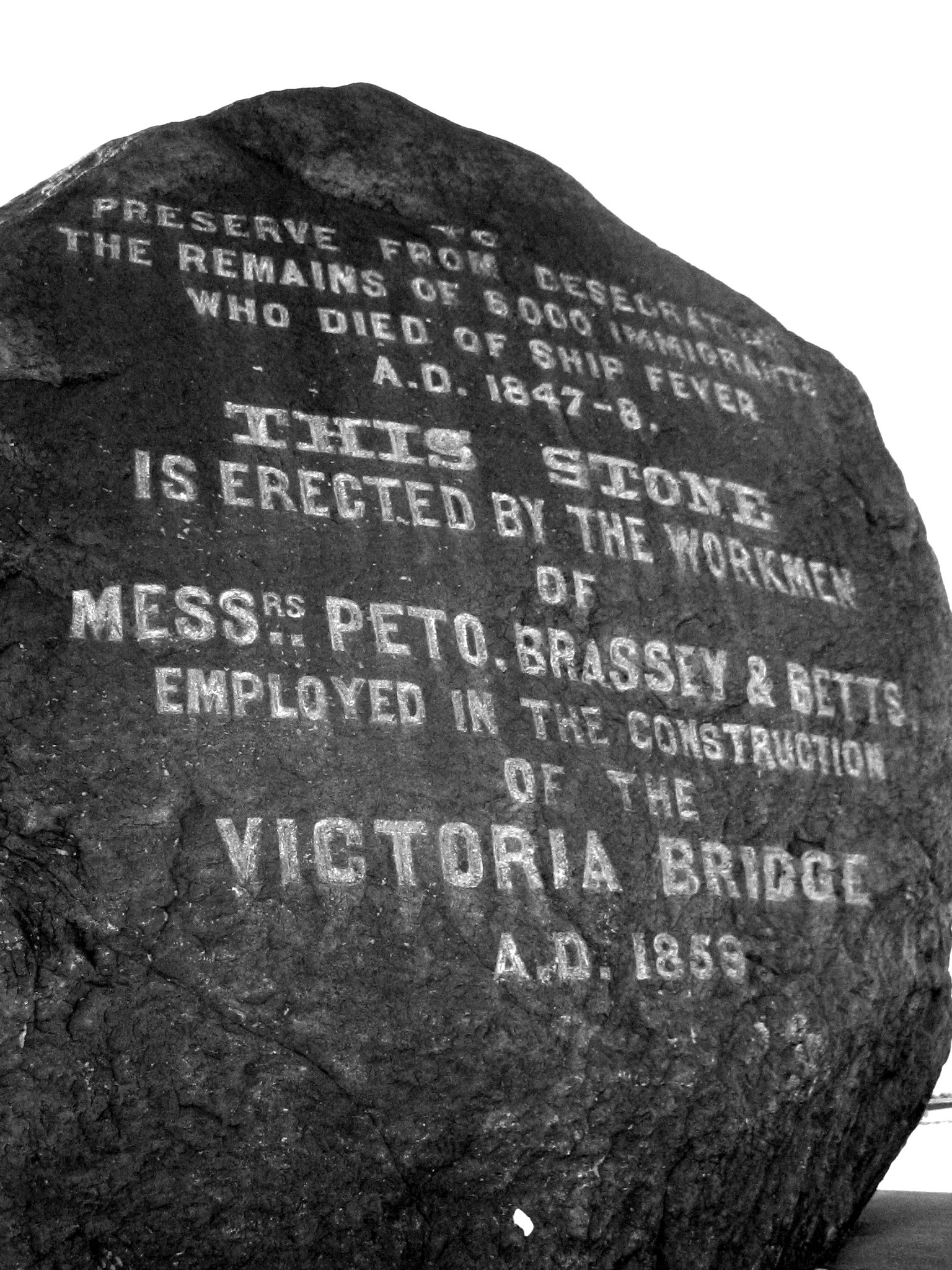
The Black Rock, erected in the memory of the mass grave. Today it's located on Bridge St. in Pointe-Saint-Charles, on the approach to the Victoria Bridge
The designer, Anouk Louten, contacted me as she attempts to get a handle on Irish culture and life in Griffintown in the mid-19th century, attempting to re-create a set as authentic as possible.
This, of course, got me thinking about the usual intersection of history, memory, and the public. Because of course Gow is taking licence from the historical record for the purpose of creating art. It is true that the mass grave of Irish Famine victims was found by the bridge workers, who were also Irish. But the workers probably lived in Goose Village, not Griffintown. A minor quibble with the historical record, to be sure, but still one that those who argue for ‘authenticity’ get their knickers in a twist over. And, I’m sure Gow will also take artistic licence with the characters, their setting, and so on and so forth.
This week, in class, I was teaching the Persian Wars, including the legendary battle at Thermopylae in 480 BCE. Of course, pretty much the entire Western world has seen the movie, 300, which fictionalises what actually happened at Thermopylae some 2,490 years ago. The movie over-dramatises the valour of the Spartans, distorts and obscures the rationale for battle decisions made by the Greeks (including the Spartans, who are conveniently left out of the decision to withdraw 6,700 Greek troops from Thermopylae to avoid being caught in a pincer movement by the Persians), leaving the brave Leonidas and his 299 Spartan warriors to hold off the Persians. As much as I love this film, I always find myself somewhat troubled by it, I kind of feel the film-makers made like the cops in the OJ Simpson case with the glove. Recall that the glove didn’t fit Simpson, who more than likely got away with murder at that trial. At the time, a friend of mine, a law student, opined that the cops may’ve planted the glove, so desperate they were to secure a conviction. If this is true (and really, who knows?), the over-zealousness of the cops allowed Simpson to walk (though, as they say, karma is a mother, and Simpson is in the slammer for other crimes right now). In the case of 300, the film-makers took an already dramatic story about Leonidas and his warriors and over-shot, they over-dramatised something which could’ve stood on its own.
So, as an historian, films like 300 bother me. Not because they take licence with the historical story, but because they pull an Oliver Stone. Stone, of course, once said that you had to hit American film audiences over the head with a mallet in order to get their attention. I think he’s wrong, people aren’t that stupid. But sometimes it makes great art, sometimes, most of the time, it’s just superfluous.
But artistic licence, I fail to see what’s wrong with that, it can make the story more interesting, it can allow the artist to make their point more effectively.
As for authenticity, I’m not sure it matters so much in the larger sense. Certainly, I like Anouk’s attempts to create an authentic set. That, for whatever reason, matters to me. The setting of historical novels, plays, films, this is the detail, the background of people’s lives. Take, for example, The Gangs of New York: a wildly fictional account of the goings-on in the Five Points of Manhattan in the early 1860s. The story itself may be a load of bollocks, but the setting of it in the Five Points, from what I can see, that’s authentic, that reflects the reality of life in what was probably the worst slum in the world.
But authenticity of story or experience (in the case of museums, etc.), I’m not so sure this is desirable or even possible. I think it is impossible to completely re-create the ‘authentic’ historical experience. For one, there’s the obvious problem: it’s impossible, because it is no longer 1861, or whenever. The physical setting is just that, a re-creation of the historical, it can be an authentic re-creation, but that’s as far as it goes. And I think that by itself is a laudable goal, but that should be the end goal. There is no need to go any further, because it is impossible to go any further.
And, so far as I’m concerned, if the story is based in this historical record, that it aims to reflect the setting, then that’s fine. Artistic licence needs to be taken, at least most of the time, maybe not so much in the case of Leonidas’ last stand.
Ruminations on the Wisdom of Don DeLillo & the Ruins of Griffintown
May 23, 2010 § 1 Comment
It’s no secret that Don DeLillo is one of my favourite novelists. His novels have a tendency to strike me on several levels, perhaps because the narrative is usually fragmentary and on several levels. And whilst his dialogue is predictable in many ways, based on particular idioms of New York City English, it’s the way DeLillo constructs sentences and thoughts that always leave me digesting his work long after I’ve read, or re-read, it. I oftentimes lose patience with people who say things like “I don’t have time to read fiction” or “I can’t remember the last time I read a novel.” To me, this shows a fundamentally closed mind; novels percolate with ideas, philosophy, and ways of being in the world. Novels allow us to personalise events and history, to re-consider moments in time, to re-consider our own ways of thinking, our own narratives.
Certainly this is true with DeLillo’s novel, Falling Man, about the aftermath of 9/11 in New York City. This is not just a rumination on 9/11, indeed, the terrorist attack is a motif to explore post-modern family life in New York. But it doesn’t have to be New York, and it doesn’t necessarily have to be post-9/11, either. But the novel would lack the punch if it was set in Winnipeg in 1986.
Anyway, the reason I’m writing this is to give thought to the on-going argument between Nina, the mother of the novel’s main female character, Lianne, and Nina’s lover, Martin. Martin, however, isn’t really Martin, he’s a former terrorist himself, named Ernst Hechinger. Nina and Martin/Ernst argue throughout the book, in the presence of Lianne, over the nature of terrorism and the attack on New York. Nina’s argument is hued by the fact that she is a Manhattanite. Martin/Ernst is German. She lacks the critical distance to see the attacks, he lacks the intimacy with Manhattan. Throughout the argument, which is fierce and scares Lianne, they consider God and the motives of the attackers. Nina sees fear on the part of the terrorists, Martin/Ernst sees history and politics.
Nina has just had knee surgery (and is developing a reliance upon painkillers) in the time after the attacks. Indeed, Lianne is stricken at how her mother, in the wake of the surgery, has embraced her old age. This worries Martin somewhat. He wants her to travel again, to go out and see the world, to revitalise herself in the wake of the surgery and the attacks. She is somewhat more reluctant.
Martin: Travel, yes, it’s a thing you ought to consider. Get your knee back to normal and we’ll go. Quite seriously.
Nina: Far away.
Martin: Far away.
Nina: Ruins.
Martin: Ruins.
Nina: We have our own ruins. But I don’t think I want to see them.”
Martin: But that’s why you built the towers, isn’t it? Weren’t the towers built as fantasies of wealth and power that would one day become fantasies of destruction? You build a thing like that so you can see it come down. The provocation is obvious. What other reason would there be to go so high and then to double it, do it twice? It’s a fantasy, so why not do it twice? You are saying, Here it is, bring it down.
I love this passage, not so much for what it says about NYC and 9/11, but for what it says for cities in general. Ruins are all around us on the urban landscape (or the rural one, for that matter, abandoned homesteads, for example). Ruins tell us the story of what was once here, how we got here, how we might have otherwise been. Ruins tell us powerful stories about destruction, that is true, as Martin is noting. But they also tell us powerful stories about ways of being that have been lost. The ruins of Griffintown are a prime example.
The ruins of the neighbourhood are there for all to see. In Parc St. Anns/Griffintown, on the former site of St. Ann’s Church, the remaining ruins of the church itself, its foundation, as well as foundation stones of the presbytery, the girls’ school, and the dormitory for the crusading priests who came through the Griff on their way to other parts of the world, are all there. There are ruins of factories and warehouses throughout the neighbourhood. Ruins of tenement flats. Palimpsests of advertising for consumer products that are long gone.

Parc St. Ann's/Griffintown
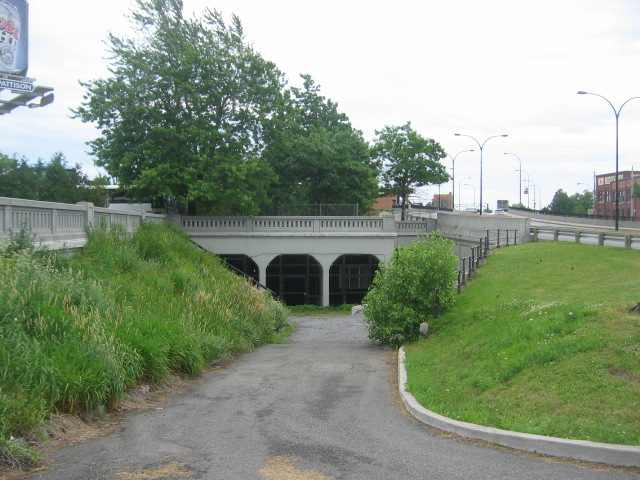
Wellington Tunnel
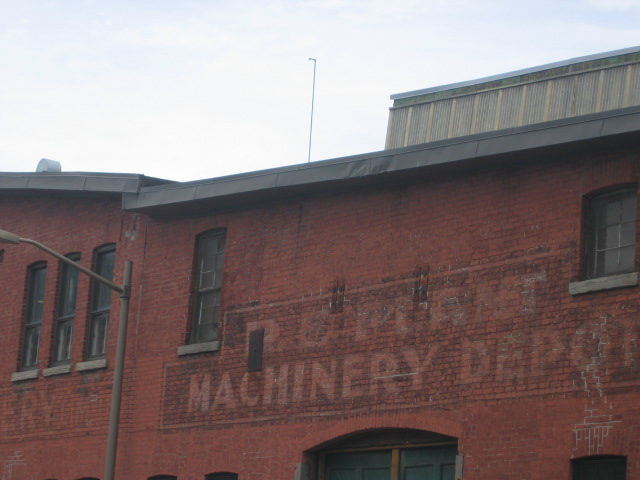
Griffintown Palimpsest
We see this life as it used to be. We consider what once was. How people moved out of Griffintown because of its proximity to all these factories, train yards, and the like. How the flats were cramped and cold, lacking in modern amenities like hot water. Or yards. The neighbourhood, when I began studying it a decade ago, always reminded me of the Talking Heads’ song, “Nothing but Flowers.” Here was the site of the beginnings of the Canadian Industrial Revolution in the 1830s, reclaimed in large part by nature. An inner city neighbourhood sprouting leaves and trees. And grass growing through fractured concrete. Trees growing out of windows of derelict, decrepit buildings. Their floors reclaimed by nature.
The ruins of Griffintown also speak to this power that Martin refers to in the novel. This was a locus of power for Canada, for the British Empire and Commonwealth. Not just the products manufactured there, but the working classes trudging along to work, filling out the army in World Wars I and II. The hulking CN viaduct, not technically a ruin yet, but something close to it, speaks to a time when the railway was king. Indeed, it was built to separate the railway from the roads.
Anyway. DeLillo’s got me thinking about the meanings of the ruins of Griffintown. And what they mean, to the old Irish community that once lived there, to the urban landscape of Montréal today, and to plans to re-develop the neighbourhood in the future.
Urban Archaeology & Material Culture
April 21, 2010 § 1 Comment
Recently, I’ve been thinking about urban archaeology and material culture. Given my research interests, I suppose it’s only natural that I would also think about the actual physical landscape of the city and how it shifts and changes with time, populations, and construction.
Years ago, I visited Montréal’s Pointe-à-Callière Museum, in the Vieux-Port. Point-à-Callière is the site of the first settlement of Ville-Marie, where Paul de Chomedy, Sieur de Maisonneuve decided to plant his new settlement in 1642. The museum itself is based around 3 archaeological digs (Pointe-à-Callière iteslf, as well as Place Royale and Place D’Youville), and artefacts from these archaeological digs are on display. But it’s not just that. In the underground of the museum, down where the digs took place, one can physically see the layers of city and settlement on Pointe-à-Callière, from the initial aboriginal inhabitants through the founding of Ville-Marie, to the governor’s mansion that was once located there, through urbanisation, industrialisation, and so on. The physical remnants of the buildings, and artefacts are there for the viewer to see.
My favourite part is the William sewer, which canalised, and placed underground, the Rivière Petite Saint-Pierre, which itself had become a stinking cesspool as it flowed above ground through what was once the Nazareth Fief (and later Griffintown), into the St. Lawrence, hence creating Pointe-à-Callière. Apparently (at least according to its entry on Wikipedia), the museum has plans to open up and expose the Petite Saint-Pierre, as well as the old location of St. Ann’s Market in Place D’Youville, as well as the remains of the Parliament House of the United Province of Canada, which was burned down in the Rebellion Losses Bill Riot in 1849 (just imagine a riot today in a democracy burning down the house of parliament!).
Anyway, this is where I first thought about urban archaeology, but I never really gave it much more thought in terms of my academic interests until a couple of summers ago, whilst walking along the Canal Lachine, where, at the St. Gabriel locks, Parks Canada has dug up the foundations and remnants of a factory on the northeastern side of the locks.
Andy Riga, over at The Gazette, has an interesting blog, “Metropolitan News;” his latest post is about the public toilets, disused and buried under Place D’Armes. During the reign of Mayor Camillien Houde in the 1930s, partly as a public works project, Vespesiennes were built in Carré Saint-Louis, Square Cabot, amongst other places, and public washrooms were constructed in places including Place D’Armes. The washrooms there were shuttered in 1980, victim of many things, including Montréal’s notoriously crumbling infrastructure. Since then, there have been a few plans or attempts at plans to revive the public toilets, but they are in serious decay and would cost too much money to renovate them, due to years of neglect, water damage, and humidity. So they remain buried under Place D’Armes which, like Dorchester Square downtown, is undergoing a massive renovation.
So notions of what’s underfoot have long interested me as I’ve wandered about the city, but especially in the sud-ouest, Griffintown and Pointe-Saint-Charles, as well as Saint-Henri, where I’ve lived for most of the past decade.
Also, too, there is the influence of Prof. Rhona Richman Kenneally of Concordia University, who encouraged me to give some thought to material culture in approaching my dissertation and my work on Griffintown. Ultimately, as interesting and exciting as I found approaches to material culture in my studies, there was no way to fit it into the dissertation (the same can be said of proper mapping of the Griff). But I remained intrigued by these ideas.
So, with all of this in mind, I finally got my hands on Stephen A. Brighton’s Historical Archaeology of the Irish Diaspora, based around digs in the Five Points of Manhattan and in Newark, New Jersey. Using the archaeological evidence, Brighton constructs an argument centred on the material culture of 19th century Irish-American life in these two urban centres. Using this methodology, Brighton is able to answer a lot of questions we cannot answer using more traditional historical methodologies. Brighton has the remnants of the material culture of the Irish immigrants and Irish-Americans. Finding glasswares with symbols of Irish nationalism on them suggests that the movement had some traction amongst the tenement dwellers of the Five Points.
My favourite part of his analysis, though, comes in relation to medicine. The artefacts from the Five Points come from the 1850s and 60s, whereas those in the New Jersey digs are from the 1880s. In other words, the Five Points Irish were more recent arrivals and lived in greater poverty than those in New Jersey. Thus, their access to the nascent public health system was different than that of their compatriots in Jersey. Brighton found that the Five Points Irish relied more on cure-alls and pseudo-medical tonics to cure what ailed them. Throughout the dig site are bottles that once contained tonics and cures, whereas in New Jersey, the digs uncovered evidence of reputable medicines. This, concludes Brighton, is symptomatic of that poverty but also, too, perhaps of the alienation of mid-19th century Irish immigrants from the mainstream of American culture and society (remember, the 1850s also saw the Know-Nothing movement in the USA and the Bowery B’hoys Riot of 1857).
So what Brighton offers up here is a piece of evidence to support what historians already know from more traditional sources. And this brings me to my problem with Brighton’s book: it doesn’t add much in the way of new information to our historical knowledge. Rather than challenge historians’ traditional takes on the Irish in the Five Points (especially), Brighton confirms what we already knew with the archaeological evidence.
Canada and Russia: Stereotypes Inverted
April 10, 2010 § Leave a comment
Growing up in Canada in the 1980s, the Cold War was kind of an abstract concept. Sure, we had the occasional drill to learn what to do in case of nuclear attack, but the larger context of the Cold War was missing. Except when it came to hockey. That was the Cold War here. It began in 1972, Canada and the Soviets played an 8-game Summit Series of hockey, 4 games in Canada, then 4 games in Russia. Canadians thought it would be a cakewalk. After Game 4 in Vancouver, Canada was booed off the ice after losing 5-3. Heading to the USSR, Canada was trailing 2 games to 1 in the series (the 4th game had been a tie). Team Canada’s Phil Esposito reacted to the booing in Vancouver in a post-game interview:

Canada came back to win the series, scoring at the last minute in Moscow. Legends were built around this series, and, in part, around Esposito’s rant. As Canada and the Soviet Union met up in international play throughout the 70s and 80s, a stereotype emerged of both nations, based on their hockey players. Canada, we were the good guys, the passionate hockey players, who’d do anything to win. The Soviets, they were the heartless commies, mechanistic and humourless. The international series went back and forth. Even club teams got into it. Apparently the greatest hockey game of all-time was played on New Year’s Eve, 1975, at the Montréal Forum, as the Montréal Canadiens played Central Red Army to a 3-3 draw.
So, given these stereotypes, I had to laugh this afternoon reading the local Montréal English-language newspaper, The Gazette. Canada’s Minister of Foreign Affairs, Lawrence Cannon, is in the Arctic this week, having just touched down in Resolute Bay, Nunavut, to inspect the activities of Canadians working on proving Canada’s claims to the Arctic Archipelago before the 2013 deadline. Cannon was impressed with their work, but not so impressed with the actions of the Russians.
The Russians are planning a few maneouvres in the Arctic, including dropping two paratroopers onto the North Pole to belatedly commemorate the 60th anniversary of a similar exercise in 1949. Said Cannon:
It was interesting . . . to see our Canadians working extremely hard to collect the data, to be able to make sure that we do submit to the commission by 2013 the extended mapping and our scientific data. On the other hand, we have the Russians playing games as to who can plant a flag or who can send paratroopers there. I thought the contrast was striking. We take our job seriously, and it seemed to me that the Russians were just pulling stunts.
New Project: Current Intelligence
March 11, 2010 § Leave a comment
The Complex Terrain Laboratory is being retired. Mike, Eric, et tout le gang from the Lab, have begun a new project, called Current Intelligence:
is a journal of opinion and analysis. Its editors and writers are preoccupied broadly with culture, politics and current affairs; narrowly with conflict,crisis, and the state of the world “out there”; and laterally with the intellectual concerns of those who research, teach, and write about the issues.
We went live on Monday, 8 March, and we will publish daily, Monday-Friday, with a quarterly print journal as well. Current Intelligence comes with its own set of sections:
- The Editor’s Desk: daily must-reads
- The Agenda: informed comment on headline issues
- The Big Smoke: reporting on London’s wealth of current affairs talk (starting in May, 2010)
- The Quiet American: analysis of foreign policy, military intervention, human rights & humanitarian affairs
- Letters From Abroad: dispatches from field researchers, expats and other travelers
We can even be found on Twitter.
So, come on over, grab a coffee and read what we’ve got to say. As for me, I’ll continue to offer my own particular position on issues that require a deeper, historical, long-view of understanding.
Modernist Architectural Behemothology
March 11, 2010 § 6 Comments
Years ago, I lived in Vancouver, perhaps once the greatest example of Modernist architecture in Canada, if not North America. Vancouver is the city that unleashed architect Arthur Erickson on the world. Sadly, Erickson died last spring. Yet, Erickson’s buildings live on in Vancouver, especially his modernist designs, most notably Simon Fraser University in suburban Vancouver (where I completed my MA), and the Canadian Embassy in DC.
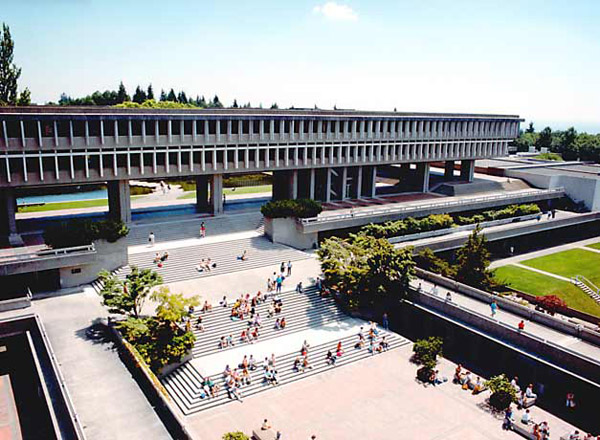

Indeed, one of my favourite architecture books is Rhodri Windsor Liscombe’s The New Spirit: Modern Architecture in Vancouver, 1939-1963. Modernist buildings haven’t really stood the test of time, I have to say, especially those designed to look like concrete bunkers, such as the Canadian Embassy. SFU is one of the most depressing places in the world on a cloudy, rainy day atop Burnaby Mountain. Unfortunately, it is often rainy and cloudy atop Burnaby Mountain. University campuses across North America are dotted with modernist buildings, as the great boom of construction on these campuses came at the height of modernism in the post-War era. In many instances, modernist behemoths look as if they were dropped into more classical settings, such is the case of Student Center Building at the University of Masscachusetts, Amherst. In the picture below, you can see those older, classic buildings scattered around the Student Center and the residence towers behind it.

So pervasive is modernist architecture on campuses that it is oftentimes pejoratively referred to as “Neo-Brutalist” architecture. Indeed, buildings such as the Student Center, or the entire Burnaby Mountain campus of SFU, re-enforce this. The buildings are concrete, massive, and imposing. Inside, there is a lot of dark browns, dark woods, and black. Gloomy is about the only way to describe these interiors.
Long and short, the term “Neo-Brutalist” quite often fits, not that there aren’t some beautiful modernist buildings to be found, such as Vancouver’s old BC Hydro Building, which has since been condofied, or MOntréal’s Palais de Congrès.


But, despite this, I can’t help but chuckle when I read stories like this one in the Globe & Mail yesterday, about the Public Safety Building in Winnipeg.

This particular behemoth, built in 1966, is a textbook case of Neo-Brutalist Behemothology. Frequently the several hundred employees of the Winnipeg Police Force are required to vacate the building because of noxious fumes that waft up into the building. This happens frequently, apparently. This time it required the Hazmat to come. The PSB is built out of
brittle Tyndall limestone, hasn’t held up against Winnipeg’s climate. Dozens of steel brackets cling to the building’s exterior like Band-Aids, preventing the facade from avalanching into the street. A $98,000 awning encircles the building, stopping pieces of the gaudy structure from braining pedestrians.
And this is the crux of the problem with many Neo-Brutalist behemoths, from SFU to Montréal’s legendary Stade Olympique, known in English as the “Big O”, or more fittingly, the “Big Owe,” as it took 30 years for the city to pay off its legacy from the 1976 Summer Olympics, by which time the Expos had decamped for Washington and the Alouettes had been re-born in McGill University’s quaint Molson Stadium at the foot of Mont-Royal. But the Big Owe and the PSB, and SFU, for that matter, all have something in common. The materials used to build them aren’t all that well-suited to the climate they are in. Hence, the PSB is falling apart, the Big O has had large slabs of concrete fall off it, and SFU, well, that much concrete in a rain forest isn’t the best idea, either.

But the bigger question is what to do with these buildings, especially those that are falling apart or being abandoned, as is the case with the PSB. Urban preservationists in Winnipeg argue that the PSB is worth saving,
According to University of Winnipeg Art Historian, Serena Keshavjee,
It’s not a love-hate relationship people have with these buildings; it’s just hate. People grew up with these buildings and don’t see them as heritage buildings, but the same thing happened 40 years ago with Victoria structures.
Had we ripped out every Victorian building in the country we would be very sorry these days,” she said. “And these are the times when they become vulnerable. The country is coming out of recession and people are gearing up to tear things down.
UW historian David Burley echoes, arguing that modernism
reflects a time when the federal government lavished money on public projects and Canadian pride soared ahead of Expo 67 and the centennial. “It was a nationwide movement,” he said. “There was this great optimism. The central parts of cities had deteriorated and there was a sense it was time to redevelop things.”
Personally, I’m not so sure that a modernist building is worth saving just because of its own merits. A building like the PSB is an ugly imposition on the urban landscape. Buildings like it seem to mock their landscapes, they don’t fit in, they crush them, they impose upon them. They belittle us. Of course, granted, that’s the point with a police station, or at least it was in the 1960s. But that doesn’t mean a building should be saved just because it’s old. Sometimes, old things are just junk. And the PSB is an example of that.
Nuit Blanche à Griffintown
February 20, 2010 § Leave a comment
This Saturday, 27 February, is Nuit Blanche in Montréal, and there will be an event in Griffintown to celebrate. Organised by Le Comité pour le sain rédeveloppement de Griffintown, spearheaded by Judith Bauer, the event will be taking place at the site of the New City Gas Works, owned by Harvey Lev, located at 140 and 143, rue Ann.
There’s a whole bevy of cultural events on deck, including talks about the history of the neighbourhood, poetry readings, live music, artwork, and all kinds of other fun stuff. The website is here.
Also of note is that the Griffintown Horse Palace Foundation will have a table there to sign people up for membership and to raise funds for our ultimate goal, to buy and convert the Griffintown Horse Palace into a museum.
An Episode in the Life of a Diasporic City
February 5, 2010 § Leave a comment
Montréal is a city of literature. It has been the home of many great novelists, both of Canadian and international reknown. It is also a city that has been the setting of many novels, bestsellers at home and abroad. For years, I lived in the neighbourhood that was the setting of Gabrielle Roy’s Bonheur d’occasion, Saint-Henri. Prior to that, I called Duddy Kravitz’s Mile End home. Presently, I call the setting of Balconville home. The Plateau-Mont-Royal has been immortalised by the likes of Michel Tremblay, Mordecai Richler, and Rawi Hage. One of the best academic reads of recent years was Sherry Simon’s Translating Montreal: Episodes in the Life of a Divided City. Simon explores the cultural and social history of her Montréal through the literature, in both official languages, that depict the city’s multicultural landscape and lived experience.
Montréal’s literary authors, to say nothing of Simon herself, have projected and reflected the experience of immigrant groups and their diasporas through their works. It was from Richler’s works that I learned so much of the Jewish experience of Montréal, that I came to understand the city as a Jewish one. Indeed, Richler was instrumental in re-casting Montréal as something more than just a bifurcated locale, a city caught between French and English, in that he inserted the city’s Jews into the dialogue, his writing maturing with the city throughout the 2nd half of the 20th century.
Today, however, in trying to find a bowl of matzoh ball soup, I was kind of stunned by just how much Richler’s Montréal has changed. As I wandered through the city’s downtown core, both searching for the soup and running a handful of other errands, I got to thinking about not just how diasporas inform and reflect off each other, but also how diasporas evolve, shift, and replace one another. This was especially true, I thought, in a 5-block section of downtown just west of Concordia’s downtown campus. In this stretch, there are, amongst other things, a German restaurant that has been there for most of my life, as well as newer Russian, Indian, Iranian, Lebanese, Irish, Armenian, Mexican, Central American, Chinese, and Thai restaurants. And not a single place that served matzoh ball soup. During Richler’s years studying at Sir George Williams University, one of the founding institutions of Con U, I’m sure matzoh ball soup could be found in the vicinity of the campus. Of course, one would not have found the plethora of “ethnic” food (the term is in quotations because it is such an unsatisfactory one to use in this instance).
This is neither a lament nor a complaint, I eventually found the matzoh ball soup at Dunn’s, an old Jewish deli, on Metcalfe. It just is what it is, an episode in the life of multicultural, diasporic city.
Transit-City
January 4, 2010 § Leave a comment
I just came across this blog, an appendage of the Transit City site. It’s a kind of French-language version of Geoff Manaugh’s BLDGBLOG, run by a chap named François Bellanger, a Parisian sociologist. OK, I must admit, M. Bellanger has entered my consciousness because he has made use of my review of Chip Jacob & William Kelly’s Smogtown: The Lung-Burning History of Pollution in Los Angeles in a post of his own. Tune in later, once I get a chance to read and digest more of Transit City, I’m sure it will become a mainstay.
 Matthew Barlow