Dear Boston: Reflecting on the Marathon Memorial at the Boston Public Library
March 7, 2014 § Leave a comment
Back in July, when the insta-memorial for the Boston Bombing of 15 April 2013 was taken down, I wrote this piece at the National Council of Public History’s history@work blog. In it, I expressed my cynicism of what happens to the items of the memorial when they are removed from the site and put in storage, or even brought out again for a more permanent exhibition. I also argued in favour of insta-memorials such as this, seeing some value in our hyper-mediated lives, watching the world through the screens of our iPhones. What resulted, from the piece on history@work, as a notification here on this site, as well as Rainy Tisdale’s blog, was a rather robust discussion, especially between myself and Rainy, a Boston-based independent curator about authenticity and memorials.
 To sum up the discussion, we debated whether or not Boston needed an exhibition on the first anniversary of the attack. I argued that the running of the 118th Boston Marathon, as well as the traditional Boston Red Sox game at Fenway Park, would serve as a chance for Bostonians to reclaim Boylston Street and Copley Square one year later. Rainy, on the other hand, argued that an exhibition was necessary in order to prevent the kind of frenzy that began to emerge surrounding the #BostonStrong rallying cry when the Bruins went to the Stanley Cup Finals last spring (and lost. I hate the Bruins).
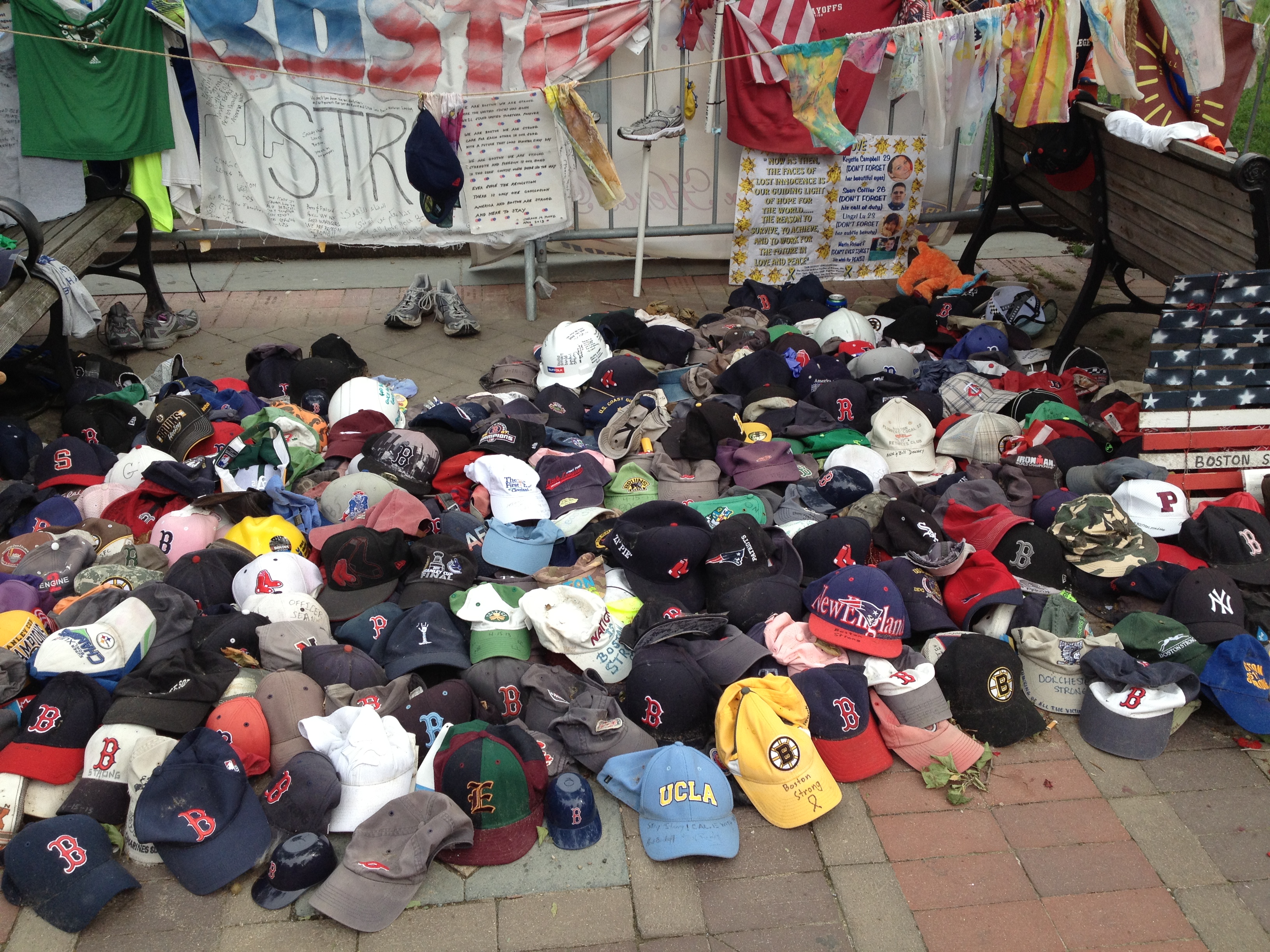 In the time since, I have come around more to Rainy’s argument than my own, though I still worry about questions of authenticity and memorial mediation on the part of the curatorial hand (though, of course, that spontaneous memorial, first on Boylston Street and then at Copley Square was also curated, in part). Nevertheless, I am very much looking forward to Rainy’s exhibit at the main branch of the Boston Public Library on Copley Square. Dear Boston: Messages from the Marathon Memorial opens on 7 April, and will run to 11 May. It is a tri-partite exhibit: the first part will encompass the immediate responses to the bombing, the second will be people’s reflections on the bombs, and the final part will be the hopeful part, messages of hope and healing.
 I appreciate the exhibit’s title perhaps more than anything at this point, as it makes direct references to the curatorial hand at work here, as the exhibit will deliver messages from the memorial. In July last year, I worried about the loss of meaning of the individual artefacts when they were boxed up and stored in the Boston Archives. A running shoe had a very poignant and powerful meaning when displayed at the memorial, and in a box in the archives, it’s a running shoe. Restored to the public eye, however, attached with a symbolic meaning that no one in Boston, or anyone visiting the exhibit, will miss, the shoe regains its poignancy.
What struck me in my discussion with Rainy last summer was how she intended to approach the exhibit, and her sensitivity to the very issues that concerned me. I am very much looking forward to what she comes up with.
Hip Hop as Public History?
February 11, 2014 § Leave a comment
Last week, the National Council on Public History (NCPH) asked on Facebook if the Facebook movies, celebrations of FB’s 10th anniversary, was public history. Um, no. They are no more public history than those wordle things were a few years back, images and video clips chosen by an algorithm programme designed to grab what in people’s timelines was most liked, most viewed, etc. In other words, it was rather random.
But, this got me thinking about curation, narrative, and how it is we decide what is and what is not public history. And this went on as I listened to Young Fathers, an Edinburgh, Scotland hop hop band comprised of three men of Nigerian, Liberian, and Scots heritage. Their music is a complex mixture of trip-hop, hip hop, with hints of indie rock. But the music is also full of African and American beats and melodies.
Hip hop, as everyone knows, is a music form that developed in the Bronx in New York City in the late 70s, it is an African American music form that has been globalised. It has also been adapted wherever it has gone; at its core, hip hop is poetry, set to a beat. Echoes of hip hop can be heard soundtracking everything from suburban teenagers’ lives to the Arab Spring to the struggle for equality on the part of Canadian aboriginals.
I’m a big fan of UK hip hop, I like the Caribbean and African influences on the music. Artists such as Roots Manuva, Speech Debelle, and cLOUDDEAD have long incorporated these influences into their music.
So, as I was listening to Young Fathers whilst pondering public history, I was rather struck by the idea of hip hop, at least in this particular case, as public history. Young Fathers have appropriated an American music form (one member lived in the US as a child), and then remixed it with a UK-based urban sound, and added African beats and melodies, to go with the occasional American gospel vocal. In short, these artists have curated their roots into their music, and presented it back to their audience. It’s the same thing Roots Manuva has been doing for the past decade-and-a-half with his Jamaican roots.
What, of course, makes Young Fathers and Roots Manuva different than the Facebook algorithms is that the music of these artists is carefully constructed and curated, they are drawing on their roots and background to present a narrative of their experiences in urban subcultures (whether by dint of music, skin colour, or ethnic heritage). So, in that sense, I would submit that this is a form of public history.
The Re-Writing of History: The Second Battle of Ypres
February 7, 2014 § 1 Comment
Ypres was a hotspot in the First World War. No fewer than five major battles took place around this Flemish town between 1914 and 1918. During the Second Battle of Ypres, fought in April-May 1915, the Germans wafted a cloud of chlorine gas at the Allied troops across No Man’s Land. The other side was occupied by Moroccan and Algerian troops, flanked by Canadians. In other words, the main targets were French African colonial troops. The Germans didn’t dare set the gas towards Europeans.
The Moroccans and Algerians died on the spot and/or broke ranks and ran. This left a massive gap, 4 miles long, in the Allied lines, which the Germans were rather hesitant to rush into, for obvious reasons. That meant the 13th Battalion, Canadian Expeditionary Force was left to counter the German attack, on its own. It was reinforced by the 10th Battalion of the 2nd Canadian Brigade, as well as the 16th Battalion of the 3rd Canadian Brigade the next day. It’s worth noting that the Canadians became the first colonials to defeat a major European power at Ypres.
In short, the Allied lines when the Germans used chlorine gas on them were manned by colonial troops: Moroccans and Algerians who took the brunt of the gas, and then Canadians who also got hit with gas, but to a lesser extent (they urinated on handkerchiefs and then put them to their faces to survive the attack).
This is the version I was taught in school and university in Canada. And it was also the version I saw in pop culture, films, literature, history books, at least until recently. In the past year or two, this story has been simplified: French and British troops were gassed by the Germans. And while that is technically true, it is massively mis-leading.
In the case of Canada, our national mythology says that our country came to age on the battlefields of the First World War. It led to Canada demanding and gaining the ear of British Prime Minister David Lloyd George with the creation of the Imperial War Council (along with the other Dominions). And Canada (as well as the other Dominions) were seated at the Versailles conference. Eventually, in 1931, Canada (and the other Dominions) gained control of their own foreign affairs in 1931 with the passing of the Statute of Westminster. And, as I argue myself in my own forthcoming book, The House of the Irish: History & Memory in Griffintown, Montreal, 1900-2013, Canadians were consciously fighting for their own nation, they fought in their own army, the Canadian Expeditionary Force. And even if the CEF was appended to the British Expeditionary Force, Canada was coming of age as a nation of its own right. So, to state that the British and French were the victims of the German gas attack is disingenuous. And yet, there it is in our culture, everywhere from writers who should know better to Downton Abbey.
Imagine my surprise, then, to be reading a quick review of Graeme Kent’s new book, On The Run: Deserters Through the Ages, (which has yet to be published in North America) in The Times Literary Supplement, that states that the gas attack “fell four square on the French and to a lesser extent on the Canadian First Division.” I quickly flipped to the back to see who the reviewer, Nathan M. Greenfield, was. A Canadian military historian. So that sort of doesn’t count. And, there is also the fact that while Greenfield did wave the Canadian flag, he also denied the Moroccan and Algerian troops their due.
Irish Slums
December 5, 2013 § 4 Comments
Last month, I met Michael Patrick MacDonald at an Irish Studies conference in Rhode Island. He was the keynote speaker. I didn’t know much about him beforehand, other than he wrote All Souls about growing up in South Boston in the 70s and 80s. I knew All Souls was a story about heartbreak, drugs, and the devastation suffered by his family. But MacDonald’s talk was one of the best I’d ever heard, he spoke of Whitey Bulger, drugs, Southie, his work in non-violence and intervention, and he talked about gentrification. He was eloquent and fierce at the same time. He is, of course, an ageing punk. He was also pretty cool to talk to over beers in the hotel bar later that night.
I finally got around to reading All Souls last week. I’m glad I did. I was stunned that MacDonald and his siblings could survive what they’ve survived: three of their brothers dead due to gangs, drugs, and violence. One of their sisters permanently damaged by a traumatic brain injury brought about due to drugs. And another brother falsely accused of murder. It was a heartbreaking read, at least to a point. I know how the story ends, obviously.
It was also interesting to read another version of Southie than the one in the mainstream here in Boston. The mainstream is that Southie was an Irish white trash ghetto, run by Whitey Bulger, terrorised by Whitey Bulger, but all those Irish were racists, as evidenced by the busing crisis in 1974. And while MacDonald tried to revise that narrative, both in his talk and in All Souls, pertaining to the busing crisis, it is hard to argue that racism wasn’t the underlying cause of the explosion of protesting and violence. But, MacDonald also offers both a personal and a sociological view of how Southie was terrorised and victimised by Bulger (and his protectors in the FBI and the Massachusetts State Senate). And, today, he talks about gentrification in a way that most mainstream commentators do not (something I’ve railed about in my extended series on Pointe-Saint-Charles, Montréal, his blog, Pt. 1, Pt. 2, Pt. 3, Pt. 4, and Pt. 5).
But something else also struck me in reading MacDonald’s take on Southie. I found that he echoed many of the oldtimers I’ve talked to in Griffintown and the Pointe in Montréal about their experiences growing up. Griff and the Pointe were the Montréal variant of Southie, downtrodden, desperately poor Irish neighbourhoods. And yet, there is humour to be found in the chaos and poverty, and there is something to be nostalgic for in looking back.
MacDonald writes:
I didn’t know if I loved or hated this place. All those beautiful dreams and nightmares of my life were competing in the narrow littered streets of Old Colony Project. Over there, on my old front stoop at 8 Patterson Way, were the eccentric mothers, throwing their arms around and telling wild stories. Standing on the corners were the natural born comedians making everyone laugh. Then there were the teenagers wearing their flashy clothes, their ‘pimp’ gear, as we called it. And little kids running in packs, having the time of their lives in a world that was all theirs.
This echoes something journalist Sharon Doyle Driedger wrote of Griffintown, where she grew up:
Griffintown had the atmosphere of an old black-and-white movie. Think The Bells of St. Mary’s,with nuns and priests and Irish brogue and choirs singing Latin hymns. Then throw in the Bowery Boys, the soft-hearted tough guys wisecracking on the corner.
The difference, of course, is that MacDonald’s ambivalence runs deep, he also sees the drug addicts and dealers, and the grinding poverty. Doyle Driedger didn’t. But, MacDonald is standing in Southie as an adult when he sees this scene, Doyle Dreidger is writing from memory.
Nostalgia is a funny thing, and it’s not something to be dismissed, as many academics and laypeople do. It is, in my books, an intellectually lazy and dishonest thing to do. Nostalgia is very real and is something that tinges all of our views of our personal histories.
But what I find more interesting here are the congruencies between what MacDonald and Doyle Driedger writes, between what MacDonald says in All Souls and what he said in his talk last month in Rhode Island, and what the old-timers from Griff and the Pointe told me whenever I talked to them. There was always this nostalgia, there was always this black humour in looking back. I also just read Roddy Doyle’s Paddy Clarke Ha Ha Ha, about a kid growing up in Dublin’s Barrytown, a fictional inner-city neighbourhood. Through Paddy Clarke, Doyle constructs an idyllic world for a boy to grow up in, as he and his mates owned the neighbourhood, running around in packs, just like the kids in Southie MacDonald describes, and just as MacDonald and his friends did when they were kids.
I don’t know if this is something particular to Irish inner-city slums or not. But I do see this tendency as occurring any time I talk to someone who grew up in such a neighbourhood, or read stories, whether fiction or non-fiction, to say nothing of the music of the Dropkick Murphys (I’m thinking, in particular, of almost the entirety of their first album, Do Or Die, or the track “Famous for Nothing,” on their 2007 album, The Meanest of Times), I’m not one for stereotyping the Irish, or any other group for that matter, I don’t think there’s anything “inherent” to the Irish, whether comedy, fighting, or alcoholism. But there is something about this view of Irish slums.
Ken Dryden and Prosthetic Memory
December 2, 2013 § 8 Comments
 On Saturday night, I went to the Bruins’ game with a buddy. Those who know me know that the only thing on God’s Green Earth I hate are the fucking Bruins. My buddy, John, is a Bruins’ fan. He has no love lost for my Canadiens de Montréal. And everytime he goes on and on about the Big Bad Bruins of the early 70s, the teams of his childhood, I say two words to him: Ken Dryden.
For those of you who don’t know, the Boston Bruins won the Stanley Cup in 1970 and 1972. They were a big, rugged team led by Phil Esposito, Wayne Cashman and, of course, Number 4, Bobby Orr. They were far and away the best team in hockey in the early 70s. But in 1971, something happened that disrupted their reign: the Montréal Canadiens. The Habs weren’t that good in 1971. They had won the Stanley Cup in 1969, but in 1970, they were the first Habs team to miss the playoffs since 1948. And the Habs wouldn’t miss the playoffs again until 1995. In 1970-71, they were an average team.
But then, in the spring, a call-up from the American Hockey League took over the Habs’ nets. Ken Dryden was his name. In the first round of the playoffs that year, the Habs took on the Big Bad Bruins. The Bruins finished with 121 points in 78 games, 12 more than the 2nd place New York Rangers. The Habs finished a full 24 points back. But the Canadiens knocked off the defending champs in the first round in 7 games, finally eliminating the Bruins in the hostile confines of the old Boston Garden. The Habs, riding Dryden’s brilliance, went on to win the Stanley Cup over the Chicago Blackhawks.
I wasn’t born in 1971, it would be a full two years until I made my début. My first hockey memories are from 1976 or so, I vaguely remember seeing a game between the Canadiens and Vancouver Canucks on our old black and white TV, and my dad took me to the Stanley Cup parade that spring in Montréal. But. Just as with Paul Henderson’s series-winning goal against the Soviets in 1972, Ken Dryden’s run in the spring of 1971 is burned into my memory.
How does this happen? Alison Landsberg’s 2004 book, Prosthetic Memory: The Transformation of American Remembrance in the Age of Mass Culture, attempts to explain. Due to the onslaught of mass media in our lives, we are increasingly able to assimilate the memory of things we did not experience. Thus, I can see, in my mind’s eye, the incredible artistry of Ken Dryden in the spring of 1971 before I was born, and long before I had any sentient thoughts.
From where we sit in 2013, almost 2014, nearly a decade since Landsberg published her book (and nearly two decades since her argument was made for the first time in an article in one of those 90s books about the “cyber-world” and “information super-highway”), the argument seems rather obvious. But it wasn’t a decade ago.
And yet, whilst Landsberg focuses on the proliferation of mass media, it is also clear that the internet plays a very clear role in the formation of prosthetic memory for her. In the case of Ken Dryden, my memories were made in the 1980s. In 1984 and again in 1986, the Habs had young, hot goalies in net to start the playoffs. Steve Penney carried a pretty lousy team to the semi-finals in 1984 and two years later, Patrick Roy carried a mediocre team all the way to the Cup. Both years, Hockey Night in Canada ran endless Dryden video, and talked about Dryden. The newspapers I read, all the way out in Vancouver, talked about Dryden. The Hockey News, of which I was a dedicated reader, talked about Dryden. I went out and bought Dryden’s book, The Game, with my own money because of the 1986 playoffs and the myth-making. And while, clearly, mass media was central to the formation of my prosthetic Dryden memories as a kid in the 80s, this is long before the internet.
The interesting thing is that, when I taught in Montréal, at both Concordia University and John Abbott College, my students, who were born in the late 80s and early 90s, long after Dryden retired, and at the height of Roy’s brilliance, knew about the legends of Ken Dryden, as if they were born with fully formed prosthetic memories.
I read an article on the BBC’s website today about how memories can be transferred from generation to generation through biology. A study of mice at Emory University in Atlanta has demonstrated how this works. For the study, a generation of lab mice were trained to fear the smell of cherry blossoms. This fear was passed on to their children and grandkids, even though the children and grandchildren had never experienced anything negative surrounding the scent of cherry blossoms.
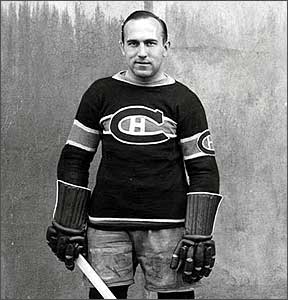
Maybe the legends of the Montréal Canadiens are passed on this way, from father to son and daughter. Maybe this is why I can see in my mind’s eye Howie Morenz rushing up the ice in the late 1920s, when my grandfather was just a lad?
Lest We Forget: Red and White Poppies
November 6, 2013 § 2 Comments
Twitter’s a wonderful thing. Sometimes. Today it is. I just learned about a movement in Canada to distribute white poppies for Remembrance Day. This apparently comes from the Rideau Institute, which is a left-of-centre think tank in Ottawa.

Flanders Field, World War I
White poppies have a long history in the United Kingdom, they date back to the immediate post-First World War era, when pacifists decided they wanted to commemorate the dead of the war and to put forward the hope that the War to End All Wars was in fact a war to end all wars (we know how that turned out). These pacifists wanted to remember all war dead, not just the British dead, which is what their problem with the red poppy was. The red poppy also took on sectarian tones in Northern Ireland during the Troubles, where it was a largely Unionist symbol.
But Canada does not have this history, it does not have the politicisation of something like the Troubles. The poppy is a pretty apolitical statement. I wore a red poppy in Canada, and now, living in the US, I feel slightly awkward in late October and November without my poppy. I have great fondness of memories of getting poppies, I liked to go to Second World War veterans, who pinned the poppy onto my lapel. There was something profound about that little ceremony, I felt like it connected me, however ephemerally, to my grandparents’ generation (both my grandmother and grandfather served in the Second World War). And it tied me to our history as a nation.
I generally oppose war, though I do believe there is such a thing as a just war. And the two world wars of the last century are, to my mind, just wars. But I don’t think my preference for peace is compromised by wearing a poppy.
The Rideau Institute says that its white poppies are for those who don’t want to celebrate war. That is not what the red poppy symbolises. The red poppy commemorates the dead of the wars, those who served. The white poppy confuses the means with the end. It politicises Remembrance Day in Canada, the very thing that should not happen. That the Rideau Institute thinks this is a good idea saddens me somewhat.
Rural Palimpsests: Amity, Missouri
October 24, 2013 § 9 Comments
 Amity is a blink-and-you-miss it tiny town on Route J in northwestern Missouri. The last census put its population at 54, though it has since shrunk to 47 (though, in the stupidity of American metropolitan areas, it is apart of the St. Joseph MO-KS Metropolitan Statistical Area, despite the fact that there is 30 miles of relatively empty farmland between St. Joseph and Amity). It looks, for all intents and purposes, like a dying town. Amity was founded in 1872, but when the Chicago and Rock Island Railway was completed in 1885, the townsite moved about a mile north to straddle the tracks. In its new location, Amity thrived, as general stores, hotels, banks, schools, and churches popped up as the town became an important stop on the railway. A stockyard for the Rock developed and the town became a waystation and loading zone for agricultural products from DeKalb County onto the railway. Similarly, consumer items were unloaded in Amity for the stores there and for DeKalb County in general. The town’s population rose to a high of 225 in the 1920s.
But Amity was a victim of circumstances, as it lived with the Rock, it also died with it. The Chicago Rock Island and Pacific (as it was eventually called) was a notoriously poorly-run and inefficient railway. By the 1970s, the gig was up. It had been run into the ground, and it pulled out of Amity in 1975. But the Rock (and Amity) were the victims of more than just poor management. Deindustrialisation was also central to the story here. As factories shut down in the major cities of the MidWest, from Chicago to Kansas City and beyond, the railways became increasingly less important to the heartland of the United States. And Amitysuffered. Even before the railway pulled out, the stores were suffering, the schools and churches were closing.

The former site of the Chicago Rock Island Pacific Railway through Amity
Today, Amity is barely hanging on. During our cross-country trip in August, we stayed with friends in Amity, Sam and Monica. To my city eyes, Amity was a piece of rural paradise. But Sam and I got talking about the history of the town. Sam is a native of Amity and Monica is from nearby Maysville. The longer we talked, the more fascinated with Amity’s past and present I became. I have written before on the changing rural landscape in North America (Hawley, Massachusetts, Phoenix, British Columbia, and Sainte-Sylvestre, Québec), but in talking with Sam I began to think about the costs of deindustrialisation in North America.

Abandoned home, Amity
Reams of work has been done on deindustrialisation in major cities (Buffalo, Cleveland, Chicago, Pittsburgh, Toronto, Hamilton), and my own work has looked at the cost of deindustrialisation on Griffintown, Montréal. But there was a real trickle-down effect at work here. The landscape of the MidWest (to say nothing of the rest of the continent) is cluttered with Amitys, places that were once important waystations on the railways, or homes to factories themselves (Monica’s mother worked at a Quaker Oats plant packaging instant oatmeal for two decades before it closed down). But their stories are in danger of being lost through little more than negligence.
As a culture, we don’t pay attention to these forgotten places, hell, we don’t even pay attention to the MidWest, at least outside of Chicago. For the life of me, I cannot call to mind a single TV show or movie set in a Midwestern city that’s not Chicago in the past quarter century. No wonder the people of the MidWest feel left out.

2nd Street, Amity, looking north towards where the railway used to be
But there is history here (I realise that sounds like a dead obvious statement) and the stories from places like Amity are important, as they speak to the human and cultural cost of deindustrialisation in the 1960s, 70s, and 80s just as much as those stories that arise out of Buffalo and Hamilton and Milwaukee. They place a human cost on the depopulation of rural areas of North America, and they place a cost on the loss of culture. The four of us (my wife, Margo, and I, Sam and Monica) are barely into our 40s, but we have lived through a series of cultural revolutions, from politics to technology. We are a transitional generation between the old ways of doing things and the (post)modern, post-industrial culture that we live in today. We remember rotary telephones and a world before the internet. Hard to imagine. But we’re also glued to our iPhones and lost without the internet when it goes down. Sam’s work as an artist seeks to preserve what he calls “obscure” technologies, printmaking and pottery. And I am an historian, my entire professional life is centred on the past. As a public historian, my work is centred on how we remember that past.
I am currently working on a research project that looks at the relationship between the far right of American politics and its relationship to history. But once that wraps up, hopefully in the next 6-8 months, I am going to begin work on my next project, which will be based on Amity and DeKalb County, looking at the cost of deindustrialisation on these rural spaces in the MidWest.
OMG! Seriously?: On Language and Swearing
October 21, 2013 § 2 Comments
In today’s Boston Globe, I read a column that I thought had been printed by mistake. Or maybe it was a leftover from 1976. Jennifer Graham, a columnist for the venerable (and quite good) Boston daily, is upset that OMG and it’s more offensive variety, “Oh my God!” are lingua franca in our culture today. She’s upset that blasphemy is everyday language. To which I say, where have you been for the past 40 years, lady?
I am from a culture where all the choice swear words are religious-based. French Canadians have a whole range of blasphemous and offensive words for all situations, the worst of which is “Tabarnak!” That literally means “tabernacle.” Other highlights are “câlisse!” and “osti!” (chalice and the holy host, respectively). If you really wanna set grandma’s wig on fire: “osti de tabarnak câlisse” will do the trick. Once more, in English, that’s “holy host of the tabernacle, chalice!” Sounds much better in québécois French, trust me. When I was a kid, these were very bad words (even Anglos in Québec swear in French, it’s much more fun), respectable people did not use them. But, by the time I was an adult, they were everywhere, even in polite company, including in newspapers, on TV, and even my dear great aunt once said “tabarnak!” (I nearly fell over).
It doesn’t take a linguist to figure out that the ramping up of swearing is due to the general breakdown of authority in western culture as a whole in the past 40 years. Sometimes even I am stunned by what I hear coming out of the mouths of my students in the hallways and around campus. Some of the names they call each other, even in jest, would flip the wig of my grandmothers, I can tell you that much.
But. Oh my god? Seriously? Graham is upset by this one because she thinks it insults people’s value systems. Oddly, I learned this particular gem within my Catholic family as a kid. For that matter, my memory of this gem of a swear is that I have tended to hear it from the mouths of Catholics, especially devout ones. Sacrilegious? Oh, heck yes. But spend an hour watching Irish TV and you’ll see what I mean.
It seems to me that Jennifer Graham is about a generation or two late in her hand-wringing over the use of oh my god in pop culture.
How Terror Works
September 26, 2013 § 16 Comments
Yesterday, there was a stabbing on my bucolic New England college campus. A male student (on leave from the university after an arrest two weeks ago) approached a female student on a campus shuttle bus and stabbed her. When the bus driver intervened, he also got stabbed. The wounds were not life-threatening, the woman was treated at the scene for a laceration to the top of her hand and the bus driver was taken to hospital for his wounds. The suspect then fled across the street and jumped in his car and escaped. This all happened about 150 yards from the campus police station, and the suspect fled past the station. Campus police then pursued him, but gave up the chase for safety reasons.
The university community was apprised of this about an hour later in an email sent out to everyone. I give the university full credit here. When I was in undergrad, there was a serial rapist on campus. The campus police and the university administration did not consider that to be information that the students, staff, and faculty had a right to know. Times have changed.
About half an hour after the email, someone resembling the suspect was spotted on campus. This led to a lockdown, or “shelter in place”, as it’s called, beginning around 12.30pm. For the next two hours, there were police crawling around campus from both the campus and city forces, there were at least two helicopters in the air (whether media or police, I don’t know) and there was a generally tense atmosphere in my building. My colleagues and I speculated on whether or not the suspect might have returned with guns. Who knew?
Around 2pm, classes were cancelled for the rest of the day and evening. About half an hour later, the lockdown was lifted. No one had any idea as to whether or not the suspect had been captured, but we presumed he had been.
But. A few hours later, it became clear that this was not the case, as an arrest warrant had been issued for the suspect, who had obviously fled. This morning, we learned from the news that he was arrested a couple of hundred miles away from here in Upstate New York.
So, in essence, campus experienced a two-hour lockdown and students, staff, and faculty experienced an unnecessary trauma. Looking at the suspect’s mugshot, he’s pretty generic looking and one can see a dozen or two young men who look vaguely like him on any given day around campus. It’s easy, of course, to conclude that the campus police and the administration over-reacted.
But did they? I’m not so sure. What happened yesterday on my campus appears to be the end result of terror and terrorism. Since 9/11, Americans have obviously become much more vigilant. And with mass shootings happening at an alarmingly frequent rate in the past couple of years, this only makes people, military/police/civilians, all the more vigilant (as an aside, I’ve noted the media, especially in Canada, likes to point out that gun deaths are down in the US, which is true, but then this is used to argue that mass shootings are no biggie. That’s false, there are more mass shootings now than ever). And, in pursuing this vigilance, the campus police and the administration yesterday erred on the side of caution, calculating the chance of a real threat to the campus community. The suspect had apparently attacked his victim(s) completely randomly. Thus, the threat was real, if he was indeed back on campus, he could conceivably randomly attack again. Or maybe he had a more destructive weapon?
And this is how terror and terrorism works (yes, I consider mass shooter and those who enable them terrorists). It causes terror, and it causes massive overreactions like we had yesterday because it is better to be safe than sorry. What if the campus police and administration did not react in the manner they did yesterday and the suspect had returned to campus and caused more damage? Imagine the lawsuits and negative reaction.
I’m not saying I like this, but I am interested in how terror works like this. I am presently teaching a course on the History of Terror. And while the course is centred around the very fundamental fact of the terror of history, that we’re all going to die, terror on a smaller scale (like 9/11, the Boston Bombing, these massacres) works the same way and makes us more vigilant, easier to scare, easier to over-react.
It’s all rather depressing, yeah?
The Long View vs. The Immediate View in History
September 13, 2013 § 7 Comments
When I was doing my PhD at Concordia University in Montréal, I TA’d for one of my favourite profs there, Norman Ingram. Norman is a French historian and in the Western Civ class I TA’d for him, he had what I still consider to be a brilliant assignment. He had the students read and compare two books written about the Fall of France in June 1940 during the Second World War. The first book was by eminent French historian, and member of the résistance (and Jew, which is how Bloch ended up being tortured and shot by the Gestapo in June 1944, as the Allies were swiftly re-conquering France), Marc Bloch, the founder of the Annales School. The second book was written in 1996 by an historian at the University of Winnipeg, Robert Young.
Strange Defeat was written by Bloch, a captain in the French Army, in the summer of 1940, immediately following the Fall of France. It is a searing book, almost painful to read, written by a fierce French patriot stunned and shocked his nation collapsed in defeat at the hands of the Nazis. Bloch blames France’s political and military leaders for failing to have prepared for modern warfare. And while Bloch remains an annaliste in writing Strange Defeat, the immediacy of the events he’s describing and his anger and fury are clear.
Young’s France and the Origins of the Second World War was, obviously, written some 50+ years after the fact, with the benefit of a half-century of hindsight, other historical views, as well as archival sources. It is dispassionate, though eminently readable.
The students were then asked to compare and contrast the two books, the immediate view versus the long view.
I think of Norman’s assignment often, both in my own teaching career, as a public historian, and, quite often, on Twitter. When I worked for a now-defunct web magazine based in London, any time we published anything to do with the Bosnian Genocide, without fail, we would get attacked almost immediately by people arguing that there was no genocide, that the suggestion there was a genocide is just Western imperialism and further proof of a conspiracy against Serbia and the Serbian people. It was almost like clockwork.
So, yesterday, when I posted this piece commenting on a New Yorker profile of the Serbian tennis player Novak Djokovic, I expected more of the same. As you can see from the comments, my expectations were met. I also got something a bit different, however. I was indeed assailed on Twitter, by a woman who says she’s from Bosnia, who seemed to be arguing that there was no genocide in Bosnia at all, and that she should know, because she was there. Upon further argument, she was saying something slightly different, that there was a lot of killing going on in Bosnia in the early-to-mid 90s, involving Croats, Serbs, and Bosnians as both aggressors and victims. That was certainly true.
However, it is indisputable that what happened at Srebrenica was a genocide. It is indisputable that the VRS, the Bosnian Serb Army, committed ethnic cleansing in Bosnia as a whole in the 1992-95 period. This has been established by countless experts in the field, it has been confirmed by the ICTY in The Hague.
As the argument carried on, I began to think back to Norman’s assignment, and to think about the difference between the immediate view of the spectator and the big picture view of the analyst. I’m not convinced that it wasn’t clear that the VRS was engaging in ethnic cleansing and genocide. But I am convinced that whatever side of the ethnic divide one was on in Bosnia/Herzogovina in the period from 1992-95, it was something close to hell. And so I am back pondering the difference in what we see based on where we’re standing (there is, of course, also the fact that metric tonnes of ink have been spilled in the past twenty years by journalists, sociologists, political scientists, anthropologists, and historians about the events). I reject the view that there was no genocide, but I do find myself wondering about what someone who was Bosnian Serb would have seen on the ground in that era.
When I lived in Vancouver in the late 90s, I talked to this guy, Dragan, a refugee from Sarajevo, at the local café. He wouldn’t say what side of the divide he was from, just that he was Yugoslavia. He was deeply traumatised by the war and genocide. Vancouver had an international fireworks competition in those days, and we lived in the West End, where the fireworks were. On those nights, if Dragan was at the café, he’d flinch, noticeably, with every loud noise from the fireworks. I don’t know what he did in Sarajevo before he escaped in 1995, and I didn’t want to ask. I don’t know if he was a perpetrator, a victim, or both. But I often think of how he described the outbreak of war in his cosmopolitan Yugoslav city in 1992. He said that, quite literally, neighbours of twenty or thirty years turned on each other, that families collapsed in spasms of violence if there was inter-ethnic mixing. And, as Dragan noted, that was very common in a city like Sarajevo. The entire world, he said, fell down, everything that had held up his universe collapsed. He knew very bad things happened in his homeland. I kind of suspected he might have played a role in his steadfast refusal to say anything, and the cold, steely glare that passed over his eyes when the subject came up, which was often, given he talked about home a lot.
And so, as I was arguing with my interlocutor on Twitter yesterday, I thought about Dragan and I thought about Norman’s assignment. I thought about the chaos of war and the view on the ground as opposed to the view from the sky, the micro vs. the macro, and I thought how much they could vary. I don’t have any real answers here, other than the obvious, but I did find the discussion and all it brought up for me rather interesting.
 Matthew Barlow