Vive le Canada!
June 30, 2010 § 1 Comment
Tomorrow, Canada Day, I will be on CJSW radio in Calgary, as part of their new series, “Today in Canadian History“, where I will be talking about the process of Canadian independence between 1848 and 1982. Details below:
Today in Canadian History launches on Canada Day of 2010. Each episode of the series contains an interview with a Canadian professor, journalist, author, or “everyday” historian and focuses on a unique event or moment that took place on that day in Canadian history. To date, the series has received contributions from over sixty individuals from across Canada.
As a podcast and radio series, Today in Canadian History presents Canada’s past in a unique and accessible manner. The series is designed to be a first step to learning more about our past. We would like to remind Canadians not just about what makes our country great, but what makes it complicated, beautiful, diverse, and ours.
How Can I Listen?
Starting on Canada Day, CJSW will be making the audio available on a variety of platforms. You can listen to the episodes:
- Every weekday morning on CJSW 90.9 FM in Calgary and cjsw.com!
- On this webpage (audio will be posted every weekday)
- On our Facebook page (search, “Today in Canadian History”)
- As a podcast (series will be posted in iTunes on Canada Day)
The series is produced by Joe Burima and Marc Affeld. Local jazz musicians Simon Fisk, Steve Fletcher, and Jon May provided original music for the series. Original artwork was provided by Reid Blakley.
____________
For more information, or to get involved in the series, contact Joe Burima at (403) 220 8033, or todayincanadianhistory@cjsw.com
Ruminations on the Wisdom of Don DeLillo & the Ruins of Griffintown
May 23, 2010 § 1 Comment
It’s no secret that Don DeLillo is one of my favourite novelists. His novels have a tendency to strike me on several levels, perhaps because the narrative is usually fragmentary and on several levels. And whilst his dialogue is predictable in many ways, based on particular idioms of New York City English, it’s the way DeLillo constructs sentences and thoughts that always leave me digesting his work long after I’ve read, or re-read, it. I oftentimes lose patience with people who say things like “I don’t have time to read fiction” or “I can’t remember the last time I read a novel.” To me, this shows a fundamentally closed mind; novels percolate with ideas, philosophy, and ways of being in the world. Novels allow us to personalise events and history, to re-consider moments in time, to re-consider our own ways of thinking, our own narratives.
Certainly this is true with DeLillo’s novel, Falling Man, about the aftermath of 9/11 in New York City. This is not just a rumination on 9/11, indeed, the terrorist attack is a motif to explore post-modern family life in New York. But it doesn’t have to be New York, and it doesn’t necessarily have to be post-9/11, either. But the novel would lack the punch if it was set in Winnipeg in 1986.
Anyway, the reason I’m writing this is to give thought to the on-going argument between Nina, the mother of the novel’s main female character, Lianne, and Nina’s lover, Martin. Martin, however, isn’t really Martin, he’s a former terrorist himself, named Ernst Hechinger. Nina and Martin/Ernst argue throughout the book, in the presence of Lianne, over the nature of terrorism and the attack on New York. Nina’s argument is hued by the fact that she is a Manhattanite. Martin/Ernst is German. She lacks the critical distance to see the attacks, he lacks the intimacy with Manhattan. Throughout the argument, which is fierce and scares Lianne, they consider God and the motives of the attackers. Nina sees fear on the part of the terrorists, Martin/Ernst sees history and politics.
Nina has just had knee surgery (and is developing a reliance upon painkillers) in the time after the attacks. Indeed, Lianne is stricken at how her mother, in the wake of the surgery, has embraced her old age. This worries Martin somewhat. He wants her to travel again, to go out and see the world, to revitalise herself in the wake of the surgery and the attacks. She is somewhat more reluctant.
Martin: Travel, yes, it’s a thing you ought to consider. Get your knee back to normal and we’ll go. Quite seriously.
Nina: Far away.
Martin: Far away.
Nina: Ruins.
Martin: Ruins.
Nina: We have our own ruins. But I don’t think I want to see them.”
Martin: But that’s why you built the towers, isn’t it? Weren’t the towers built as fantasies of wealth and power that would one day become fantasies of destruction? You build a thing like that so you can see it come down. The provocation is obvious. What other reason would there be to go so high and then to double it, do it twice? It’s a fantasy, so why not do it twice? You are saying, Here it is, bring it down.
I love this passage, not so much for what it says about NYC and 9/11, but for what it says for cities in general. Ruins are all around us on the urban landscape (or the rural one, for that matter, abandoned homesteads, for example). Ruins tell us the story of what was once here, how we got here, how we might have otherwise been. Ruins tell us powerful stories about destruction, that is true, as Martin is noting. But they also tell us powerful stories about ways of being that have been lost. The ruins of Griffintown are a prime example.
The ruins of the neighbourhood are there for all to see. In Parc St. Anns/Griffintown, on the former site of St. Ann’s Church, the remaining ruins of the church itself, its foundation, as well as foundation stones of the presbytery, the girls’ school, and the dormitory for the crusading priests who came through the Griff on their way to other parts of the world, are all there. There are ruins of factories and warehouses throughout the neighbourhood. Ruins of tenement flats. Palimpsests of advertising for consumer products that are long gone.

Parc St. Ann's/Griffintown
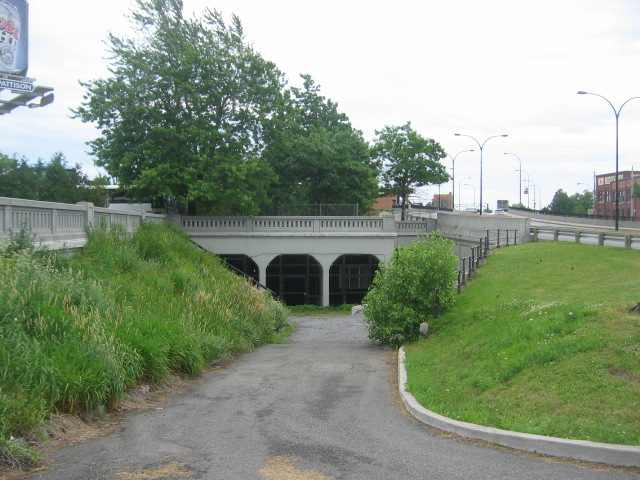
Wellington Tunnel
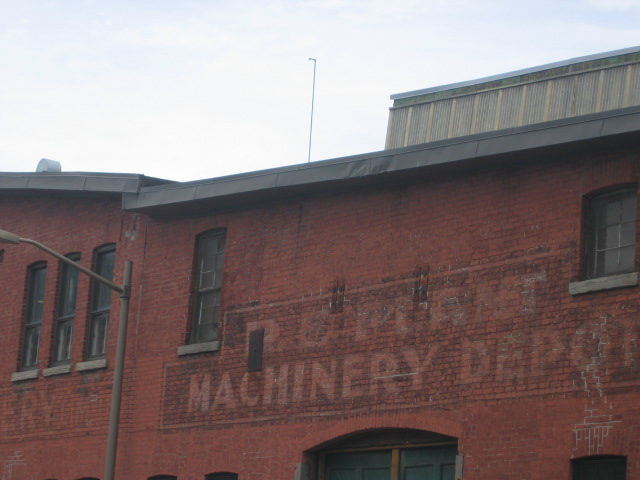
Griffintown Palimpsest
We see this life as it used to be. We consider what once was. How people moved out of Griffintown because of its proximity to all these factories, train yards, and the like. How the flats were cramped and cold, lacking in modern amenities like hot water. Or yards. The neighbourhood, when I began studying it a decade ago, always reminded me of the Talking Heads’ song, “Nothing but Flowers.” Here was the site of the beginnings of the Canadian Industrial Revolution in the 1830s, reclaimed in large part by nature. An inner city neighbourhood sprouting leaves and trees. And grass growing through fractured concrete. Trees growing out of windows of derelict, decrepit buildings. Their floors reclaimed by nature.
The ruins of Griffintown also speak to this power that Martin refers to in the novel. This was a locus of power for Canada, for the British Empire and Commonwealth. Not just the products manufactured there, but the working classes trudging along to work, filling out the army in World Wars I and II. The hulking CN viaduct, not technically a ruin yet, but something close to it, speaks to a time when the railway was king. Indeed, it was built to separate the railway from the roads.
Anyway. DeLillo’s got me thinking about the meanings of the ruins of Griffintown. And what they mean, to the old Irish community that once lived there, to the urban landscape of Montréal today, and to plans to re-develop the neighbourhood in the future.
The Problem With Writing History
March 5, 2010 § Leave a comment
I just finished Orhan Pamuk’s brilliant novel, Snow. It tells the story of a hapless Turkish exile poet, Ka, who returns to Turkey from Frankfurt. Ka is a poet without poems. He’s not written one for years when he accepts an offer from a friend who edits a Republican newspaper in Istanbul to travel to the distant eastern city of Kars. In Kars, there has been a wave of suicides by young women wearing the hijab, which is seen as a challenge to the Turkish republic of Ataturk. They were expelled from their university studies for refusing to remove them. And so a group of them killed themselves. But nothing is at seems in Kars, and Ka is drawn into the city’s murky underside, in part due to a bizarre coup led by an actor, in part because he falls in love for the beautiful Ipek, in part because of the radical Islamist terrorist, Blue. Kars is a poor city, isolated, and caught in its place in history on the borderlands, caught between its Russian, Turkish, and Armenian pasts. And Kars is isolated during Ka’s visit, it’s snowed in. It’s a mountain city and all roads in and out, as well as the railroad, are blocked by heavy, heavy snow. This isolation has its own in-built tension between this forgotten borderlands city and the cosmopolitan capital of Turkey, Ankara, and its interntionalised largest city, Istanbul. This tension within Kars echoes that of the Turkey that Pamuk presents, between this Europeanised cosmopolitanism and traditional Turkish culture, to say nothing of Islamism. And Ka, as a westernised Turk living in exile in Germany, is a focal point for this tension.
Anyway, I don’t want to give away the plot, because if you’ve not read Snow, you should. It’s not for nothing that Pamuk won the Nobel Prize for Literature in 2006.
What I want to point to is a discussion the narrator of the novel has with an associate of Ka’s, Fazil, at the end of the book. The narrator, Pamuk himself, responds to Fazil’s early declaration that he can only write about him in the book Pamuk is writing on Ka’s visit to Kars if he agrees to include what Fazil wishes to say to Pamuk’s readers. He says this:
‘If you write a book set in Kars and put me in it, I’d like to tell your readers not to believe anything you say about me, anything you say about any of us. No one could understand us from so far away.’
‘But no one believes in that way what he reads in a novel,’ I said.
‘Oh, yes, they do,’ he cried. ‘If only to see themselves as wise and superior and humanistic, they need to think of us as sweet and funny, and convince themselves that they sympathize with the way we are and even love us.’
Fazil’s words have resonance for me as an historian. I study the working-classes, I study people by-and-large excluded from, or oppressed by, systems of power. The community I study is one that was an inner-city, working-class slum. The people who lived there, grew up there, they’ve escaped, moved up the social ladder. But that history is still there.
A few years ago, I was hired as a consultant by an advertising agency working on behalf of Devimco, the development company that was planning to radically re-build Griffintown. Devimco was trying to make its plans more palatable, so they hired this advertising agency, as well as a consultant, an American living in London. This consultant has done some impressive things with shopping malls across the UK and in places like Dubai. Anyway. He prepared a text for all of us to ponder for our 2-day summit on the future of the Griff. Basically, he wanted us to come up with a marketable narrative for Griffintown, which was why I was there; the historian. In this text, he wrote:
Griffintown represents the next generation in Montreal’s long history of bold waterfront stewardship. What makes it unique is that it restores the public’s access to the waterfront, making it home for a real community, instead of simply an industrial workforce.
Leaving aside the fact that Montréal actually has a long history of the opposite of “bold waterfront stewardship” (Autoroute Bonaventure, anyone? How about all those port facilities?), the part I’ve italicised, dismissing the former residents of the Griff as simply an industrial workforce really just echoes what Fazil says in Snow. This consultant is dismissing these real people, arguing that because they were the working-classes, they couldn’t have culture or community. We’re supposed to feel superior to them, we’re supposed to see ourselves as better than them.
This is something that plagues historical scholarship, going back to the days of Herodotus. Even despite E.P. Thompson’s entreaties to be fair to the working-class (or any other subaltern group, really), to “rescue them from the enormous condescension of posterity” (to quote from his masterful The Making of the English Working Class), it’s a hard road to hoe. Indeed, Thompson himself is partly to blame for this, by taking on this providential charge to “rescue” the working-classes. We shouldn’t do that, either.
Instead, what we strive to do is to take our subaltern, down-trodden, excluded, or what-have-you, people is to take them for what they are/were: people like us. This is hard to do, it is hard to be sensitive to our historical actors, to recognise them as multi-dimensional actors, with agency, just like us. Joy Parr helps us see that in her The Gender of Breadwinners, wherein she reminds us that the roles our historical actors play were not sequential, but simultaneous. We are many things at the same time, and so, too, were our historical actors.
This is something I think historians of the subaltern need to be reminded of regularly, it’s not something we can read in a book once and keep in mind when we’re actually doing our work. This point needs constant reinforcement. It’s easy to forget, really. For me, that Devimco session helped. So, too, does doing oral history. And so, too, has the reading of Snow. I must keep Fazil’s words in mind.
An Episode in the Life of a Diasporic City
February 5, 2010 § Leave a comment
Montréal is a city of literature. It has been the home of many great novelists, both of Canadian and international reknown. It is also a city that has been the setting of many novels, bestsellers at home and abroad. For years, I lived in the neighbourhood that was the setting of Gabrielle Roy’s Bonheur d’occasion, Saint-Henri. Prior to that, I called Duddy Kravitz’s Mile End home. Presently, I call the setting of Balconville home. The Plateau-Mont-Royal has been immortalised by the likes of Michel Tremblay, Mordecai Richler, and Rawi Hage. One of the best academic reads of recent years was Sherry Simon’s Translating Montreal: Episodes in the Life of a Divided City. Simon explores the cultural and social history of her Montréal through the literature, in both official languages, that depict the city’s multicultural landscape and lived experience.
Montréal’s literary authors, to say nothing of Simon herself, have projected and reflected the experience of immigrant groups and their diasporas through their works. It was from Richler’s works that I learned so much of the Jewish experience of Montréal, that I came to understand the city as a Jewish one. Indeed, Richler was instrumental in re-casting Montréal as something more than just a bifurcated locale, a city caught between French and English, in that he inserted the city’s Jews into the dialogue, his writing maturing with the city throughout the 2nd half of the 20th century.
Today, however, in trying to find a bowl of matzoh ball soup, I was kind of stunned by just how much Richler’s Montréal has changed. As I wandered through the city’s downtown core, both searching for the soup and running a handful of other errands, I got to thinking about not just how diasporas inform and reflect off each other, but also how diasporas evolve, shift, and replace one another. This was especially true, I thought, in a 5-block section of downtown just west of Concordia’s downtown campus. In this stretch, there are, amongst other things, a German restaurant that has been there for most of my life, as well as newer Russian, Indian, Iranian, Lebanese, Irish, Armenian, Mexican, Central American, Chinese, and Thai restaurants. And not a single place that served matzoh ball soup. During Richler’s years studying at Sir George Williams University, one of the founding institutions of Con U, I’m sure matzoh ball soup could be found in the vicinity of the campus. Of course, one would not have found the plethora of “ethnic” food (the term is in quotations because it is such an unsatisfactory one to use in this instance).
This is neither a lament nor a complaint, I eventually found the matzoh ball soup at Dunn’s, an old Jewish deli, on Metcalfe. It just is what it is, an episode in the life of multicultural, diasporic city.
Diaspora and the Haitian Earthquake
January 25, 2010 § Leave a comment
I spent a chunk of my weekend reading theory on diaspora and transnationalism, as I begin the process of writing the Introduction to the book, so these topics were fresh in my mind when I read The Gazette today. Today, here in Montréal, a group of global bigwigs, including US Secretary of State Hilary Clinton, French Foreign Minister Bernard Kouchner, as well as foreign ministers from Canada, Japan, Brazil, and a hanful of other nations, plus the UN, are meeting with Haitian Prime Minister Jean-Max Bellerive to discuss rebuilding plans for Haiti.
Upon arriving in Montréal yesterday and meeting with Québec Premier Jean Charest, Bellerive told reports that the Haitian diaspora is fundamental to the re-building of his nation:
We need a direct, firm and continuous support from them. This cataclysm has amplified the movement (of people) out of Haiti, unfortunately. We will have to work hard to encourage them to come back to Haiti…I’m very happy that the help has now arrived and is being distributed, because we had a lot of logistical problems in my country.
In other words, the Haitian diaspora is a transnational one, as it stretches across several nations in addition to Haiti (including Canada and the US), and a dynamic relationship exists between Haiti and its diaspora, diasporic Haitians have not just settled in places like Montréal and New York City, they also continue to send money back to Haiti, establish charities and trusts, and so on. In the days since the earthquake there, and its aftershocks, I’ve been struck by the actions of prominent diasporic Haitians, such as Indianapolis Colts’ receiver Pierre Garçon, former Montréal Canadiens’ tough-guy Georges Laraques, Philadelphia 76ers’ Samuel Dalembert, and musicians such as Wyclef Jean and the Arcade Fire’s Régine Chassagne, amongst others. They, along with less-well-known Haitians, have been working feverishly raising funds, visiting Haiti, helping in rescue efforts and so on. Indeed, the Haitian diaspora has been instrumental in not just raising consciousness, but in keeping Haiti in the global consciousness beyond the initial burst of news of the earthquake, to work towards a rebuilding plan for a devastated nation.
Bellerive’s recognition of that is impressive, as national leaders tend not to recognise the importance of their nations’ diasporas, even in times of trouble. And yet, transnational diasporas are central to the homeland nation, as the Haitian example makes clear.
Remembering the Montréal Massacre
December 6, 2009 § 1 Comment
On 6 December 1989, a lone gunman burst into the École Polytechnique de Montréal, part of the Université de Montréal, and opened fire. He targeted women specifically. He was upset that “feminists” had ruined his life. For his delusions, 28 innocent people were shot, before he turned the gun on himself. In the first classroom he broke into, he separated men from women, then shot all 9 women, 6 of whom died. Then he wandered the hallways, the cafeteria, and another classroom, targeting women, shooting another 14 women, and 4 men. All 4 men survived, of the 24 women who were shot, 14 died. All this within 20 minutes.
I was 16, living in suburban Vancouver when this happened. I remember the shock. I couldn’t fathom then, and I still can’t, how someone could open fire in a school, let alone, to kill women for being in school. These 14 women died because they were just that: women getting an education. I have never been able to wrap my head around that concept. It doesn’t make sense to me. It didn’t in 1989 and it doesn’t in 2009. The Montréal Massacre is one of those transformative moments in my life, it is deeply embedded in my view of the world. It was a shocking, terrible event. And despite all of the school shootings since in both Canada and the USA, this is the one that is, to me, a horror story. Every 6 December, I remember watching the chilling news footage in the living room back in BC, I remember trying to understand why this had happened, my mother and I both horrified. And every 6 December, I find myself asking those same questions over and over. I still don’t have an answer.
But what particularly upsets me about 6 December is that the shooter’s name lives on, in infamy, of course, but nearly everyone of my generation, we were all affected wherever we were, know his name. I refuse to utter it, print it, post it, etc. I do not want to remember him. Diane Riopel, who taught at L’École Polytechnique in 1989, and narrowly missed meeting the killer, echoes this sentiment: “We have given him enough publicity. Out of respect for the victims, the killer should be completely anonymous.” I don’t think Hell exists, but when I think of him, I hope it does. I don’t think anyone can name all 14 women who died. I certainly can’t. They’re all agglomerated as “the victims.” The shooter maintains his individuality in death, but the 14 women he martyred lose theirs. All we seem to know is that they were engineering students. But what else about them? What were their dreams? What did they plan to do with their lives when they finished school? What books did they read? Where did they hang out with their friends? All of this, I wonder about every year at the anniversary. And I have no idea what the answers to these questions are.
These are the victims:
- Geneviève Bergeron (born 1968), civil engineering student, age 21.
- Hélène Colgan (born 1966), mechanical engineering student, age 23.
- Nathalie Croteau (born 1966), mechanical engineering student, age 23.
- Barbara Daigneault (born 1967), mechanical engineering student, age 22.
- Anne-Marie Edward (born 1968), chemical engineering student, age 21.
- Maud Haviernick (born 1960), materials engineering student, age 29.
- Maryse Laganière (born 1964), budget clerk in the École Polytechnique’s finance department, age 25.
- Maryse Leclair (born 1966), materials engineering student, age 23.
- Anne-Marie Lemay (born 1967), mechanical engineering student, age 22.
- Sonia Pelletier (born 1961), mechanical engineering student, age 28.
- Michèle Richard (born 1968), materials engineering student, age 21.
- Annie St-Arneault (born 1966), mechanical engineering student, age 23.
- Annie Turcotte (born 1969), materials engineering student age 20.
- Barbara Klucznik-Widajewicz (born 1958), nursing student, age 31.
On Language
December 3, 2009 § Leave a comment
Russell Smith has an interesting column in today’s Globe & Mail about mistakes in the English language, when the wrong word is used, and the resulting innovation in language. He makes a convincing argument, I must say. And it’s a funny read, too. Essentially, he argues that malapropisms can lead to new meanings, and, in some cases, welcome meanings. For example, he presents us with some examples:
How many times, for example, have you heard someone say that she was “on tenderhooks”? She means tenterhooks, of course – the hooks on the tenter, the device that stretches canvas. Such a stretching would make one anxious and eager for the feeling to end. But there is another, perhaps even more painful image that comes from “tender hooks” – the juxtaposition of the sharp hook and something tender, such as flesh. This is a particularly poetic image because it is the hook itself that is tender: This is the kind of impossible metaphor that surrealist poetry is built on.
Or:
Similarly, when I read that someone’s hair is “tussled,” I can never be really sure whether it’s a simple misspelling of tousled (rumpled) or a clever play on to tussle or fight – a coiffure that’s been roughed up, you might say. When people say they want to “curve their appetite” I know they mean curb, but an interesting idea comes up: the appetite as line to be bent into the desired direction. I also like the overlay of meaning in “boast your confidence.” It comes from boost, of course, or possibly even bolster, but the new connotation of vanity amps up the phrase a little.
He then talks about “eggcorns”, when we use words incorrectly. An eggcorn is apparently a more creative malapropism. Like, for example, Cold Slaw, instead of coleslaw. Or Jade Goody’s famous declaration that she didn’t want to be an “escape goat.” And so on.
Balderdash. Whatever. Smith clearly has not spent a lot of time marking undergraduate papers.
I see malapropisms and eggcorns and I kind of worry. For example, my students oftentimes write that they “should of” done something, rather than “should have.” Or they use “than” instead of “then.” They don’t know the difference between “they’re”, “there”, and “their.” Or “where” and “were.” This kind of thing worries me. Call me old fashioned, call me fussy, whatever. I believe literacy matters. And I get concerned when I come across the sorts of malapropisms I come across marking the average paper.
Language works because it is a universal coding system used by speakers of that language. English-speakers, for example, have a general, universal, understanding of what words mean. We see words and we understand their meaning, we then decode them in order to understand what we are reading or hearing (or speaking or writing). There are times when abbreviations are necessary, such as txting or when we leave short notes for spouses, partners, lovers, roommates, and so on. But these usually accord to a universally-agreed upon system as well. These universally-agreed upon codes are central to communication, of communicating ideas to one another. If we cannot communicate, well, the downside to that is rather obvious, I would say.
And so, when my students display a fundamental misunderstanding of the language they speak, it concerns me. Especially when they are 19 or 20 years old. I read too many sentences like this one: “He than thinked of another solution.” Or “He as did a new program.” These are real sentences I read today in marking a stack of papers. The first one, of course, was trying to say “He then thought of another solution.” The second, harder to decode, meant, “He created a new programme.”
Certainly, it is my job to help students learn these basic facts of communication, but I don’t think that CÉGEP is where they should be learning this. These are basic laws and facts of the English language I understood long before I finished high school. Raising a generation of people who are not fully fluent in their native language is a terrifying thought. Especially when you think about all of the fights and arguments we get into over the course of our lives due to a miscommunication, a word used incorrectly, or heard incorrectly.
The House of the Irish: The Book
November 15, 2009 § Leave a comment
Well, almost 6 months to the day of defending my dissertation, I am heading out tomorrow to begin, in earnest, work on the book. Now that I have interest, at least, from a publisher, I am getting going on the new research I want to do, and moving forth with the revisions and whatnot. Next weekend or the following one, depending on when I get a bit of time, I am going to re-write the Preface of the dissertation to lay out where I want the book to go, though, of course, that will change a few times as I move forward.
Anyway, tomorrow I am meeting with a former Griffintowner I met at a talk I gave last year, to do an oral history interview. This is kind of exciting for me, and I’m excited to learn that I am not, in fact, sick of Griffintown and its history yet. In fact, I feel rather rejuvenated by 6 months away from it, as I have been immersed in Griffintown lore for most of the past 3 years, since I started writing the dissertation in earnest.
So let us hope the book doesn’t take as long to write as the dissertation did and sometime in the not-too-distant future, The House of the Irish: Diaspora, History & Memory in Griffintown, Montréal, 1900-2010, will be on the shelves of a bookstore near you.
Griffintown Horse Palace Foundation Launch
November 15, 2009 § Leave a comment
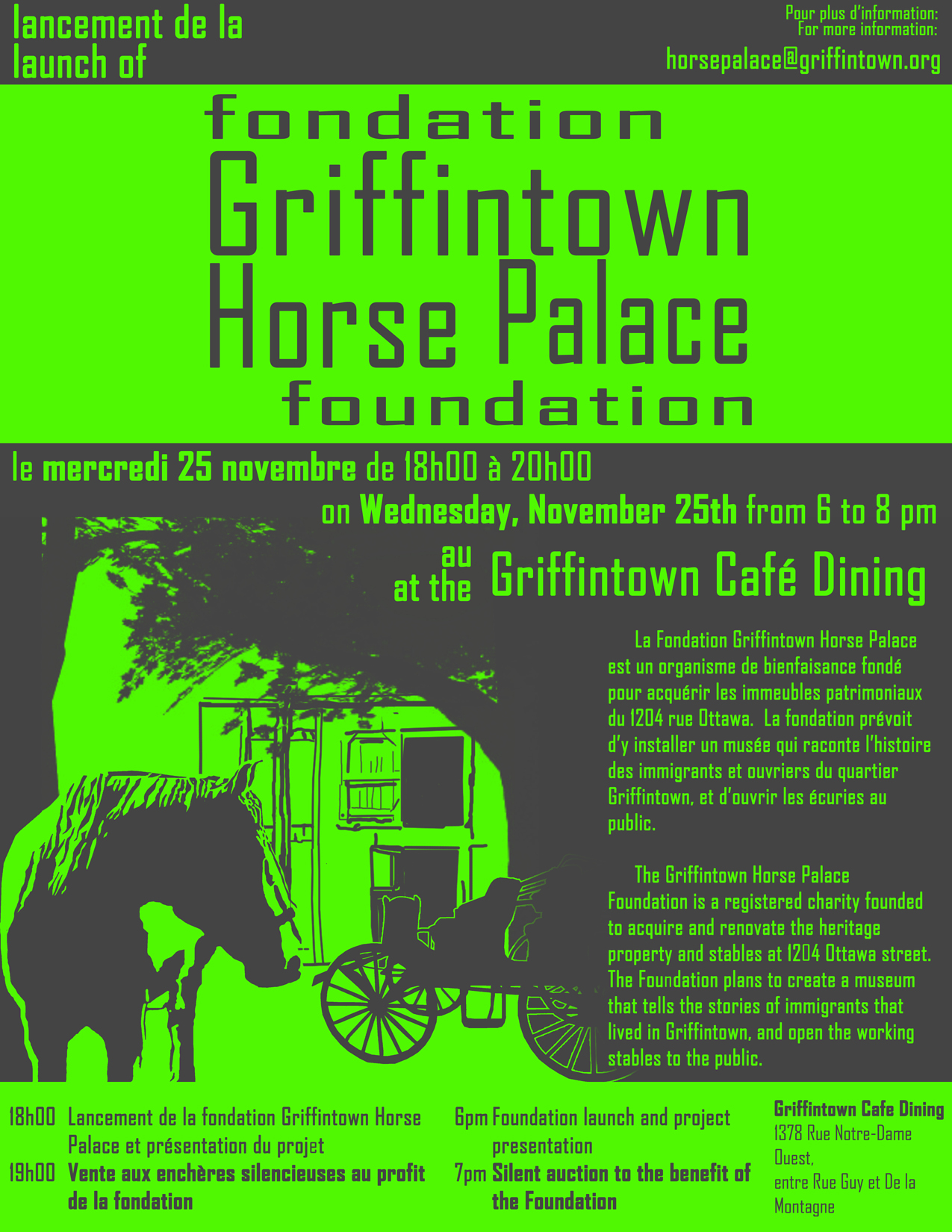
The Griffintown Horse Palace Foundation is dedicated to purchasing and renovating Leo Leonard’s Horse Palace in Griffintown, to turn it into a museum along the lines of the legendary Tenement Museum on the Lower East Side of Manhattan (frankly, one of two museums I find interesting). The Foundation is holding its launch at Café Griffintown at 1378 rue Notre-Dame in the Griff on Wednesday, 25 November, from 6-8pm. Unfortunately, I cannot be there, as I teach a night class on Wednesday nights out at Abbott, but I hope this is a resounding success. For more information, contact the Foundation at horsepalace@griffintown.org.
the house of the irish
October 5, 2009 § Leave a comment
i submitted a book proposal to mcgill-queens university press the other week. i mailed it out monday, i got an email response on thursday. i was astounded canada post could get something somewhere that fast, even if the proposal travelled no more than 3.5km from pointe-saint-charles to mcgill. anyway, mqup liked what they read. they are interested in publishing the book, once it becomes a book.
so now, i am beginning to ponder how to turn “the house of the irish”, the dissertation, into the house of the irish, the book. i am cutting out the first substantive chapter, on the shamrock lacrosse club. that will become an article or two. and i am extending a chapter on nations and nationalism in griffintown, c. 1900-17 to at least 1922, with the establishment of the irish free state. part of my argument is that once ireland gained something approximating independence, even if the north was left out (or, more properly stated, opted out), the irish of the diaspora more or less lost interest in ireland, at least that was, i think, the situation in montréal. ireland was already an imagined nation by the early 20th century on account of there being hardly any irish-born irish in montréal by this time, immigration having dried up shortly after the famine. but after the free state was established, the irish here turned even more inwards. so that’s the first major revision or expansion.
the other is to correct the methodological issues in the last two chapters of the dissertation, which is too much reliance on the same set of sources. to correct this, i am going to engage in some oral history. but i am back to the same problem i had with the dissertation in a sense here. i am not interested in talking to the professional griffintowners, the don pidgeons and denis delaneys of the world. their thoughts and opinions on the griff are very well known, they are part of the commemorative process amongst the griffintown diaspora. i want to talk to people who didn’t necessarily think that they grew up in shangri-la. the ones who have an alternative view of the griff, or at least a more critical one. one former griffintowner in burman’s film said something like it was a shame to see the griff go, as they had it all. oh really? despite the poverty, unemployment, insecurity of tenure, etc.? of course, this is partly nostalgia, partly a child’s view of life in the 1940s. but i want to talk to people who have a more critical memory.
and that’s the hard part. where do i find these people? they’re not the ones at all the various griff gatherings. i have a few ideas, one of which is to make use of the parish of saint-gabriel, the historically irish church in the pointe (in fact, almost next door to us here). i recognise old griffintowners standing outside of saint-gabriel’s every sunday morning, so i’m hoping i can start there, talk to a few of them, get references to their friends, and so on.
either way, i am excited about this, i’m excited to turn this story of griffintown into a book. i think this is a story that has wider implications, not just for montréal, but for the irish diaspora, and even as an example of the acculturation of an ethnic group in a major metropolitan centre in north america.
as my favourite soccer blogger used to say at the end of each post: onwards!
 Matthew Barlow