On Diasporas and Protests
February 6, 2011 § Leave a comment
As unrest unfolds in the Middle East, one thing I’ve enjoyed here in Montréal have been the protests of the various diasporas. A few weeks ago, as I ran errands downtown on a Saturday, I got caught up in a large group of Tunisians protesting against Ben Ali, calling for his removal. Since then, the Tunisians have protested against his brother-in-law, who has attempted to seek shelter in Montréal and claiming refugee status in Canada. Other Arab diasporas have joined in the protests. The Tunisian one I got caught up in had people not only draped in the Tunisian flag, but the Algerian, Lebanese, Palestinian, and Egyptian flag.
Yesterday, the Egyptian diaspora in Montréal was out in the streets downtown protesting against Hosni Mubarak, part of an international day of protests, calling for his ouster. As with the Tunisian protests, they were joined by other Arabs. But what makes these protests special for me is that it’s not just the Arabs, not just the Tunisians and Egyptians, out in the streets in Montréal. They are quickly joined by everyone else in the city: québécois, Anglos, Spanish, Italians, Greeks, Jews, and so on.
The Tunisian protest was a multicultural sea of faces, all united in celebrating Tunisian freedom and Ben Ali’s ouster. Video I’ve seen of yesterday’s anti-Mubarak protests were similar. It’s simply nice to see the coming together of all of these diasporas in Montréal, including ones that don’t historically get along, to protest against injustice on the other side of the world.
UPDATED: Check out this article on the Egyptian diaspora in general and their hopes for reform.
Classic Montréal Moment
February 1, 2011 § Leave a comment
There all kinds of things that make Montréal a unique city, not the least of which is language and all of the fallout from that. One of the most bizarre moments here is to find oneself, an Anglo, speaking French to another Anglo. It happens quite often, especially when dealing with the retail industry. It’s always an odd moment, because you’re thinking the guy’s French doesn’t sound quite right, his accent is slightly off. You live here long enough, you can distinguish between working class and bourgeois Québécois French, and between they and European French, and you can start to figure out the regional differences in accents within Québec, too. But Anglos have their own accent of course. So while you’re standing there trying to figure out where his is from, he’s also noticed that your French accent isn’t quite right, either. And then it hits both of you at the exact same second: you’re both Anglos. Then comes the true test, who blinks first? Who switches back to the mother tongue? Maybe now you degenerate into showing off who’s more fluent in French? All the different ways this simple transaction for a pair of jeans can turn out. In this case, he switched back to English, I followed. We had a laugh. Life went on.
The Redemptorists
January 10, 2011 § 2 Comments
I went to mass on Christmas Day, I’m not Catholic, but I kind of like the tradition. This year we were in Keene, NH, where my sister-in-law lives. The priest had as the theme of his Christmas morning sermon “redemption,” noting that that was the true meaning of the season. I like to think that is one of the good points of Catholicism, that redemption is granted through the fallibility of humanity, God’s forgiveness for our sins, in part through the sacrifice of Jesus, in part through confession. I presume that this is where the Redemptorist Brothers got their name, their job being to redeem the souls of both their parishioners, as well as their converts (they are a missionary brotherhood).
Anyway, all of this is by way of introduction of my destination tomorrow in Toronto: the archives of the Redemptorists. The Redemptorists were the parish priests in Griffintown from 1885 until the destruction of St. Ann’s Church in 1970, and the ultimate closing of the parish a dozen or so years later. So far as I know, no one has actually gone in and looked at the brothers’ records from Griffintown. I was told about them years ago by Rosalyn Trigger, who was at the time doing her PhD at McGill, but I never found the time to get to Toronto to look at them when I was researching my PhD. Funny: last time I saw my supervisor, Ron Rudin, a few months ago, I was telling him about my plans to go take a look as I finished off the research for the book. He wondered if he could take back my PhD for keeping knowledge of this archive from him. ‘Fraid not, Ron.
Anyway, I’m rather excited to be heading to the archive tomorrow morning to see what I can find, to deepen our general knowledge of Irish-Catholic Griffintown, it will also add something to my book that is not in other histories of the neighbourhood, including my own dissertation.
That the Redemptorist priests were popular in their parish of St. Ann’s is not in doubt. In 1885, when the Sulpicians were stripped of their parish of St. Ann’s, the Irish-Catholics of Griffintown were furious, to the point where they remonstrated with the Bishop of Montréal. However, the Redemptorists, upon their arrival, were able to almost instantly win the hearts and minds of their parishioners, by investing money in the church and parish. By the time that Father Strubbe, the “Belgian Irishman,” was recalled to Belgium, the Irish-Catholics were loudly remonstrating with the powers-that-be over this decision. All the former Griffintowners that I have done oral histories with fondly recall the priests of St. Ann’s, in particular Fr. Kearney.
So I’m hoping here to find out how the priests saw their impoverished parishioners, what they felt they could do for them, whether they enjoyed being in Griffintown, their impressions of the neighbourhood. I’m also interested in the question of faith. All of the former Griffintowners I’ve talked to, as well as all other evidence I’ve seen, shows a very Catholic community, one where people took the ceremonies and rituals of their faith. But what has always interested me is whether this was just that: familiar ritual. One thing the Church is very good at is giving its faithful ritual and ceremony that are both familiar and reassuring. But I’ve always wondered how deep the idea of faith goes, not just with respect to Griffintown, but the Catholic Church in general.
Then there’s the question of Irishness. One of the reasons the Griffintowners protested the removal of the Sulpicians in 1885 was because the Sulpicians were very good about ensuring the parish priests at St. Ann’s were Irish. The Redemptorists who arrived in Griffintown that year were all Belgian. Of course, Fr. Strubbe was able to win over his parishioners and even gain status as an Irishman by the time of his recall. And by the mid-20th century, the priests, like Fr. Kearney, were Irish once more. Was this a conscious decision by the Redemptorists and the Bishop to represent the faithful? What did the priests make of the Irishness of their parishioners?
So here’s hoping I can begin to find some answers to these questions in the archive.
Today in Hockey History
January 5, 2011 § Leave a comment
Happy New Year! It’s been awhile since I’ve posted, I got caught up in the craziness that is the end of the semester and then took a nice relaxing Holiday sabbatical. Anyway, yesterday, whilst sitting in a MacDonald’s parking lot in Pittsfield, Massachusetts, I did a radio interview with CJSW in Calgary, their excellent “Today in Canadian History” series. I was honoured with their first podcast last 1 July talking about the meanings of Canadian Confederation. Today marks 111 years since the Montréal Canadiens played their first home hockey game, so here I am talking about the importance of the Habs.
Magnum .357: “Expos Fitted”
October 23, 2010 § 1 Comment
A tip of the hat to Sarah, who posted a comment in response to Nos Amours (and check out the original post at NCPH’s Off The Wall), directing us to a video of Montréal rapper Magnum .357 and his début single/video, “Expos Fitted.” She posted the video in her comment, but I think it deserves wider exposure. I especially love the nostalgia of the Expos dressed up as gangsta rap.
Mag .357 is practically my neighbour, he hails from Montréal’s Anglo-Black neighbourhood, Little Burgundy, which is across the Lachine Canal from me here in Pointe-Saint-Charles. Burgundy is a curious neighbourhood, as it is home to both inner-city gang violence and yuppies who have gentrified the old worker’s cottages and triplexes that line the streets. It is also one of the oldest Black communities in Canada.
Burgundy also has a long history of being a centre of entertainment in Montréal. In the wake of Prohibition in the US and before the rise of Jean Drapeau as mayor of the city in 1960, Burgundy was home to various jazz clubs, most notably the legendary Rufus Rockhead’s Paradise. Oscar Peterson and his student Oliver Jones, the two greatest jazz musicians this country has ever produced, also grew up on the streets of Burgundy. In this sense, Mag .357 is carrying on the tradition.
I have to say, I love this track and I’ve been checking out his MySpace page. Enjoy.
Nos Amours
October 18, 2010 § 1 Comment
I have a post up at the National Counil on Public History’s (NCPH) sponsored blog, Off the Wall, looking at the difference between marketing and nostalgia when it comes to the ill-fated Montréal Expos.
Metropolitan Statistic Areas
October 16, 2010 § 3 Comments
As an addendum to Wednesday’s post on the old Town Commons of Hawley:
Usually, I study cities and the palimpsests of history upon them, the ways in which their histories are used by their publics and their powers that be, and historians as well. Hawley is about as rural a place you can get. But, Hawley (and all the tiny towns around it, none of which have much more than 1000 people in them) is included in something called the Springfield Census Metropolitan Statistical Area. The Springfield CMSA is home to over 680,000 people. Sounds impressive, no? But this is an artificial “Metropolitan” area, as are all such beasts. To wit, Springfield is actually home to about 155,000 people. Certainly, there are cities within the Springfield CMSA beyond Springfield, like West Springfield and Holyoke. But Hawley isn’t a city. And it’s not exactly near Springfield. It’s about 45 miles away, in fact.
Thus, the Springfield CMSA is an artificial catchment area. Officially, the US Office of Management and Budget and the US Census Bureau make use of CMSAs for policy making and the like. The basic idea behind the CMSA is an urban “cluster”, a region with a relatively high population density. The outlying areas are included if they have strong ties to the central urban centre. And this is where the Springfield CMSA doesn’t make a lot of sense. Hawley and the towns around it are not all that closely connected culturally or economically with Springfield. Instead, Greenfield in the Pioneer Valley and Pittsfield, in the Berkshires, are the urban centres that are tied to these towns. Northampton could also make a claim. It is to these places that the residents of Hawley, Charlemont, Plainfield, Ashfield, etc., commute if they commute. Rarely is it Springfield.
But this might also explain their inclusion in the Springfield CMSA, as both Greenfield and Northampton lie within it. And so the catchment area of Springfield just keeps spreading. Pittsfield is its own CMSA. But, still, it remains that deeply rural communities are artificially included in a statistical area that has little if any connection to them. Life in Hawley and life in Springfield are not even remotely related. Springfield, despite being a small city, is a downtrodden and gritty one. Hawley is a rural community nestled into the hills of Western Massachusetts.
Either way, while I can see the argument here, I do not see the statistical value of including Hawley with Springfield. They are 45 minutes and worlds apart from each other.
And it also speaks to the danger of trying to compare urban populations. For example, it is often said that Boston has a population over 5 million. That’s just not correct. The City of Boston has 650,000 people in it. Boston is the centre of Suffolk Co., which has a population of about 760,000. If you factor in the immediate suburbs of Boston, its population grows to about 1.5 million. But Boston’s Census Metropolitan Area is home to something close to 4.5 million people. However, Boston’s CMSA extends from New Hampshire in the north to include most of eastern Massachusetts, as well as ALL of Rhode Island, which itself includes the CMSA of Providence, the largest city in Rhode Island.
In other words, the Boston CMSA covers some 366 square kilometres, and includes regions that, like Hawley, are about as far from urban as you can get. In short, CMSAs are wildly inaccurate when it comes to measuring and comparing urban populations, especially when definitions of what constitutes a CMSA in the US is not all that consistent across the board, or when other nations use different defintions of what constitutes an urban area.
For example, in Canada, the equivalent is a Census Metropolitan Area, which is a statistical unit centred around a “large” city, of at least 100,o00 people. Montréal’s CMA is a much more sensible defintion of such a statistical area, as it includes the core city and the Île-de-Montréal, as well as the neighbouring Île-de-Jésu, which includes Laval, and the south shore, which includes suburbs such as Longeuil. And then it includes the expanded ring of suburbs that surround the Laval-Montréal-Longeuil nexus. And while there are rural areas included in this territory, especiallty to the north-west of the Île-de-Montréal, they lie between and betwixt bedroom communities and other regions that are clearly centred on Montréal.
But, either way, one cannot compare the Boston CMSA to the Montréal CMA because they are not similar birds. In fact, they might not be birds at all. To equate Montréal’s with Boston’s, one would have to include Sherbrooke, or Québec, or Ottawa within the Montréal CMA, much like Providence, RI, and Manchester, NH, are included within Boston’s.
Shameless Self Promotion, for a good cause
October 14, 2010 § Leave a comment
I was on GlobalNews at 6 last night here in Montréal in a story about the Griffintown Horse Palace and our plans to save the Palace from re-development in Griffintown. Also, The Gazette has a similar story this morning has a story.
Something is Rotten in the Country of Canada
September 6, 2010 § Leave a comment
Seriously, there is something deeply and fundamentally flawed in this country. According to The Globe & Mail, Ontario is making a push to become the centre of the digital entertainment industry in Canada. That’s all fine and good until one realises that the industry is presently centred in Vancouver and Montréal. So, basically, Toronto, backed by the provincial government, is now going to take on the other two major cities in the country, backed by their own provincial governments, in order to see who wins. This is just wrong.
Certainly, the provinces have had flashpoints, economically speaking, including Québec’s infamous deal with Newfoundland for Churchill Falls. But that deal was made because Newfoundland lacked the ability to harness the power of Churchill Falls. Vancouver and Montréal, on the other hand, are already the centre of this industry. What Toronto and Ontario are doing here is nothing short of cannibalisation.
Something is wrong, very wrong, in this country.
New Adventures in the Arts, or, Art, History, and “Authenticity”
September 3, 2010 § 1 Comment
Yesterday I met with a stage and set designer for a new play being produced at the Hudson Village Theatre in Hudson, QC (just off the Island of Montréal), opening Thursday, 28 October, entitled Wake of the Bones, written Montréal playwright David Gow. Wake of the Bones centres around the discovery of a mass grave of Famine victims on Pointe-Saint-Charles in Montréal by Irish labourers constructing the Victoria Bridge a decade later. The labourers were from Griffintown, at least in this version, and they decide that a wake needs to be held to send the dead souls off to their eternal paradise.
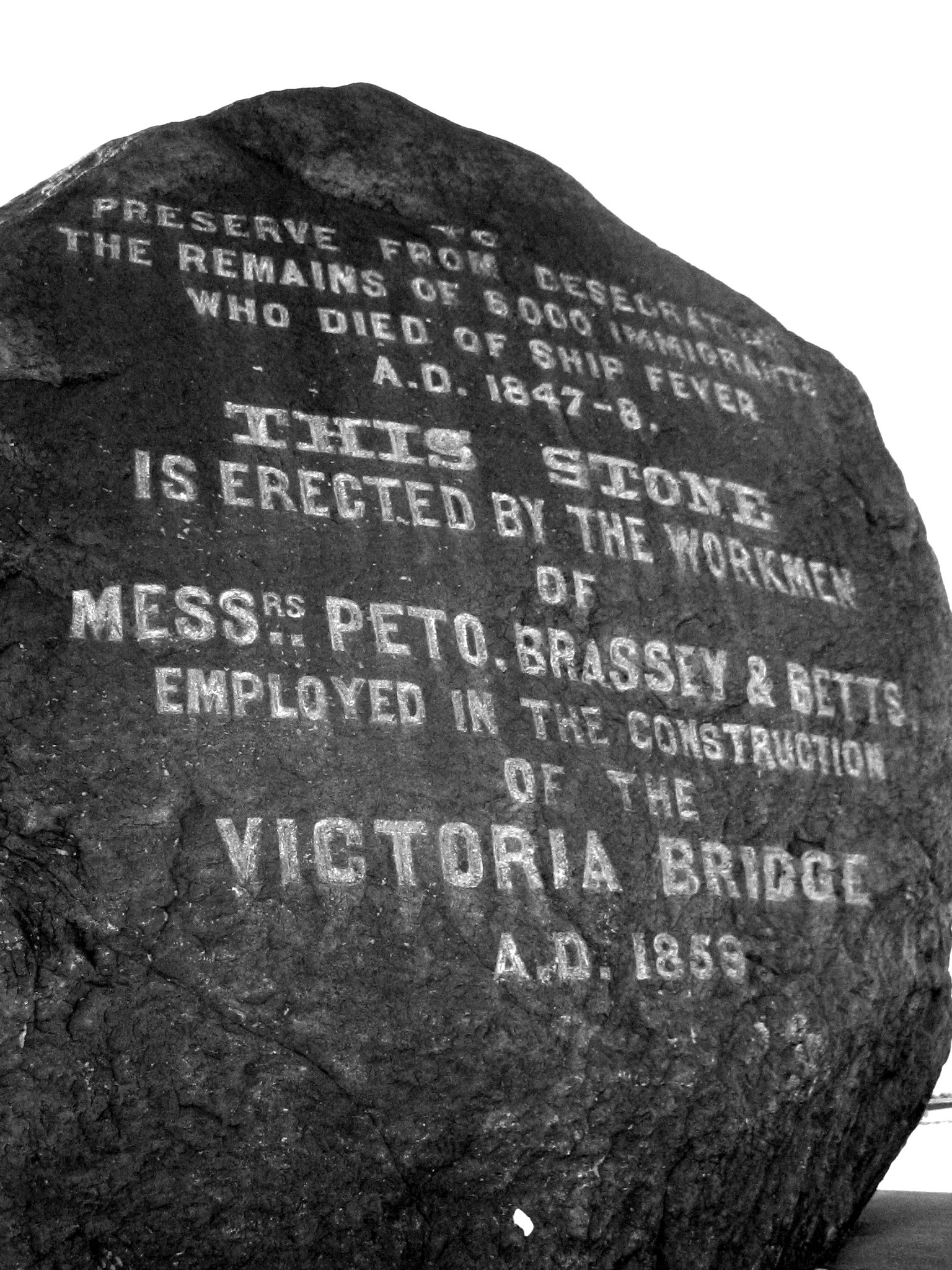
The Black Rock, erected in the memory of the mass grave. Today it's located on Bridge St. in Pointe-Saint-Charles, on the approach to the Victoria Bridge
The designer, Anouk Louten, contacted me as she attempts to get a handle on Irish culture and life in Griffintown in the mid-19th century, attempting to re-create a set as authentic as possible.
This, of course, got me thinking about the usual intersection of history, memory, and the public. Because of course Gow is taking licence from the historical record for the purpose of creating art. It is true that the mass grave of Irish Famine victims was found by the bridge workers, who were also Irish. But the workers probably lived in Goose Village, not Griffintown. A minor quibble with the historical record, to be sure, but still one that those who argue for ‘authenticity’ get their knickers in a twist over. And, I’m sure Gow will also take artistic licence with the characters, their setting, and so on and so forth.
This week, in class, I was teaching the Persian Wars, including the legendary battle at Thermopylae in 480 BCE. Of course, pretty much the entire Western world has seen the movie, 300, which fictionalises what actually happened at Thermopylae some 2,490 years ago. The movie over-dramatises the valour of the Spartans, distorts and obscures the rationale for battle decisions made by the Greeks (including the Spartans, who are conveniently left out of the decision to withdraw 6,700 Greek troops from Thermopylae to avoid being caught in a pincer movement by the Persians), leaving the brave Leonidas and his 299 Spartan warriors to hold off the Persians. As much as I love this film, I always find myself somewhat troubled by it, I kind of feel the film-makers made like the cops in the OJ Simpson case with the glove. Recall that the glove didn’t fit Simpson, who more than likely got away with murder at that trial. At the time, a friend of mine, a law student, opined that the cops may’ve planted the glove, so desperate they were to secure a conviction. If this is true (and really, who knows?), the over-zealousness of the cops allowed Simpson to walk (though, as they say, karma is a mother, and Simpson is in the slammer for other crimes right now). In the case of 300, the film-makers took an already dramatic story about Leonidas and his warriors and over-shot, they over-dramatised something which could’ve stood on its own.
So, as an historian, films like 300 bother me. Not because they take licence with the historical story, but because they pull an Oliver Stone. Stone, of course, once said that you had to hit American film audiences over the head with a mallet in order to get their attention. I think he’s wrong, people aren’t that stupid. But sometimes it makes great art, sometimes, most of the time, it’s just superfluous.
But artistic licence, I fail to see what’s wrong with that, it can make the story more interesting, it can allow the artist to make their point more effectively.
As for authenticity, I’m not sure it matters so much in the larger sense. Certainly, I like Anouk’s attempts to create an authentic set. That, for whatever reason, matters to me. The setting of historical novels, plays, films, this is the detail, the background of people’s lives. Take, for example, The Gangs of New York: a wildly fictional account of the goings-on in the Five Points of Manhattan in the early 1860s. The story itself may be a load of bollocks, but the setting of it in the Five Points, from what I can see, that’s authentic, that reflects the reality of life in what was probably the worst slum in the world.
But authenticity of story or experience (in the case of museums, etc.), I’m not so sure this is desirable or even possible. I think it is impossible to completely re-create the ‘authentic’ historical experience. For one, there’s the obvious problem: it’s impossible, because it is no longer 1861, or whenever. The physical setting is just that, a re-creation of the historical, it can be an authentic re-creation, but that’s as far as it goes. And I think that by itself is a laudable goal, but that should be the end goal. There is no need to go any further, because it is impossible to go any further.
And, so far as I’m concerned, if the story is based in this historical record, that it aims to reflect the setting, then that’s fine. Artistic licence needs to be taken, at least most of the time, maybe not so much in the case of Leonidas’ last stand.
 Matthew Barlow