The Shoe on the Other Foot
August 23, 2010 § Leave a comment
Being Canadian, it sometimes feels like we’re the ones on the short end of the stick in global affairs. We’re the ones the Americans invaded during the War of Independence and again in 1812. During World War I, the British used our troops as cannon fodder in battles like the Somme. We have been colonies of the French and the British. Economically, we’re largely dependent upon the Americans. Our peoples are descendent from the colonised of the world (ok, so is the rest of the Western world). In short, I think Canadians like to see themselves as victims, or at least feel like victims far too often. This is why winning double gold medals in hockey over the Americans at the Olympics is such a big deal. For that moment, we’re the winners.
The once-great Vancouver band, Spirit of the West, wrote a song back in the early 90s called “Far Too Canadian.” It’s a lament for our status as hewers of wood and drawers of water, amongst other things. The lyrics:
I’m so content, to stand in line
Wait and see, pass the time
Talk a streak, fall alseep, wake up late, whine and weep
I kiss the hand that slaps me senseless
I’m so accepting, so defenseless
I am far too Canadian
Far too Canadian
…I am the face of my country
Experssionless and small
Weak at the knees, shaking badly
Can’t straighten up at all
I watch the spine of my country bend and break
I’m a sorry state.
A sobering thought, that song. And all the cheesy, stupid, lame-brained Molson Canadian ads in the world (apparently has more square feet of “awesomeness per person” than any other nation on Earth) can’t change it.
That being said, we do have our moments, our victories, and our glories. But we tend to play those down, too (except when they involve gold medals, hockey, and the Olympics). We’re a modest people, I suppose.
So all of this being said, I’m always surprised to find Canadians on the other side, at least historically-speaking. Not far from Charlemont, Massachusetts, is the town of Deerfield. On 29 February 1704, during the War of Spanish Succession, a joint force of 47 French and Canadian soldiers and 200 Mohawk warriors (including the Pocumtuck, who had lived in what is now the Pioneer Valley before the English settlers arrived) raided Deerfield before dawn. The raid was partly in revenge for the settlers’ violent and callous treatment of the Pocumtuck, which culminated in a massacre in what is now nearby Montague Township in 1676.
The combined French-Canadian-aboriginal force caught the settlers unaware before dawn and massacred 56 people. 109 people survived the raid, they were captured and made to march 500km north to Québec, in harsh winter conditions. 21 of them either died or were killed during the trek. Most of those who made it to Québec were eventually ransomed and made their way back to Deerfield. A few, most notably the pastor’s daughter, Eunice Williams, chose to remain. Williams spent the rest of her life at Kahanwake, a Mohawk settlement near Montréal, marring a Mohawk man and having a family with him.
The Deerfield Raid was no doubt a traumatic event for the people of the small settlement. And it has lived on for the past 300 years, it is a foundational story in the Pioneer Valley of Massachusetts. At times, listening to people describe it, reading newspaper stories about the raid, and seeing how it is represented in the pop culture of the Valley, I even get the sense that the trauma of the raid lives on. Certainly, it is strange for a Canadian to realise the Americans were victims of the colonial era. It is even more bizarre to realise that one’s ancestors were the ones who caused the trauma. We are usucally the victims, not the aggressors of historical trauma.
The fact that the 1704 raid lives on in Deerfield, and is largely forgotten in Québec (as France lost that war), is significant. No doubt it lives on in part because Deerfield’s raison d’être today is as a tourist site. Historic Deerfield is a national historic site, and the town’s economy centres around the historical experience there, and the 1704 raid factors heavily into it. It is no doubt the most significant event to have occurred in Deerfield in its 337 year history. And, as a result of the historicisation of Deerfield, the 1704 raid gets played out, reinterpreted, and re-assessed almost daily by the town’s residents, the historical educators, and the tourists who come to visit.
But for me, a Canadian, the first time I visited Deerfield, on a warm, sunny day in late May 2006, I was stunned to find a place that was traumatised by Canadians, at least a place that was not an aboriginal settlement/reserve. And as I took in the colonial American scene in front of me that day, I couldn’t help but feel a shudder of fear imagining that 247-man strong force crawling across the plain along the Deerfield River, coming out of the mist and the snow and laying siege to a small frontier settlement. And every time since that I have driven past, or been into Historic Deerfield, I cannot shake that feeling of terror that the colonist there must’ve felt that cold February morning 306 1/2 years ago.
French Culture in Downtown Montréal
June 22, 2010 § Leave a comment
One of the most persistent complaints of the linguistic nationalists of Québec is about the fate of the French language in downtown Montréal. They claim it’s an English centre again, that they can’t get served in their own language anymore. It’s true to a degree, you hear more English in downtown Montréal than anywhere else in the city, but it’s not just because of the old Anglo business class. It’s also because downtown Montréal is where the tourists go, along with the old city. And the tourists, largely Americans, like to be served in their own language. But you want service in French, it’s there.
But there is a creeping Anglicisation going on here, culturally-speaking anyway. The downtown movie theatres don’t show French-language films, and if they do, they’re subtitled in English. There are no French-language bookstores downtown. There is an Indigo, a Chapters, a few Coles, and Paragraphe, which, despite its name, is an English-language store. There was a Renaud-Bray near Concordia University, but it closed a few years back and is now a chicken restaurant. The big Archambault in the old Eatons store is now a clothing store. The French-language music section of HMV downtown is wanting. And French-language DVDs there? Forget about it.
Yesterday, I was on a mission. I wanted to find a québécois film, le 15 fevrier 1839, about the plight of a few Patriote rebels and their execution in prison by the British on 15 February 1839. Anyway, this was a big film when it came out a few years back, caused a lot of controversy. One idiot writing in The Hour even claimed the Patriotes were génocidaires. So, I thought it would be easy to find. HMV doesn’t carry French-language films, though it does have a big section of French-language TV DVDs. The movie store in the Carrefour Industrielle-Alliance, its “Section française” is about 3% of the store. Indigo, forget about it. So I walked to the Renaud-Bray in Place-des-Arts. Nope, its film section is all English-language movies. So, for sure, the big Archambault at the corner of Sainte-Catherine and Berri would have it, correct? Nope. Its film section is also about 95% English-language films. Their québécois section is tiny, and shoved into the back corner of the store.
I don’t get this. Québécois cinema is the only one in Canada that is actually watched. People go to québécois films here, they make money, and so on. But don’t try t0 find québécois films on DVD in downtown Montréal, my friends. Because they’re not there. In the end, I had to go up the rue Saint-Denis to Boîte Noîre to find my film. The Plateau, that is.
The Apocalypse is Nigh
May 16, 2010 § Leave a comment
We interrupt regularly scheduled programming here on Spatialities to bring you the following developing news: this weekend, the Théâtre Corona, here in Montréal, held a 2-night tribute to Phil Collins: Dance into the Light: Le Meilleur de Phil Collins. The Phil Collins impersonator is Martin Levac, billed as “the best impersonator of Phil Collins” in the world, and his show spent last spring at Le Capitol in Québec before embarking on a 20-city European tour.
Yes. Phil Collins merits a tribute show. I always thought that in order to merit a tribute, an artist had to be, well, an artist. A Phil Collins tribute. WTF?!?
The Irish & Crime in 19th Century North America
May 4, 2010 § 7 Comments
WordPress lets me see what search terms lead people to this site. Usually, they’re predictable, people searching my name, or Griffintown, or things along those lines. But today, there is this term: “explain the strong association between the 19th century irish diaspora and crime?” So, explain I shall.
Yes, this is a stereotype. But behind this stereotype is some kind of truth. Yes, the Irish, especially Catholics in inner cities, tended to find themselves in trouble with the law in disproportionate fashion in the 19th century. This was particularly true in port cities: Montréal, Saint John (NB), Halifax, Boston, New York, Philly. 19th century sailors were hard-living men. And the consequence of that was an intimate knowledge of the inner workings of police stations in those cities. And, yes, a lot of those sailors were Irish Catholics.
There was also the matter of labour violence. The Irish tended to do the kinds of jobs that no one else would, but they also tended to guard their employment jealously, in that if someone else wanted to do their work (free blacks in the States, French Canadians in Québec), they would protect their right to work. Oftentimes with violence when others threatened to undercut their wages (and the Irish tended to do work on very thin margins to start with).
Connected to this was ethnic/racial violence. For example, the Bowery B’hoys Riot of 1857 in the Five Points of Manhattan, where the Irish Catholics who had recently settled there were attacked by the nativist gang, the Bowery B’hoys. Or in York Point, Saint John, in 1849, when the ultra-Protestant Orange Order insisted on marching through an Irish Catholic neighbourhood on the Glorious 12th. Or more internecine battles in places like Philadelphia between black and Irish workers.
As an aside, this has led to one of the most simplistic arguments I’ve ever come across. Noel Ignatiev, in his overly dramatic How the Irish Became White (in order to “become white,” you have to first be considered something other than “white,” and I’m not convinced that the Irish were ever seen this way), argues that slavery essentially lasted another generation in the United States because the Irish Catholic immigrants to New York and Philadelphia, poor working-class immigrants, I might add, refused to throw their lot in with the free black populations of those 2 cities prior to the US Civil War. Had they, he argues, slavery would’ve ended. So, in essence, Ignatiev argues that the Irish “became white” by siding with the Anglo-Protestant hegemons in the United Sates against the blacks. Of course, to have expected anything different is just, well, simple. Why would the Irish side with the blacks? The blacks were the only other group of people down near the bottom of the socio-econo-cultural totem pole with the Irish. So, obviously, they’re going to try to distance themselves.
Anyway, I digress. Political violence. Well, politics were corrupt in the 19th century, pure and simple, whether it was Tammany Hall in New York, or battles against Anglo-Protestant hegemony in Montréal, corruption was everywhere, and violence was a common tactic by all sides. The Irish got their shots in just like everyone else.
But the most common reason why the Irish found themselves in trouble with the law in North America wasn’t any of this. It was the drink. The Irish were a disproportionate number of public drunks in North American cities, at least in the northeast of the US and Eastern Canada, for much of the 19th century. But, before we get into stereotypes of the Irish and the drink, let us remind ourselves of something else: they were the working-classes, they lived hard lives of unsteady and dodgy employment in the factories, ports, and canals of these cities. Their lives were defined by insecurity, in terms of employment, finances, housing. Inner-cities of Boston, Montréal, New York, Baltimore, in the 19th century were, in many ways, worse than they are today. Housing was worse, social conditions were worse, welfare states were worse. And so, not surprisingly, people tended to distract themselves from their problems with alcohol. And not surprisingly, this means that they ran afoul of the law and ended up getting arrested. And the Irish, well, they were a significant chunk of the urban working-classes in these cities. So, no surprise that they appear so frequently in the crime statistics.
Years ago, I was reading a book by my MA supervisor, Jack Little, about state formation in the Eastern Townships of Québec in the mid-19th century. As the Grand Trunk Railway was being built between Montréal and Portland, ME, in the 1850s, Irish navvies flooded the Townships. A rash of crime broke out along the rail line, and Stipendiary Magistrate Ralph Johnston was dispatched out to Sherbrooke to investigate. The results of his investigation surprised him, and in his report to his bosses in Québec City, he stated that the crime was actually committed by non-Irish Catholic, non-navvies. In short, by locals. And the Irish-Catholics got the blame. “In the eyes of too many,” Johnston wrote, “their crimes are to be Irish and Catholic.”
Yup, racial profiling existed in the 19th century too.
Urban Archaeology & Material Culture
April 21, 2010 § 1 Comment
Recently, I’ve been thinking about urban archaeology and material culture. Given my research interests, I suppose it’s only natural that I would also think about the actual physical landscape of the city and how it shifts and changes with time, populations, and construction.
Years ago, I visited Montréal’s Pointe-à-Callière Museum, in the Vieux-Port. Point-à-Callière is the site of the first settlement of Ville-Marie, where Paul de Chomedy, Sieur de Maisonneuve decided to plant his new settlement in 1642. The museum itself is based around 3 archaeological digs (Pointe-à-Callière iteslf, as well as Place Royale and Place D’Youville), and artefacts from these archaeological digs are on display. But it’s not just that. In the underground of the museum, down where the digs took place, one can physically see the layers of city and settlement on Pointe-à-Callière, from the initial aboriginal inhabitants through the founding of Ville-Marie, to the governor’s mansion that was once located there, through urbanisation, industrialisation, and so on. The physical remnants of the buildings, and artefacts are there for the viewer to see.
My favourite part is the William sewer, which canalised, and placed underground, the Rivière Petite Saint-Pierre, which itself had become a stinking cesspool as it flowed above ground through what was once the Nazareth Fief (and later Griffintown), into the St. Lawrence, hence creating Pointe-à-Callière. Apparently (at least according to its entry on Wikipedia), the museum has plans to open up and expose the Petite Saint-Pierre, as well as the old location of St. Ann’s Market in Place D’Youville, as well as the remains of the Parliament House of the United Province of Canada, which was burned down in the Rebellion Losses Bill Riot in 1849 (just imagine a riot today in a democracy burning down the house of parliament!).
Anyway, this is where I first thought about urban archaeology, but I never really gave it much more thought in terms of my academic interests until a couple of summers ago, whilst walking along the Canal Lachine, where, at the St. Gabriel locks, Parks Canada has dug up the foundations and remnants of a factory on the northeastern side of the locks.
Andy Riga, over at The Gazette, has an interesting blog, “Metropolitan News;” his latest post is about the public toilets, disused and buried under Place D’Armes. During the reign of Mayor Camillien Houde in the 1930s, partly as a public works project, Vespesiennes were built in Carré Saint-Louis, Square Cabot, amongst other places, and public washrooms were constructed in places including Place D’Armes. The washrooms there were shuttered in 1980, victim of many things, including Montréal’s notoriously crumbling infrastructure. Since then, there have been a few plans or attempts at plans to revive the public toilets, but they are in serious decay and would cost too much money to renovate them, due to years of neglect, water damage, and humidity. So they remain buried under Place D’Armes which, like Dorchester Square downtown, is undergoing a massive renovation.
So notions of what’s underfoot have long interested me as I’ve wandered about the city, but especially in the sud-ouest, Griffintown and Pointe-Saint-Charles, as well as Saint-Henri, where I’ve lived for most of the past decade.
Also, too, there is the influence of Prof. Rhona Richman Kenneally of Concordia University, who encouraged me to give some thought to material culture in approaching my dissertation and my work on Griffintown. Ultimately, as interesting and exciting as I found approaches to material culture in my studies, there was no way to fit it into the dissertation (the same can be said of proper mapping of the Griff). But I remained intrigued by these ideas.
So, with all of this in mind, I finally got my hands on Stephen A. Brighton’s Historical Archaeology of the Irish Diaspora, based around digs in the Five Points of Manhattan and in Newark, New Jersey. Using the archaeological evidence, Brighton constructs an argument centred on the material culture of 19th century Irish-American life in these two urban centres. Using this methodology, Brighton is able to answer a lot of questions we cannot answer using more traditional historical methodologies. Brighton has the remnants of the material culture of the Irish immigrants and Irish-Americans. Finding glasswares with symbols of Irish nationalism on them suggests that the movement had some traction amongst the tenement dwellers of the Five Points.
My favourite part of his analysis, though, comes in relation to medicine. The artefacts from the Five Points come from the 1850s and 60s, whereas those in the New Jersey digs are from the 1880s. In other words, the Five Points Irish were more recent arrivals and lived in greater poverty than those in New Jersey. Thus, their access to the nascent public health system was different than that of their compatriots in Jersey. Brighton found that the Five Points Irish relied more on cure-alls and pseudo-medical tonics to cure what ailed them. Throughout the dig site are bottles that once contained tonics and cures, whereas in New Jersey, the digs uncovered evidence of reputable medicines. This, concludes Brighton, is symptomatic of that poverty but also, too, perhaps of the alienation of mid-19th century Irish immigrants from the mainstream of American culture and society (remember, the 1850s also saw the Know-Nothing movement in the USA and the Bowery B’hoys Riot of 1857).
So what Brighton offers up here is a piece of evidence to support what historians already know from more traditional sources. And this brings me to my problem with Brighton’s book: it doesn’t add much in the way of new information to our historical knowledge. Rather than challenge historians’ traditional takes on the Irish in the Five Points (especially), Brighton confirms what we already knew with the archaeological evidence.
Montreal Mosaic
March 31, 2010 § Leave a comment
I have an article published on the Montreal Mosaic website on the Montréal Shamrocks Hockey Club, based on the article I published. You can read it here.
Positive Feedback
March 27, 2010 § Leave a comment
A few months ago, I published an article in a book edited by John Chi-Kit Wong of the University of Western Washington in Bellingham. The book was entitled, Coast to Coast: Hockey in Canada to the Second World War (University of Toronto Press, 2009), and my article was entitled “‘Scientific Aggression’: Class, Manliness, Class, and Commercialisation in the Shamrock Hockey Club, Montreal.”
Today, John forwarded the authors a review of the book from the H-Arete listserv, which deals with sport history, written by Jason Blake, University of Ljubljana, Slovenia. Blake had this to say about my article:
A few chapters show a keen interest in narrative, examining individual newspaper reports and trends in sports reporting. In “‘Scientific Aggression’: Irishness, Manliness, Class, and Commercialization in the Shamrock Hockey Club of Montreal, 1894-1901,” John Matthew Barlow argues that reporters in Montreal “became less concerned with the idea of fair play” and “more interested with winning and losing” (37) long before the amateur debate died. In a special subsection, Barlow provides cogent Ð almost literary Ð readings of individual press accounts. Important, too, is his highlighting of how self-consciously the journalists created stories of games. Consider this 1900 pronouncement: “Narrative in the superlative can only convey an imperfect sense of the paragon of perfection and sensation detail of this, the last and premier exhibition of a week’s great hockey” (64). It’s a shame Aethlon was not around then.
Very nice to get such good feedback on my first publication.
Modernist Architectural Behemothology
March 11, 2010 § 6 Comments
Years ago, I lived in Vancouver, perhaps once the greatest example of Modernist architecture in Canada, if not North America. Vancouver is the city that unleashed architect Arthur Erickson on the world. Sadly, Erickson died last spring. Yet, Erickson’s buildings live on in Vancouver, especially his modernist designs, most notably Simon Fraser University in suburban Vancouver (where I completed my MA), and the Canadian Embassy in DC.
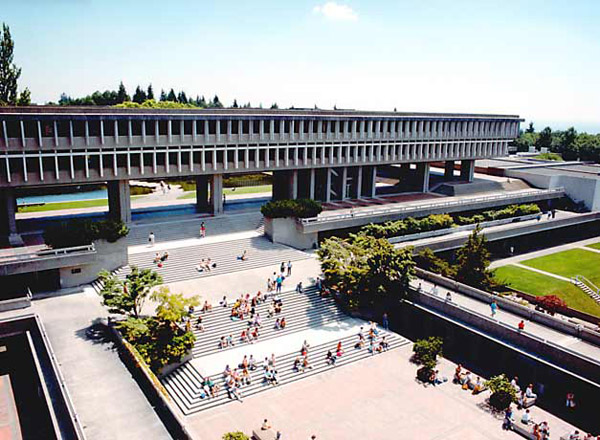

Indeed, one of my favourite architecture books is Rhodri Windsor Liscombe’s The New Spirit: Modern Architecture in Vancouver, 1939-1963. Modernist buildings haven’t really stood the test of time, I have to say, especially those designed to look like concrete bunkers, such as the Canadian Embassy. SFU is one of the most depressing places in the world on a cloudy, rainy day atop Burnaby Mountain. Unfortunately, it is often rainy and cloudy atop Burnaby Mountain. University campuses across North America are dotted with modernist buildings, as the great boom of construction on these campuses came at the height of modernism in the post-War era. In many instances, modernist behemoths look as if they were dropped into more classical settings, such is the case of Student Center Building at the University of Masscachusetts, Amherst. In the picture below, you can see those older, classic buildings scattered around the Student Center and the residence towers behind it.

So pervasive is modernist architecture on campuses that it is oftentimes pejoratively referred to as “Neo-Brutalist” architecture. Indeed, buildings such as the Student Center, or the entire Burnaby Mountain campus of SFU, re-enforce this. The buildings are concrete, massive, and imposing. Inside, there is a lot of dark browns, dark woods, and black. Gloomy is about the only way to describe these interiors.
Long and short, the term “Neo-Brutalist” quite often fits, not that there aren’t some beautiful modernist buildings to be found, such as Vancouver’s old BC Hydro Building, which has since been condofied, or MOntréal’s Palais de Congrès.


But, despite this, I can’t help but chuckle when I read stories like this one in the Globe & Mail yesterday, about the Public Safety Building in Winnipeg.

This particular behemoth, built in 1966, is a textbook case of Neo-Brutalist Behemothology. Frequently the several hundred employees of the Winnipeg Police Force are required to vacate the building because of noxious fumes that waft up into the building. This happens frequently, apparently. This time it required the Hazmat to come. The PSB is built out of
brittle Tyndall limestone, hasn’t held up against Winnipeg’s climate. Dozens of steel brackets cling to the building’s exterior like Band-Aids, preventing the facade from avalanching into the street. A $98,000 awning encircles the building, stopping pieces of the gaudy structure from braining pedestrians.
And this is the crux of the problem with many Neo-Brutalist behemoths, from SFU to Montréal’s legendary Stade Olympique, known in English as the “Big O”, or more fittingly, the “Big Owe,” as it took 30 years for the city to pay off its legacy from the 1976 Summer Olympics, by which time the Expos had decamped for Washington and the Alouettes had been re-born in McGill University’s quaint Molson Stadium at the foot of Mont-Royal. But the Big Owe and the PSB, and SFU, for that matter, all have something in common. The materials used to build them aren’t all that well-suited to the climate they are in. Hence, the PSB is falling apart, the Big O has had large slabs of concrete fall off it, and SFU, well, that much concrete in a rain forest isn’t the best idea, either.

But the bigger question is what to do with these buildings, especially those that are falling apart or being abandoned, as is the case with the PSB. Urban preservationists in Winnipeg argue that the PSB is worth saving,
According to University of Winnipeg Art Historian, Serena Keshavjee,
It’s not a love-hate relationship people have with these buildings; it’s just hate. People grew up with these buildings and don’t see them as heritage buildings, but the same thing happened 40 years ago with Victoria structures.
Had we ripped out every Victorian building in the country we would be very sorry these days,” she said. “And these are the times when they become vulnerable. The country is coming out of recession and people are gearing up to tear things down.
UW historian David Burley echoes, arguing that modernism
reflects a time when the federal government lavished money on public projects and Canadian pride soared ahead of Expo 67 and the centennial. “It was a nationwide movement,” he said. “There was this great optimism. The central parts of cities had deteriorated and there was a sense it was time to redevelop things.”
Personally, I’m not so sure that a modernist building is worth saving just because of its own merits. A building like the PSB is an ugly imposition on the urban landscape. Buildings like it seem to mock their landscapes, they don’t fit in, they crush them, they impose upon them. They belittle us. Of course, granted, that’s the point with a police station, or at least it was in the 1960s. But that doesn’t mean a building should be saved just because it’s old. Sometimes, old things are just junk. And the PSB is an example of that.
The Problem With Writing History
March 5, 2010 § Leave a comment
I just finished Orhan Pamuk’s brilliant novel, Snow. It tells the story of a hapless Turkish exile poet, Ka, who returns to Turkey from Frankfurt. Ka is a poet without poems. He’s not written one for years when he accepts an offer from a friend who edits a Republican newspaper in Istanbul to travel to the distant eastern city of Kars. In Kars, there has been a wave of suicides by young women wearing the hijab, which is seen as a challenge to the Turkish republic of Ataturk. They were expelled from their university studies for refusing to remove them. And so a group of them killed themselves. But nothing is at seems in Kars, and Ka is drawn into the city’s murky underside, in part due to a bizarre coup led by an actor, in part because he falls in love for the beautiful Ipek, in part because of the radical Islamist terrorist, Blue. Kars is a poor city, isolated, and caught in its place in history on the borderlands, caught between its Russian, Turkish, and Armenian pasts. And Kars is isolated during Ka’s visit, it’s snowed in. It’s a mountain city and all roads in and out, as well as the railroad, are blocked by heavy, heavy snow. This isolation has its own in-built tension between this forgotten borderlands city and the cosmopolitan capital of Turkey, Ankara, and its interntionalised largest city, Istanbul. This tension within Kars echoes that of the Turkey that Pamuk presents, between this Europeanised cosmopolitanism and traditional Turkish culture, to say nothing of Islamism. And Ka, as a westernised Turk living in exile in Germany, is a focal point for this tension.
Anyway, I don’t want to give away the plot, because if you’ve not read Snow, you should. It’s not for nothing that Pamuk won the Nobel Prize for Literature in 2006.
What I want to point to is a discussion the narrator of the novel has with an associate of Ka’s, Fazil, at the end of the book. The narrator, Pamuk himself, responds to Fazil’s early declaration that he can only write about him in the book Pamuk is writing on Ka’s visit to Kars if he agrees to include what Fazil wishes to say to Pamuk’s readers. He says this:
‘If you write a book set in Kars and put me in it, I’d like to tell your readers not to believe anything you say about me, anything you say about any of us. No one could understand us from so far away.’
‘But no one believes in that way what he reads in a novel,’ I said.
‘Oh, yes, they do,’ he cried. ‘If only to see themselves as wise and superior and humanistic, they need to think of us as sweet and funny, and convince themselves that they sympathize with the way we are and even love us.’
Fazil’s words have resonance for me as an historian. I study the working-classes, I study people by-and-large excluded from, or oppressed by, systems of power. The community I study is one that was an inner-city, working-class slum. The people who lived there, grew up there, they’ve escaped, moved up the social ladder. But that history is still there.
A few years ago, I was hired as a consultant by an advertising agency working on behalf of Devimco, the development company that was planning to radically re-build Griffintown. Devimco was trying to make its plans more palatable, so they hired this advertising agency, as well as a consultant, an American living in London. This consultant has done some impressive things with shopping malls across the UK and in places like Dubai. Anyway. He prepared a text for all of us to ponder for our 2-day summit on the future of the Griff. Basically, he wanted us to come up with a marketable narrative for Griffintown, which was why I was there; the historian. In this text, he wrote:
Griffintown represents the next generation in Montreal’s long history of bold waterfront stewardship. What makes it unique is that it restores the public’s access to the waterfront, making it home for a real community, instead of simply an industrial workforce.
Leaving aside the fact that Montréal actually has a long history of the opposite of “bold waterfront stewardship” (Autoroute Bonaventure, anyone? How about all those port facilities?), the part I’ve italicised, dismissing the former residents of the Griff as simply an industrial workforce really just echoes what Fazil says in Snow. This consultant is dismissing these real people, arguing that because they were the working-classes, they couldn’t have culture or community. We’re supposed to feel superior to them, we’re supposed to see ourselves as better than them.
This is something that plagues historical scholarship, going back to the days of Herodotus. Even despite E.P. Thompson’s entreaties to be fair to the working-class (or any other subaltern group, really), to “rescue them from the enormous condescension of posterity” (to quote from his masterful The Making of the English Working Class), it’s a hard road to hoe. Indeed, Thompson himself is partly to blame for this, by taking on this providential charge to “rescue” the working-classes. We shouldn’t do that, either.
Instead, what we strive to do is to take our subaltern, down-trodden, excluded, or what-have-you, people is to take them for what they are/were: people like us. This is hard to do, it is hard to be sensitive to our historical actors, to recognise them as multi-dimensional actors, with agency, just like us. Joy Parr helps us see that in her The Gender of Breadwinners, wherein she reminds us that the roles our historical actors play were not sequential, but simultaneous. We are many things at the same time, and so, too, were our historical actors.
This is something I think historians of the subaltern need to be reminded of regularly, it’s not something we can read in a book once and keep in mind when we’re actually doing our work. This point needs constant reinforcement. It’s easy to forget, really. For me, that Devimco session helped. So, too, does doing oral history. And so, too, has the reading of Snow. I must keep Fazil’s words in mind.
Nuit Blanche à Griffintown
February 20, 2010 § Leave a comment
This Saturday, 27 February, is Nuit Blanche in Montréal, and there will be an event in Griffintown to celebrate. Organised by Le Comité pour le sain rédeveloppement de Griffintown, spearheaded by Judith Bauer, the event will be taking place at the site of the New City Gas Works, owned by Harvey Lev, located at 140 and 143, rue Ann.
There’s a whole bevy of cultural events on deck, including talks about the history of the neighbourhood, poetry readings, live music, artwork, and all kinds of other fun stuff. The website is here.
Also of note is that the Griffintown Horse Palace Foundation will have a table there to sign people up for membership and to raise funds for our ultimate goal, to buy and convert the Griffintown Horse Palace into a museum.
 Matthew Barlow