Race, Class, and Food Insecurity
May 21, 2014 § 5 Comments
When we lived in Pointe-Saint-Charles in Montreal, we lived about two doors down from a community garden in the shadows of the massive Église Saint-Charles. That community garden had been there as long as I could remember, it pre-dated my first residence in the Pointe back in 2002-4. The people who used it were the poor, working-class and marginalised Irish and French Canadians who lived in the Pointe. But, by about 2009 or 2010, the garden had been taken over by the gentrifiers, forcing out the old school urban harvesters. Many of these gentrifiers thought they were new and unique in gardening in an inner-city neighbourhood. Indeed, this is something I saw over and over again in Montreal, on the Plateau, Saint-Henri, the Pointe, and other neighbourhoods, as hipsters discovered the benefits of community gardens.
But they were hardly new ideas in old working-class neighbourhoods, particularly in the Pointe. The Pointe had long had community gardens. Aside from this one in on the rue Island, there was also a bigger one in the shadows of the railway viaduct along the rue Knox. And the problems arise when the original inhabitants of the Pointe were forced out of these gardens by the gentrifiers. The gardens were used to supplement diets, obviously. I also noticed something else when I lived in the Pointe in the early part of the past decade and when I was in Saint-Henri mid-decade. In both neighbourhoods, the local IGA (grocery store), both owned by the same family, the Topettas, opened new, glitzy stores. The IGAs in the Pointe and Saint-Henri had been in grotty store fronts, on rue du Centre in the Pointe, and rue Notre-Dame in Saint-Henri. When the new IGA opened in the Pointe c. 2002 and in Saint-Henri in 2005-6, I noticed a lot of low income families wandering around the stores with a slightly dazed look on their faces, complaining about rising prices. This was ameliorated some by the opening of the big Super C at Atwater Market, which generally had much lower prices than either IGA.
I was thinking about all of this as I was reading an excellent article on TheGrio about food insecurity and food gentrification. The article was written by Mikki Kendall, an African American feminists in the States, about the process of food gentrification. Kendall writes about having grown up poor and eating the more undesirable cuts of meat, like hamhocks, neck bones, and the like. She recalls her grandmother being an expert at turning “turning offal into delicious.” Kendall notes the gentrification of what I call poor people’s food. As haute cuisine chefs re-discover these traditionally less desirable foods and turn them into fancy dishes for the wealthy, it drives up the prices of these cuts.
[As an aside, I can’t help but wonder if the joke is ultimately on the wealthy eating these cuts of meat at expensive restaurants and I think of Timothy Taylor’s brilliant début novel, Stanley Park, which recounts, in part, the story of Jeremy Papier, a chef and restaurauteur in Vancouver. Papier favours local ingredients and culture and comes to rely on animals trapped in Stanley Park for his fancy restaurant on the border of the Downtown Eastside, the poorest urban neighbourhood in Canada.]
But to return to Kendall and the IGA and community gardens in Pointe-Saint-Charles: Kendall notes that with the rising cost of these traditional cuts of meat used by the poor comes an inability to purchase them:
Yet, as consumers range further and further afield from their traditional diets, each new “discovery” comes at the expense of another marginalized community. Complaints about the problem are often met with, “Well, eat something else that you can afford” as though the poor have a wealth of options, and are immune to dietary restrictions based on religion, allergies, access, or storage capabilities.
So, ultimately, the poor are left to eat processed food, which isn’t good for any of us. That is the only thing that is easily accessible. When I was student, I noted with deep and bitter irony that the cheapest meal option was often McDonalds. Or, if I went to the grocery store, aside from Ramen noodles (a processed food I cannot stand), the cheapest option was Kraft Dinner (or Mac & Cheese for you Americans), another slightly vile processed food (full confession: KD remains my comfort food of choice, I import large quantities of it from Canada).
And the end result of all of this bad, processed food is the toll it takes on the health of the poor, both in urban centres and rural areas. In the United States, African Americans are, on the whole, poorer than everyone else. In Canada, it is the aboriginals. It is no coincidence that food insecurity hits African Americans in the US hard. It is also no coincidence that rates of heart disease, hyper-tension, diabetes, and obesity are much higher in African American and Canadian aboriginal communities than in the rest of both nations.
We can and must do better.
Griffintown and the Importance of Urban Planning
May 12, 2014 § 6 Comments
This will be the first of a series of posts on Griffintown this week. I was in Montréal last week, mostly to finish up a bit of research on the Griffintown book, which, at least has a title, ‘The House of the Irish’: History & Memory in Griffintown, Montreal, 1900-2013. The last chapter of the manuscript deals with what I call the post-memory of Griffintown, the period of the past half-decade or so of redevelopment and gentrification of the neighbourhood. Griffintown was in desperate need of redevelopment, so let’s get that out of the way first and foremost. A large swath of near-vacant city blocks next to the Old Port, along the North Bank of the Lachine Canal, and down the hill from downtown, it was inevitable that it would attract attention.
My problem was never with redevelopment per se, then. My problem was with unsustainable development, willful neglect of the environment, of the landscape of the neighbourhood, and with blatant cash grabs by condo developers, and tax grabs on the part of the Ville de Montréal. And so that’s what we now have in Griffintown, for the most part.
In between conducting oral history interviews with my former allies in the fight for sustainable redevelopment, I wandered around Griffintown, Pointe-Saint-Charles, and Saint-Henri a fair bit. This was both professional interest and because I lived in the Pointe and Saint-Henri. I also had an interesting discussion with a clerk at Paragraphe Books on McGill College. Then there were the interviews.

Housing development, Copenhagen.
My friend Scott MacLeod says that many of the condos going up in Griffintown look like “Scandinavian social housing.” I think he’s onto something. This is a picture from a housing development in Copenhagen. It is quite similar to what’s going up in Griffintown, with one key difference. In Copenhagen, there is green space. In Griffintown, there is none.
Part of the genius of Montreal is an almost utter lack of urban planning on

Griffintown condos.
the grand scale. And in the case of Griffintown, the city has been almost negligent in its approach. During its overzealous attempt to approve any and all projects proposed by developers in Griffintown from about 2006 to 2010, the Ville de Montréal overlooked a few key components for the new neighbourhood: parks and schools. It was only after 2010 that the city thought that maybe it should earmark some land for, you know, parks. Schools? Who needs them?
Griffintown: Keegan House Saved. Really?
April 29, 2014 § Leave a comment
Montreal is a strange place. The city basically works in completely counter-intuitive ways. Last week, the Comité consultatif d’urbanisme (CCU) of the arrondissement sud-ouest of the Ville de Montréal denied permission to developer, Maitre-Carré, to tear down the oldest building in Griffintown, a grotty old house that stands at 175, rue de la Montagne. The Keegan House, as it is now known, was built sometime between 1825 and 1835, on Murray Street, a block over from its present state. It was moved to what was then McCord Street in 1865, around the same time that the handsome row of townhouses was constructed up the block.
When Maitre Carré’s plans were first made public, I was apprehensive, but also thought that perhaps the developer deserved our benefit of the doubt, insofar as it had, at least, made some nod to heritage in Griff when Hugo Girard-Beauchamp, the company’s president, bought the Horse Palace and has at least nodded to the idea of maintaining the Palace as a working stable going forward (whether this will happen in practice is a whole different kettle of fish). Indeed, as my friend, G. Scott MacLeod, a film-maker interested in Griff, said, Maitre-Carré is the only developer that has at least acknowledged the history and heritage of the neighbourhood. Indeed, other condo developers, most notably Devimco and Préval have been more interested in stuffing ugly, neo-brutalist blocks of condos down on the Griffintown landscape, completely destroying the streetscape (such as it existed) and dwarfing the original buildings.
Having said all that, at this point anyway (because one never knows in Montreal), this is an optimistic sign. Anne-Marie Sigouin, the city councillor for Saint-Paul/Émard, and the chair of the CCU, said (according to The Gazette) “We have sent the architects back to the drawing board. We want to send a clear message on heritage protection.” This is rather surprising, since the CCU and the Ville de Montréal as a whole have not demonstrated much in the way of leadership up to now in Griff.
J’Accuse Mme Marois
April 8, 2014 § 1 Comment
Last night’s Québec election was about the worst outcome imaginable, as far as I’m concerned. The Parti libéral du Québec won a majority, with 70 seats in the National Assembly. The PLQ also took 42% of the popular vote. The Parti québécois got the clock cleaning it deserved, reduced to 30 seats and a scant 25% of the popular vote. Pauline Marois also lost her seat. The third place finisher was the Coalition pour l’avenir du Québec, with 22 seats and 23% of the popular vote. And finally, Québec solidaire is bringing up the rear with 3 seats and 8% of the popular vote.
The upside is the contemptible Marois is out of office and out of the National Assembly. But that’s about as far as it goes for me. Two years ago, Montréal streets were full of hundreds of thousands of protesters. The protests began when then-PLQ Premier Jean Charest declared he would lift the tuition freeze in Québec and let tuition rise. Students protested. I felt, as a professor, it was my duty to join them, to ensure that they would continue to enjoy first class education at an affordable price. A generation ago, it was my generation fighting for the right to an affordable education, this was their turn. But they needed help. But then Charest went whole hog on the protesters, and began denying their civil rights, declaring it illegal for protesters to cover their faces, amongst other things. And the Service de police de la Ville de Montréal weren’t exactly excited about allowing citizens their right to protest, quickly declaring protests illegal as an excuse to kettle, arrest, and otherwise abuse protesters. This was the tipping point, however. This is when something beautiful happened in Québec: the people came out to join the students. Not just professors, but the average Quebecer was out there, appalled at M. Charest for denying the students their rights.
This movement got dubbed the Printemps erable, a play on the Arab Spring across the world. There are all kinds of problems with this appellation, of course. Quebecers weren’t getting shot in the streets, our lives were not in danger, we were not a stifled populace under a brutal dictatorship, as in Egypt and other places.
There was a provincial election campaign in the midst of all of this. Pauline Marois got out there on the streets, wearing the carré rouge, the sign of protest, promising to undo Charest’s sins. One of the students’ leaders, Léo Bureau-Blouin, ran for the PQ in a Montréal area riding. Marois rode the tide of protest to office, though with a minority government. And almost immediately, she changed her tone. Amongst her greatest sins was the Charte des valeurs, which was to impose la laïcité on Québec, which, as I noted yesterday, in and of itself is not a bad thing. But when it’s used to target Jews and Muslims, well, then there is a problem. And in the wake of Marois’ declaration of the charte, anti-Semitic and anti-Muslim activity increased in Québec, especially in and around Montréal. Ugly times had returned.
Marois staked her case for re-election on the charte. She thought that by denigrating every single Quebecer, by appealing to the lowest common denominator, by loudly declaring that Québec is an intolerant society, she could win a majority. Happily her cynical move failed. And now she is just another failed politician. I hope she loses sleep over this.
What many Québec Anglophones fail to recognise is a degree of difference in the sovereignty movement. Thus, the PLQ can rely upon Anglo votes. For example, in the Wesmount-Saint Louis riding of Montréal, which is a predominately Anglophone riding, the PLQ member, Jacques Chagnon, was re-elected was 83.2% of the vote. The sovereignty movement has never been built on a push to get rid of Anglos, or to otherwise strip them of their rights. René Lévesque, the founder of the PQ and the modern sovereignty movement, was always clear on that, as has been pretty much every leader of the PQ, with the exceptions of the noted Anglophile Jacques Parizeau and Marois. In the 2000s, the sovereignty movement attempted to move more explicitly to a civic nationalism, one that was meant to include all Quebecers, irrespective of skin colour, mother tongue, or religion. But it failed.
It failed because of small-minded provincialists of the likes of Marois, Mathieu Bock-Côté, and opportunists like Bureau-Blouin. They thought they could fall back on exclusionary politics to achieve their goal of an independent Québec. Happily, they failed miserably.
But the outcome might be even worse. With Marois gone, candidates for leadership of the PQ have emerged, the early frontrunners are the detestable Pierre-Karl Péledeau and Jean-François Lisée. Péladeau is filthy stinking rich, a member of the 1% if ever there was one. Before entering politics last month, he ran Quebecor, one of the world’s largest printers, which had recently branched into media. It publishes the vile Sun chain of newspapers across Canada, as well as owning Sun TV. In Québec, he owned about 2/3 of the private broadcasters, as well as the Journal newspaper chain. Lysée is a small-minded academic.
And then there’s the CAQ. A right-wing sovereigntist party. Frankly, given the current situation, the only way I see forward is for the CAQ and the PQ to merge. The CAQ and its leader, François Legault, are mostly former PQ members anyway. And if Péledeau or Lysée are going to continue to push the PQ further to the right, there is no difference between the two parties.
In other words, the sovereigntist movement, which has long been based on a model of social justice, has abandoned that in recent years. It is this belief in social justice which led me to support sovereigntist parties in Québec more than anything. The PLQ isn’t exactly noted for its progressivism. In short, the PLQ is just another right-wing, pro-business, anti-labour, anti-social justice party. So now Québec will have three of those, which together garnered 90% of the vote last night.
And that, frankly, depresses me. And I see Pauline Marois as at the fault of this.
The Distinct Culture of Anglo Quebecers
April 7, 2014 § Leave a comment
I have been on this listserv of policy wonks and academics in Canada since sometime in the late 90s. Most of the time, I’m not entirely sure why I remain on it, a small handful of the approximately 100 people on it post, and some use it to beat their hobby horses to many, many deaths. But, occasionally, it serves its purpose and intelligent discussion breaks out about various world events, Canadian politics, and the like. Over the past couple of weeks, one of those broke out over the Québec election, which is underway right now.
This has been the most divisive provincial election I’ve seen in Québec in my lifetime, though, admittedly, the bar was set very low with the ruling Parti québécois’ ridiculous, offensive, and racist charte des valeurs, a sad attempt at laïcité. That in and of itself, is fine, and is perfectly consistent with the Euro-francophone world, but the way it was introduced in Québec, and the manner in which it targeted minorities, most notably Arabs and other Muslims, was appalling. And since then, it’s been a raise to the bottom between the PQ, the Parti libéral du Québec, the Coalition pour l’avenir du Québec, and the 4th party, Québec solidaire. For the uninitiated, the PQ is a former leftist, sovereigntist party; the PLQ is a rightist, federalist party, the CAQ is a right-wing, sovereigntist party, and QS is a largely irrelevant leftist sovereigntist party. For the record, I voted QS in 2012 and would’ve again this year if I was still living in Québec.
So, to return to this discussion on the listserv. It was between an Anglo political scientist in Montréal, a Québec sovereigntist, a lawyer in Vancouver, and myself. Three Quebecers and an Anglo Canadian. The discussion largely centred around the PQ and its fitness for government, though, interestingly, the major issue of the election campaign, the charte was largely ignored by three of the four in this discussion (I was the fourth). The political scientist advocated the continuation of the status quo, a PQ minority, the separatist wished for a PQ majority (and a subsequent third referendum on sovereignty), I suggested the PQ was not fit for government based on the charte, and the lawyer ridiculed the entire idea of sovereignty. Other issues raised included protection of the French language and culture of Québec, as well as the fading generation of sovereigntists.
Pauline Marois, the current leader of the PQ and (at least until later tonight) the premier of Québec, is 65 years old. This puts her at the younger end of the baby boomers, who were the ones who really carried the idea of sovereignty in Québec. Interestingly, support for sovereignty is much lower amongst my generation (Gen X) and the millennials. The political scientist noted this, the need for younger blood in the PQ.
I argued that to simply dismiss the PLQ as incapable of defending the French language and culture in Québec is simple-minded, and I mocked the PQ for the charte and also pointed out QS’ near irrelevance. This led the political scientist to assume I voted PLQ. My guess, though, is that my name had more to do with that than anything. I found this rather disappointing, given nearly everything I’ve ever said about Canada/Québec on this listserv has made it clear I am not a knee-jerk Anglo Montrealer (like one I got into an argument with on Twitter this weekend who seemed to be suggesting Anglo Quebecers are a deeply oppressed minority).
But the real silliness emerged with the lawyer, who appears to be of the opinion that Anglo Montrealers and Anglo Quebecers do not have anything distinct about their language and culture, as compared with the Rest of Canada. He opined that in leaving Montréal for Boston, I did not give up much, as opposed to a francophone who would give up nearly everything. I find this argument both fatuous and depressing.
Anglo Montreal, at the least, has a distinct culture, specific to location. Anglo Montreal is often regarded as a large village, as it seems that all Anglos are no more than 3 or 4 degrees of separation from each other. But, more concretely, as McGill linguist Charles Boberg has discovered, Anglo Montrealers speak a dialect of English that is heavily influenced by French and is rather distinct from the Canadian English dialect. This makes sense. English is the mother tongue of about 650,000 people in Québec as a whole. This out of a total population of over 8 million. Within Montréal, out of a total population of nearly 4 million, about 420,000 people are native English-speakers. In other words, Anglos are a small island in a sea of francophone culture (to borrow the metaphor about Québec adrift in the North American sea of Anglos). As such, Anglo Montreal and Anglo Quebec have their own distinct culture and history, shaped as it was by the simple demographic fact of minority. This is very different than the plight of Anglophones in the rest of most of North America (except for Mexico and the American Southwest).
In other words, despite what a lawyer in Vancouver believes, Anglo Montrealers have their own distinct culture, language and identity, one that is separate and distinct from Anglo Canadians in the rest of the country. There are both positives and negatives to this, of course.
But, my Vancouver lawyer isn’t unique. He represents and all-too-common view of Anglo Canadians. Quebecers are perceived to either be beyond the pale of the Rest of Canada (if we’re francophones, I once got told in southwest Ontario that I speak “good English”), or we’re just like everyone else (if we’re Anglos).
So look at that, Québec is a distinct culture all around (Allophones, or immigrants and their descendants also have their own distinct culture in Québec). It might even be a nation unto itself.
Alienation and Belonging
March 28, 2014 § 2 Comments
An old friend visited us this weekend, and as he and I drove up the Massachusetts coast to hunt down the best pizza in the Commonwealth (Riverview in Ipswich, if you’re wondering), we got to talking about New England. Despite having lived in New England, he always feels like he could never penetrate the insularity of New England culture, and he always feels alienated here. I found that interesting, given I don’t feel that way at all, despite obviously being a transplant.
This might be the advantage of being an Anglo from Montréal. Anglo Montrealers are always at least slightly alienated from the city and dominant culture. We are a (small) minority, and we speak a minority language. That isn’t necessarily a bad thing, mind you.
I’ve always felt alienated from my surroundings. I grew up in British Columbia, very aware of the fact I didn’t belong, which came out in everything from my distaste of the wet, soggy climate to continuing to cheer for the Montréal Canadiens, Expos, and, when they existed, the Concorde or Alouettes of the CFL, as opposed to my friends who cheered for the Vancouver Canucks, the BC Lions and either the Toronto Blue Jays or Seattle Mariners. I felt similarly alienated in Ottawa. It was only when I moved back to Montréal I finally felt comfortable in my surroundings. But I still felt alienated from the larger culture, mostly due to language, even as my French language skills improved.
But, as with all things Montréal, it was never this simple. My Anglo friends and family dismissed any suggestion I might be a Montrealer, by continually reminding me I grew up out west. On the other hand, my francophone and allophone friends made no such distinction, and this is also true of my separatist friends. Go figure. Anglo mythology would have it the other way round. One of the most amazing moments of my life in Montréal came during the 2000 federal election campaign when I answered a knock on my door and found Gilles Duceppe, the leader of the Bloc québécois, with Amir Khadir, who was the BQ’s candidate in my riding (Khadir has since gone on to be the co-leader of the sovereigntist provincial party, Québec solidaire, and is currently the MNA for the Montréal riding of Mercier). Duceppe, Khadir, and I spent a good 15-20 minutes talking about place, identity, and belonging in Québec. Largely in English. Even the leader of a separatist party and the candidate for my riding didn’t dispute my bona fides as a Montrealer and a Quebecer (maybe, in part, because I assured them the BQ had my vote).
Since 2006, I have spent a lot of time in New England, before moving here in 2012, on account of my wife being American. She lived in Western Massachusetts when we met, so we did our best to split our time between Montréal and Western Mass. After all those years spending time out there, I came to feel like it was Home. Sure, I was never going to fully fit in, be a part of the scenery, but that was ok by me. And, even now, living at the other end of the Commonwealth, in the massive urban sprawl that is Boston, I feel similarly at home. The ways I feel alienated here are mostly due being Canadian. But I don’t find myself feeling excluded by New Englanders, or, really, Americans as a whole. In other words, I can deal with my alienation, it has kind of become my default way of being.
No doubt this is due to being an Anglo Montrealer and experiencing some degree of discomfort and alienation my entire life in my hometown and anywhere else I lived in Canada, tainted as I was, so to speak, by being from Montréal.
On PK Subban and Controversy
February 27, 2014 § 8 Comments
Watching the Canadian Men’s Olympic Hockey team at Sochi, I couldn’t help but shake the feeling that there is no way that PK Subban is the 8th best defenceman in the country. He’s the reigning Norris Trophy winner, an offensive threat, a hitter of big hits, a puck carrier, and he’s a rock solid defenceman. In short, Subban’s skill set seemed to fit exactly with what Canada needed, especially in the preliminary round when it was having problems moving the puck. And while Subban makes mistakes, so, too, do Drew Doughty and Duncan Keith, Canada’s golden boys of defencemen. And surely, Subban was a better choice to play than Dan Hamhuis or Jay Bouwmeester, at the very least? But, no, not in the eyes of the coaches. And, really, at the end of it all, what’s to quibble with? Subban handled his demotion with grace, and Canada won the gold medal going away, making it two in a row for the men, and landing their first medal on the big ice of the European game.
Subban attracts attention and controversy wherever he goes. A lot of it is racially charged, and a lot of it comes from people who should know better (which is everyone, frankly, this is the 21st century, not the early 19th). Subban is many things that many hockey fans do not like: flamboyant, exuberant, and incredibly skilled. As a result, aside from legitimate criticism, Subban attracts a lot of racist attention. Let me be very clear: criticising Subban’s play for mistakes or boneheaded plays is not racism. But a lot of the static around Subban is race-based.
When Subban broke into the NHL back in 2009, a lot of the media discussion was about controlling Subban’s exuberance, about toning him down. Oddly, when Maxime Lapierre played for the Habs, he was an energy player, who was always on the edge, running his mouth on the ice, irritating opponents, trying to goad them into penalties. Sometimes he crossed the line. But there were rarely discussions about the need to control or reign in Lapierre. Unlike Lapierre, Subban can make an entire building of fans rise to their feet with a rush up the ice, the kind of thing we Habs fans haven’t seen since the glory days of Guy Lafleur, frankly.
And yet, Subban has been called out by nearly everyone in the hockey establishment for his allegedly cocky attitude, from Don Cherry to Mike Richards, and everyone in between, including a few coaches of the Club du Hockey Canadien.
And criticisms are continually made about his play. That he takes too many penalties. That he gives away the puck too often. And so on. Oddly, the Habs other young defencemen are not subject to this kind of criticism. It’s a given that defencemen take a long time to mature and they will make errors on the way. And young players, especially, will be overly exuberant at times. But they’re given leeway Subban is not, at least in the media and amongst some fans.
And yet, Subban’s penalty minutes are not egregious. And, as far as his alleged poor defensive play, that’s just patently false, as this advanced stats discourse shows. It even shows that Subban can more than carry his weight in relation to the rest of the dmen on the Olympic team.
I won’t even get into Darren Pang’s rather unfortunate mistake of referring to Subban not doing something the “white way,” as opposed to the “right way” (it was a slip of the tongue, he apologised immediately, but, we all know what Freud says of slips of the tongue).
Racism, especially in Canada, works insidiously. There are certainly still loud mouth racists out there, but aside from the occasional offensive tweet or comment board post, that is not the discourse around Subban. I could also point out that Winnipeg Jets forward Evander Kane is similarly targeted by the media for his alleged bad behaviour. Kane is also black. No, rather than outright racism, this works in a more callous manner, it creeps along, and we find Subban (and Kane) critiqued for behaving in a certain way when other, white Canadian players, are not. We find the play of Subban (and Kane) under the microscope for alleged inefficiencies when others are not. We see the the character of Subban (and Kane) under question, when white players’ characters are not.
Case in point. After the 2011-12 season, Ottawa Senators defenceman Eric Karlsson won the Norris Trophy as the best dman in the NHL. There were protests that Karlsson was a one-dimensional player, he was a defensive liability, etc. That the likes of Doughty, Keith, Shea Weber deserved to win. But the outcry died down pretty quickly when advanced stats showed that Karlsson is actually a pretty good defenceman. And by the time the 2013 season finally began after an epic lockout, the controversy was over. But here we are now, at the tail end of February, Subban won the Norris in June last year, and the controversy lives on. Tell me that racism doesn’t play a role here.
The criticism directed at Subban is not of the ilk directed at other superstars, rather, it is unrelenting and often unfair and baseless. It’s very hard not to come to the conclusion that PK Subban is resented by many in the hockey world (fans, media, players, coaches, managers) for something as simple as the colour of his skin. And that, to me, is just stupid.
Half of Québec Anglos want out. Why this isn’t news
February 25, 2014 § 8 Comments
So the CBC is reporting that 51% of Anglos and 49% of Allophones in Québec have pondered leaving in the past year (compared to 11% of francophones) But, SURPRISE, it’s not because of language. It’s the economy, stupid. And Québec’s is sinking apparently. Another report I saw today said that Montréal’s economy is lagging behind the Rest of Canada’s major cities. In the past decade, Montréal’s GDP has grown by 37 per cent. Sounds impressive, no? Well. not really, since the five major cities in the Rest of Canada (Toronto, Vancouver, Calgary, Edmonton, Ottawa) have seen their cumulative GPD grow 59 per cent. As well, Montréal’s unemployment rate hovers around 8.5 per cent, compared with TVCEO’s (I think I just invented an acronym!) 6.3 per cent. Says Jacques Ménard, chair of BMO Nesbitt Burns and President of the Bank of Montréal in Québec, “Montreal has been slowly decelerating for 15 years, and now it shows. Another 10 years of this and we will be in clear and present danger.”
A decade ago, however, Montréal had the fastest growing economy amongst Canada’s major cities, from 1999-2004, as Montréal was, for all intents and purposes, a post-conflict society. Montréal was healing from the long constitutional battles that erupted in the 1960s and seemed to have been finally put to bed with the divisive 1995 Referendum on Québec sovereignty. Certainly, Québec was by-and-large still represented by the separatist Bloc Québécois in Ottawa, but the Parti Québécois government of Lucien Bouchard and André Boisclair, and then the Liberals of Jean Charest, turned attention away from the ethnic nationalist debates that had divided Québec for so long. Instead, Bouchard, Gilles Duceppe and most of the leadership of the nationalist movement began thinking in terms of civic nationalism, but the largest issue was put on the back burner. And, as a result, Montréal recovered.
I remember walking back across downtown after Maurice “The Rocket” Richard’s funeral in the spring of 2000. As I passed Square Victoria, a little boy was pointing at a crane on the skyline, asking his father, “Ce quoi ça, Papa?” He was about 5 or 6, and it hit me that he probably hadn’t seen a crane in downtown Montréal. But, in the first decade of the 2000s, Montréal underwent a construction boom, and prosperity returned to the city (and it slowly began to lose its unique character, at least in the downtown core and much of the Anglophone parts of the city as global culture took hold).
But in the wake of the 2008 Global Economic Meltdown, all bets are off. Québec is now governed by a tribalist Parti Québécois, led by the incredibly uninspiring Pauline Marois (and let me be clear, despite being an Anglo, I voted for the PQ 2003, 2007, and 2008, and for the sovereigntist Québec Solidaire in 2012 and I voted for the Bloc Québécois federally in every election), who seems determined to play to her base, whipping up a frenzy amongst the “bluenecks” outside of the metropole. And now Diane de Courcy, Minister of Immigration and Cultural Communities, says that if the PQ wins a majority in the election everyone knows is coming this spring, well, then we can expect Bill 101 to be toughened. Oh boy.
I would like to point out, however, that when de Courcy says “Montreal is not a bilingual city. Quebec is not a bilingual Quebec,” she is right. The metropole is a multilingual city at this point. But, it is the metropole of Québec, which is, at least officially, unilingually French.
BUT: I would also like to point out that had anyone thought about polling the Allo- and Anglo- phones about their thoughts on leaving Québec at any time in the past decade, my guess is that the numbers wouldn’t be all that different. Most diasporic groups in Montréal have connections to similar ethnic communities in other Canadian and American cities. And Anglophones have a long tradition of driving up the 401 to Toronto and beyond, or heading to the United States (hi, there). This is not news.
In conjunction with the depressing state of the economy in Montréal and Québec, and the struggles of thereof, it’s not surprising to see so much unrest in the province. Usually when the economy tanks, people at least give some thought to moving. And the years since 2008 have seen a fair amount of mobility in North America. Since Ireland’s economy collapsed at the same time, the Irish have been leaving home in search of new opportunities. What would make this real news is if even a fraction of those who claim to have thought about leaving did pack up and leave Québec. Then we would see something akin to the Flight of the Anglos from Québec in the late 1970s. Until then, this really should be filed under “Interesting, but not news.”
Montréal’s Griffintown Redevelopment #FAIL
February 6, 2014 § 3 Comments
The Gazette this morning reports news that the Keegan House just around the corner on rue de la Montagne from Wellington, and across from where St. Ann’s Church once stood, is under threat of demolition from Maitre-Carré, the developer responsible for the condo tower at the corner of de la Montagne and Ottawa. The Keegan House was built sometime between 1825 and 1835 on Murray Street, a block over. In 1865, it was moved to its current site.

The house was moved because of the development around Griff. Unlike many other urban neighbourhoods, and unlike the current redevelopment, Griffintown was developed on a lot-by-lot basis. There were not block long, or multi-lot developments as a rule. So as Murray Street was developed, Andrew Keegan, a school teacher, moved his house to a more prestigious locale, across the street from St. Ann’s Church. As David Hanna, an urban studies professor at UQÀM, notes, the block across the street from St. Ann’s was where the nicest housing in Griff was. But that is still a relative statement. Even the nicest homes in Griffintown could not compare with even the swankier locales across the canal in Pointe-Saint-Charles.
In recent years, the Keegan House has fallen into disrepair. I was in the building 7 or 8 years ago, and it was in rough shape. Maitre-Carré have bought the lots from 161-75 de la Montagne for redevelopment. Also slated to be demolished is the building that housed what used to be the Coffee Pot, a hangout for Griffintowners across the street from the Church. After the Coffee Pot closed in the early 1960s, the building was split in two, with a dépanneur and a tavern operating there. The tavern limped to its death about a decade ago. Both the Coffee Pot building and the Keegan House were given an unfortunate renovation in the 1950s or 60s, with their outer walls encased in concrete, which greatly diminished their aesthetic appeal.
Now what makes this story interesting and oh-so Montréal is that Hugo Girard-Beauchamp, the president of Maitre-Carré, claims that his company has no intention of destroying the Keegan House and, in fact, wishes to incorporate it into the new development. You know what? I believe him. Maitre-Carré and Girard-Beauchamp are the ones were worked with through the Griffintown Horse Palace Foundation. And while he remains a businessman, Girard-Beauchamp was also more than willing to listen to us and even help us preserve the Horse Palace. In fact, I would go so far as to say, at least when I was on the Board of the GHPF, that we would not have succeeded without his help.
However. This is Montréal. The borough isn’t sharing the plans for this development. Julie Nadon, the chief of planning for the borough, says they’re “confidential.” They shouldn’t be. Too much of the redevelopment of Griffintown has been done this way. The Ville de Montréal has operated in Star Chamber secrecy, refusing to divulge its plans to anyone other than the developers until it’s too late. A couple of years ago, the Ville de Montréal held a public session at the ÉTS to show off its plans for Griff. It’s plans had already been made with 0 public input. None. At all.
Montréal’s Star Chamber secrecy violates the very principles of democracy and the things that Montréal likes to pride itself on, which is an open city, with a creative class proud of its civic engagement. In Griffintown, the Ville de Montréal stonewalls civic engagement at each and every turn. It’s embarrassing and it’s no way to run a city. #fail
Changes in Griffintown, 2011-2014
February 6, 2014 § 1 Comment
I got an email from Dave Flavell the other day. I’ve known Dave for a few years; he contacted me awhile back for some help on a project he was doing on Griffintown. He was collecting oral histories of the community and its diaspora, with a view towards publishing a book. Last time we talked about it, he said the book was on its way to publication. This email contained photos of Griff, in particular of the Horse Palace on Ottawa street, taken in 2011, 2013, and 2014. The changes are stunning.
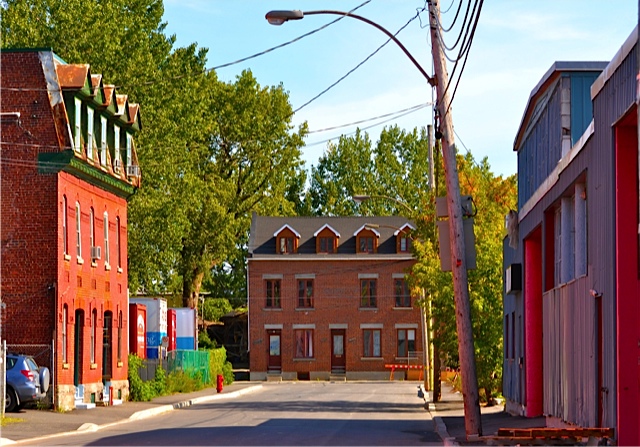
Griffintown Horse Palace, 2011. Photo courtesy of Dave Flavell
In the first photo, we look down Eleanor street at the Horse Palace, built in 1862, standing at the end of the block on Ottawa, surrounded by huge trees. Time was these were amongst the only trees in Griffintown a hundred years ago. The old St. Ann’s Kindergarten is on the left, now the headquarters of King’s Transfer, a moving company that’s been based in the neighbourhood for almost a century. It’s also where I conducted the majority of the oral history interviews for House of the Irish, thanks to the generosity of Bill O’Donell, the president of King’s. In this picture, the Horse Palace looks much as it has for the past thirty-forty years. But a closer look shows that it’s already under transformation. Leo Leonard, the legendary proprietor of the Horse Palace, and his wife Hugeuette, had already sold and moved to a retirement home. Leo, though, did not get much of an opportunity to enjoy retirement, he died in in July 2012 at the age of 87. Already, the building is under renovation, new windows have been put in on the second floor. But the actual stable, which is just out of sight, behind those moving trucks, was still in full working order.

Griffintown Horse Palace, 2013. Photo courtesy of Dave Flavell
The next picture was taken last year. From the exact same spot. Now the Horse Palace residence is dwarfed by an 8-story condo built next door and behind it, fronting on rue de la Montagne. This building was under construction in 2011, but had not yet risen to dwarf the Horse Palace. The Horse Palace building looks tiny and insignificant in the shadow of the condo, which stretches across at least three lots on de la Montagne.
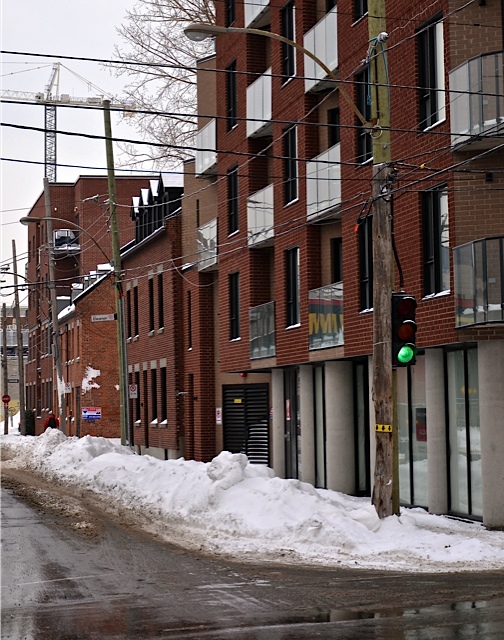
New condo tower and the Griffintown Horse Palace, January 2014. Photo courtesy of Dave Flavell
The final picture was taken a couple of weeks ago, from the corner of Ottawa and de la Montagne, looking east. The shop fronts on Ottawa in the new building remain empty, but looking down the block, after the Horse Palace residence is the old paddock of the stable, which was bought last year by the Ville de Montréal for purposes of turning it into a park to provide access to the actual stables, which the Griffintown Horse Palace Foundation has done yeoman’s work to preserve and save. (Full disclosure: I was a board member of the GHPF from 2008 until I left Montréal in 2012). Continuing on past the paddock, another mid-19th century residence still stands. And then, at the corner of Ottawa and Murray, another, shorter, 4-story condo stands. It was built in 2011. The crane is on the site of Devimco’s massive “District Griffin” development on Peel street.
Even though I have seen this view down Ottawa from de la Montagne, I was still shocked by Dave’s photo. The entire landscape of Griffintown is massively changed. The condo at the corner of de la Montagne and Ottawa is representative of the redevelopment. The streets of Griffintown are narrow, the buildings have always been hard up against the sidewalk. This has contributed to a somewhat claustrophobic atmosphere, at least on those blocks where enough buildings still remain. But these old buildings were 2 floors, at most 3. The stacking of 4, 6, 8, 10-story condos, lining these narrow streets only enhances this claustrophobia. It devastates the urban environment.
 Matthew Barlow