Success at Failure
March 26, 2014 § 3 Comments
Last week I was in sunny California at the National Council on Public History‘s annual conference in Monterey on the central coast. I was in a roundtable called “Failure: What is it Good For?” The idea behind the panel arose out of discussions between myself and Margo Shea in the autumn, surrounding various community-based projects we’ve been involved over the years, as well as our wider experiences in public history. At that point, Margo ran with it, and we proposed a roundtable to the NCPH, along with Jill Ogline Titus of the Civil War Institute at Gettysburg College, Melissa Bingmann of West Virginia University, and Dave Favolaro of the New York Tenement Museum. All five of us have a wide and divergent experience in community-based history projects in Canada and the US.
We were slightly nervous before our session, unsure if we’d have a full or empty house. The word “failure” is one that our culture and society does not like very much. We seem to go out of our way to avoid using the word, given it’s negative connotations. I have been slightly bemused with Gwyneth Paltrow and Chris Martin’s announcement yesterday that they were splitting up, they were “consciously uncoupling.” A column I read somewhere on that term (which I conveniently cannot find today) poked fun at their pretentious terminology (aren’t all breakups conscious uncouplings?) as it is really a way of getting around saying their marriage failed. I don’t find it surprising. Failure is a bad thing, continual failure makes us losers, etc.
https://twitter.com/Matthew_Barlow/status/446676391136751616
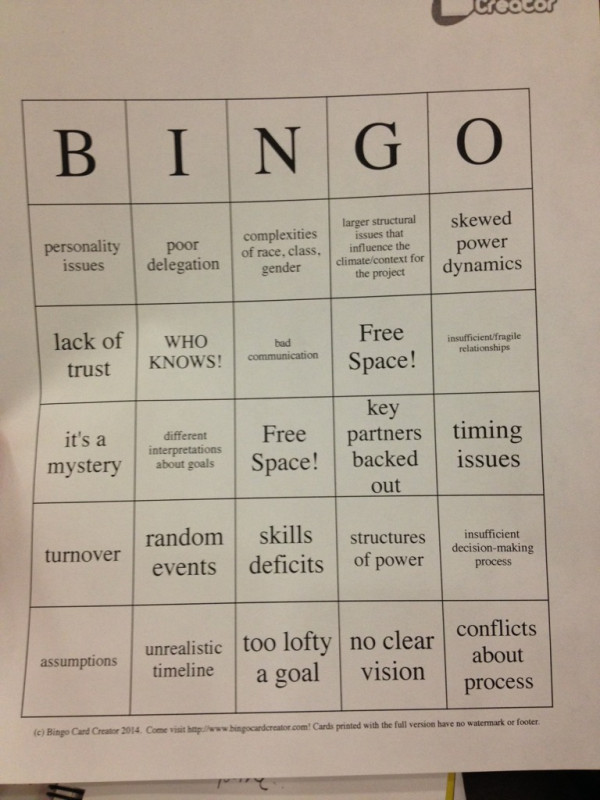 We were very pleasantly surprised to watch the room fill up; by the time Margo began the introduction to our session, I counted 3 empty seats in a room that sat somewhere between 45 and 50 people. What followed was amazing. We had our audience play some Failure Bingo ™ to get our crowd involved in the session early. And then we began to discuss the commonalities of our case studies, as well as some discussion about our particular cases.
One of the really neat things about the NCPH conference was that it was live-tweeted by several of the participants (myself included). The conference as a whole was interesting for this feature, as at every session there were a handful of people glued to their phones, laptops, and tablets as they live tweeted. I had several interactive sessions with session participants on Twitter, carrying on discussions about their talks throughout the panel.
What followed during the roundtable was kind of amazing, as a number of participants were live-tweeting events as they unfolded. After I was done with my bit, I sat back and resumed live-tweeting our session, engaging in dialogue with some of the audience members. This led to a multi-dimensional discussion between us and the audience. We had a live talk, amongst us in the room, we also used an app called Poll Everywhere to have people text their comments in, which then appeared on the screen behind us, and then there was the live-tweeting, which included interaction between me and some of the tweeters.
https://twitter.com/Matthew_Barlow/status/446779880185663488
The discussion in this multi-platform setting was fascinating, and, of course, kind of hard to keep up with. But that made it all the more interesting. As a group we spent a lot of talking about how failure works in other settings. In particular, medicine, science, and design. In those fields, failure is a necessary part of the process. It’s not too trite to say that in those cases, failure is part of success. In order to be successful, one has to first fail.
https://twitter.com/Matthew_Barlow/status/446794528393928705
https://twitter.com/Matthew_Barlow/status/446780787732381696
https://twitter.com/Matthew_Barlow/status/446792393816166400
But, of course, the difference between fields such as science, medicine, and design is that we, as public historians engaged in community-based projects is that we are dealing with other human beings. So, while I think we must be more open to failure in the same way that medical researchers and scientists and techies are, we must also keep in mind the human costs of failure. It can be embarrassing, humiliating and all other kinds of things. Marla Miller, from UMass-Amherst, also noted the way around this:
https://twitter.com/Matthew_Barlow/status/446796105963950081
But, either way, it is impossible to escape failure. But,
As this multi-dimensional discussion carried on, it was hard not to feel amazed, looking out at such a passionately engaged audience. I felt like we had at least succeeded at getting failure into the discussion.
https://twitter.com/Matthew_Barlow/status/446794954082242561
The following day, more than a few people told me ours was their favourite session of the conference. A few, tongue firmly in cheek, called me “The Failure Guy.”
https://twitter.com/Matthew_Barlow/status/447036533799784448
The Spanish Civil War: On Memory and Forgetting
March 10, 2014 § Leave a comment
 I have just finished reading Jeremy Treglown’s fantastic Franco’s Crypt: Spanish Culture and Memory since 1936. Treglown is a literary critic, so he approaches history and memory in a manner rather different than a historian, nonetheless, there is definite overlap in methodologies. I must say, I was originally concerned when I picked up the book and read this on the dust jacket: “True or False: Memory is not the same thing as History.” Um, yeah, true. No kidding. But, the whims of publishers are rather different than the arguments of authors.
Treglown does a fantastic job of dealing with the complexities of the Spanish Civil War of 1936-9 and then the long Francoist dictatorship from 1939 until the Generalisimo’s death in 1975 and the transition to democracy that followed. Treglown works very hard against the myth that Republicans = Good and Nationalists = bad during the Civil War. He also works hard against the myth that Franco’s régime was purely repressive and oppressive vis-à-vis art and artists, noting that a great amount of art (film, literature, music, visual art, sculpture) emerged in Francoist Spain. This is not to say that Treglown paints a rosy picture of Francoist Spain. He doesn’t. He doesn’t glorify Franco, but he seeks to complicate the dictator and the community of artists in Spain during and since the Civil War. He also deals with the complexity of characters like Camilo José Cela.
Cela was a nationalist soldier during the Civil War, and later worked as the censor for the Francoist state. And yet, he was also himself a novelist, and remarkably blunt and sensitive in his work. He began a literary journal in 1956 “as a way of countering cultural officialdom and giving space to the ideas of Spanish writers living abroad.” A noble sentiment, given that most of those expat Spanish writers were expatriates due to the Civil War and Franco’s dictatorship.
Treglown points to Cela’s most famous work, San Camilo, 1936. While San Camilo, 1936, has been criticised for a lack of morality, both due to the amount of time the characters spend in brothels and Cela’s avoidance of the larger issues of the war, it is in the details that the novel works. Cela shows the moral and actual ambiguity of war, in Treglown’s words:
Above all, San Camilo, 1936 grieves for Spain, gazing at a graveyard full of flowers of all colors, ignoring the shouts of “¡Viva la república!” and “¡Viva España!” because “it is no use being too enthusiastic when melancholy nests in the heart.
But what mostly interests me about Treglown’s discussion about San Camilo, 1936 is the intersection between memory and forgetting. As Cela writes, “No one knows whether it is better to remember or to forget. Memory is sad and forgetting on the other hand usually repairs and heals.” Nevertheless, as Treglown notes, San Camilo, 1936, is essentially a “puzzled, angry act of commemoration.” In other words, Cela and his characters remain ambivalent with what is to be done with trauma, history and memory.
I find Cela’ claims about the virtues of forgetting to be interesting. We live in an era that seems to believe the opposite in many ways. In our times, cultural historical memories have been exhumed and examined in public. Sometimes this takes the form of commemoration, (such as in Cork, Ireland, in the summer of 1997, marking the 150th anniversary of the Famine) or commissions of Truth and Reconciliation (such as in South Africa after Apartheid). Treglown himself recounts attempts by the caretakers of Franco’s memory to maintain his dignity, three decades later at the Valle de los Caidos (Valley of the Fallen), a huge monument outside of Madrid to honour the Nationalist fallen of the Civil War. Meanwhile, since the end of the dictatorship in 1975, the Spanish have attempted to exhume the bodies of massacred Republican soldiers and sympathisers. Indeed, the balance of power has tipped in favour of the Republicans, to the point where the atrocities committed by them during the Civil War have been whitewashed, just as the Francoists whitewashed the Nationalist atrocities.
Cela’s words, however, led me to think about Marc Bloch’s blistering Strange Defeat: A Statement of Evidence Written in 1940, about the quick Fall of France at the start of the Second World War. Bloch, a captain in the French Army and the country’s most famous historian, wrote this on the run from the Nazis (who eventually killed him). Strange Defeat is a searing book, almost painful to read, written by a fierce French patriot stunned and shocked his nation collapsed in defeat at the hands of the Nazis. Bloch blames France’s political and military leaders for failing to have prepared for modern warfare. And while Bloch remains an annaliste (the school of historical scholarship Bloch pioneered) in writing Strange Defeat, the immediacy of the events he’s describing and his anger and fury are clear.
Bloch was too close to the events, and too involved, to provide a long-view analysis of the Fall of France (nor, for that matter, did he wish to). The same can be said of Cela, a Nobel laureate. San Camilo, 1936 was published in 1969, thirty years after the end of the Civil War, while Franco was still alive and in power. Cela, like Bloch, was involved in the events his novel attempts (or doesn’t attempt) to deal with, and his view on the past, memory, and forgetting is perhaps not surprising.
My grandfather, Rodney Browne, was 17 when he joined the Royal Canadian Air Force in 1943. He was a tail gunner, which meant his chances of survival were pretty slim. And yet he did survive, and he came home to Montréal in 1945 with the conclusion of the war. But he was traumatised, deeply. He suffered silently, primarily by drinking. And he was restless, unable to settle into a job or family life, until his late 40s/early 50s, nearly thirty years after the war. By the time I was born, Rod was settled, married again, and he was a good grandfather. It is from him that I gained an historical consciousness about the Irish in Montréal. He didn’t talk about his past much, and he never talked about the war. I later found out that this was pretty common for men of his generation who served in the Second World War. He didn’t want to remember, which is why he drank when he got home, trying to obliterate those memories.
So maybe, it is the generation who lives through the worst of the trauma that wishes to forget, to never have to think of the atrocities they saw or committed. It is their descendants who feel the need to excavate these memories. Either way, these are not complete thoughts on memory, commemorations, and forgetting. Memory and forgetting remain incredibly powerful tools in historical scholarship.
Hip Hop as Public History?
February 11, 2014 § Leave a comment
Last week, the National Council on Public History (NCPH) asked on Facebook if the Facebook movies, celebrations of FB’s 10th anniversary, was public history. Um, no. They are no more public history than those wordle things were a few years back, images and video clips chosen by an algorithm programme designed to grab what in people’s timelines was most liked, most viewed, etc. In other words, it was rather random.
But, this got me thinking about curation, narrative, and how it is we decide what is and what is not public history. And this went on as I listened to Young Fathers, an Edinburgh, Scotland hop hop band comprised of three men of Nigerian, Liberian, and Scots heritage. Their music is a complex mixture of trip-hop, hip hop, with hints of indie rock. But the music is also full of African and American beats and melodies.
Hip hop, as everyone knows, is a music form that developed in the Bronx in New York City in the late 70s, it is an African American music form that has been globalised. It has also been adapted wherever it has gone; at its core, hip hop is poetry, set to a beat. Echoes of hip hop can be heard soundtracking everything from suburban teenagers’ lives to the Arab Spring to the struggle for equality on the part of Canadian aboriginals.
I’m a big fan of UK hip hop, I like the Caribbean and African influences on the music. Artists such as Roots Manuva, Speech Debelle, and cLOUDDEAD have long incorporated these influences into their music.
So, as I was listening to Young Fathers whilst pondering public history, I was rather struck by the idea of hip hop, at least in this particular case, as public history. Young Fathers have appropriated an American music form (one member lived in the US as a child), and then remixed it with a UK-based urban sound, and added African beats and melodies, to go with the occasional American gospel vocal. In short, these artists have curated their roots into their music, and presented it back to their audience. It’s the same thing Roots Manuva has been doing for the past decade-and-a-half with his Jamaican roots.
What, of course, makes Young Fathers and Roots Manuva different than the Facebook algorithms is that the music of these artists is carefully constructed and curated, they are drawing on their roots and background to present a narrative of their experiences in urban subcultures (whether by dint of music, skin colour, or ethnic heritage). So, in that sense, I would submit that this is a form of public history.
 Matthew Barlow