Clint Eastwood and Political Correctness
August 5, 2016 § 22 Comments
I have to admit, I like Clint Eastwood, the artist. He’s the star of one of my favourite films of all-time, The Good, the Bad & The Ugly. And he’s made some mighty fine films of his own. He’s also a complex man. He claims to be libertarian, but he’s supported both Democrat and Republican politicians. He’s called for gun control since the early 1970s. He was also a progressive mayor of Carmel-By-The-Sea, at least on environmental issues. And he’s long been an advocate of environmental controls. And, clearly, since he’s been mayor of his little resort town, he clearly isn’t opposed to government at all costs, nor is he opposed to using government power for the common good.
But, in recent years, he’s become a bit of a loose cannon. His speech at the 2012 Republican Conference, the so-called “Empty Chair” routine, was unforgettable. But this week, he was in the news again, complaining about the “pussy generation.” See, Ol’ Clint is tired of political correctness:
[Trump]’s onto something because secretly everybody’s getting tired of political correctness, kissing up. That’s the kiss-ass generation we’re in right now. We’re really in a pussy generation. Everybody’s walking on eggshells.
We see people accusing people of being racist and all kinds of stuff. When I grew up, those things weren’t called racist.
My response? So what? First, Clint Eastwood loves to come off as a tough guy when he’s going off on a tangent like this. Clint Eastwood ain’t no tough guy, he plays them in movies. That’s a big difference. Second, Clint Eastwood is 86 years old. When he was growing up, Jim Crow and segregation existed in the US. Is that what he wants to return to? I presume not.
As for “political correctness,” you know what? I’m sick of this one too. Creating an environment in the world where people feel comfortable, where we are all respected and treated fairly is not a bad thing. It’s easy for a multi-millionaire 86-year old white man to complain about the things that weren’t called racist 80 years ago. What discrimination has Clint Eastwood faced in his life?
And this is the thing, the people who complain about “political correctness” tend to be white and middle class, and quite often male. In other words, they tend to be people who don’t know what it feels like to be the target of discrimination or hate speech, or, worse. It’s easy for them to claim there is no discrimination, no racism in society. They’re not targeted by it. It’s easy for Eastwood to complain about the “pussy generation.”
In short, you cannot complain about “political correctness,” or claim there is no such things as racism, sexism, misogyny, or homophobia if you are of the dominant group in society.
More to the point, a long time ago, a great man once noted that the mark of a democracy was how it treated its minorities. And that is most certainly true. That great man, by the way, was former Canadian Prime Minister, Pierre Elliott Trudeau (the father of current PM, Justin “Hotty Pants” Trudeau).
On Black History Month
February 18, 2015 § 6 Comments
It is Black History Month. Specialized history months exist for a reason. They exist because black people, indigenous people, immigrants, LGBT people, women, etc., all get written out of history. Take, for example, a typical US History survey course. Usually US History survey courses at the college level are split into two parts, the first covers the period to Reconstruction, usually with the break coming in 1877; the second part goes from then to today. In the entire broad expanse of American history, nearly every single textbook I have ever reviewed with an eye towards using reflects a triumphalist narrative of progress. Certainly, some focus more on the people than the politics and wars, others focus on culture. Some have a narrative centring around the American fascination with freedom and liberty.
But, still, the narrative is dominated by white men. Indigenous peoples are the stars of the period before colonization, but that’s usually no more than a chapter. Then they share centre-stage with the colonists. Then they disappear from the narrative until the Trail of Tears in the 1830s, and then make a cameo during the story of Western expansion. Women are almost entirely invisible from the main narrative; women, especially, get shunted into little featurettes, usually at the end of the chapters. Possible exceptions are Seneca Falls in 1848, the 19th Amendment (sometimes), the Second World War, and Second Wave feminism to the failure of the Equal Rights Amendment in 1982. As for African Americans, they feature, sort of, in the story of slavery. But even then, the textbooks tend to represent slavery from the Euro-American perspective: why slave owners thought slavery just, why Northern abolitionists sought to end slavery. Rarely do we get actual glimpses of the slaves themselves. Then, after a brief light of Reconstruction, African Americans disappear until the Civil Rights Era of the 1950s and 60s. And that’s it. Thus, there is a need to focus on the history of a minority group, to focus on the contributions of that group, whether singly or collectively, to history. Hence, Black History Month.
The very existence of Black History Month, however, is a result of racism. The weight of history can be felt every single day, whether individually or collectively. We feel our own histories, but we also feel the weight of societal history on us every day. Where we are and what we have is in part a response to history. As a middle-class, white, heterosexual man, I have privilege, all of which comes from history and the way in which society has been moulded by it. Men benefit greatly from patriarchy, but not all men benefit in the same way from patriarchy. For some men, their access to patriarchal privilege is modified by race, ethnicity, sexual orientation, and class.
I got into a Twitter argument today over George Zimmerman and his murder of Trayvon Martin three years ago (Martin would have turned 20 next Thursday, 26 February). The content of the argument doesn’t matter so much as what the argument represents. Trayvon Martin was suspect to Zimmerman because Martin was black. He aroused the neighbourhood watch captain’s suspicions for “walking while black,” a pretty common occurrence for black men and women in the United States.
Racism is very real. And it is historic. It doesn’t have to come with name calling and threats of violence. It comes in more peaceable ways, too. It is subtle, it is silent. But it’s still very real. Racism against black people has a long, long history in the United States. But this was inherited from the British. The British, and other European nations, were the ones who thought it acceptable to enslave Africans and sell them at auction for profit. British cities such as Bristol and Liverpool became rich off the slave trade. In the United States, though, racialized slavery reach its apogee. And this history still weighs down American society 150 years after the Civil War ended.
Why? Eric Foner argues that Reconstruction was an “unfinished” revolution. I would suggest it was a failed revolution. Either way, as Foner rightly notes, Reconstruction failed because African Americans were left free, but impoverished, as the racist mindset that lay behind slavery sill existed. And let me remind you that many, if not most, northern abolitionists were just as deeply racist as southern slave owners. Where they differed is that the abolitionists thought it immoral for someone to own another person. The Civil Rights Era didn’t happen until a century after the Civil War. And today, we live in an era of backlash against the Civl Rights Era.
All of this, though, is due to the weight of history. On this continent, racism pre-dates the founding of Canada, the United States, and Mexico. In the United States, it dates back to the founding of Jamestown in 1608 and the Pilgrims reaching Plymouth Rock twelve years later. The very idea of British superiority over black Africans underpinned the colonial project here, as settlers had the same ideas of their own superiority over the indigenous populations. Thus it is perhaps no surprise that racism is so deeply ingrained in society. And this is not a uniquely American problem. Look at Canada, Britain, Ireland, France, Germany, Russia, Brazil, the Netherlands, etc.
For those of us who have spent their lives fighting against racism (and various other forms of oppression), we are fighting back against the cumulative weight of history; we are trying to push a massive weight off us. And until we do, we need to call out racism, but we also need to understand the reason for Black History Month this month. And Women’s History Month next month. And Native Americans’ History month in November.
Canada’s National Disgrace
February 2, 2015 § 151 Comments
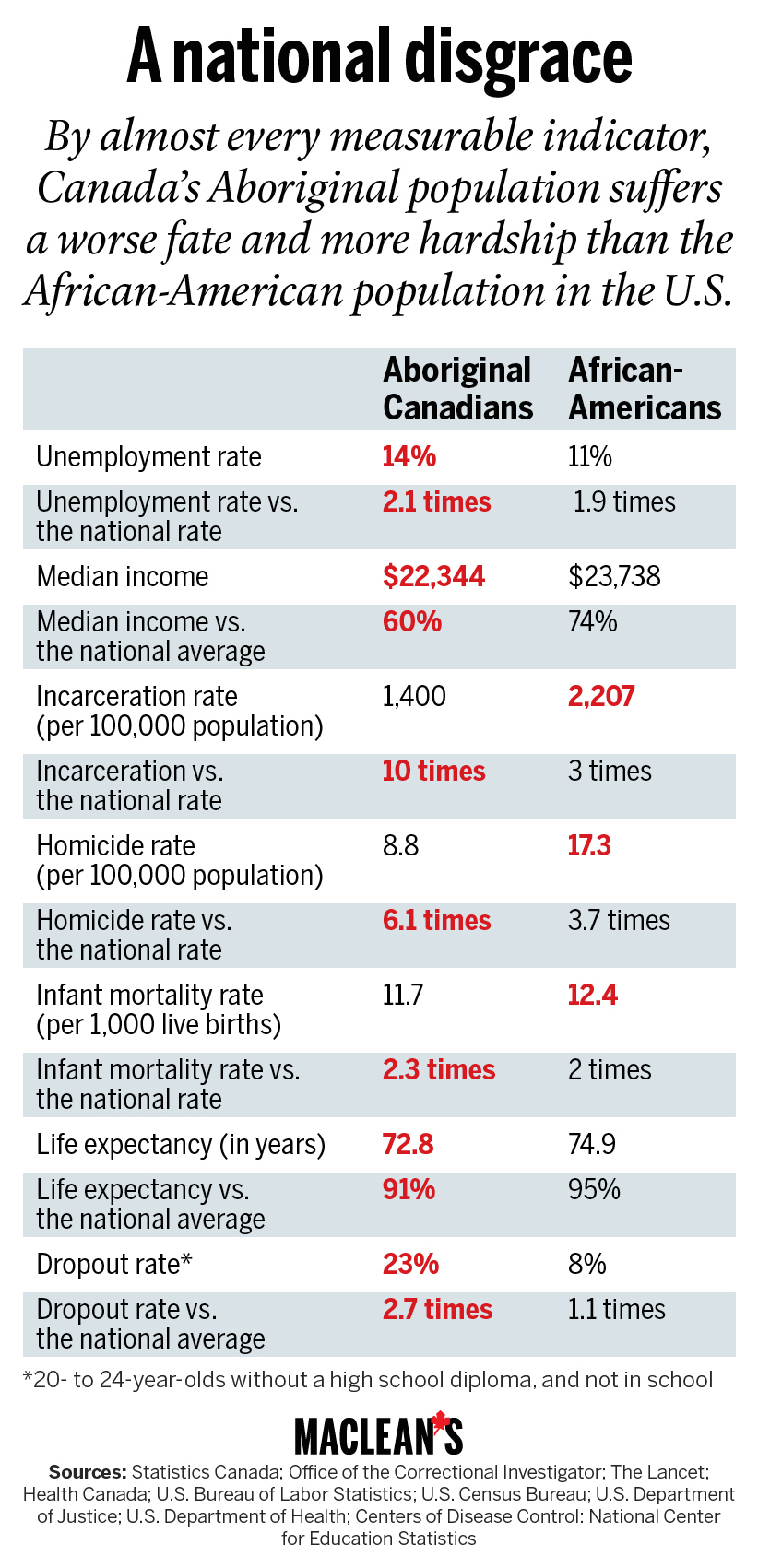
Two weeks ago, MacLeans, Canada’s only national news magazine, published an article that caused quite the uproar. Written by a former diplomat, Scott Gilmore, and entitled, “Canada’s Racism Problem? It’s Even Worse Than America’s,” it’s not hard to see why this upset people. Even better was the sub-title, “For a country so self-satisfied with its image of progressive tolerance, how is this not a national crisis?” I wish I had written this article, it says what I’ve been saying for a long, long time.
Aboriginal peoples in Canada get screwed. Have been since the first Europeans arrived, and still do today. And that’s not going to change any time soon unless Canadians do something about it. But, in my experience, they don’t care. Last year, I wrote a post about a funny sweatshirt that an aboriginal man, Jeff Menard, in Winnipeg (which MacLeans also called out as Canada’s most racist city) created that said: “Got Land? Thank an Indian.” I wrote this post in response to a response I got to a tweet stating that if you thought this hoodie racist, you’re an idiot. This response tweet said “I’m offended because they used the word Indian. My grandfather was from India. He worked for a living.”
How to unpack that? This tweet was anti-historical and offensive on so many levels. Starting with being upset at the use of the word “Indian,” the term applied to aboriginal peoples by Euro-Canadians historically. But the real kicker is “He worked for a living.” Many of the comments on Gilmore’s article, and a lot of the vituperative, racist tweets I saw complained that aboriginal peoples in Canada survive on handouts from the government and don’t work for a living. No mention of imperialism, the taking of land, the systematic attempts by the Canadian government to steal away aboriginal languages, cultures, religions, and names, of the residential schools designed to also take the children of aboriginals away from them (to say nothing of the horrific sexual abuse therein).
Gilmore pointed just how badly aboriginal peoples get screwed in Canada, by comparing them to African-Americans in the United States, in easy table format, which I produce here (and hope that MacLeans doesn’t mind). Look at those statistics and just try not to be offended, saddened, and, if you are Canadian, embarrassed. Hell, even if you’re American, you should be embarrassed by these stats. But, Gilmore’s right. Canadians are a smug lot. My Twitter feed is usually full of all kinds of anti-American comments, the implicit meaning is “Well, the US is a mess, thank god I live in Canada.” Information such as this should end such discussions and puncture our smugness forever.
At the same time the furor over Gilmore’s article was raging, another debate was happening over the death of Makayla Sault, an 11-year old from the New Credit First Nation in Ontario. Makayla died of leukaemia. When she was first diagnosed last year, she underwent chemotherapy in Hamilton, ON. But the side-effects were too great. And so she refused further treatment, preferring instead traditional medicine. Obviously, it didn’t work.
This raises interesting questions, starting with who has the right to control the lives of children who have cancer. But. Ultimately, we have to respect her decision. Why? Because it was her life.
But, then the enfant terrible of Quebec journalism, Denise Bombardier, had to get involved. Bombardier is perhaps most famous outside of Quebec for having been fired by Radio-Canada for having participated in a debate on marriage equality, taking the position against it. At any rate, this is Bombardier’s comments on Makayla Sault (thanks to Mikayla Cartwright for the image):
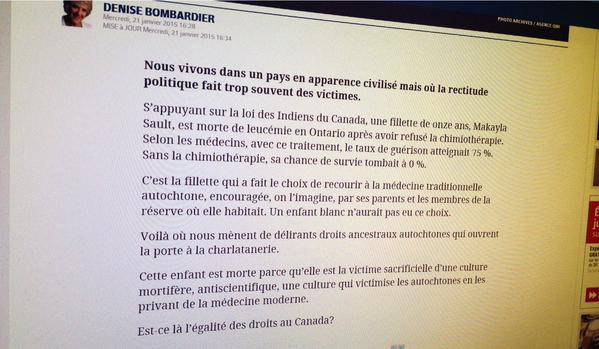
For those who cannot read French, a few of the highlights: After complaining about the cost of political correctness, she states that Makayla made the choice to be treated according to traditional medicine, encouraged, perhaps, by her parents and other members of her First Nation. Then the kicker, “A white child wouldn’t have to make this choice. This is where we see the delusional ancestral rights of the aboriginals open the door to quackery. This child died because she was the sacrifical victim of a deadly, anti-scientific culture that is killing aboriginal people.”
It took me all of about 0.33 seconds to find a Euro-American child who faced this dilemma. Daniel Hauser, a 13-year old boy who was refusing treatment in 2009, for religious reasons. Daniel Hauser, I might add, is white. My Google search turned up other kids faced with this same awful dilemma (the same search also turned up other children in the same position). So, Bombardier is factually wrong.
But she is also morally, ethically wrong. Bombardier’s screed reads like far too many documents I read in the records of Aboriginal Affairs and Northern Development Canada, the government agency (which has had many names) in charge of carrying out the responsibility that the Government of Canada has to aboriginals, according to treaties that both pre- and ante- date Confederation in 1867, as well as Section 35 of the Canadian Constitution. In many of the documents I read during my days working in the field of aboriginal law and litigation in Ottawa, various employees of Aboriginal Affairs, from lowly agents in the field to the directors of the department in Ottawa, referred to the need to civilise the aboriginals, and how white people knew what was right for them. In academia, we call this imperialism.
Bombardier says the same thing. She dismisses aboriginal culture as “anti-scientific” and “deadly.” She refers to traditional ways of life as “quackery.” In short, Canada needs to civilise the aboriginals for their own good, just as Aboriginal Affairs agents and employees argued a century ago.
In short, Gilmore is bang-on correct. Canada’s treatment of its aboriginal population is a national disgrace and tragedy, made worse by the fact that most Canadians don’t know or don’t care, and a good number of them are part of the problem, as Bombardier shows. Gilmore writes:
We are distracted by the stories of corrupt band councils, or flooded reserves, or another missing Aboriginal woman. Some of us wring our hands, and a handful of activists protest. There are a couple of unread op-eds, and maybe a Twitter hashtag will skip around for a few days. But nothing changes. Yes, we admit there is a governance problem on the reserves. We might agree that “something” should be done about the missing and murdered women. In Ottawa a few policy wonks write fretful memos on land claims and pipelines. But collectively, we don’t say it out loud: “Canada has a race problem.”
And until we do, nothing is going to change.
Thoughts on Ferguson
November 25, 2014 § 10 Comments
 This is Emmett Till, who was murdered when he was 14 years old. This is Emmett Till after he was abducted by a gang of men in rural Mississippi on the night of 28 August 1955. These men, headed by local grocer Roy Bryant, pistol-whipped Till, beat him, gouged out his eye, and then shot him. When Bryant, who was transporting Till’s body in his pick-up truck, was questioned as to what happened by an African American man, Bryant said that “this is what happens to smart niggers.” This picture sickens me. Till’s mother, Mamie, insisted on an open casket for his funeral so the world could see what happened to her little boy.
Last night, as I listened to the prosecutor in Ferguson, MO, and, then watched President Obama’s response, and watched the outrage on Twitter in response to the Michael Brown decision, I thought of Emmett Till. Last night, I had the depressing thought that Emmett Till died for nothing. I teach American history, and Till’s murder is usually regarded as a key moment in the birth of the Civil Rights movement in the United States.
Michael Brown is just one of many black men and boys to be killed in the United States by white men, oftentimes white police officers. I couldn’t help think last night of Trayvon Martin, and of Tamir Rice, the 12-year old boy gunned down by a police officer for waving a toy gun at a playground. But, the kinds of events that led to the deaths of Rice, Brown, and Martin aren’t all that new. For example, Yusef Hawkins. Or Amadou Diallo. I could go on.
Till was killed because he flirted with a white woman. Martin was killed because a neighbourhood watch captain thought him suspicious. Rice was killed because he was playing with a fake gun. Hawkins was killed because he was black in a white neighbourhood. Diallo was killed because he looked like a suspect in violent rapes. Brown was killed, well, I’m not entirely sure why. Because in August, the police claimed that the officer who shot him didn’t know he was a suspect in a convenience store robbery, though last night, the DA said that that’s why Brown was stopped.
So the right has come to the conclusion that Brown was a criminal and got what he deserved. My Twitter timeline last night had the occasional tweet or re-tweet to this effect. And news coverage I’ve read this morning follows that up. I say whether or not Brown rolled a convenience store is immaterial to his murder. The officer fired twelve shots at Brown. Six of those hit him. Two of this hit him in the head. The issue here is that a white police officer thought it necessary to fire twelve shots at an unarmed man. Fox News in the summer wondered whether Brown was, in fact, unarmed, given his physical size.
Ultimately:
https://twitter.com/Matthew_Barlow/status/537075505087131648
Perhaps, like last time I posted on race, I will get trolled by the racists. This time, I will not post racist comments in response to this article (I control what comments get posted, and, until last time, I generally allowed free speech here), but I will take them, and create a new blog post of racist, idiotic comments. And should I receive threats in response to this post, I will report them to the authorities. Consider that your fair warning.
Gratitude
November 17, 2014 § 6 Comments
A couple of week ago, I published this piece on the new racist discourse in the United States, thinking that this was pretty bloody obvious to anyone paying attention. I was surprised at the response. The post went viral, it’s been re-blogged a bunch of times, tweeted and re-tweeted, and got a lot of readers. I was also inundated by comments on the post, to the point where I had to close comments on it. I closed comments largely because I got a couple of threats in response to the post, I should note (nothing serious). This soured me to some degree, that people would take time out of their days to threaten me over what I wrote. Some of the comments that I did allow to be posted were bad enough, but there were a good 15 or so I did not post that were largely incoherent rants about Muslims, African Americans, and women, and how they are collectively ruining the world. But, it’s easy enough to dismiss wingnuts.
But what I suppose I overlooked in this storm of negativity is the positivity that came out of the post, and all the people who left positive comments on the post itself, as well as those who took time to send me a note of gratitude or agreement, all the people who re-blogged it, tweeted it, shared it on their own Facebook feeds. And, after having some time to reflect on all of this, all I can say is: thank you.
On the New Racist Discourse in America
November 4, 2014 § 78 Comments
[Note: Comments have become out of control on this blog post, including some downright racist terminology that I have not allowed to be posted, as well as a few that include veiled, and occasionally direct, threats against me.]
So Ben Stein thinks that Obama is the most racist president in the history of this great republic. He thinks so because allegedly Obama “is purposely trying to use race to divide Americans,” and is using the ‘race card’ to convince all African Americans to vote for the Democratic Party. Ben Stein is wrong.
Obama is not the racist one, but Stein is tapping into a new discourse of racist ideology arising from the right in this country. In this discourse, anyone who mentions race as an issue in contemporary American life risks being called a racist. Anyone who points out racial inequality is at risk of being branded racist. In the mindset of those who trumpet this new discourse, we’re all equal, no matter our ethnicity, gender, sexual preference, or racial background. And any attempt to point out inequality is therefore racist/sexist/homophobic, etc, by definition.
But what this discursive technique does is to deny the experiences of women and minorities in our society. It says to those who have experiences different than white men that their experiences are invalid. In short, this new racist discourse is meant to work as shorthand for racist viewpoints. Thus, by claiming Obama is racist, Stein is both diverting attention from his own racism, and engaging in that very racism he blames on Obama.
More often than not, this discursive technique comes hand-in-hand with declarations of what is in the best interests of African Americans. And in this sense, we return to the paternal racism of slave owners in the pre-Civil War era. I’m not saying that Ben Stein = slave plantation owner. I’m saying the tricks of technique here are very similar. Last spring, we saw the Carolina Chocolate Drops up in Vermont. Towards the end of the show, Rhiannon Giddens, the frontwoman of the band, told us of her own explorations of American history, and a book she read on slave narratives in the post-Civil War era. One story in particular struck her, and she wrote the song “Julie” about it.
In the story, the mistress of the plantation is shocked at the fact that Julie, the former slave woman would have a will of her own. She thought that she knew best for Julie, as did slave owners in general in a paternalist racist system.
And every time a white man or woman purports to know what’s best for African Americans, or any other minority, they’re engaging in this kind of paternalistic racism, which appears to be part and parcel of this new racist discourse from certain sectors of the political right in the United States.
Immigration in the United States, plus ça change
August 7, 2014 § 8 Comments
I am doing a bit of research into the Know Nothing movement of the 1840s and 50s in the United States. The Know Nothings were a secret society that eventually evolved into a political party, based on the premise that immigration was bad for the United States. In short, the Know Nothings, who also formed one of the bases of the nascent Republican Party in the late 1850s, were nativists. They believed in a United States for Americans only. We could, of course, note the irony of that statement, given every person not of Native American heritage in this country is of immigrant stock. But, we’ll leave that alone. They were called Know Nothings not because they were ignorant (as my students always suppose), but because, as a secret society and asked about the society replied that they “knew nothing.”
I came across this list of things that Roman Catholics hate about the United States from the Boston Know-Nothing and American Crusader in July 1854. The Know-Nothing and American Crusader was one of the main newspapers of the Know Nothings, and Boston was a major centre of the nativists. Boston was ground zero, in many ways, in the ‘invasion’ of Irish immigrants and refugees in the years of the Famine and afterwards. Here’s the list:
- They HATE our Republic, and are trying to overthrow it.
- They HATE the American Eagle, and it offends them beyond endurance to see it worn as an ornament by Americans.
- They HATE our Flag, as it manifest by their grossly insulting it.
- They HATE the liberty of conscience.
- They HATE the liberty of the Press.
- They HATE the liberty of speech.
- They HATE our Common School system.
- They HATE the Bible, and would blot it out of existence if they could!
- The Priests HATE married life, and yet by them is fulfilled the Scripture, to wit: ‘more are the children or the desolate, than the children of the married wife.’
- They HATE Protestants, and are sworn to exterminate them from our country and the earth.
- They HATE the name of Washington, because he was a Republican and Protestant.
- They HATE all rulers that do not swear allegiance to the Pope of Rome.
- They HATE to be ruled by Americans, and say “WE WILL NOT BE RULED BY THEM!”
- They HATE to support their own paupers and they are left to be supported by the tax paying Americans.
- They HATE, above all, the ‘Know Nothings,’ who are determined to rid this country of their accursed power.
The author of this wonderful list signed his name as “Uncle Sam.” Newspapers in general allowed correspondents to use anonymous pseudonyms in the 19th century, so this isn’t surprising. But the nom de plume of our correspondent is telling of the cause of the Know Nothings.
As I am doing this research, I’m thinking back to my experiences in June, when I was told by a table mate that the AP Reading I was at that I don’t belong in the United States because I “don’t love America” (I don’t “love” Canada, either, for the record). And, thenthen, on the way home, at a layover in Dallas, another traveller, watching the news, told me that all immigrants should be rounded up and deported (this one didn’t know I was an immigrant). And as I watch the drama unfold about the refugee children from Central America in this country, and see the horrible rhetoric coming from the right wing, I can’t help but think that, even if 170 years have passed since “Uncle Sam” published his list of things Catholics hate in The Know-Nothing and American Crusader, in some ways, nothing has changed. The rhetoric of “Uncle Sam” echoes that of some far right politicians, commentators, and regular citizens I’ve seen on Twitter in the past month.
Of course, the Know Nothings were never a majority of Americans, any more than those so violently opposed and hard-hearted to the plight of children today are even close to a majority. The overwhelming majority of Americans then and now do not have a problem with immigration and immigrants. But, then as now, the squeaky wheel gets the grease.
 Matthew Barlow