Griffintown: Keegan House Saved. Really?
April 29, 2014 § Leave a comment
Montreal is a strange place. The city basically works in completely counter-intuitive ways. Last week, the Comité consultatif d’urbanisme (CCU) of the arrondissement sud-ouest of the Ville de Montréal denied permission to developer, Maitre-Carré, to tear down the oldest building in Griffintown, a grotty old house that stands at 175, rue de la Montagne. The Keegan House, as it is now known, was built sometime between 1825 and 1835, on Murray Street, a block over from its present state. It was moved to what was then McCord Street in 1865, around the same time that the handsome row of townhouses was constructed up the block.
When Maitre Carré’s plans were first made public, I was apprehensive, but also thought that perhaps the developer deserved our benefit of the doubt, insofar as it had, at least, made some nod to heritage in Griff when Hugo Girard-Beauchamp, the company’s president, bought the Horse Palace and has at least nodded to the idea of maintaining the Palace as a working stable going forward (whether this will happen in practice is a whole different kettle of fish). Indeed, as my friend, G. Scott MacLeod, a film-maker interested in Griff, said, Maitre-Carré is the only developer that has at least acknowledged the history and heritage of the neighbourhood. Indeed, other condo developers, most notably Devimco and Préval have been more interested in stuffing ugly, neo-brutalist blocks of condos down on the Griffintown landscape, completely destroying the streetscape (such as it existed) and dwarfing the original buildings.
Having said all that, at this point anyway (because one never knows in Montreal), this is an optimistic sign. Anne-Marie Sigouin, the city councillor for Saint-Paul/Émard, and the chair of the CCU, said (according to The Gazette) “We have sent the architects back to the drawing board. We want to send a clear message on heritage protection.” This is rather surprising, since the CCU and the Ville de Montréal as a whole have not demonstrated much in the way of leadership up to now in Griff.
Dear Boston: Reflecting on the Marathon Memorial at the Boston Public Library
March 7, 2014 § Leave a comment
Back in July, when the insta-memorial for the Boston Bombing of 15 April 2013 was taken down, I wrote this piece at the National Council of Public History’s history@work blog. In it, I expressed my cynicism of what happens to the items of the memorial when they are removed from the site and put in storage, or even brought out again for a more permanent exhibition. I also argued in favour of insta-memorials such as this, seeing some value in our hyper-mediated lives, watching the world through the screens of our iPhones. What resulted, from the piece on history@work, as a notification here on this site, as well as Rainy Tisdale’s blog, was a rather robust discussion, especially between myself and Rainy, a Boston-based independent curator about authenticity and memorials.
 To sum up the discussion, we debated whether or not Boston needed an exhibition on the first anniversary of the attack. I argued that the running of the 118th Boston Marathon, as well as the traditional Boston Red Sox game at Fenway Park, would serve as a chance for Bostonians to reclaim Boylston Street and Copley Square one year later. Rainy, on the other hand, argued that an exhibition was necessary in order to prevent the kind of frenzy that began to emerge surrounding the #BostonStrong rallying cry when the Bruins went to the Stanley Cup Finals last spring (and lost. I hate the Bruins).
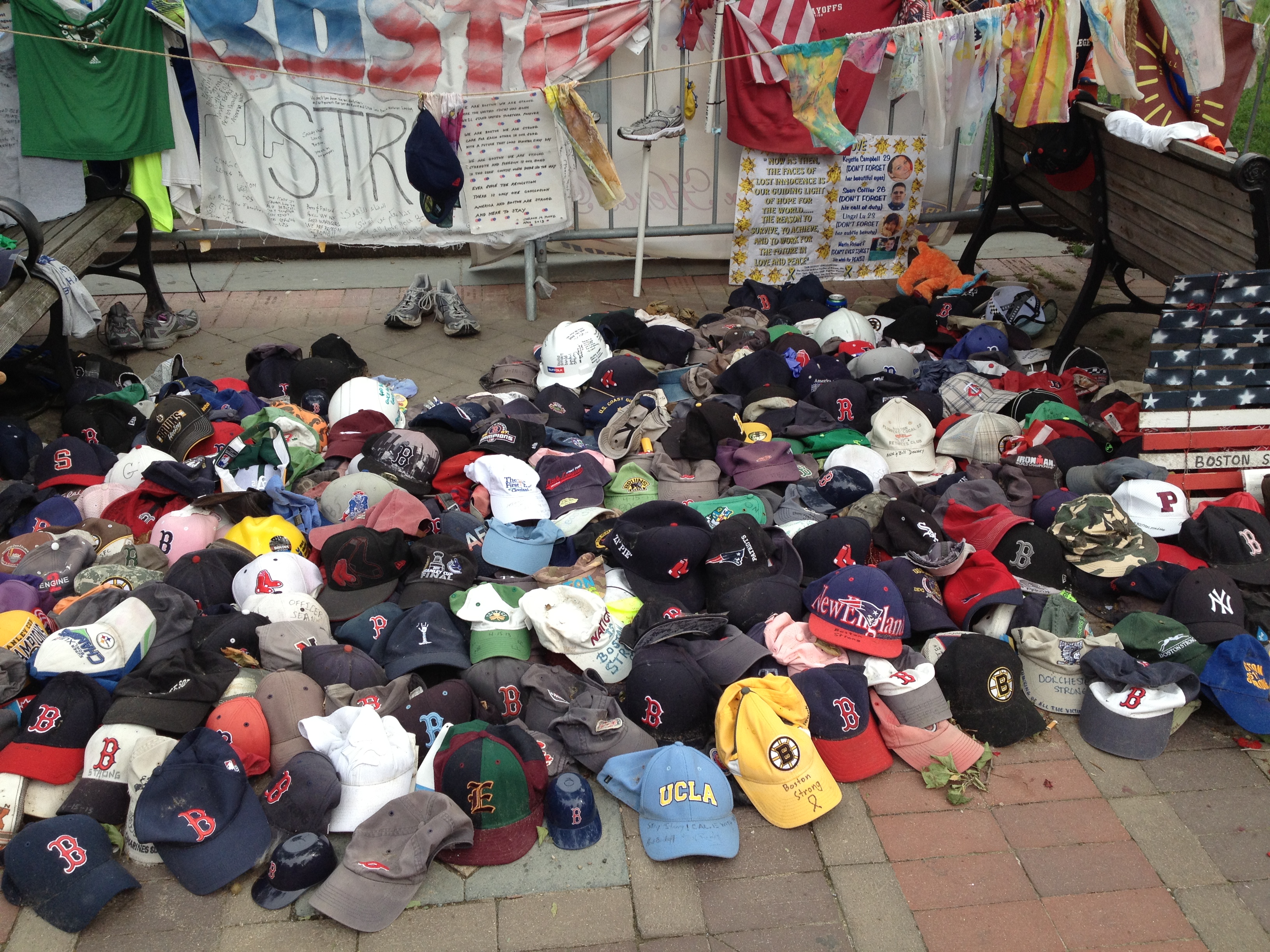 In the time since, I have come around more to Rainy’s argument than my own, though I still worry about questions of authenticity and memorial mediation on the part of the curatorial hand (though, of course, that spontaneous memorial, first on Boylston Street and then at Copley Square was also curated, in part). Nevertheless, I am very much looking forward to Rainy’s exhibit at the main branch of the Boston Public Library on Copley Square. Dear Boston: Messages from the Marathon Memorial opens on 7 April, and will run to 11 May. It is a tri-partite exhibit: the first part will encompass the immediate responses to the bombing, the second will be people’s reflections on the bombs, and the final part will be the hopeful part, messages of hope and healing.
 I appreciate the exhibit’s title perhaps more than anything at this point, as it makes direct references to the curatorial hand at work here, as the exhibit will deliver messages from the memorial. In July last year, I worried about the loss of meaning of the individual artefacts when they were boxed up and stored in the Boston Archives. A running shoe had a very poignant and powerful meaning when displayed at the memorial, and in a box in the archives, it’s a running shoe. Restored to the public eye, however, attached with a symbolic meaning that no one in Boston, or anyone visiting the exhibit, will miss, the shoe regains its poignancy.
What struck me in my discussion with Rainy last summer was how she intended to approach the exhibit, and her sensitivity to the very issues that concerned me. I am very much looking forward to what she comes up with.
Montréal’s Griffintown Redevelopment #FAIL
February 6, 2014 § 3 Comments
The Gazette this morning reports news that the Keegan House just around the corner on rue de la Montagne from Wellington, and across from where St. Ann’s Church once stood, is under threat of demolition from Maitre-Carré, the developer responsible for the condo tower at the corner of de la Montagne and Ottawa. The Keegan House was built sometime between 1825 and 1835 on Murray Street, a block over. In 1865, it was moved to its current site.

The house was moved because of the development around Griff. Unlike many other urban neighbourhoods, and unlike the current redevelopment, Griffintown was developed on a lot-by-lot basis. There were not block long, or multi-lot developments as a rule. So as Murray Street was developed, Andrew Keegan, a school teacher, moved his house to a more prestigious locale, across the street from St. Ann’s Church. As David Hanna, an urban studies professor at UQÀM, notes, the block across the street from St. Ann’s was where the nicest housing in Griff was. But that is still a relative statement. Even the nicest homes in Griffintown could not compare with even the swankier locales across the canal in Pointe-Saint-Charles.
In recent years, the Keegan House has fallen into disrepair. I was in the building 7 or 8 years ago, and it was in rough shape. Maitre-Carré have bought the lots from 161-75 de la Montagne for redevelopment. Also slated to be demolished is the building that housed what used to be the Coffee Pot, a hangout for Griffintowners across the street from the Church. After the Coffee Pot closed in the early 1960s, the building was split in two, with a dépanneur and a tavern operating there. The tavern limped to its death about a decade ago. Both the Coffee Pot building and the Keegan House were given an unfortunate renovation in the 1950s or 60s, with their outer walls encased in concrete, which greatly diminished their aesthetic appeal.
Now what makes this story interesting and oh-so Montréal is that Hugo Girard-Beauchamp, the president of Maitre-Carré, claims that his company has no intention of destroying the Keegan House and, in fact, wishes to incorporate it into the new development. You know what? I believe him. Maitre-Carré and Girard-Beauchamp are the ones were worked with through the Griffintown Horse Palace Foundation. And while he remains a businessman, Girard-Beauchamp was also more than willing to listen to us and even help us preserve the Horse Palace. In fact, I would go so far as to say, at least when I was on the Board of the GHPF, that we would not have succeeded without his help.
However. This is Montréal. The borough isn’t sharing the plans for this development. Julie Nadon, the chief of planning for the borough, says they’re “confidential.” They shouldn’t be. Too much of the redevelopment of Griffintown has been done this way. The Ville de Montréal has operated in Star Chamber secrecy, refusing to divulge its plans to anyone other than the developers until it’s too late. A couple of years ago, the Ville de Montréal held a public session at the ÉTS to show off its plans for Griff. It’s plans had already been made with 0 public input. None. At all.
Montréal’s Star Chamber secrecy violates the very principles of democracy and the things that Montréal likes to pride itself on, which is an open city, with a creative class proud of its civic engagement. In Griffintown, the Ville de Montréal stonewalls civic engagement at each and every turn. It’s embarrassing and it’s no way to run a city. #fail
Irish Slums
December 5, 2013 § 4 Comments
Last month, I met Michael Patrick MacDonald at an Irish Studies conference in Rhode Island. He was the keynote speaker. I didn’t know much about him beforehand, other than he wrote All Souls about growing up in South Boston in the 70s and 80s. I knew All Souls was a story about heartbreak, drugs, and the devastation suffered by his family. But MacDonald’s talk was one of the best I’d ever heard, he spoke of Whitey Bulger, drugs, Southie, his work in non-violence and intervention, and he talked about gentrification. He was eloquent and fierce at the same time. He is, of course, an ageing punk. He was also pretty cool to talk to over beers in the hotel bar later that night.
I finally got around to reading All Souls last week. I’m glad I did. I was stunned that MacDonald and his siblings could survive what they’ve survived: three of their brothers dead due to gangs, drugs, and violence. One of their sisters permanently damaged by a traumatic brain injury brought about due to drugs. And another brother falsely accused of murder. It was a heartbreaking read, at least to a point. I know how the story ends, obviously.
It was also interesting to read another version of Southie than the one in the mainstream here in Boston. The mainstream is that Southie was an Irish white trash ghetto, run by Whitey Bulger, terrorised by Whitey Bulger, but all those Irish were racists, as evidenced by the busing crisis in 1974. And while MacDonald tried to revise that narrative, both in his talk and in All Souls, pertaining to the busing crisis, it is hard to argue that racism wasn’t the underlying cause of the explosion of protesting and violence. But, MacDonald also offers both a personal and a sociological view of how Southie was terrorised and victimised by Bulger (and his protectors in the FBI and the Massachusetts State Senate). And, today, he talks about gentrification in a way that most mainstream commentators do not (something I’ve railed about in my extended series on Pointe-Saint-Charles, Montréal, his blog, Pt. 1, Pt. 2, Pt. 3, Pt. 4, and Pt. 5).
But something else also struck me in reading MacDonald’s take on Southie. I found that he echoed many of the oldtimers I’ve talked to in Griffintown and the Pointe in Montréal about their experiences growing up. Griff and the Pointe were the Montréal variant of Southie, downtrodden, desperately poor Irish neighbourhoods. And yet, there is humour to be found in the chaos and poverty, and there is something to be nostalgic for in looking back.
MacDonald writes:
I didn’t know if I loved or hated this place. All those beautiful dreams and nightmares of my life were competing in the narrow littered streets of Old Colony Project. Over there, on my old front stoop at 8 Patterson Way, were the eccentric mothers, throwing their arms around and telling wild stories. Standing on the corners were the natural born comedians making everyone laugh. Then there were the teenagers wearing their flashy clothes, their ‘pimp’ gear, as we called it. And little kids running in packs, having the time of their lives in a world that was all theirs.
This echoes something journalist Sharon Doyle Driedger wrote of Griffintown, where she grew up:
Griffintown had the atmosphere of an old black-and-white movie. Think The Bells of St. Mary’s,with nuns and priests and Irish brogue and choirs singing Latin hymns. Then throw in the Bowery Boys, the soft-hearted tough guys wisecracking on the corner.
The difference, of course, is that MacDonald’s ambivalence runs deep, he also sees the drug addicts and dealers, and the grinding poverty. Doyle Driedger didn’t. But, MacDonald is standing in Southie as an adult when he sees this scene, Doyle Dreidger is writing from memory.
Nostalgia is a funny thing, and it’s not something to be dismissed, as many academics and laypeople do. It is, in my books, an intellectually lazy and dishonest thing to do. Nostalgia is very real and is something that tinges all of our views of our personal histories.
But what I find more interesting here are the congruencies between what MacDonald and Doyle Driedger writes, between what MacDonald says in All Souls and what he said in his talk last month in Rhode Island, and what the old-timers from Griff and the Pointe told me whenever I talked to them. There was always this nostalgia, there was always this black humour in looking back. I also just read Roddy Doyle’s Paddy Clarke Ha Ha Ha, about a kid growing up in Dublin’s Barrytown, a fictional inner-city neighbourhood. Through Paddy Clarke, Doyle constructs an idyllic world for a boy to grow up in, as he and his mates owned the neighbourhood, running around in packs, just like the kids in Southie MacDonald describes, and just as MacDonald and his friends did when they were kids.
I don’t know if this is something particular to Irish inner-city slums or not. But I do see this tendency as occurring any time I talk to someone who grew up in such a neighbourhood, or read stories, whether fiction or non-fiction, to say nothing of the music of the Dropkick Murphys (I’m thinking, in particular, of almost the entirety of their first album, Do Or Die, or the track “Famous for Nothing,” on their 2007 album, The Meanest of Times), I’m not one for stereotyping the Irish, or any other group for that matter, I don’t think there’s anything “inherent” to the Irish, whether comedy, fighting, or alcoholism. But there is something about this view of Irish slums.
Urban Redevelopment: Getting it Wrong, Springfield, MA
October 27, 2013 § 3 Comments

City Hall Plaza, Boston
As regular readers of this blog know, I am interested in urban redevelopment, especially when it comes to questions of doing it right and doing it wrong (and chances at redemption). For the most part, the wave of urban redevelopment that hit North American cities in the 70s and 80s was the wrong way, in that it left us with neo-brutalist architecture in the midst of our cities that is cold, uninviting and intimidating. A case in point of this would be City Hall Plaza in Boston. It’s a desolate, soulless urban square that people use for one of three purposes: 1) official events, because they have no choice; 2) to sit on the fringes of to eat lunch; 3) to get to the Government Center T station. Many cities have this problem today, these horrid, horrid neo-brutalist buildings. In some places, like Boston, it doesn’t so much matter, because the downtown core of the city is bustling, Government Center lies between Faneuil Hall/Quincy Market and the stately Boston Common. Government Center is the site of, well, government in Boston and so this site is full of civil servants, but also tourists and Bostonians crossing between the tourist centres, the North End, and the downtown core of the city. In other places, like nearby Worcester, this 70s/80s wave of urban redevelopment led to a massive #fail.
But, the legacy of deindustrialisation is also very real, especially in small formerly urban centres, like Worcester, but also Springfield, Mass. Springfield is about 100 miles west of Boston and it feels about as faraway from Boston as one can get. Springfield is a depressed, sad little city. It has a high crime rate, nearly double that for the rest of the Commonwealth, including Boston. It’s murder rate, .13 per thousand, is almost triple the national average (perhaps unironically, Smith & Wesson’s corporate headquarters are in Springfield). The same is true for robbery and assault. Its property crime rates are also well above the national average.
It wasn’t always like this for Springfield. Until the 1960s, it was a bucolic industrial city, surrounded by natural beauty. It had a low crime and unemployment. It was the very first Springfield in the USA, and was the birthplace of basketball. Indian Motorcycles were from Springfield. So was Charles Goodyear. Merriam-Webster’s first dictionary was published there in 1805.

I-91, downtown Springfield and the Basketball Hall of Fame
Springfield experienced decline due to a combination of deindustrialisation, the closing of the Springfield Armory in 1969 (the target of Daniel Shays and his rebels in 1786), and poor urban development decisions (most notably the running of I-91 through the downtown core and cutting off downtown from the waterfront of the Connecticut River. Various attempts to redevelop the city have failed miserably (like the basketball Hall of Fame). And recently, the city decided that it was going to open a massive urban casino to flag the failing fortunes of Springfield. Why they thought this would work is beyond me. Certainly, people will now come to Springfield to shop and gamble. But, the casino will also siphon off jobs and hurt what business still exists in the downtown core. And now, even that appears to be at risk.
The Failure of Urban Redevelopment and the Chance at Redemption: Worcester
October 22, 2013 § 4 Comments
Worcester, Massachusetts, is like pretty much every city in New England not named Boston or Providence, and kinda like those Easter Bunnies I used to get when I was a kid: hollow centre. The downtowns of Hartford, New Haven, Springfield, Worcester, etc. were done in by deindustrialisation and horrid, horrid urban redevelopment schemes. The urban redevelopments schemes of the 70s, in hindsight, look as though they were especially created to destroy urban centres, not save them. Boston’s Government Center, for example, is one of the most hideous examples of neo-brutalist architecture I’ve ever seen.

Water/Fire, Providence, RI

Government Center, Boston
Worcester’s other problem is that it’s near Boston, less than an hour away. In fact, before I moved to Massachusetts, I thought Worcester was just a suburb of Boston. Boston is by far the biggest city in New England, over 5 times as big as the number 2 city, which just so happens to be Worcester (in fact, Worcester is the western boundary of the ridiculous Boston-Worcester-Manchester Combined Statistical Area). Worcester gets by, it is the home to several universities, including the University of Massachusetts Medical School, plus hospitals. But the downtown is a disaster.
City Hall Plaza, Boston
Worcester attempted and failed miserably to redesign its downtown in the 70s. It made sense at the time, as Paul McMorrow points out in today’s Boston Globe, the city erected a shopping mall downtown to counter the growth of suburban shopping malls. This was a common tactic. In some places, usually Canadian cities, this worked. Vancouver, Toronto, Montréal, Calgary, Ottawa all have shopping malls downtown. And in those cities, the malls are successful. Those are also very large cities, Ottawa is the smallest and its urban centre is still over 1 million people. It is worth noting, however, that I cannot think, off the top of my head, of a large American city with a successful shopping mall at its core. Boston has a small shopping concourse in the Prudential Center, but that’s it.
Nevertheless, the Worcester Center Galleria was a valiant effort. But it failed. Twice.

Worcester Center Galleria
The mall, when it was constructed, obliterated the street grid and landscape of downtown Worcester. But now, it’s been town down and the old street grid is being restored. The new CitySquare development is designed to do what most new urban redevelopments do: provide shopping, office space, and urban condos. All to convince a new, wealthy, demographic to move downtown, and stay downtown. McMorrow is hopeful for Worcester, as am I. And as Providence shows, urban redevelopment can be done and can be successful. But Worcester has the same problems as the rest of Massachusetts outside of Boston: the economy.
On Living in a Gentrifying Neighbourhood, Pt. V
October 2, 2013 § 6 Comments
[I thought I was done with this series (parts I, II, III, and IV and the prequel) when I left Pointe-Saint-Charles last summer and moved to New England. Apparently not.]
In the mid-1980s in Vancouver, the BC provincial government built the SkyTrain, a new light-rail system connecting the western suburbs of New Westminster and Burnaby to the City of Vancouver. SkyTrain caused a lot of disruption when it was built, as you might expect for a brand new system. When it finally opened, just in time for Expo ’86, people were excited. Vancouver finally got rapid trasit! But some people weren’t so happy, the people who lived along the line in New West, Burnaby, and East Vancouver (it’s worth noting the SkyTrain went primarily through working-class neighbourhoods). I recall a news segment that investigated the claims of the noise. In particular, I remember a glass of water on a counter next to an open window as the SkyTrain went by. The water didn’t move. At all.
Nonetheless, I can understand in the inconvenience of the SkyTrain for those whose day-to-day lives were affected by it. They were there before SkyTrain, it moved into their neighbourhood.
But let us now consider Pointe-Saint-Charles. The Pointe has been home to a train yard since the Grand Trunk Railway built its yards there in 1853. For those of you who are mathematically challenged, that’s 160 years ago. In other words, the trains have been in the Pointe for a long, long time. And for much of its history, the trains were part and parcel of the experience of living in the Pointe. There was a train yard there. Life goes on.
But, as I’ve been noting in this series, the Pointe is undergoing redevelopment and gentrification. And nowhere is this clearer than in that part of the southern part of the Pointe which, even a decade ago, was a pretty dodgy part of town. Here, people have been snapping up cheap housing, both the 19th century stock and hideous new condos, and movingin. The Pointe, ever-so-slowly has become a more happening place because of this gentrification and that closer to the north end of the neighbourhood, near the Canal and the Nordelec building (which is in the process of being condofied now). In short, the yuppies (of whom I was obviously one when I lived there) are moving in.
For the most part, the process of gentrification has been more or less smooth in the Pointe, but, then again, I’m not one of the people being priced out of the neighbourhood. But the tension that exists in Saint-Henri was lacking in the Pointe. But, there were subtle changes in the culture of the neighbourhood when I lived there. This was seen most obviously to me in the case of the community garden at the end of our block. A couple of years ago, the arrivistes took control of it and essentially pushed the old-timers out of the garden. Not cool.
So, today I was reading the news on CBC Montréal, and I came across this little gem. Some of the yuppies who’ve moved into that southern part of the Pointe (taking advantage of cheap housing and pushing the poor out) are crying foul over the sound of the trains at all hours of the day. Yup. Imagine that! Trains! In a train yard! One resident hears the trains and he gets afraid of what might happen. Others complain sound like The Grinch, complaining about the noise, noise, noise!
Certainly, some of this is in response to the disaster in Lac Mégantic. But, it is worth noting that in all my years in the sud-ouest, I cannot recall a single accident involving trains in Pointe-Saint-Charles or Saint-Henri. Accidents between cars, bikes, and peoples, certainly. But not trains.
So, these people want Canadian National to reduce the trains and the noise they make. This is not unprecedented. There is a condo building on rue Saint-Ambroise in Saint-Henri, right where the CN tracks go through Saint-Henri. When it was first opened up, the people who bought in there respectfully asked that the Canadian National STOP running trains through their backyards. That line, which is connected to the largely disused yards in the Pointe, remains one of the busiest train tracks in North America, used by CN and ViaRail between Montréal and Ottawa and Toronto. I’m not making that up.
It would seem to me that one of the basic facts of living in a city is that there is noise. And if you are on the market for a new condo, you would look at what’s around you in your new neighbourhood and consider the inconvenience of the noise factor, or other things that might upset you. And, if you move into a condo near a train yard, you might want to consider the fact that it’s going to get loud occasionally. Trains are like that, they’re loud (I can hear the Commuter Rail train from my house here at all hours of the day and night, in fact, one is going by right now!). It is asinine and selfish to move into a neighbourhood with a train yard in and then act surprised when there are trains that make lots of noise. It is the height of idiocy, quite frankly. If you don’t like the noise, then go live somewhere else. It’s that simple. And so, that is my solution for these fine people in the Pointe. Sell. Move elsewhere.
Boston Strong?
June 25, 2013 § 1 Comment
The Boston Bruins lost the Stanley Cup last night in glorious fashion. Up 2-1 with 89 seconds to go in Game 6, they were that close to a Game 7 back in Chicago tomorrow night. Then disaster (or, from my perspective, glory) struck, and the Black Hawks scored twice in 17.7 seconds to win the game 3-2 and capture the Cup in 6 games. All throughout the playoffs, the Bruins and their fans have rallied behind the slogan “Boston Strong!” Before every home game, the Bruins brought out victims of the 15 April Boston Marathon Bombings as a sign of solidarity with the city, with the city’s recovery and, of course, to rally the Garden faithful.
On the whole, Boston has rallied behind the “Boston Strong” cry. Every time I step out the front door, I see it on t-shirts, ball caps, bumper stickers. It’s in the windows of businesses. And the Boston sports teams, most notably the Bruins, but also the Celtics and Red Sox (the Patriots aren’t playing now, of course, and no one cares about the Revolution) have harnessed this as well. The Celtics, during their brief playoff appearance, were selling t-shirts that declared “Boston Stands As One.” A woman behind the counter at the pro shop in the Garden swore the Celtics were donating to the One Boston Fund with proceeds from the shirts. The Bruins did the same thing. And all throughout the Bruins’ run to the Cup final, “Boston Strong!” meant cheering for the Bruins as much as a declaration of strength in the face of terrorism. This, of course, made it kind of difficult for me, as anyone who knows me knows that the only thing on God’s Green Earth I hate is the fucking Boston Bruins (sorry, Auntie (my great Aunt got mad at me for using foul language in an earlier blog post)).
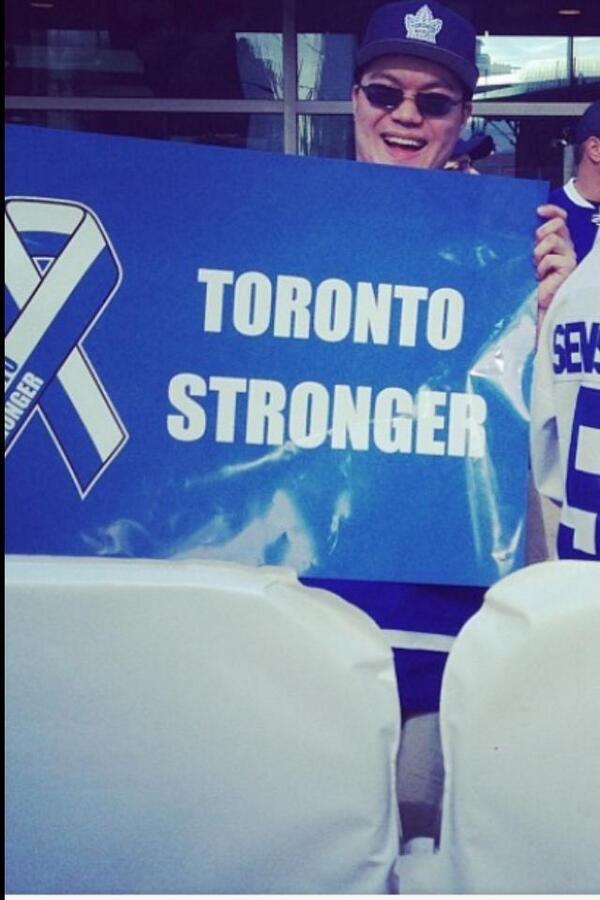 And then in the NHL playoffs, all holy hell broke lose. Some guy in Toronto, during the first round series, held up a sign that said “Toronto Stronger.” People in Boston were furious, and within minutes #TorontoStronger was the top trend on Twitter here. People not in Boston were furious, people in Toronto were furious.
It got worse in the Finals, a t-shirt company in Chicago began selling “Chicago Stronger” shirts. The response was predictable and it makes you wonder just what the guys at Cubby Tees (the company behind the t-shirts) were thinking? The t-shirts were quickly pulled from sale in response to the firestorm of protest, much of it, to be fair, from Boston.  Then the guys at Cubby Tees responded, offering some kind of apology that wasn’t really an apology, just a self-serving attempt to make themselves as the victims of the entire affair. But they kind of had a point, they argued that this is sports, and in sports, there are rivalries. And when there are rivalries, there is a competition of wit, idiocy (ok, I said that, they didn’t) and so on.
And yet, the kind of furor that erupted after the sign in Toronto and the t-shirt in Chicago was predictable. The guy in Toronto should’ve seen it coming, so, too, should have Cubby Tees. Both were in incredibly bad taste. The Boston Globe published an editorial comment a week ago decrying the co-opting of the “Boston Strong” slogan by sports fans (amongst others), claiming that it diminished from the slogan’s original point, which was “the victims of the bombing, now rebuilding their lives; the law enforcement efforts during the manhunt; the decision, by athletes and organizers, to run the Marathon in 2014.”
It’s hard to argue with that logic, but it’s also bad logic. The Boston Strong rallying cry has obviously spread to sports, and it’ll spread to music and festivals all summer long. And when the Dropkick Murphys play, whether in Boston or anywhere else, there’ll be people in the crowd chanting the slogan or they’ll have it on posters. Why? Because the Bruins and the Dropkicks are ambassadors of Boston. Both the punk band and the hockey team market a brand that makes Boston a tough, intimidating place (in reality, it’s nothing of the sort), and that’s an image that Bostonians like, and are proud to project around North America and beyond. The Bruins represent the city and the fans of the Bruins put their hopes, their energy, their money into supporting the team in cheering them on to victory. When the Bruins lost last night, Claude Julien, the coach, told reporters that he was disappointed in part because it would’ve been nice to bring the Cup back to Boston to help in the healing from the bombings.
It was always going to be the case that “Boston Strong” would become a rallying cry for Bruins’ fans. They’re Bostonians, and the Bruins are their team, their representatives. The Globe missed the point of professional sports; sports are meant as a distraction, as a means of turning our attention from reality. It’s worth noting that back in September 2001, the NFL season was meant to start the weekend after 9/11. Paul Tagliabue, the commissioner of the NFL at the time, immediately cancelled the games that weekend out of respect. It was the obviously correct choice to make. But then-president George W. Bush inveighed upon Tagliabue to reinstate the games, Americans needed the distraction.
Sports are more about identity as much as anything else for spectators and fans. And thus, it should be no surprise to anyone, lest of all the Globe that “Boston Strong” became a rallying cry for the Bruins, just as it was for the Celtics, as it is for the Red Sox, and will be for the Patriots when their season starts up in the fall.
Getting Redevelopment and Community Right
March 12, 2013 § 2 Comments
Yaletown in Vancouver has undergone massive redevelopment in the past two decades. It was once the site of Expo 86 along False Creek, and before that, an urban wasteland (actually, after Expo, too). But today, it is a sea of glass towers; one statistic I’ve seen said the population just in Yaletown approaches 30,000, though I find that hard to believe. All along False Creek is a string of residential condo towers; all along Pacific Boulevard, from Granville to Cambie streets there are towers and pied-à-terre condos. Some of them even look nice.
 As I went out for my morning run today (I’m staying with my sister here), I noticed something: this is actually a well-thought out urban redevelopment. There’s a billboard on Pacific Blvd that says that Concord, one of the developers is building community here. It’s easy to scoff at that claim. But it’s not a ridiculous claim. My sister knows her neighbours. More than that, she has friends amongst them. Dog owners around here have claimed a patch of Cooperage Park on False Creek as a dog run. They police each other, making sure nobody leaves their dog doo behind. They also police each other’s dogs, making sure they behave. There’s a bunch of cafés and restaurants along Marinaside Drive (I know, what a horrible name), and they’re populated with regulars, the neighbours around here. People nod and say hello to each other on the streets and along the path that goes along the bank of the water.

There’s more, though. There’s actual, real parks here. Cooperage stretches almost from the Plaza of Nations at the head of False Creek towards and under the Cambie Bridge. A few blocks on is David Lam Park, which lies between Pacific, Drake, and Homer streets. But it’s more than that. These parks are actually used. There’s basketball and tennis courts at David Lam, and a playground. An elementary school is on David Lam and the children can be seen playing in the park at recess and lunch and after school. The path along the water is almost always busy with joggers and cyclists, as well as roller-bladers and walkers (Vancouver was experiencing one of its trademark torrential downpours when I was out taking pictures today, thus, aside from one intrepid jogger, there was no one out playing).
When I lived in Vancouver in the late 90s, there was a lot of hand-wringing about the redevelopment of the old Expo site. The city was determined to increase density, to follow the model of the West End, which is apparently the densest neighbourhood of North America that’s not Manhattan. So the old Expo lands saw these condo towers grow out of the ground. The major difference between the West End, which lies on the other side of the Burrard and Granville Street bridges and this area, which is part of the larger Yaletown neighbourhood, is that Yaletown tends to be resident owners, whereas the West End is largely rental units (there are, of course, many exceptions to both).
 At the end of the day, however, Vancouver got it right. There is community here, the public spaces are widely used. The cafés and restaurants are, with the exception of one Starbucks (this IS Vancouver, after all) independent operators (this isn’t as true as Pacific Blvd., the main east/west thoroughfare, which has plenty of chains in between and around the indie stores). This also contributes to community, as the small business owners connect to their local community in a way that Starbucks and Quiznos can’t. And studies show that locals are more likely to patronise these small businesses than the chains. Indeed, this morning, Bojangles, the local indie café was busy, filled with both commuters on their way to work and those with more time to sit and enjoy their coffee. Whereas the Starbucks, while it got a fair amount of foot traffic from commuters, it doesn’t have the same community feel.
I fear, however, that Montréal is getting it wrong with Griffintown. The early plans for the massive redevelopment of Griff by Devimco called for massive shopping areas and big box stores. The commercial developments were supposed to pay for the residential developments. As for anything else that urban residents might need, well, “Whatever,” Devimco seemed to say. Of course, Devimco’s bold plans were thwarted somewhat by the recession. The redevelopment is now a mixture of Devimco’s big District Griffin (how tragic it would be to have that old English name on the neighbourhood, eh, OQLF?) and a smattering of smaller developments, with the massive redevelopment of the old Canada Post Lands at the other end of Griff at the foot of rue Guy.
Missing, though, from all these redevelopment plans in Griff was any idea of what residents were supposed to do. There still are no plans for schools in the neighbourhood. It wasn’t until early 2012 that the Ville de Montréal announced that it had earmarked some money to create public parks. It’s still not entirely clear where they’ll be, other than the already extant Parc St. Ann/Griffintown at the bottom of rue de la Montagne at Wellington. And given Montréal’s history of development and redevelopment, and the fact that the mayor, first Gérald Tremblay and now Michael Applebaum, just has dollar signs in his eyes when talking about Griffintown, I have zero hope of Griffintown being redeveloped right. In fact, I am almost positive it will be a disaster.
It’s tragic, as Montréal has a chance to redevelop a huge swath of valuable land at the foot of downtown, to emulate what Vancouver did with Yaletown in the 90s and 00s. But it has done nothing to suggest that it will get it right. And that’s trafic.
 Matthew Barlow