F-Bombs for Feminism
November 7, 2014 § 4 Comments
FCKH8.com, a website dedicated to eradicating hatred, posted this video a few weeks back. Not surprisingly, it caused a bit of a sensation
After all, we can’t have little kids swearing, can we? Never mind the fact that they’re noting the ridiculous gender imbalance in our world. Of course, that’s not shocking. Denise Balkissoon published this devastating opinion piece in the Toronto Globe and Mail today; she argues that the Jian Ghomeshi situation is not some magical watershed for violence against women, reciting a long litany of shocking moments that should’ve marshalled our collective anger to stop it. And this is just the Canadian context of violence against women.
But it’s not just violence. A couple of weeks ago in class, two of my female students commented on their own experiences. Both are incredibly intelligent young women, and both come from a place of privilege. They are white, and they come from relatively affluent backgrounds. Both grew up treated equally and fairly vis-à-vis the boys, but when it came time to graduate from high school and go to university, they discovered the world was not so fair. Both report they received diminished opportunities in comparison to the men they knew, in terms of their choices for university, the internships they received, the jobs they got. Why? Because they’re girls.
The Facebook post I first saw this FCK8 video on had a bunch of comments tut-tutting about the foul language of these little girls, not on the fact that what they were saying was true. And that is the entire point. If it takes a famous Canadian radio host beating his dates, a South African athlete killing his girlfriend, or little girls swearing to draw our attention to this general societal problem, we’ve failed.
On the New Racist Discourse in America
November 4, 2014 § 78 Comments
[Note: Comments have become out of control on this blog post, including some downright racist terminology that I have not allowed to be posted, as well as a few that include veiled, and occasionally direct, threats against me.]
So Ben Stein thinks that Obama is the most racist president in the history of this great republic. He thinks so because allegedly Obama “is purposely trying to use race to divide Americans,” and is using the ‘race card’ to convince all African Americans to vote for the Democratic Party. Ben Stein is wrong.
Obama is not the racist one, but Stein is tapping into a new discourse of racist ideology arising from the right in this country. In this discourse, anyone who mentions race as an issue in contemporary American life risks being called a racist. Anyone who points out racial inequality is at risk of being branded racist. In the mindset of those who trumpet this new discourse, we’re all equal, no matter our ethnicity, gender, sexual preference, or racial background. And any attempt to point out inequality is therefore racist/sexist/homophobic, etc, by definition.
But what this discursive technique does is to deny the experiences of women and minorities in our society. It says to those who have experiences different than white men that their experiences are invalid. In short, this new racist discourse is meant to work as shorthand for racist viewpoints. Thus, by claiming Obama is racist, Stein is both diverting attention from his own racism, and engaging in that very racism he blames on Obama.
More often than not, this discursive technique comes hand-in-hand with declarations of what is in the best interests of African Americans. And in this sense, we return to the paternal racism of slave owners in the pre-Civil War era. I’m not saying that Ben Stein = slave plantation owner. I’m saying the tricks of technique here are very similar. Last spring, we saw the Carolina Chocolate Drops up in Vermont. Towards the end of the show, Rhiannon Giddens, the frontwoman of the band, told us of her own explorations of American history, and a book she read on slave narratives in the post-Civil War era. One story in particular struck her, and she wrote the song “Julie” about it.
In the story, the mistress of the plantation is shocked at the fact that Julie, the former slave woman would have a will of her own. She thought that she knew best for Julie, as did slave owners in general in a paternalist racist system.
And every time a white man or woman purports to know what’s best for African Americans, or any other minority, they’re engaging in this kind of paternalistic racism, which appears to be part and parcel of this new racist discourse from certain sectors of the political right in the United States.
The Wisdom of Marc Bloch
October 8, 2014 § 5 Comments
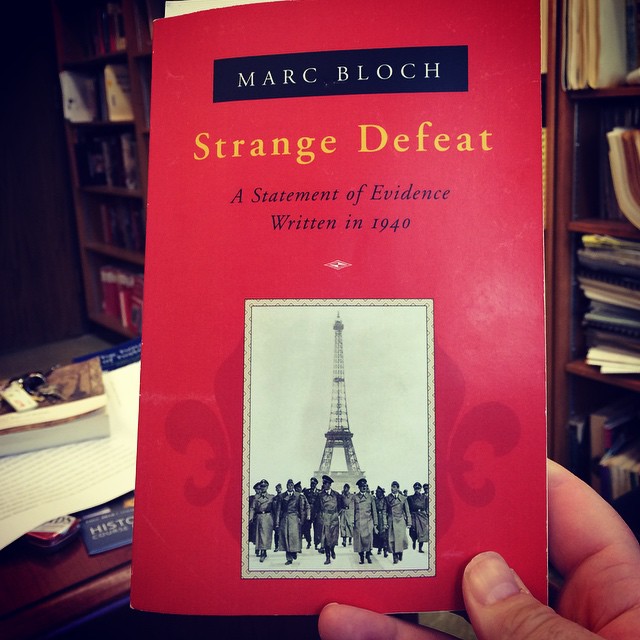 Marc Bloch is one of the most influential historians ever. An historian of mostly medieval France, he, along with Lucien Febvre, founded the Annales school of historiography in the late 1920s. The Annalistes preferred examining history over the long durée, and across various periods of time. They also advocated a more complete history than one of generals, presidents, prime ministers, and other so-called Great Men.
Bloch met his end at the hands of the Gestapo on in Saint-Didier-des-Champs, in France, on 16 June 1944, ten days after D-Day, as the Nazis realised they were going to lose France. Bloch had been a member of the Résistance since 1942. He was captured by the Vichy police in March of that year and handed over to the Gestapo. He was interrogated by Klaus Barbie, and tortured. It was a sad end for a great man.
Bloch had served in the French Army during the First World War, and remained a member of the Army reserve in the interregnum between the two wars. He was called up into action during the Second World War and was on hand for the baffling collapse of France in the face of the Nazi blitzkrieg attack in May 1940. That summer, he wrote his blistering and searing account of the Fall of France, Strange Defeat, not knowing if his words would ever see the light of day. The book was published in 1948, four years after his murder, and three years after the war ended.
Bloch is unflinching in his critique of French High Command, and France in general, for the collapse of its Army in 1940. In part, he blames the High Command’s over reliance on a false reading of history, that led it into a state of pathetic stasis, incapable of recognising that 1939-40 was not 1918, and that the Second World War was a different war than the Great War. In this passage, he makes a passionate argument for what the study of History is.
History is, in its essentials, the science of change. It knows and it teaches that is impossible to find two events that are ever exactly alike, because the conditions from which they spring are never identical…the lesson it teaches is not that what happened yesterday will necessarily happen to-morrow, or that the past will go on reproducing itself. By examining how and why yesterday differed from the day before, it can reach conclusions which will enable it to foresee how to-morrow will differ from yesterday. The traces left by past events never move in a straight line, but in a curve that can be extended into the future.
I assigned this book for my historiography class, and was deeply struck by this passage. I’ve re-read it four times now, it goes against what our culture thinks history is. Our culture thinks history is exactly what Bloch says it isn’t, that it can teach us to avoid the same mistakes over and over again.
I was thinking about this in light of my Irish history class dealing with The Liberator, Daniel O’Connell last week. O’Connell led the movement for Catholic Emancipation in Ireland, succeeding in 1829. He the turned his sights on the Repeal of the Act of Union (1800), which created the United Kingdom of Great Britain and Ireland. In this, he failed. He failed because times had changed, and attitudes were different. In the early 19th century, many in Britain, and even some amongst the Protestant Ascendancy in Ireland, had come to the conclusion that the denial of civil rights for Catholics in Ireland was not a good thing, and that Emancipation was necessary. Three of the staunchest opponents of Emancipation came around to O’Connell’s way of thinking: Sir Robert Peel, the Home Secretary; The Duke of Wellington, the Prime Minister, and King George IV). In the 1840s, though, when O’Connell’s Repeal movement reached its apogee, he did not have a groundswell of support in Britain (or amongst the Protestant Ascendancy) for Repeal. Thus, he failed because O’Connell failed to learn the proper lessons of History.
We would do well to remember Bloch’s maxim. Even we historians.
Acura #Fail
October 6, 2014 § Leave a comment
Acura is a luxury car maker, owned by Honda Motor Company. It has a new ad on TV I’ve seen a few times, and every time I see it, I’m completely gobsmacked. The ad, which I’ve posted below, shows a generic luxury car, but it’s the music that shocks. That’s Sid Vicious, former “bassist” for the Sex Pistols, mangling “My Way,” Paul Anka’s song made famous by Frank Sinatra.
Vicious, real name John Simon Ritchie, wasn’t a musician. His bass was usually unplugged when the Pistols played live. He was a junkie and a general degenerate, what would today be called a ‘gutter punk.’ On 12 October 1978, Vicious killed his girlfriend, Nancy Spungen, in a drug-stupor in the Chelsea Hotel in Manhattan. He stabbed her once in the abdomen, and she bled to death. Vicious was arrested. He eventually died of a drug overdose on 2 February 1979. No major loss, really.
Aside from the fact that Acura has clearly missed the point of 1970s punk, a movement against corporate rock and other creeping commercialisation, Acura has completely lost the plot in casting a girlfriend-killing junkie’s music as a means of selling a car. This is a complete and utter disgrace and a #fail.
Historians Being Mean: A Glossary
October 4, 2014 § 4 Comments
[Note: This is not mine, my wife, Margo Shea, came up with this last week in prepping for the Historiography course she’s teaching. But, I think it’s brilliant, and kind funny, too, and worth sharing. I took this, with her permission, of course, directly from her blog. All credit goes to her, not me. I’m just married to a woman who’s smarter than me.]
Historians Being Mean : A Glossary
OK, I think back to graduate seminars and wonder if they may be sites of some of the most grievous crimes against reality when it comes to language usage. Pompousness galore! While aspirational erudition can be really annoying (see – told you!), there are instances in which the correct word matters, not the OK word or the more or less descriptive word. This, of course, is coming from the woman who, as a four year old, asked her mom if she could postpone her nap because she wasn’t currently tired. I used the perfectly appropriate word and got out of my nap. Life lesson learned. Check.
In no particular order, then, here are a few of the most commonly used words historians sling at each other and what they mean. Followed by what they really mean
Unsubstantiated. Obvious and unequivocal, this means you just don’t have the evidence to make the claim. You rarely see the “unsubstantiated argument” in print as a response to an entire article or text, because it’s the baseline for the profession and most research that can’t pass muster on the whole ‘evidence’ thing doesn’t get published. If seen, it is usually applied to one aspect of the research, sometimes because the reviewer can’t think of anything else to criticize. More likely to be heard at conferences, occasionally seen in print records of scholarly roundtables. In which case it means, “I just don’t like you at all and I don’t care who knows it” or “You are getting way too close to my research topic.” Implied insult: You didn’t do your homework. (Alternate reading: Your sweeping, elegiac study kind of blows my mind, so instead of feeling unworthy of you, I’ll just hang out over here and quibble over details in this one subsection of this one chapter, OK?).
Overdetermined. In layman’s terms, this means that an argument about cause or motivation attributes way too much significance to one criterion or set of criteria amongst a much larger pool of possible causes or motivations. The interpretation doesn’t leave enough room for alternate readings. This critique can be lodged in a few different circumstances and can be related either to the argument itself or to the person presenting the argument. Sometimes it is just a fancy way of saying, “Hey there, you’re right on the verge of manipulating your sources to your own dastardly ends.” Also, scholars opposed to the ideologies espoused explicitly by an author or implied in the context of the historical work may use overdetermination as a stand-in for “interested.” (See below.) Implied insult: Your interpretation is about as subtle as two dogs sniffing each other’s nether regions.
Lost in the Structure/Agency Corn Maze. Anyone writing about what people did and why people did what they did, especially if they happen to occupy subaltern status vis á vis a dominant power structure, has to grapple with the whole agency thing. To what extent do individual actors and groups exert personal and collective choice propelling them to act or not act, to speak, to be silent, etc? And to what extent do the forces that structure their society influence and shape the boundaries of what is possible? (Marx’s superstructure, Bourdieu’s field, etc.) It is easy to get lost in this maze and critics are unfortunately somewhere looking down watching you bounce off dried husks. Implied Insult: Seriously, who really cares about what ordinary people did or why?
*Special thanks to Lara Kelland, who cares deeply about ordinary people who create social change, for this one.
Methods-Fetishistic. This basically red-flags an obsessive fascination with methods or methodology, a blind or perhaps naïve faith in methodology as the key to unveiling hitherto opaque historical truths. Historians who rely on quantitative, computational, data-mining methodologies fall under this scrutiny on the grounds that statistics don’t speak for themselves. Implied insult: Got analysis?
Essentialist/Essentializing. Basically, an essentialist argument applies an indispensable set of characteristics to any group of people, set of events or places or things. Over generalization but more than that – it often but not always involves negative judgment. All Irish people are alcoholic-soaked pugilists. All middle class women whose primary work is in the home in the 1950s were sexually repressed. It projects the characteristics of a few onto an entire group. Making data/evidence about a small number of historical actors apply to the whole. Treating as representative the actions, performance, rhetoric of a few. Implying connections between actions and subject positions without a lot of evidence. Implied insult: The trees aren’t the forest, sweetie. And btw, there are a LOT of shades of green.
Teleological. A teleological argument ignores contingencies that make historical change happen and basically suggest a certain inevitability of events. It is the classic “all roads led to here” argument. Basically, a teleological argument looks at the present scenario and structures evidence about the past in such a way as to explain smoothly and coherently how A led to Z. And occasionally you might get really lucky and be get told that you are “reifying a teleology.” Historical scholarship as means to end. Implied insult: Go back to grad school, Marxist.
Interested/Present-minded. These are teleological’s pesky little brothers. It is a somewhat less harsh way of saying much the same thing. You are hereby convicted of reading the past through a set of political, social or cultural interests and commitments or are looking at present circumstances and making assumptions about how historical actors might have responded to the same kinds of circumstances or how historical processes might have operated, etc. Plus, you aren’t even badass enough for me to throw teleology at you. Implied insult: Go to American Studies or Performance Studies or somewhere, you contemporary person, you. You don’t belong here.
Whiggish. Present-Minded + Pollyanna. Herbert Butterfield published The Whig Interpretation of History in 1931. “The Whig interpretation of history,” he said, was “the tendency in many historians to write on the side of Protestants and Whigs, to praise revolutions provided they have been successful, to emphasize certain principles of progress in the past and to produce a story which is the ratification if not the glorification of the present.” Things are always getting better. Progress is inevitable. History is a straight line towards awesome. Implied insult: If you love the system so much, maybe you should have just gone to business school.
What Steve Earle can teach us about the Annales school of historiography
October 2, 2014 § 4 Comments
I’m teaching a course on Historiography this semester. This week, we’re dealing with the Annales school of history, as a sort of background before we read Marc Bloch’s Strange Defeat. While this book isn’t really an annaliste work, Bloch’s theories of history still impacted his evisceration of his country after the Fall of France in 1940. We’re reading an excerpt from Fernand Braudel’s magnum opus, La Méditerranée et le Monde Méditerranéen à l’Epoque de Philippe II, published in 1949.
In it, Braudel talks about the mountain regions of the Mediterranean world, and argues that the culture and civilisation of the plains didn’t reach into the mountains. The hills, he claims “were the refuge of liberty, democracy, and peasant ‘republics.'” And he mentions bandits. One of my favourite history books of all-time, and one which was massively influential on me as a young scholar, is Eric Hobsbawm’s Social Bandits and Primitive Rebels, which, despite Hobsbawm being primarily thought of as a Marxist, was deeply indebted to the annalistes, and to Braudel in particular.
But, as Braudel goes on and on about the freedom of the mountains, I kept thinking about hillbilly culture, about the Hatfields and the McCoys, about hillbilly culture, and so on. And it occurred to me that the mountains are no longer this mythical place beyond the reach of modern society. The coercive power of the state has caught up to the mountains.
And then I thought of my favourite Steve Earle song, “Copperhead Road.” In this song, Earle sings of three generations of a family who live in the ‘holler’ down Copperhead Road. In the American Civil War era, copperheads were northern Democrats who opposed the Civil War and called upon President Lincoln to immediately come to peace with the Confederacy. Braudel argues that
The mountain dweller is apt to be the laughing stock of the superior inhabitants of the towns and plains. He is suspected, feared, and mocked…The lowland peasant had nothing but sarcasm for the rude fellow from the highlands, and marriages between their families were rare.
At any rate, Earle sings of John Lee Pettimore III, named after his “daddy and his daddy before.” Granddaddy John Lee made moonshine down Copperhead Road. Daddy John Lee ran whiskey in a big black Dodge, which he bought at an auction. Meanwhile, John Lee III is a Vietnam vet growing marijuana in the holler down Copperhead Road. He signs the song in a good ol’ boy twang, and sings of white trash.
Granddaddy John Lee hid out down Copperhead Road, only came to town twice yearly for supplies, and successfully dealt with a “revenue man” from the government. Daddy John Lee was doing alright for himself before he crashed that big, black Dodge and the whiskey he was running burst into flames, killing him, on the weekly trip down to Knoxville. Meanwhile, John Lee III wakes up in the middle of the night with the DEA and its choppers in the air above his land.
In other words, as we move through the 20th century, from Granddaddy in the 1940s to John Lee III in the 1980s, we see the mountains lose their allure and mystique. What was once the badlands is now under the control of the government. In the early 21st century, it is even more so.
Deindustrialisation in the Rural Heartland
September 22, 2014 § 8 Comments
The Macon County Fair in Decatur, Il, was cancelled this year. The fair has been a going concern for 158 years, but it also survives through funding from the state of Illinois. Illinois, of course, is a particularly cash-strapped state, which is saying something. It has the lowest bond rating from Moody’s of all 50 states of these United States of America. So funding for county fairs in Illinois has dropped drastically since the turn of the century, from $8.16 million to $5.07 million. Meanwhile, Macon County’s population has been in steady decline since the 1980s, falling from 131,375 to 109,278 today.
We were in Decatur last summer, in our drive across the continent to my sister’s wedding in Portland, OR. It was a pretty, but sleepy town in Central Illinois. It remains a central component of the industrial/agricultural heartland of the United States. It is also the birthplace of the Chicago Bears, the franchise known as the Decatur Staleys, after its original owner, a food-processing magnate.
But Decatur is in trouble, its population also in steady decline since the 1980s. And this decline is reflected in the trouble the Macon County Fair has encountered, as the organisation that puts on the fair is carrying a $300,000 debt, and its headquarters was damaged by heavy rains in July.
What is happening in Macon County is not unique, it is symptomatic of most rural areas in the United States (and Canada) today, as corporate farming becomes further and further entrenched, in the wake of deindustrialisation. Oportunities in these areas dry up, people are left with no choice but to move away, most of them to big cities, both in the MidWest, but also Chicago and coastal cities. Most Midwestern cities continue to grow, though St. Louis seems to be bucking this trend, its population in free-fall since the mid-20th century.
The story of deindustrialisation in North America is one that has been largely limited to big coastal cities, most notably in the northeast, and the so-called “Rust Belt” that stretches around the Great Lakes on both sides of the border (for an excellent treatment of deindustrialisation in the Rust Belt, check out Steve High’s book, Industrial Sunset). Left out of this story is the affect of deindustrialisation on the rural areas across the Heartland.
Writing Deindustrialisation
September 19, 2014 § 3 Comments
I’m always surprised by how deindustrialisation and the economic and social dislocation it caused in the northern United States and Canada gets written about. Take, for example, an otherwise interesting and informative article in The Boston Globe last weekend. In an article about Sahro Hussan, a young Somali-American, and Muslim, woman who has created a business of avant-garde fashions for Muslim women, in Lewiston, ME, Linda Matchan, The Globe‘s reporter, writes:
Lewiston was one of the largest textile producers in New England, rolling out millions of yards in cotton fabrics every year. In time, though, the industry struggled to compete with Southern states where production costs were lower. Lewiston went into decline.
While there is nothing factually wrong with Matchan’s description of what happened in Lewiston (or any other industrial town across the northern portion of North America), note how any responsibility for what happened is removed from the equation. Matchan makes it sound like this was just an entirely natural process.
Deindustrialisation wasn’t a natural process, it didn’t just happen. The reason why the mills in Lewiston (or Lowell, Laurence, Lynn, or anywhere else) struggled wasn’t some random event. It happened because the corporations that owned those mills decided that they were not producing enough value for share-owners. So these corporations pulled out of places like Lewiston and moved down South. Why? Because production costs were too great in the North, the workers made too much (they were often unionised), and there was too much regulation of the workplace for the corporations’ preferences. So, they were induced to pull out and move down South where workplace regulation was minimal, where workers weren’t unionised, and the corporations could make great profits. The governments down South actively worked with these corporations to bring them South, mostly through these unregulated workplaces and tax incentives. As a friend of mine notes, this is how the South won the Civil War. But the South’s victory was shortlived, as soon, the corporations realised they could make even more money for their shareholders by moving overseas.
So. Long and short, deindustrialisation wasn’t just some random process, it was a cold, calculated manoeuvre by the corporations that owned these mills, in conjunction with cynical state and local governments in the South.
Bad Fashion and the Importance of History
September 17, 2014 § Leave a comment
 Urban Outfitters is no stranger to controversy, having a long history of doing stupid things
  and offering up offensive products to tasteless and tactless hipsters. A sample of the company’s idiocy sees anti-Semitic t-shirts and accessories, racist board games, and the like. But this week, we got an offensive sweatshirt. Urban Outfitters began selling a “vintage” Kent State University sweatshirt (at $120, a price only a clueless hipster would spend) that looked like it was spattered with blood, complete with what looked like bullet holes. This, of course, recalled the 1970 Kent State shootings, when four students were killed and nineteen injured when the Ohio National Guard opened fire on unarmed protesters. Almost immediately, the company was besieged with howls of protest, calling this move insensitive, at best (do a Twitter search for some more colourful responses). It then responded with a typical corporate nothing-speak empty apology:
If you click on the link in that tweet, you can read the end of this empty apology, which talks about sun-faded vintage clothing and discolourisation and “how saddened” the company was by public perception. Given the company’s history of provocation and offensive behaviour, I see nothing sincere here.
 It’s been a bad stretch for clothing makers, last month, Spanish clothing retail giant Zara tried selling a children’s pyjama that recalled the uniform Jewish prisoners were forced to wear in concentration and death camps during the Holocaust. Faced with a similar storm of protest on Twitter and elsewhere, Zara withdrew the item and issued a similarly empty corporate apology. In its version of the gormless apology, Zara said this pyjama shirt was meant to recall the star sheriffs wore in the American West. Sure. Right.
I won’t even get into the downright daftness of hipsters wearing aboriginal headdresses. That’s an entire dissertation on stupidity, cultural appropriation, and a how-to guide on offensiveness. (There is, however, a Tumblr devoted to mocking hipsters in headdresses).
But all of this idiocy reinforces the importance of history and the impact a little bit of historical knowledge can have on the world. Someone in my Facebook feed today suggested that fashion companies simply hire someone to be an historian-minded vettter, to ensure plain, outright stupidity like this doesn’t happen. But the very fact that these two items of clothing actually got to market displays an epic failure of corporate oversight. In order for something to get from design to retail to production means that both items went through many checks, were seen by many eyes. And no one thought, “Hey, this is a bad idea.” Or, no one cared. Certainly, one can come to that conclusion vis-à-vis Urban Outfitters, given the serial nature of its offensiveness and lack of good corporate citizenship.
Memory and the Music of U2
September 15, 2014 § 2 Comments
[We now return to regular programming here, after a busy summer spent finishing a book manuscript]
So U2 have a new album out, they kind of snuck up on us and dropped “Songs of Innocence” into our inboxes without us paying much attention. Responses to the new album have ranged from ecstatic to boredom, but I’ve been particularly interested in how the album got distributed: Apple paid U2 some king’s ransom to give it to us for free. Pitchfork says that we were subjected to the album without consent, a lame attempt to appropriate the words of the ant-rape movement to an album.
As for me, I’m still not entirely sure what I think of “Songs of Innocence.” I think it’ll ultimately be disposable for me, though it’s certainly better than their output last decade, but not as good as the surprising “No Line on the Horizon” which, obviously was not up to the standard of their heyday in the 80s and 90s. And I’m not sure about Bono’s Vox as he ages, it’s starting to sound too high pitched and thin for my tastes, whereas it used to be so warm and rich.
 Anyway. iTunes is now offering U2’s back catalogue on the cheap. I lost most of my U2 cd’s in a basement flood a few years ago, so I took a look. But looking at the album covers, I was struck by the flood of memories that came to me. For a long time, U2 were one of my favourite bands, and “The Joshua Tree” has long been in the Top 3 of my Top 5. But, just how deeply U2’s music is embedded in my memories was surprising. For example, looking at the cover of “The Unforgettable Fire,” I am immediately transported back in time, to two places. First, I’m 11 or 12, in suburban Vancouver, listening to “Pride (In the Name Of Love)” for the first time, on C-FOX, 99.3 in Vancouver. Secondly, I’m on a train to Montreal, from Ottawa, in the fall of 1991, listening to “A Sort of Homecoming” as I head back to my hometown for the first time in a long time.
 The cover of “Zooropa” takes me back to the summer of 1993, riding around Vancouver in the MikeMobile, the ubiquitous automobile of my best friend, Mike. That summer, “Zooropa” alternated with the Smashing Pumpkins’ “Siamese Twins” in the cd player, which was a discman plugged into the tape deck of the 1982 Mercury Lynx. US and the Pumpkins were occasionally swapped out for everything from Soundgarden and Fugazi to the Doughboys and Mazzy Star, but those two albums were the core.
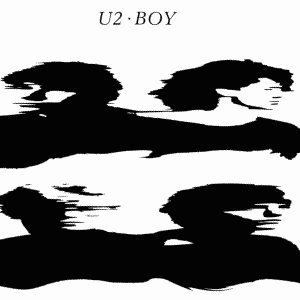 “Boy” takes me back to being a teenager, too, my younger sister, Valerie, was also a big U2 fan back in the day, and she really liked this album, so we’re listening to it on her pink cassette player (why we’re not next door, in my room, listening on my much more powerful stereo, I don’t kn0w). She went on to become obsessed with the Pet Shop Boys’ horrid, evil, and wrong cover of “Where the Streets Have No Name” (and the PSB were generally so brilliant!), to the point where she once played the song 56 times in a row on her pink cassette player, playing, rewinding, and playing the cassette single over and over.
Obviously the soundtrack of our lives (or The Soundtrack Of Our Lives, a brilliant Swedish rock band last decade) is deeply embedded in our memories, much the same way that scents can transport us back in place and time. But I was more than a little surprised how deep U2 is in my mind, how just seeing an album cover can take me back in time across decades, and in place, across thousands upon thousands of kilometres.
 Matthew Barlow