Urban Archaeology & Material Culture
April 21, 2010 § 1 Comment
Recently, I’ve been thinking about urban archaeology and material culture. Given my research interests, I suppose it’s only natural that I would also think about the actual physical landscape of the city and how it shifts and changes with time, populations, and construction.
Years ago, I visited Montréal’s Pointe-à-Callière Museum, in the Vieux-Port. Point-à-Callière is the site of the first settlement of Ville-Marie, where Paul de Chomedy, Sieur de Maisonneuve decided to plant his new settlement in 1642. The museum itself is based around 3 archaeological digs (Pointe-à-Callière iteslf, as well as Place Royale and Place D’Youville), and artefacts from these archaeological digs are on display. But it’s not just that. In the underground of the museum, down where the digs took place, one can physically see the layers of city and settlement on Pointe-à-Callière, from the initial aboriginal inhabitants through the founding of Ville-Marie, to the governor’s mansion that was once located there, through urbanisation, industrialisation, and so on. The physical remnants of the buildings, and artefacts are there for the viewer to see.
My favourite part is the William sewer, which canalised, and placed underground, the Rivière Petite Saint-Pierre, which itself had become a stinking cesspool as it flowed above ground through what was once the Nazareth Fief (and later Griffintown), into the St. Lawrence, hence creating Pointe-à-Callière. Apparently (at least according to its entry on Wikipedia), the museum has plans to open up and expose the Petite Saint-Pierre, as well as the old location of St. Ann’s Market in Place D’Youville, as well as the remains of the Parliament House of the United Province of Canada, which was burned down in the Rebellion Losses Bill Riot in 1849 (just imagine a riot today in a democracy burning down the house of parliament!).
Anyway, this is where I first thought about urban archaeology, but I never really gave it much more thought in terms of my academic interests until a couple of summers ago, whilst walking along the Canal Lachine, where, at the St. Gabriel locks, Parks Canada has dug up the foundations and remnants of a factory on the northeastern side of the locks.
Andy Riga, over at The Gazette, has an interesting blog, “Metropolitan News;” his latest post is about the public toilets, disused and buried under Place D’Armes. During the reign of Mayor Camillien Houde in the 1930s, partly as a public works project, Vespesiennes were built in Carré Saint-Louis, Square Cabot, amongst other places, and public washrooms were constructed in places including Place D’Armes. The washrooms there were shuttered in 1980, victim of many things, including Montréal’s notoriously crumbling infrastructure. Since then, there have been a few plans or attempts at plans to revive the public toilets, but they are in serious decay and would cost too much money to renovate them, due to years of neglect, water damage, and humidity. So they remain buried under Place D’Armes which, like Dorchester Square downtown, is undergoing a massive renovation.
So notions of what’s underfoot have long interested me as I’ve wandered about the city, but especially in the sud-ouest, Griffintown and Pointe-Saint-Charles, as well as Saint-Henri, where I’ve lived for most of the past decade.
Also, too, there is the influence of Prof. Rhona Richman Kenneally of Concordia University, who encouraged me to give some thought to material culture in approaching my dissertation and my work on Griffintown. Ultimately, as interesting and exciting as I found approaches to material culture in my studies, there was no way to fit it into the dissertation (the same can be said of proper mapping of the Griff). But I remained intrigued by these ideas.
So, with all of this in mind, I finally got my hands on Stephen A. Brighton’s Historical Archaeology of the Irish Diaspora, based around digs in the Five Points of Manhattan and in Newark, New Jersey. Using the archaeological evidence, Brighton constructs an argument centred on the material culture of 19th century Irish-American life in these two urban centres. Using this methodology, Brighton is able to answer a lot of questions we cannot answer using more traditional historical methodologies. Brighton has the remnants of the material culture of the Irish immigrants and Irish-Americans. Finding glasswares with symbols of Irish nationalism on them suggests that the movement had some traction amongst the tenement dwellers of the Five Points.
My favourite part of his analysis, though, comes in relation to medicine. The artefacts from the Five Points come from the 1850s and 60s, whereas those in the New Jersey digs are from the 1880s. In other words, the Five Points Irish were more recent arrivals and lived in greater poverty than those in New Jersey. Thus, their access to the nascent public health system was different than that of their compatriots in Jersey. Brighton found that the Five Points Irish relied more on cure-alls and pseudo-medical tonics to cure what ailed them. Throughout the dig site are bottles that once contained tonics and cures, whereas in New Jersey, the digs uncovered evidence of reputable medicines. This, concludes Brighton, is symptomatic of that poverty but also, too, perhaps of the alienation of mid-19th century Irish immigrants from the mainstream of American culture and society (remember, the 1850s also saw the Know-Nothing movement in the USA and the Bowery B’hoys Riot of 1857).
So what Brighton offers up here is a piece of evidence to support what historians already know from more traditional sources. And this brings me to my problem with Brighton’s book: it doesn’t add much in the way of new information to our historical knowledge. Rather than challenge historians’ traditional takes on the Irish in the Five Points (especially), Brighton confirms what we already knew with the archaeological evidence.
Climate of Conflict in the Arctic
March 29, 2010 § Leave a comment
A couple of weeks ago, I was emailed interviewed by the ISN Security Watch for an article on the Arctic and the growing interest being shown in it by the Arctic nations and their neighbours, which is back in the news today. Read the ISN article here.
New Project: Current Intelligence
March 11, 2010 § Leave a comment
The Complex Terrain Laboratory is being retired. Mike, Eric, et tout le gang from the Lab, have begun a new project, called Current Intelligence:
is a journal of opinion and analysis. Its editors and writers are preoccupied broadly with culture, politics and current affairs; narrowly with conflict,crisis, and the state of the world “out there”; and laterally with the intellectual concerns of those who research, teach, and write about the issues.
We went live on Monday, 8 March, and we will publish daily, Monday-Friday, with a quarterly print journal as well. Current Intelligence comes with its own set of sections:
- The Editor’s Desk: daily must-reads
- The Agenda: informed comment on headline issues
- The Big Smoke: reporting on London’s wealth of current affairs talk (starting in May, 2010)
- The Quiet American: analysis of foreign policy, military intervention, human rights & humanitarian affairs
- Letters From Abroad: dispatches from field researchers, expats and other travelers
We can even be found on Twitter.
So, come on over, grab a coffee and read what we’ve got to say. As for me, I’ll continue to offer my own particular position on issues that require a deeper, historical, long-view of understanding.
Modernist Architectural Behemothology
March 11, 2010 § 6 Comments
Years ago, I lived in Vancouver, perhaps once the greatest example of Modernist architecture in Canada, if not North America. Vancouver is the city that unleashed architect Arthur Erickson on the world. Sadly, Erickson died last spring. Yet, Erickson’s buildings live on in Vancouver, especially his modernist designs, most notably Simon Fraser University in suburban Vancouver (where I completed my MA), and the Canadian Embassy in DC.
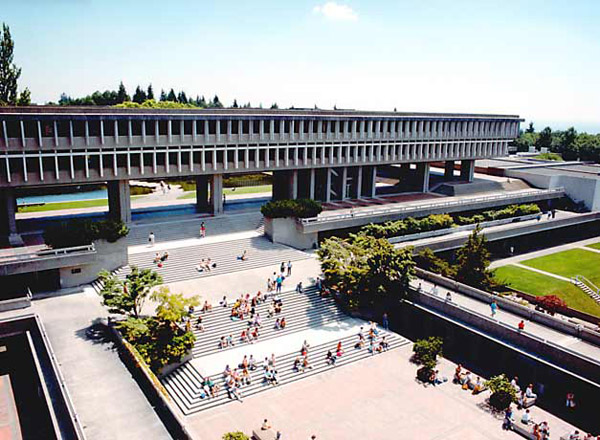

Indeed, one of my favourite architecture books is Rhodri Windsor Liscombe’s The New Spirit: Modern Architecture in Vancouver, 1939-1963. Modernist buildings haven’t really stood the test of time, I have to say, especially those designed to look like concrete bunkers, such as the Canadian Embassy. SFU is one of the most depressing places in the world on a cloudy, rainy day atop Burnaby Mountain. Unfortunately, it is often rainy and cloudy atop Burnaby Mountain. University campuses across North America are dotted with modernist buildings, as the great boom of construction on these campuses came at the height of modernism in the post-War era. In many instances, modernist behemoths look as if they were dropped into more classical settings, such is the case of Student Center Building at the University of Masscachusetts, Amherst. In the picture below, you can see those older, classic buildings scattered around the Student Center and the residence towers behind it.

So pervasive is modernist architecture on campuses that it is oftentimes pejoratively referred to as “Neo-Brutalist” architecture. Indeed, buildings such as the Student Center, or the entire Burnaby Mountain campus of SFU, re-enforce this. The buildings are concrete, massive, and imposing. Inside, there is a lot of dark browns, dark woods, and black. Gloomy is about the only way to describe these interiors.
Long and short, the term “Neo-Brutalist” quite often fits, not that there aren’t some beautiful modernist buildings to be found, such as Vancouver’s old BC Hydro Building, which has since been condofied, or MOntréal’s Palais de Congrès.


But, despite this, I can’t help but chuckle when I read stories like this one in the Globe & Mail yesterday, about the Public Safety Building in Winnipeg.

This particular behemoth, built in 1966, is a textbook case of Neo-Brutalist Behemothology. Frequently the several hundred employees of the Winnipeg Police Force are required to vacate the building because of noxious fumes that waft up into the building. This happens frequently, apparently. This time it required the Hazmat to come. The PSB is built out of
brittle Tyndall limestone, hasn’t held up against Winnipeg’s climate. Dozens of steel brackets cling to the building’s exterior like Band-Aids, preventing the facade from avalanching into the street. A $98,000 awning encircles the building, stopping pieces of the gaudy structure from braining pedestrians.
And this is the crux of the problem with many Neo-Brutalist behemoths, from SFU to Montréal’s legendary Stade Olympique, known in English as the “Big O”, or more fittingly, the “Big Owe,” as it took 30 years for the city to pay off its legacy from the 1976 Summer Olympics, by which time the Expos had decamped for Washington and the Alouettes had been re-born in McGill University’s quaint Molson Stadium at the foot of Mont-Royal. But the Big Owe and the PSB, and SFU, for that matter, all have something in common. The materials used to build them aren’t all that well-suited to the climate they are in. Hence, the PSB is falling apart, the Big O has had large slabs of concrete fall off it, and SFU, well, that much concrete in a rain forest isn’t the best idea, either.

But the bigger question is what to do with these buildings, especially those that are falling apart or being abandoned, as is the case with the PSB. Urban preservationists in Winnipeg argue that the PSB is worth saving,
According to University of Winnipeg Art Historian, Serena Keshavjee,
It’s not a love-hate relationship people have with these buildings; it’s just hate. People grew up with these buildings and don’t see them as heritage buildings, but the same thing happened 40 years ago with Victoria structures.
Had we ripped out every Victorian building in the country we would be very sorry these days,” she said. “And these are the times when they become vulnerable. The country is coming out of recession and people are gearing up to tear things down.
UW historian David Burley echoes, arguing that modernism
reflects a time when the federal government lavished money on public projects and Canadian pride soared ahead of Expo 67 and the centennial. “It was a nationwide movement,” he said. “There was this great optimism. The central parts of cities had deteriorated and there was a sense it was time to redevelop things.”
Personally, I’m not so sure that a modernist building is worth saving just because of its own merits. A building like the PSB is an ugly imposition on the urban landscape. Buildings like it seem to mock their landscapes, they don’t fit in, they crush them, they impose upon them. They belittle us. Of course, granted, that’s the point with a police station, or at least it was in the 1960s. But that doesn’t mean a building should be saved just because it’s old. Sometimes, old things are just junk. And the PSB is an example of that.
Here We Go Again: Looting in Chile
March 6, 2010 § Leave a comment
By now we all know that Chile was devastated by a massive earthquake this week, and by massive, we’re talking 8.8 on the Richter Scale; by comparison, the earthquake that devastated Haiti in January measured 8.0, certainly massively devastating.
In the aftermath, looting has broken out in across the nation. I find looting in the wake of natural disasters fascinating, as condemnations of it clearly show a disturbing trend of our culture: that private property in many cases is more sacrosanct than life. Indeed, if Western history teaches us anything, it is that property was and is quite often more important than the lives of the commoners or the poor or the working-classes. Indeed, this is clear from Thompson and his The Making of the English Working Class: property matters. The state is constituted to protect men, true, but also, men’s property. Especially that of wealthy men. Indeed, as no less an authority as Jean-Jacques Rousseau points out in his Discourse on Inequality, it is private property that is at the heart of that inequality. Thus we band together to be governed, surrendering some of our own personal sovereignty in order that our lives and property can be protected and, thus, at the same time, inequality.
Consider this passage from the Washington Post today:
Though there were middle-class looters — some carried off their booty in expensive four-wheel-drive vehicles — the pillaging was carried out largely by poorer Chileans, and it left some horrified onlookers wondering whether their country had really advanced as much as the economists and government officials had believed.
I can’t understand why it is that the poor looting carried out by the poor would cause such hand-wringing and soul-searching. And this causes The Post to go onto a long discourse on inequality and poverty, the nation with the lowest poverty rate (14%) in South America. But one also, according to Piero Mosciatti, a lawyer and director at Radio Bio-Bio in the city of Concepion. He says that:
I think there are very big resentments on the part of those who are poorest and marginalized. Chile is a country that is tremendously unequal, scandalously unequal. The statistics show it.
That may very well be. But aren’t all Western nations predicated on this inequality? It is one thing to wring our hands and tut-tut when the desperately poor of Port-au-Prince engage in looting. But, culturally, we expect that. We expect the desperately poor in a desperately poor nation to loot in the wake of a natural disaster. But when it happens in a supposedly wealthy western nation, then we get concerned. We saw this in New Orelans after Hurricane Katrina. And we’re seeing the same thing in Chile after this earthquake.
The media is shocked to learn that there are poor people, an underclass in first-world nations. Why this is is beyond me. Any trip through any major city in the west, be it London, Miami, New Orleans, Buenos Aires, and one is confronted by the urban poor. Our society is predicated on that inequality, for better or worse. And quite often, wealthy, industrialised nations have a massive disparity between the rich and the poor. This was made abundantly clear in the wake of Katrina in New Orelans in 2006. And this is true of not just the United States.
According to one of the looters in Concepcion, Chile, “This is done for necessity. Everything is abandoned, and we are looking for what has been left behind.”
At least the Chileans, according to The Post, are beginning to have the discussion as to whether or not Chile, which has developed rapidly, has done enough to bridge the gap between rich and poor. This is a discussion worth having in Canada.
Nuit Blanche à Griffintown
February 20, 2010 § Leave a comment
This Saturday, 27 February, is Nuit Blanche in Montréal, and there will be an event in Griffintown to celebrate. Organised by Le Comité pour le sain rédeveloppement de Griffintown, spearheaded by Judith Bauer, the event will be taking place at the site of the New City Gas Works, owned by Harvey Lev, located at 140 and 143, rue Ann.
There’s a whole bevy of cultural events on deck, including talks about the history of the neighbourhood, poetry readings, live music, artwork, and all kinds of other fun stuff. The website is here.
Also of note is that the Griffintown Horse Palace Foundation will have a table there to sign people up for membership and to raise funds for our ultimate goal, to buy and convert the Griffintown Horse Palace into a museum.
Knee-Jerk Anti-Americanism…
January 26, 2010 § Leave a comment
Zach McKelvie is a prospect for the Boston Bruins, a defenceman playing for Army. That means he signed up for the Army. Today, word has come that rather than pursue his professional career, McKelvie must report for active duty and training at Fort Benning. McKelvie says he understands the decision, but he also sounds pretty frustrated about it:
It’s frustrating on one side. At the same time, I can understand it…I have no problem serving in the military. This is what we train to do here. We train to be a part of this Army and help this country out. But at the same time … I feel like they never should have, I guess, led me on. And at the same time, it’s a pretty hard time to let someone play professionally. I totally understand that because of the situation that’s going on.
He thinks he was led on because, when he signed up, US Army policy was that if an athlete had a professional contract, s/he would be allowed to play for 2 years before being re-evaluated for future service. That policy has since been changed, and there is apparently no grandfather clause. He’s also frustrated because some prospective Olympic athletes are being allowed to pursue that by the Army. Fair enough, I can understand why McKelvie is frustrated, but I can also understand why he would accept the Army’s ruling.
What I find stupid and pathetic are some of the comments on TSN’s website. One commentor says McKelvie is brainwashed if he accepts the US Army’s ruling. Others comment on the “militaristic US culture.” My favourite, though, says this: “thats the usa for you.” Um, no. That’s not the USA for you. It’s also got nothing to do with militarism. Or brainwashing. It has everything to do with signing up for the military. In any nation. The same would happen in Canada. There are obligations and rules one must respect. It’s that simple. Knee-jerk anti-Americanism is just so boring.
Diaspora and the Haitian Earthquake
January 25, 2010 § Leave a comment
I spent a chunk of my weekend reading theory on diaspora and transnationalism, as I begin the process of writing the Introduction to the book, so these topics were fresh in my mind when I read The Gazette today. Today, here in Montréal, a group of global bigwigs, including US Secretary of State Hilary Clinton, French Foreign Minister Bernard Kouchner, as well as foreign ministers from Canada, Japan, Brazil, and a hanful of other nations, plus the UN, are meeting with Haitian Prime Minister Jean-Max Bellerive to discuss rebuilding plans for Haiti.
Upon arriving in Montréal yesterday and meeting with Québec Premier Jean Charest, Bellerive told reports that the Haitian diaspora is fundamental to the re-building of his nation:
We need a direct, firm and continuous support from them. This cataclysm has amplified the movement (of people) out of Haiti, unfortunately. We will have to work hard to encourage them to come back to Haiti…I’m very happy that the help has now arrived and is being distributed, because we had a lot of logistical problems in my country.
In other words, the Haitian diaspora is a transnational one, as it stretches across several nations in addition to Haiti (including Canada and the US), and a dynamic relationship exists between Haiti and its diaspora, diasporic Haitians have not just settled in places like Montréal and New York City, they also continue to send money back to Haiti, establish charities and trusts, and so on. In the days since the earthquake there, and its aftershocks, I’ve been struck by the actions of prominent diasporic Haitians, such as Indianapolis Colts’ receiver Pierre Garçon, former Montréal Canadiens’ tough-guy Georges Laraques, Philadelphia 76ers’ Samuel Dalembert, and musicians such as Wyclef Jean and the Arcade Fire’s Régine Chassagne, amongst others. They, along with less-well-known Haitians, have been working feverishly raising funds, visiting Haiti, helping in rescue efforts and so on. Indeed, the Haitian diaspora has been instrumental in not just raising consciousness, but in keeping Haiti in the global consciousness beyond the initial burst of news of the earthquake, to work towards a rebuilding plan for a devastated nation.
Bellerive’s recognition of that is impressive, as national leaders tend not to recognise the importance of their nations’ diasporas, even in times of trouble. And yet, transnational diasporas are central to the homeland nation, as the Haitian example makes clear.
Radicalism and Diaspora in Canada
January 15, 2010 § 2 Comments
Yesterday, the ring-leader of the Toronto 18, Zakaria Amara, apologised to Canadians for his role in plotting to blow up U-Haul trucks outside of the Toronto Stock Exchange, the Toronto CSIS HQ, and a military base just outside the city. It is worth noting that the Toronto 18’s goal was specific, to convince the Canadian government to pull out of Afghanistan. Amara said that he “deserves nothing less than [Canadians’] complete contempt.” At least according to The Globe & Mail, he went onto to explain how it was he was radicalised in suburban Mississauga.
Starting off by quoting the Quran, in hindsight, [Amara] said his interpretation of Islam was “naïve and gullible,” and that his belief system made worse by the fact he had “isolated himself from the real world.”
Today he told the court he has been rehabilitated by his time awaiting trial in jail – mostly through his interactions with fellow prisoners who challenged his hate-filled ideology. He promised he would change from a “man of destruction” to a “man of construction.
He also apologised to Canada’s Muslim community, noting that he had brought unwelcome attention and scrutiny.
The Globe also reports on Amara’s accounting of his radicalisation in suburban Mississauga, a multicultural locale with a population larger than all but a handful of Canadian cities (Toronto, Montréal, Vancouver, and Ottawa-Gatineau), one that sounds not all that dissimilar than what Marisa Urgo describes in Northern Virginia, a suburb of Washington, DC. As she notes, Northern Virginia has produced a fair number of radicalised young men. Mississauga, on the other hand, has not, other than the Toronto 18. In Mississauga, Amara isolated himself from all but a small handful of radicals, and they fed off each other.
In prison, Amara claims to have seen the light, befriending a former stock broker who worked at the very exchange Amara had planned to blow up. He, a Sunni Muslim, also befriended both a Jew and a Shi’a Muslim. In his radical era, Amara had nothing but contempt for Jews and Shi’a. But now, he says, he’s seen how wrong he was.
Amara’s psychiatric examination in prison suggests that he became radicalised as a means of escapism, the drudgery of life, of having had to drop out of university to help support and raise a daughter, as well as the pain from his parents’ divorce.
One thing that strikes me the most, though, about the discourse surrounding the Toronto 18, is this horror that Canada might have produced radicalised terrorists from a diasporic community. Canadians seem genuinely befuddled that this could happen in his multicultural nation where immigrants and their progeny are generally welcomed (not that there isn’t racism in Canada, there is. A lot).
But, this is where being an historian is kind of fascinating. As I have argued over at the CTlab, historians get to take the long-view, we see context, and depth. We don’t, or at least we shouldn’t, engage in knee-jerk reactions. And so, I would like to point out that this isn’t the first and only time that diasporic radicals have trod on Canadian soil.
Indeed, the neighbourhood I study, Griffintown, here in Montréal was once one of the hottest of hotbeds of radicalism, in the 1860s, 150 years ago. Then, it was the Fenians, a group of Irish nationalists who were always more successful in the diaspora than in Ireland itself. Indeed, their plan wasn’t all that different than that of the Toronto 18. The Fenians in the United States and Canada dreamed of seizing and conquering Canada and holding it as ransom against the British in return for Irish independence. And Griffintown was the centre of Fenianism in Canada.
The Fenians met secretly around Griffintown and Pointe-Saint-Charles, plotting how to act as a 5th column when their American brethren invaded, and how they would then take over the country. The Griffintown Fenians were also the ones responsible for the first political assassination in Canadian history (there have been only 2 in total), that of Father of Confederation and Member of Parliament for Montréal West, Thomas D’Arcy McGee on 7 April 1868 on Sparks St. in Ottawa. McGee had been a radical in his youth in Ireland, a member of the Young Ireland movement there in the 1840s, but, after relocating to Montréal, he had become convinced of the Canadian cause, and during the particular contentious 1867 federal elections (the first Canadian election), McGee had outed the Fenians in the pages of The Gazette. Not surprisingly, this didn’t go over well, and the Fenians, acting, it seems, independently of their American counterparts, and Patrick Whelan shot him.
Then, as now, there was all sorts of anguish over the thought of terrorists (though this word wasn’t used for the Fenians) on Canadian soil. Anglo-Canadians couldn’t understand why the Irish would wish to carry their old world battles into the new Dominion, and they tended to see Irish-Catholics as a singular whole. Not unlike how Canadians in the early 21st century have responded to the Toronto 18, in fact. Not that this exonerates either the Fenians or the Toronto 18 as radicalised diasporic terrorists, but the long view is always interesting in and of itself.
Crime in the Big City
January 15, 2010 § Leave a comment
This is kind of bizarre and gruesome, but yesterday a body was found in a suitcase at the corner of rues de Bullion and Charlotte in that funky part of downtown, just off the Main, the legendary Lower Saint-Laurent. There are a bunch of rooming houses there. Anyway, the Montréal police, in all their brilliance, then announced that the body showed signs of violence. Really???? A body is stuffed into a suitcase and you might think that it got there by means of violence? Wow.
Certainly this was only part of the story, of course the cops knew more than they were saying, and no doubt this bit of intelligence came as an answer to a simplistic question from a reporter, and The Gazette ran with it. But, still.
Anyway, the Montréal police got their man, arresting a man in Ottawa today.
 Matthew Barlow