On Immigration
June 20, 2014 § 8 Comments
Earlier this week, I was told I shouldn’t be living in the United States because I don’t “love America.” Dismissing this comment was easy enough, it came in response to the fact I am not cheering for the US at the World Cup (France, Argentina, and then any underdog, if you must know). But. Yesterday, at the Dallas/Fort Worth airport, a wealthy-looking, white, middle-aged man went on a rant about immigrants (not knowing I am one, he assumed because I was also white and middle-class, I must be American). Something was on FoxNews on the TV in the lounge, I wasn’t paying attention. I presume that’s what set this guy off. He told me that immigrants do not belong in the United States, that they do not bring anything to the country, that they’re a drain on the resources of “this great nation.” He opined that no immigrants whatsoever should be let into the country. He didn’t go so far as to suggest they be rounded up and deported, though I have seen that opinion expressed on Twitter a few times. At any rate, when I told him I was an immigrant, he looked a little confused for a second and then said, “Oh, I don’t mean you.” I pointed out he clearly did, he said “all immigrants” are a drain and that “none” should be let in. I walked away, leaving him looking like the idiot he was.
This unsettled me. It’s one thing for an idiot to get mad at me for not cheering for the US in the World Cup. That’s just knee-jerk idiocy. It’s another for a guy to have a well-formulated, if ignorant, argument about the cost of immigration. And before someone dismisses this as “well, that’s Texas,” let me point out that Texas is an immigrant-rich society, and not just Mexicans and other Hispanics, but also South and South East Asians. And, for the most part, Texas, at least the cities, have integrated cultures.
At any rate, I stewed over this the rest of the day and on the flight home to Boston. And then I got a cab home. My cabbie was from Guinea. He couldn’t be much older than his early 30s, and he said he’s been in the US for 11 years, and made sure to note he has a Green Card. We talked about the heat (it was hot here yesterday), the World Cup, and Montréal, and we spoke some in French. I was his last fare of the day, the end of a 12-hour shift, 6am-6pm. The end of a 6-day run driving a cab around Boston and the North Shore. Today, he was up at 3am to get to work at 4am, at Dunkin’ Donuts, where he worked 4-12, as a baker. Tomorrow, he’s back in his cab, 6am-6pm, but he is off Monday. He works 60-70 hours a week driving a cab, and another 8-16 hours baking at Dunkin’ Donuts for a very simple reason: he needs to take care of his parents, his brother, his nieces and nephews back in Guinea. He hasn’t been home in four years, but he keeps working to send money home. Meanwhile, he’s also got a son here in the States, who he gets to see sometimes when he’s not working, though he supports his kid.
We often talk about how tired we are, because we’re always busy, working, etc. But this guy was exhaustion personified. He had dark rings under his eyes, and though he was at least pretending to be happy, his exhaustion came through. And I thought, well, here is the face of immigration to the United States (or Canada. Or Britain. Or France. Or Germany). A guy working himself to the bone at two jobs, partly to get himself ahead a little bit, but also to take care of his son, and to take care of his family back home. He estimated if he just had to worry about himself and his son, he could quit Dunkin’ Donuts and only work 3-4 days a week driving a cab. But, he has responsibilities and obligations.
I enjoyed talking to him, though I feel horrible for him. But I respected his attitude, that he had to do this, it was his responsibility to his son, his parents, his brother, his nieces and nephews. This is the immigrant life. It is not, as my Texan friend claims, collecting welfare (immigrants can’t, just so you know, though refugees are entitled to some support), procreating, and being drug dealers, prostitutes, and terrorists.
The Mormons and the Great Salt Lake
June 18, 2014 § Leave a comment
I’m in Salt Lake City, Utah, this week. This is the second time in two years I’ve been in the area. Last year on our cross-continental road trip, we passed through on our way from Idaho to Moab, Utah. We did, however, stop at Antelope Island State Park, just north of Salt Lake City, in Davis County. Antelope is on the Great Salt Lake. It was one of my favourite stops on the trip.

As I write this, I am looking out my hotel window, on the 12th floor, at the mountains to the north of downtown Salt Lake. As I’m sure everyone saw back during the 2002 Winter Olympics, this city is surrounded by some amazing landscape. But, last summer, standing on Antelope Island, I understood why the Mormons stopped here on their trek west.
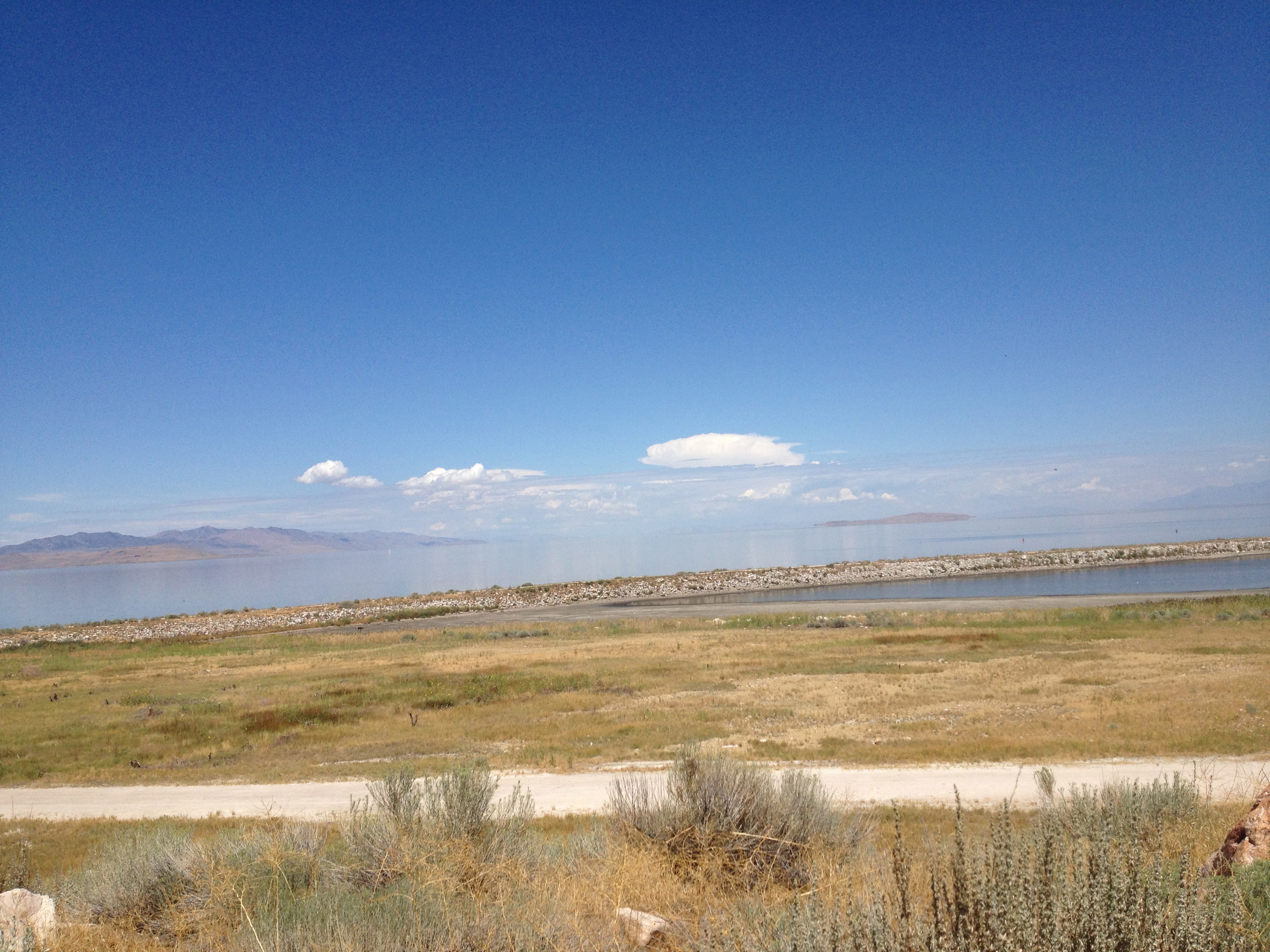 The Great Salt Lake is an amazing thing. It’s the largest salt lake in the western hemisphere, covering some 1,700 square miles. And it is almost spectral, with its lunar sheen to it. What amazed me on Antelope Island was watching a series of birds come to land on the lake. They just slid into place, there was no ripple effect, no wave action. People call the Great Salt Lake “America’s Dead Sea.” That’s completely wrong, but that’s beside the point. As I stood on Antelope Island, I looked at the desert landscape around me, I couldn’t see Salt Lake City or any other human settlement (though the park isn’t actually that far from suburbia), just the mountains around me, the desert, and the lake. And I thought, it kind of looks like the Holy Lands, or at least how I imagine the Holy Lands look. And, so, no kidding the Mormons stopped here to set up shop.
On the Radio: Boston College’s Belfast Project
June 4, 2014 § Leave a comment
Here is the podcast (you want to click on the 29 May show) of my appearance on CKUT’s O Stories show last Thursday. The show is an hour long, the first half of the show is en français and is, in part, a discussion about the Québécois chanteur Fred Pellerin. The Anglo half of the show begins, well, half-way through. The second half hour is myself and my good friend, film-maker G. Scott MacLeod. For the first bit, we talk about his excellent work on Griffintown. And then I discuss Boston College’s Belfast Project with host (and friend) Elena Razlagova. Happy listening.
On the Radio: Boston College’s Belfast Project
May 28, 2014 § Leave a comment
 Tomorrow, Thursday 29 May, I’ll be appearing on CKUT, McGill University Campus Radio’s programme on Oral History, O Stories. The show will be hosted by my old friend, Elena Razlagova, a professor of Public History at Concordia University. I will be talking about Boston College’s Belfast Project, and the fallout therefrom. So tune in around 2pm tomorrow, I’ll be on around 2.30. You can tune in the old fashioned way, on your radio at 90.3 fm, or on CKUT’s website.
Return to Sender: Lessons from Boston College’s Belfast Project
May 9, 2014 § Leave a comment
[Note: This article is written by my wife, Margo Shea, an historian of Northern Ireland, who has written another excellent post on the Belfast Project, which you can find here. This article is re-published here in an effort to circulate it as widely as possible. And also because my wife is smarter than me and says what needs to be said about the Belfast Project and Boston College’s ham-fisted response to the current furor better than anyone else can.]
On Tuesday, May 6th, Boston College’s Director of Public Affairs, Jack Dunn, announced that ‘The Belfast Project” oral history initiative would honor all requests from participants to return recordings and transcripts of interviews not currently in use as evidence in the murder investigation of Jean McConville, a Belfast widow abducted and murdered by the IRA in 1972. The college will keep no copies. The information in the interviews will remain known only to the interviewers, a few Boston College employees and William Young, a federal district court judge who read the transcripts to determine which ones should be delivered to Northern Irish authorities under a treaty governing exchanges of information between nations for the purposes of law enforcement.
Boston College’s decision came on the heels of events last week, when the Police Service of Northern Ireland held Sinn Féin leader Gerry Adams for questioning about his involvement in the McConville murder. Evidence came directly from the Belfast Project interviews. The move by the PSNI invited new scrutiny on an oral history project that has already been the focus of very public controversy, as Beth McMurtrie laid out in her detailed investigative piece published last January in The Chronicle of Higher Education.
News that the recordings and transcripts would be returned was surely met with relief by former republican and loyalist combatants who had agreed to share their stories from the front lines of Northern Ireland’s Troubles, a thirty-year period of political turmoil and civil violence which left 3,700 people dead and approximately 10,000 injured. Those interviewed had been promised confidentiality in exchange for honesty. Interviewees revealed information about activities “the dogs on the street” may have known about, but which were rarely discussed on the record.
 For Anthony McIntyre, the former republican prisoner and scholar who conducted interviews with fellow ex-combatants, the public announcement was a “symbolic washing of the hands” on the part of Boston College, a way to distance itself from criticism emerging about the project. Despite having been cast adrift, McIntyre and others closely associated with the project agree that the information on the recordings was not safeguarded well.
While the case has implications for a wide scope of scholarly research, oral historians in particular have been watching the situation closely since 2011, when information from the interviews was first subpoenaed on the basis of material that project co-director, journalist Ed Moloney, included in his book Voices from the Grave: Two Men’s War in Ireland. Moloney’s use of interviews by former IRA Belfast Brigade commander Brendan Hughes was in accordance with contracts signed by each interviewee forbidding access to interviews until after a participant’s death. Hughes died in 2008; however, many of the people he discussed on the record remained very much alive.
An increasingly public and vitriolic disagreement has taken place about who is to blame for the exposure of paramilitary secrets, heating up over the past week when Northern Ireland’s republican community reacted to Adams’ arrest. They slammed the Belfast Project as a vehicle for former republicans disgruntled by the way the peace process unfolded to air dirty laundry, lionize themselves and castigate their enemies within the movement. McIntyre has long been a vocal opponent of both Gerry Adams and post-1998 republicanism, fueling these suspicions.

Photo credit: http://extramuralactivity.com/
The project director, Moloney, and interviewers, McIntyre and Wilson McArthur, who have no professional experience with higher education institutions, say they took Boston College at its word that the material would remain confidential. They believed the college would be an honest broker and that BC’s Burns Library Special Collections would not only process, catalogue and preserve the collection, but would keep the information it contained confidential. College spokespeople say that project directors knew from the start that the information would only be protected as “far as American law will allow” and that Bob O’Neill, head of the Burns Library, specifically indicated that it was not clear the commitment to protect the information could withstand a federal court subpoena.
The question remains: What can oral and public historians engaged in collecting and interpreting histories about controversial, divisive and difficult issues and events learn from the Belfast Project and its fallout?
First, if you are serious about collecting and archiving sensitive historical material, put your publishing ambitions aside for the time being. Ed Moloney’s use of information
provided in Hughes’ interview and his discussion about it it with a Boston Globe reporter in 2010 (Thomas Gagen, “Adams’ Secret, Now His Shame,” The Boston Globe, January 07, 2010) opened up this can of worms.
Next, when addressing controversial histories, it is even more important to remember that interviews are not objective, disinterested, or omniscient sources. We all know this, but in this case, the media keeps forgetting it. Obsession with “what is on the tapes” obscures the larger issues around collecting histories in conflict and recent post-conflict zones.
Third, in cases like this one, the institutional review board (IRB) is your friend. Establishing protocols and taking the necessary precautions to locate control of materials with the interviewees, instead of with the institutions, probably would have made a difference in this case, where interviewees didn’t have final say on edits, redactions, deletions, pseudonyms or anonymity, etc. They talked, and that was that. Getting involved with high-stakes history means taking seriously that, well, the stakes are high.
Finally, the critical lesson I take away from this is an affirmation of our priorities as public and oral historians: Trust matters. So does process. All the players in the Boston College case got involved for different reasons and wanted different things from the project. Understanding and identifying partners’ motivations is a necessary prerequisite for endeavors like this. It in only through this process that those involved can gain a clear understanding of the stakes involved and the breaking point at which commitment to the project and to the relationships that sustain it might falter. The fragile and failed relationships between project administrators, researchers and interviewees in this case should be a cautionary tale for us all.
Alienation and Belonging
March 28, 2014 § 2 Comments
An old friend visited us this weekend, and as he and I drove up the Massachusetts coast to hunt down the best pizza in the Commonwealth (Riverview in Ipswich, if you’re wondering), we got to talking about New England. Despite having lived in New England, he always feels like he could never penetrate the insularity of New England culture, and he always feels alienated here. I found that interesting, given I don’t feel that way at all, despite obviously being a transplant.
This might be the advantage of being an Anglo from Montréal. Anglo Montrealers are always at least slightly alienated from the city and dominant culture. We are a (small) minority, and we speak a minority language. That isn’t necessarily a bad thing, mind you.
I’ve always felt alienated from my surroundings. I grew up in British Columbia, very aware of the fact I didn’t belong, which came out in everything from my distaste of the wet, soggy climate to continuing to cheer for the Montréal Canadiens, Expos, and, when they existed, the Concorde or Alouettes of the CFL, as opposed to my friends who cheered for the Vancouver Canucks, the BC Lions and either the Toronto Blue Jays or Seattle Mariners. I felt similarly alienated in Ottawa. It was only when I moved back to Montréal I finally felt comfortable in my surroundings. But I still felt alienated from the larger culture, mostly due to language, even as my French language skills improved.
But, as with all things Montréal, it was never this simple. My Anglo friends and family dismissed any suggestion I might be a Montrealer, by continually reminding me I grew up out west. On the other hand, my francophone and allophone friends made no such distinction, and this is also true of my separatist friends. Go figure. Anglo mythology would have it the other way round. One of the most amazing moments of my life in Montréal came during the 2000 federal election campaign when I answered a knock on my door and found Gilles Duceppe, the leader of the Bloc québécois, with Amir Khadir, who was the BQ’s candidate in my riding (Khadir has since gone on to be the co-leader of the sovereigntist provincial party, Québec solidaire, and is currently the MNA for the Montréal riding of Mercier). Duceppe, Khadir, and I spent a good 15-20 minutes talking about place, identity, and belonging in Québec. Largely in English. Even the leader of a separatist party and the candidate for my riding didn’t dispute my bona fides as a Montrealer and a Quebecer (maybe, in part, because I assured them the BQ had my vote).
Since 2006, I have spent a lot of time in New England, before moving here in 2012, on account of my wife being American. She lived in Western Massachusetts when we met, so we did our best to split our time between Montréal and Western Mass. After all those years spending time out there, I came to feel like it was Home. Sure, I was never going to fully fit in, be a part of the scenery, but that was ok by me. And, even now, living at the other end of the Commonwealth, in the massive urban sprawl that is Boston, I feel similarly at home. The ways I feel alienated here are mostly due being Canadian. But I don’t find myself feeling excluded by New Englanders, or, really, Americans as a whole. In other words, I can deal with my alienation, it has kind of become my default way of being.
No doubt this is due to being an Anglo Montrealer and experiencing some degree of discomfort and alienation my entire life in my hometown and anywhere else I lived in Canada, tainted as I was, so to speak, by being from Montréal.
Power and imperialism: The power of naming things
March 19, 2014 § 2 Comments
I was at a public talk being given by my wife, Margo Shea, at the Beverly Public Library on Monday. She was talking about the Troubles in Northern Ireland and their aftermath, attempts to deal with the past, to heal, etc. One of the great contestations of that greatly contested history is what to call it: was it a civil war? Was it a police action? In the case of the former, she cited family members of young men, members of the IRA, killed by the British Army in the early 1970s. They, their family members argued, felt they were fighting in a war. On the other hand, Margo cited the families of Royal Ulster Constabulary (RUC) officers, who argued this was most certainly NOT a civil war.
Over 3,700 people died in the Troubles. Another 50,000 were injured. It is well nigh impossible to draw a line between civilians and combatants, given the Provisional IRA, much like the IRA it took inspiration from during the Irish War of Independence (1919-21) was a guerilla force and faded back into the civilian population after striking. At least in theory. The official dating of the Troubles is 1969-97, the years of the Provos campaign against the British. But the violence began at least a year earlier and the last major bombing, in Omagh, happened in 1998.
I am less interested in the history than terminology here. Because as Margo was talking about this dispute as to whether the Troubles was a civil war or police action, I got to thinking about the term “Troubles.” It is very British in origin. I also thought about the 1857 “Sepoy Mutiny” in India. And the 1837 “Rebellion” in Lower Canada. In all three cases, the descriptive name came from the British, the colonial power the Irish, Indians, and Lower Canadians were rebelling against.
In grad school, I read Alan Greer’s The Patriots and the People: The Rebellion of 1837 in Rural Lower Canada. In it, Greer argues that the failed 1837 Rebellion would be better understood as a failed revolution, as the Parti patriote were directly inspired by ideas of liberalism and freedom that drove the American, French, and Haitian Revolutions. The Patriotes, then, were products of their time.
Twenty years later, in 1857, the sepoys, or the Indian soldiers in the employ of the East India Company, rebelled. The rebellion began in Meerut and then spread. It took 13 months to fully suppress. The British termed it the “Sepoy Mutiny,” attempting to limit the damage to the military, dismissing it as the work of a few disaffected soldiers. In India, however, the 1857 rebellion is more commonly known as the First War of Indpendence.
Interesting. The distance between “Troubles”, “Rebellion,” and “Mutiny” from “civil war,” “revolution,” and “war of independence.” The terminology and the fight over it, though, are not surprising. For the British, minimising these revolts to minor occurrences makes sense in the name of justifying continued British imperialist presence. This is especially the case for Lower Canada and India, perhaps much less so for 20th century Northern Ireland. On the other hand, “civil war,” “revolution,” and “war of independence” also carry a lot more weight from the other, oppressed sides. These words work to serve the rebels’ purposes.
It is worth noting, though, I have never heard anyone seriously refer to the 1837 Rebellion in Lower Canada as a revolution, even amongst nationalist/separatist circles. Unlike the case of the Troubles and the Indian Rebellion, I have included the Lower Canadian conflagration here due to an argument made by an academic, as opposed to common usage.
But. I do think the battle over terminology for different circumstances in three very different corners of the British Empire (Ireland, it turns out, was both the first and is now the last of the English overseas colonies). And which term one chooses says just as much about “which foot you kick with,” to use a Northern Irish turn of phrase, than anything else.
I bring this up due to a series of conversations I have been involved with of late, both in real time and on social media, about power and privilege. And, certainly, tied up with questions of power and privilege are the rights to name events and items. A similar process can be seen in the naming of the landscape in any colony. Take, for example, Lake Superior. As Gordon Lightfoot reminds us in my favourite of his songs, “The Wreck of the Edmund Fitzgerald,” the Ojibwe called the lake gichigami,” which means, literally, “great sea.” (It’s also worth noting that Lightfoot calls the Ojibwe the Chippewa, the name the Europeans gave them) But, when the French arrived, they re-named the body of water Lac Supérieure, due to both its size and the fact it is the head of the Great Lakes. Literally, Lac Supérieure means “upper lake,” as in it is above Lake Huron. Lake Superior is simply an angicisation (though technically incorrect) of the French name.
Such is how power and privilege work. And when the formerly oppressed/subjugated/colonised people gain a modicum of power and/or independence, name changing abounds. For example, in my hometown, take the case of Dorchester Boulevard. It was renamed in honour of René Lévesque upon his death in the late 80s. Guy Carleton, first Baron Dorchester, was the Governor General of Canada following the Conquest (which is called La conquête in French, if you were wondering). Lévesque was the first separatist premier of Quebec, from 1976-84. Or, take the case of Mumbai, formerly known as Bombay. I could go on. I won’t. I’ll stop here.
Argh. The Men’s Rights Movement
March 8, 2014 § 2 Comments
Apparently one of the search terms that led people to my website is “why is it sexist and racist to have women’s day, black history month, but not white men’s day.” Seriously. As if every day isn’t already white men’s day.
Update
February 18, 2014 § 2 Comments
Just so you know, Nicholas Kristoff has yet to contact me in response to yesterday’s blog, though it has brought about hella amount of traffic here. Nor, for the record, has any other journalist contacted me. 😉
A Response to Nicholas Kristof
February 17, 2014 § 7 Comments
I read with some bemusement Nicholas Kristof’s critique of academia in yesterday’s New York Times. Kristof complains that professors have cloistered themselves up in some ivory tower and disdain the real world. He says that the academy exists on a publish or perish mentality and that it encourages conformity. Perhaps due to limited space in a newspaper column, Kristof comes off sounding petulant and occasionally stuck on stereotypes of the academy that are at least twenty years out of date.
He also uses a broad-stroke brush to critique a very large, diverse institution. But I did find his argument that academics are out of touch with reality interesting, in that it reflects an argument I saw on Facebook last week about the massive bloat on university campuses of non-academic staff, which has apparently reached a 2:1 ratio on public and 2.5:1 ratio on private campuses in the United States. In this argument, which largely pitted professors against non-academic staff, the latter repeated this shibboleth that academics are unable to engage with the real world.
However, he does provide a jumping off point.
The academy does operate in a publish or perish paradigm, and academics who spend their time engaging with the public, rather than publishing in peer-reviewed journals, do get punished. And it does encourage conformity, in terms of theory, models, and interpretation. He is correct to note that “This culture of exclusivity is then transmitted to the next generation through the publish-or-perish tenure process. Rebels are too often crushed or driven away.”
Back in 1998, Canada’s crusty old historian, Jack Granatstein (in)famously published Who Killed Canadian History? wherein he lambasted the left for having created microstudies, feminism, and various other things that left us with histories of something Granatstein called “housekeeper’s knee”, which he dismissed pithily with a petulant “Who cares?” Granatstein, perhaps intentionally, engaged in rhetoric and anti-intellectualism in this little gem, essentially dismissing all who disagreed with him as irrelevant, as if he was the sole judge, jury, and executioner of what was a viable topic of study in Canadian history.
In the 1960s, “history from below” developed, primarily in England, around the work of brilliant minds such as Eric Hobsbawm, Christopher Hill, and the husband-and-wife team of E.P. and Dorothy Thompson. They wanted to know how the common person dealt with history and change. Taking their cue, historians in the US and Canada began to conduct similar studies of the working-classes and rural communities, but with far less interesting results than the English New Left, largely because the English historians wrote well, and did not get bogged down in statistics and turgid prose. Nonetheless, these studies in Canada and the US were essential to the development of the field.
But the real problem is that the likes of Kristof and Granatstein hearken back to a glory day in the academy that never existed. Kristof complains that academics write horribly, and seem to go out of their way to not engage. Many do. Because, quite simply, the academy has always worked that way. The great works of Canadian history that Granatstein refers to are horridly boring, I used to read them when I had insomnia to put myself to sleep. Kritof cites stats that claim that academics in the social sciences were more engaged in public debate in the 1930s and 40s than today. That may be true, but the readership of academic journals in the 1930s and 40s was just as limited as it is today. Hundreds of academic monographs get published to almost complete indifference, that is true today and was just as true in this supposed heyday. The academy has always been removed from the world, as it must indeed be to some degree to escape the noise of the world.
Nonetheless, there is some truth in Kristof’s complaint. But, he also undoes his argument by noting that historians, public policy wonks, and economists, amongst others, are very much engaged in public discussions. About economics, he says:
In contrast, economics is a rare academic field with a significant Republican presence, and that helps tether economic debates to real-world debates. That may be one reason, along with empiricism and rigor, why economists (including my colleague in columny, Paul Krugman) shape debates on issues from health care to education.
This comes after a critique of academia for having failed to predict the Arab Spring. I found this juxtaposition curious. The 2008 economic meltdown was missed by the massive majority of economists. And the ones who were sounding the alarm were just as ignored as those academics who foresaw something like the Arab Spring.
And so this brings me to my greatest critique of Nichols Kristof’s argument. Academics can yell and scream and tilt at windmills all we want. But without help, we are largely left standing by ourselves. The only way for our ideas to spread into the mainstream of society is with the help of the likes of Kristof: journalists. When I still lived in Montréal, I found myself fielding calls from the media with some frequency on a variety of topics from Griffintown to Irish history to the Montréal Canadiens. Journalists found me, at first, through Concordia University, where I did my PhD, and then because they had contacts and colleagues who knew me. Never once was I found through this blog (readership tended to spike after I made an appearance in the media) or through my publications. Kristof also takes academics to task for not using Twitter and other social media for communicating with the world. Guess how many times a journalist has asked me a question on Twitter? And this is despite the fact that several journalists follow me. In other words, without journalists seeking me out, I had no platform upon which to speak.
Kristof ends his column with what sounds like a desperate appeal:
I write this in sorrow, for I considered an academic career and deeply admire the wisdom found on university campuses. So, professors, don’t cloister yourselves like medieval monks — we need you!
But in so doing, he is being disingenuous and shifting the blame entirely to academics and removing the role of journalists in this discussion about the relative accessibility or non-accessibility of academics. Kristof is right to call on the academy to make greater engagement with the mainstream, but he is incorrect in assuming that without the help of journalists it will just happen spontaneously.
 Matthew Barlow