Why We Need Feminism
December 11, 2012 § Leave a comment
Last week was the 23rd anniversary of the Montréal Massacre. On 6 December 1989, a deranged man wandered into the École Polytechnique de Montréal, the engineering school of the Université de Montréal. After clearing the men from a classroom, he opened fire. He killed six women and injured three more before leaving the classroom and wandering the halls, where he wounded three more before he made a failed attempt to enter a locked classroom, wounding another woman in the hallway, before killing a support worker in her office. Upon reaching the cafeteria, he continued shooting. By the time he turned the gun on himself twenty minutes later, he had killed fourteen women, as well as wounding another thirteen, as well as one man.
I was 16 at the time, still in high school, at the other end of the country, in Vancouver. I remember coming home from school and being glued to the TV that night, shocked, amazed, dismayed, and depressed this could happen. Not that it could happen in Canada. Of course it could. But that it could happen. Period. This deranged man shot and killed these women because he hated feminists. To this day, 23 years and 5 days later, I refuse to utter his name.
But I know his name. It’s seared into my memory. This is true for pretty much all Canadians old enough to be cognisant of the massacre in 1989. But we don’t necessarily know the dead women’s names. There are:
- Geneviève Bergeron, 21, civil engineering student
- Hélène Colgan, 23, mechanical engineering student
- Nathalie Croteau, 23, mechanical engineering student
- Barbara Daigneault, 22, mechanical engineering student
- Anne-Marie Edward, 21, chemical engineering student
- Maud Haviernick, 29, materials engineering student
- Maryse Laganière, 25, budget clerk in the École Polytechnique’s finance department
- Maryse Leclair, 23, materials engineering student
- Anne-Marie Lemay, 22, mechanical engineering student
- Sonia Pelletier, 28, mechanical engineering student
- Michèle Richard, 21, materials engineering student
- Annie St-Arneault, 23, mechanical engineering student
- Annie Turcotte, 20, materials engineering student
- Barbara Klucznik-Widajewicz, 31, nursing student
Each year, as we get further and further away from 6 December, we forget the importance of the event just a little bit more. And each year we get further and further away from 6 December, we lose the shock and dismay we felt that day.
That same week, there was a meme on Twitter, We Need Feminism because. One of the images that came through my timeline struck me.
 Her words say it all. And so I thought back to my frosh week in 1991 at Carleton University in Ottawa. We were taught that “No Means No.” Full stop. Period. No does not mean “maybe later,” or “not now,” or “maybe.” It means “NO.” Very simple. That phrase was beaten into our heads, not even two full years since the Massacre.
But reading the words in this image, I realised I haven’t heard the phrase “No Means No” in a long time. At least a decade. And I spend a lot of time on university campuses. In fact, I have been on a college or university campus every academic year since my first year undergrad in 1991-2 every year except two in the late 90s.
And now, apparently young women are taught to avoid being raped. Men are not taught not to rape. One would think that teaching “No Means No” would have benefited the women at Amherst College who were raped. One would think that all young women on all university campuses would benefit. As would all young men. “No means no” taught us to respect words. And we all, men and women, need that respect.
Certainly, I would much prefer to live in a world where sexual assault and rape did not occur. But I don’t see that happening, unfortunately. But I would also much prefer it if universities did their part and taught young men and women that No means no. That simple. Three little words.
And for that reason, we need feminism.
On Regulating Economies v. Free Market Economies
November 9, 2012 § Leave a comment
I am reading a fascinating book right now, as I plan for my courses next semester, David J. Bodenhamer’s The Revolutionary Constitution, an history of the US Constitution. Bodenhamer does a brilliant job, I think, of tracing the history of the US Constitution and its uses in American history, politics, law, culture, and life.
One thing that is continually striking me is the on-going public argument in the United States and elsewhere between regulated v. free market economies. Maybe this is just the echo of the US election in my head. Or it could also be a reflection of all the info I have inhaled since the economy went kaputski in 2008. When FDR was elected in 1933, he sought to expand the state, based on Keynesian economies, to attempt to get the United States out of the Depression. FDR felt that free market economics were what got the United States into the mess of the Depression in the first place. And this has long been clear to me as an historian, but it is put in stark relief in Bodenhamer’s new book.
Fast forward to the present day. The recession of 2008 and beyond was caused, to a large degree, by unregulated economies. And yet, the right continues to argue that the free market will right all wrongs. Turns out we didn’t learn from the Depression. We let it all happen again in the 1990s and early 2000s. And this isn’t simply a right/left argument, either, as plenty on the left fell into this trap in the past two decades.
The problem with the free market economy is simple. Bodenhamer writes:
In recent years a conservative attack on this New Deal constitutionalism has emerged among scholars who asserted the superiority of a private market and sought to apply a cost-benefit analysis to public regulation. According to proponents of the so-called law and economics school, all people voluntarily make rational decisions to further their self-interest.
The problem is that people do not make rational decisions economically-speaking. If people did, the sub-prime mortgage meltdown would never have happened. If people did, I wouldn’t insist on drinking a latté in the morning instead of a cheaper coffee when my budget requires restructuring. If people did, we wouldn’t be carrying around crippling amounts of debt. The entire Enlightenment ideal of the rational behaviour of human beings has clearly been debunked. Ideally, we act rationally in matters of economics, politics, and so on. But clearly, in reality, we do not. If we did, the working-classes would always vote for the Democrats in the States and the NDP in Canada and Labour in England. But they don’t. They usually vote Republican and Conservative in Canada and England. That is not in their rational self-interest.
Indeed, as Canada’s Prime Minister, of whom I am no fan, likes to crow: Canada survived the meltdown to a large degree due to the strict regulation of Canada’s banking industry.
So why we continue to have this argument baffles me. In fact, I’d even go so far as to suggest that believing in the rational behaviour of the free market is, in fact, a completely irrational position and actually serves to de-bunk the arguments of these free market fantastists.
Le Reigne Elizabeth
October 19, 2012 § Leave a comment
The Queen Elizabeth Hotel on blvd. René-Lévesque has fascinated me ever since I was a kid. Structurally and aesthetically, it is one of the ugliest buildings in the downtown core of Montréal. Built in a neo-brutalist style usually reserved for university campuses, the Queen Elizabeth is nonetheless the swishest hotel in Montréal. It is also the largest hotel in Montréal and Québec, with over 1,000 rooms. The other thing that has fascinated me since the mid-70s is the name of the hotel. How does a hotel in the middle of Montréal, the metropole of Québec, end up being named after the Queen? Better yet, what’s with the incongruity of the name in French, Le Reigne Elizabeth, with the masculine article there before the feminine monarch?
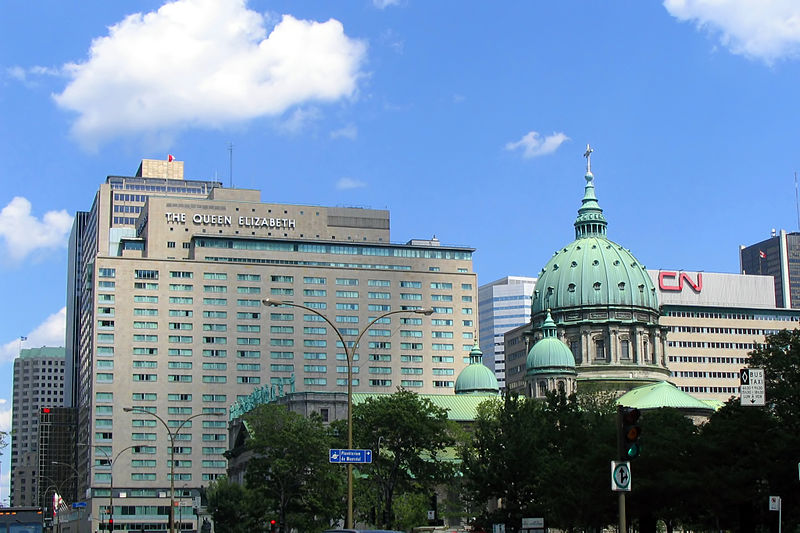
When the hotel was first proposed back in 1952, there was an upsurge of love for the monarch in English Canada. Queen Elizabeth II had just ascended the throne, and around the former British Empire, people were gaga over the queen, somewhat like people are currently in a tizzy over the former Kate Middleton. However, the 1950s also saw the rumblings that led to the eruption of the Quiet Revolution in Québec in 1960. There was an upsurge of québécois nationalism in the city and province as well. Indeed, nationalists argued that the Canadian National Railways should name the new hotel after the founder of Montréal, Paul de Chomedy, sieur de Maisonneuve. Nonsense, responded the CNR’s president, Donald Gordon: Canada is a Commonwealth nation, and the head of the Commonwealth is Queen Elizabeth II. Since he was the one building the hotel, he won the debate.
As for the masculine article in the hotel’s French name, well, it turns out that refers to the implied ‘hotel’ in the name, and hotel is masculine. There you have it.
 The Queen Elizabeth Hotel, of course, has lived up to its reputation. The Queen herself has rested her head on its pillows four times, and her son, Prince Charles, has also visited. The NHL entry draft was held there pretty much every year until 1979. But, of course, the most famous event to have occurred in the Queen Elizabeth is the “bed-in” of John Lennon and Yoko Ono, 26 May-2 June 1969. Lennon and Ono had been denied entry to the United States, because Lennon had a cannabis conviction from 1968. A bed-in was planned for New York City. So now the plan had to be changed, and so Lennon and Ono bedded down in the Queen Elizabeth for their second Bed In for Peace (the first had been in Amsterdam 25-31 March). During the Montreal bed-in, the anthem “Give Peace a Chance” was recorded by André Perry.
Farewell to Leo Leonard
July 12, 2012 § 1 Comment
Leo Leonard, the long-time proprietor of the Griffintown Horse Palace, died a week ago today at the Verdun Hospital. He was 87 years old. Leo bought the Horse Palace in 1968 after a life of doing hard manual labour on the Montréal waterfront and in Griffintown. Leo himself came from Goose Village, born in 1924. Leo, also known as Clawhammer Jack, is responsible for the Horse Palace getting its name. The stables were actually built over a century earlier, in 1862. As Leo told the story, he was working in the stables one day when a sign painter happened to amble by sometime in the late 1960s. So, Leo told him “to get scribblin'”, figuring that if San Francisco had its Cow Palace, then Griff should have the Horse Palace.
Leo’s funeral was this past Tuesday at Feron’s at the corner of Notre-Dame Ouest and Charlevoix. Jimmy Feron, the founder of Feron’s was himself a Griffintowner, a friend of the legendary alderman “Banjo” Frank Hanley.
This Saturday, the Griffintown Horse Palace Foundation, which is trying to save and preserve the Horse Palace, is hosting a visit to the site at 10am. We are also going to clean up the Palace a bit, preparing it for its next life.
We invite any and all to come down to the Horse Palace on Saturday, 14 July, at 10am, to take a look around. It’s amazing site, a little piece of a rural oasis in the middle of the city. Standing in the yard, in the shade of century old trees, you can almost forget you’re in Montréal.
The Griffintown Horse Palace is located at 1216, rue Ottawa, between rue de la Montagne and rue Murray in Griffintown. The nearest métro is Bonaventure, just head down Peel Street and turn right at Ottawa, the Horse Palace is three blocks from there. The nearest Bixi stands are at the corner of de la Montagne and Notre-Dame Ouest, three blocks north of the Palace.
If you want more information, you can email either myself or Juliette Patterson.
The Uniqueness of Cities
June 20, 2012 § 1 Comment
For some odd reason, I find myself reading a lot about London these days. I’m really not sure why, I have no real love for the city, to me, as represented in pop culture, it’s a megalopolis of bad architecture. Nonetheless, I am fascinated by authors’ attempts to tease out what it is that makes London a unique location. For the most part, I am reading cultural histories, so the focus is less on the built landscape of London (though that certainly frames the action) than on the people who live(d) there. For the most part, Londoners tend to be praised for their resourcefulness. And their stolidity. And the city itself for the ways in which it constantly re-invents itself.
I live in Montréal, a city that claims to be a unique location itself: a French-speaking metropolis in the Anglo sea of North America (conveniently, the Hispanic fact of the southern part of the continent always gets overlooked). Montréal is a bit of Europe in North America, I am constantly told by both the natives and the tourists who come here. When I lived in Vancouver, it was the outdoorsiness of the people that made the city unique (nevermind the fact that most Vancouverites AREN’T the outdoorsy types at all). And Doug Coupland argued it was the glass architecture.
I could go on, taking a trip around the world, laying out urban stereotypes as to what makes each unique. But in reading all this ephemera about London, I am continually struck by the fact that the things that apparently make London unique in the eyes of erudite and knowledgeable authors really just make London another generic big city. I would think that ALL urbanites are resourceful and stolid. And ALL cities constantly reinvent themselves. (As a running series on this blog about my neighbourhood of Pointe-Saint-Charles makes clear).
So what then? Cities are indeed generic. They all contain the same basics, which vary according to size. When it comes to the built environment, you’ve got a downtown core, inner-city residential neighbourhoods, some industrial (or post-industrial) inner city neighbourhoods, and these patterns repeat themselves out to and through the suburbs, residential/industrial, until you get to the city limits and the countryside takes over. Urbanites are a shifty breed, skilled at not noticing the homeless dude begging for change, but very skilled at noticing the various challenges along the sidewalk, including how to carefully avoid the homeless guy. Neighbourhoods in cities all follow similar patterns, there are points of convergence for the residents, there are amenities, parks, and so on.
And, of course, there is the anonymity of city life. I live in a city of around 4 million people, but I can go days, weeks, even months without running into someone I know on the streets of Montréal. I seriously doubt that is any different in Dublin, Boston, San Francisco, Nairobi, Tokyo, or Beijing.
So what is it that makes cities unique? What is it that makes London or Montréal unique? Does it come down to how we, the urbanites ourselves, choose to build our cities, and reinvent our cities, and carry out our lives in them? Certainly Pittsburgh has different things to offer than, say, Winnipeg. But either way, trying to boil down the lived experience of millions of people, and their millions upon millions of ancestors in any one urban location, whether it has existed for over 2000 years like London or for just over 200 years like Vancouver, is a pointless exercise. London is no more unique for its constant reinventions and the resourcefulness and stolidity of its people than is, I don’t know, St. Petersburg, Russia.
On Living in a Gentrifying Neighbourhood, Pt. IV
June 17, 2012 § 3 Comments
Yesterday, during Bloomsday, I presented The Point a 1978 documentary on Pointe-Saint-Charles directed by Robert Duncan and produced by William Weintraub. The film presents a very depressing picture of a very depressed neighbourhood in the late 1970s: a picture of unemployment, alcoholism, violence, and dislocation. The graduating class of James Lyng Catholic High School faced a bleak future in 1978, unilingual and unskilled.
I then presented a bit of context to the film, both the historical time period in which the film, and by whom (Anglos in the late 1970s, between the election of the Parti québécois as the provincial government in 1976 and the First Referendum on Québec sovereignty in 1980). In shot, a very volatile period in Montréal’s and Québec’s history. I also pointed out that the Pointe was more than just some sad sack inner-city slum, pointing to such things as the Clinique communitaire de Pointe-Saint-Charles and other examples of neighbourhood organisation and resistance (i.e.: the very things that I love the Pointe for). I felt it was important to demonstrate to the audience that a poor, dislocated neighbourhood with rampant unemployment during the years of deindustrialisation was more than just that, it was a community (this is something I have learned in studying Griffintown, especially from talking to former Griffintowners).
I then moved on to discuss gentrification here in the Pointe. I am of two minds on it. On the one hand, the Pointe is not Griffintown, the condo developers and gentrifying tenement owners do not have to start from scratch. There is a very strong community here already. On the other hand, the community that exists here only works when those of us who are interlopers get involved, and understand what already exists here and how precious that is.
I have posted before in this series “On Living in a Gentrifying Neighbourhood,” (here, here, and here) my experiences and impressions as I look around the Pointe, both good and bad.
But tonight, sitting on my front stoop, talking on the phone (because it’s about the only place I can get a continuous signal in my flat), the entire process of gentrification was brought home to me in blatant fashion. A young woman, in her early 20s, and pregnant, is looking for a place to live. The flat upstairs is for rent, so I talked to her, told her about it, how big it was, etc. It was apparent that she is a single mother-to-be, as she used the singular in referring to her needs for a flat. She looked sad and defeated, because the flats around here cost too much for her to afford. As she turned to go, she said “It looks like they just want to push all the poor people out of the Pointe.”
What can you say to that? Especially when you’re one of the guilty. It is a simple fact that rents are going up in the Pointe, both because former rental units are being bought up and converted into single-family homes, and because landlords are realising they can make a lot more money if they renovate and gentrify their flats. And so where does that leave this woman? A quick search of Craigslist for flats in the Pointe reveals the same thing, they’re getting expensive. And so where do those who can’t afford to live here go?
I don’t have the answer for that one.
An Oddity
June 17, 2012 § Leave a comment
Yesterday marked the first time ever readership of Spatialities was not predominately Canadian. Yesterday, for some odd reason, readership was dominated by Americans at a two-to-one ratio over the next most common nationality: Russians. And the Russians had a 80% lead on the French, who were tied with the Canadians. This has never happened before. Every time I’ve looked at viewers’ nationalities (gotta love the obsessive-compulsiveness of WordPress’ nerds), Canadians have far out-stripped Americans, by anywhere from two-to-one to twenty-to-one. So, thanks, eh! to the Americans, Russians, and French
The Most Incredible Title. Ever
June 13, 2012 § Leave a comment
Suleiman the Magnificent ruled the Ottoman Empire was the longest-serving of all Ottoman Emperors, sitting on the throne in Istanbul from 1520-66. As emperor, Suleiman was truly magnificent, in terms of territorial expansion, legal reforms, and almost completely reforming Ottoman life. However, I do think that the greatest of his legacy to the world comes in the form of his title:
His Imperial Majesty The Sultan Süleyman I, Sovereign of the Imperial House of Osman, Sultan of Sultans, Khan of Khans, Commander of the Faithful and Successor of the Prophet of the Lord of the Universe, Protector of the Holy Cities of Mecca, Medina, and Jerusalem, Emperor of the Three Cities of Constantinople, Adrianople, and Bursa, and of the Cities of Damascus and Cairo, of all Armenia, of the Magris, of Barka, of Kairuan, of Aleppo, or Arabic Iraq, of Cilicia, of the Vilayets of Erzurum, of Sivas, of Adana, of Karaman, of Van, of Barbary, of Abysinnia, of Tunisia, of Tripoli, of Damascus, of Cyprus, of Rhodes, of Candia, of the Vilayet of the Morea, of the Marmara Sea, the Black Sea and also its coasts, of Anatolia, of Rumelia, Baghdad, Kurdistan, Greece, Turkmenistan, Tatary, Circassia, of the two regions of Kabarda, of Georgia, of the plain of Kypshak, of the whole country of the Tatars, of Kefa, and all of the neighbouring countries, of Bosnia and its dependencies, of the City and Fort of Belgrade, of the Vilayet of Serbia, with all the castles, forts, and cities of all Albania, of all Iflak and Bogdania…
Bloomsday Montreal 2012
June 13, 2012 § Leave a comment
Montreal’s first annual Bloomsday gets underway tomorrow at 12.30pm at the Atwater Library, with a a reading and music inspired by Joyce’s Ulysses, hosted by Dana O’Hearne. And also tomorrow night, 5pm, at Hurley’s Irish Pub on Crescent, we will be hosting a Trivia Night, so come on down and check out both events.
The full schedule for the 3-day event can be found here.
Highlights, aside from what I’ve already noted:
4pm, Friday 15 June, Bombardier Theatre, McCord Museum, Official Launch, featuring Prof. Michael Kenneally, Principal of the School for Canadian Irish Studies at Concordia, who will speak on “The Achievement of Joyce’s Ulysses.
8.30am, Saturday, 16 June at Le Vieux Dublin Pub on Cathcart, I will be hosting a breakfast event featuring the indomitable Don Pidgeon, who will tell stories about Griffintown. Don’s ALWAYS entertaining, a natural-born story-teller, this is not to be missed.
9.45-11.30am, Saturday, 16 June: Prof. David Hanna of UQÀM will be leading a tour of Griffintown, which will meet at Métro Square Victoria.
10am-5pm, Saturday, 16 June: Our main event at James Square on McGill’s Campus (the entrance on University), where we will have daylong readings from Ulysses, as well as performances by the Bernadette Short Dancers, and Irish and classical music performances.
1pm-3pm, Saturday, 16 June: I will be screening a viewing of William Weintraub’s 1970s documentary, The Point, at the McGill Community for Lifelong Learning, which is located at 688 Sherbrooke Ouest, I’ll be in Room 1041. I will also talk about Pointe-Saint-Charles, my favourite Montreal neighbourhood (and also my home).
2.45pm-4.45pm, Saturday, 16 June, in the Bombardier Theatre of the McCord, film-maker Brian McKenna will present his new film, The Coffin Ship Hanna.
On the Difference between being a Reader and a Writer
June 12, 2012 § Leave a comment
Upon the recommendation of the fine people at Argo Bookshop, I read Italo Calvino‘s If on a winter’s night a traveller, which was in and of itself an excellent read, a meditation on the multiple meanings of reading, amongst other things. I was struck by a discussion between the protagonist, The Reader, and The Other Reader, who at least got a name, Ludmilla. Both The Reader and The Other Reader have been continually frustrated in their attempts to read a book, any book, as they are continually met with incomplete manuscripts, so they get into their novel, only to have it end. Up to this point, it has been due to publisher’s errors and problems in the actual process of printing and binding the books.
But The Reader has made a contact within the publishing firm, who has given him reign to peruse the completed manuscripts, and he excitedly tells The Other Reader when they meet in a café. He then wants to rush back to the publisher to continue their investigation. But she refuses.
Why don’t you want to come?
On principle.
What do you mean?
There’s a boundary line: on ne side are those who make books, on the other those who read them. I want to remain one of those who read them, so I take care always to remain on my side of the line. Otherwise, the unsullied pleasure of reading ends, or at least is transformed into something else, which is not what I want. This boundary line is tentative, it tends to get erased: the world of those who deal with books professionally is more and more crowded and tends to become one with the world of readers…I know that if I cross that boundary, even as an exception, by chance, I risk being mixed up in this advancing tide; that’s why I refuse to set foot inside a publishing house, even for yourself.
It is clear that for The Other Reader, this is her own stance. Of course, within a few chapters, she has violated her position. But that’s irrelevant. What is relevant is the point she raises, and the separation between authors and publishers and readers. I had a thought similar to this last week when I was in Archambault looking for a book. I didn’t find what I was looking for, a history book, but I did see my friend Simon Jolivet‘s book on the shelf. Now, this is not surprising, Simon wrote a book, based on his PhD dissertation, and it got published. That’s the way it’s supposed to work in academia. In fact, that’s the very process I am presently engaged in myself. And certainly I have known many, many authors throughout my academic career (to say nothing of the fiction writers I know). And certainly, books get treated differently in academia than in the general public: we have to publish them if we want to survive in our field, it’s part of the job (which is why I find it obnoxious when people presume that because it’s summer I’m doing nothing if I’m not teaching).
And yet, it’s one thing to see my professors’ books on the shelf in the bookstore, it’s another to see a friend’s, especially when we did our PhD’s together. It’s not an incredibly profound statement, I realise, but there is still something rather exciting about seeing your friend’s book on a shelf in a busy downtown Montréal bookstore, to know that people have bought it and read it and will continue to do so, and to finally have it sink in that this will also happen for me, my book will be on these same shelves and people will buy it and read it, beyond the academy (I hope).
But does that change my relationship with reading, both fiction and non-fiction? I doubt it. And, of course, The Other Reader eventually realised that herself when she started to get mixed up in book production and forgery rings.
 Matthew Barlow