Climate of Conflict in the Arctic
March 29, 2010 § Leave a comment
A couple of weeks ago, I was emailed interviewed by the ISN Security Watch for an article on the Arctic and the growing interest being shown in it by the Arctic nations and their neighbours, which is back in the news today. Read the ISN article here.
Positive Feedback
March 27, 2010 § Leave a comment
A few months ago, I published an article in a book edited by John Chi-Kit Wong of the University of Western Washington in Bellingham. The book was entitled, Coast to Coast: Hockey in Canada to the Second World War (University of Toronto Press, 2009), and my article was entitled “‘Scientific Aggression’: Class, Manliness, Class, and Commercialisation in the Shamrock Hockey Club, Montreal.”
Today, John forwarded the authors a review of the book from the H-Arete listserv, which deals with sport history, written by Jason Blake, University of Ljubljana, Slovenia. Blake had this to say about my article:
A few chapters show a keen interest in narrative, examining individual newspaper reports and trends in sports reporting. In “‘Scientific Aggression’: Irishness, Manliness, Class, and Commercialization in the Shamrock Hockey Club of Montreal, 1894-1901,” John Matthew Barlow argues that reporters in Montreal “became less concerned with the idea of fair play” and “more interested with winning and losing” (37) long before the amateur debate died. In a special subsection, Barlow provides cogent Ð almost literary Ð readings of individual press accounts. Important, too, is his highlighting of how self-consciously the journalists created stories of games. Consider this 1900 pronouncement: “Narrative in the superlative can only convey an imperfect sense of the paragon of perfection and sensation detail of this, the last and premier exhibition of a week’s great hockey” (64). It’s a shame Aethlon was not around then.
Very nice to get such good feedback on my first publication.
Ann Coulter is an Idiot
March 23, 2010 § Leave a comment
Ann Coulter is an idiot. A true, complete idiot. Never one to let facts get in the way of a good story, Coulter sounded off yesterday, on the eve of a tour of Canadian campuses, saying that “The provost of the u. of Ottawa is threatening to criminally prosecute me for my speech there on Monday – before I’ve even set foot in the country!” Dream on, Annie. What happened is that the provost informed her that she might give some thought to Canadian hate speech laws before opening her mouth here. Coulter, of course, is famous for provoking Muslims, feminists, gays, lesbians, Catholics, and pretty much anyone who isn’t like her. Of course, she is merely symptomatic of the larger problem of polemicists and idiotlogues, like Karl Rove, Dick Cheney, Sarah Palin, and Michael Moore. Lies become truths when spoken by the likes of them. It’s 1984 all over again.
The Young & The Expendable
March 13, 2010 § Leave a comment
Over at the Kings of War, Dave Betz has an interesting piece on the gender imbalance of children in many parts of Asia, based on an article from The Economist. Both Betz and The Economist bring up many issues and questions to ponder, but here I’d like to look at one, from an historical perspective. Betz ruminates on whether or not a surfeit of young men in a society (most particularly China) will lead to a rise of militarism in that culture and, ultimately, belligerance.
The Economist points out that “in any country rootless young males spell trouble.” Indeed. Society tends to be suspicious of young men in general. However, historically, there have been simple uses for such young men: the military or colonisation. Essentially, they were the cannon fodder, whether literally or figuratively. Societies never got too excited about their demise, either, at least not on the macro-level, there were always more where they came from.
The Ancient Greeks also found another use for rootless young men: they made excellent colonisers. So the Greek city-states would send out boatloads of young men, sending them across the Aegean Sea to Anatolia. Or up towards the Black Sea. If they were successful, and they established a colony, hey, great. Now there was a captive market for goods produced in the home city. If not, meh, so be it, there would be another boatload next year. This model was picked up again by Europeans in the Age of Expansion in the 15th and 16th centuries.
Across North America, bachelor cultures emerged. For example, in the inland woods of New France, the coureurs de bois spent their time carting furs from the hinterland, where they traded with the aboriginals, back to the colonial centre, such as Montréal or Detroit. But out in the woods, these guys lived life hard. Their work was insanely physical, carting the furs and other goods in their canoes, over portages, in and out of the water, most of which was insanely cold, and rafting down rapids. Priests in the back country were both in awe of these men’s physical strength and stamina, and terrified of them. Probably for good reason.
Along with their intensely physical work, the coureurs had a bachelor culture that reflected their hard lives. They drank heavily, sang songs, engaged in all kinds of physical tests of strength and stamina, including wrestling, fighting (boxing hadn’t been invented yet), and various other events that would put MMA to shame. Colonial officials echoed the priests’ fear of them.
The West, in both Canada and the United States, was also another bachelor culture. And whilst Hollywood has over-dramatised the violence in the American West, Canadian historians have under-represented the violence of the Canadian West.
The bachelor culture of the Western frontier was not all that different than the coureurs 3 centuries earlier: heavy drinking, braggadacio, and contests to see how was the “best” man. The best man was usually the one who could drink the most, make the most money, was physically the strongest, or who had the best luck with the ladies.
Long and short, young men have historically been the most rambunctious segment of society. But historically, societies have found an outlet for their bored, rootless young men, whether as cannon fodder or as explorers/colonists. What happens to these young men in Asia is something, as Betz notes, for us all to ponder. It is clear the issues run deeper than just simply a gender imbalance and too many young men for the young women.
False Reporting
March 12, 2010 § Leave a comment
The CBC is declaring that a full 98% of Canadian family doctors have experienced abuse at the hands of their patients. Of that, 75% had suffered “major abuse,” and 40% had experienced “severe” abuse. This information comes from a report in the journal Canadian Family Physician. But a closer look reveals that this claim, that nearly all doctors have been abused, is close to bogus. The researchers randomly selected 3,802 family physicians across the country and then sent out a survey. Of those 3,802, only 774 responded, or 20.4%. So the results are based on a 20.4% response rate. A response rate that low comes close to negating the results, according to standards of social science research.
I haven’t read the original study, I’m responding to a media report of it. Could be that the report in the trade journal says something different. But the CBC is claiming that 98% of all family physicians in Canada have been abused. Balderdash. Here’s why: given that the survey was mailed out to doctor’s offices, that means that the doctors themselves had to take the initiative to fill it out and return it. And, certainly, those who did respond, this 20.4%, were mostly likely those who have an interest in the issue. In short, those who responded were those who had been affected by the issue, abuse.
Grandstanding like this on the part of the CBC is regrettable because it distracts from the larger issue, which is the fact that our doctors are being abused by their patients. That is an unacceptable situation. What is even more disturbing is that female doctors are more likely to suffer abuse from their patients than their male counterparts.
As our health system gets more and more overburdened, doctors and nurses, the front-line respondents, are the ones who take the brunt of the anger of their patients, frustrated by any number of reasons, from waiting lists to doctors being over-worked and unable to spend as much time as they’d like with their patients.
But the CBC obscures this with its fantastic claim that nearly every single doctor in the land has been abused in some, way, shape, or form by their patients. It’s kind of like when that cop at O.J. Simpson’s double-murder trial was found to have planted evidence at the scene of the crime. Over-reaching to make a point does nothing but detract from the issue at hand.
Modernist Architectural Behemothology
March 11, 2010 § 6 Comments
Years ago, I lived in Vancouver, perhaps once the greatest example of Modernist architecture in Canada, if not North America. Vancouver is the city that unleashed architect Arthur Erickson on the world. Sadly, Erickson died last spring. Yet, Erickson’s buildings live on in Vancouver, especially his modernist designs, most notably Simon Fraser University in suburban Vancouver (where I completed my MA), and the Canadian Embassy in DC.
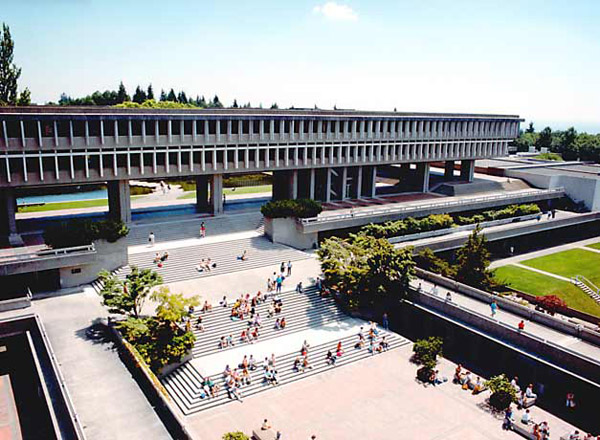

Indeed, one of my favourite architecture books is Rhodri Windsor Liscombe’s The New Spirit: Modern Architecture in Vancouver, 1939-1963. Modernist buildings haven’t really stood the test of time, I have to say, especially those designed to look like concrete bunkers, such as the Canadian Embassy. SFU is one of the most depressing places in the world on a cloudy, rainy day atop Burnaby Mountain. Unfortunately, it is often rainy and cloudy atop Burnaby Mountain. University campuses across North America are dotted with modernist buildings, as the great boom of construction on these campuses came at the height of modernism in the post-War era. In many instances, modernist behemoths look as if they were dropped into more classical settings, such is the case of Student Center Building at the University of Masscachusetts, Amherst. In the picture below, you can see those older, classic buildings scattered around the Student Center and the residence towers behind it.

So pervasive is modernist architecture on campuses that it is oftentimes pejoratively referred to as “Neo-Brutalist” architecture. Indeed, buildings such as the Student Center, or the entire Burnaby Mountain campus of SFU, re-enforce this. The buildings are concrete, massive, and imposing. Inside, there is a lot of dark browns, dark woods, and black. Gloomy is about the only way to describe these interiors.
Long and short, the term “Neo-Brutalist” quite often fits, not that there aren’t some beautiful modernist buildings to be found, such as Vancouver’s old BC Hydro Building, which has since been condofied, or MOntréal’s Palais de Congrès.


But, despite this, I can’t help but chuckle when I read stories like this one in the Globe & Mail yesterday, about the Public Safety Building in Winnipeg.

This particular behemoth, built in 1966, is a textbook case of Neo-Brutalist Behemothology. Frequently the several hundred employees of the Winnipeg Police Force are required to vacate the building because of noxious fumes that waft up into the building. This happens frequently, apparently. This time it required the Hazmat to come. The PSB is built out of
brittle Tyndall limestone, hasn’t held up against Winnipeg’s climate. Dozens of steel brackets cling to the building’s exterior like Band-Aids, preventing the facade from avalanching into the street. A $98,000 awning encircles the building, stopping pieces of the gaudy structure from braining pedestrians.
And this is the crux of the problem with many Neo-Brutalist behemoths, from SFU to Montréal’s legendary Stade Olympique, known in English as the “Big O”, or more fittingly, the “Big Owe,” as it took 30 years for the city to pay off its legacy from the 1976 Summer Olympics, by which time the Expos had decamped for Washington and the Alouettes had been re-born in McGill University’s quaint Molson Stadium at the foot of Mont-Royal. But the Big Owe and the PSB, and SFU, for that matter, all have something in common. The materials used to build them aren’t all that well-suited to the climate they are in. Hence, the PSB is falling apart, the Big O has had large slabs of concrete fall off it, and SFU, well, that much concrete in a rain forest isn’t the best idea, either.

But the bigger question is what to do with these buildings, especially those that are falling apart or being abandoned, as is the case with the PSB. Urban preservationists in Winnipeg argue that the PSB is worth saving,
According to University of Winnipeg Art Historian, Serena Keshavjee,
It’s not a love-hate relationship people have with these buildings; it’s just hate. People grew up with these buildings and don’t see them as heritage buildings, but the same thing happened 40 years ago with Victoria structures.
Had we ripped out every Victorian building in the country we would be very sorry these days,” she said. “And these are the times when they become vulnerable. The country is coming out of recession and people are gearing up to tear things down.
UW historian David Burley echoes, arguing that modernism
reflects a time when the federal government lavished money on public projects and Canadian pride soared ahead of Expo 67 and the centennial. “It was a nationwide movement,” he said. “There was this great optimism. The central parts of cities had deteriorated and there was a sense it was time to redevelop things.”
Personally, I’m not so sure that a modernist building is worth saving just because of its own merits. A building like the PSB is an ugly imposition on the urban landscape. Buildings like it seem to mock their landscapes, they don’t fit in, they crush them, they impose upon them. They belittle us. Of course, granted, that’s the point with a police station, or at least it was in the 1960s. But that doesn’t mean a building should be saved just because it’s old. Sometimes, old things are just junk. And the PSB is an example of that.
Nuit Blanche à Griffintown
February 20, 2010 § Leave a comment
This Saturday, 27 February, is Nuit Blanche in Montréal, and there will be an event in Griffintown to celebrate. Organised by Le Comité pour le sain rédeveloppement de Griffintown, spearheaded by Judith Bauer, the event will be taking place at the site of the New City Gas Works, owned by Harvey Lev, located at 140 and 143, rue Ann.
There’s a whole bevy of cultural events on deck, including talks about the history of the neighbourhood, poetry readings, live music, artwork, and all kinds of other fun stuff. The website is here.
Also of note is that the Griffintown Horse Palace Foundation will have a table there to sign people up for membership and to raise funds for our ultimate goal, to buy and convert the Griffintown Horse Palace into a museum.
An Episode in the Life of a Diasporic City
February 5, 2010 § Leave a comment
Montréal is a city of literature. It has been the home of many great novelists, both of Canadian and international reknown. It is also a city that has been the setting of many novels, bestsellers at home and abroad. For years, I lived in the neighbourhood that was the setting of Gabrielle Roy’s Bonheur d’occasion, Saint-Henri. Prior to that, I called Duddy Kravitz’s Mile End home. Presently, I call the setting of Balconville home. The Plateau-Mont-Royal has been immortalised by the likes of Michel Tremblay, Mordecai Richler, and Rawi Hage. One of the best academic reads of recent years was Sherry Simon’s Translating Montreal: Episodes in the Life of a Divided City. Simon explores the cultural and social history of her Montréal through the literature, in both official languages, that depict the city’s multicultural landscape and lived experience.
Montréal’s literary authors, to say nothing of Simon herself, have projected and reflected the experience of immigrant groups and their diasporas through their works. It was from Richler’s works that I learned so much of the Jewish experience of Montréal, that I came to understand the city as a Jewish one. Indeed, Richler was instrumental in re-casting Montréal as something more than just a bifurcated locale, a city caught between French and English, in that he inserted the city’s Jews into the dialogue, his writing maturing with the city throughout the 2nd half of the 20th century.
Today, however, in trying to find a bowl of matzoh ball soup, I was kind of stunned by just how much Richler’s Montréal has changed. As I wandered through the city’s downtown core, both searching for the soup and running a handful of other errands, I got to thinking about not just how diasporas inform and reflect off each other, but also how diasporas evolve, shift, and replace one another. This was especially true, I thought, in a 5-block section of downtown just west of Concordia’s downtown campus. In this stretch, there are, amongst other things, a German restaurant that has been there for most of my life, as well as newer Russian, Indian, Iranian, Lebanese, Irish, Armenian, Mexican, Central American, Chinese, and Thai restaurants. And not a single place that served matzoh ball soup. During Richler’s years studying at Sir George Williams University, one of the founding institutions of Con U, I’m sure matzoh ball soup could be found in the vicinity of the campus. Of course, one would not have found the plethora of “ethnic” food (the term is in quotations because it is such an unsatisfactory one to use in this instance).
This is neither a lament nor a complaint, I eventually found the matzoh ball soup at Dunn’s, an old Jewish deli, on Metcalfe. It just is what it is, an episode in the life of multicultural, diasporic city.
The Arctic: The Final Frontier
February 5, 2010 § 1 Comment
This weekend, the G7’s finance ministers are gathering in Iqaluit, in the Canadian Eastern Arctic, to discuss the fallout from last year’s global economic meltdown, as well as how best to prevent the same from happening again. The meeting comes amidst questions about the on-going relevancy fo the G7 in the face of the creation of the G20 to handle the global economy.
That the meeting is being held in the Arctic is both interesting and significant, as Canada is currently attempting to bolster its claim to various lands and waters in the Arctic, as are the US, Russia, Norway, and Denmark. That the G7 is meeting in the Canadian Arctic is surely no coincidence.

Canada is also caught up in a sort of new Cold War with Russia, its neighbour across the North Pole, in the Arctic. Russia has just announced it is going to spend another $50 million USD on hydrographic and geophysics research along the Arctic Ocean bed. This comes as Canada, Russia, and the other Arctic nations face a UN-mandated deadline to register their claims to the Arctic according to the UN Convention on the Law of the Sea. Norway did so over a year ago, whilst the other 3 Arctic nations. The 5 Arctic nations face staggered deadlines, Norway’s was last year, Russia’s this year, Canada’s in 2013. Denmark has a claim to the Arctic through its possession of Greenland.
Under UNCLOS, panels of scientists will assess the validity of uncontested claims in the Arctic, but the 5 nations themselves will sort out their own disagreements when it comes to disputed claims.
For example, Canada’s mapping effort is focussed on proving that 2 massive under-water mountain chains, the Alpha and Lomonosov, are geologically connected to North America. If this is indeed the case, not only will Canada benefit, but so, too, would Denmark and the US. Hence, whilst Canada is carrying out the majority of the mapping work, it periodically co-operates with the Danes and Americans. Meanwhile, both Canada and the US will come to loggerheads over the Beaufort Sea and its oil & gas reserves, whilst Canada, Denmark, and Russia are expected to have competing claims to the territory around the North Pole. And then there is the battle over the Northwest Passage. Canada hopes to prove the waters within the Arctic Archipelago belong to it, meaning the Passage would be Canadian. This would limit access to the Passage as a shipping chanel as global warming causes the ice in the passage to melt.
Cross-posted at Current Intelligence.
Off the Deep End…
January 26, 2010 § Leave a comment
Yesterday, Canada’s Fisheries Minister, Gail Shea, was hit in the face with a tofu cream pie, due to her support of the seal hunt in Canada. PETA quickly claimed responsibility for the act. OK, big deal. A nice publicity stunt, got the topic back on the national radar here in the Great White North. But today, Liberal MP Gerry Byrne, who represents a Newfoundland riding that has an interest in the seal hunt, suggests that this makes PETA a terrorist organisation:
When someone actually coaches or conducts criminal behaviour to impose a political agenda on each and every other citizen of Canada, that does seem to me to meet the test of a terrorist organization…I am calling on the Government of Canada to actually investigate whether or not this organization, PETA, is acting as a terrorist organization under the test that exists under Canadian law.
Moreover, says Byrne, the pie-in-the-face (which occurred in Burlington, Ontario, some 3,200km west of Newfoundland) is a threatening act which puts hunters and sealers at risk.
Oh boy.
Cross-posted at Current Intelligence.
UPDATED: It seems that PETA got a taste of its own medicine in St. John’s, Newfoundland. On Friday, a PETA member dressed in a seal costume outside of a speech by Canadian PM Stephen Harper was pied in the face by an unidentified man. No one is wondering if he’s a terrorist, however.
In slightly-related news, I saw a bumper sticker in rural Western Massachusetts that read: “PETA: People Eating Tasty Animals.” Said bumper sticker was on a pickup truck with a gun rack, containing 3 rifles, and carrying 2 hillbillies in hunting gear. I had to laugh.
 Matthew Barlow