The Re-Writing of History: The Second Battle of Ypres
February 7, 2014 § 1 Comment
Ypres was a hotspot in the First World War. No fewer than five major battles took place around this Flemish town between 1914 and 1918. During the Second Battle of Ypres, fought in April-May 1915, the Germans wafted a cloud of chlorine gas at the Allied troops across No Man’s Land. The other side was occupied by Moroccan and Algerian troops, flanked by Canadians. In other words, the main targets were French African colonial troops. The Germans didn’t dare set the gas towards Europeans.
The Moroccans and Algerians died on the spot and/or broke ranks and ran. This left a massive gap, 4 miles long, in the Allied lines, which the Germans were rather hesitant to rush into, for obvious reasons. That meant the 13th Battalion, Canadian Expeditionary Force was left to counter the German attack, on its own. It was reinforced by the 10th Battalion of the 2nd Canadian Brigade, as well as the 16th Battalion of the 3rd Canadian Brigade the next day. It’s worth noting that the Canadians became the first colonials to defeat a major European power at Ypres.
In short, the Allied lines when the Germans used chlorine gas on them were manned by colonial troops: Moroccans and Algerians who took the brunt of the gas, and then Canadians who also got hit with gas, but to a lesser extent (they urinated on handkerchiefs and then put them to their faces to survive the attack).
This is the version I was taught in school and university in Canada. And it was also the version I saw in pop culture, films, literature, history books, at least until recently. In the past year or two, this story has been simplified: French and British troops were gassed by the Germans. And while that is technically true, it is massively mis-leading.
In the case of Canada, our national mythology says that our country came to age on the battlefields of the First World War. It led to Canada demanding and gaining the ear of British Prime Minister David Lloyd George with the creation of the Imperial War Council (along with the other Dominions). And Canada (as well as the other Dominions) were seated at the Versailles conference. Eventually, in 1931, Canada (and the other Dominions) gained control of their own foreign affairs in 1931 with the passing of the Statute of Westminster. And, as I argue myself in my own forthcoming book, The House of the Irish: History & Memory in Griffintown, Montreal, 1900-2013, Canadians were consciously fighting for their own nation, they fought in their own army, the Canadian Expeditionary Force. And even if the CEF was appended to the British Expeditionary Force, Canada was coming of age as a nation of its own right. So, to state that the British and French were the victims of the German gas attack is disingenuous. And yet, there it is in our culture, everywhere from writers who should know better to Downton Abbey.
Imagine my surprise, then, to be reading a quick review of Graeme Kent’s new book, On The Run: Deserters Through the Ages, (which has yet to be published in North America) in The Times Literary Supplement, that states that the gas attack “fell four square on the French and to a lesser extent on the Canadian First Division.” I quickly flipped to the back to see who the reviewer, Nathan M. Greenfield, was. A Canadian military historian. So that sort of doesn’t count. And, there is also the fact that while Greenfield did wave the Canadian flag, he also denied the Moroccan and Algerian troops their due.
Changes in Griffintown, 2011-2014
February 6, 2014 § 1 Comment
I got an email from Dave Flavell the other day. I’ve known Dave for a few years; he contacted me awhile back for some help on a project he was doing on Griffintown. He was collecting oral histories of the community and its diaspora, with a view towards publishing a book. Last time we talked about it, he said the book was on its way to publication. This email contained photos of Griff, in particular of the Horse Palace on Ottawa street, taken in 2011, 2013, and 2014. The changes are stunning.
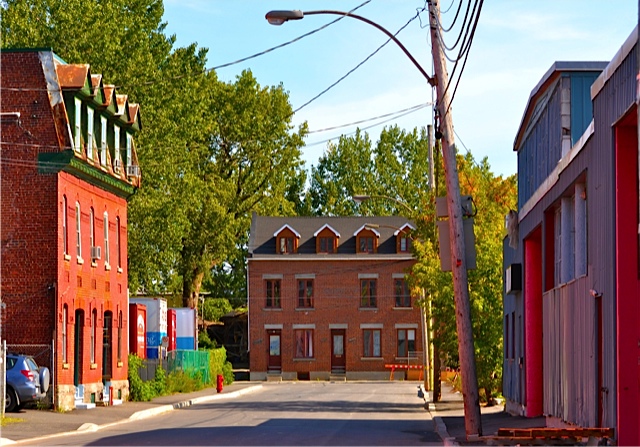
Griffintown Horse Palace, 2011. Photo courtesy of Dave Flavell
In the first photo, we look down Eleanor street at the Horse Palace, built in 1862, standing at the end of the block on Ottawa, surrounded by huge trees. Time was these were amongst the only trees in Griffintown a hundred years ago. The old St. Ann’s Kindergarten is on the left, now the headquarters of King’s Transfer, a moving company that’s been based in the neighbourhood for almost a century. It’s also where I conducted the majority of the oral history interviews for House of the Irish, thanks to the generosity of Bill O’Donell, the president of King’s. In this picture, the Horse Palace looks much as it has for the past thirty-forty years. But a closer look shows that it’s already under transformation. Leo Leonard, the legendary proprietor of the Horse Palace, and his wife Hugeuette, had already sold and moved to a retirement home. Leo, though, did not get much of an opportunity to enjoy retirement, he died in in July 2012 at the age of 87. Already, the building is under renovation, new windows have been put in on the second floor. But the actual stable, which is just out of sight, behind those moving trucks, was still in full working order.

Griffintown Horse Palace, 2013. Photo courtesy of Dave Flavell
The next picture was taken last year. From the exact same spot. Now the Horse Palace residence is dwarfed by an 8-story condo built next door and behind it, fronting on rue de la Montagne. This building was under construction in 2011, but had not yet risen to dwarf the Horse Palace. The Horse Palace building looks tiny and insignificant in the shadow of the condo, which stretches across at least three lots on de la Montagne.
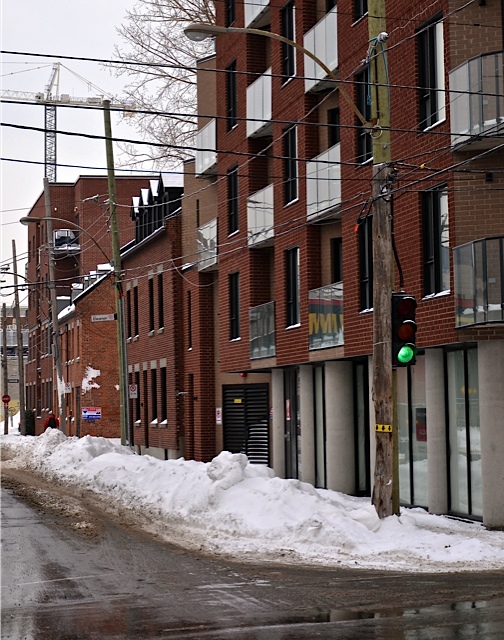
New condo tower and the Griffintown Horse Palace, January 2014. Photo courtesy of Dave Flavell
The final picture was taken a couple of weeks ago, from the corner of Ottawa and de la Montagne, looking east. The shop fronts on Ottawa in the new building remain empty, but looking down the block, after the Horse Palace residence is the old paddock of the stable, which was bought last year by the Ville de Montréal for purposes of turning it into a park to provide access to the actual stables, which the Griffintown Horse Palace Foundation has done yeoman’s work to preserve and save. (Full disclosure: I was a board member of the GHPF from 2008 until I left Montréal in 2012). Continuing on past the paddock, another mid-19th century residence still stands. And then, at the corner of Ottawa and Murray, another, shorter, 4-story condo stands. It was built in 2011. The crane is on the site of Devimco’s massive “District Griffin” development on Peel street.
Even though I have seen this view down Ottawa from de la Montagne, I was still shocked by Dave’s photo. The entire landscape of Griffintown is massively changed. The condo at the corner of de la Montagne and Ottawa is representative of the redevelopment. The streets of Griffintown are narrow, the buildings have always been hard up against the sidewalk. This has contributed to a somewhat claustrophobic atmosphere, at least on those blocks where enough buildings still remain. But these old buildings were 2 floors, at most 3. The stacking of 4, 6, 8, 10-story condos, lining these narrow streets only enhances this claustrophobia. It devastates the urban environment.
An Alternative America
January 30, 2014 § 4 Comments
A couple of days ago, an interesting article appeared in the Des Moines Register. I knew of it because my social media friend, and a geographer at Mansfield University in Pennsylvania, Andy Shears, had a map published with the article. Andy’s map is an alternative United States, based on historically proposed states, none of which came into existence. He created the map 2 1/2 years ago for his own blog. The Register also mis-identifies Andy’s map as one of what the country would look like if all the separatist movements in history had actually worked. But, either way, it’s actually a really interesting map, put together in what I image was after agonising research, Andy came up with an alternative United States based on a country of 124 separate states, all based on proposals that never came to be. In the case of Massachusetts, there would actually be two states: Massachusetts and Boston. Of course, anyone who lives outside the Hub, especially in Western Mass, would say there already ARE two Massachusetts. Cascadia, in this version, is a state that straddles the mountains of eastern Washington and Oregon. And then there’s a wonderful little state called Forgottonia carved into what is today the border between Illinois and Missouri, just north of the hypothetical state of St. Louis.

The America That Never Was, map courtesy of AndrewShears.com
But I digress. The column in the Register was written by Steffan Schmidt, a political scientist at Iowa State. In it, Schmidt ruminates on an apparent proposal in California to split the state into six smaller states, based on a proposal from Silicon Valley. Schmidt notes that this would give the general California region 12 senators compared to the 2 it has now, which means that it would have much greater power in Washington. Schmidt, though, seems to assume that the 6 Californias would all elect Democratic senators, which is incredibly unlikely.
Schmidt’s larger point is about the apparent immutability of the United States, that Americans consider the national boundaries to be sacrosanct. He ties that back to the Civil War, just another legacy of that war in American life. But then he goes on to note that countries fracture into newer ones continually, pointing to various examples from Slovakia to Scotland to South Sudan. Interestingly, he does not mention Québec and Canada. But that’s an entirely different kettle of fish (though, interestingly, both Canadians and Quebecers consider their national borders to be sacrosanct). But it is a point well worth considering, at least to a degree.
The difference between, say, Scotland and the United States is simple. Scotland was annexed by England to create Britain in 1707. The United States is comprised of states that all chose to be part of the Union. By that I mean the European settlers of the territory that is now the United States of America all petitioned to Congress to be admitted to the Union. And even if the Confederate States were defeated and then had to be re-admitted to the Union, they also did so willingly (or at least as willingly as they could). In contrast, Scotland was annexed. Slovakia was annexed. We all know how Yugoslavia was formed and what happened when that came apart.
So there is a huge difference between the American model and those Schmidt offers in comparison. Similarly, Canada was formed in a manner very similar to the United States. But Schmidt is correct to note that it is remarkable how resilient the American state has been since 1776. I was recently thinking about this when I saw news that the population shift in the United States, based on recent census data, will make the South and the West stronger politically, at least in the House. This led me to think about my current research, of course (The far right of American politics and history), and I began to wonder if the relative decline of New England and the Northwest in favour of greater power in the South and Southwest would lead to separatist movements throughout the nation. Not that I think they’d ever be successful, any more than I think Québec will ever separate. But it’s fun to have such idle thoughts.
And then I got one of the great classics of punk rock in my head, “Alternative Ulster,” by Belfast punks Stiff Little Fingers. The song dates from 1978, the height of the Troubles, and the Stiffies, two Catholics and two Protestants, simply wanted a different future for themselves.
Got Land? Thank an Indian and Canadian racism
January 17, 2014 § 12 Comments
Tenelle Star is a 13-year old girl who is a member of the Star Blanket First Nation in Saskatchewan. She goes to school in Balcarres, SK. Last week when she wore a hilarious pink hoodie that asked “Got Land?” on the front, and said “Thank an Indian” on the back, she created a controversy. The CBC reported on the matter on 14 January, and from there things have gone sort of viral. Jeff Menard, the Winnipeg man behind the shirts, says he’s getting flooded with orders. But the fallout around Star’s hoodie is getting ridiculous.
A few days ago, I tweeted my disbelief, in a rather inelegant fashion after reading the comments on the original CBC story:
https://twitter.com/Matthew_Barlow/status/423498348289474560
The response to this and a few other similar, though more eloquent, tweets was generally positive, but I got some pushback. Most of it was garden-variety racism, but this one was particularly interesting:
Further discussion revealed nothing, and I spent the rest of the day trying to figure out the logic, which appeared to be connected to the term “Indian.” Of course, the term comes from Christopher Columbus who, upon landing Hispaniola in 1492 thought he was in India. The name stuck. Today it is an incredibly loaded term politically, but, despite all that many aboriginals in Canada continue to prefer the term to the various attempts at replacing it. And if we really want to get semantic, I could point out that the term “India” for the country India actually comes from the Persians who termed the land around the Indus River India in the 5th century BCE.
The second part of that tweet was much more obvious. Blue Squadron’s grandfather worked for a living, the implication being that aboriginals in Canada do not. That’s beneath contempt.
This morning on the CBC’s website the fallout from Star’s hoodie continued. Her Facebook page has been inundated with comments, most of which are positive, but more than a few are disgustingly racist. The sad fact of the matter is that Canada is a racist nation when it comes to the First Nations, as I noted in this tweet
https://twitter.com/Matthew_Barlow/status/423596289733824512
One only need read the comments on the CBC article, or even the comments on Star’s Facebook page to see that. I also have the added benefit of having worked for eight years in the field of aboriginal law and litigation in Canada. I was a research analyst for an Ottawa-based company, we did research surrounding the myriad claims and counterclaims between the First Nations of Canada and the federal and provincial governments. The duplicity of government agents astounded me then, it still does today. And that’s not even touching the racism. I could cite many examples of horrible racist comments I came across the in the archives, but one has always stuck out for its complete lack of self-reflection. It came from an RCMP officer named Gallagher (an Irish name) who, when supervising a work camp where a few aboriginal men were sentenced for trivial criminal acts, complained that they didn’t want to do the backbreaking work. Said Gallagher, “They are sun-burnt Irishmen.” Oy vey.
But today, a new low was reached with the CBC reporting on the response of a Vancouver woman, Michele Tittler, to Star’s sweatshirt. Tittler is the head of this group called End Race-Based Laws, Inc., which was apparently formed in response to last year’s #IdleNoMore movement. This is from the CBC article:
Michele Tittler was posting on social media sites connected to the story. Tittler, from Vancouver, is a co-founder of a non-profit political organization called End Race-Based Laws, or ERBL Inc.
“I was immensely offended,” Tittler told CBC News Thursday, regarding the message of the shirt. “And I was going to do everything within my power to have that shirt banned from that school.”
Tittler said she had written to the Balcarres school and also sent notes to Facebook, complaining about the content on Starr’s page.
She is also planning to lodge a formal complaint with the Canadian Human Rights Commission , although it’s not clear on what grounds. Tittler is, however, convinced that the message of the shirt is racist.
“This is racism,” she said. “Canadians are really getting sick of the double-standard. No white kid could walk into a school with a shirt that says that in reverse.”
First off, no white kid SHOULD walk into school wearing the reverse of Star’s hoodie. Secondly, it is NOT reverse racism, it’s not racism. Tittler is is just flat-out, plain wrong. She is the latest iteration of an old phenomenon in Canadian history. Many aboriginals in Canada would be just as happy getting rid of the Indian Act, but the fact of the matter is that cannot happen. The playing field in Canada is not even. First Nations start at such a massive disadvantage to the average Canadian it’s almost unbelievable. The on-going legacy of Canadian colonialism and the systematic attempt at ethnocide in the 19th and early 20th centuries remain. During that period Canada made every attempt it could to eradicate aboriginals from Canada, not by killing them, but by taking their culture, making their kids speak English or French, through residential schools, through enfranchising aboriginals for leaving reserves and so on. None of that worked, for obvious reasons.
It is disgraceful that Canada remains such a fundamentally racist society when it comes to First Nations. It is a shame. It embarrasses me. In the year 2000, I was working in Ottawa, on a claim that centred around a group of Inuit in what is now Nunavut. This is where that gem from Officer Gallagher comes from. It was just one of many, and the more I read in the archives, the more appalled I was. And the more embarrassed that my country could have acted in this way. It was also Canada Day. In Ottawa. It was not a happy time for me.
And fourteen years on, it hasn’t got any better. The National Post, that noted bastion of retrenchment, published a collection of letters it received on residential schools, all of which appear to have been written by white people. I was astounded. Just astounded at these comments.
This is not going to get better at any time soon. It’s acceptable for far too many Canadians to be racist in this respect. And that is to the great shame of Canada.
The Making of the Historian
January 12, 2014 § Leave a comment
One of my favourite history books is Angela Bourke’s The Burning of Bridget Cleary. The book, published in 2001, tells the story of Bridget Cleary’s death at the hands of her husband, Michael, and a mixture of extended family, in Ballyvadlea, Co. Tipperary in Ireland in March 1895. As Bourke unravels the story, the murder of Bridget Cleary is an opportunity for the historian (or folklorist, in her case) to examine the collision between modern culture and folkways. Ballyvadlea in 1895 was essentially the boondocks of Ireland, far removed from the encroaching modern world, people there still lived according to old Irish ways, with beliefs in fairies, banshees, and the like. Whether or not Michael Cleary and his cohorts actually believed in this is neither here nor there, argues Bourke, what matters is that the belief system still existed and was still accessible to Cleary and his co-conspirators.
When I was in graduate school, I was fascinated by the collision between modernity and ancient folkways. In particular, I was interested in charivari, a means of community policing in pre-modern societies in Europe and amongst settler societies in North America. In fact, I was so interested in this, I set out to do my Master’s degree on this topic in Québec. What fascinated me then, and still does today, and why I enjoy Bourke’s book so much (I usually assign it when I teach Irish History) is the way in which modern legal culture intersects with traditional folkways.
Societies have traditionally been able to police themselves. Today, we live in a society where the state is omnipresent, whether in the form of of our driver’s licenses, or the regulation of education, and various other means. When someone breaks the law, we expect the police to make an arrest, the prosecutor to secure a conviction, and the jail to secure the lawbreaker until her debt to society is paid. But it hasn’t always been that way.
In October 1855, Robert Corrigan was beaten to death in Saint-Sylvestre, Québec, a remote agricultural community, some fifty miles south of Québec City, in the foothills of the Appalachians. He was beaten by a gang of his neighbours for stepping out of line. They did not mean to kill him, they meant to discipline him for his bullying, aggressive behaviour. That Corrigan was an Irish Protestant and his murderers Irish Catholics was secondary (at least in Saint-Sylvestre, for the rest of Canada, that was the most important detail in the highly sectarian mid-19th century). When the state attempted to arrest the accused men, they were easily able to elude the police forces sent in from Montréal and Québec, aided by their neighbours. When they did finally turn themselves in in January 1856, they did so on their own terms. They were also able to rig the jury when they went to trial in February so that they were acquitted.
The Corrigan Affair, in this light, was entirely about a local community maintaining its right to police itself in the face of the power of the state. The mid-19th century in Canada was a time of massive state formation and expansion. The same period in Québec saw a spate of construction projects around the province of courthouses and jails and other such buildings. The buildings were all the same down to the shade of paint used on them. Why? Because the state was attempting to establish its control across the province and it was attempting to do so with the message that the state was indifferent to local contingencies. Not surprisingly, the people of Québec rebelled against this. The mid-19th century in Canada offers endless examples of local communities rebelling against the state in Nova Scotia, New Brunswick, Québec, Ontario, Prince Edward Island, and Newfoundland.
The Wild West in the United States is another such example. The West has a reputation for violence that is only partly deserved. Much of the legends of the Wild West are just that: legends. But violence there was. Much of it was about the same thing as charivari in England or The Corrigan Affair in Québec: community policing. Disputes were settled between the belligerents for several reasons, most importantly, the state did not have the power yet to mediate between its citizens.
Historians have been studying this collision between folkways and the rise of modernity since the 1960s. During that era, that great generation of English historians (E.P. Thompson, Christopher Hill, Dorothy Thompson, Eric Hobsbawm) became fascinated by this collision. I always find it interesting when I see the influence of the historians I read in graduate school still on me today, all these years later.
Last semester, our favourite work study student, Alvaro, graduated. Alvaro had worked in our departmental office since we both (as in my wife and I) arrived here in the fall of 2012. For his graduation, we decided to buy him the books that had the greatest impact on us in our development as historians, as Alvaro is planning on going on to graduate school. I got him E.P. Thompson’s The Making of the English Working Class. I first read this book in 1996, my first semester of graduate school. It was one of the few books I read in graduate school where I just couldn’t put it down. Meticulously research, and brilliantly insightful, Thompson crafted an historical study that could stand on its own on its literary merits. I re-read it a couple of years ago. It remains one of my favourite books of all time.
Shameless
December 7, 2013 § Leave a comment
We’ve been watching the American version of Shameless off and on for the past year. The American version is based on the British show, but is set in the South Side of Chicago. It is centred around the big and cacophonous Gallagher clan. The patriarch is Frank, played by William H. Macy. Frank is a drunk asshole. There’s no other way to put it. His wife, the children’s mother, has up and left. The family is held together by the eldest daughter, Fiona. There are 5 more children, the youngest of which is 2 (and somehow African American in a family of white Irish Americans; this is never explained). Fiona scrounges and scrimps and saves to keep food on the table and the roof over the heads of the other Gallagher kids. The house is possessed by the Gallaghers through dubious means, involving some welfare scam on the part of Frank. Fiona is left to scam to keep the family together and to keep the rest of the kids from ending in foster care.
I have to say, I enjoy the TV show, though occasionally it hits kind of close to home, in that I grew up mostly poor with an alcoholic and abusive step-father. But, this show is a rather complicated look at poverty, particularly white poverty in America. It also dovetails nicely with Michael Patrick MacDonald’s points about South Boston. The show is set in Canaryville, the historically Irish section of Chicago’s South Side. Canaryville, like Southie or Griff, is rather legendary for being both Irish and hostile to outsiders.
As I watch the show, I can’t help but wonder if Shameless romanticises poverty, portrays it accurately, or stereotypes poor people as scammers. I find myself torn every time I watch it.
On the one hand, the Gallagher clan and their friends struggle everyday trying to make ends meet, but it seems they’re always able to put aside their money worries to have fun. No, they don’t get drunk (except for Frank) and they don’t do drugs. But they do have a lot of fun, there’s a lot of wisecracking, and teasing. There’s also a lot of scamming of pretty much anything that can be scammed, from welfare officers to schools, to businesses and anyone else stupid enough to get involved.
When I was growing up, my life wasn’t exactly as glamourous as the Gallaghers, but it’s not like we spent our entire lives miserable because we were poor. And the “system,” such as it were, was there to be scammed. To a degree. It was not like anyone I knew scammed welfare or Unemployment Insurance (as Employment Insurance was once called in Canada), and so on. Scams tended to be smaller scale. Like scamming free rides on the bus or the Skytrain. Life wasn’t one thing or the other, it wasn’t black and white. It was complicated.
And this is where I think Shameless is a brilliant show. Obviously there is some mugging for the cameras and the creation of some dramatic storylines for entertainment purposes. But it represents the life of these poor white trash Irish Americans in Canaryvlle, South Side Chicago, as complicated. Their lives aren’t all of one or the other. They live lives as complicated as the middle-classes. Perhaps more so, because they’re always worried about having something to eat and having gas to heat the house. In the end, Shameless represents the poor as multi-faceted, complicated people, who are pulled in various different directions according to their conflicting and various roles (as breadwinner, daughter, son, friend, lover, etc.). In short, at the core, their lives are no different than ours. They are, essentially, fully human.
Too often, when I see representations of the working-classes and the poor in pop culture, whether fiction or non-fiction, these representations are nothing more than stereotypes. Poor people are lazy. Poor people are scammers. Poor people are dishonest. Poor people are victims. Poor people need help. And so on and so on. In reality poor people are none of these things and all of these things and more. In fact, the poor are just like you and me. And, at least in my experience, essentialising the working classes does them a disservice.
And this is where works like Shameless or All Souls come in. MacDonald complicates our stereotypes of Southie. He shows us the complications of the impoverished Irish of South Boston, and he makes it impossible for us to stereotype. In the end, Shameless does the exact same thing.
Lest We Forget: Red and White Poppies
November 6, 2013 § 2 Comments
Twitter’s a wonderful thing. Sometimes. Today it is. I just learned about a movement in Canada to distribute white poppies for Remembrance Day. This apparently comes from the Rideau Institute, which is a left-of-centre think tank in Ottawa.

Flanders Field, World War I
White poppies have a long history in the United Kingdom, they date back to the immediate post-First World War era, when pacifists decided they wanted to commemorate the dead of the war and to put forward the hope that the War to End All Wars was in fact a war to end all wars (we know how that turned out). These pacifists wanted to remember all war dead, not just the British dead, which is what their problem with the red poppy was. The red poppy also took on sectarian tones in Northern Ireland during the Troubles, where it was a largely Unionist symbol.
But Canada does not have this history, it does not have the politicisation of something like the Troubles. The poppy is a pretty apolitical statement. I wore a red poppy in Canada, and now, living in the US, I feel slightly awkward in late October and November without my poppy. I have great fondness of memories of getting poppies, I liked to go to Second World War veterans, who pinned the poppy onto my lapel. There was something profound about that little ceremony, I felt like it connected me, however ephemerally, to my grandparents’ generation (both my grandmother and grandfather served in the Second World War). And it tied me to our history as a nation.
I generally oppose war, though I do believe there is such a thing as a just war. And the two world wars of the last century are, to my mind, just wars. But I don’t think my preference for peace is compromised by wearing a poppy.
The Rideau Institute says that its white poppies are for those who don’t want to celebrate war. That is not what the red poppy symbolises. The red poppy commemorates the dead of the wars, those who served. The white poppy confuses the means with the end. It politicises Remembrance Day in Canada, the very thing that should not happen. That the Rideau Institute thinks this is a good idea saddens me somewhat.
On Living in a Gentrifying Neighbourhood, Pt. V
October 2, 2013 § 6 Comments
[I thought I was done with this series (parts I, II, III, and IV and the prequel) when I left Pointe-Saint-Charles last summer and moved to New England. Apparently not.]
In the mid-1980s in Vancouver, the BC provincial government built the SkyTrain, a new light-rail system connecting the western suburbs of New Westminster and Burnaby to the City of Vancouver. SkyTrain caused a lot of disruption when it was built, as you might expect for a brand new system. When it finally opened, just in time for Expo ’86, people were excited. Vancouver finally got rapid trasit! But some people weren’t so happy, the people who lived along the line in New West, Burnaby, and East Vancouver (it’s worth noting the SkyTrain went primarily through working-class neighbourhoods). I recall a news segment that investigated the claims of the noise. In particular, I remember a glass of water on a counter next to an open window as the SkyTrain went by. The water didn’t move. At all.
Nonetheless, I can understand in the inconvenience of the SkyTrain for those whose day-to-day lives were affected by it. They were there before SkyTrain, it moved into their neighbourhood.
But let us now consider Pointe-Saint-Charles. The Pointe has been home to a train yard since the Grand Trunk Railway built its yards there in 1853. For those of you who are mathematically challenged, that’s 160 years ago. In other words, the trains have been in the Pointe for a long, long time. And for much of its history, the trains were part and parcel of the experience of living in the Pointe. There was a train yard there. Life goes on.
But, as I’ve been noting in this series, the Pointe is undergoing redevelopment and gentrification. And nowhere is this clearer than in that part of the southern part of the Pointe which, even a decade ago, was a pretty dodgy part of town. Here, people have been snapping up cheap housing, both the 19th century stock and hideous new condos, and movingin. The Pointe, ever-so-slowly has become a more happening place because of this gentrification and that closer to the north end of the neighbourhood, near the Canal and the Nordelec building (which is in the process of being condofied now). In short, the yuppies (of whom I was obviously one when I lived there) are moving in.
For the most part, the process of gentrification has been more or less smooth in the Pointe, but, then again, I’m not one of the people being priced out of the neighbourhood. But the tension that exists in Saint-Henri was lacking in the Pointe. But, there were subtle changes in the culture of the neighbourhood when I lived there. This was seen most obviously to me in the case of the community garden at the end of our block. A couple of years ago, the arrivistes took control of it and essentially pushed the old-timers out of the garden. Not cool.
So, today I was reading the news on CBC Montréal, and I came across this little gem. Some of the yuppies who’ve moved into that southern part of the Pointe (taking advantage of cheap housing and pushing the poor out) are crying foul over the sound of the trains at all hours of the day. Yup. Imagine that! Trains! In a train yard! One resident hears the trains and he gets afraid of what might happen. Others complain sound like The Grinch, complaining about the noise, noise, noise!
Certainly, some of this is in response to the disaster in Lac Mégantic. But, it is worth noting that in all my years in the sud-ouest, I cannot recall a single accident involving trains in Pointe-Saint-Charles or Saint-Henri. Accidents between cars, bikes, and peoples, certainly. But not trains.
So, these people want Canadian National to reduce the trains and the noise they make. This is not unprecedented. There is a condo building on rue Saint-Ambroise in Saint-Henri, right where the CN tracks go through Saint-Henri. When it was first opened up, the people who bought in there respectfully asked that the Canadian National STOP running trains through their backyards. That line, which is connected to the largely disused yards in the Pointe, remains one of the busiest train tracks in North America, used by CN and ViaRail between Montréal and Ottawa and Toronto. I’m not making that up.
It would seem to me that one of the basic facts of living in a city is that there is noise. And if you are on the market for a new condo, you would look at what’s around you in your new neighbourhood and consider the inconvenience of the noise factor, or other things that might upset you. And, if you move into a condo near a train yard, you might want to consider the fact that it’s going to get loud occasionally. Trains are like that, they’re loud (I can hear the Commuter Rail train from my house here at all hours of the day and night, in fact, one is going by right now!). It is asinine and selfish to move into a neighbourhood with a train yard in and then act surprised when there are trains that make lots of noise. It is the height of idiocy, quite frankly. If you don’t like the noise, then go live somewhere else. It’s that simple. And so, that is my solution for these fine people in the Pointe. Sell. Move elsewhere.
Immigration: The More Common North American Experience
September 6, 2013 § 4 Comments
The scenery as we drove across the United States and back was amazing. So were many of the place names. There is a town in Colorado named Rifle. Another town in Colorado is called Cahones. I kid you not. But perhaps my favourite highway road sign in all of the United States was this one we saw on the side of I-84 in Eastern Oregon.
 The sign pretty much says it all. Canadian and American culture is full of stories of the successful immigrant, the ones who came to these shores with nothing and made lives for themselves, who made fortunes and found fame. And while certainly there were a few who experienced this good fortune on North American shores, the majority did not. Most settled somewhere in between fame and fortune and poverty and despair.
Certainly, pop culture contains references to the downside of emigration. In Canada, university students in Canadian history and literature are tortured with perhaps one of the worst books in Christendom, Susanna Moodie’s interminable Roughing It In the Bush, Or, Life in Canada, about the trials and tribulations of Moodie and her husband, John Weddiburn Dunbar Moodie, a down-at-the-heels member of the British gentry, in the wilds of Upper Canada in the 1830s and 40s. While Moodie was a horrible writer and her husband an even worse poet, the book is a key text on the struggles of even wealthy emigrants in the British colonies in the mid-nineteenth century (it worked out ok for the Moodies, they ended up moderately wealthy and living in the thriving town of Belleville, Ontario).
One of my favourite Pogues songs is “Thousands Are Sailing,” which is the story of downtrodden Irish emigrants in New York City in the 19th century. The song is actually kind of heartbreaking.
So this sign for an exit on I-70 in Eastern Oregon struck me as a remarkable site. Old Emigrant Hill Road is on the northern side of I-70, and it runs into Poverty Flat Road on the southern side of the highway. Obviously, these two roads have been there for a lot longer than the Interstate. And, as you can see from the terrain surrounding the sign for the exit on the highway, the landscape around Poverty Flat Road isn’t exactly all that welcoming. This was also a common experience for emigrants to the “New World” in the 19th and 20th centuries: they ended up farming lands that were not conducive to growing much of anything. Generations struggled to make a living on these farms until someone, whether out of optimism or desperation, decided to clear off the land and make his or her fortunes elsewhere.
Perhaps this is the more common story of the immigrant in North America than the one of fame and fortune.
The Symbolism of Maps
July 1, 2013 § 4 Comments

London Tube map. 1908
As noted, I’m reading Peter Ackroyd’s epic London: The Biography. As might be expected of such a tome, it’s a treasure of information, some interesting, some not so much. But in reading it, I’m reminded of the London Underground map. Like the transportation network in any major city, London’s was originally a hodgepodge of private companies providing service, which were eventually centralised and then nationalised. The maps were created for what maps are always created for: to help people navigate their way around the system. The first map dates from 1908.

London Tube map, 2013
The basic template of this map remains in use today. As Ackroyd notes, “The original Underground map bears only approximate relation to the location of lines and stations, but it is so aesthetically pleasing that its lineaments have never been changed.” In other words, today’s Tube map is a representation of reality, it only gives a vague idea of the system. Countless Londoners and tourists both state at the map with great intensity trying to figure out where to go. And while the map does give a vague idea of where things are, it is highly impressionistic. But, boy, it sure does look great, doesn’t it?

Montréal métro system map
The thing I find most interesting about the London Tube map, though, is that it has become the template for subway/métro systems the world over. These maps are stylistic triumphs, but they are, quite frankly, useless as maps. Nonetheless, as urbanites, we are trained to be able to read these maps and navigate our way around the city. And let me also point out that cities are incredibly complex organisms. Navigating them has become second nature to us, but if we stop and thinking about it, what we can do on a daily basis without thinking too much is pretty impressive. At any rate, these transit maps. Consider, for example, the Montréal métro map. It’s a highly stylised representation of the métro and commuter rail lines in the city and its surrounding areas. Nothing other than the stations and ultimate destinations of the train lines are identified. In order to read the métro map, one requires a basic knowledge of the geography of the city.

Map of Montréal
Compare the métro map with that of the city as a whole. The métro map only covers a small part of the central portion of the Île-de-Montréal. Of course, that’s where the métro is. And note that the map of Montréal as a whole is missing perhaps the biggest geographical fact of the island, other than it is an island: Mont-Royal. That, of course, suggests that maps in general are just impressionistic and little more than symbols of what it is they are meant to represent.
 This is a point that I like to make to my students about the great explosion of map-making in the West during the Age of Exploration, as well as the process of state formation in the Early Modern era: I ask them to think about what it is that they know makes them American (or Canadian, when I lived in Montréal), what makes them know that they in the upper right corner of the country know that all those people down in the lower left hand corner are all American. The map of the United States. As Benedict Anderson notes in his still brilliant Imagined Communities (seriously, this remains one of the greatest books I’ve ever read), part of the process of state-formation is achieved through the creation of a logoised map that is then emblazoned into the brains of the citizenry. When someone says the word “Canada” to me, many things flash through my head, but amongst all these images is the outline of the map of Canada.
In other words, maps aren’t really anything more than symbols of what it is they represent. We are trained in map reading from a very young age, so that even as children we can look at a map and instantly recognise what it is we’re supposed to be seeing.
 Matthew Barlow