On Canadian Anti-Americanism
December 18, 2012 § 7 Comments
Sometimes there are few things as depressing as Canadian anti-Americanism. We Canadians are a smug lot, we think we’re smarter, more cosmopolitan, less racist, less sexist, more everything that’s good, less everything that’s bad than Americans. And yet we’re obsessed with Americans. For many of us, our self-identity as a nation is simple: we’re not American. Years ago, even the Canadian Football League fell for this with an ad that asked “WHAT’S THE DEFINITION OF CANADIAN?!? NOT AMERICAN!!!” Yeah, great, thanks for that. I find few things as sad, pathetic, and limiting as we Canadians identifying ourselves in the negative, as in NOT American, NOT British, NOT French.
But it appears that this means of self-definition still appeals to and obsesses too many of my fellow citizens. And this leads to this sad anti-Americanism. The kind that leads Canadians to proudly declare we live in a paradise of non-existant crime, racism, homophobia, etc. And sometimes, it leads to leftist Americans fetishising Canada. Think, for example, of Michael Moore’s fatuous claim in Bowling for Columbine that Canadians don’t lock their doors at night because there’s no crime. I have never, ever, ever left my door unlocked living in Vancouver, Ottawa, and Montréal. Not once. Ever. You think I’m nuts?!?
Canadian anti-Americanism is quite the phenomenon in social media right now. All kinds of Canadians lecturing, hectoring, and badgering Americans (not that they’re paying attention) about guns in the wake of the Newtown massacre (and let’s not forget the mall shooting in Oregon last week) (if you’d really like to depress yourself about mass shootings in the United States over the past thirty years, I have this for you). The script of this particular anti-Americanism is consistent: “You Americans are dumb. You have guns. And you shoot each other and yourselves with them. We Canadians are smart. We don’t shoot ourselves and each other.” And so and so forth. To that, my fellow Canadians, I will remind you of the rash of shootings in Toronto last summer. As for mass shootings, I present École Polytechnique; Concordia University; Taber, AB; Dawson College. You want a closer look at mass shootings in Canada? Go here. But this kind of anti-Americanism is predictable. But it’s not like Americans aren’t upset and distressed by these goings-on. It’s not like Americans aren’t trying to have this very same discussion.
But there’s also the more prosaic kind of anti-Americanism. Since I re-located to Boston this summer, I’ve had a few choice comments directed my way on Twitter and in real life. Comments like “I could NEVER live in the States, it’s so violent,” “Ha! Better get a gun!” and “Americans are dumb” (yes, seriously), and so on and so forth. A couple of weeks ago on Twitter, one numbskull went crazy on me in response to a tweet about the subtle difference I have noticed between the two nations: Canadians have social programmes, Americans have entitlements. This now-former tweep went on a tirade about Americans and war, suggesting that the American entry into the Second World War had nothing to do with the Allies winning the war. But it got better. Apparently the only thing Americans can do is fight, they can’t do diplomacy, and they can’t innovate unless it’s war. Cars, electricity, nope, none of that comes from the United States. Certainly, this kind of irrational anti-Americanism is not the norm in Canada, but it is still symptomatic of the larger problem.
I don’t see how this kind of irrational anti-Americanism can square with our self-image as more erudite, more intelligent, etc. than Americans. For that matter, I can’t see why this comparison even exists in the first place. I am Canadian. Full stop. I am not not-American. I don’t care what Americans are or do. That’s for Americans to decide. As Canadians, we need to get over our inferiority complex.
The “Curation” of Southie and the General Over Use of the Term
December 10, 2012 § 4 Comments
We were in Southie yesterday, the former Irish-Catholic working-class neighbourhood of Boston. Southie is undergoing massive yuppification these days. The working classes are being squeezed out, and the yuppies are moving in. This was clear as we took the #9 Broadway bus from Copley Square into Southie. The bus is the great equaliser of Boston society; in some parts of the city, it’s the only time one sees large numbers of minorities. We got off the bus at the corner of West Broadway and A Street, on our way to a yuppified Christmas foodie craft fair at Artists for Humanity on West 2nd Street. In a lot of ways, Southie looked to me like a combination of parts of the Plateau Mont-Royal and Pointe-Saint-Charles back home in Montréal. The architecture was Plateau-like in terms of post-industrial spaces and housing, but the people looked like they could be in the Pointe. There was a curious mixture of the down and out, the working-classes, hipsters, and yuppies of every skin colour.
Gentrification is a creeping problem in pretty much every North American and European city, and much has been written about this, including on this very blog (like, here, here, here, here, here, here, and here, for starters). But what struck me the most was Social Wines, a wine and beer emporium in a spanking new building on West Broadway at A Street. Social Wines offers its clientele “Curated Craft Beer and Spirits.” Now, I must confess, this is my kind of store: it focuses on smaller, indie breweries and vineyards. I like giving my money to these kinds of companies, rather than the Molsons, Budweisers, and massive vineyard conglomerates of the world. But curated? What the hell does that mean?
According to the Meriam-Webster dictionary on-line, a “curator” is “one who has the care and superintendence of something; especially : one in charge of a museum, zoo, or other place of exhibit. To “curate” is: “to act as curator of a museum or exhibit curated by the museum’s director.”
Of late, hipsters and academics have abused the term “curate” like it’s nobody’s business. It is one thing, in the field of Public History and its corollaries, to write of the ways in which museums and the like have “curated” items. That is the proper use of the term. But when editors of edited collections of academic papers start referring to themselves as “curators” and not “editors,” well, then we have a problem. Meanwhile. Hipsters. On any given day, one can go to PitchforkMedia and see articles about this or that music festival that has been “curated” by someone. The most egregious example of this is the All Tomorrow’s Parties festival, which takes place in merry olde England, with branches occurring in the US, too. Each year, ATP is “curated” by a guest musician, one of stature and great fame. What that means is that someone is in charge of deciding who should play, and the list of artists reflects the curator’s tastes. Yup, deciding who should play a music festival is curation.
And so now we have a hipster beer and wine store in Southie that offers us “curated” booze. What, exactly is curated? The collection of booze on sale. See, the old ma and pop liquor store down the street just orders in booze that they figure their clientele will enjoy. But, not hipsters, they lovingly and carefully “curate” the collection of booze on sale at Social Wines. I don’t know about you, but I feel a lot better knowing that rather than having some old geezer just randomly order wines and beers that may or may not be any good, we have the fine folk at Social Wines to very carefully curate their collection.
My problem with the use of this term? It’s very simple. It’s pretentious. And nothing quite says “I’m a wanker” like declaring that you curated your liquor store. I applaud Social Wines’ mission. Hell, next time I’m in Southie, I may even stop in and peruse their collection of wines. But the use of this term by book editors, musicians, and liquor store owners also seriously devalues the meaning of the word in its true professional sense.
Professional curators, those who work in museums and art galleries, do not just collect stuff they like to display. They are responsible for the content of exhibits, and they are required to carefully make decisions on what is appropriate and what is not, to carefully arrange the displays, to negotiate with sponsors, and so on and so forth. There is a reason why curators go to school to learn how to properly curate. Musicians and liquor store owners do not.
Arrival Cities: The Book
December 10, 2012 § Leave a comment
I have touched on Doug Saunders’ Arrival City previously on this blog here and here. This review was also in the works with Current Intelligence before I left back in 2011. So, I am sticking it here for my own purposes.
Doug Saunders. Arrival City: The Final Migration and Our Next World. London: William Heinemann, 2010. ISBN: 9780307396891. 356pp.
Doug Saunders’ Arrival City was published to almost universal acclaim last fall. The Guardian nearly fell over itself hailing it as “the perfect antidote to the doom-laden determinism of the last popular book on urbanisation, Mike Davis’s Planet of Slums” and declaring it “the best popular book on cities since Jane Jacobs’s The Death and Life of Great American Cities half a century ago.” Saunders’ own newspaper, The Globe & Mail hails his calming certitude on the wonderful nature of progress that the city provides us. And the Wall Street Journal praises Arrival Cities for its optimistic view of globalisation.
Certainly, Arrival Cities is an important book, its well-written and is clearly and cogently argued. It is also somewhat of a disappointment, at least in the first half of the book. Saunders is the European Bureau Chief for The Globe & Mail and his reportage and columns generally provide a balanced view of the world; his is one of the few columns in that newspaper I actively seek out. Thus, I expected more from Arrival Cities. I did not get it. While Saunders does give us a counter-narrative to Davis’ doom and gloom, it occasionally reads Pollyana-ish. And at times, Saunders’ journalistic eye overwhelms his argument. Indeed, Dwight Garner in The New York Times notes this problem: his lengthy quotes from the people he talked to in arrival cities around the world sound formulaic and too easy.
Certainly, Planet of Slums was an overly statistical analysis, and statistics are on the aggregate level, they do not always us to view the micro- and quotidian levels. But Arrival City is plagued by the opposite problem: in focusing on a success story or two from each of the arrival cities he visits around the world (and Saunders has certainly been travelling the world), he over-personalises his arguments, which gives the impression that he’s choosing to extrapolate the success stories he saw, not the marginalised. Certainly, all of the people in arrival cities are marginalised in the larger sense of the word, but within the poor, there are class/caste divisions.
More fundamental, though, is Saunders’ reliance on Hernando de Soto’s arguments that all people need in the slums and favellas of the world is security of tenure, if they owned their own homes, all would be good. As Davis notes, the problem with titling in the slums is that it perpetuates the problem of class, in that the wealthier squatters win and the poorer lose, or continue to lose. And de Soto has also been criticised for over-estimating the amount of wealth land titling would create. The other problem of de Soto’s claims is the very notion of property: generally speaking, slums and favellas work due to the co-operation between residents. The creation of private property is at diametrical odds to this economic system. Saunders parrots de Soto throughout large part of Arrival City, arguing that private ownership of homes and security of tenure would encourage slum-dwellers to, essentially, take pride in their homes and communities and would give them a base of capital to invest in the economy. This is not to suggest that de Soto and Saunders are all wrong and their critics all right, but it is to suggest that life does not work quite as neatly and systematically as de Soto and Saunders would hope.
The first five chapters of the book are also plagued by an alarming ahistoricism as Saunders takes us on a tour of arrival cities across the globe from London to Dhaka, Nairobi, Los Angeles, and Shenzhen. In Chapter 5, he looks a the historical growth of cities in the west, focussing specifically on Paris, London, Toronto, and Chicago. Oddly enough, even in a historical chapter, one is left alarmed at Saunders’ ahistoricism. In discussing the differences between urbanisation rates in the United Kingdom and France in the mid-19th century, Saunders somehow manages to overlook the major impetus behind urbanisation in that century: the Industrial Revolution. The Industrial Revolution is the determinative factor behind the wildly different rates of urbanisation in France and Britain in the 19th century, plain and simple.
Also, a cardinal crime to an entire generation of historians, Saunders attempts to take on E.P. Thompson and The Making of the English Working Class. The problem is that he seems not to have read the book. He says that Thompson sees his working class heroes as “passive victims.” This is just plain wrong, the key argument that emerges from The Making is that the working classes were not just passive victims, that they employed agency in agitating for their rights through corresponding societies, proto-unions, and through the church.
In addition, one is left rather flummoxed by Saunders’ apparent naïveté in looking at housing projects in Paris. He criticises the project builders for not soliciting input from those who were to be the future residents of the projects. Seriously. Nonetheless, he does make the point that the lack of accountability on the part of both the authorities and residents in the projects, to say nothing of their discombobulating impact on community.
Following this, however, Arrival City improves exponentially, in the final five chapters. In this sense, it is as if the book is split in two. In the second half of the book, Saunders seems to adopt a more complicated approach to the arrival cities of the world. This includes pointing out the ridiculousness of immigration policies in Canada and the United States. Canada and the United States take in the largest number of immigrants in the world, at least on a per capita basis for Canada, a relatively tiny (population-wise) country.
But it is Saunders’ chapter on the geçekondus that surround Istanbul that really shines. Here, we get a detailed, excellent study of the politics of the geçekondus from the 1970s to today and the struggle of the resident of the slums to attain regularisation and integration into Istanbul. Istanbul, of course, is one of the fastest growing cities in the world. In 1950, Istanbul’s population was 983,000; today, over 13,000,000 call the city home. The slums on the Asian side of the Bosporus grew up in the 70s as impoverished rural Turks migrated to the great city. They established their slum housing outside the boundaries of the city and then agitated for the right to have such luxuries as running water and sewers. The organisers of the 70s and 80s were almost all radical lefties and, during the military dictatorship and its aftermath in Turkey, many spent time in jail and saw their homes routinely torn down. By the turn of the millennium, their geçekondus had been integrated into Istanbul (a large part of what saw the city’s population triple in the past thirty years). Today, these old geçekondus are now part of the inner ring of Istanbul suburbs, fully integrated into the city, and the children of these old radicals are Istanbullus. However, the geçekondus aren’t simply a case of de Soto’s economic theories being put into practice, the regularisation of the geçekondus and their residents, the geçekondullus, required state assistance.
In the second half of the book, Saunders also goes beyond the role of banks and business in the regularisation of the arrival cities. He also notes that the state needs to take an activist role, whether of its own accord or spurred on by the arrival city residents. In order to do this, however, the state needs to have the resources to do so. This is simply not possible in many impoverished and/or corrupt developing world nations, like Bangladesh. Instead, it requires the intervention of richer nations like Turkey, which could afford for Istanbul to absorb and regularise its geçekondus. But more than this, the integration and regularisation of these arrival cities is necessary for local schools, jobs, health care facilities, water and sewer services, and transportation. And then, finally, Saunders strikes a balance between the de Soto right and the Davis left:
What comes from this work, and form the experiences of families like the Magalhãeses in Brazil and the Parabs in India, is a conclusion that is unlikely to please the ideologues on the socialist left or the free-market right: to achieve social mobility and a way into the middle class for the rural-migrant poor, you need to have both a free market in widely held private property and a strong assertive government willing to spend heavily on this transition. When both are present, change will happen [p. 288].
What we are left with then, is half a great book. The first half of Arrival City is done in by its overly simplistic and journalistic approach, its lack of historicity and its over-reliance on de Soto. In the second half, though, Saunders finds his feet, and finds his own original argument that more than splits the difference between de Soto and Davis. I remain unconvinced that the urbanisation of humanity on such a level as we are seeing today is a good thing, but it is also a truism throughout history, at least in the West, that periods of urbanisation have spurred on trade, the economy, and general human progress. And during periods of de-urbanisation, such as in the Dark Ages following the fall of the Roman Empire in the West, Europeans were only slightly more evolved than cavemen, at least in relation to the rest of the Mediterranean world and the Middle East, as David Levewing Lewis points out in God’s Crucible: Islam and the Making of Europe, 579-1215. Either way, there is no simple answer to the question of the massive urbanisation of the globe today, despite what the Mike Davises and Doug Saunderses of the world would have us believe.
Montréal’s Anglo Mayor: Dr. JJ Guerin
November 16, 2012 § Leave a comment
So Montréal got itself a new mayor today, Michael Applebaum. He wasn’t democratically elected, but given the sudden resignation of the scandal-plagued Gérald Tremblay on 5 November, he has to be an improvement. The big woopedy-do about Applebaum is that he’s Anglophone (he’s also the metropole’s very first Jewish mayor). Montréal hasn’t had an Anglo mayor since 1910, when James John Guerin sat in the mayor’s chair.
Guerin, despite the last name, was Irish Catholic. He was also a central player in one of the most vicious election campaigns in Canadian history. In 1917, at the height of the First World War, Prime Minister Sir Robert Borden called an election over the issue of conscription. Borden had invited the Liberal Party, under Sir Wilfrid Laurier (Prime Minister of Canada, 1896-1911), into his government to form a Union government for Canada for the duration of the war. Laurier, however, could not countenance conscription nor could his Québec powerbase. He refused. Borden called an election for 17 December.
By 1917, voluntary enlistments into the Canadian Expeditionary Force (CEF) was pretty much drying up. The war had been going on for three years. And the Great War was little more than a killing field. Mechanised warfare wreaked havoc on the soldiers. Casualty rates were enormous. Canada, with a population of little more than 7 million, lost 65,000 men, with another 150,000 wounded. Many of those who were wounded and survived were never the same again. They lost their eyesight, their hearing, limbs; their lungs were destroyed by the Germans’ poisonous gas; they were shell-shocked. It wasn’t just in Canada that enlistments were drying up by 1917, the same was true in England, Scotland, and Wales. Thus, conscription was needed to compel young Canadian men to fight. Conscription was made palpable in the rest of Canada, in part, due to exemptions. The most famous case was that of farmboys, whose labour was needed on the farms of the Prairies (and Ontario). (Not that Borden kept this promise). But, in Québec, nationalists failed to see why Canada should be wrapped up in an imperialist war that had nothing to do with Canada’s interests. Indeed, Henri Bourassa, the most influential nationalist leader of the day, and founding editor of Le Devoir, argued in that paper’s pages
Le Canada aurait pu intervenir comme nation, lié a l’Angleterre par des attaches politiquées, et à la France par des motifs de sentiment et d’intérêt, sans compromettre en rien son état politique…[and that Canada had] aucune sort d’obligation morale ou légale de participer à la guerre et tenir compte des conditions particulières, des intérêts vitaux qu’il doit sauvegarder comme pays d’Amérique avant lier sont à celui des nations d’Europe.
Bourassa wasn’t entirely correct, Canada did have a legal obligation to participate. Britain still controlled Canada’s foreign affairs, and would continue to do so until the Statute of Westminster in 1931. Thus, when Britain went to war, Canada went to war.
At any rate, the Liberal Party of Canada split over conscription in 1917. Most Liberals outside of Québec took Borden up on his offer; most Liberals in Québec stood behind Laurier. The outcome of the election was a foregone conclusion, of course. But that didn’t stop the Bordenites from engaging in some skeezy politics. They enfranchised women who had sons or husbands in the military, calculating that they would vote for the Bordenites. They gerrymandered ridings to ensure the best possible outcome for the Unionists.
One of the gerrymandered ridings was St. Ann’s, in Montréal’s west end. Prior to the 1917 election, the riding was comprised of Griffintown, Little Burgundy, and Pointe-Saint-Charles, a working-class industrial slum. The sitting member was Charles J. Doherty, a Conservative and the Minister of Justice in Borden’s government. He was initially election to represent St. Ann’s in 1917. He was also Irish-Catholic, so, in essence, the Irish of Griffintown (and Pointe-Saint-Charles) had elected one of their own. Again. St. Ann’s was one of those ridings where the outcome was not a foregone conclusion. It could just as easily go Liberal. Thus, the gerrymander. Conservative, non-Irish, neighbourhoods including the western part of Pointe-Saint-Charles and all of Verdun, were added to the riding.
The Irish were an issue in 1917 because of the effect of the 1916 Easter Rising in Dublin on the Irish diaspora. The 1916 Rising, and the brutality of the British response, served to radicalise the Irish, both in Ireland and the diaspora, including and perhaps especially, Griffintown. Griffintown was home of the most radical republican Irish nationalists in Canada in the 1910s, mostly centred on the Ancient Order of Hibernians (AOH). Thus, for the Bordenites, it was essential that Doherty, who was responsible for conscription, be protected at all costs. Hence, the gerrymander.
Borden was opposed in the riding by two Liberals at the outset. Daniel Gallery, the former Liberal member (and city councillor) for St. Ann’s, as well as Dr. J.J. Guerin, a long-time city councillor and former mayor of Montréal. Gallery, though, ultimately lost the Liberal Party’s endorsement and was left to run as an independent against the Liberal Guerin and the Conservative Doherty. The election was vicious in Griffintown. Goon squads intimidated followers of all three candidates. All three were heckled mercilessly on the campaign trail. Threats were made.
Doherty won the election handily. Indeed, he won with the largest margin of his career. But he also won in large part due to the gerrymander. In Griffintown, the heart of St. Ann’s, Guerin walked away with the vote, outpolling Doherty by an almost 2-1 margin. Gallery, despite a long career in service of Griffintown, was never a credible candidate. He spent most of his time denying that the Unionists were paying him to split the Liberal vote with Guerin. He garnered fewer than 1000 votes. Guerin may have lost the election, but he won Griffintown. And he eventually succeeded in representing St. Ann’s in Parliament; he was elected the Liberal member in the 1925 election and held the seat until his death five years later.
Le Reigne Elizabeth
October 19, 2012 § Leave a comment
The Queen Elizabeth Hotel on blvd. René-Lévesque has fascinated me ever since I was a kid. Structurally and aesthetically, it is one of the ugliest buildings in the downtown core of Montréal. Built in a neo-brutalist style usually reserved for university campuses, the Queen Elizabeth is nonetheless the swishest hotel in Montréal. It is also the largest hotel in Montréal and Québec, with over 1,000 rooms. The other thing that has fascinated me since the mid-70s is the name of the hotel. How does a hotel in the middle of Montréal, the metropole of Québec, end up being named after the Queen? Better yet, what’s with the incongruity of the name in French, Le Reigne Elizabeth, with the masculine article there before the feminine monarch?
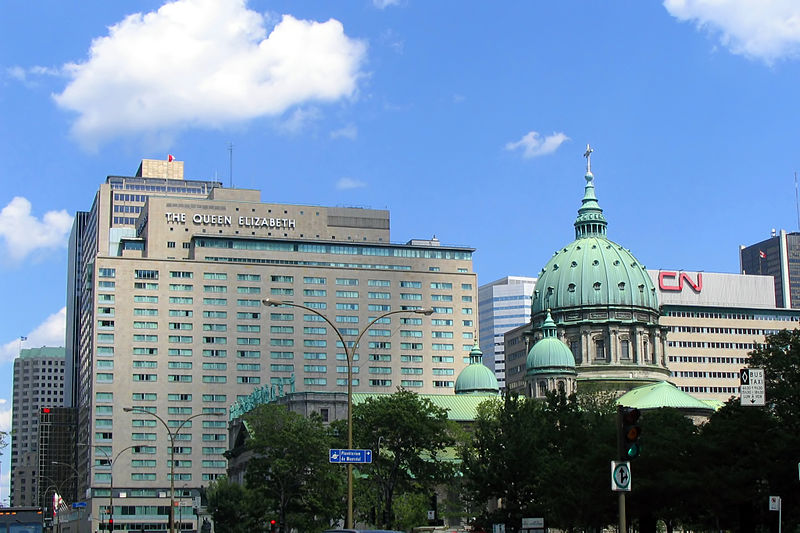
When the hotel was first proposed back in 1952, there was an upsurge of love for the monarch in English Canada. Queen Elizabeth II had just ascended the throne, and around the former British Empire, people were gaga over the queen, somewhat like people are currently in a tizzy over the former Kate Middleton. However, the 1950s also saw the rumblings that led to the eruption of the Quiet Revolution in Québec in 1960. There was an upsurge of québécois nationalism in the city and province as well. Indeed, nationalists argued that the Canadian National Railways should name the new hotel after the founder of Montréal, Paul de Chomedy, sieur de Maisonneuve. Nonsense, responded the CNR’s president, Donald Gordon: Canada is a Commonwealth nation, and the head of the Commonwealth is Queen Elizabeth II. Since he was the one building the hotel, he won the debate.
As for the masculine article in the hotel’s French name, well, it turns out that refers to the implied ‘hotel’ in the name, and hotel is masculine. There you have it.
 The Queen Elizabeth Hotel, of course, has lived up to its reputation. The Queen herself has rested her head on its pillows four times, and her son, Prince Charles, has also visited. The NHL entry draft was held there pretty much every year until 1979. But, of course, the most famous event to have occurred in the Queen Elizabeth is the “bed-in” of John Lennon and Yoko Ono, 26 May-2 June 1969. Lennon and Ono had been denied entry to the United States, because Lennon had a cannabis conviction from 1968. A bed-in was planned for New York City. So now the plan had to be changed, and so Lennon and Ono bedded down in the Queen Elizabeth for their second Bed In for Peace (the first had been in Amsterdam 25-31 March). During the Montreal bed-in, the anthem “Give Peace a Chance” was recorded by André Perry.
Farewell to Leo Leonard
July 12, 2012 § 1 Comment
Leo Leonard, the long-time proprietor of the Griffintown Horse Palace, died a week ago today at the Verdun Hospital. He was 87 years old. Leo bought the Horse Palace in 1968 after a life of doing hard manual labour on the Montréal waterfront and in Griffintown. Leo himself came from Goose Village, born in 1924. Leo, also known as Clawhammer Jack, is responsible for the Horse Palace getting its name. The stables were actually built over a century earlier, in 1862. As Leo told the story, he was working in the stables one day when a sign painter happened to amble by sometime in the late 1960s. So, Leo told him “to get scribblin'”, figuring that if San Francisco had its Cow Palace, then Griff should have the Horse Palace.
Leo’s funeral was this past Tuesday at Feron’s at the corner of Notre-Dame Ouest and Charlevoix. Jimmy Feron, the founder of Feron’s was himself a Griffintowner, a friend of the legendary alderman “Banjo” Frank Hanley.
This Saturday, the Griffintown Horse Palace Foundation, which is trying to save and preserve the Horse Palace, is hosting a visit to the site at 10am. We are also going to clean up the Palace a bit, preparing it for its next life.
We invite any and all to come down to the Horse Palace on Saturday, 14 July, at 10am, to take a look around. It’s amazing site, a little piece of a rural oasis in the middle of the city. Standing in the yard, in the shade of century old trees, you can almost forget you’re in Montréal.
The Griffintown Horse Palace is located at 1216, rue Ottawa, between rue de la Montagne and rue Murray in Griffintown. The nearest métro is Bonaventure, just head down Peel Street and turn right at Ottawa, the Horse Palace is three blocks from there. The nearest Bixi stands are at the corner of de la Montagne and Notre-Dame Ouest, three blocks north of the Palace.
If you want more information, you can email either myself or Juliette Patterson.
The Uniqueness of Cities
June 20, 2012 § 1 Comment
For some odd reason, I find myself reading a lot about London these days. I’m really not sure why, I have no real love for the city, to me, as represented in pop culture, it’s a megalopolis of bad architecture. Nonetheless, I am fascinated by authors’ attempts to tease out what it is that makes London a unique location. For the most part, I am reading cultural histories, so the focus is less on the built landscape of London (though that certainly frames the action) than on the people who live(d) there. For the most part, Londoners tend to be praised for their resourcefulness. And their stolidity. And the city itself for the ways in which it constantly re-invents itself.
I live in Montréal, a city that claims to be a unique location itself: a French-speaking metropolis in the Anglo sea of North America (conveniently, the Hispanic fact of the southern part of the continent always gets overlooked). Montréal is a bit of Europe in North America, I am constantly told by both the natives and the tourists who come here. When I lived in Vancouver, it was the outdoorsiness of the people that made the city unique (nevermind the fact that most Vancouverites AREN’T the outdoorsy types at all). And Doug Coupland argued it was the glass architecture.
I could go on, taking a trip around the world, laying out urban stereotypes as to what makes each unique. But in reading all this ephemera about London, I am continually struck by the fact that the things that apparently make London unique in the eyes of erudite and knowledgeable authors really just make London another generic big city. I would think that ALL urbanites are resourceful and stolid. And ALL cities constantly reinvent themselves. (As a running series on this blog about my neighbourhood of Pointe-Saint-Charles makes clear).
So what then? Cities are indeed generic. They all contain the same basics, which vary according to size. When it comes to the built environment, you’ve got a downtown core, inner-city residential neighbourhoods, some industrial (or post-industrial) inner city neighbourhoods, and these patterns repeat themselves out to and through the suburbs, residential/industrial, until you get to the city limits and the countryside takes over. Urbanites are a shifty breed, skilled at not noticing the homeless dude begging for change, but very skilled at noticing the various challenges along the sidewalk, including how to carefully avoid the homeless guy. Neighbourhoods in cities all follow similar patterns, there are points of convergence for the residents, there are amenities, parks, and so on.
And, of course, there is the anonymity of city life. I live in a city of around 4 million people, but I can go days, weeks, even months without running into someone I know on the streets of Montréal. I seriously doubt that is any different in Dublin, Boston, San Francisco, Nairobi, Tokyo, or Beijing.
So what is it that makes cities unique? What is it that makes London or Montréal unique? Does it come down to how we, the urbanites ourselves, choose to build our cities, and reinvent our cities, and carry out our lives in them? Certainly Pittsburgh has different things to offer than, say, Winnipeg. But either way, trying to boil down the lived experience of millions of people, and their millions upon millions of ancestors in any one urban location, whether it has existed for over 2000 years like London or for just over 200 years like Vancouver, is a pointless exercise. London is no more unique for its constant reinventions and the resourcefulness and stolidity of its people than is, I don’t know, St. Petersburg, Russia.
On Living in a Gentrifying Neighbourhood, Pt. IV
June 17, 2012 § 3 Comments
Yesterday, during Bloomsday, I presented The Point a 1978 documentary on Pointe-Saint-Charles directed by Robert Duncan and produced by William Weintraub. The film presents a very depressing picture of a very depressed neighbourhood in the late 1970s: a picture of unemployment, alcoholism, violence, and dislocation. The graduating class of James Lyng Catholic High School faced a bleak future in 1978, unilingual and unskilled.
I then presented a bit of context to the film, both the historical time period in which the film, and by whom (Anglos in the late 1970s, between the election of the Parti québécois as the provincial government in 1976 and the First Referendum on Québec sovereignty in 1980). In shot, a very volatile period in Montréal’s and Québec’s history. I also pointed out that the Pointe was more than just some sad sack inner-city slum, pointing to such things as the Clinique communitaire de Pointe-Saint-Charles and other examples of neighbourhood organisation and resistance (i.e.: the very things that I love the Pointe for). I felt it was important to demonstrate to the audience that a poor, dislocated neighbourhood with rampant unemployment during the years of deindustrialisation was more than just that, it was a community (this is something I have learned in studying Griffintown, especially from talking to former Griffintowners).
I then moved on to discuss gentrification here in the Pointe. I am of two minds on it. On the one hand, the Pointe is not Griffintown, the condo developers and gentrifying tenement owners do not have to start from scratch. There is a very strong community here already. On the other hand, the community that exists here only works when those of us who are interlopers get involved, and understand what already exists here and how precious that is.
I have posted before in this series “On Living in a Gentrifying Neighbourhood,” (here, here, and here) my experiences and impressions as I look around the Pointe, both good and bad.
But tonight, sitting on my front stoop, talking on the phone (because it’s about the only place I can get a continuous signal in my flat), the entire process of gentrification was brought home to me in blatant fashion. A young woman, in her early 20s, and pregnant, is looking for a place to live. The flat upstairs is for rent, so I talked to her, told her about it, how big it was, etc. It was apparent that she is a single mother-to-be, as she used the singular in referring to her needs for a flat. She looked sad and defeated, because the flats around here cost too much for her to afford. As she turned to go, she said “It looks like they just want to push all the poor people out of the Pointe.”
What can you say to that? Especially when you’re one of the guilty. It is a simple fact that rents are going up in the Pointe, both because former rental units are being bought up and converted into single-family homes, and because landlords are realising they can make a lot more money if they renovate and gentrify their flats. And so where does that leave this woman? A quick search of Craigslist for flats in the Pointe reveals the same thing, they’re getting expensive. And so where do those who can’t afford to live here go?
I don’t have the answer for that one.
Filming Griffintown
June 10, 2012 § Leave a comment
Two months ago, I posted this about film-maker Scott MacLeod‘s fundraising attempts for a documentary on Griffintown. I’m happy to report he raised enough money and all systems are go. Today, I will be meeting up with Scott and his crew for a bit of filming before Ireland takes on Croatia in its first match of Euro 2012. I am slated to discuss the destruction of Griffintown in the 20th century, due to both bureaucratic inertia on the part of Hôtel de Ville, and depopulation due to deindustrialisation in Griffintown. Of course, all the Lachine Canal-side neighbourhoods of Montréal experienced deindustrialisation, but Pointe-Saint-Charles, Little Burgundy, Saint-Henri, Côte-Saint-Paul and the like didn’t become ghost towns like the Griff. The difference? A combination of local populations resisting deindustrialisation and depopulation (the Pointe, in particular, was home to a radical, populist resistance), as well as political support. Griffintown got none of that. The city abandoned Griffintown, left it to die.
Fast-forward 50 years and now there is nothing the Ville de Montréal loves more than Griffintown. You can practically see the dollar signs in Mayor Gerald Tremblay’s eyes whenever someone mentions the word “Griffintown.” All the city can see is the tax dollars that will come in from all the condo dwellers there once Devimco and a handful of other developers are done with the neighbourhood. Did I say neighbourhood? Oops, sorry. To me, neighbourhood means a form of community, there is common cause amongst neighbours. In some cases, this is organic, in other cases, communities can be planned to encourage neighbourliness. The re-jigged Griffintown, however, is not one of those. No parks, no schools. None of that. Can’t have that, that’d steal space from condos!
So we are going to get a district of high rise condominiums, populated by harried, busy urban dwellers with no real, organic chances for community living, unless they seize the chances themselves. Maybe they’ll become the condo dwellers here in the Pointe, many of whom have joined the casseroles protests, such as they exist in the Pointe, and have joined the community gardens, and have joined the old populist community organisations of the Pointe? Or maybe they won’t. I’m not optimistic, because the Pointe already had this community-based model when the condos went up and when we gentrifiers moved into remodelled tenements. The Griff has none of that.
But don’t tell Gerald Tremblay. Actually, go ahead, he’s not listening anyway.
Adding to the Wasteland of Griffintown
April 13, 2012 § 1 Comment
I have taken to going through Griffintown on my morning run of late, in part because it gives me a chance to keep an eye on the redevelopment there. I come up from the Lachine Canal to de la Montagne, to Ottawa, over to Peel and then down Wellington back down to the Canal, which gives me a quick tour through the heart of old Griffintown, past the old ruins of St. Ann’s Church, by the recently sold Horse Palace, past the Merciers’ old home and Fire Station No. 3.
A condo tower is going up at the corner of de la Montagne and Ottawa, there is work going on around the Horse Palace, there is a new condo bloc at the corner of Ottawa and Murray. And another development is underway on the northeastern corner of Peel and Wellington. And then, of course, across Wellington, between Young and Shannon is Devimco’s massive construction site. Buildings have come down and holes have been dug for Devimco.

And Devimco has moved its condo sales office. It was once located up the block on the eastern side of Peel near Ottawa, but now it sits proudly, if not somewhat barrenly, on the southeastern corner of Peel and Wellington. I did find myself wondering if the sales people are still promising potential buyers that the CNR would move its railway, as the viaduct is across the very narrow Smith street from the site of Devimco’s condo towers.
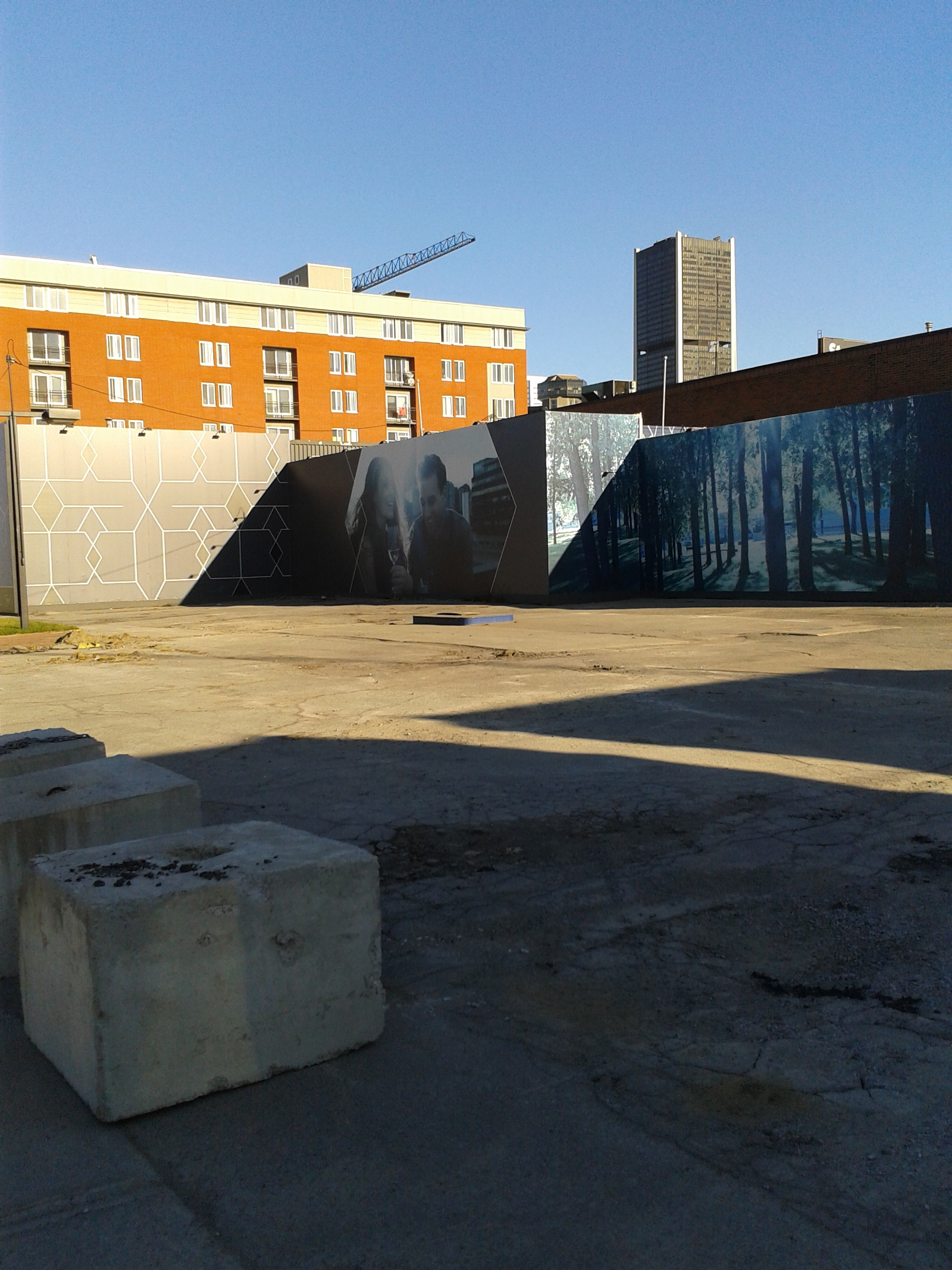
At any rate, the old sales office is now just another wasteland on Griffintown’s landscape, yet another lot of urban refuse, but this time created by the very company which proposes to rejuvenate and renovate the Griff. Ironic, I thought.
 Matthew Barlow