Globalised Montréal
May 12, 2011 § Leave a comment
In the past few years, there’s been a new trend in Montréal History and historiography that has seen us seek to place the city within a global context. This is a welcome change from our usual navel-gazing, as we sought to explain developments in Canada solely within a Canadian context. Certainly, the local context is important, but Canada did not develop in solitude. It was always a colony and nation tied into global political and economic currents, closely related to goings-on in Paris, London, and Washington. Indeed, scholars of Canadian foreign policy have long framed Canada within the North Atlantic Triangle, along with the UK and USA.
But, culturally and socially, while historians have noted the impact of British and/or American ideas in Canada, we have gone onto explain and analyse the Canadian context separate from the global. In Québec, though, perhaps due to political exigencies. Back in undergrad at UBC, Alan Greer’s masterful book, The Patriots and the People was the first study I ever read that attempted to internationalise Canadian history. In it, Greer re-cast the 1837 Patriote rebellions in Lower Canada within the revolutionary fervour that had swept Europe and the United States since the late 18th century. Seen in this light, the Parti Patriote wasn’t just a nationalist French Canadian political party, but part of an international of liberal revolutionaries that had corollaries in England, Ireland, France, the German territories, the Italian countries, the United States, and so on.
Greer’s book fit into the larger work of the revisionist Québec historians, who often sought to put Québec into a global context, both to explain the colony/province/nation’s development, as well as to give credence to Québec’s claims to nationhood. The goal was to present Québec as a nation commes les autres. Perhaps the book that had the greatest impact on me in this sense was Gérard Bouchard’s 2000 monograph, Genèse des nations et cultures du Nouveau Monde: Essai d’histoire comparée, in which Bouchard examines the development of Québec in relation to other “new world” cultures in Mexico, Australia, New Zealand, Canada, and the United States. Put this way, Québec’s (and Canada’s) development from the moment of European settlement is globalised and we realise that Canada (and Québec) is not really all that unique.
This tendency to internationalise Québec seems to be continuing with a younger generation of historians. My friend and colleague, Simon Jolivet, has just published his new book, Le vert et le bleu: Identité québécoise et identité irlandaise au tournant du XXe siècle. Simon and I did our PhDs together at Concordia, and in 2006, the School of Canadian Irish Studies there hosted a roundtable discussion that looked at connections between Ireland and Québec, in large part this grew out of the work our PhD supervisor, Ronald Rudin had done early in the decade. It was probably the most dynamic and informative conference I’ve been at, as ideas flew around the table. Both Simon and I gained a lot from that conference and it is clear in both of our work.
For my part, I am interested in the Irish in Griffintown, Montréal, over the course of the 20th century. What I look at is, of course, identity, but I’m interested in the shaping of a diasporic identity amongst the Montréal Irish, one that situates the Irish of the city within the global context of the Irish around the world, as well as the links (such as they were) with Ireland itself. To do so, I make use of post-colonial theory, which seems particularly à-propos for the Irish, descendents of a colonial culture in Ireland, living in Montréal, the largest city of the French diaspora and thus necessarily a post-colonial location.
And this is what Sean Mills picks up in his brilliant new book, The Empire Within: Postcolonial Thought and Political Activism in Sixties Montreal. Mills situates Montréal within that postcolonial framework, and examines the ideas of decolonisation and colonialism within activist circles in Montréal in the 60s. The activists were heavily influenced by what was going on in the world around them, in de-colonial movements in Algeria, Tunisia, and, especially, Cuba, as well as the Caribbean in the 50s and 60s. Certainly, they were well aware of their skin colour and Canada’s place as a first-world nation. But the ambivalence of Montréal (still the economic centre of Canada in the 60s) is something Mills excels at drawing out. As the decade went on, American activists, in particular African American activists like Malcolm X and Stokely Carmichael, became influential in the de-colonial struggle of the French Canadian majority of the city. This was further complicated by Montréal’s own black population, which also identified itself with the ideas coming out of the United States and the Caribbean. And as Montréal became a more complicated city, ethnically-speaking, to say nothing of the actions of the FLQ in October 1970, ideas of decolonisation lost their appeal.
Nonetheless, what is clear is that Montréal is a global city, one that takes its cue from its global connections as much as its local ones. Indeed, this is the basis of my next project about layers of diaspora on the urban landscape of the city. In the meantime, it also gives me a way to situate my own work on the Irish of Montréal in a larger global context.
Community in Pointe-Saint-Charles
April 29, 2011 § 3 Comments
Pointe-Saint-Charles has historically been an inner-city working-class neighbourhood. And a forgotten one, hemmed in by the industrial nature of the Lachine Canal and the Canadian National Railway tracks and train yards. The inhabitants toiled away for long hours for low wages, often without security of tenure at work. And then deindustrialisation hit the Pointe hard in the 70s and 80s. Suddenly, all the people who worked long hours for low wages couldn’t work anymore for any wages. And the Pointe’s unemployment rate shot up, reaching something like 33% by 1990. Even today, with creeping gentrification, the Pointe still has shocking pockets of poverty, high unemployment, and high reliance on social services. Each week, the food bank at St. Gabriel’s Church across the street from my flat has a long line outside it. The Mission du Grand Berger on rue Centre and the charity shop in the back of the towering Église Saint-Charles are going concerns. As is the pawn shop and the dollar stores on Centre. Wellington, the former commercial hub of the Pointe, looks like a ghost town.
In short, the Pointe is a classic, inner-city, downtrodden neighbourhood. And yet, it has one of the strongest senses of community I have ever seen in a city. And it is an inclusive community, one that welcomes all: French, English, working class, yuppies, immigrants. The lingering tension that hangs over the sud-ouest of Montréal between French and English doesn’t exist here. The tensions surrounding gentrification is also more or less absent. The block I live on is a dividing line between the yuppies and the working classes. I live on the north side, the yuppified side. And yet, everyone is friendly. This is seriously a place where you go into the dépanneur and end up having a 20-minute conversation with the shopkeeper and customers about the Habs. Where you know your neighbours.
The sense of community is deeply-rooted in the Pointe. One of the focal points is the Clinique communitaire de Pointe-Saint-Charles on rue Ash in the southern end of the neighbourhood. The Clinic was founded back in 1968 when a bunch of radical medical students from McGill came down here and were appalled by what they saw in terms of public health. My favourite story involved a young girl who said that when she went to the bathroom at home, she had to pound the floor with her shoes so that the rats didn’t bite her. So they did something. They weren’t entirely welcomed by the people of the Pointe, it must be noted. Instead of picking up their marbles and going home, instead they invited the community to get involved. The Clinic was a radical organisation, grassroots in nature, and the medical staff there made the connection between poverty, ill health, and mental health. The Clinic has had a psychiatrist on staff since 1970.

The Pointe Clinic predates Québec’s innovative CLSC (Centre local des services communitaire) system, a sort of front-line centre for health and other social services in the communities of the province. In fact, the Pointe Clinic was a model for Robert Bourassa’s Liberals when they created the CLSC system in 1974. The Pointe Clinic demanded that it’s autonomy be respected and the government left it outside of the CLSC system. Five years later, the Parti Québécois of René Lévesque was in power, and the government attempted to bring the Pointe Clinic into the CLSC system. Bad move, as the community mobilised and protested against the government’s decision. The government had no choice but to back down. Indeed, the Health Minister said: “Compte tenu de votre existence antérieure à l’implantation des CLSC, le ministère des affaires sociales a confirmé son intention de ne pas vous assimiler à ce type d’établissement mais bien de respecter la spécificité de votre organisme.”
And so the Clinic survived and thrived, as it continued to grow in terms of staff and importance in the community. Indeed, the Clinic is still run by members of the community, not the medical staff and certainly not the government. But this autonomy has not been easy to protect. Perhaps the greatest battle came in 1992, when Robert Bourassa and the Liberals were back in power. That year, the government proposed the Loi sur la santé et les services sociaux. As the Clinic explains on its website:
Le projet de loi C-120 menace la survie de la Clinique en la plaçant devant un choix qui n’en est pas un : soit la Clinique conserve sa charte d’organisme communautaire ‘privé’ et perd alors son permis de CLSC ainsi que le financement qui lui ai rattaché, soit elle devient un CLSC ‘public’ et renonce à sa charte et à son mode de fonctionnement communautaire.
Bad move, government. The community of Pointe-Saint-Charles mobilised on the streets. 600 people marched to protest the government’s plan. There was street theatre and delegations to the local and provincial politicians. Half of the adult population of the Pointe signed a petition protesting the government’s plans. The government had no choice but to back down.
A final battle in the middle of the last decade saw the Clinic brought within the larger system, but at the same time maintaining its autonomy. No one calls it the CLSC here in the Pointe. Instead, we all know it as the Clinique Communautaire de Pointe-Saint-Charles, or the Clinic.
A second branch was opened on rue Centre. One of the deepest ironies of a protest against the condofication of the neighbourhood came a couple of years ago when a condo development on Centre, next door to the CLSC went up in flames when it was still under construction. The developers returned, and rebuilt the condos. But those who suffered: the small drycleaner next door and the CLSC, which was closed for nearly a year as it attempted to recover.

The Clinic is a community centre in the Pointe, something for which the people here have every right to be proud. And because the people of the Pointe have been so successful in creating and protecting their clinic, the community here has been able to successfully protect itself from some forms of gentrification. I had the opportunity to spend a fair amount of time at the Clinic this winter due to some freaky health issues, and I was always blown away by the ways in which this community has mobilised to protect itself.
These days, the big issue is what is to become of the CNR yards at the southern end of the neighbourhood, the point for which Pointe-Saint-Charles is named. Rather than allow a bunch of condos be thrown up on the old rail yards , the Comité Action CN formed out of the Carrefour d’éducation populaire de Pointe-Saint-Charles on rue Centre to protect the community and to propose an alternative for the development of those lands. Last autumn, the Comité created a glossy publication, “Les terrains du CN de Pointe-Saint-Charles: Des proposition citoyennes.” Not wishing to be subject to expensive condos that will further alienate the residents of the neighbourhood and continue to put affordable housing out of reach, to say nothing of the pollution and noise caused by the construction condos on the site, the Comité proposes community gardens and a market, and to use the old buildings as a new community centre, as well as a housing co-operative. But before any of this happens, the Comité insists that the CN lands need to be decontaminated.

Too often I read of laments for community, or worse yet, the argument that community can only be forged by yuppies in their soul-less condos. Clearly, the Pointe says otherwise.
Planet of Slums or Arrival Cities?
April 28, 2011 § 2 Comments
It was with great anticipation that I opened Douglas Saunders‘ recent book, Arrival City: The Final Migration and Our Next World. The reviews I’d read of the book praised its brilliance and Saunders’ regular column for The Globe & Mail suggested this was a book anyone who thinks and writes about cities themselves had to read. It is rare I have been so disappointed in a book.
I will write in greater detail about Arrival City on my blog at Current Intelligence in the next month or so, but for now, let me just say that this book is a massive disappointment. Saunders does little more than re-hash neo-liberal, whiggish arguments about progress and the city and how the city is the panacea to all that threatens humanity and the environment. The problems begin with what Saunders calls an “arrival city,” which is never properly defined. Could be a city, could be a neighbourhood, could be a slum, could be all kinds of things. But the rest of the book more or less dismisses the problem of the slum in the developing world. Saunders acknowledges that they exist, but then goes on to suggest they are just temporary dwellings for people on the rise into the middle-classes. He picks up Hernando de Soto’s argument that all slum-dwellers in the developing world need is security of tenure, to own their own homes and property. This is the solution to poverty in slums. To prove his point, Saunders, a journalist, puts a human face on the residents of the slums, but he tends to pick people who are successful, who do get out of the slums. He champions the spread of middle-class North American culture (and its attendant free-trade) around the globe as the solution to urban poverty. Of course, this proves his point, about how these arrival cities are just that, a sort of purgatory for migrants from the countryside, a way-station on their way to respectability and security in the city.
I read Arrival City in conjunction with Mike Davis‘ Planet of Slums. The contrast between the two studies could not be more shocking. Whereas Davis has often been criticised as being too harsh in his arguments about the problem of slums and development globally, the problem with Saunders is the exact opposite: he’s far too wide-eyed to the point where he seems to be ignoring the harsh realities of life in slums of cities in the developing world.
John Lorinc, Cities: A Groundwork Guide
April 24, 2011 § Leave a comment
[Eds. note: Over the next few weeks, I will be re-publishing some of the articles I wrote for the Complex Terrain Laboratory, a precursor to Current Intelligence magazine. For the most part, these are articles I don’t want to lose, so re-posting them here is my way of creating an archive of them. Some are book reviews, a series of articles on cities and the slum, and some on landscape, memory, and archaeology.]
John Lorinc, Cities: A Groundwork Guide. Toronto & Berkeley, CA: Groundwood/House of Anansi, 2009. 140pp + index, $11.00 (CAN) $10.00 (USA)
2009 was a watershed for humanity. It was the first time that a majority of people, worldwide, lived in urban areas. This was fuelled by a process of urbanisation in the developing world; in western Europe and Canada, the majority of people lived in cities by the First World War. The United States reached this milestone shortly thereafter. But in the developing world, people remained primarily rural until the past couple of decades when industrialisation reached this part of the world, in large part because North American and European companies began to outsource and move production off-shore. This, in turn, had massive consequences for cities in this part of the world, as jobs dried up and industrial areas were abandoned. This has led to a paradoxical situation in terms of urbanism in the world. For example, Manila has grown by some 10.5 million people since 1951 to its present population of 12 million. Meanwhile, Detroit and other cities in the North American rustbelt have experienced depopulation in the past few decades.
Throughout all of this, cities, especially in the industrialised world, gain more power and influence, not just on the national scale (such as London, the British metropole), but on the global scale (London remains the financial capital of the world, a position it has held for centuries).[1] And in the process, cities, worldwide, continue to grow, becoming larger than some nations. For example, there are more people in Tokyo than in all of Canada. That is a mind-boggling thought, given the size of Canada’s geographic footprint (the 2nd largest nation in terms of landmass in the world) compared to that of Tokyo.
It is in this context that Canadian journalist John Lorinc has written a primer on cities for the 21st century, the appropriately titled Cities. Lorinc is a specialist on urban affairs, his work having appeared in several Canadian publications; he also currently contributes to the New York Times’ eco-business blog, “Green Inc.: Energy, the Environment, and the Bottom Line.” His last book, 2006’ The New City: How the Crisis in Canada’s Large Urban Centres is Re-Shaping the Nation (Penguin) was especially well-received and serves as somewhat of a basis for his argument in Cities, insofar as he notes the power of cities. In Canada, a full one-third of the nation’s population lives in the three largest cities: Toronto, Montréal, and Vancouver. In this sense, then, Lorinc is very well-positioned to ponder the plight, role, and impact of global cities in the 21st century.
Cities is the latest edition to a series from revered Canadian independent publisher, House of Anansi Press, the Groundwork Guides. Previous volumes have examined topics as diverse as oil, empire, genocide, slavery, and sex. The series is meant to provide an overview of cultural and political issues, offering “both a lively introduction and a strong point of view.” [back cover]. Lorinc accomplishes both, this volume is a lively discussion of the role and plight of cities, and though his “strong point of view” is somewhat muted in his prose, it is very clear. Lorinc argues that we must be conscious and aware of the impact of cities on our wider culture, their economic, cultural, and political power, to say nothing of their environmental impact, and the plight of the poor in the megacities of the developing world. In making this argument, though, Lorinc isn’t really saying anything new, nor anything controversial. He covers the expected, and says the expected.
Rather than focus on the benefits and upside of city life, like other urbanists like Jane Jacobs and Richard Florida, Lorinc is more interested in problematising the city. And this is beneficial tact to take. Whereas as Jacobs and Florida focus on how the city is a creative force, a site of community, and so on, this is limiting argument and only deals with a minority of cities and a minority of people in cities worldwide. Lorinc’s more comprehensive approach to the city allows for a wider analysis, both in the developed and developing worlds. Indeed, the problem with Florida, in particular, is that he is not all that interested in slums and the poor in North American’s cities, which is troubling.
Nevertheless, while Lorinc travels down a road already well-travelled in Cities, his gift lies in the quick and coherent synthesis of the urban condition in the new century. Broken up into 7 simple chapters, he gives us an overview of the issues facing cities the world over today. He also moves easily from the developed to the developing worlds, between the historical and the contemporary. Each chapter covers a central concept of urbanism: the city in the 21st century, urban forms and functions, sprawl, the environment and energy, transportation, poverty, and crimes, epidemics, and terrorism. In addition to this division, the book is unofficially split so that the first half more or less focuses on the developed world, whilst the second half deals with the developing world. The division isn’t absolute, of course, as both halves of the globe fit into the discussion throughout.
Central to the analysis is the environment, and the city’s impact upon it, in both the developed and developing world. Each chapter serves as an introduction to the topic and hand, and whilst it is impossible for Lorinc to be comprehensive and exhaustive in the roughly 20 pages devoted to each chapter, he excels in introducing the problems and challenges facing cities to his readers.
Cities are incredibly complex and complicated socio-political structures. They require careful- and micro- management; problems arise from dense population structures, complicated landscapes, environmental degradation, communications and transportation, amongst other things. And Lorinc is best at pointing out that the problems that the megacities of the developing world face are problems that cities in the developed world are perpetually struggling with.
Most obvious here is the question of the environment. Cities are cesspools of pollution and toxicity. As noted, Lorinc’s discussion of the environmental impact of cities dominates this book; no fewer than 3 chapters (3: Sprawl Happens; 4: Environment and Energy; 5: Cities and Transportation) are dominated by environmental questions. Chapter 3 examines the environmental (and socio-cultural) consequences of urban sprawl, primarily in Europe and North America. Here, Lorinc touts cities that have managed to tout responsible development, vertical rather than horizontal. Manhattan and the west end of Vancouver are two such examples, as they provide high-density urban settlement of high-rise condo development. His argument is hurt, however, in a table that accompanies this discussion, a “selected” listing of the population density of the worlds 250 largest cities. The table, however, is ultimately meaningless, in part because we don’t know the overall population of the cities, and the neighbourhoods/boroughs that he points to in his text aren’t in the table. Manhattan is grouped in with the rest of New York City, which sees its density rating fall to 16th on the table (though whether that is 16th in the world or not is another matter entirely) and Vancouver isn’t listed at all. In short, this table is rendered ultimately useless, as it offers us no real basis of comparison. For example, while it is clear that Atlanta is much less dense than, say, London, this nugget means nothing to me without information on overall population size and geographic footprint of the two cities.
Lorinc also focuses on the degradation of the air we breathe in urban centres, offering a quick discussion of air-borne pollution in western cities during the industrial revolution. Here he notes that by the 1880s, London’s air was close to being a toxic soup. Oddly, though, he doesn’t mention the most obvious and famous example of air-borne toxicity in the developed world: Los Angeles. That being said, he notes the lack of political will in battling air-borne pollution, politicians were not all that keen on dealing with the problem because of the damage it would to do the local economy and business. Whilst London is his example, nearly every industrial city in Western Europe and North America has faced this problem. Indeed, this seems to still be the crux of the question of global warming and environmental degradation today, as politicians remain unwilling to show leadership and make hard decisions, out of fear of upsetting the populace and damaging the economy (despite the fact that many studies note that implementing the Kyoto Accord would not harm the economy in the way that its alarmist opponents suggest), to say nothing of their chances at re-election.
Lorinc then nicely segues into a discussion of “Environmental Degradation in the South’s Megacities.” Here, he deftly explores the problems facing these cities. For example, he points to Lagos, the largest city and capital of Nigeria, which is a bustling metropolis of around 8 million (Lorinc uses the metropolitan population of 15 million [ed.: see my post on the difficulty in using Metropolitan population statistics here]). Here he cites journalist George Packer, who has noted that the inner-city urban slums of Lagos are, in part, built on and around a heavily-polluted lagoon. (As an aside, it is interesting to note that Lagos’ entry on Wikipedia makes absolutely no mention of the city’s slums).[2] The polluted water of Lagos Lagoon is where the poor draw their water from, and where fishermen catch food. The consequences of this for the health of these slum residences are obvious. In discussing Lagos’ problems, however, it is interesting to note that Lorinc doesn’t point to the obvious source of the problem of pollution and a lack of regulation: there is no central urban government for the Lagos metropolitan area, the municipal government that does exist only serves a small core at the centre of the city.
Emissions are also a problem in these megacities of the developing world. Even smaller cities are moving towards an environmental apocalypse. Recently, China eclipsed the United States as the world’s emissions leader; of the top 20 cities in terms of emissions worldwide, 16 are Chinese. The problem, in part, is due to the fact that the Chinese tend to incinerate their garbage, which causes serious emissions problems. But Lorinc misses the other side of the equation here: automobiles. And China’s streets and roads teem with automobiles belching emissions into the environment. Indeed, the picture of China Lorinc paints in Cities reminds me of Dr. Seuss’ iconic Lorax, who speaks for the trees. But the Chinese experience also points to another question of emissions and global warming, as the developing world is unwilling to be held to standards designed to ease the problems, arguing that such regulations would be handicaps to their own development. They quickly point to the fact that North American and European nations were not subjected to such regulation during their period of industrialisation.
The discussion about trash is important because garbage dumps are quickly emerging not just as environmental disasters waiting to happen, but because slums are developing in and around them in various cities, such as Lagos, Buenos Aires, and Manila, amongst others. In these cities, garbage is just piled up on top of itself in dumps (not that the developed world has a great record here, New York City has garbage barges floating in its harbour, and Toronto is engaged in an on-going battle with Michigan about where to put its garbage). Dumps in these developing world cities have become the site of labour-intensive recycling businesses. Scavengers, many of them children, dig through the dumps earning their keep, usually a few dollars a day, which they earn by selling what they find to scrap companies. The scrap companies themselves turn around and make a handsome profit by selling the goods to recycling companies. Not surprisingly, work conditions are brutal and dangerous, not to mention unsanitary. It doesn’t take much of imagination to visualise these scrap-pickers climbing over the mountains of garbage, trying to avoid cesspools of toxic runoff, lethal smoke, bulldozers, garbage trucks, birds of prey, and insects. Accidents can be fatal, Lorinc reports, such as in 2000 when the 20-hectare Pyatas dump in Manila capsized. The garbage has been piled up to 13-storeys high when it fell over, smothering several hundred trash-pickers who lived in shanties at the foot of the garbage.
But it’s not just these megacities in the global South that are leading us to environmental danger, writes Lorinc. Cities in the developed world are also intimately connected to our long-term survival in terms of climate change: “The reason is that wealthy nations are heavily urbanized, so the way these cities grow has a direct bearing on the pace of global warming, which in turn is already causing havoc in populous low-lying cities.” [p. 56]. Here, he points to Tokyo as a model. Tokyo’s housing requires less energy than is the case in Europe and North America; the city is more tightly-packed and the transit system is both cost-effective and efficient, making the city easier to navigate.
Lorinc spends some time discussing environmentally-responsible architecture, as well as the reclamation of brownfields for housing and other purposes. Brownfields are former industrial areas, located all over cities in the developed world, the consequence of the de-industrialisation of the developed world in the mid-20th century. Lorinc correctly points to the redevelopment of brownfields in city cores as a means of increasing density, as well as developing better transit systems. But he misses a prime opportunity to discuss the legacy of industrialisation in North American and Western European cities. For example, I live in a former industrial neighbourhood in Montréal, surrounded by former factories and other sorts of industrial concerns. My neighbourhood is like many around Europe and North America; cities like Pittsburgh have been left with massive brownfields that they have tried to redevelop to recover from deindustrialisation. Some of the factories in my neighbourhood have been reclaimed as condos and office space. Others, like the former metalshop that forms the backwall of my back garden, stand derelict and abandoned. Nearby is the Lachine Canal, on the banks of which the Canadian industrial revolution began back in the 1840s. In other words, I live in a neighbourhood that has been the site of almost continual industrial activity for the past 160 years (a few factories and railyards still exist). To this day, the leisure craft that ply the canal today (it has been reclaimed as a recreation site) cannot travel at speeds in excess of 15 km/h, otherwise they run the risk of stirring up the toxic silt on the floor of the canal. Redevelopment in my neighbourhood usually means cleaning the soil, but either way, there are serious environmental issues in neighbourhoods such as mine, ones that Lorinc doesn’t explore.
One way in which North American cities, in particular, can contribute to reversing climate change is through the implementation of viable public transit systems. Most of the major cities in Canada and the US have good public transit: New York City, Chicago, Boston, Montréal, Toronto, for example. Others, however, do not, such as Houston, or Calgary, or Atlanta. These three cities are also home to considerable urban sprawl. And Lorinc notes that this sprawl isn’t conducive to public transit:
there’s a powerful economic relationship between transit, population density and land-use planning. Transit agencies must make substantial investments in vehicles and other equipment, like signalling systems. They have hefty operating expenses, such as drivers’ salaries, vehicle maintenance and fuel costs…without a critical mass of riders, transit service becomes unaffordable and inefficient. In general, transit riders want convenience, reliable and efficient service, and value for their money. When a transit service doesn’t generate enough revenue, it often cuts back on service – for example, by reducing the number of vehicles running on any given route. And when that happens, commuters…are much more likely to rely on their vehicles. [pp. 72-3]
And whilst this is certainly true, what Lorinc overlooks is that two of his examples of sprawl cities, Houston and Calgary, are the centres of the oil industry in the United States and Canada. Another city with a shoddy public transportation system is Detroit, home of the domestic car industry in the United States. In the case of Detroit, the car companies made sure that the city didn’t have a viable and efficient public transit system; what would it say if the home of the car companies had efficient transit? It would hurt their bottom lines. Certainly, the fact that public transit in Calgary and Houston is a dodgy proposition is not all that surprising.
The discussion of epidemics and the city in the final chapter is quite timely, given the recent worldwide paranoia about H1N1. Our concentration in cities will make the transmission of H1N1 faster and more intense (though, of course, H1N1 remains less potent than common influenza, at least in Canada and the United States). Indeed, cities in the industrialised world used to be cesspools of disease and epidemics, even as recently as the late 19th century. Montréal was the site of the last smallpox epidemic in the industrialised west, in 1885. Epidemiology in 1885 was only starting to develop, but its successive advancement throughout the 20th century has meant that epidemics like the Spanish influenza in the wake of World War I have become increasingly a thing of the past. Governments, at all levels, have recognised their responsibility to protect the health and lives of their citizens. To that end, massive public health bureaucracies have grown in the industrialised north to protect us from disease. However, this doesn’t mean that we are no longer vulnerable. Lorinc reminds us of this when he points to the 2003 SARS outbreak in Toronto. SARS originated in the Guangdong region of China before spreading, primarily to Hong Kong, Singapore, and Toronto. Why an outbreak occurred in Toronto, rather than Vancouver, itself a major city of the Chinese diaspora, is instructive. In Ontario, the province of which Toronto is the capital, a right-wing, anti-big government administration came to power 8 years earlier, and proceeded to radically slash government spending in all areas, including public health. The consequences were disastrous, as hundreds were infected and quarantined, and 43 people died in Toronto from SARS, as hospitals lacked the resources to deal with the infection (in Walkerton, Ontario, a small city, government cutbacks led to a fatal outbreak of e.coli in the water supply in 2000). Meanwhile, in Vancouver, writes Lorinc,
provincial labor officials had trained health care workers in the proper use of special masks and other safety systems designed to protect them from catching contagious diseases while administering emergency procedures to ill patients.[p. 121].
All in all, Lorinc provides us with an instructive and lively introduction to the problems facing cities and, as a result, humanity in the urban century. That being said, however, his conclusion remains rather trite and does a disservice to the discussion throughout the book:
The twenty-first metropolis will be a concentrated place of nearly unfathomable diversity – ethnic, social, economic, environmental, religious. Large cities have become a microcosm of everything that’s taking place in this complex world. For good or ill, they are our future. [p. 128].
The Redemptorists
January 10, 2011 § 2 Comments
I went to mass on Christmas Day, I’m not Catholic, but I kind of like the tradition. This year we were in Keene, NH, where my sister-in-law lives. The priest had as the theme of his Christmas morning sermon “redemption,” noting that that was the true meaning of the season. I like to think that is one of the good points of Catholicism, that redemption is granted through the fallibility of humanity, God’s forgiveness for our sins, in part through the sacrifice of Jesus, in part through confession. I presume that this is where the Redemptorist Brothers got their name, their job being to redeem the souls of both their parishioners, as well as their converts (they are a missionary brotherhood).
Anyway, all of this is by way of introduction of my destination tomorrow in Toronto: the archives of the Redemptorists. The Redemptorists were the parish priests in Griffintown from 1885 until the destruction of St. Ann’s Church in 1970, and the ultimate closing of the parish a dozen or so years later. So far as I know, no one has actually gone in and looked at the brothers’ records from Griffintown. I was told about them years ago by Rosalyn Trigger, who was at the time doing her PhD at McGill, but I never found the time to get to Toronto to look at them when I was researching my PhD. Funny: last time I saw my supervisor, Ron Rudin, a few months ago, I was telling him about my plans to go take a look as I finished off the research for the book. He wondered if he could take back my PhD for keeping knowledge of this archive from him. ‘Fraid not, Ron.
Anyway, I’m rather excited to be heading to the archive tomorrow morning to see what I can find, to deepen our general knowledge of Irish-Catholic Griffintown, it will also add something to my book that is not in other histories of the neighbourhood, including my own dissertation.
That the Redemptorist priests were popular in their parish of St. Ann’s is not in doubt. In 1885, when the Sulpicians were stripped of their parish of St. Ann’s, the Irish-Catholics of Griffintown were furious, to the point where they remonstrated with the Bishop of Montréal. However, the Redemptorists, upon their arrival, were able to almost instantly win the hearts and minds of their parishioners, by investing money in the church and parish. By the time that Father Strubbe, the “Belgian Irishman,” was recalled to Belgium, the Irish-Catholics were loudly remonstrating with the powers-that-be over this decision. All the former Griffintowners that I have done oral histories with fondly recall the priests of St. Ann’s, in particular Fr. Kearney.
So I’m hoping here to find out how the priests saw their impoverished parishioners, what they felt they could do for them, whether they enjoyed being in Griffintown, their impressions of the neighbourhood. I’m also interested in the question of faith. All of the former Griffintowners I’ve talked to, as well as all other evidence I’ve seen, shows a very Catholic community, one where people took the ceremonies and rituals of their faith. But what has always interested me is whether this was just that: familiar ritual. One thing the Church is very good at is giving its faithful ritual and ceremony that are both familiar and reassuring. But I’ve always wondered how deep the idea of faith goes, not just with respect to Griffintown, but the Catholic Church in general.
Then there’s the question of Irishness. One of the reasons the Griffintowners protested the removal of the Sulpicians in 1885 was because the Sulpicians were very good about ensuring the parish priests at St. Ann’s were Irish. The Redemptorists who arrived in Griffintown that year were all Belgian. Of course, Fr. Strubbe was able to win over his parishioners and even gain status as an Irishman by the time of his recall. And by the mid-20th century, the priests, like Fr. Kearney, were Irish once more. Was this a conscious decision by the Redemptorists and the Bishop to represent the faithful? What did the priests make of the Irishness of their parishioners?
So here’s hoping I can begin to find some answers to these questions in the archive.
Magnum .357: “Expos Fitted”
October 23, 2010 § 1 Comment
A tip of the hat to Sarah, who posted a comment in response to Nos Amours (and check out the original post at NCPH’s Off The Wall), directing us to a video of Montréal rapper Magnum .357 and his début single/video, “Expos Fitted.” She posted the video in her comment, but I think it deserves wider exposure. I especially love the nostalgia of the Expos dressed up as gangsta rap.
Mag .357 is practically my neighbour, he hails from Montréal’s Anglo-Black neighbourhood, Little Burgundy, which is across the Lachine Canal from me here in Pointe-Saint-Charles. Burgundy is a curious neighbourhood, as it is home to both inner-city gang violence and yuppies who have gentrified the old worker’s cottages and triplexes that line the streets. It is also one of the oldest Black communities in Canada.
Burgundy also has a long history of being a centre of entertainment in Montréal. In the wake of Prohibition in the US and before the rise of Jean Drapeau as mayor of the city in 1960, Burgundy was home to various jazz clubs, most notably the legendary Rufus Rockhead’s Paradise. Oscar Peterson and his student Oliver Jones, the two greatest jazz musicians this country has ever produced, also grew up on the streets of Burgundy. In this sense, Mag .357 is carrying on the tradition.
I have to say, I love this track and I’ve been checking out his MySpace page. Enjoy.
Metropolitan Statistic Areas
October 16, 2010 § 3 Comments
As an addendum to Wednesday’s post on the old Town Commons of Hawley:
Usually, I study cities and the palimpsests of history upon them, the ways in which their histories are used by their publics and their powers that be, and historians as well. Hawley is about as rural a place you can get. But, Hawley (and all the tiny towns around it, none of which have much more than 1000 people in them) is included in something called the Springfield Census Metropolitan Statistical Area. The Springfield CMSA is home to over 680,000 people. Sounds impressive, no? But this is an artificial “Metropolitan” area, as are all such beasts. To wit, Springfield is actually home to about 155,000 people. Certainly, there are cities within the Springfield CMSA beyond Springfield, like West Springfield and Holyoke. But Hawley isn’t a city. And it’s not exactly near Springfield. It’s about 45 miles away, in fact.
Thus, the Springfield CMSA is an artificial catchment area. Officially, the US Office of Management and Budget and the US Census Bureau make use of CMSAs for policy making and the like. The basic idea behind the CMSA is an urban “cluster”, a region with a relatively high population density. The outlying areas are included if they have strong ties to the central urban centre. And this is where the Springfield CMSA doesn’t make a lot of sense. Hawley and the towns around it are not all that closely connected culturally or economically with Springfield. Instead, Greenfield in the Pioneer Valley and Pittsfield, in the Berkshires, are the urban centres that are tied to these towns. Northampton could also make a claim. It is to these places that the residents of Hawley, Charlemont, Plainfield, Ashfield, etc., commute if they commute. Rarely is it Springfield.
But this might also explain their inclusion in the Springfield CMSA, as both Greenfield and Northampton lie within it. And so the catchment area of Springfield just keeps spreading. Pittsfield is its own CMSA. But, still, it remains that deeply rural communities are artificially included in a statistical area that has little if any connection to them. Life in Hawley and life in Springfield are not even remotely related. Springfield, despite being a small city, is a downtrodden and gritty one. Hawley is a rural community nestled into the hills of Western Massachusetts.
Either way, while I can see the argument here, I do not see the statistical value of including Hawley with Springfield. They are 45 minutes and worlds apart from each other.
And it also speaks to the danger of trying to compare urban populations. For example, it is often said that Boston has a population over 5 million. That’s just not correct. The City of Boston has 650,000 people in it. Boston is the centre of Suffolk Co., which has a population of about 760,000. If you factor in the immediate suburbs of Boston, its population grows to about 1.5 million. But Boston’s Census Metropolitan Area is home to something close to 4.5 million people. However, Boston’s CMSA extends from New Hampshire in the north to include most of eastern Massachusetts, as well as ALL of Rhode Island, which itself includes the CMSA of Providence, the largest city in Rhode Island.
In other words, the Boston CMSA covers some 366 square kilometres, and includes regions that, like Hawley, are about as far from urban as you can get. In short, CMSAs are wildly inaccurate when it comes to measuring and comparing urban populations, especially when definitions of what constitutes a CMSA in the US is not all that consistent across the board, or when other nations use different defintions of what constitutes an urban area.
For example, in Canada, the equivalent is a Census Metropolitan Area, which is a statistical unit centred around a “large” city, of at least 100,o00 people. Montréal’s CMA is a much more sensible defintion of such a statistical area, as it includes the core city and the Île-de-Montréal, as well as the neighbouring Île-de-Jésu, which includes Laval, and the south shore, which includes suburbs such as Longeuil. And then it includes the expanded ring of suburbs that surround the Laval-Montréal-Longeuil nexus. And while there are rural areas included in this territory, especiallty to the north-west of the Île-de-Montréal, they lie between and betwixt bedroom communities and other regions that are clearly centred on Montréal.
But, either way, one cannot compare the Boston CMSA to the Montréal CMA because they are not similar birds. In fact, they might not be birds at all. To equate Montréal’s with Boston’s, one would have to include Sherbrooke, or Québec, or Ottawa within the Montréal CMA, much like Providence, RI, and Manchester, NH, are included within Boston’s.
Shameless Self Promotion, for a good cause
October 14, 2010 § Leave a comment
I was on GlobalNews at 6 last night here in Montréal in a story about the Griffintown Horse Palace and our plans to save the Palace from re-development in Griffintown. Also, The Gazette has a similar story this morning has a story.
Old Hawley Town Commons
October 13, 2010 § 11 Comments
Driving through the hills of Western Massachusetts this past long weekend, we came across the old Town Commons of Hawley. Hawley today is a town that is home to fewer than 400 people and has no real centre to it. Aside from a Highways Department, there’s not much evidence of an infrastructure in Hawley, though there is also a Town Hall. There is no post office or schools in Hawley, nor is there, to my knowledge a church. There is one corner store, though, but no gas stations. For services, the people of Hawley tend to travel to neighbouring towns, in particular, Charlemont.

Hawley Town hall
But Hawley has a history. Pioneers from nearby Hatfield made their way up the mountains and into Hawley. It was incorporated as a town in the Commonwealth of Massachusetts in 1792. From then until the mid-19th century, Hawley was a centre of the forestry industry, as well as several smaller businesses, like the usual: blacksmiths, taverns, etc. There was once an old town commons on what is today called East Hawley Road.
Today, the old Town Commons is the parking lot for a series of trails that explores the bog and lakes around the area. There is also an information kiosk about the old town commons, including a plan of what used to be there.
Now, it’s not like North America is a place without history, though sometimes it’s as though Europeans seem to think it is. The aboriginals have been here for thousands of years, and there are remnants and ruins of their cultures littered across the continent. The Spanish have been in Mexico since the early 16th century. The French have been in Canada since the early 17th century, around the same time the Dutch and the English landed in what is now the United States. And those European colonies conquered, colonised, and displaced the aboriginal populations as they expanded across the continent. So none of this is news, but my point is that there is evidence of earlier settlements and cultures across the continent.
Out west, there are ghost towns. These places were once booming frontier towns whose time has come and gone. The most recent spate of ghost towns date from the 80s and 90s, as frontier industry dried up and hit hard times. Sometimes, the ghost towns aren’t on the frontiers. As a teenager, I lived in Port Moody, BC, which itself had annexed and old Imperial Oil Company town, cleverly called Ioco (get it, Imperial Oil Co.?). By the time I lived there in the early 90s, the town had long since been abandoned, the oil refinery on its last legs (it’s since been closed).

Lawn Bowling in Ioco, c. 1920
In the eastern part of the continent, ghost towns are rarer, but if you find yourself in the countryside, there are abandoned farmhouses and homesteads. In the swamps of Eastern Ontario between Kingston and Ottawa, near the Rideau Canal, one sees countless abandoned homesteads from the windows of the train. This was marginal land, settled in the 19th century and then abandoned and farm kids moved into the industrial towns and cities that dot the landscape of eastern Ontario. In Western Massachusetts, the area around Hawley is littered with decaying stone fences that once marked of homesteads from each other. Now they appear as seemingly random markers in the woods.
But to see visual evidence of a settlement that no longer exists is something else. I found it slightly strange to be standing on a site that 150 years ago was home to taverns, churches, shops, and the like. More people lived in Hawley in those days, of course, and travel to the neighbouring towns wasn’t as easy as it is today. The roads of Western Mass are narrow and windy as they go up and down the hills, around corners, avoiding private property, mountains, hills, lakes, creeks, and rivers.

Drawing of Old Town Commons, Hawley, MA
But once there were people in Hawley, and there was a common. And that’s where they conducted their business, got married, had their children baptised, got drunk, fought, and came together as a community. It was rather eery to stand in that same place on a sunny Sunday 150 years later, contemplating whether or not the bog would be a good place to walk the dog, and pondering the Volkswagen, Subaru, and Volvo station wagons that brought the yuppies from Boston, New York, Northampton (and, of course, Montréal) to the trails that lead out from the Old Town Common of Hawley. The land today is owned by the 5 Colleges of the Pioneer Valley of Western Massachusetts. And they’re the ones who’ve put the effort into at least re-creating the plan of the Old Commons and they take care of the bog and the trails.
New Adventures in the Arts, or, Art, History, and “Authenticity”
September 3, 2010 § 1 Comment
Yesterday I met with a stage and set designer for a new play being produced at the Hudson Village Theatre in Hudson, QC (just off the Island of Montréal), opening Thursday, 28 October, entitled Wake of the Bones, written Montréal playwright David Gow. Wake of the Bones centres around the discovery of a mass grave of Famine victims on Pointe-Saint-Charles in Montréal by Irish labourers constructing the Victoria Bridge a decade later. The labourers were from Griffintown, at least in this version, and they decide that a wake needs to be held to send the dead souls off to their eternal paradise.
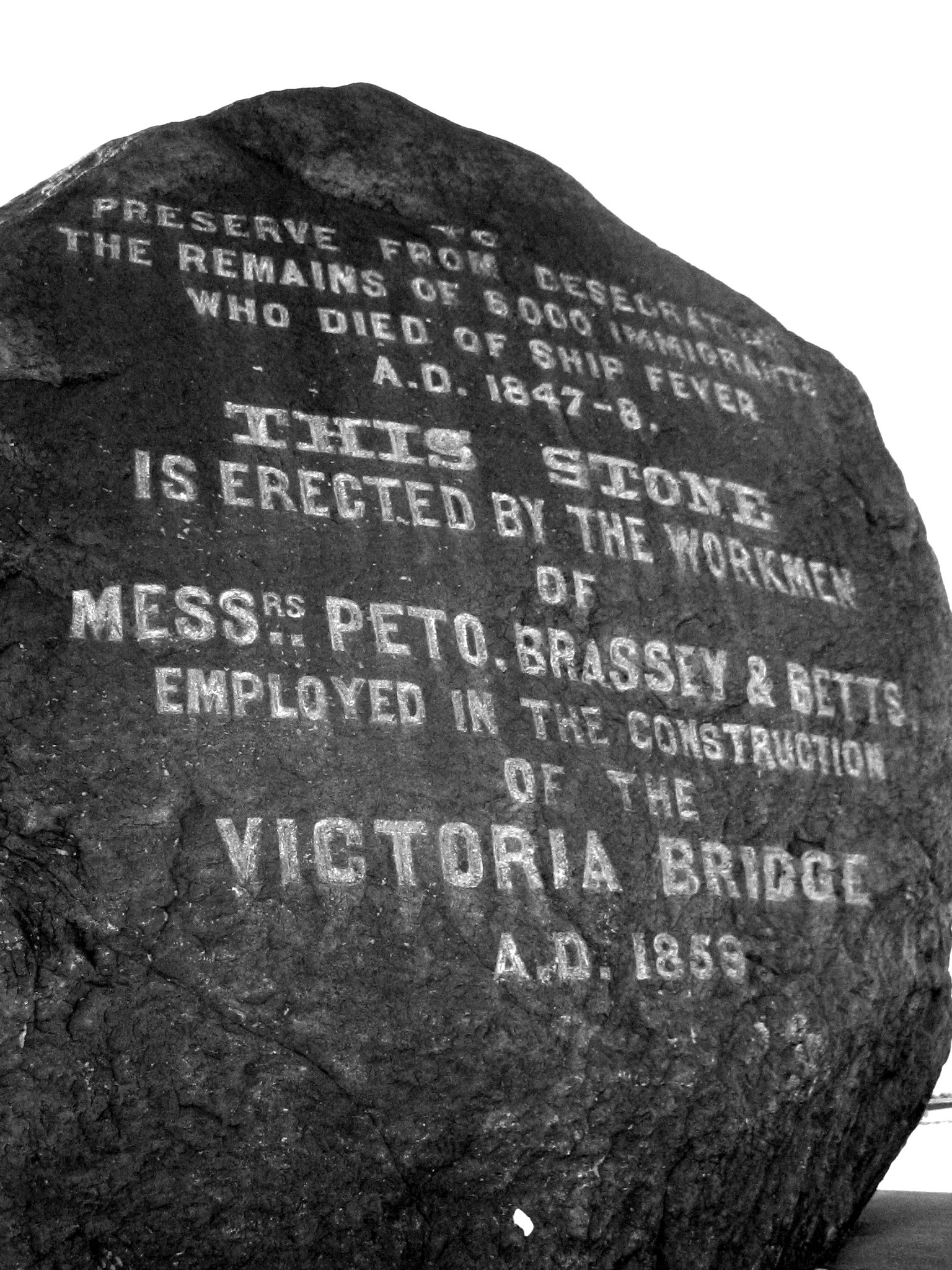
The Black Rock, erected in the memory of the mass grave. Today it's located on Bridge St. in Pointe-Saint-Charles, on the approach to the Victoria Bridge
The designer, Anouk Louten, contacted me as she attempts to get a handle on Irish culture and life in Griffintown in the mid-19th century, attempting to re-create a set as authentic as possible.
This, of course, got me thinking about the usual intersection of history, memory, and the public. Because of course Gow is taking licence from the historical record for the purpose of creating art. It is true that the mass grave of Irish Famine victims was found by the bridge workers, who were also Irish. But the workers probably lived in Goose Village, not Griffintown. A minor quibble with the historical record, to be sure, but still one that those who argue for ‘authenticity’ get their knickers in a twist over. And, I’m sure Gow will also take artistic licence with the characters, their setting, and so on and so forth.
This week, in class, I was teaching the Persian Wars, including the legendary battle at Thermopylae in 480 BCE. Of course, pretty much the entire Western world has seen the movie, 300, which fictionalises what actually happened at Thermopylae some 2,490 years ago. The movie over-dramatises the valour of the Spartans, distorts and obscures the rationale for battle decisions made by the Greeks (including the Spartans, who are conveniently left out of the decision to withdraw 6,700 Greek troops from Thermopylae to avoid being caught in a pincer movement by the Persians), leaving the brave Leonidas and his 299 Spartan warriors to hold off the Persians. As much as I love this film, I always find myself somewhat troubled by it, I kind of feel the film-makers made like the cops in the OJ Simpson case with the glove. Recall that the glove didn’t fit Simpson, who more than likely got away with murder at that trial. At the time, a friend of mine, a law student, opined that the cops may’ve planted the glove, so desperate they were to secure a conviction. If this is true (and really, who knows?), the over-zealousness of the cops allowed Simpson to walk (though, as they say, karma is a mother, and Simpson is in the slammer for other crimes right now). In the case of 300, the film-makers took an already dramatic story about Leonidas and his warriors and over-shot, they over-dramatised something which could’ve stood on its own.
So, as an historian, films like 300 bother me. Not because they take licence with the historical story, but because they pull an Oliver Stone. Stone, of course, once said that you had to hit American film audiences over the head with a mallet in order to get their attention. I think he’s wrong, people aren’t that stupid. But sometimes it makes great art, sometimes, most of the time, it’s just superfluous.
But artistic licence, I fail to see what’s wrong with that, it can make the story more interesting, it can allow the artist to make their point more effectively.
As for authenticity, I’m not sure it matters so much in the larger sense. Certainly, I like Anouk’s attempts to create an authentic set. That, for whatever reason, matters to me. The setting of historical novels, plays, films, this is the detail, the background of people’s lives. Take, for example, The Gangs of New York: a wildly fictional account of the goings-on in the Five Points of Manhattan in the early 1860s. The story itself may be a load of bollocks, but the setting of it in the Five Points, from what I can see, that’s authentic, that reflects the reality of life in what was probably the worst slum in the world.
But authenticity of story or experience (in the case of museums, etc.), I’m not so sure this is desirable or even possible. I think it is impossible to completely re-create the ‘authentic’ historical experience. For one, there’s the obvious problem: it’s impossible, because it is no longer 1861, or whenever. The physical setting is just that, a re-creation of the historical, it can be an authentic re-creation, but that’s as far as it goes. And I think that by itself is a laudable goal, but that should be the end goal. There is no need to go any further, because it is impossible to go any further.
And, so far as I’m concerned, if the story is based in this historical record, that it aims to reflect the setting, then that’s fine. Artistic licence needs to be taken, at least most of the time, maybe not so much in the case of Leonidas’ last stand.
 Matthew Barlow