French Culture in Downtown Montréal
June 22, 2010 § Leave a comment
One of the most persistent complaints of the linguistic nationalists of Québec is about the fate of the French language in downtown Montréal. They claim it’s an English centre again, that they can’t get served in their own language anymore. It’s true to a degree, you hear more English in downtown Montréal than anywhere else in the city, but it’s not just because of the old Anglo business class. It’s also because downtown Montréal is where the tourists go, along with the old city. And the tourists, largely Americans, like to be served in their own language. But you want service in French, it’s there.
But there is a creeping Anglicisation going on here, culturally-speaking anyway. The downtown movie theatres don’t show French-language films, and if they do, they’re subtitled in English. There are no French-language bookstores downtown. There is an Indigo, a Chapters, a few Coles, and Paragraphe, which, despite its name, is an English-language store. There was a Renaud-Bray near Concordia University, but it closed a few years back and is now a chicken restaurant. The big Archambault in the old Eatons store is now a clothing store. The French-language music section of HMV downtown is wanting. And French-language DVDs there? Forget about it.
Yesterday, I was on a mission. I wanted to find a québécois film, le 15 fevrier 1839, about the plight of a few Patriote rebels and their execution in prison by the British on 15 February 1839. Anyway, this was a big film when it came out a few years back, caused a lot of controversy. One idiot writing in The Hour even claimed the Patriotes were génocidaires. So, I thought it would be easy to find. HMV doesn’t carry French-language films, though it does have a big section of French-language TV DVDs. The movie store in the Carrefour Industrielle-Alliance, its “Section française” is about 3% of the store. Indigo, forget about it. So I walked to the Renaud-Bray in Place-des-Arts. Nope, its film section is all English-language movies. So, for sure, the big Archambault at the corner of Sainte-Catherine and Berri would have it, correct? Nope. Its film section is also about 95% English-language films. Their québécois section is tiny, and shoved into the back corner of the store.
I don’t get this. Québécois cinema is the only one in Canada that is actually watched. People go to québécois films here, they make money, and so on. But don’t try t0 find québécois films on DVD in downtown Montréal, my friends. Because they’re not there. In the end, I had to go up the rue Saint-Denis to Boîte Noîre to find my film. The Plateau, that is.
Ruminations on the Wisdom of Don DeLillo & the Ruins of Griffintown
May 23, 2010 § 1 Comment
It’s no secret that Don DeLillo is one of my favourite novelists. His novels have a tendency to strike me on several levels, perhaps because the narrative is usually fragmentary and on several levels. And whilst his dialogue is predictable in many ways, based on particular idioms of New York City English, it’s the way DeLillo constructs sentences and thoughts that always leave me digesting his work long after I’ve read, or re-read, it. I oftentimes lose patience with people who say things like “I don’t have time to read fiction” or “I can’t remember the last time I read a novel.” To me, this shows a fundamentally closed mind; novels percolate with ideas, philosophy, and ways of being in the world. Novels allow us to personalise events and history, to re-consider moments in time, to re-consider our own ways of thinking, our own narratives.
Certainly this is true with DeLillo’s novel, Falling Man, about the aftermath of 9/11 in New York City. This is not just a rumination on 9/11, indeed, the terrorist attack is a motif to explore post-modern family life in New York. But it doesn’t have to be New York, and it doesn’t necessarily have to be post-9/11, either. But the novel would lack the punch if it was set in Winnipeg in 1986.
Anyway, the reason I’m writing this is to give thought to the on-going argument between Nina, the mother of the novel’s main female character, Lianne, and Nina’s lover, Martin. Martin, however, isn’t really Martin, he’s a former terrorist himself, named Ernst Hechinger. Nina and Martin/Ernst argue throughout the book, in the presence of Lianne, over the nature of terrorism and the attack on New York. Nina’s argument is hued by the fact that she is a Manhattanite. Martin/Ernst is German. She lacks the critical distance to see the attacks, he lacks the intimacy with Manhattan. Throughout the argument, which is fierce and scares Lianne, they consider God and the motives of the attackers. Nina sees fear on the part of the terrorists, Martin/Ernst sees history and politics.
Nina has just had knee surgery (and is developing a reliance upon painkillers) in the time after the attacks. Indeed, Lianne is stricken at how her mother, in the wake of the surgery, has embraced her old age. This worries Martin somewhat. He wants her to travel again, to go out and see the world, to revitalise herself in the wake of the surgery and the attacks. She is somewhat more reluctant.
Martin: Travel, yes, it’s a thing you ought to consider. Get your knee back to normal and we’ll go. Quite seriously.
Nina: Far away.
Martin: Far away.
Nina: Ruins.
Martin: Ruins.
Nina: We have our own ruins. But I don’t think I want to see them.”
Martin: But that’s why you built the towers, isn’t it? Weren’t the towers built as fantasies of wealth and power that would one day become fantasies of destruction? You build a thing like that so you can see it come down. The provocation is obvious. What other reason would there be to go so high and then to double it, do it twice? It’s a fantasy, so why not do it twice? You are saying, Here it is, bring it down.
I love this passage, not so much for what it says about NYC and 9/11, but for what it says for cities in general. Ruins are all around us on the urban landscape (or the rural one, for that matter, abandoned homesteads, for example). Ruins tell us the story of what was once here, how we got here, how we might have otherwise been. Ruins tell us powerful stories about destruction, that is true, as Martin is noting. But they also tell us powerful stories about ways of being that have been lost. The ruins of Griffintown are a prime example.
The ruins of the neighbourhood are there for all to see. In Parc St. Anns/Griffintown, on the former site of St. Ann’s Church, the remaining ruins of the church itself, its foundation, as well as foundation stones of the presbytery, the girls’ school, and the dormitory for the crusading priests who came through the Griff on their way to other parts of the world, are all there. There are ruins of factories and warehouses throughout the neighbourhood. Ruins of tenement flats. Palimpsests of advertising for consumer products that are long gone.

Parc St. Ann's/Griffintown
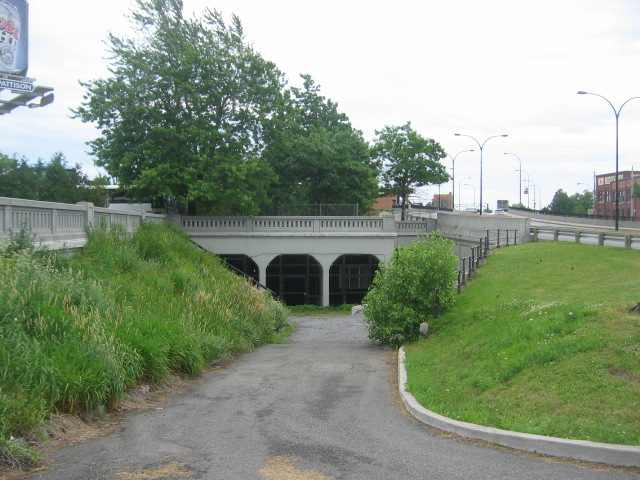
Wellington Tunnel
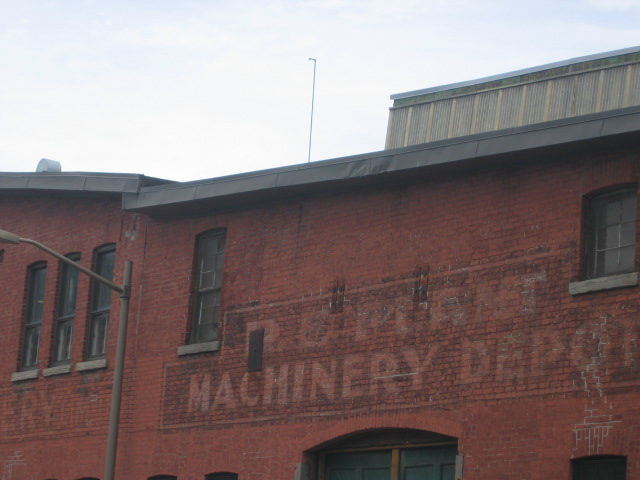
Griffintown Palimpsest
We see this life as it used to be. We consider what once was. How people moved out of Griffintown because of its proximity to all these factories, train yards, and the like. How the flats were cramped and cold, lacking in modern amenities like hot water. Or yards. The neighbourhood, when I began studying it a decade ago, always reminded me of the Talking Heads’ song, “Nothing but Flowers.” Here was the site of the beginnings of the Canadian Industrial Revolution in the 1830s, reclaimed in large part by nature. An inner city neighbourhood sprouting leaves and trees. And grass growing through fractured concrete. Trees growing out of windows of derelict, decrepit buildings. Their floors reclaimed by nature.
The ruins of Griffintown also speak to this power that Martin refers to in the novel. This was a locus of power for Canada, for the British Empire and Commonwealth. Not just the products manufactured there, but the working classes trudging along to work, filling out the army in World Wars I and II. The hulking CN viaduct, not technically a ruin yet, but something close to it, speaks to a time when the railway was king. Indeed, it was built to separate the railway from the roads.
Anyway. DeLillo’s got me thinking about the meanings of the ruins of Griffintown. And what they mean, to the old Irish community that once lived there, to the urban landscape of Montréal today, and to plans to re-develop the neighbourhood in the future.
The Irish & Crime in 19th Century North America
May 4, 2010 § 7 Comments
WordPress lets me see what search terms lead people to this site. Usually, they’re predictable, people searching my name, or Griffintown, or things along those lines. But today, there is this term: “explain the strong association between the 19th century irish diaspora and crime?” So, explain I shall.
Yes, this is a stereotype. But behind this stereotype is some kind of truth. Yes, the Irish, especially Catholics in inner cities, tended to find themselves in trouble with the law in disproportionate fashion in the 19th century. This was particularly true in port cities: Montréal, Saint John (NB), Halifax, Boston, New York, Philly. 19th century sailors were hard-living men. And the consequence of that was an intimate knowledge of the inner workings of police stations in those cities. And, yes, a lot of those sailors were Irish Catholics.
There was also the matter of labour violence. The Irish tended to do the kinds of jobs that no one else would, but they also tended to guard their employment jealously, in that if someone else wanted to do their work (free blacks in the States, French Canadians in Québec), they would protect their right to work. Oftentimes with violence when others threatened to undercut their wages (and the Irish tended to do work on very thin margins to start with).
Connected to this was ethnic/racial violence. For example, the Bowery B’hoys Riot of 1857 in the Five Points of Manhattan, where the Irish Catholics who had recently settled there were attacked by the nativist gang, the Bowery B’hoys. Or in York Point, Saint John, in 1849, when the ultra-Protestant Orange Order insisted on marching through an Irish Catholic neighbourhood on the Glorious 12th. Or more internecine battles in places like Philadelphia between black and Irish workers.
As an aside, this has led to one of the most simplistic arguments I’ve ever come across. Noel Ignatiev, in his overly dramatic How the Irish Became White (in order to “become white,” you have to first be considered something other than “white,” and I’m not convinced that the Irish were ever seen this way), argues that slavery essentially lasted another generation in the United States because the Irish Catholic immigrants to New York and Philadelphia, poor working-class immigrants, I might add, refused to throw their lot in with the free black populations of those 2 cities prior to the US Civil War. Had they, he argues, slavery would’ve ended. So, in essence, Ignatiev argues that the Irish “became white” by siding with the Anglo-Protestant hegemons in the United Sates against the blacks. Of course, to have expected anything different is just, well, simple. Why would the Irish side with the blacks? The blacks were the only other group of people down near the bottom of the socio-econo-cultural totem pole with the Irish. So, obviously, they’re going to try to distance themselves.
Anyway, I digress. Political violence. Well, politics were corrupt in the 19th century, pure and simple, whether it was Tammany Hall in New York, or battles against Anglo-Protestant hegemony in Montréal, corruption was everywhere, and violence was a common tactic by all sides. The Irish got their shots in just like everyone else.
But the most common reason why the Irish found themselves in trouble with the law in North America wasn’t any of this. It was the drink. The Irish were a disproportionate number of public drunks in North American cities, at least in the northeast of the US and Eastern Canada, for much of the 19th century. But, before we get into stereotypes of the Irish and the drink, let us remind ourselves of something else: they were the working-classes, they lived hard lives of unsteady and dodgy employment in the factories, ports, and canals of these cities. Their lives were defined by insecurity, in terms of employment, finances, housing. Inner-cities of Boston, Montréal, New York, Baltimore, in the 19th century were, in many ways, worse than they are today. Housing was worse, social conditions were worse, welfare states were worse. And so, not surprisingly, people tended to distract themselves from their problems with alcohol. And not surprisingly, this means that they ran afoul of the law and ended up getting arrested. And the Irish, well, they were a significant chunk of the urban working-classes in these cities. So, no surprise that they appear so frequently in the crime statistics.
Years ago, I was reading a book by my MA supervisor, Jack Little, about state formation in the Eastern Townships of Québec in the mid-19th century. As the Grand Trunk Railway was being built between Montréal and Portland, ME, in the 1850s, Irish navvies flooded the Townships. A rash of crime broke out along the rail line, and Stipendiary Magistrate Ralph Johnston was dispatched out to Sherbrooke to investigate. The results of his investigation surprised him, and in his report to his bosses in Québec City, he stated that the crime was actually committed by non-Irish Catholic, non-navvies. In short, by locals. And the Irish-Catholics got the blame. “In the eyes of too many,” Johnston wrote, “their crimes are to be Irish and Catholic.”
Yup, racial profiling existed in the 19th century too.
Recent Readings on the Irish Diaspora
April 26, 2010 § Leave a comment
As I continue to read, deepening my knowledge of the Irish diaspora in the United States and Canada, I find I’m struck by the changing trends in the historiography, in particular the fact that this literature IS diasporic and transnational in nature. Ever since Kerby Miller published his landmark Emigrants and Exiles in 1985, historians of the Irish in North America have been encouraged to keep an eye on the Irish context. But, for a long time, this was no more than a cursory glance across the Atlantic Ocean, briefly acknowledging what it was that lead the Irish to leave Ireland in the first place.
But, in the past decade or so, a much deeper understanding of the Irish context has taken root in the literature. Diasporic Irish historians have been caught up in the debates in Irish historiography, the revisionists v. the post-revisionists, but even the older discussion between revisionists and nationalists. And what I’m finding interesting is the influence of these Irish historiographical debates on scholars studying the diaspora. It also seems that it is social scientists, rather than historians, who seem to be caught up in these debates. I suppose for historians, historiographical debates are so internalised in our work, to openly comment on them seems redundant, at least for some of us.
Take, for example, Reginald Byron’s 1999 study, Irish America, an overly ambitious title for a case study approach to the diasporic Irish of Albany, NY. Indeed, part of the chip on Byron’s shoulder is that studies of the Irish in the US have focused on the ethnic enclaves of major cities: New York, Boston, Philadelphia, and Chicago, to the detriment of smaller centres, such as Albany. But then the problem is that Albany itself isn’t all that representative of the larger American context, in that it was a predominately Catholic city, and it, too, is a northeastern city. Anyway. Byron is a cynic of the Irish, which is fine, he argues, ultimately, that symbols of Irishness, most notably St. Patrick’s Day, are no longer Irish in nature, they are American, as the Irish have been fully assimilated into the mainstream of American life. To an extent, I agree. He bases his conclusion on 500 oral interviews with “Albanians,” most of whom were people who are of Irish descent, amongst others (German, English, French Canadian, Italian, so on). What he found is that most of the informants had no special knowledge of Ireland and Irish affairs, and did not live their quotidian lives in the Irish fashion, whatever that is. Fair enough, but when you read into the Irish context he covers, in discussing the historical background as to how Albany became so Irish in the first place, one begins to see the connections.
Byron spends a lot of time attempting to portray Ireland as un nation comme les autres, to borrow from the revisionists of Québec historiography. Indeed, this is the very goal of the Irish revisionists, who seek to downplay many of the more traumatic events in Irish history as a means to normalise its history within the mainstream of Western Europe. The problem with this is that there are things that make Ireland exceptional: it was colonised by its neighbour, its Catholic population was oppressed and disenfranchised by the colonising power. Byron scoffs at the common misconception that the Irish were in permanent rebellion in the 19th century. Again, to some extent, I do agree. However, this ignores the fact that the Irish did rebel in 1798, 1847, 1867, and that there were revolutionary, physical force nationalists operated on Irish soil for most of the 19th century leading up to Irish independence and Partition in 1921. Indeed, the response to the 1798 and 1916 rebellions were particularly draconian on the part of the British colonisers.
Indeed, it was this on-going pattern of rebellion that galvanised the Irish diaspora, especially in Canada and the United States, as nationalist circles were strong in both countries. Indeed, it was the Irish in North America who raised funds for the independence struggle “back home,” even if Ireland was a country many diasporic Irish never saw, and only knew through stories and memories of their ancestors and more recent immigrants.
But this also leads to problems, as evidenced in Paul Darby’s Gaelic Games, Nationalism, and the Irish Diaspora in the United States. Darby, who plays Irish football, occasionally comes off more as a fanboy than a scholar in discussing the trials and tribulations of the Gaelic Athletic Association’s American branches, praising their dedication, hard work, and so on, and not acknowledging the American GAA’s biggest problem: an inability to make itself relevant to the diasporic Irish. The GAA, according to Darby, was incredibly successful within circles of Irish immigrants in the cities he studies: New York, Boston, Chicago, and San Francisco. But the American GAA faded when immigration from Ireland dried up.
At any rate, the larger issue I have with Darby’s work is that he seems to equate the Irish in North America with Irish nationalism, in that the Irish here were all nationalists. No doubt this stems from studying a particularly nationalist organisation as the GAA. But the GAA didn’t speak for all the Irish in North America, even within the contexts of Boston, New York, Chicago, and San Francisco.
Thus, Darby leaves us with a problem that is at the opposite end of the spectrum from Byron. Whereas Byron wishes to downplay the ruptures of Irish history and identity in Albany, NY, Darby seeks to keep those ruptures in his readers’ minds, in order to explain this strong Irish identity amongst his case studies in New York, Boston, Chicago, and San Francisco. Surely there is a common ground between Byron and Darby.
Indeed, my own work, as well as that of many others (Rosalyn Trigger and David Wilson, for example) explore the ambivalences and ambiguities of the Irish in North America. It is too simplistic to say, as Byron does, that they became assimilated into the mainstream of North American culture and politics (if they did, JFK wouldn’t have been identified as an Irish-Catholic American), or to say that the Irish in North America = Irish nationalists, as Darby does.
Urban Archaeology & Material Culture
April 21, 2010 § 1 Comment
Recently, I’ve been thinking about urban archaeology and material culture. Given my research interests, I suppose it’s only natural that I would also think about the actual physical landscape of the city and how it shifts and changes with time, populations, and construction.
Years ago, I visited Montréal’s Pointe-à-Callière Museum, in the Vieux-Port. Point-à-Callière is the site of the first settlement of Ville-Marie, where Paul de Chomedy, Sieur de Maisonneuve decided to plant his new settlement in 1642. The museum itself is based around 3 archaeological digs (Pointe-à-Callière iteslf, as well as Place Royale and Place D’Youville), and artefacts from these archaeological digs are on display. But it’s not just that. In the underground of the museum, down where the digs took place, one can physically see the layers of city and settlement on Pointe-à-Callière, from the initial aboriginal inhabitants through the founding of Ville-Marie, to the governor’s mansion that was once located there, through urbanisation, industrialisation, and so on. The physical remnants of the buildings, and artefacts are there for the viewer to see.
My favourite part is the William sewer, which canalised, and placed underground, the Rivière Petite Saint-Pierre, which itself had become a stinking cesspool as it flowed above ground through what was once the Nazareth Fief (and later Griffintown), into the St. Lawrence, hence creating Pointe-à-Callière. Apparently (at least according to its entry on Wikipedia), the museum has plans to open up and expose the Petite Saint-Pierre, as well as the old location of St. Ann’s Market in Place D’Youville, as well as the remains of the Parliament House of the United Province of Canada, which was burned down in the Rebellion Losses Bill Riot in 1849 (just imagine a riot today in a democracy burning down the house of parliament!).
Anyway, this is where I first thought about urban archaeology, but I never really gave it much more thought in terms of my academic interests until a couple of summers ago, whilst walking along the Canal Lachine, where, at the St. Gabriel locks, Parks Canada has dug up the foundations and remnants of a factory on the northeastern side of the locks.
Andy Riga, over at The Gazette, has an interesting blog, “Metropolitan News;” his latest post is about the public toilets, disused and buried under Place D’Armes. During the reign of Mayor Camillien Houde in the 1930s, partly as a public works project, Vespesiennes were built in Carré Saint-Louis, Square Cabot, amongst other places, and public washrooms were constructed in places including Place D’Armes. The washrooms there were shuttered in 1980, victim of many things, including Montréal’s notoriously crumbling infrastructure. Since then, there have been a few plans or attempts at plans to revive the public toilets, but they are in serious decay and would cost too much money to renovate them, due to years of neglect, water damage, and humidity. So they remain buried under Place D’Armes which, like Dorchester Square downtown, is undergoing a massive renovation.
So notions of what’s underfoot have long interested me as I’ve wandered about the city, but especially in the sud-ouest, Griffintown and Pointe-Saint-Charles, as well as Saint-Henri, where I’ve lived for most of the past decade.
Also, too, there is the influence of Prof. Rhona Richman Kenneally of Concordia University, who encouraged me to give some thought to material culture in approaching my dissertation and my work on Griffintown. Ultimately, as interesting and exciting as I found approaches to material culture in my studies, there was no way to fit it into the dissertation (the same can be said of proper mapping of the Griff). But I remained intrigued by these ideas.
So, with all of this in mind, I finally got my hands on Stephen A. Brighton’s Historical Archaeology of the Irish Diaspora, based around digs in the Five Points of Manhattan and in Newark, New Jersey. Using the archaeological evidence, Brighton constructs an argument centred on the material culture of 19th century Irish-American life in these two urban centres. Using this methodology, Brighton is able to answer a lot of questions we cannot answer using more traditional historical methodologies. Brighton has the remnants of the material culture of the Irish immigrants and Irish-Americans. Finding glasswares with symbols of Irish nationalism on them suggests that the movement had some traction amongst the tenement dwellers of the Five Points.
My favourite part of his analysis, though, comes in relation to medicine. The artefacts from the Five Points come from the 1850s and 60s, whereas those in the New Jersey digs are from the 1880s. In other words, the Five Points Irish were more recent arrivals and lived in greater poverty than those in New Jersey. Thus, their access to the nascent public health system was different than that of their compatriots in Jersey. Brighton found that the Five Points Irish relied more on cure-alls and pseudo-medical tonics to cure what ailed them. Throughout the dig site are bottles that once contained tonics and cures, whereas in New Jersey, the digs uncovered evidence of reputable medicines. This, concludes Brighton, is symptomatic of that poverty but also, too, perhaps of the alienation of mid-19th century Irish immigrants from the mainstream of American culture and society (remember, the 1850s also saw the Know-Nothing movement in the USA and the Bowery B’hoys Riot of 1857).
So what Brighton offers up here is a piece of evidence to support what historians already know from more traditional sources. And this brings me to my problem with Brighton’s book: it doesn’t add much in the way of new information to our historical knowledge. Rather than challenge historians’ traditional takes on the Irish in the Five Points (especially), Brighton confirms what we already knew with the archaeological evidence.
Modernist Architectural Behemothology
March 11, 2010 § 6 Comments
Years ago, I lived in Vancouver, perhaps once the greatest example of Modernist architecture in Canada, if not North America. Vancouver is the city that unleashed architect Arthur Erickson on the world. Sadly, Erickson died last spring. Yet, Erickson’s buildings live on in Vancouver, especially his modernist designs, most notably Simon Fraser University in suburban Vancouver (where I completed my MA), and the Canadian Embassy in DC.
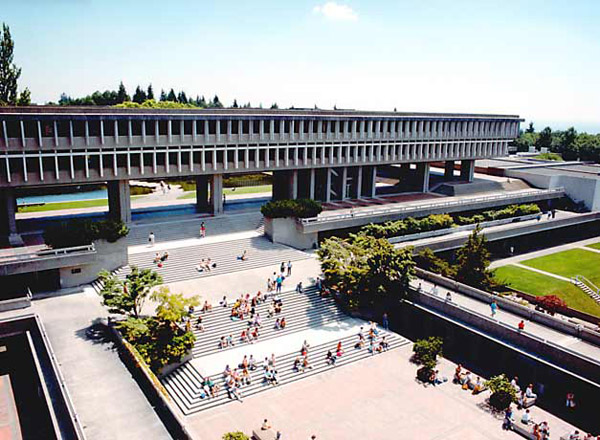

Indeed, one of my favourite architecture books is Rhodri Windsor Liscombe’s The New Spirit: Modern Architecture in Vancouver, 1939-1963. Modernist buildings haven’t really stood the test of time, I have to say, especially those designed to look like concrete bunkers, such as the Canadian Embassy. SFU is one of the most depressing places in the world on a cloudy, rainy day atop Burnaby Mountain. Unfortunately, it is often rainy and cloudy atop Burnaby Mountain. University campuses across North America are dotted with modernist buildings, as the great boom of construction on these campuses came at the height of modernism in the post-War era. In many instances, modernist behemoths look as if they were dropped into more classical settings, such is the case of Student Center Building at the University of Masscachusetts, Amherst. In the picture below, you can see those older, classic buildings scattered around the Student Center and the residence towers behind it.

So pervasive is modernist architecture on campuses that it is oftentimes pejoratively referred to as “Neo-Brutalist” architecture. Indeed, buildings such as the Student Center, or the entire Burnaby Mountain campus of SFU, re-enforce this. The buildings are concrete, massive, and imposing. Inside, there is a lot of dark browns, dark woods, and black. Gloomy is about the only way to describe these interiors.
Long and short, the term “Neo-Brutalist” quite often fits, not that there aren’t some beautiful modernist buildings to be found, such as Vancouver’s old BC Hydro Building, which has since been condofied, or MOntréal’s Palais de Congrès.


But, despite this, I can’t help but chuckle when I read stories like this one in the Globe & Mail yesterday, about the Public Safety Building in Winnipeg.

This particular behemoth, built in 1966, is a textbook case of Neo-Brutalist Behemothology. Frequently the several hundred employees of the Winnipeg Police Force are required to vacate the building because of noxious fumes that waft up into the building. This happens frequently, apparently. This time it required the Hazmat to come. The PSB is built out of
brittle Tyndall limestone, hasn’t held up against Winnipeg’s climate. Dozens of steel brackets cling to the building’s exterior like Band-Aids, preventing the facade from avalanching into the street. A $98,000 awning encircles the building, stopping pieces of the gaudy structure from braining pedestrians.
And this is the crux of the problem with many Neo-Brutalist behemoths, from SFU to Montréal’s legendary Stade Olympique, known in English as the “Big O”, or more fittingly, the “Big Owe,” as it took 30 years for the city to pay off its legacy from the 1976 Summer Olympics, by which time the Expos had decamped for Washington and the Alouettes had been re-born in McGill University’s quaint Molson Stadium at the foot of Mont-Royal. But the Big Owe and the PSB, and SFU, for that matter, all have something in common. The materials used to build them aren’t all that well-suited to the climate they are in. Hence, the PSB is falling apart, the Big O has had large slabs of concrete fall off it, and SFU, well, that much concrete in a rain forest isn’t the best idea, either.

But the bigger question is what to do with these buildings, especially those that are falling apart or being abandoned, as is the case with the PSB. Urban preservationists in Winnipeg argue that the PSB is worth saving,
According to University of Winnipeg Art Historian, Serena Keshavjee,
It’s not a love-hate relationship people have with these buildings; it’s just hate. People grew up with these buildings and don’t see them as heritage buildings, but the same thing happened 40 years ago with Victoria structures.
Had we ripped out every Victorian building in the country we would be very sorry these days,” she said. “And these are the times when they become vulnerable. The country is coming out of recession and people are gearing up to tear things down.
UW historian David Burley echoes, arguing that modernism
reflects a time when the federal government lavished money on public projects and Canadian pride soared ahead of Expo 67 and the centennial. “It was a nationwide movement,” he said. “There was this great optimism. The central parts of cities had deteriorated and there was a sense it was time to redevelop things.”
Personally, I’m not so sure that a modernist building is worth saving just because of its own merits. A building like the PSB is an ugly imposition on the urban landscape. Buildings like it seem to mock their landscapes, they don’t fit in, they crush them, they impose upon them. They belittle us. Of course, granted, that’s the point with a police station, or at least it was in the 1960s. But that doesn’t mean a building should be saved just because it’s old. Sometimes, old things are just junk. And the PSB is an example of that.
Nuit Blanche à Griffintown
February 20, 2010 § Leave a comment
This Saturday, 27 February, is Nuit Blanche in Montréal, and there will be an event in Griffintown to celebrate. Organised by Le Comité pour le sain rédeveloppement de Griffintown, spearheaded by Judith Bauer, the event will be taking place at the site of the New City Gas Works, owned by Harvey Lev, located at 140 and 143, rue Ann.
There’s a whole bevy of cultural events on deck, including talks about the history of the neighbourhood, poetry readings, live music, artwork, and all kinds of other fun stuff. The website is here.
Also of note is that the Griffintown Horse Palace Foundation will have a table there to sign people up for membership and to raise funds for our ultimate goal, to buy and convert the Griffintown Horse Palace into a museum.
On Race, Haiti, and New Orleans
February 8, 2010 § Leave a comment
Watching the Super Bowl yesterday, we were inundated with stories of redemption and New Orleans (something I hope to return to in a post later this week, stay tuned), but something in my brain clicked when images of the immediate aftermath of Hurricane Katrina were shown, including the scene at the Superdome, the home of the New Orleans Saints, and I thought of coverage I have seen of the aftermath of the Haiti earthquake last month.
In both instances, there were wide-spread reports of looting and violence in the aftermath of these natural disasters. In both cases, media coverage was overwhelming negative of these events, with a strong hint of moral condemnation (one headline in The Times speaks of “retribution” against rioters). This coverage, it seems to me, is intimately tied up with questions of race and power.
In the aftermath of Katrina and the earthquake, large cities were destroyed (New Orleans and Port-au-Prince), meaning the survivors had no homes, no food, no shelter, things that humans require. Basic requirements of life. In both cases, aid was slow to arrive on the ground (David Letterman on the Super Bowl: “And the New Orleans Saints’ fans, I’m telling you, they have waited a long, long time for their team to get into the Super Bowl. Not as long as they waited for FEMA, but still, it’s been a very long, long time”). This seems to me the very defintion of a desperate time calling for desperate measures. Hence, the turn to violence to get the basics of life. It is neither surprising, nor, really, as far as I see it, wrong (at least to a certain degree).
But coverage in the media is universally negative. In New Orleans, the media focused on African-Americans who were engaged in looting. Haitians are also black. It would seem to me that nothing beyond racism fuels the apocalyptic coverage provided by the mainstream media in the US, UK, and Canada.
Cross-posted at Current Intelligence.
An Episode in the Life of a Diasporic City
February 5, 2010 § Leave a comment
Montréal is a city of literature. It has been the home of many great novelists, both of Canadian and international reknown. It is also a city that has been the setting of many novels, bestsellers at home and abroad. For years, I lived in the neighbourhood that was the setting of Gabrielle Roy’s Bonheur d’occasion, Saint-Henri. Prior to that, I called Duddy Kravitz’s Mile End home. Presently, I call the setting of Balconville home. The Plateau-Mont-Royal has been immortalised by the likes of Michel Tremblay, Mordecai Richler, and Rawi Hage. One of the best academic reads of recent years was Sherry Simon’s Translating Montreal: Episodes in the Life of a Divided City. Simon explores the cultural and social history of her Montréal through the literature, in both official languages, that depict the city’s multicultural landscape and lived experience.
Montréal’s literary authors, to say nothing of Simon herself, have projected and reflected the experience of immigrant groups and their diasporas through their works. It was from Richler’s works that I learned so much of the Jewish experience of Montréal, that I came to understand the city as a Jewish one. Indeed, Richler was instrumental in re-casting Montréal as something more than just a bifurcated locale, a city caught between French and English, in that he inserted the city’s Jews into the dialogue, his writing maturing with the city throughout the 2nd half of the 20th century.
Today, however, in trying to find a bowl of matzoh ball soup, I was kind of stunned by just how much Richler’s Montréal has changed. As I wandered through the city’s downtown core, both searching for the soup and running a handful of other errands, I got to thinking about not just how diasporas inform and reflect off each other, but also how diasporas evolve, shift, and replace one another. This was especially true, I thought, in a 5-block section of downtown just west of Concordia’s downtown campus. In this stretch, there are, amongst other things, a German restaurant that has been there for most of my life, as well as newer Russian, Indian, Iranian, Lebanese, Irish, Armenian, Mexican, Central American, Chinese, and Thai restaurants. And not a single place that served matzoh ball soup. During Richler’s years studying at Sir George Williams University, one of the founding institutions of Con U, I’m sure matzoh ball soup could be found in the vicinity of the campus. Of course, one would not have found the plethora of “ethnic” food (the term is in quotations because it is such an unsatisfactory one to use in this instance).
This is neither a lament nor a complaint, I eventually found the matzoh ball soup at Dunn’s, an old Jewish deli, on Metcalfe. It just is what it is, an episode in the life of multicultural, diasporic city.
Web Resource: Transnational Urbanism in the Americas
January 27, 2010 § Leave a comment
This just came through on the H-Urban listserv. Cambridge University Press has launched a multimedia companion, Transnational Urbanism in the Americas, a companion to a special issue of the journal, Urban History. This is from CUP:
In this special issue, a project of the journal’s North American Editorial Board, six authors from Canada, France, and the United States explore a sweeping range of historical issues that linked cities of the Americas to the rest of the globe. They write: “The emerging transnational paradigm suggests intriguing new possibilities for the historical study of cities. Transnationalism challenges us to map out the patterns of human life in neways as they cross and construct cities, nations, and other crucial formations. Even as this new paradigm stimulates a fundamental rethinking of urban historical scholarship, the Internet and the World Wide Web are also challenging our received modes of scholarly communication.
This multimedia companion meets these challenges through a hybrid of cartographic, narrative, and photographic presentation, featuring the publishing debut of HyperCities, an online, open-source research and educational platform for studying and interacting with layered hypermedia histories of city and global spaces.
Access to the on-line companion is free. Subscribers get access to the journal itself.
 Matthew Barlow