Arrival Cities: The Book
December 10, 2012 § Leave a comment
I have touched on Doug Saunders’ Arrival City previously on this blog here and here. This review was also in the works with Current Intelligence before I left back in 2011. So, I am sticking it here for my own purposes.
Doug Saunders. Arrival City: The Final Migration and Our Next World. London: William Heinemann, 2010. ISBN: 9780307396891. 356pp.
Doug Saunders’ Arrival City was published to almost universal acclaim last fall. The Guardian nearly fell over itself hailing it as “the perfect antidote to the doom-laden determinism of the last popular book on urbanisation, Mike Davis’s Planet of Slums” and declaring it “the best popular book on cities since Jane Jacobs’s The Death and Life of Great American Cities half a century ago.” Saunders’ own newspaper, The Globe & Mail hails his calming certitude on the wonderful nature of progress that the city provides us. And the Wall Street Journal praises Arrival Cities for its optimistic view of globalisation.
Certainly, Arrival Cities is an important book, its well-written and is clearly and cogently argued. It is also somewhat of a disappointment, at least in the first half of the book. Saunders is the European Bureau Chief for The Globe & Mail and his reportage and columns generally provide a balanced view of the world; his is one of the few columns in that newspaper I actively seek out. Thus, I expected more from Arrival Cities. I did not get it. While Saunders does give us a counter-narrative to Davis’ doom and gloom, it occasionally reads Pollyana-ish. And at times, Saunders’ journalistic eye overwhelms his argument. Indeed, Dwight Garner in The New York Times notes this problem: his lengthy quotes from the people he talked to in arrival cities around the world sound formulaic and too easy.
Certainly, Planet of Slums was an overly statistical analysis, and statistics are on the aggregate level, they do not always us to view the micro- and quotidian levels. But Arrival City is plagued by the opposite problem: in focusing on a success story or two from each of the arrival cities he visits around the world (and Saunders has certainly been travelling the world), he over-personalises his arguments, which gives the impression that he’s choosing to extrapolate the success stories he saw, not the marginalised. Certainly, all of the people in arrival cities are marginalised in the larger sense of the word, but within the poor, there are class/caste divisions.
More fundamental, though, is Saunders’ reliance on Hernando de Soto’s arguments that all people need in the slums and favellas of the world is security of tenure, if they owned their own homes, all would be good. As Davis notes, the problem with titling in the slums is that it perpetuates the problem of class, in that the wealthier squatters win and the poorer lose, or continue to lose. And de Soto has also been criticised for over-estimating the amount of wealth land titling would create. The other problem of de Soto’s claims is the very notion of property: generally speaking, slums and favellas work due to the co-operation between residents. The creation of private property is at diametrical odds to this economic system. Saunders parrots de Soto throughout large part of Arrival City, arguing that private ownership of homes and security of tenure would encourage slum-dwellers to, essentially, take pride in their homes and communities and would give them a base of capital to invest in the economy. This is not to suggest that de Soto and Saunders are all wrong and their critics all right, but it is to suggest that life does not work quite as neatly and systematically as de Soto and Saunders would hope.
The first five chapters of the book are also plagued by an alarming ahistoricism as Saunders takes us on a tour of arrival cities across the globe from London to Dhaka, Nairobi, Los Angeles, and Shenzhen. In Chapter 5, he looks a the historical growth of cities in the west, focussing specifically on Paris, London, Toronto, and Chicago. Oddly enough, even in a historical chapter, one is left alarmed at Saunders’ ahistoricism. In discussing the differences between urbanisation rates in the United Kingdom and France in the mid-19th century, Saunders somehow manages to overlook the major impetus behind urbanisation in that century: the Industrial Revolution. The Industrial Revolution is the determinative factor behind the wildly different rates of urbanisation in France and Britain in the 19th century, plain and simple.
Also, a cardinal crime to an entire generation of historians, Saunders attempts to take on E.P. Thompson and The Making of the English Working Class. The problem is that he seems not to have read the book. He says that Thompson sees his working class heroes as “passive victims.” This is just plain wrong, the key argument that emerges from The Making is that the working classes were not just passive victims, that they employed agency in agitating for their rights through corresponding societies, proto-unions, and through the church.
In addition, one is left rather flummoxed by Saunders’ apparent naïveté in looking at housing projects in Paris. He criticises the project builders for not soliciting input from those who were to be the future residents of the projects. Seriously. Nonetheless, he does make the point that the lack of accountability on the part of both the authorities and residents in the projects, to say nothing of their discombobulating impact on community.
Following this, however, Arrival City improves exponentially, in the final five chapters. In this sense, it is as if the book is split in two. In the second half of the book, Saunders seems to adopt a more complicated approach to the arrival cities of the world. This includes pointing out the ridiculousness of immigration policies in Canada and the United States. Canada and the United States take in the largest number of immigrants in the world, at least on a per capita basis for Canada, a relatively tiny (population-wise) country.
But it is Saunders’ chapter on the geçekondus that surround Istanbul that really shines. Here, we get a detailed, excellent study of the politics of the geçekondus from the 1970s to today and the struggle of the resident of the slums to attain regularisation and integration into Istanbul. Istanbul, of course, is one of the fastest growing cities in the world. In 1950, Istanbul’s population was 983,000; today, over 13,000,000 call the city home. The slums on the Asian side of the Bosporus grew up in the 70s as impoverished rural Turks migrated to the great city. They established their slum housing outside the boundaries of the city and then agitated for the right to have such luxuries as running water and sewers. The organisers of the 70s and 80s were almost all radical lefties and, during the military dictatorship and its aftermath in Turkey, many spent time in jail and saw their homes routinely torn down. By the turn of the millennium, their geçekondus had been integrated into Istanbul (a large part of what saw the city’s population triple in the past thirty years). Today, these old geçekondus are now part of the inner ring of Istanbul suburbs, fully integrated into the city, and the children of these old radicals are Istanbullus. However, the geçekondus aren’t simply a case of de Soto’s economic theories being put into practice, the regularisation of the geçekondus and their residents, the geçekondullus, required state assistance.
In the second half of the book, Saunders also goes beyond the role of banks and business in the regularisation of the arrival cities. He also notes that the state needs to take an activist role, whether of its own accord or spurred on by the arrival city residents. In order to do this, however, the state needs to have the resources to do so. This is simply not possible in many impoverished and/or corrupt developing world nations, like Bangladesh. Instead, it requires the intervention of richer nations like Turkey, which could afford for Istanbul to absorb and regularise its geçekondus. But more than this, the integration and regularisation of these arrival cities is necessary for local schools, jobs, health care facilities, water and sewer services, and transportation. And then, finally, Saunders strikes a balance between the de Soto right and the Davis left:
What comes from this work, and form the experiences of families like the Magalhãeses in Brazil and the Parabs in India, is a conclusion that is unlikely to please the ideologues on the socialist left or the free-market right: to achieve social mobility and a way into the middle class for the rural-migrant poor, you need to have both a free market in widely held private property and a strong assertive government willing to spend heavily on this transition. When both are present, change will happen [p. 288].
What we are left with then, is half a great book. The first half of Arrival City is done in by its overly simplistic and journalistic approach, its lack of historicity and its over-reliance on de Soto. In the second half, though, Saunders finds his feet, and finds his own original argument that more than splits the difference between de Soto and Davis. I remain unconvinced that the urbanisation of humanity on such a level as we are seeing today is a good thing, but it is also a truism throughout history, at least in the West, that periods of urbanisation have spurred on trade, the economy, and general human progress. And during periods of de-urbanisation, such as in the Dark Ages following the fall of the Roman Empire in the West, Europeans were only slightly more evolved than cavemen, at least in relation to the rest of the Mediterranean world and the Middle East, as David Levewing Lewis points out in God’s Crucible: Islam and the Making of Europe, 579-1215. Either way, there is no simple answer to the question of the massive urbanisation of the globe today, despite what the Mike Davises and Doug Saunderses of the world would have us believe.
Le Reigne Elizabeth
October 19, 2012 § Leave a comment
The Queen Elizabeth Hotel on blvd. René-Lévesque has fascinated me ever since I was a kid. Structurally and aesthetically, it is one of the ugliest buildings in the downtown core of Montréal. Built in a neo-brutalist style usually reserved for university campuses, the Queen Elizabeth is nonetheless the swishest hotel in Montréal. It is also the largest hotel in Montréal and Québec, with over 1,000 rooms. The other thing that has fascinated me since the mid-70s is the name of the hotel. How does a hotel in the middle of Montréal, the metropole of Québec, end up being named after the Queen? Better yet, what’s with the incongruity of the name in French, Le Reigne Elizabeth, with the masculine article there before the feminine monarch?
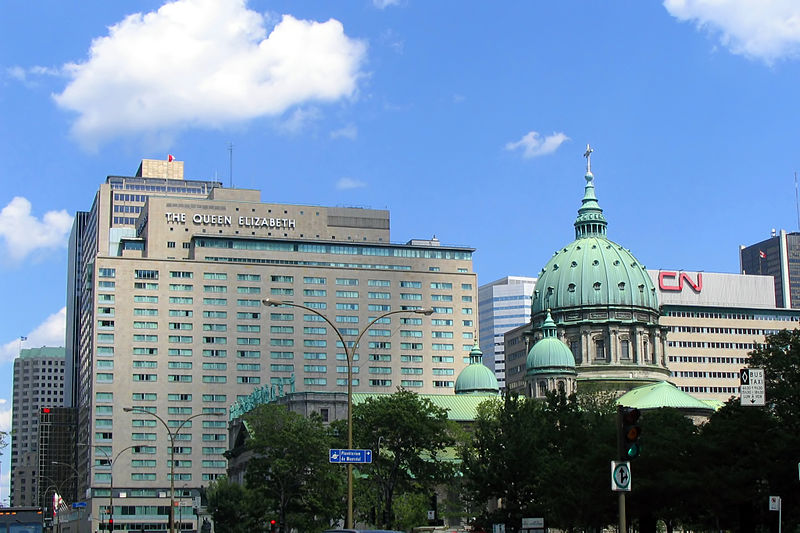
When the hotel was first proposed back in 1952, there was an upsurge of love for the monarch in English Canada. Queen Elizabeth II had just ascended the throne, and around the former British Empire, people were gaga over the queen, somewhat like people are currently in a tizzy over the former Kate Middleton. However, the 1950s also saw the rumblings that led to the eruption of the Quiet Revolution in Québec in 1960. There was an upsurge of québécois nationalism in the city and province as well. Indeed, nationalists argued that the Canadian National Railways should name the new hotel after the founder of Montréal, Paul de Chomedy, sieur de Maisonneuve. Nonsense, responded the CNR’s president, Donald Gordon: Canada is a Commonwealth nation, and the head of the Commonwealth is Queen Elizabeth II. Since he was the one building the hotel, he won the debate.
As for the masculine article in the hotel’s French name, well, it turns out that refers to the implied ‘hotel’ in the name, and hotel is masculine. There you have it.
 The Queen Elizabeth Hotel, of course, has lived up to its reputation. The Queen herself has rested her head on its pillows four times, and her son, Prince Charles, has also visited. The NHL entry draft was held there pretty much every year until 1979. But, of course, the most famous event to have occurred in the Queen Elizabeth is the “bed-in” of John Lennon and Yoko Ono, 26 May-2 June 1969. Lennon and Ono had been denied entry to the United States, because Lennon had a cannabis conviction from 1968. A bed-in was planned for New York City. So now the plan had to be changed, and so Lennon and Ono bedded down in the Queen Elizabeth for their second Bed In for Peace (the first had been in Amsterdam 25-31 March). During the Montreal bed-in, the anthem “Give Peace a Chance” was recorded by André Perry.
The Problem With Niall Ferguson
June 16, 2012 § 6 Comments
I’ve never been crazy about Niall Ferguson. I don’t think he’s ever had an original thought, and he’s about the worst kind of academic bully, demeaning himself to attack his critics in a petty, small-minded manner. Hell, we’re talking about a guy who in, his latest book, Civilization: The West and the Rest, who attacks Gandhi! Yes, Gandhi! Gandhi, in a 1931 interview in London, noted the use of disease in the European conquest of the rest of the world (indeed, Jared Diamond confirms the disease theory in his 1999 book, Guns, Germs & Steel: The Fate of Human Societies). Ferguson heaps scorn on Gandhi and goes on to argue that Western medicine did a world of good in the conquered parts of the world. Ferguson isn’t entirely wrong, especially in the case of malaria in Africa. But he’s too smart by half here, by mocking Gandhi, he discounts the fact that disease was a corollary of Western conquest. Want some figures? Try these on for size:
Caribbean Islands, 1492-1542: nearly 6,000,000 dead
Peru, 1570-1620: 750,000 dead.
Mexico, 1519-1600: 24,000,000 dead.
Ferguson’s attack on Gandhi is symptomatic of Ferguson’s general crusade against those who have the temerity to suggest that Western imperialism was not an entirely good thing. See, for example, his Empire: The Rise and Demise of the British World Order and the Lessons for Global Power.
At least in Civilization, when he’s done attacking the likes of Gandhi and others who experienced the negative effects of Western imperialism, he does go on to note the horrors of the German Empire in Africa, which does show some maturity in Ferguson in the decade since Empire.
Then there’s his attack on Marx & Engels. Ferguson wrote his manuscript in 2010, twenty years after the end of the Cold War. And yet, Ferguson, showing how petty-minded he can be, spends almost as much time attacking Marx and Engels personally than actually discussing their arguments. Why bother? Seriously. Ad hominen attacks in the works of an historian as eminent as Ferguson are just kind of sad and pathetic, especially when tacked onto commentary of Marxism/Communism.
Ferguson is also adept at the fine art of quoting out of context. For example, he attributes the following quotation to Orhan Pamuk, the Nobel Prize-winning Turkish author:
Will the West, which takes its great invention, democracy, more seriously than the Word of God, come out against this coup that has brought an end to democracy in Kars?…Or are we to conclude that democracy, freedom and human rights don’t matter, that all the West wants is for the rest of the world to imitate it like monkeys? Can the West endure any democracy achieved by enemies who in no way resemble them?
Sure, Pamuk wrote these words. However, these words are those of the narrator of his fine novel, Snow. They are not the words of Pamuk himself. But Ferguson kind of forgets to tell us that in his book. These words are the epigraph to Chapter 5, “Consumption” (Consumption is one of the “killer apps” we in the West invented, but have now been “downloaded” by the East, seriously, that’s Ferguson’s language). And Pamuk’s words here are meant to be mocking. But when you know the context of the quotation, well, then they mean something quite differently, don’t they?
And so once again, Ferguson, who actually makes a pretty good, if unoriginal argument in Civilization, shoots himself in his rhetorical foot and one is left wondering just how seriously he can actually be taken.
Bloomsday Montreal 2012
June 13, 2012 § Leave a comment
Montreal’s first annual Bloomsday gets underway tomorrow at 12.30pm at the Atwater Library, with a a reading and music inspired by Joyce’s Ulysses, hosted by Dana O’Hearne. And also tomorrow night, 5pm, at Hurley’s Irish Pub on Crescent, we will be hosting a Trivia Night, so come on down and check out both events.
The full schedule for the 3-day event can be found here.
Highlights, aside from what I’ve already noted:
4pm, Friday 15 June, Bombardier Theatre, McCord Museum, Official Launch, featuring Prof. Michael Kenneally, Principal of the School for Canadian Irish Studies at Concordia, who will speak on “The Achievement of Joyce’s Ulysses.
8.30am, Saturday, 16 June at Le Vieux Dublin Pub on Cathcart, I will be hosting a breakfast event featuring the indomitable Don Pidgeon, who will tell stories about Griffintown. Don’s ALWAYS entertaining, a natural-born story-teller, this is not to be missed.
9.45-11.30am, Saturday, 16 June: Prof. David Hanna of UQÀM will be leading a tour of Griffintown, which will meet at Métro Square Victoria.
10am-5pm, Saturday, 16 June: Our main event at James Square on McGill’s Campus (the entrance on University), where we will have daylong readings from Ulysses, as well as performances by the Bernadette Short Dancers, and Irish and classical music performances.
1pm-3pm, Saturday, 16 June: I will be screening a viewing of William Weintraub’s 1970s documentary, The Point, at the McGill Community for Lifelong Learning, which is located at 688 Sherbrooke Ouest, I’ll be in Room 1041. I will also talk about Pointe-Saint-Charles, my favourite Montreal neighbourhood (and also my home).
2.45pm-4.45pm, Saturday, 16 June, in the Bombardier Theatre of the McCord, film-maker Brian McKenna will present his new film, The Coffin Ship Hanna.
On the Difference between being a Reader and a Writer
June 12, 2012 § Leave a comment
Upon the recommendation of the fine people at Argo Bookshop, I read Italo Calvino‘s If on a winter’s night a traveller, which was in and of itself an excellent read, a meditation on the multiple meanings of reading, amongst other things. I was struck by a discussion between the protagonist, The Reader, and The Other Reader, who at least got a name, Ludmilla. Both The Reader and The Other Reader have been continually frustrated in their attempts to read a book, any book, as they are continually met with incomplete manuscripts, so they get into their novel, only to have it end. Up to this point, it has been due to publisher’s errors and problems in the actual process of printing and binding the books.
But The Reader has made a contact within the publishing firm, who has given him reign to peruse the completed manuscripts, and he excitedly tells The Other Reader when they meet in a café. He then wants to rush back to the publisher to continue their investigation. But she refuses.
Why don’t you want to come?
On principle.
What do you mean?
There’s a boundary line: on ne side are those who make books, on the other those who read them. I want to remain one of those who read them, so I take care always to remain on my side of the line. Otherwise, the unsullied pleasure of reading ends, or at least is transformed into something else, which is not what I want. This boundary line is tentative, it tends to get erased: the world of those who deal with books professionally is more and more crowded and tends to become one with the world of readers…I know that if I cross that boundary, even as an exception, by chance, I risk being mixed up in this advancing tide; that’s why I refuse to set foot inside a publishing house, even for yourself.
It is clear that for The Other Reader, this is her own stance. Of course, within a few chapters, she has violated her position. But that’s irrelevant. What is relevant is the point she raises, and the separation between authors and publishers and readers. I had a thought similar to this last week when I was in Archambault looking for a book. I didn’t find what I was looking for, a history book, but I did see my friend Simon Jolivet‘s book on the shelf. Now, this is not surprising, Simon wrote a book, based on his PhD dissertation, and it got published. That’s the way it’s supposed to work in academia. In fact, that’s the very process I am presently engaged in myself. And certainly I have known many, many authors throughout my academic career (to say nothing of the fiction writers I know). And certainly, books get treated differently in academia than in the general public: we have to publish them if we want to survive in our field, it’s part of the job (which is why I find it obnoxious when people presume that because it’s summer I’m doing nothing if I’m not teaching).
And yet, it’s one thing to see my professors’ books on the shelf in the bookstore, it’s another to see a friend’s, especially when we did our PhD’s together. It’s not an incredibly profound statement, I realise, but there is still something rather exciting about seeing your friend’s book on a shelf in a busy downtown Montréal bookstore, to know that people have bought it and read it and will continue to do so, and to finally have it sink in that this will also happen for me, my book will be on these same shelves and people will buy it and read it, beyond the academy (I hope).
But does that change my relationship with reading, both fiction and non-fiction? I doubt it. And, of course, The Other Reader eventually realised that herself when she started to get mixed up in book production and forgery rings.
Filming Griffintown
June 10, 2012 § Leave a comment
Two months ago, I posted this about film-maker Scott MacLeod‘s fundraising attempts for a documentary on Griffintown. I’m happy to report he raised enough money and all systems are go. Today, I will be meeting up with Scott and his crew for a bit of filming before Ireland takes on Croatia in its first match of Euro 2012. I am slated to discuss the destruction of Griffintown in the 20th century, due to both bureaucratic inertia on the part of Hôtel de Ville, and depopulation due to deindustrialisation in Griffintown. Of course, all the Lachine Canal-side neighbourhoods of Montréal experienced deindustrialisation, but Pointe-Saint-Charles, Little Burgundy, Saint-Henri, Côte-Saint-Paul and the like didn’t become ghost towns like the Griff. The difference? A combination of local populations resisting deindustrialisation and depopulation (the Pointe, in particular, was home to a radical, populist resistance), as well as political support. Griffintown got none of that. The city abandoned Griffintown, left it to die.
Fast-forward 50 years and now there is nothing the Ville de Montréal loves more than Griffintown. You can practically see the dollar signs in Mayor Gerald Tremblay’s eyes whenever someone mentions the word “Griffintown.” All the city can see is the tax dollars that will come in from all the condo dwellers there once Devimco and a handful of other developers are done with the neighbourhood. Did I say neighbourhood? Oops, sorry. To me, neighbourhood means a form of community, there is common cause amongst neighbours. In some cases, this is organic, in other cases, communities can be planned to encourage neighbourliness. The re-jigged Griffintown, however, is not one of those. No parks, no schools. None of that. Can’t have that, that’d steal space from condos!
So we are going to get a district of high rise condominiums, populated by harried, busy urban dwellers with no real, organic chances for community living, unless they seize the chances themselves. Maybe they’ll become the condo dwellers here in the Pointe, many of whom have joined the casseroles protests, such as they exist in the Pointe, and have joined the community gardens, and have joined the old populist community organisations of the Pointe? Or maybe they won’t. I’m not optimistic, because the Pointe already had this community-based model when the condos went up and when we gentrifiers moved into remodelled tenements. The Griff has none of that.
But don’t tell Gerald Tremblay. Actually, go ahead, he’s not listening anyway.
The Names and History
May 20, 2012 § Leave a comment
[Ed.’s note: I wrote this about a year ago, it’s already been published. But it’s been front and centre in my mind of late as I read more history, more Don De Lillo, and as world events continue to unfold. It’s often been said that history repeats itself. It’s a trite comment, but there is some truth to it. Anyway, I like this piece. So I’m republishing it. Enjoy.]
Historians take the long view when examining global affairs. I was recently reading microfilm of newspapers from the early 1920s, doing some last research for my book. The countries that dominated the headlines then were the same ones that dominate them today. The Third Anglo-Afghan War had just concluded with the Treaty of Rawalpindi, ostensibly settling boundary issues between India and Afghanistan. The Levant was under British and French mandate following the First World War. The Republic of Turkey was in its infancy under Mustafa Kemal Atatürk, and the British had just revoked Egypt‘s independence.
I had the same sense of déjà-vu in reading Don DeLillo’s 1982 novel, The Names. It’s set against the geopolitical backdrop of the Iranian Revolution, the rescue of the American hostages in Tehran, the Lebanese Civil War, the 1980 Turkish coup d’état, chronic Greco-Turkish tensions over Cyprus, and the instability of Greek democracy. The Names centres around a group of expats involved in various shadowy activities involving international banking, risk analysis, security, and archaeology. Its hero, James Axton, is a risk analyst for a mysterious American group found to have ties to the CIA. David Keller, another American, is based in Athens. He works for a bank that has heavy ties to the Turkish government, and becomes the target of an assassination attempt in Greece. Charles Maitland, a Brit, is a security specialist. The men spend their time flying around the Middle East attending to business in dodgy locales: Tehran, Ankara, Istanbul, Jerusalem, Damascus, and Beirut in particular.
Control is a central theme of the novel, whether it’s states trying to manage their politics or DeLillo’s characters handling their personal affairs. Axton loses control in his marriage as his wife, Kathryn, slips further and further away from him (she moves from a Greek island to Victoria, British Columbia – about as remote and obscure a locale from Greece as possible). He loses control over his own reality, holding on desperately to his job, revelling in mundane office paperwork as he becomes increasingly obsessed by a mysterious, murderous cult. He eventually travels to the Pelopennese and as far as Jerusalem, Damascus, and India in an attempt to learn more about it. Along the way, something interesting happens: language, the means by which people order and make sense of their mental worlds, takes on a new importance for Axton; religion, as exemplified by the mystery cult, is what orders the meaning that he finds through language. The connections they establish and the control they represent suggest a world made in the cult’s own image, which Axton sees painted on a rock on the outskirts of an abandoned village in the Pelopennese: Ta Onómata, The Names.
As the novel closes, Axton is back in Athens. After the CIA revelations, he resigns from his job. Rootless, his wife and son on the other side of the world. He regains control of his life, while the world around him continues to spin out of control; he witnesses the assassination attempt on Keller. Geopolitics and the personal chaos caused by the characters’ involvement in it are useful allegories these days. In the continuing drama of the Arab Spring, states and their residents, the masses and their leaders, are locked in a competition over who gets to dictate the terms of order. The newspapers of the 1920s were clear about who was meant to maintain control over the countries of the Middle East and North Africa. Today, questions of empire, language, religion and politics, domesticated and boiling over, are much more complex. For that we should probably be grateful.
The Cavalier Middle Classes
May 19, 2012 § 3 Comments
I am in the process of reading what is generally an excellent book, Jerry White‘s London in the 20th Century, itself part of a recently completed trilogy on London. The 20th century came first, in 2001, followed by the 19th century in 2008, and the 18th a few months ago. It’s an intriguing read, as White is adept at pulling together disparate strains of the history of the city in a compelling and very readable narrative.
But sometimes, he gets hard to take seriously. For example, in discussing homelessness and begging in London in the 1980s, one of the toughest decades in English history due to a global recession and Margaret Thatcher’s scorched earth economic policies, White writes:
London experienced a begging revivals in the 1980s, especially among the young homeless and squatters, to an extent probably only paralleled in some of the bleakest years of the nineteenth century. In the absence of children, dogs had always been a useful prop for beggars to squeeze that extra penny from a sentimental public. In the 1980s and 1990s the small dog on a length of string was a required fashion accessory for the young beggars of Stoke Newington Church Street or Islington’s Upper Street or Camden High Street and probably every other high road of inner London.
Yes. Right. Because being homeless is really just a career choice, complete with the same fashion accessories of the London City banker. Except instead of the Brooks Brother suit, Rolex watch, and Porsche, the beggar chooses ratty clothes and a mutt on a string to get that extra bit of change out of the public. Obviously White is being sarcastic here, injecting some humour into his narrative. But it’s inappropriate humour.
White strikes a similar chord in discussing the fate of the Port of London and the Royal Opera House, two unionised work places in the 70s and 80s. Here, he calls the unionised workers, and the unions, “stupid” because they were unable to see the long-term and to protect their jobs (and their industries). Indeed, this is a pretty common attitude amongst historians of late in discussing the deindustrialisation that struck Western Europe and North America in the 70s, 80s, and 90s. Unions were daft because they refused to accept their fate. For that matter, we see the same discourse surrounding the plight of Greece today, those dumb Greeks refuse to see reality.
It’s not that simple, of course. The critics of the Greeks aren’t experiencing what the Greeks are experiencing, quite obviously. It’s very easy to preach and be judgemental from Berlin, London, New York, or Toronto. Of course, what those observers also have is a view of the bigger picture, and can no doubt see the forest, rather than just the trees.
It’s the same thing with the historians looking back at deindustrialisation. Sure, from where we sit today in the early 21st century, it’s easy to see the bigger picture of the process of deindustrialisation in the 70s, 80s, and 90s. But, know what? It wasn’t so easy to see that from the position of the working classes in that era. These people were fighting for their jobs and their livelihood. What else you expect them to do? Lie down and take it? To allow the system to run them over, dispossess them? To settle for less than they thought they deserved? How many people do that? Right, approximately zero. Sure, they were wrong. But for them it was a personal fight, not some abstract discussion of the economy and projections, stagnation, and inflation.
It wasn’t pretty. The 80s were a horrible decade for the working classes of North America and Western Europe. Jobs disappeared as the world’s economy globalised. When Free Trade came to Canada at the end of the decade, it had a direct impact on my family. My old man lost his job, victim to Free Trade, because his company realised that a welder in South Carolina could do the same work for far less money than he did in Vancouver. Not only that, but unionisation was a lot less likely in South Carolina. And so on.
The process of deindustrialisation had very real human costs. End of story. Historians would do well to remember than when discussing the process, rather than dismiss workers and their unions as “stupid” or “daft.”
Adding to the Wasteland of Griffintown
April 13, 2012 § 1 Comment
I have taken to going through Griffintown on my morning run of late, in part because it gives me a chance to keep an eye on the redevelopment there. I come up from the Lachine Canal to de la Montagne, to Ottawa, over to Peel and then down Wellington back down to the Canal, which gives me a quick tour through the heart of old Griffintown, past the old ruins of St. Ann’s Church, by the recently sold Horse Palace, past the Merciers’ old home and Fire Station No. 3.
A condo tower is going up at the corner of de la Montagne and Ottawa, there is work going on around the Horse Palace, there is a new condo bloc at the corner of Ottawa and Murray. And another development is underway on the northeastern corner of Peel and Wellington. And then, of course, across Wellington, between Young and Shannon is Devimco’s massive construction site. Buildings have come down and holes have been dug for Devimco.

And Devimco has moved its condo sales office. It was once located up the block on the eastern side of Peel near Ottawa, but now it sits proudly, if not somewhat barrenly, on the southeastern corner of Peel and Wellington. I did find myself wondering if the sales people are still promising potential buyers that the CNR would move its railway, as the viaduct is across the very narrow Smith street from the site of Devimco’s condo towers.

At any rate, the old sales office is now just another wasteland on Griffintown’s landscape, yet another lot of urban refuse, but this time created by the very company which proposes to rejuvenate and renovate the Griff. Ironic, I thought.
In Griffintown/Dans L’Griff
April 2, 2012 § 1 Comment
In Griffintown/Dans L’Griff will be a documentary about Griffintown, made by my friend, film-maker G. Scott MacLeod. Scott’s most recent film, a short entitled The Saga of Murdo MacLeod has been received rapturously by Montrealers at its various showings around town, most recently at Ciné-Gael, Montréal’s Irish film series, which is celebrating its 20th season this year.
Scott is proposing to do a short documentary on Griffintown through the eyes of Claude and Lyse Mercier, amongst the last generation of Griffintowners. Claude and Lyse, as you might guess by their names, are NOT Irish! Shock! Indeed, they are French Canadian, a voice that has long been lost in the stories and memories of the Griff (as my forthcoming book, The House of the Irish: History, Memory and Diaspora in Griffintown, Montreal, will tell you). Almost all the attention on the Griff’s history has been focused on the working-class Irish Catholics, leaving out the other residents there: French Canadians and Anglo-Protestants, and Scott’s about to address this lacuna.
Scott and I have had a lot of conversation about Griffintown, over Thai food and as we’ve wondered the streets of the neighbourhood both of us are so hell-bent on preserving the memory of. And while books are great (especially mine!), a documentary, graphic evidence of what once was, is a brilliant addition to the growing corpus of Griffintown memories.
The trailer for the film is below, but I urge you to click on this link, which will take you to Scott’s indiegogo page, where he is attempting to raise money to help with the costs of film-making. Any amount will help, but Scott is offering 3 levels of support. 20$ gets you a thank you in the end credits and a copy of the DVD, 100$ gets you into the end credits and a DVD, and 1000$ makes you a producer, and you also get a copy of the DVD.
 Matthew Barlow