Irish Slums
December 5, 2013 § 4 Comments
Last month, I met Michael Patrick MacDonald at an Irish Studies conference in Rhode Island. He was the keynote speaker. I didn’t know much about him beforehand, other than he wrote All Souls about growing up in South Boston in the 70s and 80s. I knew All Souls was a story about heartbreak, drugs, and the devastation suffered by his family. But MacDonald’s talk was one of the best I’d ever heard, he spoke of Whitey Bulger, drugs, Southie, his work in non-violence and intervention, and he talked about gentrification. He was eloquent and fierce at the same time. He is, of course, an ageing punk. He was also pretty cool to talk to over beers in the hotel bar later that night.
I finally got around to reading All Souls last week. I’m glad I did. I was stunned that MacDonald and his siblings could survive what they’ve survived: three of their brothers dead due to gangs, drugs, and violence. One of their sisters permanently damaged by a traumatic brain injury brought about due to drugs. And another brother falsely accused of murder. It was a heartbreaking read, at least to a point. I know how the story ends, obviously.
It was also interesting to read another version of Southie than the one in the mainstream here in Boston. The mainstream is that Southie was an Irish white trash ghetto, run by Whitey Bulger, terrorised by Whitey Bulger, but all those Irish were racists, as evidenced by the busing crisis in 1974. And while MacDonald tried to revise that narrative, both in his talk and in All Souls, pertaining to the busing crisis, it is hard to argue that racism wasn’t the underlying cause of the explosion of protesting and violence. But, MacDonald also offers both a personal and a sociological view of how Southie was terrorised and victimised by Bulger (and his protectors in the FBI and the Massachusetts State Senate). And, today, he talks about gentrification in a way that most mainstream commentators do not (something I’ve railed about in my extended series on Pointe-Saint-Charles, Montréal, his blog, Pt. 1, Pt. 2, Pt. 3, Pt. 4, and Pt. 5).
But something else also struck me in reading MacDonald’s take on Southie. I found that he echoed many of the oldtimers I’ve talked to in Griffintown and the Pointe in Montréal about their experiences growing up. Griff and the Pointe were the Montréal variant of Southie, downtrodden, desperately poor Irish neighbourhoods. And yet, there is humour to be found in the chaos and poverty, and there is something to be nostalgic for in looking back.
MacDonald writes:
I didn’t know if I loved or hated this place. All those beautiful dreams and nightmares of my life were competing in the narrow littered streets of Old Colony Project. Over there, on my old front stoop at 8 Patterson Way, were the eccentric mothers, throwing their arms around and telling wild stories. Standing on the corners were the natural born comedians making everyone laugh. Then there were the teenagers wearing their flashy clothes, their ‘pimp’ gear, as we called it. And little kids running in packs, having the time of their lives in a world that was all theirs.
This echoes something journalist Sharon Doyle Driedger wrote of Griffintown, where she grew up:
Griffintown had the atmosphere of an old black-and-white movie. Think The Bells of St. Mary’s,with nuns and priests and Irish brogue and choirs singing Latin hymns. Then throw in the Bowery Boys, the soft-hearted tough guys wisecracking on the corner.
The difference, of course, is that MacDonald’s ambivalence runs deep, he also sees the drug addicts and dealers, and the grinding poverty. Doyle Driedger didn’t. But, MacDonald is standing in Southie as an adult when he sees this scene, Doyle Dreidger is writing from memory.
Nostalgia is a funny thing, and it’s not something to be dismissed, as many academics and laypeople do. It is, in my books, an intellectually lazy and dishonest thing to do. Nostalgia is very real and is something that tinges all of our views of our personal histories.
But what I find more interesting here are the congruencies between what MacDonald and Doyle Driedger writes, between what MacDonald says in All Souls and what he said in his talk last month in Rhode Island, and what the old-timers from Griff and the Pointe told me whenever I talked to them. There was always this nostalgia, there was always this black humour in looking back. I also just read Roddy Doyle’s Paddy Clarke Ha Ha Ha, about a kid growing up in Dublin’s Barrytown, a fictional inner-city neighbourhood. Through Paddy Clarke, Doyle constructs an idyllic world for a boy to grow up in, as he and his mates owned the neighbourhood, running around in packs, just like the kids in Southie MacDonald describes, and just as MacDonald and his friends did when they were kids.
I don’t know if this is something particular to Irish inner-city slums or not. But I do see this tendency as occurring any time I talk to someone who grew up in such a neighbourhood, or read stories, whether fiction or non-fiction, to say nothing of the music of the Dropkick Murphys (I’m thinking, in particular, of almost the entirety of their first album, Do Or Die, or the track “Famous for Nothing,” on their 2007 album, The Meanest of Times), I’m not one for stereotyping the Irish, or any other group for that matter, I don’t think there’s anything “inherent” to the Irish, whether comedy, fighting, or alcoholism. But there is something about this view of Irish slums.
Wither the Working Classes?
April 7, 2013 § 3 Comments
South Boston is undergoing massive redevelopment these days, something I’ve already noted on this blog. Every North American city has a Southie, a former industrial working-class neighbourhood that is undergoing redevelopment in the wake of deindustrialisation and the gentrification of inner cities across the continent. In Montréal, the sud-ouest is ground zero of this process, something I got to watch from front-row seats. In Vancouver, it was Yaletown. Cities like Cleveland and Pittsburgh have done brilliant jobs in re-claiming these post-industrial sites. In Boston, however, Southie’s redevelopment has attracted the usual controversy and digging in by those working-class folk who remain there. It’s even the locale of a “reality” TV show that is more like working-class porn than anything else.
The same discourse always emerges around these post-industrial neighbourhoods under redevelopment, something I first noticed in my work on Griffintown in Montréal. Today, in the Boston Globe there is a big spread ostensibly about a sweet deal given to a Boston developer by City Hall, but is really more an examination of the redevelopment of Southie’s waterfront. In in, James Doolin, the chief development officer of the Port Authority of Massachusetts, one of the players in this redevelopment, reflects on the ‘new buzz’ surrounding the area, going to to talk about how this ‘speaks to a demographic that is young, employed, and looking for social spaces.”
Right. Because the Irish who lived and worked in Southie during its life as an industrial neighbourhood were really just bums, always unemployed and so on. And, of course, those unemployed yobs would never look for social spaces, all those little cretins hung out in back alleys and under expressways. This attitude is unfortunate and is part and parcel when it comes to the redevelopment of these neighbourhoods: the belief that the working classes never had jobs, had no social lives and were just drones. I’ve seen it in literature from developers in Griffintown and other parts of Montréal’s sud-ouest, so it’s no surprise to find this attitude in Boston. But it doesn’t make it right. In one sweeping, gross over-generalisation, Doolin (and the Boston Globe) sweep away centuries of history, of life in Southie, and the day-to-day struggles of the working classes in the neighbourhood to survive and live their lives on their terms.
Getting Redevelopment and Community Right
March 12, 2013 § 2 Comments
Yaletown in Vancouver has undergone massive redevelopment in the past two decades. It was once the site of Expo 86 along False Creek, and before that, an urban wasteland (actually, after Expo, too). But today, it is a sea of glass towers; one statistic I’ve seen said the population just in Yaletown approaches 30,000, though I find that hard to believe. All along False Creek is a string of residential condo towers; all along Pacific Boulevard, from Granville to Cambie streets there are towers and pied-à-terre condos. Some of them even look nice.
 As I went out for my morning run today (I’m staying with my sister here), I noticed something: this is actually a well-thought out urban redevelopment. There’s a billboard on Pacific Blvd that says that Concord, one of the developers is building community here. It’s easy to scoff at that claim. But it’s not a ridiculous claim. My sister knows her neighbours. More than that, she has friends amongst them. Dog owners around here have claimed a patch of Cooperage Park on False Creek as a dog run. They police each other, making sure nobody leaves their dog doo behind. They also police each other’s dogs, making sure they behave. There’s a bunch of cafés and restaurants along Marinaside Drive (I know, what a horrible name), and they’re populated with regulars, the neighbours around here. People nod and say hello to each other on the streets and along the path that goes along the bank of the water.

There’s more, though. There’s actual, real parks here. Cooperage stretches almost from the Plaza of Nations at the head of False Creek towards and under the Cambie Bridge. A few blocks on is David Lam Park, which lies between Pacific, Drake, and Homer streets. But it’s more than that. These parks are actually used. There’s basketball and tennis courts at David Lam, and a playground. An elementary school is on David Lam and the children can be seen playing in the park at recess and lunch and after school. The path along the water is almost always busy with joggers and cyclists, as well as roller-bladers and walkers (Vancouver was experiencing one of its trademark torrential downpours when I was out taking pictures today, thus, aside from one intrepid jogger, there was no one out playing).
When I lived in Vancouver in the late 90s, there was a lot of hand-wringing about the redevelopment of the old Expo site. The city was determined to increase density, to follow the model of the West End, which is apparently the densest neighbourhood of North America that’s not Manhattan. So the old Expo lands saw these condo towers grow out of the ground. The major difference between the West End, which lies on the other side of the Burrard and Granville Street bridges and this area, which is part of the larger Yaletown neighbourhood, is that Yaletown tends to be resident owners, whereas the West End is largely rental units (there are, of course, many exceptions to both).
 At the end of the day, however, Vancouver got it right. There is community here, the public spaces are widely used. The cafés and restaurants are, with the exception of one Starbucks (this IS Vancouver, after all) independent operators (this isn’t as true as Pacific Blvd., the main east/west thoroughfare, which has plenty of chains in between and around the indie stores). This also contributes to community, as the small business owners connect to their local community in a way that Starbucks and Quiznos can’t. And studies show that locals are more likely to patronise these small businesses than the chains. Indeed, this morning, Bojangles, the local indie café was busy, filled with both commuters on their way to work and those with more time to sit and enjoy their coffee. Whereas the Starbucks, while it got a fair amount of foot traffic from commuters, it doesn’t have the same community feel.
I fear, however, that Montréal is getting it wrong with Griffintown. The early plans for the massive redevelopment of Griff by Devimco called for massive shopping areas and big box stores. The commercial developments were supposed to pay for the residential developments. As for anything else that urban residents might need, well, “Whatever,” Devimco seemed to say. Of course, Devimco’s bold plans were thwarted somewhat by the recession. The redevelopment is now a mixture of Devimco’s big District Griffin (how tragic it would be to have that old English name on the neighbourhood, eh, OQLF?) and a smattering of smaller developments, with the massive redevelopment of the old Canada Post Lands at the other end of Griff at the foot of rue Guy.
Missing, though, from all these redevelopment plans in Griff was any idea of what residents were supposed to do. There still are no plans for schools in the neighbourhood. It wasn’t until early 2012 that the Ville de Montréal announced that it had earmarked some money to create public parks. It’s still not entirely clear where they’ll be, other than the already extant Parc St. Ann/Griffintown at the bottom of rue de la Montagne at Wellington. And given Montréal’s history of development and redevelopment, and the fact that the mayor, first Gérald Tremblay and now Michael Applebaum, just has dollar signs in his eyes when talking about Griffintown, I have zero hope of Griffintown being redeveloped right. In fact, I am almost positive it will be a disaster.
It’s tragic, as Montréal has a chance to redevelop a huge swath of valuable land at the foot of downtown, to emulate what Vancouver did with Yaletown in the 90s and 00s. But it has done nothing to suggest that it will get it right. And that’s trafic.
The Working-Class and Community, Griffintown and Beyond
February 1, 2013 § 6 Comments
Almost to a person, every former Griffintowner I talked to over a decade of working on the neighbourhood commented on the sense of community they felt in living there, how it was a place where people took care of their neighbours. David O’Neill, who helped me extensively during the research and who put in me in contact with many former Griffintowners, commented that when he was growing up there in the 1940s and 50s, it was like having a community of parents, everyone watched out for each other’s children on the streets. And if O’Neill and his friends got up to something they shouldn’t have, by the time they returned home, their parents would be waiting for them with the intelligence, ready to punish the kids.
But Griffintown was never unique for this characteristic, this is a commonality to nearly all former working-class neighbourhoods I’ve ever read about, on both sides of the Atlantic Ocean. It is also a way that is lost today. People who grew up in close-knit working-class communities are almost always nostalgic for what has been lost. They miss the community and comaraderie they experienced in those communities. They miss what kept them in line, be it the Church or work, or just the simple existence of real and authentic community.
The universality of this mindset hit home the other day in Salem, MA, at the National Park Service’s Custom House site. When the Park Service created the site, they removed a set of derelict buildings that had popped up in an alleyway behind the old Customs House on Derby Street. In the early 20th century, an entire working-class immigrant community existed along Derby Street, and in the alleys behind the Customs House. Here there were tenement houses of varying quality and shops and services that served, first, Irish immigrants, and then, in the 20th century, Poles and Russians and Ukrainians. Taking aside the question of the authenticity of the Customs House site given the destruction of the homes of this long-gone working-class community, what struck me the most was the description of what was once there, including a quotation from a former resident, Dorothy Philip, as seen in the photo here.
The “Curation” of Southie and the General Over Use of the Term
December 10, 2012 § 4 Comments
We were in Southie yesterday, the former Irish-Catholic working-class neighbourhood of Boston. Southie is undergoing massive yuppification these days. The working classes are being squeezed out, and the yuppies are moving in. This was clear as we took the #9 Broadway bus from Copley Square into Southie. The bus is the great equaliser of Boston society; in some parts of the city, it’s the only time one sees large numbers of minorities. We got off the bus at the corner of West Broadway and A Street, on our way to a yuppified Christmas foodie craft fair at Artists for Humanity on West 2nd Street. In a lot of ways, Southie looked to me like a combination of parts of the Plateau Mont-Royal and Pointe-Saint-Charles back home in Montréal. The architecture was Plateau-like in terms of post-industrial spaces and housing, but the people looked like they could be in the Pointe. There was a curious mixture of the down and out, the working-classes, hipsters, and yuppies of every skin colour.
Gentrification is a creeping problem in pretty much every North American and European city, and much has been written about this, including on this very blog (like, here, here, here, here, here, here, and here, for starters). But what struck me the most was Social Wines, a wine and beer emporium in a spanking new building on West Broadway at A Street. Social Wines offers its clientele “Curated Craft Beer and Spirits.” Now, I must confess, this is my kind of store: it focuses on smaller, indie breweries and vineyards. I like giving my money to these kinds of companies, rather than the Molsons, Budweisers, and massive vineyard conglomerates of the world. But curated? What the hell does that mean?
According to the Meriam-Webster dictionary on-line, a “curator” is “one who has the care and superintendence of something; especially : one in charge of a museum, zoo, or other place of exhibit. To “curate” is: “to act as curator of a museum or exhibit curated by the museum’s director.”
Of late, hipsters and academics have abused the term “curate” like it’s nobody’s business. It is one thing, in the field of Public History and its corollaries, to write of the ways in which museums and the like have “curated” items. That is the proper use of the term. But when editors of edited collections of academic papers start referring to themselves as “curators” and not “editors,” well, then we have a problem. Meanwhile. Hipsters. On any given day, one can go to PitchforkMedia and see articles about this or that music festival that has been “curated” by someone. The most egregious example of this is the All Tomorrow’s Parties festival, which takes place in merry olde England, with branches occurring in the US, too. Each year, ATP is “curated” by a guest musician, one of stature and great fame. What that means is that someone is in charge of deciding who should play, and the list of artists reflects the curator’s tastes. Yup, deciding who should play a music festival is curation.
And so now we have a hipster beer and wine store in Southie that offers us “curated” booze. What, exactly is curated? The collection of booze on sale. See, the old ma and pop liquor store down the street just orders in booze that they figure their clientele will enjoy. But, not hipsters, they lovingly and carefully “curate” the collection of booze on sale at Social Wines. I don’t know about you, but I feel a lot better knowing that rather than having some old geezer just randomly order wines and beers that may or may not be any good, we have the fine folk at Social Wines to very carefully curate their collection.
My problem with the use of this term? It’s very simple. It’s pretentious. And nothing quite says “I’m a wanker” like declaring that you curated your liquor store. I applaud Social Wines’ mission. Hell, next time I’m in Southie, I may even stop in and peruse their collection of wines. But the use of this term by book editors, musicians, and liquor store owners also seriously devalues the meaning of the word in its true professional sense.
Professional curators, those who work in museums and art galleries, do not just collect stuff they like to display. They are responsible for the content of exhibits, and they are required to carefully make decisions on what is appropriate and what is not, to carefully arrange the displays, to negotiate with sponsors, and so on and so forth. There is a reason why curators go to school to learn how to properly curate. Musicians and liquor store owners do not.
Montréal’s Anglo Mayor: Dr. JJ Guerin
November 16, 2012 § Leave a comment
So Montréal got itself a new mayor today, Michael Applebaum. He wasn’t democratically elected, but given the sudden resignation of the scandal-plagued Gérald Tremblay on 5 November, he has to be an improvement. The big woopedy-do about Applebaum is that he’s Anglophone (he’s also the metropole’s very first Jewish mayor). Montréal hasn’t had an Anglo mayor since 1910, when James John Guerin sat in the mayor’s chair.
Guerin, despite the last name, was Irish Catholic. He was also a central player in one of the most vicious election campaigns in Canadian history. In 1917, at the height of the First World War, Prime Minister Sir Robert Borden called an election over the issue of conscription. Borden had invited the Liberal Party, under Sir Wilfrid Laurier (Prime Minister of Canada, 1896-1911), into his government to form a Union government for Canada for the duration of the war. Laurier, however, could not countenance conscription nor could his Québec powerbase. He refused. Borden called an election for 17 December.
By 1917, voluntary enlistments into the Canadian Expeditionary Force (CEF) was pretty much drying up. The war had been going on for three years. And the Great War was little more than a killing field. Mechanised warfare wreaked havoc on the soldiers. Casualty rates were enormous. Canada, with a population of little more than 7 million, lost 65,000 men, with another 150,000 wounded. Many of those who were wounded and survived were never the same again. They lost their eyesight, their hearing, limbs; their lungs were destroyed by the Germans’ poisonous gas; they were shell-shocked. It wasn’t just in Canada that enlistments were drying up by 1917, the same was true in England, Scotland, and Wales. Thus, conscription was needed to compel young Canadian men to fight. Conscription was made palpable in the rest of Canada, in part, due to exemptions. The most famous case was that of farmboys, whose labour was needed on the farms of the Prairies (and Ontario). (Not that Borden kept this promise). But, in Québec, nationalists failed to see why Canada should be wrapped up in an imperialist war that had nothing to do with Canada’s interests. Indeed, Henri Bourassa, the most influential nationalist leader of the day, and founding editor of Le Devoir, argued in that paper’s pages
Le Canada aurait pu intervenir comme nation, lié a l’Angleterre par des attaches politiquées, et à la France par des motifs de sentiment et d’intérêt, sans compromettre en rien son état politique…[and that Canada had] aucune sort d’obligation morale ou légale de participer à la guerre et tenir compte des conditions particulières, des intérêts vitaux qu’il doit sauvegarder comme pays d’Amérique avant lier sont à celui des nations d’Europe.
Bourassa wasn’t entirely correct, Canada did have a legal obligation to participate. Britain still controlled Canada’s foreign affairs, and would continue to do so until the Statute of Westminster in 1931. Thus, when Britain went to war, Canada went to war.
At any rate, the Liberal Party of Canada split over conscription in 1917. Most Liberals outside of Québec took Borden up on his offer; most Liberals in Québec stood behind Laurier. The outcome of the election was a foregone conclusion, of course. But that didn’t stop the Bordenites from engaging in some skeezy politics. They enfranchised women who had sons or husbands in the military, calculating that they would vote for the Bordenites. They gerrymandered ridings to ensure the best possible outcome for the Unionists.
One of the gerrymandered ridings was St. Ann’s, in Montréal’s west end. Prior to the 1917 election, the riding was comprised of Griffintown, Little Burgundy, and Pointe-Saint-Charles, a working-class industrial slum. The sitting member was Charles J. Doherty, a Conservative and the Minister of Justice in Borden’s government. He was initially election to represent St. Ann’s in 1917. He was also Irish-Catholic, so, in essence, the Irish of Griffintown (and Pointe-Saint-Charles) had elected one of their own. Again. St. Ann’s was one of those ridings where the outcome was not a foregone conclusion. It could just as easily go Liberal. Thus, the gerrymander. Conservative, non-Irish, neighbourhoods including the western part of Pointe-Saint-Charles and all of Verdun, were added to the riding.
The Irish were an issue in 1917 because of the effect of the 1916 Easter Rising in Dublin on the Irish diaspora. The 1916 Rising, and the brutality of the British response, served to radicalise the Irish, both in Ireland and the diaspora, including and perhaps especially, Griffintown. Griffintown was home of the most radical republican Irish nationalists in Canada in the 1910s, mostly centred on the Ancient Order of Hibernians (AOH). Thus, for the Bordenites, it was essential that Doherty, who was responsible for conscription, be protected at all costs. Hence, the gerrymander.
Borden was opposed in the riding by two Liberals at the outset. Daniel Gallery, the former Liberal member (and city councillor) for St. Ann’s, as well as Dr. J.J. Guerin, a long-time city councillor and former mayor of Montréal. Gallery, though, ultimately lost the Liberal Party’s endorsement and was left to run as an independent against the Liberal Guerin and the Conservative Doherty. The election was vicious in Griffintown. Goon squads intimidated followers of all three candidates. All three were heckled mercilessly on the campaign trail. Threats were made.
Doherty won the election handily. Indeed, he won with the largest margin of his career. But he also won in large part due to the gerrymander. In Griffintown, the heart of St. Ann’s, Guerin walked away with the vote, outpolling Doherty by an almost 2-1 margin. Gallery, despite a long career in service of Griffintown, was never a credible candidate. He spent most of his time denying that the Unionists were paying him to split the Liberal vote with Guerin. He garnered fewer than 1000 votes. Guerin may have lost the election, but he won Griffintown. And he eventually succeeded in representing St. Ann’s in Parliament; he was elected the Liberal member in the 1925 election and held the seat until his death five years later.
Farewell to Leo Leonard
July 12, 2012 § 1 Comment
Leo Leonard, the long-time proprietor of the Griffintown Horse Palace, died a week ago today at the Verdun Hospital. He was 87 years old. Leo bought the Horse Palace in 1968 after a life of doing hard manual labour on the Montréal waterfront and in Griffintown. Leo himself came from Goose Village, born in 1924. Leo, also known as Clawhammer Jack, is responsible for the Horse Palace getting its name. The stables were actually built over a century earlier, in 1862. As Leo told the story, he was working in the stables one day when a sign painter happened to amble by sometime in the late 1960s. So, Leo told him “to get scribblin'”, figuring that if San Francisco had its Cow Palace, then Griff should have the Horse Palace.
Leo’s funeral was this past Tuesday at Feron’s at the corner of Notre-Dame Ouest and Charlevoix. Jimmy Feron, the founder of Feron’s was himself a Griffintowner, a friend of the legendary alderman “Banjo” Frank Hanley.
This Saturday, the Griffintown Horse Palace Foundation, which is trying to save and preserve the Horse Palace, is hosting a visit to the site at 10am. We are also going to clean up the Palace a bit, preparing it for its next life.
We invite any and all to come down to the Horse Palace on Saturday, 14 July, at 10am, to take a look around. It’s amazing site, a little piece of a rural oasis in the middle of the city. Standing in the yard, in the shade of century old trees, you can almost forget you’re in Montréal.
The Griffintown Horse Palace is located at 1216, rue Ottawa, between rue de la Montagne and rue Murray in Griffintown. The nearest métro is Bonaventure, just head down Peel Street and turn right at Ottawa, the Horse Palace is three blocks from there. The nearest Bixi stands are at the corner of de la Montagne and Notre-Dame Ouest, three blocks north of the Palace.
If you want more information, you can email either myself or Juliette Patterson.
In Griffintown
June 12, 2012 § 1 Comment
I spent Sunday morning, prior to the destruction of the Irish team at the hans of Croatia in Euro 2012, in Griffintown, with Scott MacLeod, working on his documentary, In Griffintown/Dans l’Griff. It was an incredibly hot day, and Scott, myself, the crew, and Claude Mercier who, along with his wife, Lyse, are the stars of the film, all got nice and sunburned. Below are some action shots, as well as Claude, Scott, and I in Parc Saint-Ann/Griffintown, squinting in the bright sunlight. It was a great experience, in between shots, Scott and I talked about his vision for the film, how he planned to intersplice archival footage, his own animations, and live action shots to create the documentary. I look forward to seeing the final version.
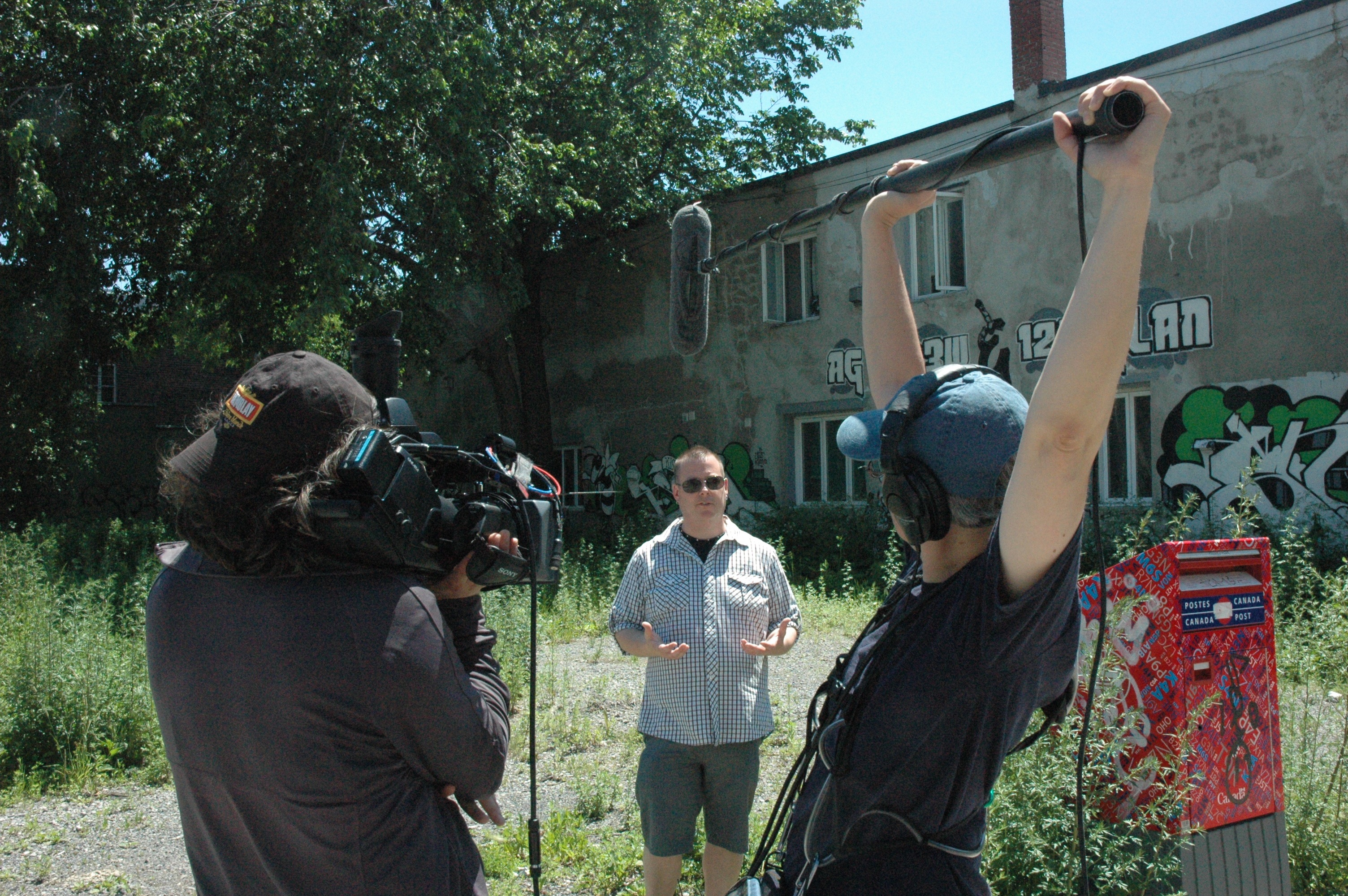

Filming Griffintown
June 10, 2012 § Leave a comment
Two months ago, I posted this about film-maker Scott MacLeod‘s fundraising attempts for a documentary on Griffintown. I’m happy to report he raised enough money and all systems are go. Today, I will be meeting up with Scott and his crew for a bit of filming before Ireland takes on Croatia in its first match of Euro 2012. I am slated to discuss the destruction of Griffintown in the 20th century, due to both bureaucratic inertia on the part of Hôtel de Ville, and depopulation due to deindustrialisation in Griffintown. Of course, all the Lachine Canal-side neighbourhoods of Montréal experienced deindustrialisation, but Pointe-Saint-Charles, Little Burgundy, Saint-Henri, Côte-Saint-Paul and the like didn’t become ghost towns like the Griff. The difference? A combination of local populations resisting deindustrialisation and depopulation (the Pointe, in particular, was home to a radical, populist resistance), as well as political support. Griffintown got none of that. The city abandoned Griffintown, left it to die.
Fast-forward 50 years and now there is nothing the Ville de Montréal loves more than Griffintown. You can practically see the dollar signs in Mayor Gerald Tremblay’s eyes whenever someone mentions the word “Griffintown.” All the city can see is the tax dollars that will come in from all the condo dwellers there once Devimco and a handful of other developers are done with the neighbourhood. Did I say neighbourhood? Oops, sorry. To me, neighbourhood means a form of community, there is common cause amongst neighbours. In some cases, this is organic, in other cases, communities can be planned to encourage neighbourliness. The re-jigged Griffintown, however, is not one of those. No parks, no schools. None of that. Can’t have that, that’d steal space from condos!
So we are going to get a district of high rise condominiums, populated by harried, busy urban dwellers with no real, organic chances for community living, unless they seize the chances themselves. Maybe they’ll become the condo dwellers here in the Pointe, many of whom have joined the casseroles protests, such as they exist in the Pointe, and have joined the community gardens, and have joined the old populist community organisations of the Pointe? Or maybe they won’t. I’m not optimistic, because the Pointe already had this community-based model when the condos went up and when we gentrifiers moved into remodelled tenements. The Griff has none of that.
But don’t tell Gerald Tremblay. Actually, go ahead, he’s not listening anyway.
Adding to the Wasteland of Griffintown
April 13, 2012 § 1 Comment
I have taken to going through Griffintown on my morning run of late, in part because it gives me a chance to keep an eye on the redevelopment there. I come up from the Lachine Canal to de la Montagne, to Ottawa, over to Peel and then down Wellington back down to the Canal, which gives me a quick tour through the heart of old Griffintown, past the old ruins of St. Ann’s Church, by the recently sold Horse Palace, past the Merciers’ old home and Fire Station No. 3.
A condo tower is going up at the corner of de la Montagne and Ottawa, there is work going on around the Horse Palace, there is a new condo bloc at the corner of Ottawa and Murray. And another development is underway on the northeastern corner of Peel and Wellington. And then, of course, across Wellington, between Young and Shannon is Devimco’s massive construction site. Buildings have come down and holes have been dug for Devimco.

And Devimco has moved its condo sales office. It was once located up the block on the eastern side of Peel near Ottawa, but now it sits proudly, if not somewhat barrenly, on the southeastern corner of Peel and Wellington. I did find myself wondering if the sales people are still promising potential buyers that the CNR would move its railway, as the viaduct is across the very narrow Smith street from the site of Devimco’s condo towers.
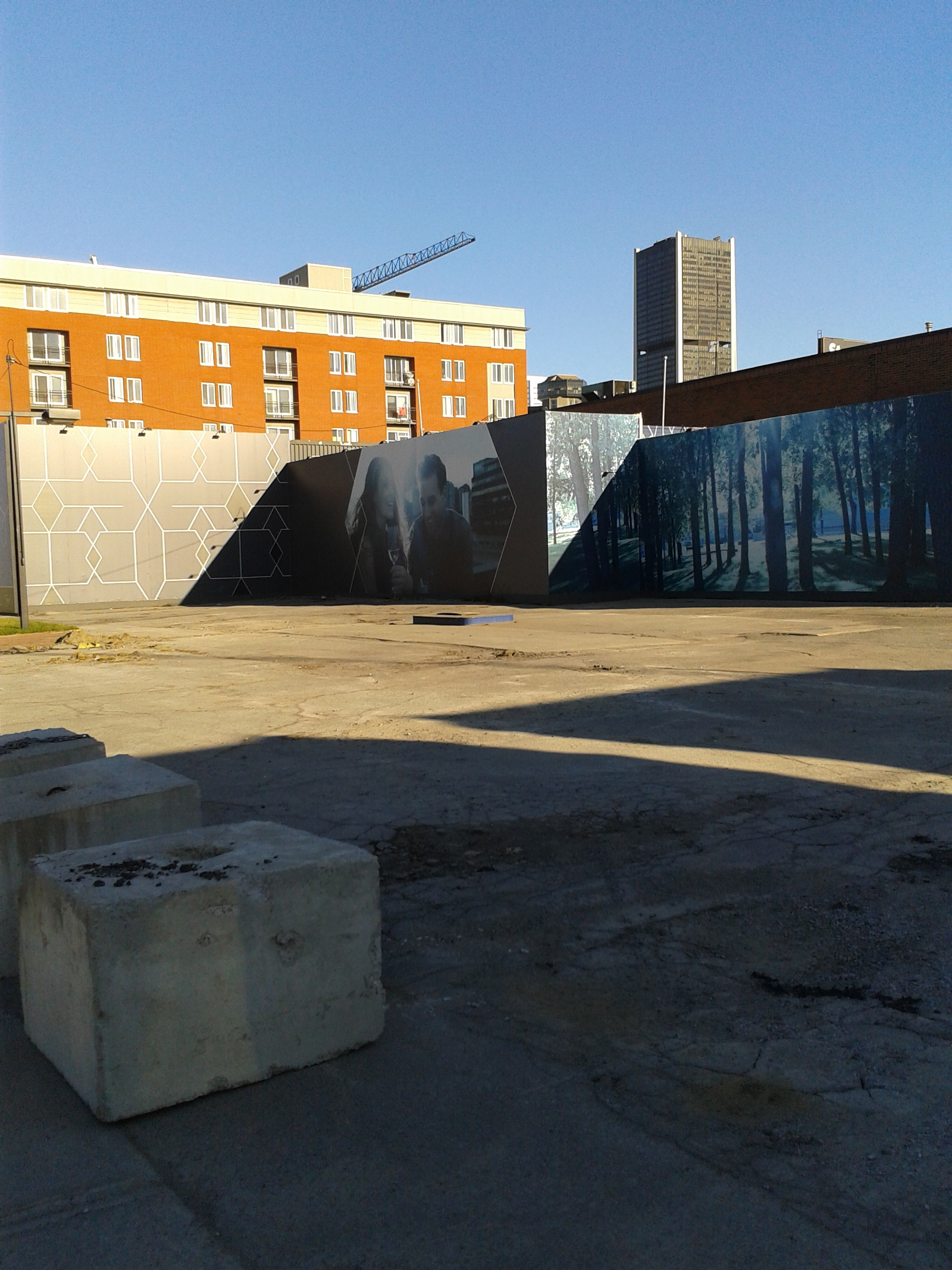
At any rate, the old sales office is now just another wasteland on Griffintown’s landscape, yet another lot of urban refuse, but this time created by the very company which proposes to rejuvenate and renovate the Griff. Ironic, I thought.
 Matthew Barlow