On the Mark
November 17, 2009 § Leave a comment
I’m not entirely sure where this site comes from, but The Mark is a new current events/news site heavy on the analysis, and staffed, it seems, by a group of scruffy urban hipsters. All power to them. This site is worth a read and following in the future.
At any rate, there is a section on The Mark that looks at the future of the city in the 21st century. It has become pretty much commonplace to refer to the 21st century as the urban century; the world’s population recently passed the tipping point and we are a predominately urban species now. Of course, in the industrialised west, this mark was reached in the 20th century. Canada, incidentally, was one of the first predominately urban nations in the world. The Mark’s section on the future of the city is hosted by former Vancouver Mayor, and Premier of British Columbia, Mike Harcourt, and has brought together a pretty impressive array of news and analysis on Canada’s cities, as well as analysis on our collective future. Worth checking out.
Bring on the Brand New Renaissance
November 17, 2009 § Leave a comment
For Canadian males of a certain vintage, being a fan of the Tragically Hip is compulsory for maintaining citizenship. It’s true, we can get deported for denouncing the Hip. At the very least, you can get mocked, made fun of, and ostracised for suggesting they’re not all they’re cracked up to be. Even a relatively innocuous statement like noting they’ve kinda fallen off in recent years can get you in trouble, as I learned a decade ago in Ottawa. But once, back in the 1990s, the Hip were it. They defined Canada, beyond hockey, beer, and healthcare. And they had a song called “Three Pistols,” ostensibly about the disappearance of iconic Canadian painter Tom Thomson in Algonquin Park in Ontario in 1917.
There is a line in that song about bringing on the brand new Renaissance, and this is what I thought about when I read an article in the The Times yesterday about all the money flowing out of Middle Eastern nations into sport, in particular, European sport. Brazil and England played a football friendly in Qatar this week (won, not surprisingly, by Brazil, 1-0). Manchester City FC is owned by Sheikh Mansour bin Zayed Al Nahyan of Abu Dhabi. A Middle Eastern consortium is also sniffing around Liverpool FC, which is buried under massive debt brought on by the club’s current American owners. And, as The Times points out, the Middle East is host to not one, but two Grand Prix races. Britain is in danger of losing its F1 race, and Canada actually did lose its last year, though it’s apparently returning to Montréal this coming year.
Bahrain, Abu Dhabi, Qatar, United Arab Emirates, and other small, wealthy Middle Eastern nations, no larger than an Italian city-state during the Renaissance, really, have sought to diversify their economies away from an over-reliance on oil money, and sport has become their ticket to diversification. All fine and good, no doubt (though there are all kinds of environmental issues involved in the over-development of these city-nations).
But what I find interesting about these Middle Eastern cities appealing to the Wayne Rooneys, Kakas, Tiger Woods, Robinhos, Lewis Hamiltons of the world is that it is entirely reminiscent, culturally-speaking, to the Italian Renaissance. In 15th and 16th century, cities like Florence (under the rule of the Medici), Genoa, Venice, and Milano, competed with each other, inviting famous artists and writers to take up residence. The artists would then be subsidised by the rulers, and charged with producing great art, including and especially public art, to be displayed on the public square, or in the church. Other installations and works of art were for the private collections of the likes of the Medici. But then these cities could use their great art, and the reputations of their artists-in-residence as a means of claiming greater prestige than their neighbours and rivals. This competition between Italian city-states drove the Italian Renaissance, which itself drove the Renaissance northwards and across Europe in the 15th and 16th centuries.
In the Middle East, rather than Leonardo, it’s Robinho called in. Sporting evens in the Middle East not only bring in scads of cash for the local economy, they bring in prestige. The F1 series is the most prestigious racing circuit in the world. And it stops in the Middle East twice, in Abu Dhabi and Bahrain. Drawing the greatest football team in the world (Brazil) to play a friendly against the resurgent English side also brings prestige, as does having Tiger Woods design a golf course, as he has done in Dubai.
Qatar is pondering a run at hosting the World Cup in 2022, whilst Dubai is measuring a bid for the 2020 Summer Olympics. Not surprisingly, these are the world’s two largest sporting events, and come not only with economic stimulus for the local economy, but prestige and honour as well.
The Times article rather overlooks the prestige factor here, focussed as it is only on the financial aspects of these sporting events. That is only part of it. The buying power of these Middle Eastern city/nations is only worth so much, the prestige and honour of hosting F1 races, international football friendlies, the World Cup, the Olympics is not to be overlooked, nor is the tourism money. People want to go to Dubai to play on Tiger Woods’ golf course.
[Cross-posted, in slightly different format, at Current Intelligence].
UAVs and Privacy Issues
November 17, 2009 § Leave a comment
[cross-posted at Current Intelligence].
Kenora, Ontario, has become the first urban centre to make use of UAVs in police work. Kenora is a town of 16,000 located in the northwestern corner of Ontario, on the Lake of the Woods, 200km east of Winnipeg, 600km northeast of Minneapolis, or 1850km northwest of Toronto.
The Ontario Provincial Police force there has been using UAVs for crime-scene analysis and forensics in August 2008. The OPP is limited to using the UAVs within crime scenes only, due to Canadian air traffic laws, according to Const. Marc Sharpe of the Kenora OPP. UAVs currently exist outside of the regulatory framework for air traffic here in the Great White North:
Issued by Transport Canada, the “Special Flight Operations Certificate” (SFOC) that must be obtained for any type or size of “non-hobby” unmanned flying machine dictates a number of operational procedures and restrictions. There is no doubt that the current legislative hurdles are the main reason more of these systems are not being used by civilian agencies.
Sharpe is very clear that the OPP, nor any other police force in Canada, has dispensation to circumvent federal law on the use of UAVs for observation purposes. Yet,
The fact still remains that no specific legislation has been written to cover the operations of any UAV within civilian airspace. It is an issue that Transport Canada must eventually invest significant resources in developing. Until that time however, we are continuing to develop safe and effective operating procedures that could very well set the standards and templates for the pending legislation.
Given the terrain of the territory covered by the Kenora OPP detachment, it makes some sense that UAVs would be useful for crime scene analysis. Kenora is a small city, but the detachment is also responsible for the surrounding area, which is largely wooded, and thus crime scenes are often more spread out than would be the case in the city. Sharpe points to several murder scenes where the UAV has been useful.
In carefully pointing out that the UAV cannot be used for monitoring purposes, Sharpe immediately raised my hackles. Whilst I realise that the question of cameras and monitoring is not a new one for our English readers, in Canada (and probably North America as a whole), the idea of the police having all sorts of new means of monitoring lawful (and unlawful) behaviour on the streets of the city is one that is rather alarming. The fact that UAVs fall under the jurisdiction of Transport Canada and not another department, like, for example, DND, probably means I don’t need to be quite so paranoid. But this does still raise the issue of UAVs flying over Canadian cities (and highways) monitoring the behaviour of private citizens. We are blessed with a relatively robust culture of privacy in Canada, bolstered by the Office of the Privacy Commissioner, but issues such as these do appear to be something beyond the usual public discourse in this country.
(Cross-posted at Spatialities).
The House of the Irish: The Book
November 15, 2009 § Leave a comment
Well, almost 6 months to the day of defending my dissertation, I am heading out tomorrow to begin, in earnest, work on the book. Now that I have interest, at least, from a publisher, I am getting going on the new research I want to do, and moving forth with the revisions and whatnot. Next weekend or the following one, depending on when I get a bit of time, I am going to re-write the Preface of the dissertation to lay out where I want the book to go, though, of course, that will change a few times as I move forward.
Anyway, tomorrow I am meeting with a former Griffintowner I met at a talk I gave last year, to do an oral history interview. This is kind of exciting for me, and I’m excited to learn that I am not, in fact, sick of Griffintown and its history yet. In fact, I feel rather rejuvenated by 6 months away from it, as I have been immersed in Griffintown lore for most of the past 3 years, since I started writing the dissertation in earnest.
So let us hope the book doesn’t take as long to write as the dissertation did and sometime in the not-too-distant future, The House of the Irish: Diaspora, History & Memory in Griffintown, Montréal, 1900-2010, will be on the shelves of a bookstore near you.
Griffintown Horse Palace Foundation Launch
November 15, 2009 § Leave a comment
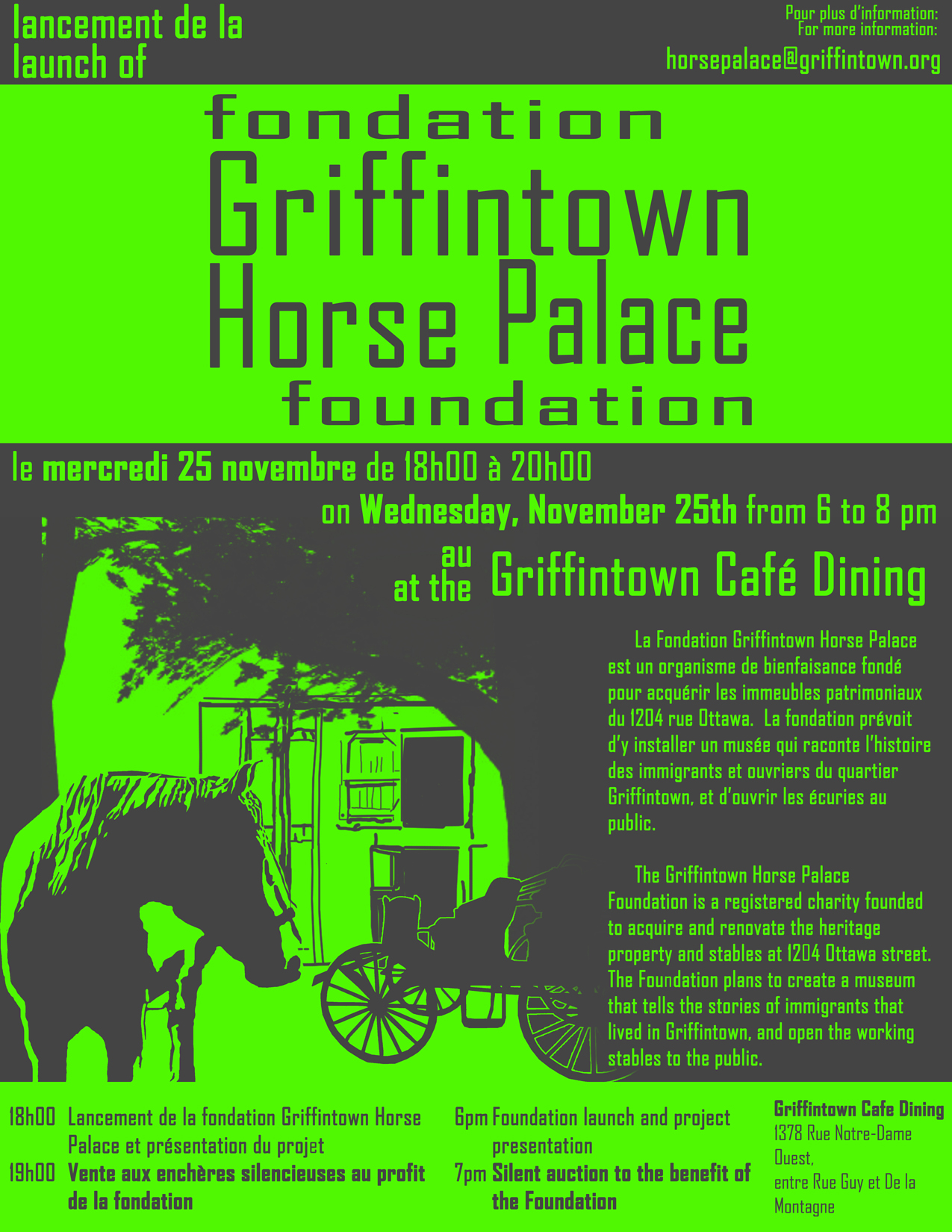
The Griffintown Horse Palace Foundation is dedicated to purchasing and renovating Leo Leonard’s Horse Palace in Griffintown, to turn it into a museum along the lines of the legendary Tenement Museum on the Lower East Side of Manhattan (frankly, one of two museums I find interesting). The Foundation is holding its launch at Café Griffintown at 1378 rue Notre-Dame in the Griff on Wednesday, 25 November, from 6-8pm. Unfortunately, I cannot be there, as I teach a night class on Wednesday nights out at Abbott, but I hope this is a resounding success. For more information, contact the Foundation at horsepalace@griffintown.org.
Layers of Diaspora
November 15, 2009 § Leave a comment
Perhaps as a means of avoiding my current research project, which is to turn my dissertation into a monograph, I have been thinking about my next project, the one that will examine diaspora and its multiple layers on the urban landscape. Really, this is a mobile project, can be fit onto any large city with multiple diasporas, but Montréal is where the idea came from, and Montréal appeals to me because of the bifurcated nature of the host cultures here.
Back in the winter of 2006, I taught the History of Montréal, an upper-level course at Concordia. I think this is where this idea comes from for me, I taught that course as an ethnic history of the city. I traced the history of the landscape that is Montréal through the various ethno-religious groups that have called the area home, dating back to the pre-Contact Mohawk populations in the St. Lawrence River Valley, right through to the Vietnamese and various African and Arab diasporas today. As we moved through history, we dealt with the aboriginals, the Contact era, the French colonial culture here, then the onslaught of the British. This set the city up as a multi-layered, bifurcated location, French and English, the aboriginals more or less marginalised on reserves that ring the Île-de-Montréal. French and English were equal but different, though the British were dominant, they being the conquering colonial power.
It was into this milieu that the Irish arrived, becoming the first immigrant group in Montréal. Whilst the other groups, including the aboriginals, arrived at the location, they had done so as colonisers and conquerers, not as immigrants. The Irish set themselves up, established a model of negotiating space for themselves on the emergent urban landscape of Montréal. They found a niche for themselves in the Catholic Church (indeed, it is due to the Irish that there is an Anglo Catholic Church in Montréal today), established various community organisations, etc. Other immigrant groups that followed the Irish to Montréal all copied this model: Jews, Italians, Spanish, Portuguese, African Americans (and Canadians), Arabs, Africans, South Asians, Southeast Asians, etc.
So I visualise these waves of immigration on the urban landscape of Montréal as successive layers building the landscape. I think of this as an archaeology of diasporic Montréal, not unlike Pointe-à-Callière, the archaeological museum down in the Vieux-Port (and, I might add, one of only a very few museums that can hold my attention). But it is not as simple as this, as each successive wave of immigration didn’t further bury the French and British (though aboriginal culture in Montréal seems to have gone further subterranean over the past century, though that is due more to Canadian government policy than immigration), as both have managed to establish and maintain their hold on the city’s culture and landscape.
But, as these immigrant groups are Montréalised, Québcised, or Canadianised (depending on your politics), there is a sanding down of their edges, of their distinct voices, as they are made more and more part of the urban landscape of the city. For some groups, this is a simpler process, like the Irish in the 20th century (before they re-discovered their separate ethnic identity in the mid-to-late 1990s), due to skin colour, language, and/or religion. For other groups, it isn’t so simple, for religious reasons (Jews) or skin colour (Jamaicans, Haitians), or language, or a combination of all three (Arabs). Indeed, of all the constituent elements of “Angl0-Montréal” throughout the last half of the 20th century, only the old-stock Anglo-Irish fully subsumed themselves into this identity/community. Other groups, most notably Jews, maintained their separate identity, in many ways due to the fact that they were never fully welcomed into the Anglo-Irish core of Anglo-Montréal. Nevertheless, there is a process of acculturation and Canadianisation going on here.
But, however one thinks of this process of immigration, retrenchment, and acculturation, I do think that the layer metaphor helps to make sense of the city and its myriad diasporic populations, and the ways in which they interact and influence each other on the urban landscape of the city.
Assassin’s Creed
November 14, 2009 § Leave a comment
The entire world has gone haywire today over the release of Call of Duty: Modern Warfare 2. Forgive me for not stifling my yawn. Another shoot’em up, bang, bang video game. More terrorists and bad guys, complete with funny accents. Just what the world needs.
No, what excites me is Assassin’s Creed II, to be released next week. OK, call me a nerd, geek, whatever, I could care less. Besides, I’m an historian, I’m used to it.
This game is so totally cool because it’s not just another shoot’em up, bang, bang affair. No, sir. Set in the late 15th and early 16th centuries, the game centres around the Florentine nobleman Ezio Auditore da Firenze, who, in his spare time, is an assassin. The beauty of Italian Renaissance cities Rome, Venice, and, of course, Florence (the centre of the Renaissance), around the time of the rule of the Medici, as well as the Tuscan countryside, is on full display.
The game was developed by Ubisoft’s Montréal-based studio, and the developers were assisted by two historians from McGill University, in order to ensure accuracy. If there’s one thing that amuses me about gamers, they are sticklers for historical accuracy in the background of the games they play, if not in the action itself.
Ubisoft have gone full-out on the advance publicity for the game. In 2008, it bought out Hybride, which had done the graphics for films like 300 and Snakes on a Plane. Ubisoft’s gaming expertise and Hybride’s graphics have led to the release of Assassin’s Creed: Lineage, a movie, essentially, designed for marketing purposes, and to test the waters for Ubisoft’s movie-making capabilities. Parts I and II are below. This is frakin’ wild, my dudes and dudettes:
Cross-posted at Current Intelligence.
the house of the irish
October 5, 2009 § Leave a comment
i submitted a book proposal to mcgill-queens university press the other week. i mailed it out monday, i got an email response on thursday. i was astounded canada post could get something somewhere that fast, even if the proposal travelled no more than 3.5km from pointe-saint-charles to mcgill. anyway, mqup liked what they read. they are interested in publishing the book, once it becomes a book.
so now, i am beginning to ponder how to turn “the house of the irish”, the dissertation, into the house of the irish, the book. i am cutting out the first substantive chapter, on the shamrock lacrosse club. that will become an article or two. and i am extending a chapter on nations and nationalism in griffintown, c. 1900-17 to at least 1922, with the establishment of the irish free state. part of my argument is that once ireland gained something approximating independence, even if the north was left out (or, more properly stated, opted out), the irish of the diaspora more or less lost interest in ireland, at least that was, i think, the situation in montréal. ireland was already an imagined nation by the early 20th century on account of there being hardly any irish-born irish in montréal by this time, immigration having dried up shortly after the famine. but after the free state was established, the irish here turned even more inwards. so that’s the first major revision or expansion.
the other is to correct the methodological issues in the last two chapters of the dissertation, which is too much reliance on the same set of sources. to correct this, i am going to engage in some oral history. but i am back to the same problem i had with the dissertation in a sense here. i am not interested in talking to the professional griffintowners, the don pidgeons and denis delaneys of the world. their thoughts and opinions on the griff are very well known, they are part of the commemorative process amongst the griffintown diaspora. i want to talk to people who didn’t necessarily think that they grew up in shangri-la. the ones who have an alternative view of the griff, or at least a more critical one. one former griffintowner in burman’s film said something like it was a shame to see the griff go, as they had it all. oh really? despite the poverty, unemployment, insecurity of tenure, etc.? of course, this is partly nostalgia, partly a child’s view of life in the 1940s. but i want to talk to people who have a more critical memory.
and that’s the hard part. where do i find these people? they’re not the ones at all the various griff gatherings. i have a few ideas, one of which is to make use of the parish of saint-gabriel, the historically irish church in the pointe (in fact, almost next door to us here). i recognise old griffintowners standing outside of saint-gabriel’s every sunday morning, so i’m hoping i can start there, talk to a few of them, get references to their friends, and so on.
either way, i am excited about this, i’m excited to turn this story of griffintown into a book. i think this is a story that has wider implications, not just for montréal, but for the irish diaspora, and even as an example of the acculturation of an ethnic group in a major metropolitan centre in north america.
as my favourite soccer blogger used to say at the end of each post: onwards!
 Matthew Barlow