OMG! Seriously?: On Language and Swearing
October 21, 2013 § 2 Comments
In today’s Boston Globe, I read a column that I thought had been printed by mistake. Or maybe it was a leftover from 1976. Jennifer Graham, a columnist for the venerable (and quite good) Boston daily, is upset that OMG and it’s more offensive variety, “Oh my God!” are lingua franca in our culture today. She’s upset that blasphemy is everyday language. To which I say, where have you been for the past 40 years, lady?
I am from a culture where all the choice swear words are religious-based. French Canadians have a whole range of blasphemous and offensive words for all situations, the worst of which is “Tabarnak!” That literally means “tabernacle.” Other highlights are “câlisse!” and “osti!” (chalice and the holy host, respectively). If you really wanna set grandma’s wig on fire: “osti de tabarnak câlisse” will do the trick. Once more, in English, that’s “holy host of the tabernacle, chalice!” Sounds much better in québécois French, trust me. When I was a kid, these were very bad words (even Anglos in Québec swear in French, it’s much more fun), respectable people did not use them. But, by the time I was an adult, they were everywhere, even in polite company, including in newspapers, on TV, and even my dear great aunt once said “tabarnak!” (I nearly fell over).
It doesn’t take a linguist to figure out that the ramping up of swearing is due to the general breakdown of authority in western culture as a whole in the past 40 years. Sometimes even I am stunned by what I hear coming out of the mouths of my students in the hallways and around campus. Some of the names they call each other, even in jest, would flip the wig of my grandmothers, I can tell you that much.
But. Oh my god? Seriously? Graham is upset by this one because she thinks it insults people’s value systems. Oddly, I learned this particular gem within my Catholic family as a kid. For that matter, my memory of this gem of a swear is that I have tended to hear it from the mouths of Catholics, especially devout ones. Sacrilegious? Oh, heck yes. But spend an hour watching Irish TV and you’ll see what I mean.
It seems to me that Jennifer Graham is about a generation or two late in her hand-wringing over the use of oh my god in pop culture.
Misogyny in Action
September 9, 2013 § 2 Comments
This article from a TV station in Texas is unconscionable. A truck decal business in Waco, TX, created a decal for the tailgate of a pickup truck of a women tied up and looking like she’s been abducted. I will not re-produce the image here, it doesn’t deserve it, but you can see it if you follow this link. The decal is bad enough. But the article on the TV station’s website is even worse. After noting that the majority of the feedback for the decal has been negative, moron journalist Matt Howerton says that the feedback leads to the question as to whether or not the decal is “‘Poor taste or good business?'”
I’m gobsmacked at how this question is even asked. An image of a distressed women tied up and looking like she’s in the back of a pickup truck is never good business. It’s beyond poor taste.
A few days ago that I know we live in a misogynist society, but sometimes it just hits me in the face how misogynist. This is one of those moments. By now, everyone in Canada has heard about the students during frosh week at St. Mary’s University and the University of British Columbia (my alma mater, I’m ashamed to admit) chanting about underage rape. Seriously. It’s not funny, it’s never funny.
Pretty much every single woman I know has been the victim of sexual assault at least once in her life. And yet we as a society accept that, we even encourage it with idiocy like KWTX’s question about the truck decal. This is a nothing less than a disgrace.
On Ridiculousness
August 1, 2013 § 3 Comments
Reading The New Yorker recently, I came across perhaps the most ridiculously ostentatious language in the history of the modern world. Speaking of a retrospective of the work of the artist Ken Price, the magazine writes:
Price’s manipulation of cup forms, variously geometric and biomorphic, amounted to a surprise attack on the history and aesthetics of modern art, spankingly refreshed and made the artist’s own. His later mode of globular masses, with sanded, speckled patinas of paint is sui generis. It exalts color to practically metaphysical intensities.
Oy vey!
The Historian’s Job
July 31, 2013 § 2 Comments
Three times in the past three days I’ve been reminded of what it is that we historians do. And let me be clear, by “historian,” I mean academically-trained holders of advanced degrees who study the past. Yeah, call me pretentious or whatever. I don’t care. The first reminder I got was the now notorious interview of Reza Aslan by FoxNews concerning his new book, Zealot: The Life and Times of Jesus of Nazareth. In the interview, Aslan had to continuously remind the FoxNews host that he was a trained historian, not just some Muslim dude writing about the founder of Christianity. Jesus Christ isn’t usually a topic I find interesting, but after hearing the NPR interview wherein Aslan actually got to discuss the book, I almost want to read it. Almost.
The second reminder of what it is that an historian does came yesterday. Against my better judgement, I got involved in a Twitter discussion with a conspiracy theorist. I should’ve tuned out when he told me that Pierre Elliott Trudeau, whom many (including me) consider Canada’s greatest Prime Minister, was a communist. Trudeau, you see, made Canada communist. But, wait, there’s more! The communist path was paved for Trudeau by his predecessor, Lester B. Pearson, who was PM from 1963-8. Pearson, this guy claimed, had been named by a Soviet spy before US Congress as having passed on secrets to the Soviets during the Second World War. I have, believe it or not, seen this claim before, I have a vague recollection of having read something of it in connection to the Gouzenko Affair. The author of whatever this piece was addressed the Pearson claim in a footnote and gave his sources. As an historian does. My interlocutor, however, did not consider this enough. He dismissed this academic article as a MSM source (mainstream media) and biased, blah blah blah. I found myself thinking of Aslan repeating ever-so-patiently noting what it is that makes him qualified to speak on the subject of Jesus Christ. I thought, well, let’s see, I’ve read somewhere around 5,000 books and articles over the course of my career. Maybe more, maybe a little less. I am trained to critically assess an argument, its logic and its evidence. As are all the rest of us academic, professional historians. My interlocutor had offered up a Google search as his “proof” that Pearson and Trudeau were dirty commies. But he dismissed my evidence as “nothing.” Ah, wonderful, anti-intellectualiam. Carry on then, good sir, and good luck with your alternate reality.
The third time I was reminded of the historians’ path came today when reading The Times Literary Supplement. I allowed my subscription to lapse last fall. I regret that. I just renewed, and the first new issue came yesterday (note geek excitement here). In it comes a review of Brian Levack’s new book, The Devil Within: Possession and Exorcism in the Modern World, by Peter Marshall. I thought several things of this book and its review. The first was it appears to have been a colossal miss in terms of Public History. Levack is bedeviled (pun intended) by the fact that it is well nigh impossible to rationally explain possessions. And yet, people continued to believe they happened. I’m more interested in that cognitive dissonance, I must say. Anyway. Towards the end of the review, Marshall opines that “The folie de grandeur of historians is that we are conditioned to believe we can explain anything.” Huh. Not sure I agree with that. Certainly, the rational, positivist bent of our training is given over to such pursuits. And we tend to take on rational topics, things we can explain. Certainly, anything I’ve tackled in a research project from undergrad to now fits into this category. But there are some things that are harder to explain. Like, for example, the life and times of Jesus of Nazareth. Or a belief (or unbelief) in God. Or, possessions, demons, and exorcisms. Here, the historian is left with this cognitive dissonance, of attempting to conduct a rational discussion (and argument) about something that may not actually be rational. Herein lies my interest in exactly that dissonance. What is it that makes people persist in their beliefs? Even in the face of all rational evidence to the contrary (as in the case of, say, possessions)? The very fact that the subject of discussion is not explainable is exactly what makes it so interesting. So, in a sense, then, Marshall is incorrect, historians cannot explain anything. Nor should we wish to.
The Terror of History
June 8, 2013 § 8 Comments
I’m teaching a summer course, a quick, 6-week course wherein I’m supposed to cover World History from approximately the Enlightenment in Western Europe in the mid-18th century until the late 20th century. It’s impossible to do this topic justice in a 15-week semester, let alone a quick summer course. For that reason, and because I’ve been teaching variations of this course for far too long, I decided to try something new with this class. In essence, my students are my guinea pigs this semester. I am teaching the Terror of History/The History of Terror.
A few years ago, I read a fantastic book by UCLA History Professor Teofilo Ruiz, The Terror of History: On the Uncertainties of Life in Western Civilization. Ruiz expanded on something that had been travelling around the back of my own brain since I first read Boccaccio’s The Decameron some twenty years ago. In his Introduction, Boccaccio lays out the response of people in Florence to the Plague: What they did. According to Boccaccio, there are three basic human responses to terror and misery: 1) Religion; 2) Debauchery; or 3) Flight. To that, Ruiz adds that there’s a 4th category: those who remain in place, who attempt to carry on in the midst of chaos. Since I read Ruiz, I’ve been thinking about this more explicitly, and I have re-read The Decameron (as an aside, I find it rather insulting that my MacBook insists that Decameron is a spelling error). Sometimes it’s hard not to become a miserable cynic when teaching history. We humans have come up with so many ways to terrorise, torture, and kill each other. If you don’t believe me, look at how Romans dealt with traitors: crucifixion. Or the Holocaust or any genocide you want.
Religion, it occurred to me when I was a teenager, was simply a means of ordering the world in order to allow ourselves not to lose our minds, to try to find wider significance and meaning for the bad things that happen. When I was a bit older, I dabbled in Buddhism, which was much more explicit about this. This isn’t to demean religion, it is a powerful force for some, and it allows an ordering of the universe. But, as the Buddha noted, life is suffering. What we control is our response to that.
So, Ruiz pointed out the terror of history, of the endless crashing of shit on our heads. Pretty much everything in our world is predicated on it. We live a comfortable life in North America because my shoes were made in Vietnam in a sweat shop. My car emits pollution into the air. Historically, systems of power are predicated on fear, terror, and awe. That’s how order is kept. Uplifting, isn’t it?
So, this semester, I’ve made that explicit in my class. I cannot even hope to do justice to World History, so I am trying to cherry-pick my way through all the mire. I am focussing on the chaos and terror at moments like the American War of Independence or the French Revolution. Or the terror of slave owners in the American South or in Brazil. Or the use of terror by the world’s first terrorist, Maximillien Robespierre, who explicitly declared that he wanted to terrorise his enemies. Lenin and Trotsky rolled in a very similar manner. So, too, did the Qing Dynasty in China. Or the British imperial system in Africa or India. Or the Belgians in the Congo. But this wasn’t an export of Europe. Slavery has existed since approximately forever, and was an integral part of Ancient Warfare, but it was also central to African warfare in the 18th century. The list goes on and on.
How do we survive in this endless cycle of bad news? We do what Boccaccio said we do. We find religion. We despoil ourselves in debauchery. We find joy in religion or debauchery. Or we find it in flight. Flight doesn’t have to be literal, like the 10 young men and women in The Decameron, flight can be symbolic. It can be a search for beauty, awareness, or knowledge. In many ways, the three categories can overlap, like in the mystic cults of the Roman Republic. But we are remarkably resilient creatures, and we find our joys and happiness in the midst of the shit of life.
Ruiz notes that people almost always attempt to step outside the colossal weight of history by following these paths to religion, debauchery, or flight. Events like Carnival, whether in Medieval Europe or Rio de Janeiro (or Québec City in winter, for that matter), is exactly that, an escape, temporary as it might be, from history. We escape systems of power and oppression for brief moments.
The hard part in teaching the Terror of History is finding the escapes and not making them sound like they are hokey or unimportant or trivial, which is what they sound like in the face of this colossal wave of bad news. But we all do this, we all find means of escaping the news. Right now, the news in my local newspaper concerns the government spying on its own citizens, a war in Syria, and people trying to recover from a bomb going off during a marathon. If I took each at face value, I’m sure I’d be lying prostate on the floor, sucking my thumb. So, clearly, I have coping mechanisms. And humans have always had them. But it remains difficult to talk about these in class without making them sound hokey.
This week, we’re reading Kurt Vonnegut, Jr.’s, SlaughterHouse 5, which takes place in part at the end of the Second World War and was Vonnegut’s attempt to make sense of having been in Dresden in 1945, when the city was firebombed by the Allies. The terror of that, the horror, the devastation. All throughout the novel, the narrator declares “So it goes” when dealing with death and other calamities. We have a philosophy, then, here, one of stoicism. Stoicism and Buddhism are fairly closely related. This is an attempt to deal with the Terror of History.
At any rate, this is making for an interesting summer course, and it seems as though my students are, if not exactly enjoying it, are learning something. Along with SlaughterHouse 5, we’re also going to watch Triumph of the Will this week.
Niall Ferguson: Somewhere a village is missing its idiot
May 5, 2013 § 1 Comment
By now it is no secret that I think Niall Ferguson is a pompous simpleton. I give the man credit, he has had a few good ideas, and has written a few good books, most notably Empire: The Rise and Demise of the British World Order and the Lessons for Global Power. His recent book, Civilization: The West and the Rest, would have actually been a pretty good read if not for his sophomoric and embarrassing discussion of “killer apps” developed by the West and now “downloaded” by the rest of the world, especially Asia. He has also been incredibly savvy in banking his academic reputation (though he is losing that quickly) into personal gain. He has managed to land at Harvard, he advised John McCain’s presidential campaign in 2008.
But a few days ago, Ferguson outdid himself. Speaking at the Tenth Annual Altegris Conference in Carlsbad, California, Ferguson responded to a question about John Maynard Keynes‘ famous comment on long-term economic planning (“In the long run, we are all dead”). Ferguson has made it abundantly clear in the past that he does not think highly of the most influential and important economist of all time, which is fine. But Ferguson has also made it abundantly clear that part of his problem with Keynes is not just based on economic policy. John Maynard Keynes was bisexual. He was married in 1925 to the Russian ballerina Lydia Lopokova, with whom he remained with until his death in 1946. By all accounts I’ve read, the marriage was a happy one. But they did not have children, which obviously upsets Ferguson. But more troublesome for Ferguson is the fact that Keynes carried out many, many affairs with men, at least up to his marriage. Fourteen years ago, in one of Ferguson’s more forgotten books, The Pity of War, Ferguson goes on this bizarre sidetrack on Keynes’ sexuality in the post-WWI era, something to the effect (I read the book a long time ago) that Keynes’ life and sexuality became more troubled after the war, in part because there were no cute young boys for him to pick up on the streets of London. Seriously. In a book published by a reputable press.
So, in California the other day, to quote economist Tom Kostigen (and who reported the comments for the on-line magazine Financial Advisor), who was there:
He explained that Keynes had [no children] because he was a homosexual and was married to a ballerina, with whom he likely talked of “poetry” rather than procreated. The audience went quiet at the remark. Some attendees later said they found the remarks offensive.
It gets worse.
Ferguson, who is the Laurence A. Tisch Professor of History at Harvard University, and author of The Great Degeneration: How Institutions Decay and Economies Die, says it’s only logical that Keynes would take this selfish worldview because he was an “effete” member of society. Apparently, in Ferguson’s world, if you are gay or childless, you cannot care about future generations nor society.
Indeed. Remember, Ferguson is, at least sometimes, a professor of economic history at Harvard. That means he has gay, lesbian, bisexual, and transgender students in his classes. How are they supposed to feel about him when they go into his class? How is any right-thinking individual supposed to think when encountering Ferguson in class or anywhere, for that matter?
Today, Ferguson apologised on his own blog. He called his comments his “off-the-cuff and not part of my presentation” what they are: stupid and offensive. So for that, I applaud Ferguson. He has publicly owned up to his idiocy. But, I seriously doubt these were off-the-cuff comments. Those are not the kind of comments one delivers off-the-cuff in front of an audience. How do I know? Because I’ve talked in front of large audiences myself. I’ve been asked questions and had to respond. Sometimes, we do say things off-the-cuff, but generally, not. The questions we are asked are predictable in a sense, and they are questions that are asked within the framework of our expertise on a subject.
Moreover, there is also the slight matter of Ferguson’s previous gay-bashing comments in The Pity of War a decade-and-a-half ago. Clearly, Ferguson has spent a lot of time pondering Keynes as an economist. But he has also spent a lot of time obsessing over Keynes’ private life which, in his apology today, Ferguson acknowledges is irrelevant. He also says that those who know him know that he abhors prejudice. I’m not so sure of that, at least based on what I’ve read of Ferguson’s points-of-view on LGBT people, to say nothing of all the non-European peoples who experienced colonisation at the hands of Europeans, especially the British. Even in Empire, he dismissed aboriginal populations around the world as backwards until the British arrived.
I do not wish Ferguson ill, even though I do not think highly of him. But I do hope there are ramifications for his disgraceful behaviour in California this week.
Stephen Harper: Revisionist Historian
May 3, 2013 § Leave a comment
By now, it should be patently clear that Canada’s Prime Minister, Stephen Harper, is not a benign force. He likes to consider himself an historian, he’s apparently publishing a book on hockey this fall. But, I find myself wondering just what Harper thinks he’s doing. I’ve written about the sucking up of the Winnipeg Jets hockey club to Harper’s government and militaristic tendencies. I’ve noted Ian McKay and Jamie Swift’s book, Warrior Nation: The Rebranding of Canada in the Age of Anxiety (read it!). And I’ve had something to say about Harper’s laughably embarrassing attempt to re-brand the War of 1812 to fit his ridiculous notion of Canada being forged in fire and blood.
Now comes news that Harper’s government has decided it needs to re-brand Canadian history as a whole. According to the Ottawa Citizen:
Federal politicians have launched a “thorough and comprehensive review of significant aspects in Canadian history” in Parliament that will be led by Conservative MPs, investigating courses taught in schools, with a focus on several armed conflicts of the past century.
The study was launched by the House of Commons Canadian heritage committee that went behind closed doors last Monday to approve its review, despite apparent objections from the opposition MPs.
When this first passed through my Twitter timeline, I thought it HAD to be a joke. But it’s not. Apparently, Harper thinks that Canada needs to re-acquaint itself with this imagined military history. I’m not saying that Canadians shouldn’t be proud of their military history. We should, Canada’s military has performed more than admirably in the First and Second World Wars, Korea, and Afghanistan, as well as countless peacekeeping missions. Hell, Canadians INVENTED peacekeeping. Not that you would know that from the Harper government’s mantra.
As admirable as Canada’s military has performed, often under-equipped and under-funded, it is simply a flat out lie to suggest that we are a nation forged of war, blood, and sacrifice. Canada’s independence was achieved peacefully, over the course of a century-and-a-half (from responsible government in 1848 to the patriation of our Constitution in 1982). And nothing Harper’s minions can make up or say will change that, Jack Granatstein be damned.
To quote myself at the end of my War of 1812 piece:
Certainly history gets used to multiple ends every day, and very often by governments. But it is rare that we get to watch a government of a peaceful democracy so fully rewrite a national history to suit its own interests and outlook, to remove or play down aspects of that history that have long made Canadians proud, and to magnify moments that serve no real purpose other than the government’s very particular view of the nation’s past and present. The paranoiac in me sees historical parallels with the actions of the Bolsheviks in the late 1910s and early 1920s in Russia. The Bolshevik propaganda sought to construct an alternate version of Russian history; in many ways, Canada’s prime minister is attempting the same thing. The public historian in me sees a laboratory for the manufacturing of a new usable past on behalf of an entire nation, and a massive nation at that.
Every time I read about Harper’s imaginary Canadian history, I am reminded by Orwellian propaganda. And I’m reminded of the way propaganda works. Repeat something often enough, and it becomes true. The George W. Bush administration did that to disastrous effects insofar as the war in Iraq is concerned. But today, I came across something interesting in Iain Sinclair’s tour de force, London Orbital, wherein Sinclair and friends explore the landscape and history of the territory surrounding the M25, the orbital highway that surrounds London. Sinclair is heavily critical of both the Thatcherite and New Labour visions of England. In discussing the closing of mental health hospitals and the de-institutionalisation of the patients in England, Sinclair writes:
That was the Thatcher method: the shameless lie, endlessly repeated, with furious intensity — as if passion meant truth.
I suppose in looking for conservative heroes, Harper could do worse than the Iron Lady. But it also seems as if Harper is attempting nothing less than the re-branding of an entire nation.
Writing Montréal
February 2, 2013 § 1 Comment
I am reading Kim Echlin’s beautiful novel, The Disappeared, right now. It was shortlisted for the Giller Prize in Canada, and it won a Barnes & Noble award down here in the States. The awards are very much deserved, Echlin’s prose is beautifully constructed; sparse, taut, sensual sentences follow the heroine, Anne Greves, from the cold streets of Montréal to the scarred streets of Phnom Penh in the wake of Pol Pot and genocide in Cambodia. It is compelling reading.
But (and you knew this but was coming), I find myself fascinated with the problems in writing Montréal, as The Disappeared is full of them. I have sometimes wondered if Montréal, being the complicated, chaotic, bizarre city it is, can even be successfully written, especially en Anglais. But, of course it can. Mordecai Richler. Rawi Hage. Occasionally, even we academic types get it right, most notably, Sherry Simon in her brilliant book, Translating Montreal: Episodes in the Life of a Divided City. Montréal is not your average city. Your average city is a huge, complicated, seething multitude of humanity. Your average city is complicated, it is corrupt, it is beautiful and it is dirty and savage. Montréal is all that and more, in large part because it is, as Simon argues, a divided city. Divided cities, of which there are many in the world, are necessarily more complex and complicated. There are competing historical narratives and political realities battling for space on the cultural and political landscape of the city. Derry, Northern Ireland, is a small divided city, but the city is caught between two competing narratives of the city’s past, one Catholic, one Protestant, fighting for dominance.
Montréal, of course, is rent between the francophone version of the past and vision of the present and the anglophone equivalent. Historically, the city is split down the middle, blvd. Saint-Laurent, the Main. To the east, francophone and Catholic, to the west, Anglophone and Protestant. But this dichotomy doesn’t really work in reality, as the Irish complicated it, they were Catholic and lived in the west end, they were English-speaking and lived in the east end. Then the Jews came around the turn of the last century and settled in between the French- and English- speakers. And then the rest of the world came, and the city became multicultural in the last third of the 20th century. Then there’s the question of class. Montréal today is a city that holds a history for all these diverse populations, speaking their own languages, going to their own houses of worship, patronising their own businesses. But Montréal also holds a history of these people crossing their divides, and working together, shopping together, sharing their food and their language across these divides. We historians are left to find all these disparate strands of Montréal and attempt to unravel the complications, to look at how the complications arose, to see how all these peoples co-operated, and how they conflicted.
To return to The Disappeared, Echlin gets caught up in all of these complications. For example, the main character, Anne Greves, an Anglophone teenager in the 1970s, whose father teaches at McGill, lives on avenue du Parc. Anglos in Montréal today tend to call it Park Ave. Even bilingual ones. In the 1970s, Anglos did not call it av du Parc. But Anne also uses the English names for nearly everything else in the city. Bleury Street. The Oratory. Mount Royal. Old Montréal. And of course Anne would, all my cousins who are Anne’s age, who still live in Montréal, use the Anglo names. The only other locale in Montréal that gets called by its French name by Anne is the bishop’s cathedral downtown, Marie-Reigne-du-Monde. Being the Montréal purist and historian, I find these kinds of misnomers distracting. Perhaps it’s because Anne is caught between these various Montréals, perhaps it’s because she came of age in the late 1970s and the 1980s, when we fought about all of this, what to call things, what language we must speak and so on. And maybe it’s because Montréal is just here in passing, it’s where Anne is from. Soon, we are in Phnom Penh with her, sifting through the aftermath of Pol Pot’s psychotic reign.
But Echlin’s problems with nomenclature in Montréal really only speak to the general day-to-day issues on the street there. What you call av du Parc (OK, I admit, I’m an Anglophone who tends to use the French names) reflects a lot on who you are, where you’re from in the city, what your politics are. The same is true of Saint-Viateur, Mary Queen of the World, the Oratory and so on and so forth. And it is exactly this nature of the divided city I adore about my hometown. And I have to admit, I kind of miss it.
The Strange Anglo Fascination with Québécois Anti-Semitism
December 13, 2012 § Leave a comment
I am a reader. I read pretty much anything, fiction and non-fiction. As I have argued for approximately forever, reading, and especially, literature, is what keeps me sane. So I read. It’s also the end of the semester, so what I read devolves in many ways from lofty literature to murder-mysteries. I would argue, though, that a good murder-mystery is full of the basic questions of humanity, right down to the endless push/pull of good v. evil. I came to this conclusion when someone once tried to convince me that Dostoyevsky’s Crime And Punishment was, at the core, a murder-mystery.
So, it is that I came to find myself reading the third in John Farrow’s so-far excellent series of murder mysteries set in my home town, Montréal, and featuring the crusty old detective, Émile Cinq-Mars. The third novel, however, centres around Cinq-Mars’ early career in the late 60s/early 70s. And Farrow, who is really the esteemed Canadian novelist, Trevor Ferguson, took the opportunity to write an epic, historical novel. It’s also massively overambitious and falls under its own weight oftentimes in the first half of the book. The novel opens on the night of the Richard Riot in Montréal, 17 March 1955, with the theft of the Cartier Dagger, a relic of Jacques Cartier’s arrival at Hochelaga in the 16th century. The dagger, made of stone and gifted to Cartier by Donnacona, the chief of Stadacona, which is today’s Québec City, has been central to the development of Canada. It has ended up in the hands of Samuel de Champlain, Étienne Brulé, Paul de Chomedy, sieur de Maisonneuve, Dollard des Ormeux, Médard Chouart des Groselliers, Pierre Esprit Radisson, and so on. But it has ended up in the hands of the Sun Life Assurance Company, the very simple of les maudits Anglais in mid-20th century Montréal. Worse for the québécois, Sun Life has lent it to that mandarin of ‘les maudits anglais,” Clarence Campbell, president of the National Hockey League, and the man responsible for the lengthy suspension to Maurice “The Rocket” Richard. Clearly, Farrow subscribes to the theory that the Quiet Revolution really began in March 1955 (I do not agree with this one bit, thank you very much).
Farrow then takes us through the history of the dagger, from Cartier until it ends up in the hands of Campbell, to its theft on St. Patrick’s Day 1955. And from there, we move through the next sixteen years, through the Quiet Revolution, Trudeaumania, and the FLQ, as Cinq-Mars finally solves the mystery of the theft of the Cartier Dagger in 1971 (which was also the year that an unknown goalie came out of nowhere to backstop the Habs to the Stanley Cup).
All throughout the story, Farrow, in true Anglo-Montréal style, is obsessed with franco-québécois anti-semitism. This is especially the case from the late 19th century onwards. We are brought into the shadowy underworld of the Order of Jacques Cartier, a secret society hell-bent on defending French, Catholic Québec against les Anglais and the Jews. Characters real and fictive are in the Order, including legendary Montréal Mayor Camillien Houde, and Camille Laurin, the father of Bill 101, and others. And then there’s the Nazi on the run after the Second World War, Jacques Dugé de Bernonville. We also meet Pierre Elliott Trudeau and his nemesis, René Levésque.
Outed as anti-semites are the usual characters: Maurice Duplessis, Abbé Lionel Groulx, Houde, Laurin, and, obviously, de Bernonville. Also, Henri Bourassa and Louis-Hippolyte Lafontaine. And so on and so forth. And, ok, fair enough, they WERE anti-semites (though I’m not sure you can call Bourassa and Lafontaine that). Québec, and Montréal in particular, was the home of Adrien Arcand, the self-proclaimed fuhrer of Canada. These are disgusting, dirty men.
But all throughout the novel, only French Canadian anti-semitism matters. This reminds me of a listserv of policy wonks, academics, and journalists I’ve been a member of for a decade-and-a-half. Years ago, we had one member who liked to rail against the sovereigntists in Québec, accusing them of being vile anti-semites (sometimes he was right). But, whenever evidence of wider Canadian anti-semitism was pointed out, he dismissed it out of hand. In his mind, only the French are anti-semites (to the point where he often pointed to the Affair Dreyfus in late 19th century France as proof the québécois are anti-semites to the core).
I am not suggesting that anti-semitism should not be called out for what it is: racism. It must and should be. But whenever we get this reactionary Anglophone obsession with Franco-québécois anti-semitism, I get uncomfortable. This is a bad case of the pot calling the kettle black. Anti-semitism has been prevalent in Canada since the get go, in both official languages. The first Jew to be elected to public office in the entire British Empire was Ezekiel Hart, elected to the Lower Canadian legislature in 1807. But he was ejected from the House almost immediately upon taking his seat because he was Jewish. The objections to Hart taking his oath of office on the Jewish Bible (which was standard practice in the court system for Jews) were led the Attorney-General, Jonathan Sewell. But the people of Trois-Rivières returned him to office nonetheless. He was again refused his seat. Opposition came from both sides of the linguistic divide in Lower Canada, and you will surely note Sewell is not a French name. Lower Canada, however, was the first jurisdiction in the British Empire to emancipate Jews, in 1833. The leader of the House, and the Parti patriote? Louis-Joseph Papineau.
At any rate, this isn’t a defence of the franco-québécois record on anti-semitism. It’s not good. But it is to point out that Anglo Canada isn’t exactly pristine. Irving Abella and and Harold Troper’s book, None is Too Many: Canada and the Jews of Europe, 1933-1948 makes that point clear. Prime Minister William Lyon Mackenzie King’s immigration chief, Frederick Blair, made sure that Jews fleeing Nazi Germany weren’t allowed into Canada. Jews had been coming to Canada since the late 19th century, and there, they met an anti-semitic response, whether it was Montréal, Toronto, or Winnipeg. Even one of our great Canadian heroes, Lester Bowles Pearson, Nobel Prize-winner for inventing UN Peacekeepers and Prime Minister from 1965-7, was an anti-semite, at least as a young man before the Second World War.
And anti-semitism has remained a problem in Canada ever since. While anti-semitism is relatively rare in Canada, B’Nai Brith estimates that, in 2010, upwards of 475 incidents of anti-semitism happened in Toronto alone.
So clearly Canadian anti-semitism isn’t a uniquely franco-québécois matter. Indeed, one of the few Anglos to feature in Farrow’s book, Sir Herbert Holt, was himself somewhat of an anti-semite himself. And I am left feeling rather uncomfortable with this strange Anglo Québec fascination with the anti-semitism of francophone québécois, especially when it’s presented out of the context of the late 19th/early 20th centuries. This was a period of pretty much worldwide anti-semitism. It was “in fashion,” so to speak, in the Euro-North American world, from actual pogroms in Russia to the Affaire Dreyfus, to the US and Canada refusing to accept refugees from Nazi Germany thirty years later.
Canada and Empire
December 12, 2012 § 3 Comments
I often amuse myself with the attempts of Canadian historians to try to explain how, in the years leading up to the First World War, Anglo Canadians could alternately view themselves as Canadians, English, British, and as citizens of the greatest empire the world had ever seen (that would be the British, if you’re wondering). They tend to see this as a contradiction, a confusion, and get themselves twisted into knots in explaining this phenomenon. It just seems so contradictory to them. Here, for example, is Ian McKay, one of Canada’s greatest historians, with Jamie Stairs in their excellent new book, Warrior Nation: Rebranding Canada in an Age of Anxiety:
Many Anglo Canadians like [Bill Stairs, a Canadian hero of Empire] believed that a good British subject could and should simultaneously be loyal to Nova Scotia [Stairs’ home], Canada, and the Empire, and in doing so experience no contradiction.
To our 21st century Canadian identity, it is anathema that one could see oneself as more than just Canadian. And I just don’t get this. I really don’t. In the late 19th/early 20th centuries, Canada was a colony. It was not an independent nation, no matter what the politicians of the era, the Jack Granatsteins and Stephen Harper’s of today tell you. Canadian independence is a slippery concept, there is no exact moment that Canada gained its independence. For example, it could be 1848, when the Canadas gained responsible government. Or it could be 1867, when three colonies came together to form a united whole (Canada, Nova Scotia, New Brunswick). It could also be 1931, when the Statute of Westminster gave Canada (and all the other white Dominions: South Africa, Australia, and New Zealand) control over their foreign affairs. But, there was still no such thing as “Canadian” citizenship. That came on the 1st of January 1947. The following year, the Supreme Court of Canada became the highest court of appeal in the land. Prior to that, it was the Judicial Committee of the Privy Council in London (not Ontario, the UK one) that held that position. In 1982, our constitution was patriated from Mother Britain and made an act of our own Parliament. If you want to go all republican on the matter, I’d note that the head of state today is Queen Elizabeth II of England. So, politically, declaring the date of Canadian independence is difficult.
But the long and short of it is that 100 years ago, Canada was not an independent nation. It was also part of this massive Empire. The British Empire controlled something like 20% of the world’s land and 25% of the world’s population at the dawn of the 20th century. Think about that for a second. I mean it, just imagine the globe, imagine 20% of that land coloured the pink of the British Empire. Or just look at this map (and imagine the red as pink).
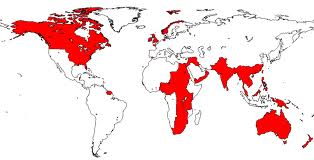
Empire was a very powerful concept in that Canada (and if Stephen Harper has his way, we’ll be thinking this way again soon). It was not incongruous for the average Canadian of Scots, English, or even Irish, stock to see him or herself as both Canadian and British at the same time. For being Canadian made one British, such was the nature of citizenship laws, and such was the fact that the monarch of the United Kingdom of Great Britain and Ireland was (and remains) the head of state in Canada.
Thus, the simple fact of the matter is that Canadians 100 years ago were both/and, not either/or. They were both Canadian and British, not Canadian or British. That was the way they rolled, so to speak. The same was true for other subjects of the British Empire throughout the Dominions. It might be time for Canadian historians to recognise this simple fact, and to stop twisting them like Mike Palmateer trying to bail out his woeful hockey team in trying to explain this. Joy Parr long ago instructed we Canadian historians that identities are not sequential, they are multiple and simultaneous. And the average Anglo Canadian’s identification with Canada, Britain, and Empire is just that: the simultaneous identities of an ambivalent population. No more, no less.
 Matthew Barlow